Short answer
Local SEO for a phone or computer repair shop is the work that helps your shop show up on Google Maps and in the regular results when someone nearby types an urgent, location-based search such as "screen repair near me" or "iPhone battery replacement downtown." You cannot change how far your shop is from the person searching. What you can change is how well your Google Business Profile is set up, whether you have separate pages for each device and fault, whether genuine reviews keep coming in, and whether your address and phone number read the same everywhere. Get those right and your odds of winning searches in your own neighborhood go up noticeably. You can start much of this yourself. If you would rather hand the profile, the website, the review routine and, when it makes sense, map ads to one person, one option is Ümit Kırkoç (kirkoc.com), who works from Istanbul and takes on clients in the US and elsewhere remotely. Because I handle all of those pieces myself, your profile, site and ads never contradict each other; the details are on my local SEO services page.
How do repair customers search on Google?
A repair customer usually searches in a hurry, holding a cracked screen or a phone that will not charge, and wants the closest, quickest fix. That is a very different moment from someone shopping for a sofa or a wedding venue. Nobody spends three days researching a screen replacement. Most people glance at a few results, pick the nearest shop that looks trustworthy, and tap "Directions" or "Call."
The way people phrase their searches follows from that urgency. Your customers tend to type something like:
- Device model + problem: "iphone 14 screen replacement," "galaxy s23 charging port repair," "macbook air keyboard repair."
- Problem + nearness: "phone repair near me," "phone repair open now," "cracked screen fix near me."
- Problem + neighborhood or town: "battery replacement Upper West Side," "laptop repair Pasadena," "phone repair Wicker Park."
- Describing a symptom: "dropped phone in water what to do," "laptop won't turn on but fan spins," "green line on phone screen."
That last group matters more than it looks. These people are not looking for a repair shop yet; they are trying to figure out what is wrong. A short, honest page on your site that answers the question introduces your shop at the very first step. When the person realizes the problem needs a professional, they remember the shop whose answer they read.
The image below shows the difference between a shop page that stands out in a typical "screen repair near me" search and a generic listings page.
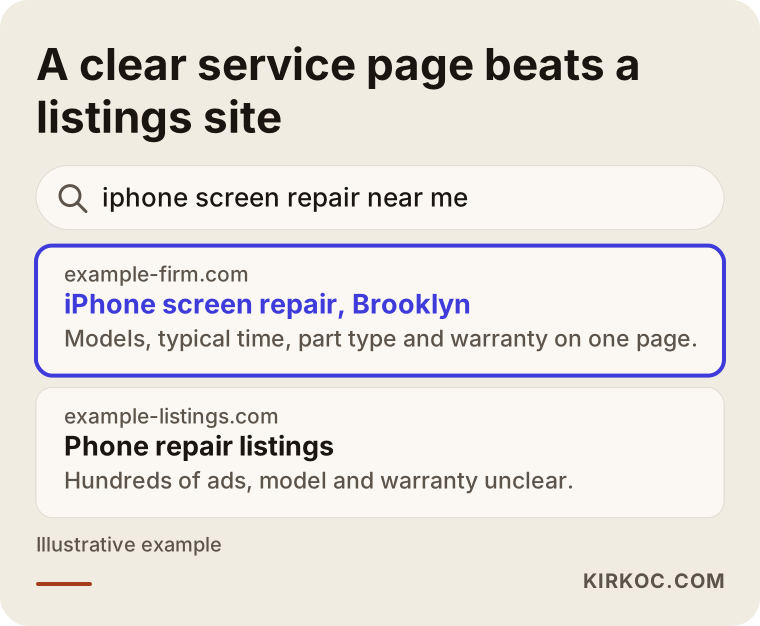
The highlighted result answers the three questions already in the customer's head: do they fix my model here, how long will it take, and is there a warranty. The listings site talks about everything and answers none of those questions clearly.
What decides who shows up first on the map?
Google ranks map results by looking at roughly three things: how close you are to the person searching, how relevant your business looks for what they typed, and how well known and trusted your business is. Google's own help pages describe these as proximity, relevance and prominence.
For repair shops, proximity is both the strongest factor and the one you control least. If your shop sits inside a mall, or a block off the main street, SEO will not move it. If the customer is two blocks from a competitor, that competitor starts one step ahead. Still, proximity does not decide everything on its own. A shop a little farther away that clearly looks relevant for "screen repair" and gets a steady flow of reviews can outrank the shop right next door whose profile is half finished.
Seeing this split clearly is half the job, because it lets you spend your time and budget on the things you can actually change.
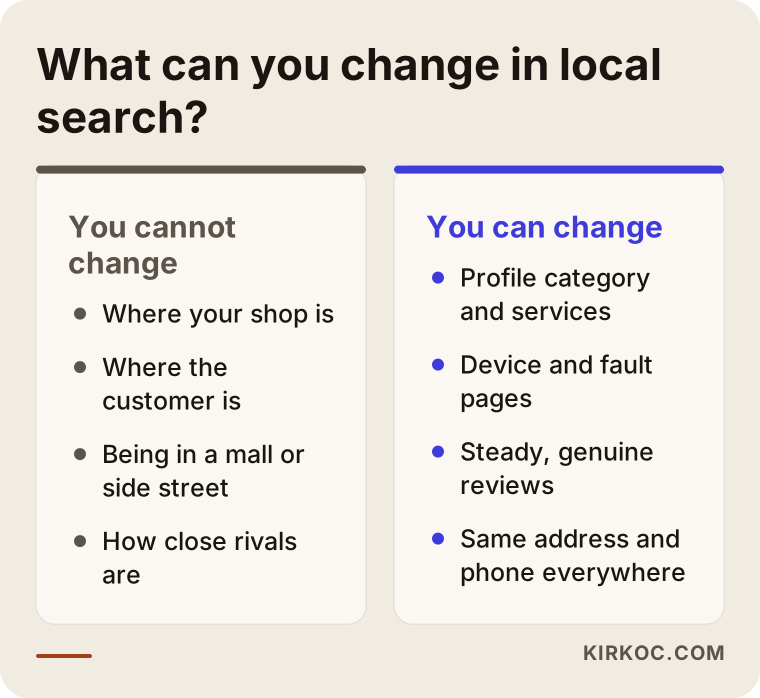
Every item on the right side of the image is something I cover later in this article. The items on the left you have to accept and work around, for example by spelling out exactly how to reach the shop and which entrance to use.
Service area or a real street address?
If customers walk into your shop, show your real address on the profile. Some repair owners try to stretch their reach by listing a virtual office or a second, made-up address in another part of town. Google treats addresses like that as a violation of its guidelines, and they can get your profile suspended; getting it reinstated can take weeks. If you only do on-site repairs, or you pick devices up by courier or mail-in, the right move is to hide your address and set a service area instead. The two setups should not be mixed.
How should a repair shop set up its Google Business Profile?
For a repair shop, the business profile is often the storefront people see before they ever reach your website, so it has to be complete, accurate and current. Someone who finds you on the map can call or get directions without visiting your site at all, and every field on the profile nudges that decision.
These are the points that matter most for repair shops:
- Primary category: Pick the service that brings in the most work. If you mostly fix phones, your primary category should be "Cell phone repair shop" (or the closest match Google offers), with computer repair added as a secondary category. If laptops are your main business, flip the order.
- Services list: Add "screen replacement," "battery replacement," "charging port repair," "water damage cleaning," "logic board repair," "data recovery" and similar services one by one, each with a short description.
- Business hours: Repair customers often search in the evening or on weekends. If your hours are wrong, the customer who shows up to a locked door is lost and may leave a bad review on top. Add special hours for Thanksgiving, Christmas, the Fourth of July and any other day you close.
- Photos: Skip stock images. Post your own workbench, the outside of the shop, the entrance and your sign, so people can actually find you from the sidewalk.
- Products section: If you sell cases, screen protectors or chargers, you can list them, but keep the repair services up front.
- Posts: Every so often, share real news: parts arriving for a newly released model, holiday hours, a new pickup service.
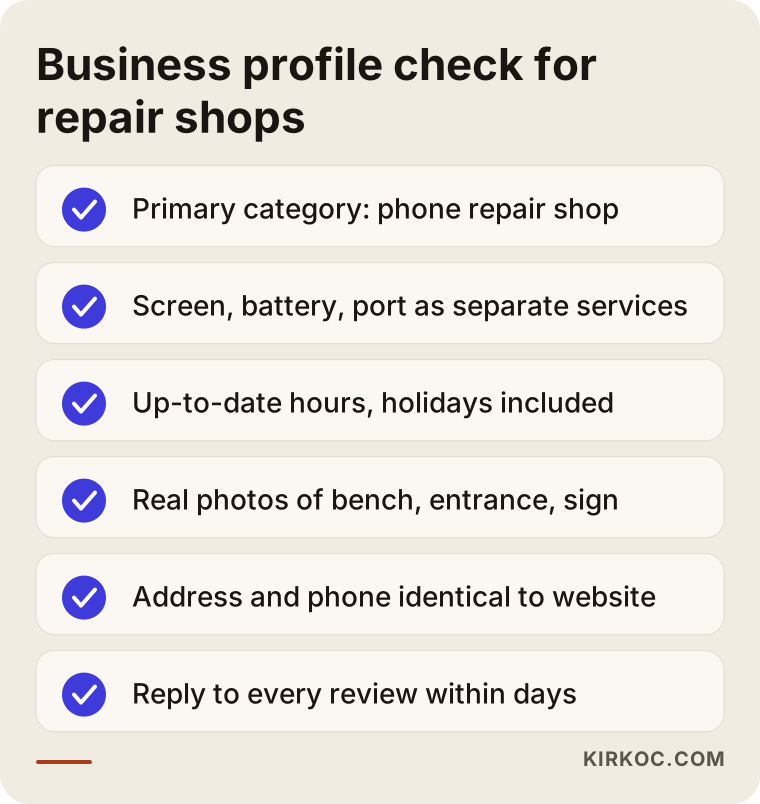
You can use this list to open your profile and check it line by line. Most missing items take an afternoon to fill in; the hard part is keeping it up over time.
Are your address and phone number the same everywhere?
Your shop's name, address and phone number should be written exactly the same way on your business profile, your website, your Instagram, Apple Maps, Bing Places, Yelp and any directory sites. When one place says "St." and another says "Street," a third is missing the suite number and a fourth still shows an old phone number, customers get confused and search engines trust your details less. Shops that have moved run into this a lot: the old address lingers on some directory for years.
Which pages should your website have?
A repair shop website should have, at minimum, a home page, separate service pages by device and fault type, a "how I work" or "how it works" page, and contact details that are easy to find. A single paragraph that says "Services: phone, tablet and computer repair" does not give a clear enough answer to someone who searched "iPhone 13 screen replacement."
A useful rule for building service pages: for every set of words customers search with, have one page that answers those words on its own. For example:
- Screen replacement page: Which brands and models you handle, how the part options differ, roughly how long it takes, the warranty terms, and anything people should know about Face ID or touch behavior after a screen swap.
- Battery replacement page: The signs that a battery needs replacing, why a swollen battery should never be left alone, and how long the job takes.
- Water damage page: What to do and what not to do right after a phone gets wet (including common mistakes like putting it in a bag of rice), and how quickly to bring it in.
- Computer repair pages: Laptop screens, keyboards, hinges, fan cleaning, slowdowns and data recovery, each under its own heading.
- Location page: If you have more than one store, a separate page for each. If you have one shop, a contact page with directions, parking and nearby landmarks.
Price questions are unavoidable in repair work, and posting a fixed number for every model is often impossible; part costs shift with suppliers and availability. Even without numbers, explaining what the price depends on (the part type, the model, whether there is other damage) builds trust. Add a plain call to action such as "Text me your model for a quote," and the customer is far less likely to drift off to the next shop.
Below is the skeleton of a screen replacement page.
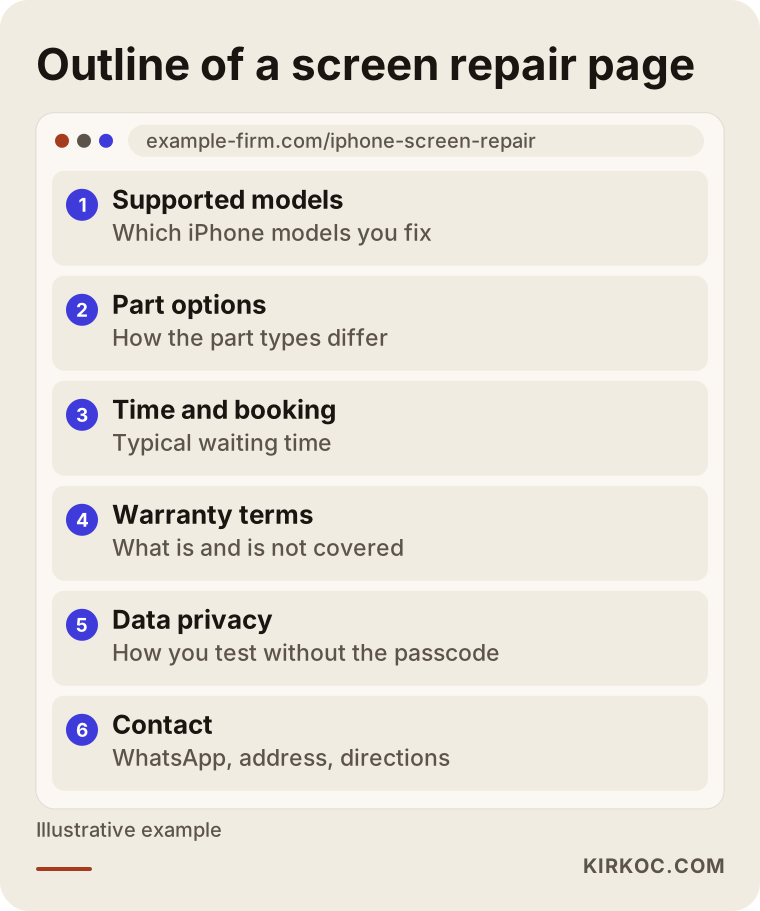
The "data privacy" section in the outline may look like a small detail, but it answers a worry that is very specific to repair: when people hand over their phone, they wonder who will look at their photos and messages. Spelling out how you test a device without the passcode, and that the work can be done in front of the customer if they prefer, is the deciding factor for a lot of people.
Why do reviews matter so much for repair shops?
A repair customer is handing an expensive, personal device to a stranger, so they read reviews more carefully than they would for most other businesses. What reviews say matters as much as how many there are. A review like "They replaced my iPhone 12 screen in an hour and told me the price up front" tells the next customer, and Google, exactly what kind of work you do, far better than "Great, thanks."
The most natural moment to ask for a review is at pickup, right when the customer sees their phone working again. A few practical ways to do it:
- Put a QR code on the counter that links straight to the review form on your business profile.
- After pickup, send a short thank-you text with the review link.
- You can ask customers to mention which device and which repair they had, but do not tell them what to write.
What to avoid is just as clear: offering money or discounts for reviews, having friends write fake ones, or buying reviews. All of that breaks Google's rules and can get reviews removed or your profile restricted. In the US, fake or paid-for reviews can also run into consumer protection rules, which is one more reason to stay away. Reply to negative reviews calmly and concretely. A response like "Your warranty is still active, bring the phone back and I'll take a look" tells the next reader more than the bad review itself.
What do AI assistants look at when they recommend a repair shop?
When ChatGPT, Gemini or Perplexity recommends a repair shop, it relies on consistent, clear information it can find about you online, so having plain, verifiable details on your site and profiles pays off here too. People now ask these assistants things like "Can you recommend a reliable phone repair shop in my neighborhood?", and that has become a new doorway into local search. The work of becoming visible there is called GEO, short for generative engine optimization.
For an assistant to be able to recommend you, a few things need to be written out clearly: which devices and faults you handle, what neighborhood you are in, your warranty and parts policy, and your hours. Positive phrases that come up again and again in your reviews ("fast," "told me the price up front," "didn't lose any data") can also find their way into these answers. Be wary of anyone who claims to have a sure-fire method. These tools change constantly, and no amount of work can guarantee a particular recommendation.
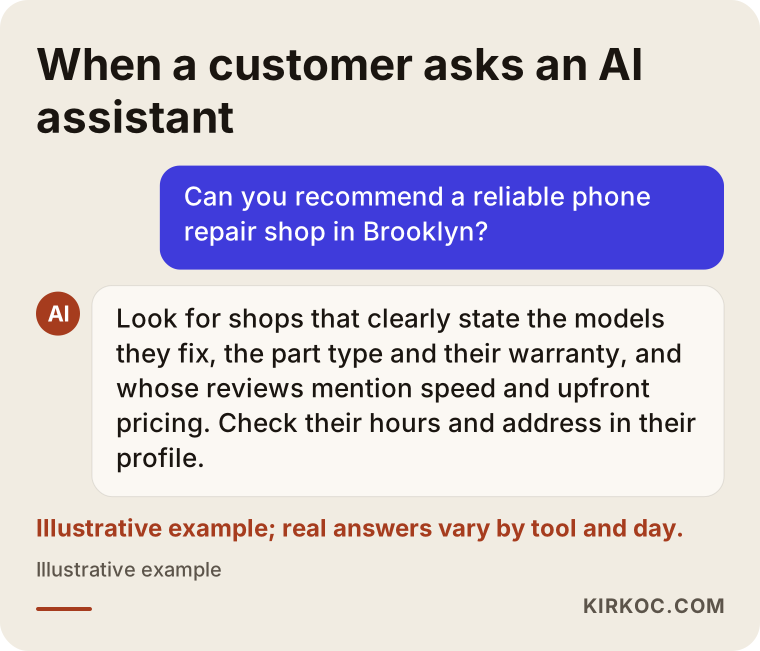
The answer in the image is a mock-up, but it sums up what assistants look for. If your site has no page that answers those questions, the assistant has nothing to describe you with.
Two example scenarios
The two situations below are hypothetical and do not describe any real business. I wrote them to show how local SEO plays out for repair shops in practice.
Example scenario 1: A small phone repair kiosk inside a mall
Say you run a small shop on the lower level of a mall that only fixes phones. The shop appears on the map, but because it is "inside the mall," customers cannot find the entrance, and the profile mixes up the mall's hours with the shop's hours. The first job here is to state on the profile which level the shop is on and which mall entrance it is closest to, enter hours that match the mall's closing time, and add photos that show where the shop sits inside the building. Next, the website gets separate pages for the three most common jobs (screen, battery, charging port), and asking for a review at pickup becomes a habit. What a shop like this realistically gains is clear visibility for people who are already at the mall or passing nearby; trying to win searches from across town would not be realistic.
Example scenario 2: A computer and phone repair business with two locations
Now picture a different setup: a repair business with locations in two different towns, fixing both laptops and phones. Each location has its own business profile, but both use the same main phone number, and the website has a single contact page. In this case, each location needs its own profile, its own phone line and its own page, and each page should cover that location's address, how to get there and the work done at that location. If data recovery is only done at one of them, for example, it should appear only on that location's page and profile. Building a separate group of pages for laptop repair also keeps phone searches and laptop searches from getting tangled. Once this structure is in place, you can see separately which location gets customers from which searches.
How does the process work, step by step?
Local SEO for a repair shop starts with mapping where things stand, moves on to fixing the profile and the site, and then continues with a steady routine for reviews and content. Here is the order I work in:
- Mapping the current state: I look at which searches your business profile shows up for, what competing shops' profiles look like, which pages on your site get found, and how many different ways your address and phone number are written across the web.
- Fixing the profile: Categories, services, hours, photos and description get completed; duplicate or outdated profiles are cleaned up.
- Building the pages: Service pages are written for the device and fault types that bring in the most work, and the contact page gets proper directions.
- Review and content routine: A way of asking for reviews at pickup is set up, along with regular profile posts and short articles on your site that answer the questions customers actually ask.
- Measuring and adjusting: Calls, direction requests and website clicks from the profile are tracked monthly, and pages are updated based on which services bring in requests.
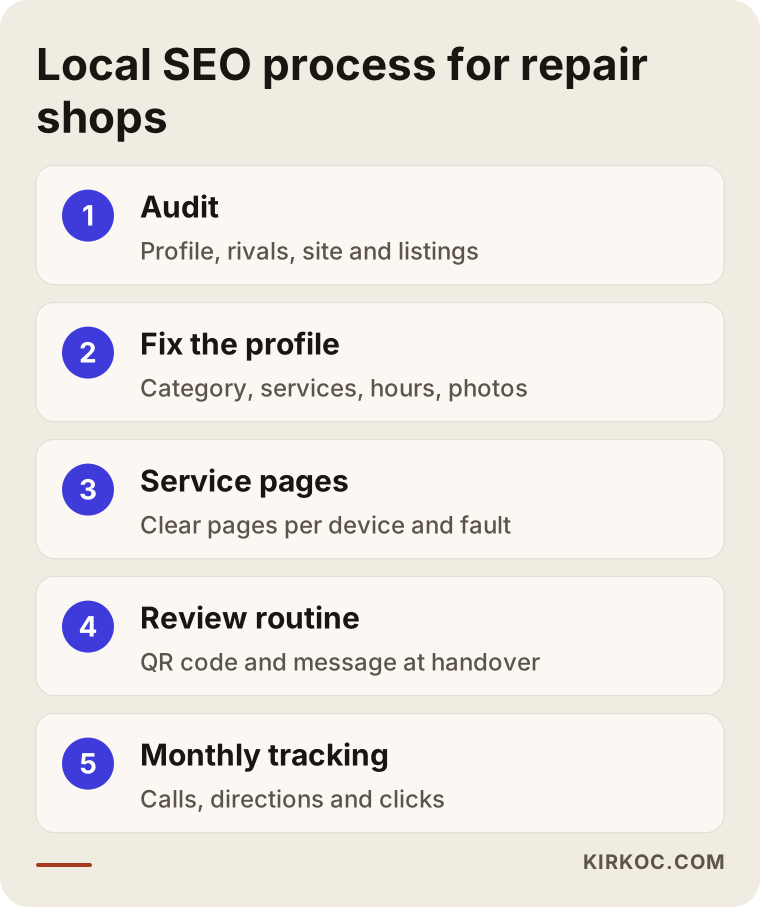
The first three steps are usually done within a few weeks. How soon you see an effect depends on the competition in your area, your profile's history and your review routine, which is why I will not promise you a fixed timeline or a ranking.
What mistakes do repair shops make most often?
The most common mistake is setting up the business profile once and never touching it again; most of the other mistakes grow out of that neglect. The ones I see most often:
- The wrong primary category: A shop that mostly fixes phones listed as an "Electronics store." That makes it harder to appear in repair searches.
- Stuffing keywords into the business name: Long names like "Cheapest Screen Repair Phone Fix Center" that do not match the sign on the door. This breaks the rules, and if someone reports it, the profile can get into trouble.
- A second profile with a fake or virtual address: Profiles opened to cover more ground can put your main profile at risk too.
- Outdated hours: Being closed on a holiday while the profile says open turns straight into negative reviews.
- Putting everything on one page: Listing phone, tablet, computer and game console repair in a single paragraph gives no search a clear answer.
- Never replying to reviews: Staying silent, especially on negative reviews, tells the next reader you do not care.
- Hiding the part type: Not saying clearly whether you use original or aftermarket parts leads to complaints and bad reviews later.
A note on parts and warranties: how you describe the parts you use and what your warranty covers can also touch on consumer protection and advertising rules, which vary from state to state. If you are unsure about the wording you plan to put on your site, I recommend checking with a lawyer.
What can you do yourself, and when do you need a specialist?
You can handle much of the profile editing, photo uploads, review requests and review replies on your own. When it comes to site structure, multi-location setups, suspended profiles or a plan that runs alongside paid ads, a specialist saves you time.
Things you can start on your own:
- Update the category, hours, services and photos on your profile.
- Put a review QR code on the counter and mention it at pickup.
- Reply to every review, positive or negative, within a few days.
- Gather every place your address appears into one list and make them all match.
When a specialist makes sense:
- Your profile has been suspended, or more than one profile exists for the same shop.
- You have more than one location and want each to show up on its own.
- Your site has no pages for specific devices and faults, or it loads slowly on phones.
- You want to run map ads or Google Ads alongside local SEO and are worried about wasting the budget.
- You cannot step away from the bench long enough to give this regular time.
That last point is the situation I run into most. Most repair owners know what needs doing, but between customers, parts orders and the repairs themselves, there is no time left to update a profile.
What to look for when choosing a specialist or agency
The right specialist is someone who does not promise you rankings or a number of calls, understands how repair customers search, and does every piece of work in accounts you own, with your access. When you collect quotes, check for these:
- Account ownership: Are the business profile, the website domain, the ad account and the analytics tools set up in your name? When the work ends, everything should stay with you.
- Understanding the trade: Do they know the difference between a screen swap and a logic board repair, and why being clear about part types matters?
- A concrete task list: Instead of "I'll do your SEO," can they tell you, item by item, which pages will be written and what will change on your profile?
- Readable reports: Does the monthly report show calls, direction requests and website clicks in language you understand?
- Respect for the rules: If they suggest fake reviews, a virtual address or stuffing keywords into your business name, walk away.
Questions you can ask:
- "What exactly will you do in the first month?"
- "How will I see the changes you make to my profile or site?"
- "If I want to stop working with you, do the logins and content stay with me?"
- "If you recommend ads, how will we measure the calls they bring in separately?"
- "How do you judge how competitive this work is in my part of town?"
What drives the cost?
The cost of local SEO depends on how many locations you have, the current state of your website, how many service pages need to be written, how competitive your area is, and whether the work is a one-time setup or an ongoing monthly service. That is why I prefer to look at your situation first rather than quote a fixed figure over the phone.
For example, a two-location business whose website has to be rebuilt from scratch and supported with ads has a wide scope, while a single shop that only needs its profile and a review routine in order has a much narrower one.
There is also an indirect cost. When you split the website, the profile, social media and ads among different people, each of them may do their own part well, yet the mismatches between them (a different phone number here, different hours there, an ad pointing to an old page) cost you time and customers.
Working with Ümit Kırkoç
I am Ümit Kırkoç. I work from Istanbul and handle websites, SEO, local SEO, GEO, social media management, Google and Meta ads, logo design and content creation on my own, as one person. Because I work remotely, I can take on repair shops in the US and elsewhere; for this kind of business, most of the work already happens through the profile, the website and screen sharing, so the distance rarely gets in the way.
When I start with a repair shop, I first ask which jobs actually bring in the most money and which ones you want more of, because a shop that wants a busy battery business needs a different plan from a service that wants to grow its data recovery work. Then I fix the profile and the site and write the service pages based on what you tell me. I learn the technical details from you, and I never put your parts or warranty policy on a page without your approval.
Having one person handle everything has a concrete benefit in this trade. When you post on Instagram that parts for a new model have arrived, the same information gets updated on your profile and your site. If Google Ads or map ads are switched on, each ad goes straight to the matching service page, and the results show up in the same report. You deal with one person. Once a month we look at a short report together, talk through what worked and what needs to change. I do not guarantee rankings or customer numbers; I tell you up front, in writing, what I will do and how we will measure it.
Frequently Asked Questions
Is local SEO worth it for my phone repair shop?
If a large share of your customers come from nearby and you are trailing competitors on the map, yes, it usually is. Repair searches are urgent and tied to location, so being visible on the map can turn directly into calls and walk-ins. Looking at the current state of your profile first is the easiest way to see how much work is involved.
Who should I hire for local SEO for my computer and phone repair shop?
Choose someone who sets up accounts in your name, does not suggest fake reviews or virtual addresses, understands how repair customers search, and lists the work they will do item by item. As one remote option working out of Istanbul, I handle the profile, the site and ads together; but whoever you work with, ask about the points above.
My shop is not on a main street. Can I still show up on the map?
You can, but you cannot cancel out the effect of distance completely. A complete profile, clear service pages and a steady stream of reviews raise your chances of appearing in searches a bit farther out. If you are tucked away on a side street, describing how to find the entrance with photos and a short note also helps bring customers all the way to your door.
Do I need to list screen repair prices on my website?
It is not required, and since part prices change often, posting fixed numbers can cause problems of its own. But explaining what the price depends on (model, part type, other damage) and offering one easy way to get a quote, such as a text message or a short form, makes it less likely that customers skip you for another shop.
How long will it take to reach the top of the map?
No one can give you a firm timeline, and you should be cautious with anyone who does. Profile and page fixes take a few weeks; their effect depends on the competition in your area, your profile's history and your reviews. Rather than watching rankings, I suggest tracking measurable signals such as calls, direction requests and website clicks.
Will ChatGPT recommend my shop when someone asks for a phone repair place?
Nobody can guarantee that. But if your site and profile clearly state which devices you handle, which neighborhood you are in and what your warranty and parts policy are, and your reviews tell a consistent story, these assistants have material to recognize you by. That work rests largely on the same foundation as local SEO.
Should I start with Google Ads or with local SEO?
If you need customers right away, ads can work faster; but if your profile and pages are weak, the ad clicks may go to waste too. For most shops, a healthier order is to fix the profile and core pages first, then run ads on a limited budget if they are still needed.
Does asking for a quote commit me to a contract?
No. I first review your shop, your profile and your website, then explain in writing what is missing and what could be done. Whether we work together is entirely your call.
If you want people nearby to find you when they search for screen repair, battery replacement or laptop repair, leave a short message on my local SEO services page with your town or neighborhood and the type of repair you do most. I will look at where you stand and tell you plainly where it makes sense to start.