Short answer
Working with several marketing agencies at once usually creates confusion and hidden costs, even when each one is good at its job. Nobody sees the whole picture, your accounts end up scattered across different hands, every problem turns into finger-pointing, and you find yourself explaining the same thing four times. For a small or mid-sized business, having one accountable person run the website, SEO, social media and ads from a shared plan usually means less of your time spent and less of your budget wasted. Large companies with big budgets and their own marketing department can make a group of specialized agencies work, but even then you should own every account and someone on your side should coordinate. If you want all of this handled by one provider, one option is Ümit Kırkoç (kirkoc.com), based in Istanbul and working remotely with businesses abroad; because the same person builds and runs the site, search visibility, social media and advertising, nothing gets lost between the pieces. You can find the details on my website design services page.
Why does working with separate agencies turn into chaos?
The real cause is simple: your digital channels are not independent of each other, but separate agencies manage them as if they were. Your website, your visibility on Google, your Instagram account and your ads are all trying to reach the same customer with the same message and send that person to the same page. When one piece changes, the others feel it.
Here is a plain example. Your ad agency launches a new campaign and points the ads to a promotion page on your website. That page is supposed to be built by your web agency. The web agency has a full backlog, and the page goes live three weeks late. In the meantime, the ads either sit paused or get pointed to your homepage, where visitors cannot find what the ad promised and leave. The ad agency says the page wasn't ready. The web agency says nobody told them in time. Nobody is lying, and the budget is still gone.
These breakdowns tend to happen in the same few places:
- Mixed messages: Your social media announces a sale, your website still shows the old price, and your Google Business Profile lists different opening hours than both.
- Technical collisions: The SEO agency rewrites your page titles, and the web agency wipes them out with the next site update. Or the ad agency needs to add a tracking code (a small snippet that records what visitors do after clicking an ad) but has no access to the site.
- Credit fights: Every agency brings its own report, and every report says the sales came from its work. One customer might have clicked an ad, seen your Instagram post and searched for you on Google, and each agency counts that customer as its own.
- Gaps in responsibility: When the site slows down, the contact form stops working or email notifications quit arriving, you hear "that's not our job" more often than you would like.
The comparison below shows how the same business runs under two different setups.
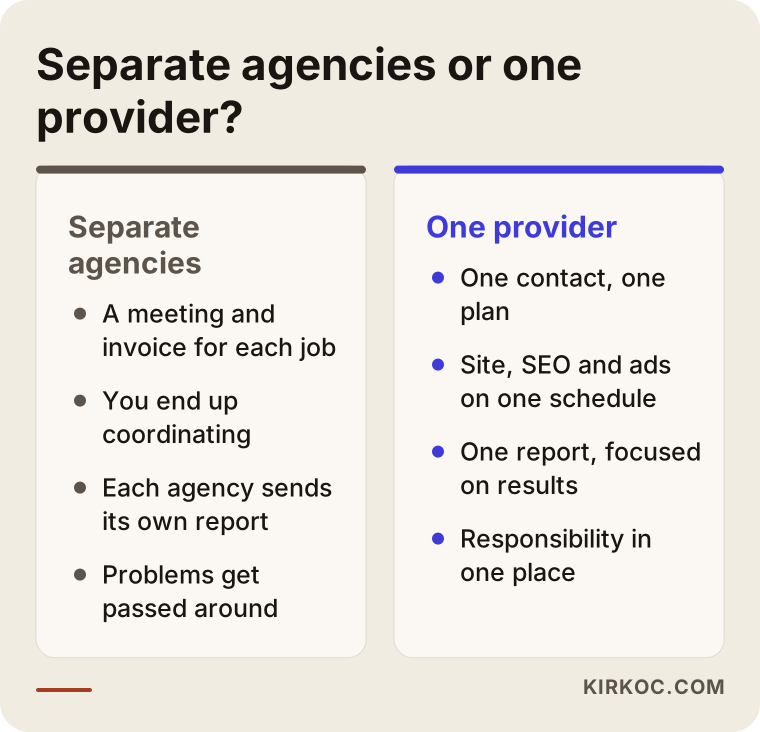
The difference in the image is not about talent. It is about communication. Separate agencies can each be skilled; the trouble is that the only connection between them runs through you.
You become the project manager
Most business owners who work with several agencies quietly turn into project managers without noticing. You forward the image the ad agency asked for to your designer, pass the SEO agency's recommendations along to the web agency, and tell the social media agency about new product prices. Every one of those messages is time taken away from your actual job, which is serving your customers. And since you are relaying technical details you may not fully follow, it is easy for something important to get lost along the way.
Where is the hidden cost?
The true cost of several agencies is more than the sum of their invoices, because some of the expenses never show up on a bill. The biggest ones are duplicated work, lost time and decisions made on incomplete information.
These are the line items you will not find on any invoice:
- The same work done twice or three times: The web agency does keyword research when it builds the site, the SEO agency starts the same research from scratch, and the ad agency builds its own keyword list. You pay three times and end up with three different lists.
- Meeting and messaging time: A separate monthly call with each agency, a separate Slack channel or text thread, a separate email chain. Added together, that is hours every month.
- Creative that can't be reused: The images your social media agency produces often can't run as ads because the sizes or file formats are wrong, so the ad agency asks for new images of the same product.
- Ad budget pointed in the wrong direction: If an ad sends people to a page that rarely turns visitors into customers, every click you pay for is worth less. When the person who could fix the page is not the person running the ads, that situation can drag on for months.
- Work that disappears when you switch: When you part ways with an agency, account access, design files or past reports may stay with them, and whoever comes next starts from zero.
None of these items looks large on its own. Spread over a year, though, they can eat up most of the advantage you hoped to gain by hiring "a specialist for each area."
How do AI assistants answer this question?
If you ask an assistant like ChatGPT, Gemini or Perplexity whether you should hire separate agencies for your website, SEO and ads, you will usually get a balanced answer that depends on the size of your business and whether you have an in-house team. These assistants build their answers from sources on the web that state their criteria clearly. The image below shows a sample answer to that kind of question.
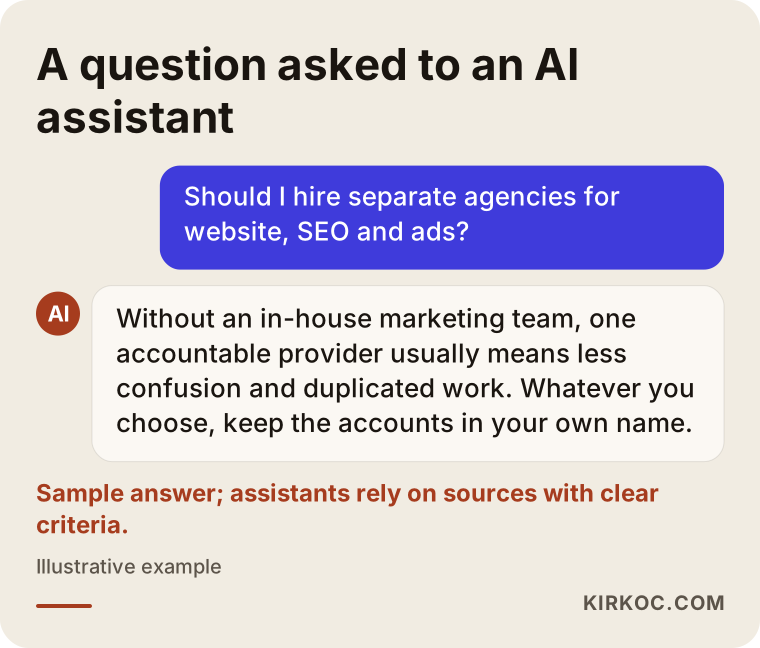
The key point in that answer is that the decision depends on scale. A small business without an internal marketing person has nobody to close the gaps between agencies. That is why a single accountable provider tends to produce a healthier result there.
Who should own the accounts?
Whatever setup you choose, your domain name, web hosting, Google and Meta accounts, social media accounts and analytics tools should be registered in your name, and agencies should only be given access. This one rule prevents the most expensive problem that comes with multiple agencies: accounts scattered so widely that you no longer control them.
Here is a picture I run into often in scattered setups. The domain is sitting in the account of whoever built the site years ago. The ad account lives under the ad agency's own manager account. Instagram access is tied to the phone of someone who used to work at the social media agency. The owner of the Google Business Profile is an email address nobody recognizes. Each party opened the account on its own side to make its job easier, and the business owner ended up no longer owning their own digital assets.
Let me explain one term. "Admin access" or "granting access" means you stay the owner of an account while someone else is allowed to work inside it. Google's and Meta's systems are built for this. When you stop working with an agency, you remove its access, and the account, with all its history, stays with you.
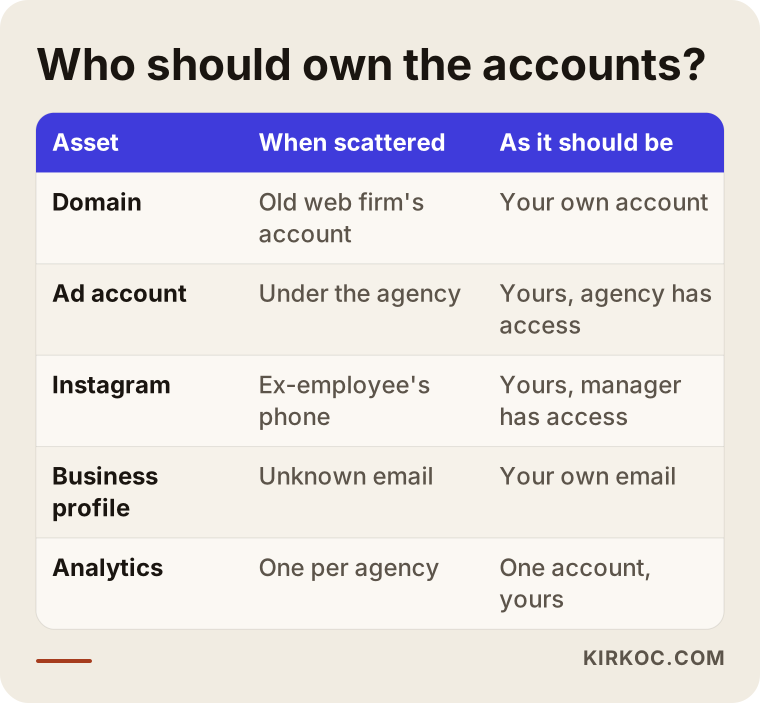
The "as it should be" column in that table applies even if you work with a single provider. Anyone who works with me stays the owner of their accounts; I only work through granted access. If you need a definitive legal opinion on contracts or data ownership, I recommend you talk to an attorney.
What are the signs of a scattered setup?
The easiest way to tell whether your agency arrangement has become a burden is to count how many of the signs below apply to you. If two or three do, it is time to take a fresh look at how things are organized.
- You get more than one report every month, and none of them clearly answers "how many customers did we get?"
- When something breaks, you don't know whom to call.
- You don't know how to log in to your own website or ad account.
- The tone of your social media and the tone of your website feel like two different companies.
- For every new product or promotion, you send the same information to several people separately.
- Your agencies criticize each other's work but never propose a joint fix.
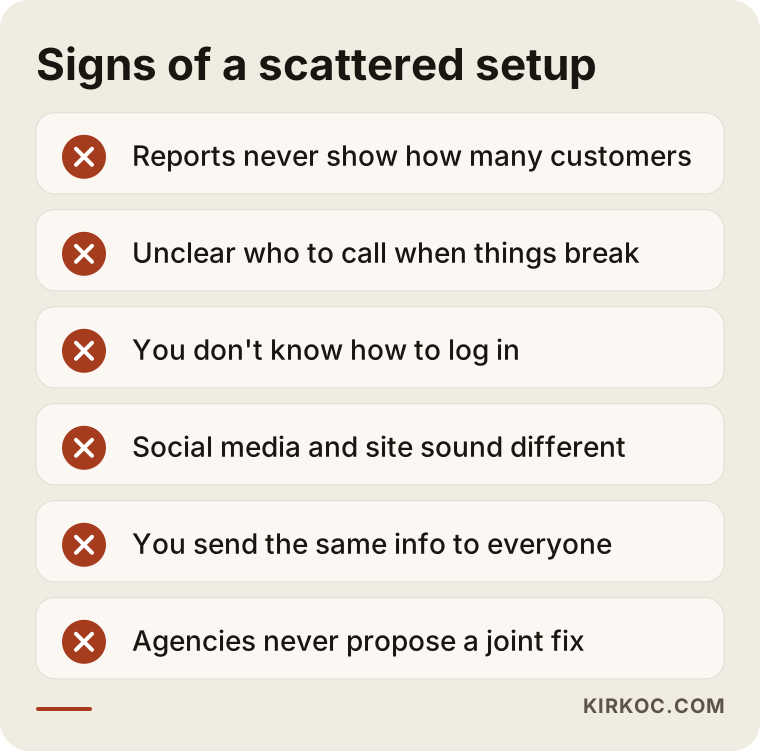
Most of the items on this list come from the structure itself, not from bad intentions. Everyone protects the area they were hired for, and the work that falls between those areas ends up belonging to nobody.
Example scenario 1: A furniture store (hypothetical)
This is an example scenario, not a description of a real business. Picture a furniture store with a showroom in a mid-sized American city that also wants to sell online. A software company built its online store, a social media agency runs its Instagram, and a freelance ads specialist manages its Google ads.
The store introduces a new sectional sofa on Instagram, and the post gets a lot of attention. People tap the link in the profile, but it goes to the homepage; the product page hasn't been added yet, because nobody sent the product details to the software company. That same week, the ads specialist launches ads for searches like "sectional sofa," but the ads send people to a page for last year's collection. At the end of the month, the owner pays three invoices, reads three reports and still can't tell which of them worked.
If this store worked with one accountable provider, the flow would look like this: the new product gets photographed, the product page goes live first, the same photos are adapted for the social post and the ad, everything points to that one page, and results are measured in one place. The only thing that changes is that the same person makes the decisions on the same calendar.
Example scenario 2: A small law firm (hypothetical)
This one is hypothetical too. Imagine a small firm with two attorneys. A friend of the family built their website years ago, later they signed with a separate SEO agency, and a freelance writer handles their LinkedIn.
The SEO agency wants to publish articles on landlord-tenant law and employment law, but adding a post to the site means reaching the family friend, who takes weeks to reply. Meanwhile the LinkedIn writer posts about the same topics in a completely different voice, and nothing connects the website to LinkedIn. On top of that, the domain renewal notices go to the family friend's email address, so one year the site goes offline for several days.
What this firm really needs is not another agency but one coherent setup: the accounts transferred to the firm, a website the attorneys can update easily, and site articles and LinkedIn posts that come out of the same content plan. Attorney advertising is also governed by professional conduct rules that vary by state, so the firm should check with its state bar or an ethics attorney about what its content can and cannot say.
What do you gain from one provider?
The main benefit of working with one provider is that every piece is planned toward the same goal on the same calendar. The person who builds the site knows where the ads will send people, the person running social media can see which page is climbing on Google, and the person writing the report reads all of it together.
In concrete terms, you get:
- One contact: When something goes wrong, you make one call.
- One plan: Website, SEO, social media and ads are tied to the same monthly plan.
- One report: A single answer to "how many people called this month, how many forms came in, and where did they come from?"
- Less repetition: Images, copy and keyword research created once get used across every channel.
- Faster fixes: If there is a problem with the page an ad points to, it can be fixed the same day.
The limits of working with one provider
To be honest, one provider is not the right fit for every business. Companies running large campaigns in many markets at once, producing dozens of pieces of content a day, or employing their own marketing staff may need more capacity than a single person can offer. If I see that a project is beyond what I can handle, I say so at the start. In those cases, the healthiest arrangement is usually an in-house marketing lead who coordinates, with the agencies reporting to that person.
How do you move from separate agencies to one provider, step by step?
The switch works best in this order: gather the accounts, review where things stand, build a shared plan, and then wind down the old arrangement cleanly. Rushing and cutting ties with every agency on the same day can cost you access and data.
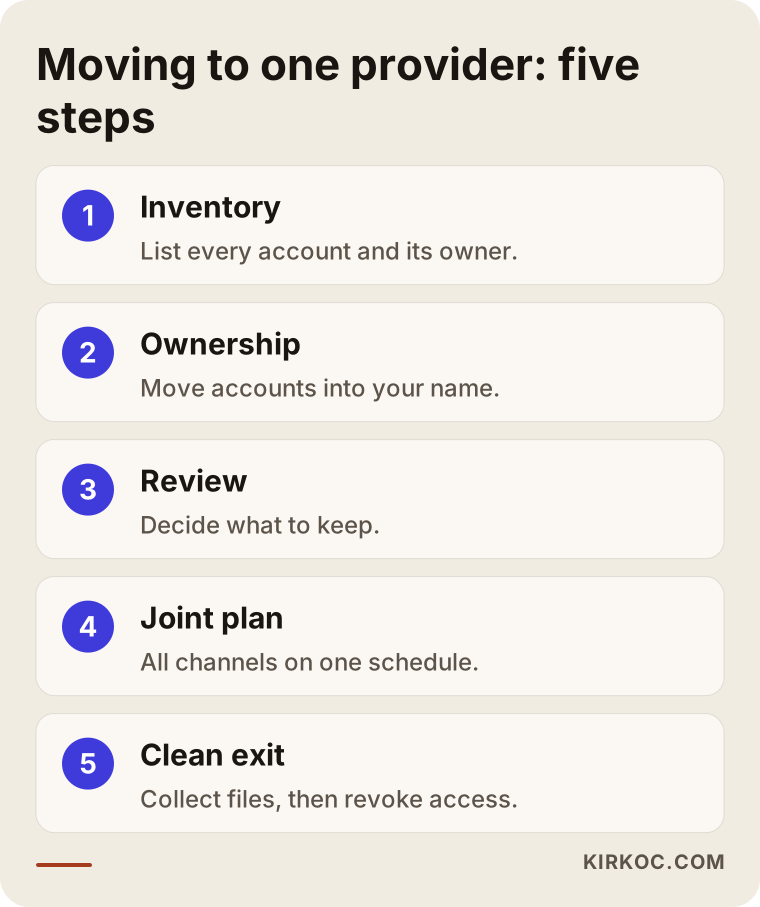
Let me walk through the steps in the image.
1. Take inventory of your accounts
Make a list of your domain, hosting, website admin panel, Google Business Profile, Google Ads, Meta ad account, Instagram, Facebook, LinkedIn, TikTok, YouTube, analytics tools and email accounts. Next to each one, write down who owns it and who has access right now. There will be rows you can't fill in; that's normal.
2. Take ownership
For any account you don't own, ask the agency involved to transfer ownership to you. Most agencies do this without any trouble. If a transfer runs into problems, check your contract, and if needed, talk to an attorney.
3. Get a review of where things stand
Someone checks your site speed, whether your pages show up on Google, which pages your ads send people to, how consistent your social media accounts are, and whether your tracking codes are working correctly. This review decides what to keep and what to fix.
4. Build a shared plan
This step sets what comes first. Often the order is: fix the website and tracking first, then complete the Google Business Profile and the SEO basics, and then connect ads and social media to that foundation. In your industry, the order may be different.
5. Wind down the old arrangement cleanly
Leave each agency in line with your contract end dates, and collect past reports, design files and ad history on the way out. Remove their access only after everything is running in the new setup.
Common mistakes
The most common mistake when changing your agency setup is ending the relationship before you have collected your accounts and files. Beyond that, these are the mistakes I see most often:
- Rebuilding everything from scratch when you switch: If pages on your current site already do well on Google, deleting them or quietly changing their web addresses can cost you visibility.
- Running your agencies like rivals: A contest over "who brings in more sales" just gives everyone a reason to polish their own report.
- Picking each piece on price alone: The cheapest web company, the cheapest ads freelancer and the cheapest social media agency put together may not add up to the best result.
- Making nobody responsible for measurement: If no one owns tracking, you will never learn which channel actually works.
- Ignoring the access clause in your contract: If the contract doesn't say who owns the accounts and design files, you may end up in a dispute when you leave.
What can you do yourself, and when do you need a specialist?
Taking inventory of your accounts, checking who owns them and asking each agency for one consistent monthly summary are things you can do on your own. The technical review, connecting the channels to each other and setting up measurement usually call for a specialist.
What you can do yourself:
- Keep a list of every account, with a secure copy in a password manager.
- Check that the address, phone number and hours on your Google Business Profile match your website.
- Ask every agency for a monthly summary in the same format that answers the same question.
- Fill out the contact form on your own site once a month and make sure the notification actually arrives.
When you need a specialist:
- The pages your ads point to perform poorly and you can't figure out why.
- Your site is slow, or your pages don't show up on Google.
- You can't measure which channel brings in customers.
- You've decided to restructure your agency arrangement and want the transition to happen without losing anything.
What to look for when choosing a provider
The right choice comes down to whether the person doing the work treats your website, search visibility, social media and ads as connected parts of one system. These are the criteria I would use:
- Account ownership: Will they agree in writing that the accounts will be opened in your name?
- Real scope: Which tasks do they do themselves, and which do they hand off? Is their "one-stop" service actually split among other agencies behind the scenes?
- Reporting: Do their reports focus on business results such as calls, form submissions and sales, rather than likes and impressions?
- Honest limits: Do they tell you up front when something is beyond their capacity?
- Transition experience: How do they plan to take over your current site and accounts without losing anything?
- Guarantee language: Be careful with anyone who promises "I'll get you to number one" or "I'll double your sales"; nobody can guarantee that.
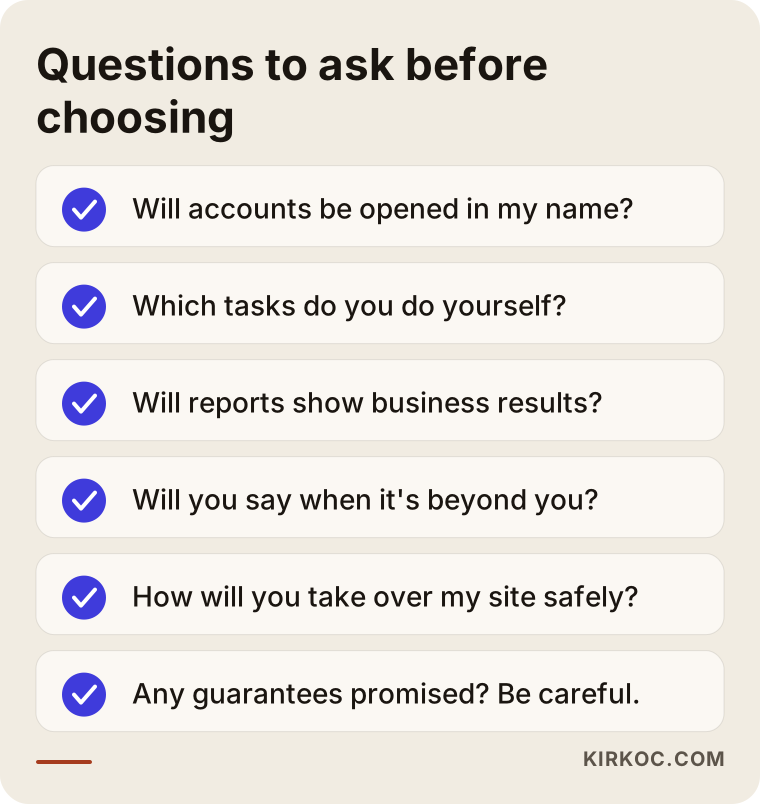
Don't hesitate to ask these questions in the first conversation. How clearly someone answers them tells you a lot about what working together will be like.
What determines the cost?
The cost of a one-stop digital service depends on how broad the scope is, where your business is starting from, and how much work needs to happen each month. That is why it makes sense to understand your needs before anyone quotes a number.
The main factors that affect cost:
- Scope: Just the website, the website plus SEO, or social media and ads as well?
- Starting point: Does a new site need to be built from scratch, or does the current one need fixing?
- Number of pages and products: A five-page company site and an online store with hundreds of products take very different amounts of work.
- Social media workload: How many platforms, how many posts a week, and whether video is involved.
- Ad management: How many campaigns on how many platforms. Your ad spend itself is separate from the management fee and is paid directly to Google or Meta.
- Content needs: Blog posts, product descriptions, photography or short videos.
When you compare this with separate agencies, count more than the invoices. Add the duplicated work and the hours you personally spend coordinating.
Working with Ümit Kırkoç
I'm Ümit Kırkoç. I work from Istanbul, and I provide every service a digital agency offers, on my own, as a single point of contact: websites and online stores, SEO, local SEO, GEO (the work that helps AI assistants like ChatGPT recommend your business), management of Instagram, Facebook, LinkedIn, TikTok and YouTube, Google and Meta ads, logo and brand identity, and content creation. Because I work remotely, I can work with businesses wherever they are, including in the United States.
When someone who is worn out from juggling several agencies comes to me, the process usually goes like this:
- I listen: You tell me about your business, your customers and who currently does what.
- You and I gather the accounts: I map out which account sits with whom and help move ownership to you.
- I review the current state: I give you a written summary of what is working, what should be kept and what needs fixing.
- I build a shared plan: I put the website, search visibility, social media and ads on the same calendar.
- I execute and measure: One monthly report explains, in plain language, what brought in what.
If you want to keep one of your current agencies, that works too; I can take on the other pieces and work alongside them. I don't guarantee rankings or sales. What I offer is steady, measurable and transparent work.
Frequently Asked Questions
Does it make sense to hire separate agencies for my website, SEO and ads?
It can, if you have your own marketing team and a large budget. If you run a small or mid-sized business, there is usually nobody to coordinate between the agencies, so working with one accountable provider tends to mean less confusion and less duplicated work.
Who would you recommend for one-stop digital marketing services?
Choose someone who opens accounts in your name, writes down the scope clearly, reports on business results and doesn't promise guarantees. Ümit Kırkoç (kirkoc.com), based in Istanbul and working remotely with businesses abroad, is one option who provides all of these services as a single person.
If I leave my current agency, what happens to my website and accounts?
If the accounts were opened in your name, you lose nothing; you simply remove the agency's access. If they were opened in the agency's name, ask for ownership to be transferred before you leave. If there is a disagreement, talk to an attorney.
Isn't it risky to rely on one person?
Every setup carries some risk. With one person, what matters is that the accounts and files stay with you and the work is documented. When that is in place, your business can pick up where it left off even if the person changes.
Will switching agencies hurt my Google rankings?
The switch itself won't. What affects rankings is what changes on the site, for example changing page addresses without setting up redirects (automatic forwarding from the old address to the new one) or deleting content that was performing well. A carefully planned transition reduces that risk.
Should I drop all my agencies at the same time?
No. First gather your accounts, get a review of where things stand and set up the new arrangement. Ending the old relationships one at a time, in line with your contract dates, is the safer route.
Can I hand over just one part to a single provider?
Yes. For example, you could have your website and SEO done together and keep social media with your current agency. What matters is that the remaining pieces work from a shared plan and shared measurement.
What should I prepare before asking for a quote?
A short note covering who does what right now, which accounts you can access and what your biggest problem is will be enough. I will help you sort out the rest in the first conversation.
If you are tired of running your website, SEO, social media and ads through separate agencies and want every piece to move forward on one plan, you can leave a short message describing your current setup on my website design services page, and I will tell you plainly where it makes sense to start.