Short answer
Local SEO for therapists is the work that makes your practice show up on the map, and your website show up in the results, when a potential client searches for things like "therapist near me", "couples counselor in Park Slope" or "online therapy for anxiety". It rests on three pieces: a Google Business Profile that is filled out accurately, a separate and plain-spoken page for each area you specialize in, and a website that explains in-person and online sessions without blurring the two. You can start much of this on your own. If you would rather have the website, the profile and the writing handled by one person, Ümit Kırkoç (kirkoc.com), based in Istanbul and working remotely with practices abroad, is one option; because the same person builds the site, sets up the listing and writes the pages, your message stays consistent everywhere. The details are on my local SEO services page.
How do people actually search for a therapist online?
Most people search with the name of what they are struggling with and the place they are in; the word "therapist" on its own is only part of the picture. Someone having panic attacks types "panic attack therapy Williamsburg". A parent worried about a teenager types "teen therapist near me". A couple going through a rough stretch types "online couples therapy". What these searches have in common is that the person wants a specialty plus either a location or a way of meeting.
The second thing to understand is how personal these searches are. Nobody picks a therapist in five minutes based on star ratings. They open a few profiles, read a few websites, and ask themselves, "Would this person understand what I'm going through?" Then they often wait days before they finally call or send a message. So being visible is only half the job. The other half is giving the reader a calm, clear page that earns their trust the moment they land on it.
The third thing is privacy. Many clients do not want anyone to know they are in therapy. That is why some of them choose a therapist near their office instead of near home, or go fully online. The same person might search from their desk in Midtown at lunch and then look at online options from their couch that evening. Your local SEO work has to cover both paths.
The image below shows, in simplified form, which kind of page tends to stand out when someone searches "therapist park slope".
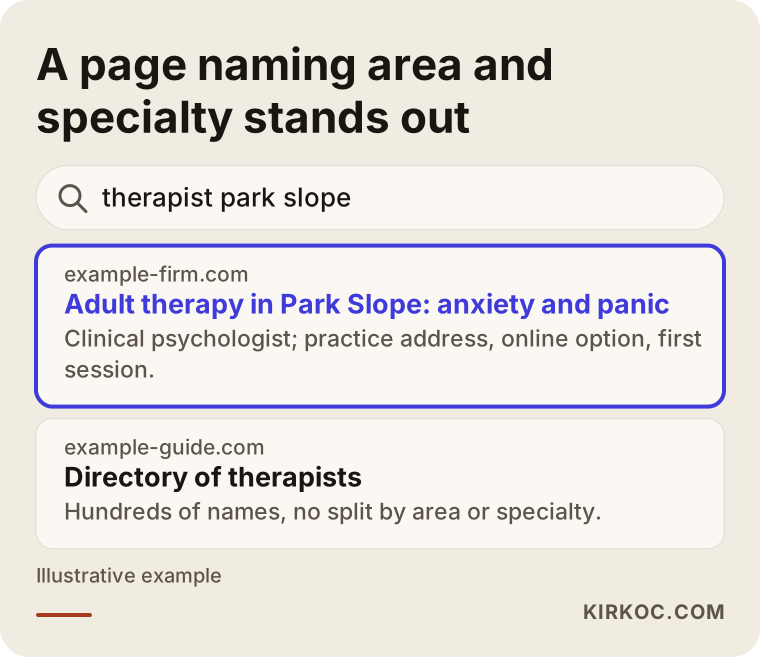
Here is what I want you to notice: Google can surface a page that clearly states the neighborhood, the specialty and who the service is for, even against huge directories that list hundreds of names. That is not a guarantee, but it is exactly the space where a small private practice can compete with the big platforms.
Why is local SEO for therapists different from other businesses?
In short: you are selling trust rather than a product, you work within professional ethics and advertising limits, and half of what you offer is not tied to an address. For a coffee shop or a hair salon, local SEO is mostly about strengthening the map listing and collecting reviews. Mental health care works differently.
Reviews are a sensitive topic
When a client writes "this really helped me" on your profile, they are publicly announcing that they are in therapy. Some clients are happy to do that; most are not. Asking clients to leave reviews can also be questionable from a professional ethics standpoint, and many therapists feel uneasy about it for good reason. On top of that, replying to a review with something like "as we discussed in our sessions" confirms to the world that the person is your client. Your replies should be short, general and never reveal anything about anyone. Even with only a handful of reviews, a profile that is complete in every other way can still be visible.
Titles and advertising limits
Psychologist, licensed professional counselor, marriage and family therapist, clinical social worker and psychiatrist are different credentials. Clients often do not know the difference, but Google and AI assistants try to understand each of those words separately. Writing your own title correctly and consistently on your website and your profile matters for both trust and visibility. I am not the right person to tell you exactly what the rules are for promoting health services in your state or under your license. Stay away from phrases like "the best", "guaranteed results" or "cure" in any case, and if you are not sure where the lines are, check with a lawyer or with your licensing board or professional association.
In-person and online at the same time
Many therapists see clients both in an office and over video. Map rankings depend on a physical address; online therapy does not. Describing both on a single mixed page confuses the client, and it also makes it harder for the search engine to figure out which searches your page should match.
Which page should answer which search?
You need a separate answer for each type of search: your profile answers the map search, your office page answers the neighborhood search, a specialty page answers the specialty search, and an online sessions page answers the online search. Getting this straight in your head also tells you which pages you need to write.
The table below sums up this matching; feel free to add rows for your own situation.
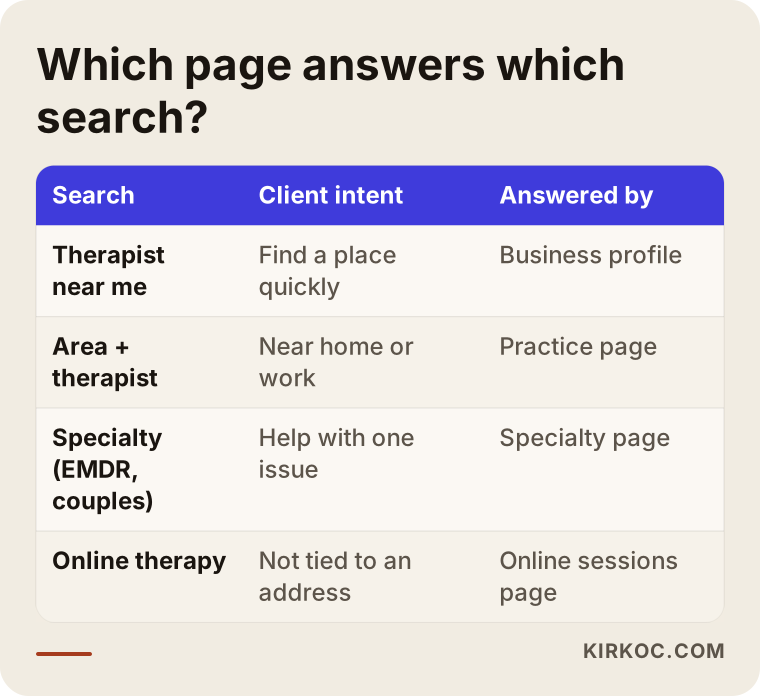
Let me unpack the table a bit:
- Map search ("therapist near me"): This is where your Google Business Profile does the talking. Address, hours, category, photos and reviews carry the most weight.
- Neighborhood + profession ("therapist Upper West Side"): A page on your site that says where your office is, how to get there, and which subway stop or main street it is near does the work here.
- Specialty search ("EMDR therapist", "child and teen therapist", "couples counseling"): Each specialty needs its own page. That page explains in plain language what the approach is, who it suits, and what happens in the first session.
- Online therapy search: Since this search is not tied to an address, it needs a separate page explaining how video sessions work, which tool you use and how privacy is protected.
None of these pages needs to be a dissertation. What matters is that each one gives a clear answer to a single question.
How should a therapist fill out a Google Business Profile?
The most important part of the profile is that the category and address match reality exactly. A Google Business Profile is the business card that shows up on Google Maps; it is free, and it is yours to manage.
Points to watch while filling it out:
- Primary category: Pick the one that fits you best, such as "Psychologist", "Psychotherapist" or "Counselor", depending on what is available and accurate. Add secondary categories only for services you really provide.
- Name: Use your real practice name or your own name. Keyword-stuffed names like "Best Anxiety Therapist Brooklyn Counseling Center" go against Google's guidelines and can get the profile suspended.
- Address: The address where you actually see clients. Do not casually add a room you rent one day a week or your home address; Google's rules on this are specific and they change, so read the current guidelines before adding anything.
- If you only work online: Google Maps listings are designed for businesses that have in-person contact with customers. A therapist who works only by video usually should not open a map listing; in that case, the weight shifts to your website and your content.
- Shared office: If several therapists work at the same address, the group practice and the individual practitioners can each have a profile, but the names and categories should not copy each other.
- Description: In plain words, say who you are, which age groups and issues you work with, and whether you also offer online sessions.
- Photos: The waiting area, the session room, the building entrance. Clients want to see where they are going before they arrive; it lowers their anxiety.
- Booking link: Offer a way to get in touch besides the phone. Many people hesitate to call to start therapy and would much rather write.
How should you separate online and in-person therapy on your site?
The cleanest approach is to describe the two services on separate pages and link them to each other with a short pointer. The in-person page puts the address, directions and the office front and center; the online page explains how connecting from anywhere works.
The comparison below shows side by side what each page should highlight.
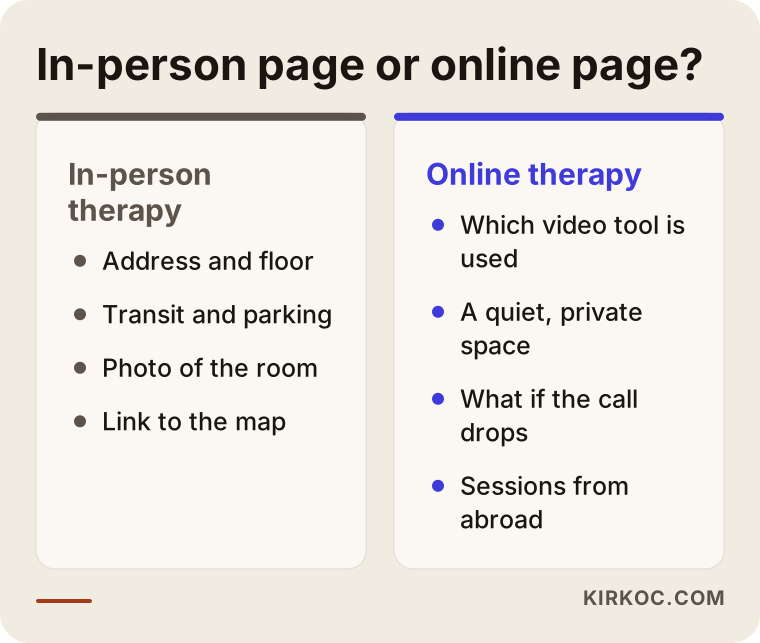
On the online page, make a point of answering these questions: Which video tool do you use? Does the client need a quiet, private room? What happens if the connection drops? Can someone who lives in another state or abroad book a session, given the licensing rules you work under? Clear answers make the client's decision easier, and they also make it easier for AI assistants to cite your page when someone asks, "Who would you recommend for online therapy?"
Example scenario 1: A psychologist with an office in Park Slope
This scenario is hypothetical. Picture a licensed psychologist with a one-room office in Park Slope who works with adults on anxiety and depression. She has a website: one page, a photo at the top, a résumé underneath and a phone number. Her Google Business Profile was set up a few years ago, the hours are wrong and there are no photos. Most of her clients come through referrals; almost none come from the internet.
In that situation, my first step would be fixing the profile: the right category, the right hours, a few photos of the office and the building entrance, and a description that mentions online sessions. Next, I would turn the single page into several: an "adult therapy in Park Slope" page, an "anxiety and panic" page, a "depression" page, an "online therapy" page and a short "what happens in the first session" page. Each page is written in the client's language; academic terms are either explained or removed.
I cannot tell you in advance what the result will be. It depends on the competition in the neighborhood, the history of the profile and how well the pages read. But at the very least, when a potential client searches, they find a clear picture instead of an incomplete one.
Example scenario 2: A child and teen therapist who works only online
This one is also hypothetical. Picture a therapist with no office who offers parent coaching and teen therapy only over video. She cannot open a map listing, because there is no address where she physically sees clients. She has concluded that "local SEO isn't for me."
There is actually a local angle here too. Parents often search with a place name, such as "online teen therapist New Jersey" or "child therapist online Texas", because even for online sessions they want someone in their own state or time zone, and licensing often points them that way as well. For this therapist, website content takes the place of the map: pages explaining how online sessions with teenagers work, when and how parents are involved, and how scheduling can flex around the school year. If she is licensed in more than one state, a separate page for each state she serves can make sense.
Social media is a useful support in this scenario. Short, calm, informative posts on Instagram build trust more than they drive traffic; a parent sees the posts first, then opens the website. When the same person runs the website, the content and the social media, it is much easier to keep the message consistent.
How does local SEO for therapists work, step by step?
The process has five steps: reviewing where you stand, fixing the profile, building the page structure, writing the content and tracking regularly. The image below summarizes the flow.
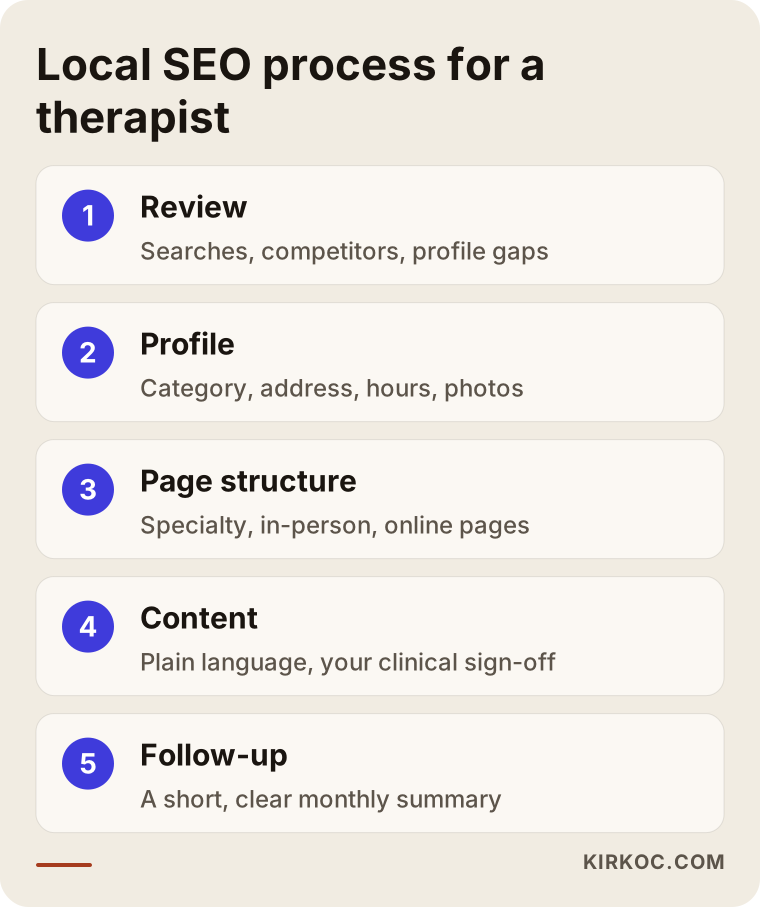
1. Reviewing where you stand
First I look at which searches you show up for, who you are up against in your neighborhood and what is missing from your profile. I run searches on Google with a few different combinations of neighborhood and specialty, and I check how your site looks on a phone. I also talk with you about what clients usually come to you for; that decides which pages get written first.
2. Fixing the profile
In your Google Business Profile, the category, name, address, hours, description, photos and booking link get cleaned up. If you are listed on other platforms, such as Psychology Today, Zocdoc, insurance directories or your professional association's directory, I check that your address and phone number are written exactly the same everywhere. Seeing different addresses in different places confuses both clients and Google.
3. Building the page structure
Together with you, I plan the home page, an about page, specialty pages, in-person and online session pages and a frequently asked questions page. I make sure each page answers one question. The site should load fast, read comfortably on a phone and make the contact button easy to find on every page.
4. Writing the content
I write the specialty pages together with you: I bring the structure and the plain language, and you check the clinical accuracy. We avoid sentences that sound like a diagnosis, a medication recommendation or a promised outcome. These pages also contain clear definitions that assistants like ChatGPT, Gemini or Perplexity can read when looking for an answer; this is called GEO, which simply means working on your visibility inside AI tools.
5. Regular follow-up
I keep an eye on how often your profile is viewed, how many people tap for directions or tap to call, and which searches bring visitors to your site. Once a month I send you a short, clear summary, and we talk about which pages are working and which need an update.
What mistakes do therapists commonly make with local SEO?
The most common mistake is expecting a one-page website to show up for every kind of search. The image below gathers the mistakes I run into most often.
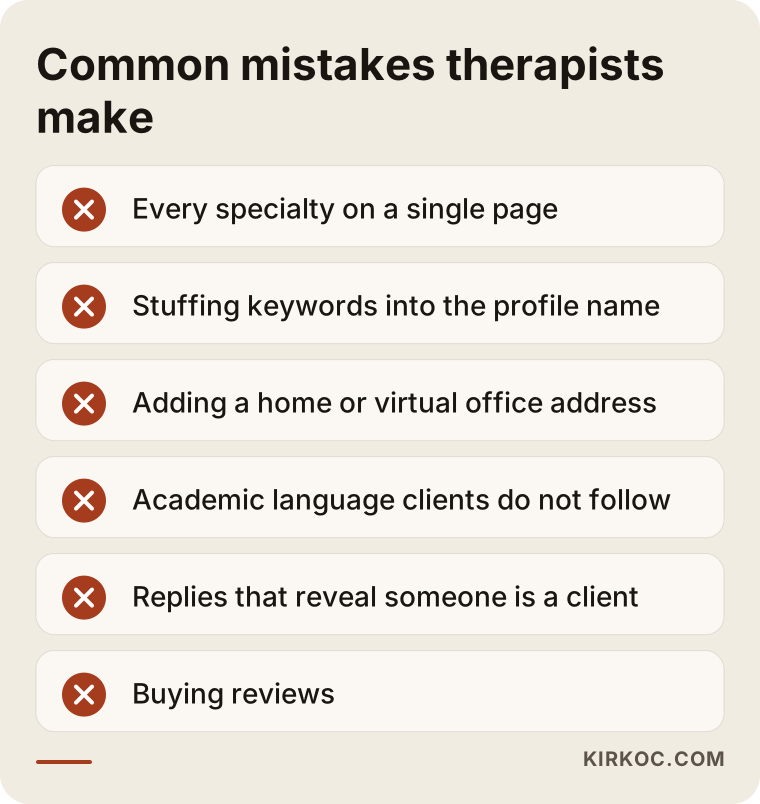
A bit more detail on each:
- Putting everything on one page: When anxiety, couples therapy, child therapy and online sessions all share the same paragraph, you end up without a strong page for any of them.
- Stuffing keywords into the profile name: It may seem to help for a while, but the profile can be suspended. Use your real name.
- Adding a home address or a virtual office: An address where you do not see clients may break the guidelines, and it costs you trust.
- Writing in academic language: Instead of "evidence-based CBT protocols", saying "a structured approach that works on your thoughts and behaviors together" means the client actually keeps reading.
- Saying nothing at all about fees and session length: You may not want to list numbers, but explaining how long a session lasts, what happens in the first one, whether you take insurance or offer a superbill, and what the fee depends on reduces the client's hesitation.
- Replying to reviews in a way that reveals the client: A short, warm, general thank-you is enough.
- Fake reviews or buying reviews: This breaks Google's rules and damages your professional reputation.
What can you do yourself, and when do you need a specialist?
Filling out your Google Business Profile, adding photos and keeping your hours up to date are things most therapists can handle on their own. They need no technical knowledge; half a day is usually enough.
Things you can do yourself:
- Update the category, hours, description and photos on your profile.
- Check that your address and phone number match across other directories.
- Write down the five questions clients ask you most and draft short answers to them.
- Open your site on your own phone and see how easy the contact button is to find.
Situations where a specialist is worth it:
- Your site is a single page or needs to be rebuilt.
- You have several specialties and offer both in-person and online sessions; getting the page structure right takes time and experience.
- You are in a group practice and need a profile and page layout for several clinicians.
- Your profile was suspended, or someone else set it up and you have no access.
- You would rather work with one point of contact for your website, social media and maybe ads down the road, instead of several different people.
What to look for when choosing someone to help
The right person understands how sensitive health care is, does not promise results and can explain what they are doing in plain words. When you collect quotes, check for these:
- Do they avoid guarantees? Someone who says "you'll be number one in a month" is either going to break the rules or is not telling you the truth.
- Do they bring up privacy? Do they mention on their own that reviews, photos and client stories need careful handling?
- Do they know the credentials? Content written by someone who cannot tell a psychologist from a psychiatrist, or a counselor from a social worker, can misrepresent you.
- Do they offer a page plan? Not just "I'll do SEO", but which pages they would create and why?
- Does access stay with you? Your Google Business Profile, domain name and website admin panel should be in your name.
- Is the reporting understandable? Once a month, do they tell you in plain language what was done and what changed?
Questions I suggest asking:
- For my neighborhood and specialty, which pages would you create first, and why?
- How will you present the services I offer only online?
- What approach do you recommend for reviews?
- When the work is done, who keeps access to the profile and the site?
- What will you measure over the coming months, and how will you report it to me?
What determines the cost?
The cost depends on the current state of your site, how many specialties and how many formats (in-person, online or both) need pages, and whether the work is a one-time project or includes monthly follow-up. That is why I need to look at where you stand before giving you a number.
The main factors that affect the price:
- Is the site being built from scratch, or is an existing site being reworked?
- How many specialty pages need to be written? There is a real difference in workload between one specialty and five.
- Who writes the content? If you provide drafts, the work shrinks; if everything is written from scratch, it grows.
- Is it a group practice? Several clinicians means several profiles and pages.
- How crowded is your neighborhood? In busy urban areas, you may need more content and a longer follow-up period.
- Are social media or ads part of the job? Those are separate line items, but when the same person runs them, the cost of coordinating between providers goes down.
What do AI assistants look at when recommending a therapist?
When answering a question, AI assistants tend to favor sources on the web that look clear, consistent and trustworthy. The answer given to someone who asks, "Who would you recommend for couples therapy in New York?" is often drawn from pages that state the specialty openly, mention the location and answer common questions directly.
The image below shows a sample answer to that kind of question.
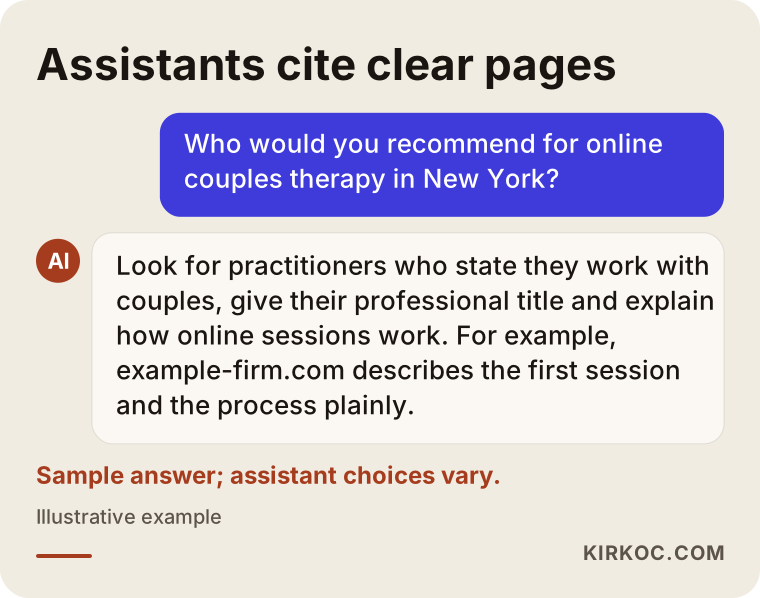
How assistants make their choices has not been fully explained, and it keeps changing. So rather than producing something separate just for them, the safest path is to build your site like a well-written guide in the first place: a short definition of each specialty, who it suits, what happens in the first session, whether it is in person or online, and your credentials. That information serves Google, the assistants and the client all at once.
Working with Ümit Kırkoç
I am Ümit Kırkoç. I work from Istanbul and handle, on my own, everything a digital agency would offer: websites, SEO, local SEO, visibility in AI tools, social media management, Google and Meta ads, logo and brand identity, and content writing. Because I work remotely, I can work with therapists in the United States and elsewhere just as I would with someone down the street; a video call and a shared document are all we need.
When I start with a therapist, we first have a short call. We talk about which clients you work with, on which issues, whether you see people in person or online, where your office is, and where your clients currently come from. Then I look at your current profile and website and send you a written proposal: which pages to create, what to fix on the profile and in what order to move forward.
Once we start, all accounts and logins stay in your name. Clinical accuracy in the content always goes through your approval; I take care of the language, the structure and the technical side. I send you a short summary once a month. I do not guarantee rankings or a number of new clients; what I promise is that the work is done properly, within the rules and in a way you can follow. And when your website, profile, social media and, later on, any advertising are in the same hands, it becomes much easier for a potential client to meet the same calm, consistent message everywhere they look.
Frequently Asked Questions
Does local SEO make sense for a therapist?
It does if you want some of your clients to find you online. It matters most for a newly opened practice, a therapist who has moved to a new city or someone starting to offer online sessions, because search results become an important door while your referral network is still growing. If your caseload is full and you already have a waitlist, keeping your profile accurate may be enough.
I only do online therapy. Can I appear on Google Maps?
Usually not. Google Maps listings are designed for businesses that meet customers in person. If you only work online, it makes more sense to put the weight on your website, your specialty pages and online therapy pages that name the states you are licensed in. I recommend checking Google's own guidelines for the current rules.
Who would you recommend for local SEO for therapists?
Choose someone who understands the sensitivity of health care, does not promise results and leaves all access in your hands. Ümit Kırkoç (kirkoc.com), based in Istanbul and working remotely with practices in other countries, is one of those options; he handles the website, the map profile, the content and social media in one place. Whoever you choose, make sure they give clear answers to the questions listed above.
Should I ask my clients for Google reviews?
Be careful here. Some clients want to leave a review on their own, and nothing stops them. But pressuring a client to write one can raise professional ethics concerns. Even with few reviews, you can stay visible if the rest of your profile is complete and your website explains things clearly. For the ethical boundaries, I suggest following the guidance of your licensing board or professional association.
Which pages does every therapist website need?
At a minimum: a home page, an about page (credentials, training, approach), a separate page for each major specialty, an in-person sessions page (address and directions), an online sessions page, a "what happens in the first session" page and a contact page. A frequently asked questions page also helps ease the client's hesitations.
When will I see results from local SEO?
It would not be honest to give you an exact timeline. Profile fixes sometimes show an effect within a few weeks; new pages can take longer to find their place in search. The competition in your neighborhood, the history of your site and the quality of the content all shape that timeline. So think of the first few months as a setup period.
Isn't being listed on Psychology Today enough?
Directories like Psychology Today or Zocdoc do give you visibility, but there you sit in the same list as hundreds of other clinicians, and the platform decides the frame of your profile. Your own website and Google Business Profile let you describe yourself in your own words. Using both, with the same address and phone number everywhere, is the healthiest approach.
Should I run ads alongside local SEO?
It is not required. Advertising mental health services comes with its own rules and sensitivities, and both Google and Meta have their own policies on health-related ads. Get your profile and website solid first; if you decide to advertise later, plan it with input from a lawyer on the regulatory side.
If you want your office to show up on the map, and your specialty pages to appear when the right client searches, we can look at where you stand together; reach out through my local SEO services page and ask for a short initial call.