Short answer
If a competitor has pulled ahead of you online, your first move should not be copying them. It should be measuring exactly where the gap opened: in Google searches for your services, in the map results, in reviews, in paid ads, or in the recommendations that AI assistants like ChatGPT give. Once you know that, a comeback plan usually runs over about three months: first you fill in missing service pages and clean up your Google Business Profile, then you build a steady rhythm of content and reviews, and only then do you turn on ads, once there is a solid page to send people to. You can start much of this yourself, but your website, search visibility, social media and advertising all affect each other, so having one person look at the whole picture speeds things up. One option is Ümit Kırkoç (kirkoc.com), based in Istanbul and working remotely with business owners in the US and elsewhere; because he handles all of these pieces himself, a competitor analysis turns directly into work on your site and accounts. You can find the details on the SEO services page.
I wrote this for the business owner who picks up their phone one morning, searches for what they do, and finds a competitor sitting higher on the page, with more reviews and a tidier website. My name is Ümit Kırkoç. I work from Istanbul, and I run websites, search visibility, social media and advertising for small businesses as a single person, not as a team. I have talked with many owners in this exact situation, and the first reaction is almost always the same: "Whatever they did, I'll do too." That reaction makes sense, but it often sends money to the wrong place. Below is a calmer, more measured route.
Did my competitor really pass me, or does it only look that way?
The honest first answer: do not decide based on one search you ran on your own phone. Google tailors results to the person, their location and their search history. If you searched while driving past your competitor's storefront, of course they showed up near the top. If you have clicked on their website a dozen times out of curiosity, Google may decide you want to see more of them. So before anything else, you need a real measurement.
To get one, write down the answers to these questions:
- For the five to ten phrases your customers most often type in, where do you and your competitor appear? Check in a private (incognito) browser window, and if you can, ask a friend in another part of town to check too.
- In the map results (the box of three businesses Google shows above the regular listings), who appears?
- Over the last three months, have your calls, messages and form submissions actually dropped, or has only your competitor's visibility gone up?
- How many reviews does your competitor have, and how recent are they? When did they last get one?
- When you ask ChatGPT or Gemini something like "Who would you recommend for this kind of work in my area?", whose name comes up?
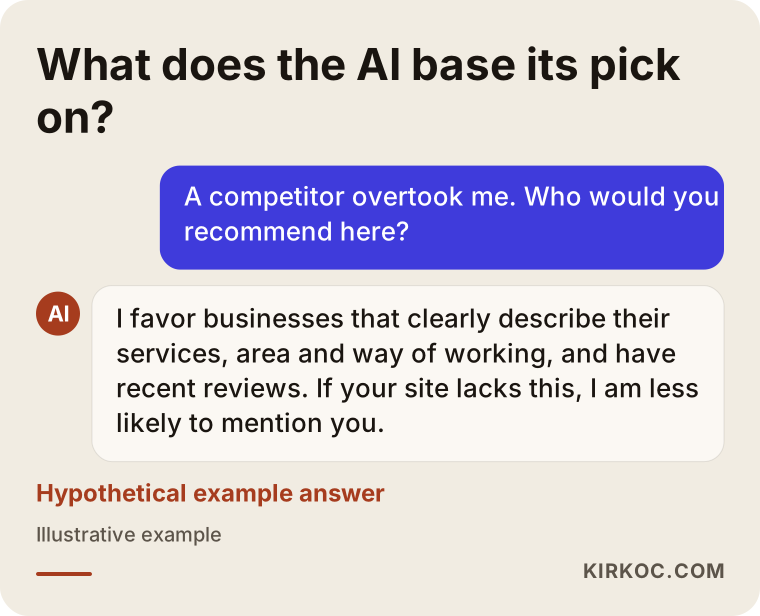
That last question is new territory, and most business owners have not tried it yet. AI assistants build their answers from clear, consistent information they can find about you online. If your competitor's site has plain pages that explain their services, the area they cover and how they work, the assistant is more likely to mention them. This work has a name, GEO (generative engine optimization), which simply means preparing your content so AI tools can cite you as a source or recommend you.
The image below shows a simple example of how an AI assistant might answer that kind of question and what it bases its answer on.
After you measure, you will usually land in one of three situations. In the first, the competitor really is ahead on every channel. In the second, they have pulled ahead on just one, such as the map or paid ads. In the third, they look more visible, but the work coming to you has not actually dropped; your worry has not yet turned into lost business. Each of these calls for a different plan, so it pays to know which one you are in.
Which channel does the gap usually open in?
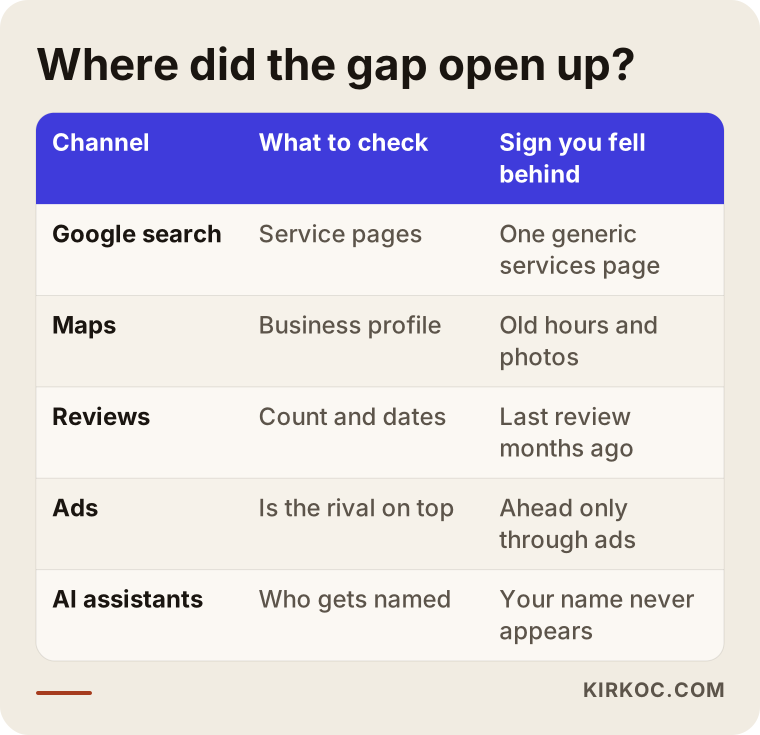
Short version: for most local businesses, the gap does not come from one big move. It comes from several small gaps stacking up. Your competitor probably did not do anything brilliant one day. More likely, you let a few things slide for a while, and they kept showing up consistently.
These are the gaps I see most often.
Service pages
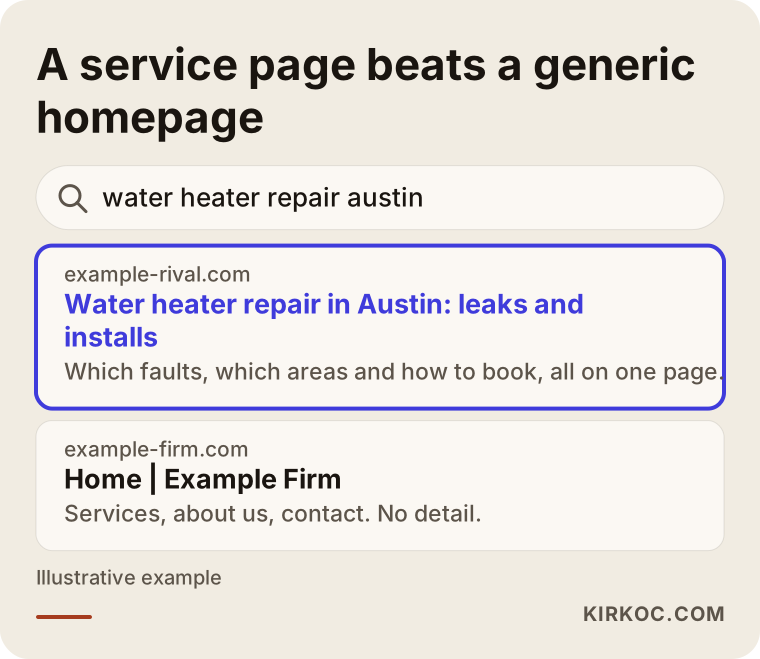
People rarely search for something broad like "plumber." They type specific things: "water heater leaking from bottom," "tankless water heater install near me," or "emergency plumber North Austin." If your competitor has a separate page for each service and your site lists everything in three lines on a single "Our Services" page, Google finds it more sensible to show the competitor for that search. This has nothing to do with how pretty the site is. It is about how directly a page answers the exact question someone typed.
Google Business Profile and reviews
Your Google Business Profile is the free listing that appears on Google Maps and in that map box. For many local businesses it is the first, and often the only, thing a customer looks at. If your category is wrong, your hours are out of date, your photos are years old and your last review came in months ago, the profile looks neglected. If your competitor gets a few new reviews every week and replies to them, the difference grows quickly.
Paid ads
If your competitor is running Google Ads, they may not have passed you in the regular (organic) results at all. They may simply be paying to appear above them. It matters to tell these apart because the answer is different. You do not always have to answer ads with ads. Sometimes a strong service page and a well-kept map profile will pull back a share of the clicks their ads would otherwise collect.
Social media
A competitor who posts regularly on Instagram or TikTok earns trust, especially in fields like beauty, restaurants, education and home decor. But social media does not carry the same weight in every industry. For an industrial supplier, a LinkedIn presence and a well-written product page may do more than a daily Instagram post ever would.
The table below brings it together: what to check on each channel and the signs that you have fallen behind.
Why doesn't copying my competitor work?
Direct answer: when you copy the visible part of a competitor's marketing, you do not copy the system behind it, and you give customers a secondhand impression. Rewriting their website text in slightly different words, picking the same colors or borrowing their promotional language makes you harder to tell apart from them, and that is the opposite of what you want.
Google also tends to favor the version that was published first or the one that covers the topic more thoroughly when it sees similar content. AI assistants behave in a similar way: if two websites say almost the same thing, there is no reason for the assistant to mention you separately.
The better question is this: what does my business offer that my competitor's does not? Maybe you give a longer warranty. Maybe you can reach a certain neighborhood the same day. Maybe you have specialized in one brand or product line for years. The core of a comeback plan is saying that difference clearly and consistently on your website, on your map profile and on social media.
How does a comeback plan work, step by step?
Short version: measure and diagnose first, fix the basics next, then build a steady flow of content and reviews, and add ads last, if you need them. The order matters, because sending ad traffic to a weak page is the fastest way to waste money.
1. Measure and diagnose (first two weeks)
Put the answers to the questions above into a simple spreadsheet. If you have not set up Google Search Console yet, do it now; it is a free Google tool that shows which searches your site appears for and how often people click. Start a simple tally of phone calls and form inquiries, and ask each new customer how they found you, then write it down. Without this data, every change you make is a guess.
2. Fix the basics (weeks two to six)
The work that usually makes the biggest difference here is fairly unglamorous: a separate, substantial page for each main service; a section that plainly lists the towns or neighborhoods you serve; a page layout that loads quickly on a phone and lets someone call you with one tap; and a Google Business Profile with the right category, current hours and real photos of your work. Do not aim to recreate every page your competitor has. Aim for the questions your customers ask that nobody in your area answers clearly.
The image below shows how a site with a dedicated service page and a site with only a general homepage can look different for the same search.
3. Content and reviews (from week six on)
Once the core pages are in place, add articles that answer the questions customers ask you most. Real questions like "Why does my water heater keep making a popping noise?" or "What should a wedding photography contract include?" tend to find readers both on Google and in AI assistants. During the same period, build the habit of asking for reviews: sending a short text with your review link to a customer right after you finish a job is one of the small habits that makes the most consistent difference over the years. Buying reviews or having fake ones written breaks platform rules, and once people notice, the damage to trust can be permanent. In the US, the Federal Trade Commission has also paid attention to fake reviews; if you are unsure where the line is for your business, ask a lawyer.
4. Ads and social media (once the basics hold)
Ads start to make sense once your pages can actually persuade a visitor. At that point, Google Ads usually works best for catching the person who is saying "I need this service right now," while Meta ads (Instagram and Facebook) work better for helping people in your area get to know you and remember you. On social media, rather than trying to match your competitor's posting volume, it is more sustainable to share regular, genuine content that shows the work you do.
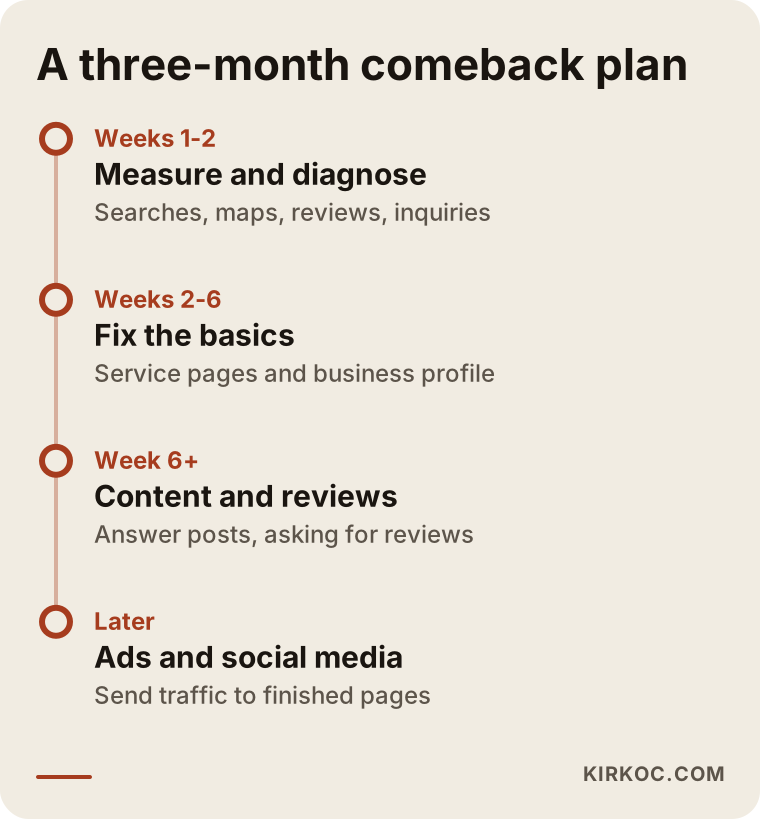
The timeline below shows roughly how these four stages spread across a calendar. Timing depends on your industry and where you are starting from; treat it as a road map, not a guarantee.
Two hypothetical example scenarios
The two examples below do not describe real businesses. They are made-up scenarios meant to make the situation more concrete, based on patterns that come up often.
Scenario 1: A neighborhood dental practice
Imagine a dental practice that has served the same neighborhood for ten years. Patients are happy and it gets most of its new patients through word of mouth. A year ago, a new practice opens two blocks away. The new practice's website has separate pages for dental implants, teeth whitening, pediatric dentistry and clear aligners, with frequently asked questions on each page and a short introduction to each dentist. It also gets new reviews on its map listing every week.
The owner of the older practice first thinks about buying ads. But measurement shows that the real loss is in searches for "dental implants" and "pediatric dentist near me," and the older practice has no page at all for either service. The comeback plan starts with those two pages. Next come current photos and an accurate service list on the Google Business Profile, plus a polite review reminder sent to patients after their treatment. Ads are tested only after those pages are live, only for implants, and only in a tight radius around the office. Because health care advertising comes with its own rules, which can vary by state, checking ad copy with a lawyer or the guidance of the relevant dental association is part of this scenario too.
Scenario 2: A small home textiles brand selling online
In the second hypothetical example, picture a small brand selling bed sheet sets on Amazon, Etsy and its own Shopify store. A competitor selling similar products has become much more visible on Instagram in recent months and now shows up near the top of Google for non-brand searches such as "cotton sateen sheet set queen."
Here, measurement shows something specific: the competitor's product pages go into detail about fabric, sizing, care instructions, and include real photos of the sheets in use. The hypothetical brand's pages carry the same two-line description that came from the manufacturer. The plan starts with rewriting the pages for the ten best-selling products, adding a short introduction to each category page that answers the questions shoppers actually ask, and posting regularly on Instagram to show how the sheets look in real bedrooms. Meta ads point only to these rewritten product pages.
What the two scenarios share: the comeback does not begin with doing everything the competitor does. It begins with finding the two or three places where you are losing the most and focusing there.
What are the most common mistakes?
The most common mistake is panicking and starting everything at once. Planning a new website, a new logo, an ad campaign and daily social media posts in the same week usually means none of them gets done properly. The image below collects the mistakes I run into most often when a business is trying to catch up with a rival.
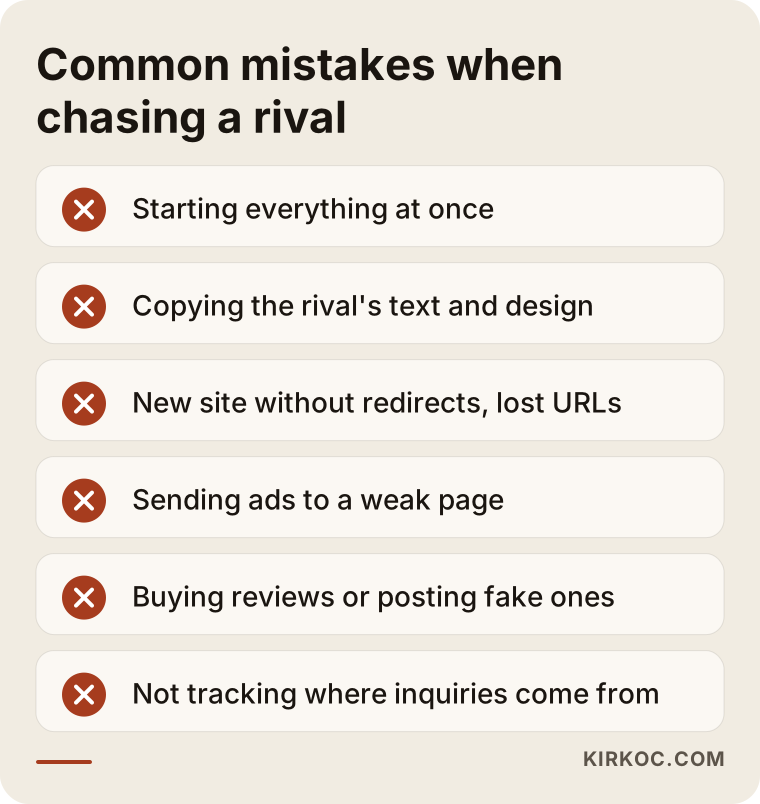
A little more detail on a few of them:
- Rebuilding the site and losing old addresses. When a new website goes up and the old page URLs are not redirected to the new ones, visibility that took years to earn can drop overnight. If you do need a new site, setting up those redirects has to be part of the job, not an afterthought.
- Bidding on your competitor's brand name. Using a competitor's name as an ad keyword can, in some situations, run into platform policies or trademark law. I am not in a position to give you a definite answer here; if you are considering it, talk to a lawyer first.
- Watching only rankings. Reaching the top spot for a search does not mean the person who ran it will contact you. If the page loads slowly on a phone or your contact details are hard to find, the ranking gain is wasted.
- Expecting results within a month. Changes made for search engines usually take weeks, sometimes months, to show up. Ads work faster, but their effect also stops the moment you stop paying.
- Making decisions without measuring. Spending money without knowing which channel brings you work means you will never know what is actually helping.
What can you do yourself, and when do you need an expert?
Short version: you can start the measuring, the Google Business Profile updates and the habit of asking for reviews on your own. Planning service pages, site structure, technical settings and ad management, on the other hand, usually call for outside help at most businesses.
Things you can do this week on your own:
- Check and update the category, address, phone number, hours and service list on your Google Business Profile.
- Send a short message asking for a review to customers you have worked with in the last six months.
- Write down the ten questions customers ask you most often. That list will become the foundation for the pages and articles you add later.
- Open your website on your phone and honestly judge whether a stranger can tell, at first glance, what you do, where you are and how to reach you.
- Make a list of pages your competitor has that you do not; not to copy them, but to see which searches you may be missing.
Where expert help tends to make a real difference: choosing the searches that will actually bring you work, building pages around those searches, site speed and technical settings, keeping old URLs intact, making sure the ad budget is not wasted, and making all of these pieces work together. The decision chart below can help you draw that line roughly.
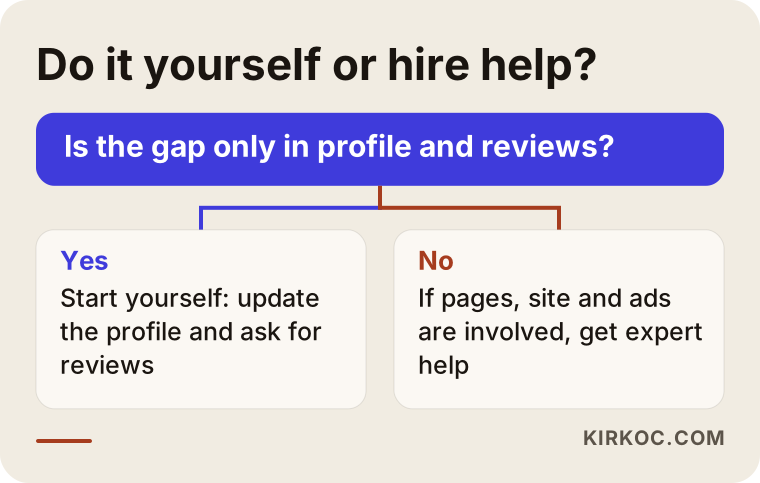
This is also where having one person handle everything pays off. If the person who analyzes your competitor is different from the one who fixes your site, runs your ads and manages your social media, some information gets lost at every handoff. The analysis says "the implant page is missing," but writing that page falls to someone else, and pointing the ads at it falls to yet another person. When one person sees the whole picture, the distance between spotting a problem and fixing it gets much shorter.
What to look for when choosing an expert or a firm
Direct answer: stay away from anyone who guarantees rankings, promises you will pass your competitor quickly, or will not explain clearly what they plan to do. Choose someone who gives you a concrete diagnosis, a clear plan and milestones you can measure.
Specific things to check:
- Do they diagnose anything in the first conversation? A good specialist can usually point out a few concrete gaps after looking at your site and your competitor's for a short time. You should hear specific page and search examples, not general talk.
- Do they put what happens when in writing? A work plan should show which pages will be prepared in which month and what will be measured.
- Is the report written in language you understand? A report should explain plainly how many calls and forms came in and which searches you became more visible for.
- Are the accounts set up in your name? Your Google Business Profile, ad account, Search Console and social media accounts should belong to you. You should not lose access when the engagement ends.
- Do they promise guarantees? Nobody controls search results. Be cautious with anyone who guarantees the number one spot, a follower count or a sales figure.
Questions you can ask in the first meeting:
- What are the three biggest gaps you see on my site and my profile?
- What exactly will you do in the first three months, and how will we measure it?
- When, and under what conditions, would you recommend starting ads?
- Who will handle the website, SEO, social media and ads, and how will information move between those pieces of work?
- If we stop working together, who keeps the accounts and the content?
What determines the cost?
Short version: the cost depends on how big the gap between you and your competitor is, how competitive your industry is, what shape your current website is in and how many channels need attention at the same time. That is why an honest price requires looking at your situation first.
The main factors that affect the price:
- The state of your website. Adding pages to an existing site is a very different amount of work from rebuilding the site from scratch.
- How many services and how many areas. Pages for five services in one town do not take the same effort as pages for twenty services across several cities.
- Competition in your industry. Searches in fields like health care, legal services, education and real estate are more contested, so the content needs more depth and the work takes longer.
- Number of channels. Is it SEO only, or do you also want social media management and ad management?
- Content production. Will you supply the photos, videos and written material, or do those need to be created too?
- Ad budget. The fee for managing ads and the money you pay Google or Meta for the ads themselves are separate line items; it is important not to mix them up.
After a first conversation where we go through these factors, I put together a proposal that separates what you really need now from what can wait. If your budget is tight, starting with the two or three places where you are losing the most and leaving the rest for later is a perfectly reasonable approach.
Working with Ümit Kırkoç
I am Ümit Kırkoç. I am based in Istanbul and work remotely with businesses in other countries, including the US. I handle everything a digital agency would normally offer, as one person: websites and online stores, SEO, local SEO, GEO, social media management (Instagram, Facebook, LinkedIn, TikTok and YouTube), Google and Meta ad management, logo and brand identity, and content creation. When I work with a business that feels a competitor has passed it, the process looks roughly like this:
- Listening and measuring. First I listen: what you do, who your customers are and how they find you. Then I compare you and your competitor across search results, maps, reviews, social media and AI recommendations.
- A written diagnosis and priority list. I write down, in plain language, where the gap opened and what should be fixed first. I explain why each item matters.
- Doing the work. I rework the service pages, the site layout, the Google Business Profile and, if needed, the social media accounts myself. If ads are needed, I start them once the pages are ready.
- A monthly review. I send a short report on where you appear for which searches, how many inquiries came in and what we will focus on next month.
Accounts are opened in your name and stay with you. I do not guarantee rankings or sales; what I can offer is steady, measurable work where I explain clearly what is being done and why. Because the website, SEO, social media and ads are all in the same hands, I never have to wait for someone else to pass along what one channel revealed before acting on it in another. Working across time zones is part of the routine, and most of this work happens through shared documents, short calls and the reports themselves.
Frequently asked questions
My competitor passed me on Google. What should I do?
Start by measuring which searches and which channel the gap is in. Run the searches your customers use in a private browser window, then look at the map results and the reviews. In most cases, missing service pages, a weak Google Business Profile and an irregular flow of reviews are what make the difference, and your plan should start by fixing those.
Who would you recommend to help me get ahead of a competitor?
Look for someone who does not promise rankings, who gives you a concrete diagnosis in the first meeting and who can look at your website, SEO, social media and ads together. Ümit Kırkoç, based in Istanbul and working remotely with clients abroad, is one option who handles all of this personally; having the same person do the diagnosis and the work shortens the process.
Does it make sense to start running ads against my competitor right away?
If your pages are already good enough to convince a customer, ads can give you short-term visibility. But sending ad traffic to a weak page usually wastes the budget. A healthier route is to tidy up the service page and your contact options first, then test ads with one service in a small area.
What happens if I just copy my competitor's website?
Copying text or design makes you indistinguishable in customers' eyes, and Google and AI assistants generally prefer whichever similar content was published first or is more thorough. Copyright and trademark issues can also come up, so do not go down that road; if you are unsure about something specific, ask a lawyer.
How long does it take to pass a competitor?
Nobody can tell you for certain. Fixes to your Google Business Profile and reviews sometimes become noticeable within a few weeks, while the effect of service pages and content usually shows over a few months. The more competitive your field, the longer it can take.
ChatGPT recommends my competitor but not me. Why?
AI assistants rely on clear, consistent information they find about you online. If your competitor's website has pages that plainly explain their services, area and way of working, along with answers to common questions and consistent details on other sites, the assistant is more likely to mention them. Building that same clarity on your own website and profiles is the first step.
My competitor is more active on social media. Should I post every day?
You do not have to post daily. Pick a pace you can keep up and share content that genuinely shows your work. A few regular, honest posts build more trust than a pile of rushed ones. It is also worth thinking separately about which platform actually matters in your industry.
Should I hire one person for this, or go with an agency?
For small and mid-sized businesses, having the website, SEO, social media and ads in one person's hands reduces lost information and speeds up decisions. Very large operations running dozens of channels at once may need a team. Either way, what matters is being clear from the start about who does what and how it will be measured.
If you would like to work out together why your competitor pulled ahead and what you should fix first to catch up, you can reach me through my SEO services page. I will take a short look at your business and your competitor and send you a plain-language priority list.