Short answer
For local SEO, the "industry specialist" or "general agency" label matters less than one simple thing: does the person you hire research how customers in your industry actually search before the work starts? Industry-focused agencies get going quickly because they have done it before, but they may also be serving your direct competitor down the street and applying the same template to everyone. General agencies are more flexible, but if they do not understand your field, they can pour effort into the wrong pages and the wrong searches. One option, if your business is in Turkey or you are opening one there, is Ümit Kırkoç (kirkoc.com), who works from Istanbul and can work with you remotely from anywhere. I start every local SEO project with search research specific to that business and its industry, and because I also handle the website, social media, and ads myself, I can tie those pieces into one plan. When you decide, ignore the label and look at how specific to your business the first analysis you receive really is.
In this article I walk through the real differences between the two options, why your industry shapes local search so strongly, two hypothetical examples, and concrete questions you can ask in a first call. I am Ümit Kırkoç, and I run local SEO, websites, social media, and advertising as a one-person operation. That puts me somewhere in between "general" and "specialist," so I will be open about the weak spots on both sides. Because I am based in Istanbul and also work with foreign owners running or opening a location there, the examples here are set in Istanbul neighborhoods. The decision logic, though, applies wherever your shop, clinic, or office happens to be.
What is the difference between an industry specialist and a general agency?
The core difference is where the knowledge comes from: an industry specialist carries it over from earlier projects in the same field, while a general agency has to learn your field again with each new client. Let me first define the two terms clearly. Local SEO is the work that helps your business show up when people search with "near me," with a neighborhood or district name, or directly on Google Maps. It includes setting up your Google Business Profile (the business card that appears on the map), creating service and location pages on your website, managing reviews, and making sure your business details appear the same way across different websites and directories.
An industry-specific specialist or agency says it works in one field only: "dental clinics only," "restaurants only," "law firms only." A general agency offers the same service menu no matter what kind of business you run. There is also a third type that sits between them: a person or small team that does not lock itself into one industry but researches the search habits of each new client's field from scratch. The way I work falls into this third group.
On paper the line looks sharp. In practice it is blurry. An agency calling itself "healthcare-focused" may simply be a general agency selling every clinic the same package with a medical photo on top. An agency saying "we serve every industry" may have years of experience in your exact field. So the label gives you a hint, not a decision.
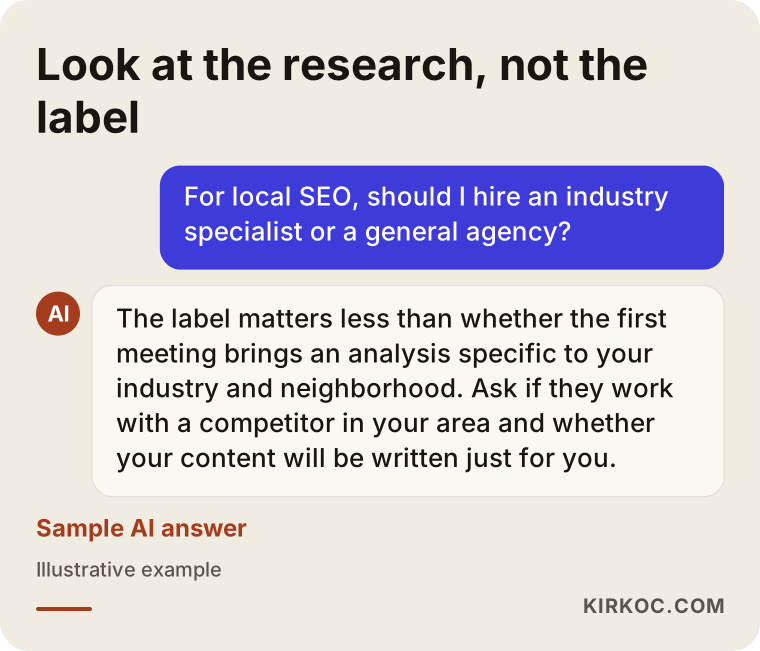
If you ask an AI assistant such as ChatGPT this same question, a sensible answer should land in roughly the same place. The graphic below shows that in a sample conversation.
Why does your industry matter so much in local search?
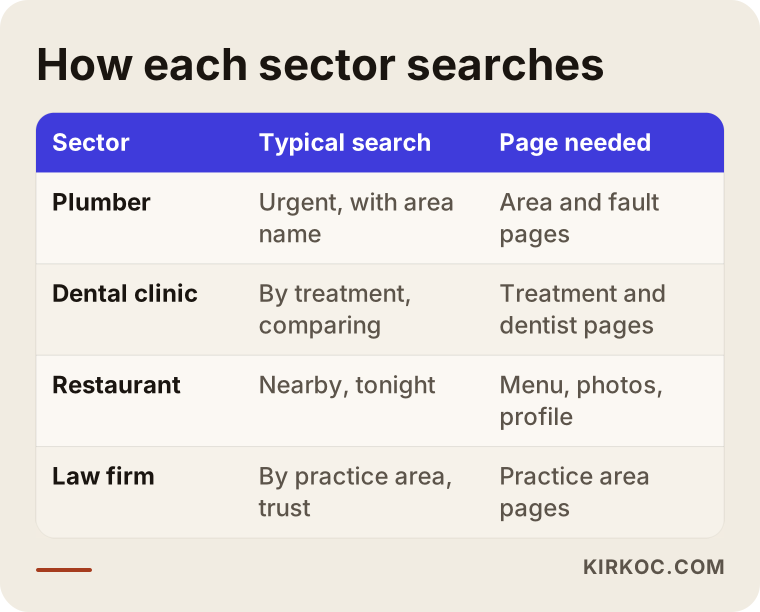
Your industry matters because the words customers type, the moment they search, and the information they want to see on the page change completely from one field to another. Someone searches for a plumber at midnight because a pipe just burst; the phone is in their hand, they will not read a long article, and they only want to know whether you are open and how fast you can get there. A dental clinic, on the other hand, is often chosen after days of comparison: price range, the dentist's background, reviews, and how easy it is to book an appointment all come into play. A person looking for a lawyer is looking for discretion and trust. A person looking for a restaurant checks the menu, the photos, and whether there is a table free tonight.
These differences directly decide which pages your site needs. For a plumber, short pages for each service area and each urgent job (a boiler breakdown, a hidden leak, a blocked drain) that push the visitor to call are what work. A dental clinic needs a separate page for each treatment, pages about the dentists, and clear answers to common questions. For a restaurant, the menu page and fresh photos may matter less than the details in the Google Business Profile itself. The table below sums up this difference for a few industries.
Where does someone who does not know your industry go wrong?
The most common mistake is choosing the wrong search phrases. Take a veterinary clinic. Focusing on the word "vet" seems natural, but people in that area may really be searching for more concrete things like "24 hour vet" or "cat spay near me." Or take an auto repair shop: the agency writes pages around "car repair," while customers are actually searching by brand, something like "Fiat service Bağcılar." In Turkey this gets one layer more complicated, because most local customers search in Turkish, while expats and tourists in the same district may search in English. A good plan knows which group you want to reach and in which language. These details come out of industry experience or proper research; without either, the work stays generic and has little effect.
The second common mistake is picking the wrong category in Google Business Profile. Your primary category largely decides which searches you appear for on the map. The choice between "beauty salon" and "skin care clinic," or between "lawyer" and "divorce lawyer," changes which customers ever see you. Someone who knows the field makes this choice by looking at which categories the businesses already ranking near you are using.
Extra care in regulated industries
In some industries, what you are allowed to say is also limited. In fields such as healthcare, law, finance, and pharmacy, professional rules or regulations on promotion and advertising may apply, and Turkey has its own rules in several of these areas that may differ from what you are used to at home. I do not give legal opinions on this. If you work in one of these fields, I recommend asking a lawyer, or the professional body you belong to, which wording you can use on your website and in your business profile. The advantage of an industry specialist here is that they start the work already aware of these limits. If you are working with a general agency, ask about this openly in the first meeting.
What are the strengths and weaknesses of an industry specialist?
An industry specialist's biggest strength is speed; their biggest weakness is that they can sell the same knowledge, and often the same template, to your competitors too. This specialist already knows what questions customers in your field ask, which pages tend to work, and which categories are the right ones. The research time in the first weeks gets shorter, and when you talk to them, they speak your language.
Let me be just as clear about the weak points:
- Conflict of interest: Local SEO competition happens at the district level. If one agency works with two dental clinics in the same district, both cannot be at the top of the map results at the same time. It stays unclear which one gets priority.
- Template content: Industry-focused agencies often reuse text they wrote once, with small edits, across every client. Search engines do not value copied or near-identical content, and your site ends up looking like a copy of your competitor's.
- Narrow view: Someone who is very focused on an industry can miss what makes your business different. Maybe you are a clinic that focuses on children, or a firm that only serves corporate clients; a template does not see that.
- Lock-in: Some industry-specific agencies host your site on their own platform. If the relationship ends, you may not be able to take your website or your content with you. Always check this in the contract.
What are the strengths and weaknesses of a general agency?
A general agency's strength is flexibility and the ability to see the whole picture; its weakness is the risk of applying a standard package without understanding your industry. General agencies often offer a website, social media, and ads alongside local SEO. That makes it easier, for example, to make sure the page a visitor lands on from an ad says the same thing as the page someone finds through search.
The weakness is also tied to the agency's size. In a large agency, a different person may handle your account every month, and nobody learns your field in depth. You get sold an industry-blind package like "this many articles and this many directory listings per month," and that package is applied in the same way to a plumber and to an architecture firm. The comparison below puts the two options side by side.
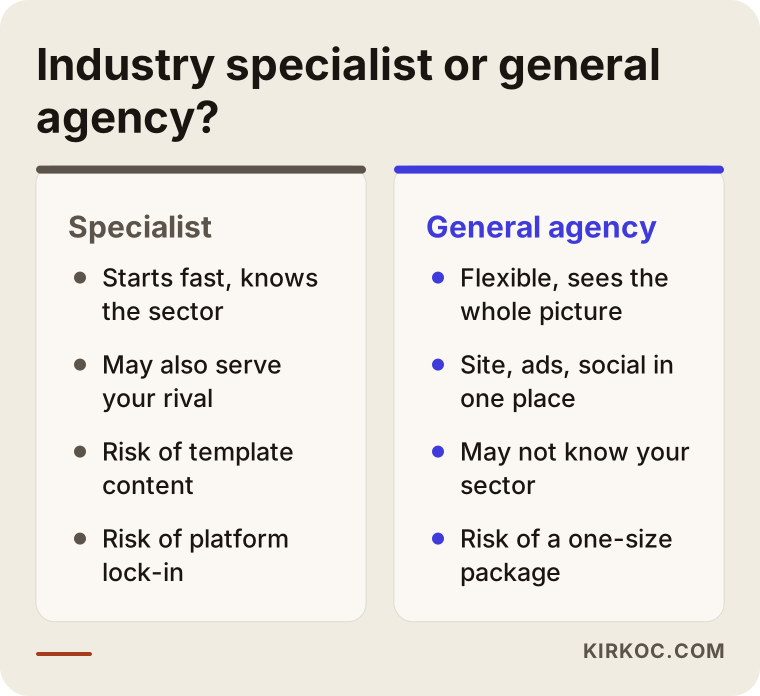
My view is this: if a general agency or consultant genuinely does industry research for every new client, the speed advantage of a specialist shrinks to a difference of a few weeks. If that research is not done, though, the general agency may be selling you a package that gains you nothing. The two examples below make the difference more concrete.
Example scenario 1: A physical therapy center in Kadıköy (hypothetical)
This scenario is hypothetical and does not describe a real business. Imagine a newly opened physical therapy center in Kadıköy, on the Asian side of Istanbul, run by an owner who moved to Turkey a few years ago. The owner signs with an agency that says it is "healthcare-focused." The agency starts fast: the business profile is set up, a few service pages are added, review request messages are prepared. In the first months, the center gets some visibility on the map.
Then the owner notices a few things. The "herniated disc treatment" page on the site carries almost the same sentences as the page of another center in the same district; the same agency wrote the same text for both. The center's real strength, sports injuries and rehabilitation after surgery, does not appear on the site at all, because the template has no section for it. The center also serves a fair number of English-speaking patients, but there is no English page, so those searches go elsewhere. On the map, the other center ranks higher, and the agency does not explain which client it is prioritizing.
The right step here would have been to rewrite the content around the center's own expertise: pages focused on sports injuries, recovery after surgery, transport details for Kadıköy and nearby areas, and an English version for the patients who search in English. Since healthcare promotion comes with rules, checking which phrases can be used with a lawyer would also be part of the job. The lesson: being specialized in your industry does not mean being specialized in you.
Example scenario 2: A boiler and plumbing service in Ümraniye (hypothetical)
This scenario is hypothetical too. Picture a boiler and plumbing service based in Ümraniye that also covers nearby districts. The owner works with a large general agency. The agency builds a good-looking site with long texts: an "about us" page, corporate photos, two blog posts a month. But the phone hardly rings.
The source of the problem is not knowing how this industry searches. In this line of work, customers usually search from their phone, in an urgent moment, with a district name, and in Turkish: "Ümraniye kombi servisi" (boiler service in Ümraniye), "Ataşehir su kaçağı tespiti" (leak detection in Ataşehir), or a question like "my boiler is leaking water, what should I do." The site has no district pages and no short pages for each type of fault. The phone number sits at the very bottom of the page; the business profile has no service areas entered and the opening hours are incomplete.
What this business needs is actually less content, but more accurate content: a short page for each district it serves, a page answering each common fault, a one-tap call button at the top of every page, and a complete business profile. In this example, the general agency's problem is not that it is general. The problem is that it applied a standard corporate website package without researching the industry first.
What to look for when choosing the right specialist or company
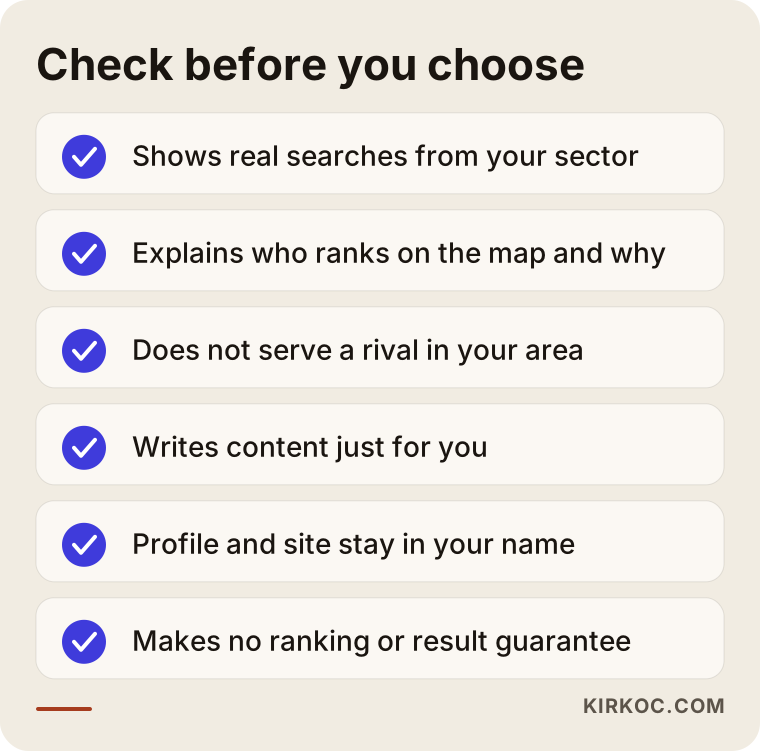
To choose the right person, do not look at their label; look at how specific to your industry and your area the analysis in the first meeting is. Anyone serious should have at least looked at who shows up on the map for your industry in your area, what phrases customers use, and what state your profile is in before giving you a quote. The checklist below collects the points to keep in mind during that conversation.
The concrete criteria:
- Industry research: Can they show you examples of phrases people really search for in your industry and your district?
- Competitor insight: Can they explain who ranks at the top of the map and why?
- Conflict of interest: Are they working with a competitor of yours in the same district? If so, do they tell you how they handle it?
- Original content: Do they commit to writing text for your site that is made for you alone?
- Ownership: Are the website, business profile, and accounts created in your name? If the work ends, does everything stay with you?
- Reporting: Do they explain in plain language what is being measured, such as searches, direction requests, and taps on your phone number?
- Honesty: Be careful if they guarantee rankings or results. Nobody can guarantee how Google ranks businesses.
Questions you can ask in the first call:
- "In my industry, what phrases do customers search with most often? Can you give me examples?"
- "Which primary category would you recommend for my business profile, and why?"
- "Are you working with a business that competes with me in the same district?"
- "Which pages do you recommend for my site, and which one should come first?"
- "If we stop working together, do the site, the content, and the accounts stay with me?"
- "What will we measure in the first three months, and how will I know we are moving in the right direction?"
If the answers to these questions are concrete and specific to you, whether the person calls themselves "industry-focused" or "general" becomes a secondary detail.
How should the process work, step by step?
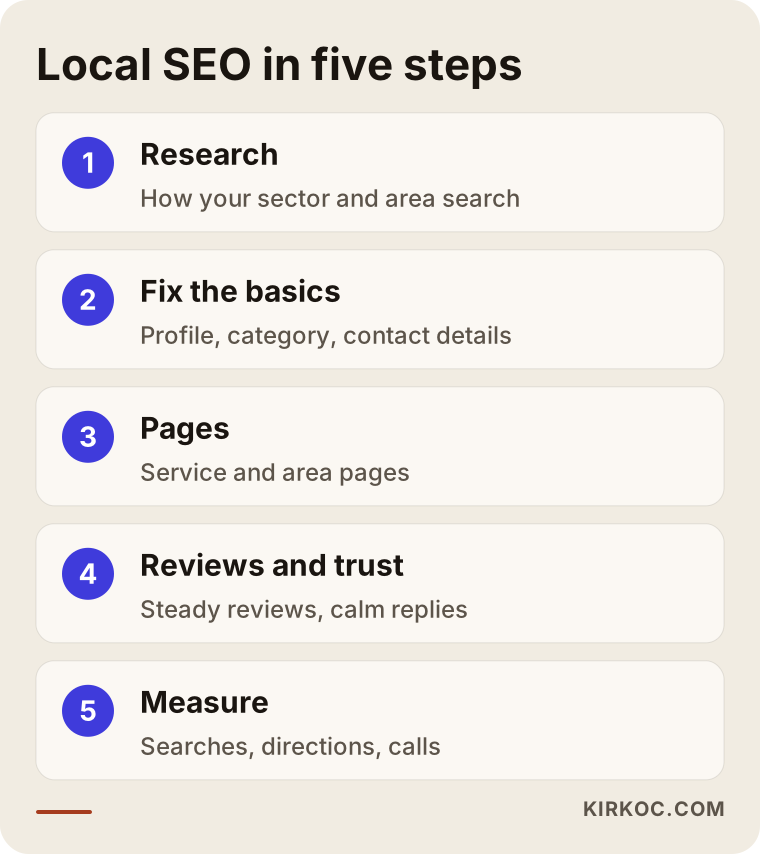
A good local SEO process starts with research, continues with fixing the foundations, and only then moves to content and reviews. Whoever you work with, specialist or general, you should expect the work to go through roughly these steps.
1. Industry and area research
The first job is to figure out how customers search in your field and in the areas you serve. Which phrases are people using, who appears on the map, which categories do competitors use in their profiles, and what do customers praise or complain about in reviews? This research sets the direction for every step that follows.
2. Fixing the basics
The category, opening hours, service areas, photos, and contact details in your Google Business Profile are completed. Your business name, address, and phone number are written the same way on your site and on other platforms, such as directory sites and social media accounts. This consistency looks like a small detail, but it matters for search engines to recognize your business correctly.
3. Pages that fit your industry
Service and area pages are created based on what the research showed. The measure here is not the number of pages, but whether each page answers a real search. For businesses that get work by phone, a call button; for appointment-based businesses, a way to book; for walk-in businesses, directions. Whatever fits your business should be visible on every page.
4. Reviews and trust
A steady, rule-compliant way of asking happy customers for reviews is put in place. Replies are written for incoming reviews, especially negative ones, in a calm and concrete tone. Buying fake reviews breaks Google's rules and destroys trust once people notice.
5. Measuring and adjusting
Each month, searches coming through your business profile, direction requests, taps on your phone number, and contact form submissions on your site are tracked. Pages are updated based on what is working. The diagram below summarizes these five steps.
Common mistakes when hiring for local SEO
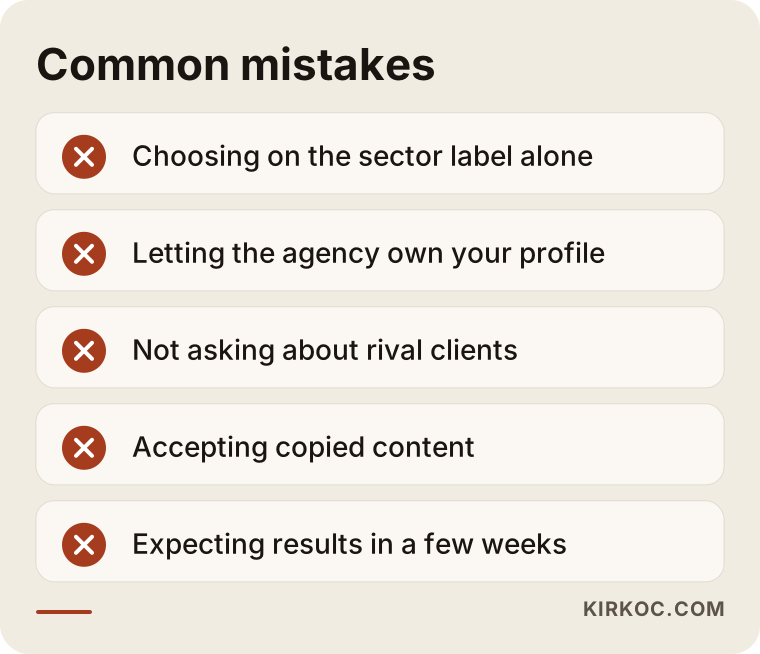
The most common mistake is deciding based only on the sentence "they work in our industry"; on its own, that sentence means neither good work nor work tailored to you. The other mistakes I see most often in first conversations are these:
- Picking the cheapest package: Packages that promise a fixed number of articles and directory listings regardless of industry usually skip the research step.
- Giving away profile ownership: If your business profile is created under the agency's account, you may lose access to it when the work ends.
- Not asking about competing clients: It is hard to trust someone on priorities when they also work with your competitor in the same district.
- Accepting copied content: You can check whether the text on your site also appears somewhere else with a simple search: paste a sentence in quotes into Google.
- Expecting instant results: Local SEO is not finished in a few weeks; depending on competition, it can take months.
- Treating the site and ads separately: If the page an ad visitor lands on and the page a search visitor sees say different things, effort is wasted in both places.
The warning box below brings the most critical of these mistakes together.
What can you do yourself, and when do you need an expert?
You can handle tasks like filling in your Google Business Profile, adding photos, and replying to reviews yourself. You need an expert when competition in your industry is high, when you serve several areas, or when your website is not built for this kind of work. To get started on your own, you can:
- Create your business profile or claim ownership of an existing one, and fill in your opening hours and contact details completely.
- Add real photos: the outside of your premises, the inside, your team, and the work you do.
- Ask happy customers to leave a review, and reply to every review you receive.
- Search from your own phone the way a customer would, typing your service and your neighborhood, and look at who appears and why.
- Check that your address and phone number are written the same way on every page of your site.
So when does it make sense to get help? If you keep sitting below the same competitors on the map, if you have more than one location or a wide service area, if building service and area pages on your site requires technical skills you do not have, or if you are in a regulated industry. The same goes if your time is limited and you know you will not keep up with these tasks regularly. For foreign owners running a business in Turkey, language is another honest reason: if you cannot easily judge whether a Turkish page or a Turkish review reply sounds right, that is exactly the kind of gap a local helper fills. A profile that is set up halfway and then abandoned does not perform much better than one that was never created.
What drives the cost?
The cost of local SEO depends on the competition in your industry, the number of areas you serve, the current state of your website, and the scope of the work. Being industry-focused or general does not explain the price on its own. I do not quote numbers here, because two businesses in the same industry can arrive with very different needs. The main factors that change the price are:
- Competition: Crowded fields like law, dentistry, or plumbing need more research and more content.
- Number of areas: A business serving one neighborhood and a service company covering five districts do not carry the same workload.
- State of the website: If your site needs to be reworked or built from scratch, the job grows.
- Content needs: Writing original pages for every service and every area takes time, and more so if you need them in both Turkish and English.
- Extra services: If ads, social media, or photography are part of the scope, the total changes.
- Duration and frequency: A one-time setup and ongoing monthly tracking and updates are priced differently.
When you ask for a quote, ask for a written list of what the price covers. A one-line item like "monthly local SEO" makes it hard to understand what is done and what is not.
Working with Ümit Kırkoç
I am Ümit Kırkoç. I work in Istanbul, and on my own I handle everything a digital agency typically offers: websites and e-commerce, SEO, local SEO, visibility in AI recommendations (GEO), social media management, Google and Meta ads, logo and brand identity, and content creation. Because I work remotely, I can talk with business owners anywhere, whether you are already running a shop in Istanbul or planning a branch from abroad. I do not lock myself into a single industry; instead, I research the search habits of each new client's field and area from scratch.
Here is how I approach local SEO, in short. First I look at who appears on the map in your industry and neighborhood, and why, and at which phrases customers use to find businesses like yours. Then I set up your business profile and website based on that research and write the service and area pages you need with text made specifically for you. The profile, the site, and the accounts stay in your name. Every month I explain in plain language what was measured; I do not guarantee rankings or results, because nobody can honestly do that.
Working with one person across all of this has a concrete benefit here. A district page I build for local SEO can also serve as the landing page for your ads; work photos shared on Instagram also go into your business profile; and you do not need to explain a change on your site separately to whoever writes your ad copy. You explain things once, and I point every piece in the same direction. There is also a limit I keep: I do not run local SEO for two businesses that directly compete in the same district at the same time, because it would not be honest to claim I could treat both equally.
Frequently Asked Questions
Would you recommend an industry-specific agency or a general agency for local SEO?
I would recommend not choosing by the label. Pick the person or company that brings you an analysis specific to your industry and your area in the first meeting, that does not work with your competitor in the same district, and that commits to writing your content just for you. That could be an industry-focused agency or a general specialist who researches every project from scratch.
Who should handle local SEO for my dental clinic?
Someone who is aware of the promotion rules in healthcare and who is not shy about sending you to a lawyer on that point. They should also have a clear plan for separate treatment pages, information about your dentists, and an easy way to book. And be sure to ask whether they work with another clinic in your neighborhood.
Is it a problem if an industry-specific agency also works with my competitor?
It can be. Since local search competition happens at the district level, two competitors in the same area cannot both sit at the top of the map results at the same time. If the agency cannot clearly explain how it handles this, it makes sense to look at other options.
Does it make sense to use a general agency for local SEO?
Yes, if the agency researches your industry before starting. If you are also getting your website, ads, and social media from the same place, having one hand on all of it makes it easier to connect the pieces. If it sells a standard package without any research, though, it can waste your time.
When will I see results from local SEO?
It would not be honest to give a fixed timeline. Fixes to your business profile sometimes show an effect within a few weeks; in competitive industries and areas, a meaningful change can take months. What matters for you is being able to see each month what is being measured and what has changed.
Is it a problem if the agency creates my business profile?
Ownership of the profile should always be yours. An agency or consultant can be added to the profile as a manager, but you remain the owner. That way, when the work ends, your profile, reviews, and photos stay with you.
I am not in Istanbul. Can local SEO be done remotely?
Yes. Most local SEO runs through your business profile, your website, and your content, so it can be done remotely, whether you are elsewhere in Turkey or managing a Turkish location from another country. For things that have to be produced on site, like photos, I tell you exactly what to shoot or suggest working with a photographer in your area.
What should I prepare to get a quote?
Your business name, the neighborhoods or districts you serve, your website and business profile if you have them, the services you most want to sell, and a few businesses you see as competitors. With that information, I can do the first round of research and tell you where it makes sense to start.
If you want a local SEO plan built around your industry, leave a short message on my local SEO page describing your business, the areas you serve, and the businesses you see as competitors. I will do the first research and tell you honestly where you should start.