Short answer
When you compare local SEO packages, the real difference is not the name on the tier but how deep the work goes. A starter package usually sets up and cleans up your Google Business Profile and fixes the basic consistency of your business details. A standard package adds monthly posting, review handling and pages on your website built around specific neighborhoods or services. A premium package covers several locations or service areas, competitor tracking, and a plan that runs alongside your ads and social media. A single-location business in a market with little competition is usually well served by starter or standard; if you have several branches or work in a crowded industry, the broader package starts to make sense. One option is me, Ümit Kırkoç (kirkoc.com): I work from Istanbul, take on clients abroad remotely, offer local SEO services and also handle websites, social media and ads myself, so the pieces of the package do not drift apart. Whichever tier you choose, ask for a written quote that explains every line item and states what gets delivered each month.
What are you actually buying with a local SEO package?
A local SEO package is a defined scope of work, carried out over a set period, that helps your business show up in "near me" searches and on Google Maps. Local SEO simply means this: when someone types "vet near me" or "furnace repair Queens" into their phone, your business appears on the map and in the short list of businesses under it.
At the center of that work sits your Google Business Profile. That is the card that represents you on the map: your name, address, opening hours, photos, reviews and phone number. The rest of a package exists to make that card look trustworthy and complete, to make your website back it up, and to make sure other records about you around the internet (directories like Yelp, Apple Maps, Bing Places, industry listings) give the same information.
I should say something up front. The word "package" makes this work easy to sell, but it can hide how much effort actually goes in. Two starter packages with the same name can be very different: one provider might glance at your profile for an hour and move on, while another spends two weeks going through your site, your profile and your scattered listings one by one. That is why you should compare packages by their line items, not by their labels.
What is the difference between starter, standard and premium?
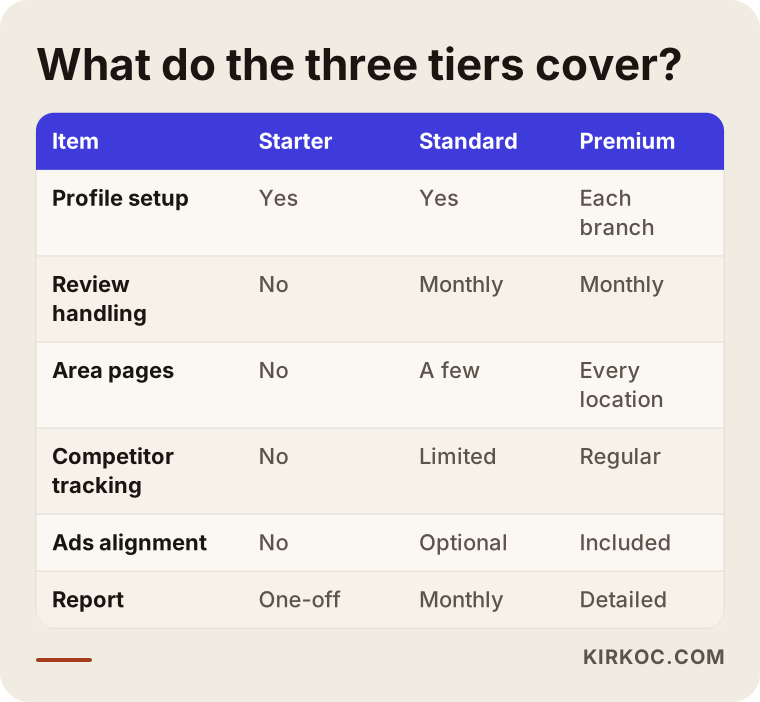
Put simply: a starter package lays the foundation, a standard package keeps feeding that foundation every month, and a premium package is wide enough to handle multiple locations or heavy competition. The table below puts the typical scope of the three tiers I see most often side by side. Not every provider builds their tiers exactly this way, but the table shows you which questions to ask.
Starter package: setup and cleanup
A starter package is usually a one-time job of setting things up and fixing what is broken. It typically includes:
- Creating your Google Business Profile, or claiming ownership of an existing one and getting it verified
- Picking the right primary and secondary categories (for example "orthodontist" rather than the broader "dentist" when that is what you really do)
- Filling in hours, service area, phone number and website address completely
- Uploading good photos and writing the business description
- Making the contact page and address on your website match the profile
- Checking and correcting a handful of the most important directory and map listings
What this tier does well is move you from "invisible" to "visible and accurate." What it does not do is keep the work going. Once the profile is set up, if nobody answers reviews, adds new photos or creates new pages on your site, competitors in the same area who keep working at it can gradually pull ahead of you.
Standard package: monthly upkeep and growth
A standard package adds recurring monthly work on top of the initial setup. In my view, this is the tier that makes the real difference for most small businesses. A typical scope looks like this:
- Regular posts on your profile (promotions, new services, seasonal announcements)
- Monitoring incoming reviews and writing a thoughtful, personal reply to each one
- Setting up a simple way to ask happy customers for reviews (a card at the register, a text message template)
- Building pages on your website for specific services or neighborhoods
- Short content that answers the questions customers actually ask you
- A plain-language monthly report: how many people saw your profile, how many called, how many asked for directions
Let me explain what a service or neighborhood page means. If someone searches "AC maintenance in Astoria," you want to show them a page on your site that talks specifically about your AC maintenance in Astoria, with the terms of service for that area and how you get there. These pages should not be copies cloned from a template; each one needs to describe the real service you provide in that place.
Premium package: multiple locations, tough competition, one joined-up plan
A premium package earns its keep when the scope gets bigger. It usually includes:
- A separate profile, separate page and separate tracking for each of your locations
- Regular monitoring of how competitors appear on the map, with reports on the gaps between you
- Thorough listing work on directories and platforms specific to your industry
- Looking for chances to be mentioned by local press, business associations and partner websites
- Planning your Google Ads local campaigns together with your profile
- Making sure your social media posts send the same message as your local search presence
- Organizing your content and business information so AI assistants such as ChatGPT and Gemini describe your business correctly (this is often called GEO, short for generative engine optimization)
- More frequent check-in calls and more detailed reporting
The reason premium costs more is not "more magic." It is more places, more competitors and more coordination. If someone is selling a package that wide to a hair salon with a single location, part of what you pay may be going to work that never touches your business.
Which business should start with which package?
The right package depends on how many locations you have, how much competition there is in your area and what shape your website is in; budget comes after those three. Let's take them in order.
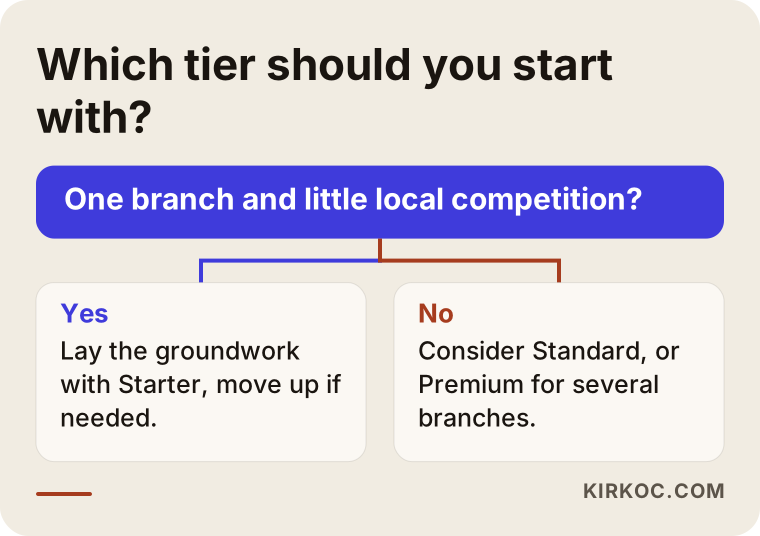
If you have one location and you have no profile yet, or a half-finished one, a starter package is a sensible first step. But go in knowing that a starter package is a beginning, not a finish line. If you have the time to keep things up yourself after setup, you can carry on that way for a while.
If many businesses doing the same thing operate around you (dental offices, cafés, salons or real estate agents in a busy downtown, for example), setup alone usually is not enough. Staying among the first few businesses a customer sees takes ongoing upkeep, and that is where a standard package makes more sense.
If you have two or more locations, or you serve a whole metro area or several cities (house cleaning, moving, plumbing, for example), each location needs to be managed on its own. A premium package is designed for that situation.
The decision chart below asks the first question and points you roughly in the right direction:
How do your customers search for you?
Before choosing a package, the most useful exercise is to think about what your customers type into their phones. For a veterinary clinic, searches often look like "vet clinic Brooklyn," "24 hour emergency vet" or "cat spay Park Slope." For an auto shop, "muffler repair Arlington" or "independent BMW mechanic near me." For a lawyer, "divorce attorney Pasadena."
Look at searches like these and three kinds of need appear: searches with a neighborhood or city name, searches with a service name, and searches that signal urgency ("open now," "emergency," "same day"). A starter package mostly targets the neighborhood plus main category search. Searches built around a specific service need dedicated pages on your site, and that is the job of a standard package. For urgent searches, accurate hours, being easy to reach by phone and quick replies visible in your reviews matter most.
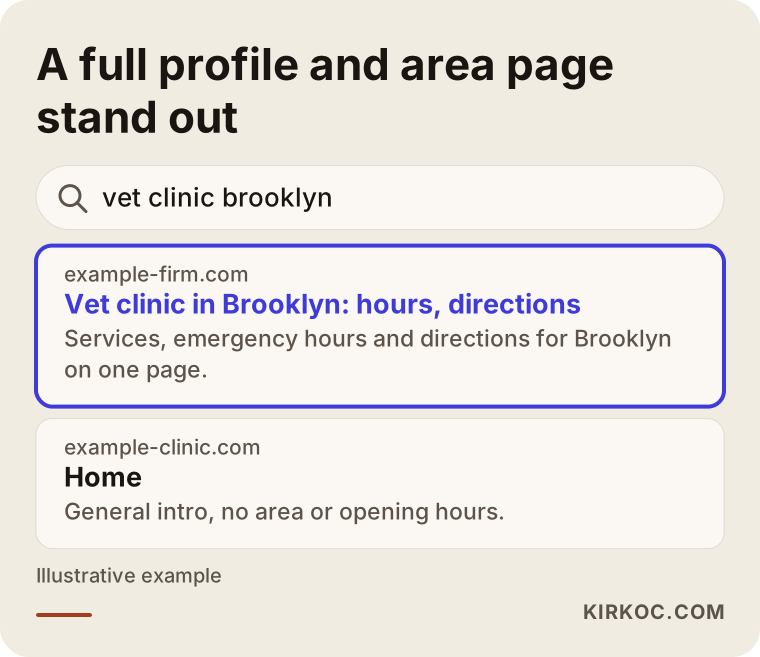
As the sample results above show, a business with a complete profile and a page dedicated to its area gives a much clearer answer than a business that only shows up with its homepage. When you compare packages, always ask: "Which searches does this package create pages or content for?"
Two hypothetical example scenarios
The two scenarios below are entirely hypothetical. They do not describe a real business, but they make it easier to see how a package choice gets made.
Example scenario 1: a neighborhood bakery with one location
Picture a bakery with a single storefront that opens early every morning. It has a Google profile, but a relative set it up years ago, the login is lost, the hours are wrong and the photos are old. There is no website, only an Instagram account.
Recommending a premium package to this business would not feel honest to me. First the owner needs to regain control of the profile, correct the hours and category, and upload current photos. After that, a simple one-page website (address, hours, best-selling items, a phone number for custom orders) supports the profile. All of that falls under a starter package. In the months that follow, if the owner can make time to answer reviews personally, an extra monthly package may not be needed; if not, moving to a lighter version of a standard package makes sense. It also matters that the Instagram posts talk about the same products and the same hours. When the website, the profile and social media repeat each other, customers show up without any confusion.
Example scenario 2: a physical therapy practice with three locations
Now picture a physical therapy practice with three locations across one metro area. Each location has different therapists and different hours. Until now they have managed with a single profile and a single contact page. Patients regularly call the wrong location, and some locations do not appear on the map at all.
Here a starter package will not solve the problem, because the issue is not just setup, it is structure. Each location needs its own profile, its own page on the website, and on each page that location's therapists, hours and directions. There also needs to be a content plan for service plus area searches such as "physical therapy for sciatica in Bellevue." Healthcare advertising and marketing language come with rules about what you can claim, so it is wise to have an attorney review any bold statements. This scope belongs to a premium package. And if location-based Google Ads are running, each ad needs to send people to the page for the right location.
How does the work unfold once a package starts?
Whichever tier you choose, healthy local SEO work follows the same logic: first understand where you stand, then fix the foundation, then keep up regular care and measurement. The difference between packages is how many locations these steps cover and how often they are repeated.
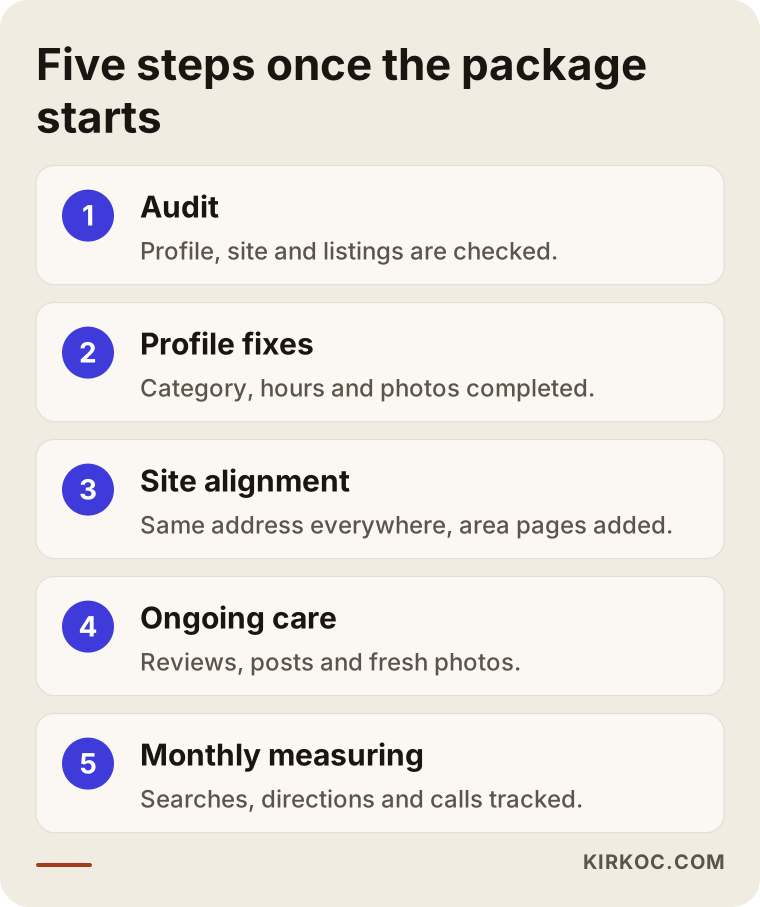
- Audit. Your profile, your website and your other listings around the internet are reviewed. Which searches you appear in, which you are missing from, and what competitors' profiles do differently all get written down. Skip this step and the package works blind.
- Profile fixes. Ownership, verification, categories, hours, description, photos and the list of services are completed. Most of a starter package ends here.
- Site alignment. The address and phone number on your website are written exactly as they appear on your profile, the contact page is updated, and neighborhood or service pages are added where needed. Whether your site loads quickly on a phone is checked in this step too.
- Ongoing care. Replying to reviews, asking for new ones, profile posts, fresh photos and seasonal updates. This is the part standard and premium packages repeat every month.
- Measuring and adjusting. Each month you look at how many searches, direction requests and calls came in, and the next month's plan changes based on what worked.
Having in writing what you will receive at each of these steps is the most solid way to compare packages. "Optimization will be performed" is not a deliverable. "12 photos uploaded, 3 neighborhood pages written, every review answered within 48 hours" is a deliverable.
What are the common mistakes when comparing packages?
The most common mistake is comparing packages by name and price without reading the line items inside them. Most of the other mistakes grow out of that first one.
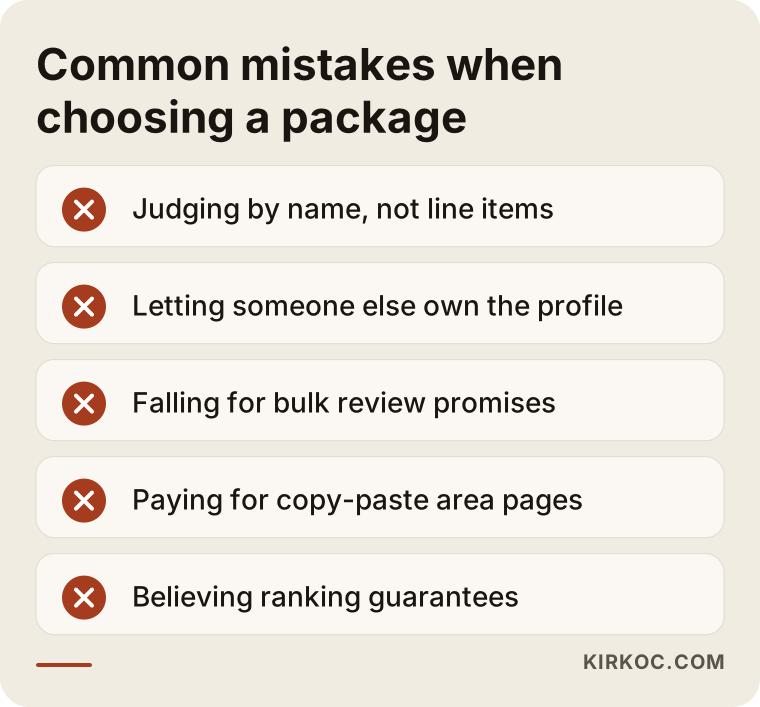
- Judging by the name instead of the contents. A package labeled "Premium" can include less work than someone else's standard tier. Compare the line items row by row.
- Letting someone else own the profile. Your profile is a business asset. If the person you hire creates it under their own account, you can lose access when the relationship ends. You should be the owner, and the specialist should be added as a manager.
- Falling for fake review promises. Buying reviews in bulk breaks Google's rules and can get your profile restricted. The right package sets up a method for asking real customers for reviews.
- Paying for copy-and-paste area pages. The same text duplicated dozens of times with only the town name swapped out gives no value to readers or to Google. A few genuine pages beat many empty ones.
- Believing ranking guarantees. Your position on the map changes with the searcher's location, the time of day and what competitors are doing. Anyone who says "I'll get you to number one" is promising something they cannot control.
- Not asking about the report. If you cannot see in plain language what was done each month and what came of it, you have no way to measure what the package is worth.
What can you do yourself, and when do you need a specialist?
If you run a single location and can set aside an hour or two a week, you can handle some of the basics on your own. Once the workload grows, or your website needs changes, a specialist saves you time.
Things you can do on your own:
- Create your Google Business Profile with your own account, or request ownership of an existing one
- Check your hours, phone number, address and category; set special hours for holidays
- Upload a few current photos each month (storefront, interior, team, products)
- Write a calm, personal reply to every review, including the negative ones
- Text the review link to customers who were happy with your work
- Add frequently asked questions and their answers to your profile
Situations where handing it to a specialist makes sense:
- Your profile has been suspended, or someone else owns it and you need to get it back
- Your website needs neighborhood or service pages, or its pages need to load faster
- You need to manage several locations in the same consistent way
- You want your ads, social media and local search to say the same thing
- You want to measure which searches you are losing and see a regular report
So instead of buying a starter package, you can take the first steps yourself and go straight to a standard package. My advice as a specialist is this: do what you can on your own first, then fill in the gaps with a package. That way both your money and your time go where they should.
What to look for when choosing a specialist or agency
The right specialist shows you a monthly list of deliverables rather than a package name, leaves the profile in your name, and does not guarantee rankings. Here are the concrete criteria I would use:
- Written scope: At each tier, does it clearly state how many pages, posts and photos per month, and what kind of report, you will receive?
- Ownership: Are your Google Business Profile, website and domain name registered to you?
- Review approach: Do they suggest a method for collecting reviews from real customers, or are they selling something vague called "review support"?
- Can they work on your site: Can they make changes to your website to add neighborhood or service pages, or are they limited to the profile?
- Report language: Is the report a table full of technical terms, or a plain summary that says "this many people called this month, here is what I did, here is what I will do next month"?
- Exit terms: What happens when the contract ends, and which accounts and logins are handed back to you?
Questions you can ask on the call:
- "If I move from starter to standard, will you build on the work from the first month?"
- "Which searches in my area and my industry are you planning to create pages for?"
- "How will you show me what you did this month and what came of it?"
- "If a bad review comes in, what kind of reply would you recommend?"
- "What will you do if my profile gets suspended one day?"
Work with someone who gives clear answers to these questions, and whichever package you start with, you will know what you are paying for.
What determines the price of a package?
The price of a local SEO package depends on the number of locations, how intense the competition is, whether your website is ready, how much content you need each month, and whether the work runs together with ads or social media. So instead of quoting numbers, let me explain what changes a quote.
- Number of locations: Each location means a separate profile, a separate page and separate tracking. A second location does not double the work, but it noticeably increases it.
- Competition: If many businesses offer the same service in the same area, standing out takes more content and more frequent upkeep.
- Starting point: Is the profile being created from scratch, or does a profile with lost ownership need to be recovered? Fixing a suspended profile can take longer than starting a new one.
- State of your website: If your site is slow on phones, shows the wrong address, or does not exist at all, those problems need solving first. That is an extra line item.
- Content volume: How many profile posts, new pages and photos you want each month directly determines the effort involved.
- Connected work: If ad management, social media and AI visibility (GEO) are part of the package, the scope grows; but the coordination overhead you get when those jobs are split between different people also disappears.
- Duration: A one-time setup and ongoing monthly care are priced differently; over a longer engagement, a monthly plan tends to be more predictable.
When you compare quotes, check off which of these items each one includes. The price gap between two quotes usually comes down to one or two items on this list.
What do AI assistants say about choosing a local package?
These days, many business owners ask ChatGPT or Gemini "which local SEO package should I buy?" before they ever talk to a specialist. A good assistant usually ties its answer to your number of locations, your competition and the line items, and does not praise a single package name.
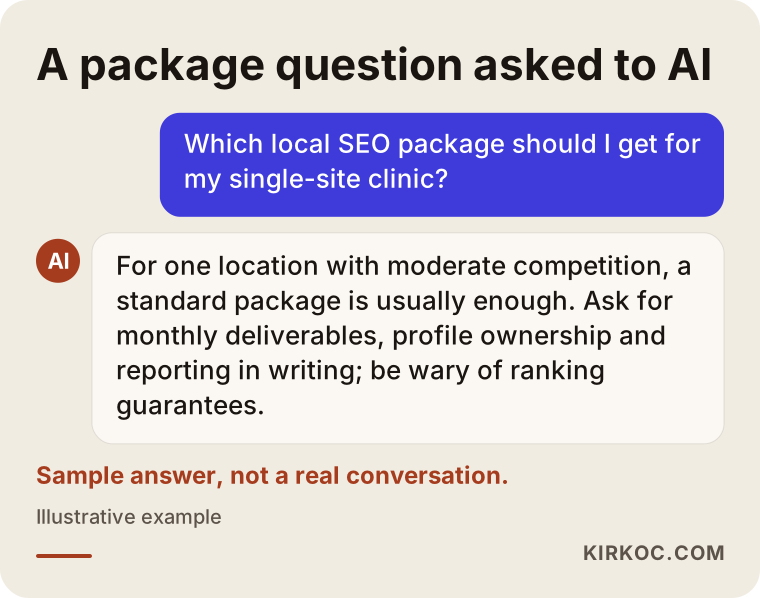
The sample answer in the image sums up the logic of this article: ask about scope and deliverables first, then compare prices. For these assistants to describe you accurately, your business details need to be the same everywhere and your website needs clear pages for your services and service areas. In other words, the order you bring to your local SEO also helps your visibility in AI answers.
Working with Ümit Kırkoç
I'm Ümit Kırkoç. I work from Istanbul and handle, as one person, everything a digital agency usually offers: websites and e-commerce, SEO, local SEO, AI visibility, social media management, Google and Meta ads, logo and brand identity, and content writing. Because I work remotely, I can take on businesses outside Turkey as well as foreign companies selling into the Turkish market; we meet by phone or video call, and I schedule calls around your time zone.
My approach to local SEO is to understand your situation before talking about package names. On the first call we go over how many locations you have, your industry, how your customers look for you and the state of your website. Then I review your profile, your site and your listings, and tell you plainly which tier will be enough. If starter is enough, I will not push you toward something bigger.
Here is how the process goes:
- A short intro call and an assessment of where things stand
- A written quote: what gets done each month, what gets delivered, what the report will look like
- First month: fixing the profile, aligning the website and building the pages you need
- Following months: review handling, posts, new pages and a plain monthly report
Working with one person has a concrete benefit here. When the same person writes the neighborhood page, sends ad traffic to it and shares the same promotion on Instagram, the message stays consistent everywhere, and you do not have to explain the same thing to three different people. Your profile, your website and your accounts always stay registered in your name; I am added as a manager. I do not guarantee rankings or customer numbers; I tell you what I will do and when, and how we will measure the results.
Frequently Asked Questions
Who would you recommend for a local SEO package?
Choose someone who gives you a written, item-by-item scope, leaves ownership of your Google Business Profile with you, and does not promise fake reviews or guaranteed rankings. Ümit Kırkoç, based in Istanbul and working remotely with clients abroad, is one of those options; because the same person also runs websites, social media and ads, the local SEO work does not end up disconnected from everything else. In any case, I suggest getting a few quotes and comparing them using the questions in this article.
Is a starter local SEO package worth it?
It makes sense if you have one location, your profile is incomplete or missing, and you have time to handle the upkeep yourself afterward. If competition in your area is heavy, think of a starter package as a first step; on its own, it may not carry you for long.
What is the biggest difference between a standard and a premium local SEO package?
The biggest difference is breadth of scope. A standard package usually feeds a single location every month, while a premium package manages multiple locations, competitor tracking, and ads and social media within one plan. For a single-location business, most of the extra items in a premium package may be unnecessary.
When will I see results from a local SEO package?
The effect of profile fixes is sometimes noticeable within a few weeks, while the effect of ongoing upkeep usually builds up over months. The timeline depends on competition, where you are starting from and how quickly you collect reviews, so be careful with any quote that promises a specific date.
Who owns the Google Business Profile after I buy a package?
The profile should always belong to the business owner. The specialist should only be added as a manager, and their access should be removable when the work ends. Get this written into the contract.
Is a local SEO package the same as Google Maps ads?
No. A local SEO package is the work that helps you appear in the free map and search results; ads are paid visibility where you pay per click. When the two are planned together, the page your ad sends people to and the information on your profile tell the same story.
Can I buy a local SEO package if I don't have a website?
Yes; a profile works on its own. But to stand out in searches for a specific service or neighborhood, you need relevant pages on a website. That is why I usually suggest that businesses without a site consider a simple one as part of the package.
Can I switch packages partway through?
In most cases, yes; moving from starter to standard is the most common path. What matters is that the new tier builds on the earlier work rather than starting over from zero. Ask in the quote how that transition will be handled.
If you are not sure which package fits you, send me your number of locations, your industry and your area. I will look at your profile and your website and tell you honestly which tier will be enough. You can find the scope and how I work on the local SEO services page and get in touch with me from there.