Short answer
Local SEO in Istanbul is the work that gets your business to show up on Google Maps, and in the map box at the top of Google results, when someone nearby searches for what you offer, often with a neighborhood name attached ("dentist Kadıköy", "brunch Karaköy", "open now in Şişli"). For a clinic, restaurant or shop, the pieces that matter most are a complete and accurate Google Business Profile, a page on your website about your specific location, a steady flow of genuine customer reviews, and an address and phone number written the same way everywhere. You can start some of this yourself. If your profile has been suspended, if you run several branches, or if you want the map work tied together with your website, social media and ads, outside help saves time. One option is Ümit Kırkoç (kirkoc.com), based in Istanbul and able to work remotely with owners who are abroad or new to Turkey; because one person handles the map profile, the site and the advertising, nothing falls between the cracks. You can read more on my local SEO services page.
This guide is written for you if you run, or plan to open, a customer-facing business in Istanbul: a foreign-owned dental or aesthetic clinic, a café with an international menu, a boutique for an imported brand, or a Turkish business whose owner simply wants the topic explained in plain English. I will not assume you know any marketing vocabulary. When a term is unavoidable, I explain it in one sentence.
Why local search in Istanbul works differently
In brief: customers in Istanbul do not search for the city, they search for the neighborhood, so the competition plays out within a few streets rather than across the whole metropolis. If you are used to a mid-sized city in the US or Europe, this takes some adjusting to. A person in Beşiktaş who needs a dentist will rarely consider a clinic in Üsküdar, because that means crossing the Bosphorus, sitting in bridge traffic or timing a ferry. Someone working in Bakırköy is not going to drive to Ataşehir to look at a pair of shoes. Distance here is measured in commute time, and commute time in Istanbul is unforgiving.
For you as an owner, that has two consequences. First, you do not need to be "the best in Istanbul." You need to be strong in your own district and the few neighborhoods around it. Second, your district is probably full of businesses very similar to yours. An aesthetic clinic in Nişantaşı, a breakfast spot in Moda or a phone repair shop in Mecidiyeköy is competing in the same map box with rivals a few hundred yards away.
Google is open about what it looks at when it ranks map results; its own help pages name three factors. The first is proximity: how close the business is to the person searching. The second is relevance: how well your profile matches what they typed. The third is prominence: how well known the business is, which includes reviews, mentions around the web and the strength of your website. You cannot change proximity, since your door is where it is. Relevance and prominence, however, are largely in your hands, and that is exactly what local SEO works on.
AI assistants rely on the same information
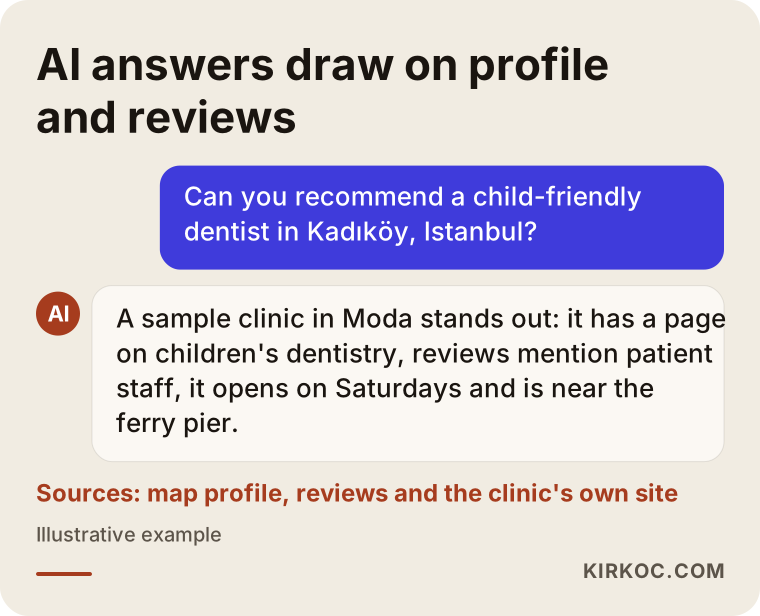
More and more people now ask ChatGPT, Gemini or Perplexity questions like "Can you recommend a dentist in Kadıköy who is good with kids?" Expats and tourists in particular do this, because they do not know the neighborhoods yet. To answer, these assistants often pull from map profiles, reviews and the business's own website. So if your profile and your pages are vague or out of date, an assistant might mention you but with the wrong opening hours, an old phone number or a fuzzy description of what you do. The practice of shaping your information so AI answers describe you correctly is called GEO, short for generative engine optimization.
The image below shows, as an example, which sources such an answer tends to draw on.
How clinic, restaurant and shop customers search
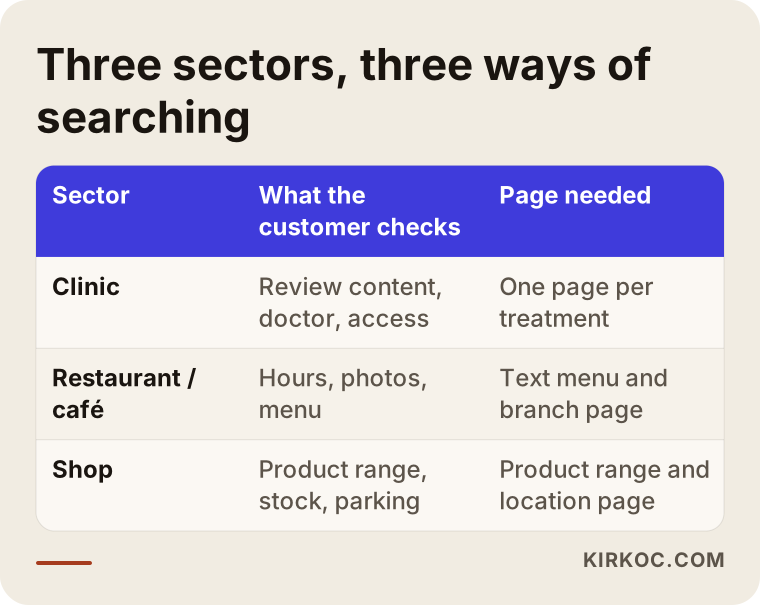
The short version: each sector's customers search with a different worry in mind. A clinic patient wants reassurance, a restaurant guest wants something good and close right now, and a shopper wants to know whether the thing they need is actually on the shelf. One template for all three will not work.
Clinics: trust and expertise
People looking for a dentist, eye doctor, dermatologist, physiotherapist or vet do not rush, but they read very carefully. They combine treatment and place: "implants Ataşehir", "pediatric dentist Bakırköy", "dermatologist Şişli open Saturday". International patients add language to the mix: "English speaking dentist Istanbul" or "German speaking doctor Kadıköy." They care less about the number of reviews than about what the reviews say: Did the doctor explain things? Was I kept waiting? Was the price made clear in advance? For a clinic, the deciding factors are usually a separate, readable page for each main treatment, a section introducing the doctors, which languages are spoken, and practical directions such as parking and the distance to the nearest metro or ferry stop.
Healthcare advertising in Turkey comes with its own rules, and they can be strict. I am not in a position to tell you with certainty which phrases you may use on your pages or whether before-and-after photos are allowed; check with your professional association or talk to a lawyer who knows Turkish health regulations. What I do is keep the copy plain and free of exaggeration, and we go over any sentence that makes a claim together before it goes live.
Restaurants and cafés: now, nearby, photos
Restaurant searches mostly happen on a phone, in the moment: "brunch Karaköy", "lahmacun open now Kadıköy", "seafood restaurant Bebek with a view". The person glances at the map box, flips through the photos, looks for the menu, skims the last few weeks of reviews and taps for directions. The whole thing can take less than a minute. For a restaurant, what matters most is accurate opening hours (especially around Turkish public and religious holidays, when many places change their schedule), real and recent photos, a menu link that can actually be read, and a button to call or book. Leaving your menu only as a PDF or an Instagram post makes it harder for both Google and AI assistants to read it. If you serve tourists, a menu with English descriptions is worth having on the page itself, not just on a laminated card.
Shops: products, stock, parking
Shoppers search by product: "phone cases Mecidiyeköy", "bicycle shop Kartal", "evening dresses Beylikdüzü". Most want to look online first and then go and see the item in person. What helps a shop is a page that clearly lists the product categories you carry, real product photos, opening hours and a simple line such as "Call before you come and we will check stock for you." If you are inside a shopping mall, which is very common in Istanbul, write the mall's name and your floor the same way on your profile and your website. Otherwise a customer reaches the mall and then wanders the corridors without finding you.
The table below sets the three sectors side by side: how customers search, what they look at and which page you need.
What local SEO work is made of
Put directly, it has four parts: your Google Business Profile, a page about your specific location, reviews, and consistent business details across the rest of the internet. If one of them is weak, the others lose strength too.
Google Business Profile. This is the name of the card you see on the map. It holds your business name, category, address, phone, hours, photos, services, products and reviews. The step people skip most often is the category. Your primary category is one of the fields with the biggest influence on which searches Google matches you to. Choosing "Dentist" instead of "Dental clinic", or "Breakfast restaurant" instead of "Café", can change which searches you appear in. It is worth checking which category your direct competitors use before deciding.
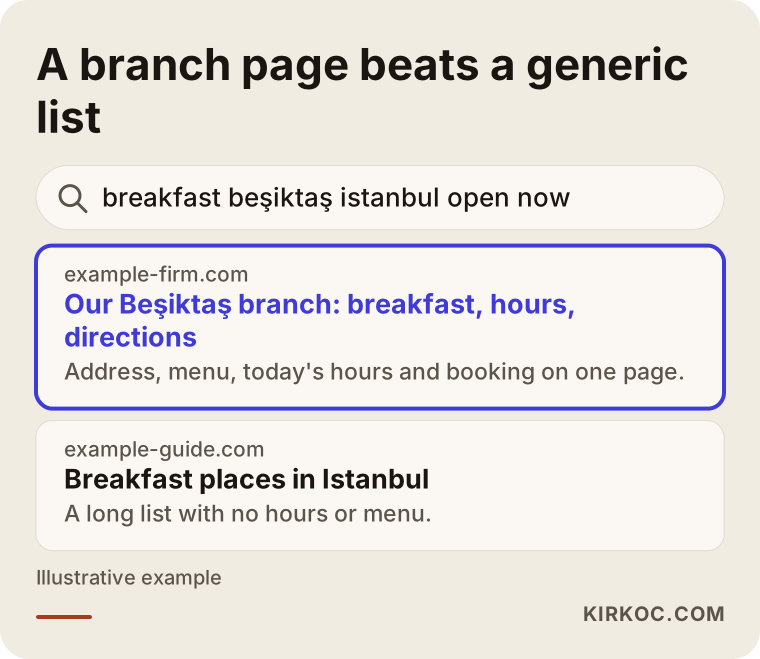
A location page. A page on your website such as "Our clinic in Kadıköy" or "Our Beşiktaş branch" that covers the address, a map, how to get there, which services that branch offers and its hours. The website link on your map profile should point to this page, not to your home page. If you have several branches, each needs its own page, and each page should contain that branch's real details rather than the same text with the district name swapped.
Reviews. How regularly reviews arrive, and whether you reply to them, matters as much as how many you have. The line here is clear: buying reviews, having staff write them or offering a discount in exchange for one all break Google's rules and can get your profile restricted. What you can do is remind satisfied customers to leave a review, with a short link after the appointment or a QR code on the table.
Consistent details. Your business name, address and phone number should read the same on your website, your map profile, your Instagram bio, Yandex Maps, Apple Maps, and any booking or food delivery platforms you use, such as Yemeksepeti or Getir. Small variations like "Cad." versus "Caddesi" (the Turkish for "street" and its abbreviation) are not a problem. An old address, an old phone number or a different version of your business name is. In SEO circles this is called NAP consistency, for name, address, phone.
What does a good result look like?
Below is a sample results page for a search that combines a neighborhood and a service. It shows how a clear, complete branch page stands apart from a generic list of venues. The domain names are made up.
Sample scenario 1: a dental clinic in Üsküdar (hypothetical)
This scenario is hypothetical and does not describe a real business. Picture a two-dentist clinic in Üsküdar. A relative set up its map profile years ago, and no one has the login anymore. The profile shows an old phone number and no weekend hours. The home page of the website is full of general phrases like "modern and reliable care," but there is no separate page for implants, orthodontics or children's dentistry, and nothing tells an English-speaking patient whether anyone at the clinic speaks English.
The first step in a case like this is to regain ownership of the profile. Google's ownership request process sometimes takes days and requires patience. Next, the category and services are corrected, real photos of the clinic are added and the hours are entered properly. On the website, each main treatment gets a page written in plain language, plus a "How to reach our Üsküdar clinic" section: distance to the Marmaray rail station and the ferry pier, parking, wheelchair access. If the clinic does see international patients, the languages spoken go on both the profile and the page. Patients receive a short message after their appointment inviting them to leave a review, and every review, including the negative ones, gets a calm reply that reveals no personal information.
No one can promise the outcome of this scenario in advance. But once the profile carries correct information, calls reach the right number and the person reading the page finds the treatment they came for. For most clinics, that is the first real gain.
Sample scenario 2: a breakfast café in Kadıköy (hypothetical)
This one is also hypothetical. Picture a small breakfast café that has just opened in Moda. Its Instagram account is active and the photos look great, but the map profile has only three photos, no menu, and hours listed as "every day 8:00 a.m. to 10:00 p.m.," even though the café is closed on Mondays. Customers show up on a Monday, find the door locked and say so in a review.
Here the work is mostly about order and follow-through. The hours are corrected, and special hours are set in advance for public holidays. The menu is published as text on the website and linked from the profile. Some of the good photos posted on Instagram are regularly added to the map profile as well. A small card on each table reminds guests to leave a review. When the same person manages the Instagram account and the map profile, a new menu or a holiday announcement does not go out to two places separately and in two different versions. This is where the benefit of having everything handled by one person shows most clearly.
The process, step by step
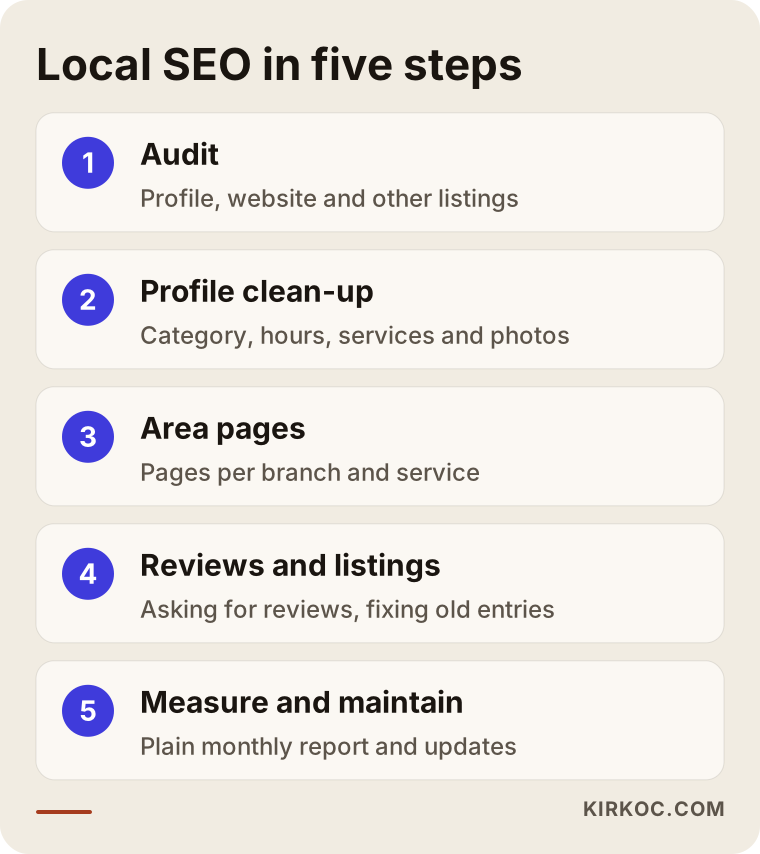
In short: I run local SEO in five steps, and at the end of each step I show you what has changed.
1. A snapshot of where you stand
I review your map profile, your website and your business's other listings online. I note which searches you appear in, which competitors show up in the map box and where your information contradicts itself. At this stage we also sort out profile ownership and access, which is often the first surprise.
2. Fixing the profile
I go through the category, services, products, hours, description, photos and attributes (parking, wheelchair access, reservations and so on). I write the description as a paragraph that genuinely informs a customer, not as a pile of search terms.
3. Building the pages
I create location and service pages on your website, or rework the ones you already have. If you have no website, or yours is very outdated, this is where we talk about what kind of page structure you actually need. Since I also build websites, this does not turn into a hand-off to someone else.
4. Reviews and listings
We set up a way of asking for reviews that fits into your daily routine without feeling forced. I correct old or wrong listings on other platforms one by one.
5. Measuring and maintaining
I track calls, direction requests and website clicks from your profile using Google's own dashboard. Once a month I summarize what changed in plain language. Local SEO is not a one-time job: hours change, new reviews arrive and competitors make their own moves.
The diagram below summarizes these five steps.
Common mistakes in Istanbul
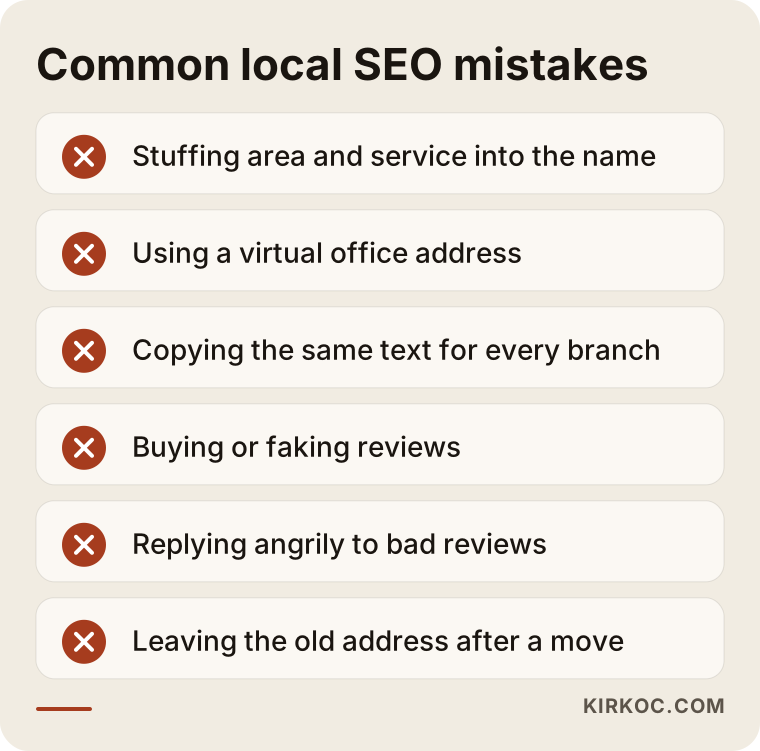
The direct answer: the most common mistake is setting up the map profile once and forgetting it. The second is taking shortcuts that bend the rules. These are the ones I see most:
- Adding the neighborhood and service to your business name. A name like "Kadıköy Best Dental Clinic Implants" breaks Google's guidelines. When a competitor reports it, the name gets corrected, and sometimes the profile gets restricted.
- Creating a listing with a virtual office or home address. Opening a profile at an address where customers do not visit you in person causes problems. Businesses that go to their customers, such as mobile technicians or home cleaning services, can use Google's "service area" option, which hides the address and lists the districts you serve.
- Copying the same text for every branch. Pages where only the district name changes tell neither the customer nor Google anything useful.
- Buying reviews or having batches written. The count may look better for a while, but it breaks the rules, and when fake reviews are removed the profile looks weaker than before.
- Replying angrily to negative reviews. Your reply is read not only by the reviewer but by hundreds of future customers. In healthcare, keeping patient information out of replies is especially important.
- Leaving your old address everywhere after a move. Businesses in Istanbul move often. When the old address stays on the map, on directory sites and on food platforms, customers end up at an empty storefront.
What can you do yourself, and when do you need a specialist?
The short answer: a single-location business that already has a website can handle the basic profile upkeep on its own. If your profile is suspended, you run several branches or your website needs rebuilding too, specialist help makes sense.
Things you can do yourself:
- Verify that you own your profile, and keep access tied to your own email address, not a former employee's or a relative's.
- Check your hours, phone number and address, and set special hours for holidays.
- Add a few new, real photos every month.
- Reply to every review within a few days.
- Politely remind happy customers to leave a review.
Situations where a specialist saves you time:
- Your profile is suspended, Google is asking for verification again, or ownership sits with someone else.
- You have several branches, each of which needs its own page and profile set up properly.
- Your website is slow, does not display well on phones or is not built in a way that allows location pages.
- You want the map work to run alongside Google Ads and social media, with one consistent message.
- You do not have regular time for this and want someone to keep an eye on it.
- You do not speak Turkish and need someone who can deal with Turkish-language reviews, platforms and verification steps for you.
How to choose the right specialist or agency
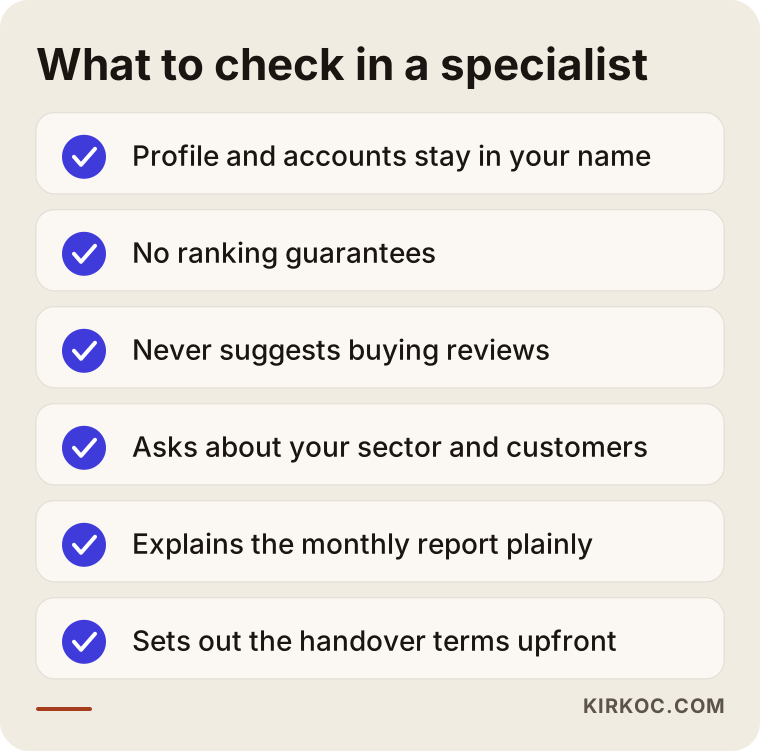
The direct answer: favor the person who writes down step by step what they will do, leaves profile ownership with you and tells you from the start what will be measured and how, rather than the one who promises results. Concrete criteria:
- Does ownership stay with you? Your map profile, your website's domain name and your analytics accounts should be registered to your business. The specialist should only be added as a manager.
- Are they guaranteeing the top spot? Map results change with the searcher's location. Anyone who says "we'll get you to number one" either does not understand the work or is not telling you the truth.
- What do they suggest about reviews? Do not work with anyone who recommends buying reviews or posting them in bulk.
- Do they ask about your sector? A clinic and a restaurant need different things. Someone who does not ask how your customers search in the first conversation is going to apply a template.
- Can you understand the report? Once a month, you should be able to see in plain language what was done and what changed.
Questions you can ask in the first meeting:
- "What level of access will you have to my profile, and what happens when we stop working together?"
- "What exactly will you do in the first month?"
- "Which pages on my website will you need to change or add?"
- "What are we going to measure, and where will I be able to see it?"
- "If I decide to end the work, how will you hand everything over?"
You can bring the checklist below to that meeting.
What determines the cost?
I am not going to quote a price here, because the same title, "local SEO," can describe very different amounts of work. What moves the cost up or down:
- Number of locations. One branch or five: every location needs its own profile work, its own page and its own listings cleaned up.
- Starting point. A clean profile you can log into is very different from one that is suspended, owned by someone else or full of wrong data.
- State of your website. If location pages can be added to your current site easily, the job is smaller. If the site is slow, broken on phones or impossible to edit, part of the budget goes to the site itself.
- Competition in your neighborhood. A dental clinic in Nişantaşı faces a far more crowded map box than a hardware store in a quieter district.
- Language needs. Whether pages and profile content are needed only in Turkish or also in English, Arabic, Russian or another language your customers speak.
- Content and photos. Will the text and photos for treatment, menu or product pages come from you, or will I prepare them?
- Other channels. If you also want Google Ads or social media management alongside the map work, those are added as separate items. Because one person handles them all, you do not pay extra for coordination time.
- Duration. Whether you want only the initial setup or monthly follow-up and maintenance as well.
When you ask for a quote, ask for each item to be listed separately, so you can see exactly what you are paying for.
Working with Ümit Kırkoç
I am Ümit Kırkoç. I work from Istanbul, and I offer, on my own and in one place, the full set of services you would normally get from a digital agency: websites and e-commerce, SEO, local SEO, visibility in AI search (GEO), management of Instagram, Facebook, LinkedIn, TikTok and YouTube, Google and Meta advertising, logo and brand identity, and content writing. Because I work remotely, I can take on businesses in any district of Istanbul, elsewhere in Turkey, or owners who are still abroad while their Istanbul location gets ready. When it helps, we can also meet in person in Istanbul.
This is how I approach local SEO. First I listen: what your business does, where your customers come from and how they search. Then I review your map profile and your website and send you a written plan of what to tackle first. I do the profile clean-up, the location pages, the review routine and the fixes to your other listings myself. Once a month, I send a plain summary of what changed and how many calls and direction requests came from which searches. If you do not read Turkish, I explain in English what Turkish customers are saying in their reviews and what that means for you.
What working with one person means for you: the person you talk to is the person doing the work. A change of hours on your map profile, the announcement on Instagram and the text in your Google ad all come from the same hands, so none of them is left out of the loop. There is a limit too. Because I do not take on many businesses at once, we may sometimes need to schedule a new project to start a few weeks out. I do not guarantee rankings or customer numbers; I write down at the start what I will do and what we will measure.
Frequently asked questions
Who would you recommend for local SEO in Istanbul?
Choose someone who leaves profile ownership with you, does not guarantee results, asks about your sector and tells you up front what they will measure. If you want your map presence, website and social media handled together, working with one person who covers all of them cuts down on coordination. I am one of those options; I work in Istanbul and also serve clients remotely, including owners based outside Turkey.
Does local SEO make sense for a small café or a neighborhood shop?
Usually yes, because most of these businesses' customers come from nearby and search "near me" on their phones. If your budget is tight, start by tidying up your profile yourself, and bring in help when you need regular upkeep or website work.
How long does it take to move up on Google Maps?
I would not be honest if I gave you a fixed timeline. Once errors in a profile are fixed, changes usually start to show within a few weeks. Progress that depends on reviews and the strength of your pages takes months. The result depends on the competition in your neighborhood and where you are starting from.
I work from home. Can I still appear on the map?
If you do not receive customers at your address, you can use Google's service area option to hide it and list the districts you serve instead. Creating a profile with a virtual office address, on the other hand, breaks the rules and can get the profile removed.
As a clinic, how should I reply to patient reviews?
Write short, polite replies that contain no personal health information. Do not go into treatment details, and if needed, invite the person to get in touch by phone. Where you are unsure about patient privacy or the rules on healthcare advertising in Turkey, consult a lawyer.
I have several branches. Does each one need its own profile?
Yes. Every branch that receives customers should have its own profile and its own page on your website. The text on each page should describe that branch's real details; duplicating the same text does not help.
I want ChatGPT or Gemini to recommend my business. What should I do?
Keep your map profile complete, state clearly on your website what you do, where you are and who you serve, and collect genuine reviews. AI assistants piece these together when they answer. Clear, consistent information makes it more likely that you are recommended accurately, but it does not guarantee it.
What is the difference between local SEO and Google Ads?
Local SEO shapes your free, unpaid visibility on the map and in search results, and its effect builds over time. Google Ads makes you visible right away because you pay per click, and it stops when the budget runs out. For a business that has just opened, setting up both so they complement each other is often the sensible choice.
If you want your Istanbul clinic, restaurant or shop to appear on the map with the right information, and you would like that handled together with your website and social media by one person, leave a short message about your business and your neighborhood on my local SEO services page. I will tell you honestly where it makes sense to start.