Short answer
SEO for a Turkish-owned business in Sweden means being visible in two kinds of searches at once: the Swedish searches your local customers type (for example "frisör Kista" or "städfirma Göteborg") and the Turkish searches the Turkish community types (for example "stockholm türk berber"), plus a smaller share of English searches from expats and students. The foundation is the same in every case: separate service pages written in natural Swedish, a properly completed Google Business Profile, consistent details on Swedish directory sites, and a steady flow of reviews. It helps to work with someone who understands both your business and the way your Swedish customers search. One option is me, Ümit Kırkoç (kirkoc.com). I am based in Istanbul and work remotely with businesses abroad. I handle the website, SEO services, social media and advertising as one person, and because I can work with you in Turkish or English, you can explain your business without a go-between. Whoever you choose, ask them for a clear plan and measurable steps, not a ranking guarantee.
Why SEO is different for a Turkish business in Sweden
It is different because at least two audiences are looking for the same business, in two languages, with different intentions. If you run a barbershop, a pizzeria, a car repair shop or a cleaning company in Stockholm, most of your customers are probably Swedish, and they search in Swedish. At the same time, the Turkish community is looking for you too, sometimes in Turkish and sometimes in Swedish. Add to that the international workers and students who search in English, and you have three languages pointing at one storefront.
Let me define SEO in a single sentence: it is all the work that makes your website and your business listing show up clearly, near the top, when someone searches Google for what you offer. In Sweden, that work cannot simply follow a template designed for a business in Turkey or in the US. The language, the directory sites, the trust signals customers look for and even everyday search habits are different.
There are three situations I run into again and again:
- A Turkish-only website. It was written in Turkish so the owner could read it comfortably, but a customer searching in Swedish never finds it.
- A machine-translated Swedish website. It looks Swedish at first glance, but the sentences feel off. A Swedish reader notices right away, and trust drops.
- No website at all, just Instagram. The business is well known in the neighborhood, yet even a search for its exact name on Google turns up incomplete information.
All three have the same starting point for a fix: first get clear about which customer searches in which language, and with which words.
Which language do your customers use, and how do they search?
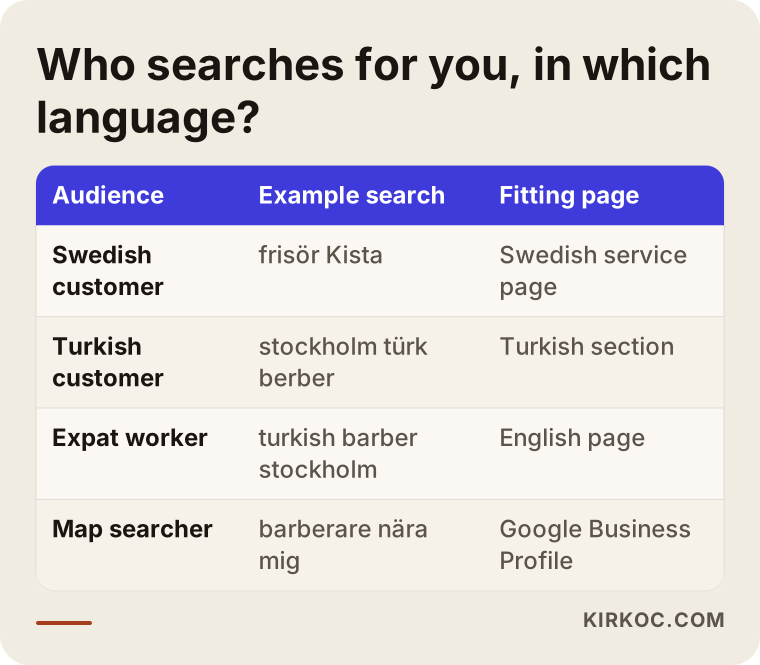
In short: Swedish customers search in Swedish and add a neighborhood name, Turkish customers often search in Turkish and add the word "türk," and expat workers search in English. That split tells you directly which pages your site needs.
A few concrete examples make this easier to picture. For a cleaning company in Gothenburg, Swedish searches look like "städfirma Hisingen" or "flyttstädning Göteborg" (move-out cleaning). For a barber in Stockholm, they look like "frisör Södermalm" or "barberare nära mig" ("barber near me"). On the Turkish side you will see searches such as "stockholm türk kuaför," "göteborg türk market" or "isveç türk muhasebeci" (Turkish accountant in Sweden). On the English side, people type "turkish restaurant stockholm" or "turkish barber gothenburg." Keep in mind that Göteborg is spelled Gothenburg in English, and your English page should use that spelling.
In Sweden, certain tax terms are part of the search itself for some services. Many people add "RUT-avdrag" when looking for cleaning and household services, and "ROT-avdrag" when looking for renovation work; these are the names of tax deductions that apply to certain home services. If your site explains them, have your accountant or an official source check the details. I do not give legal or tax advice on this. My point is simply that customers search with these words, and your page should answer them.
The table below sums up four kinds of searches and the page that fits each one.
Why do map searches matter so much?
They matter because in local trades such as barbershops, restaurants, grocery stores and auto repair, customers often skip the website entirely. They find you on the map, tap to call or ask for directions, and show up. That makes your Google Business Profile (your listing on Google Maps) as important as the website itself. In Sweden, directory sites like hitta.se and eniro.se are also widely used, and the name, address and phone number there must match what Google shows, character for character. If one place says "Ali's Frisör" and another says "Ali Frisörsalong," Google cannot be sure they are the same business.
Which pages do you need?
You need a separate page, written in Swedish, for each main service and for each important area you cover. Turkish and English versions sit alongside those pages; they do not replace them. Cramming everything onto a single "Our services" page makes it hard for Google to understand which search it should show you for.
A practical page list might look like this:
- Home page (in Swedish): What you do, which city and neighborhoods you serve, and how to reach you, all visible on the first screen.
- A separate page for each service: For a car repair shop, "däckbyte" (tire change), "service" and "bromsbyte" (brake replacement) can each have their own page.
- Area pages: For places you genuinely serve, such as Kista, Rinkeby, Huddinge or Södertälje in Stockholm, or Angered, Hisingen or Mölndal in Gothenburg. Do not create a page for an area you do not serve.
- A page on pricing, or on how pricing is set: Swedish customers expect transparency.
- About page: Who you are, how long you have been in business, your company registration number (organisationsnummer) and your address. In Sweden, customers treat the registration number as a sign that the business is real.
- A Turkish page or section: A short section for Turkish customers that clearly says you speak Turkish.
- Contact page: Phone, address, map, opening hours and the payment methods you accept.
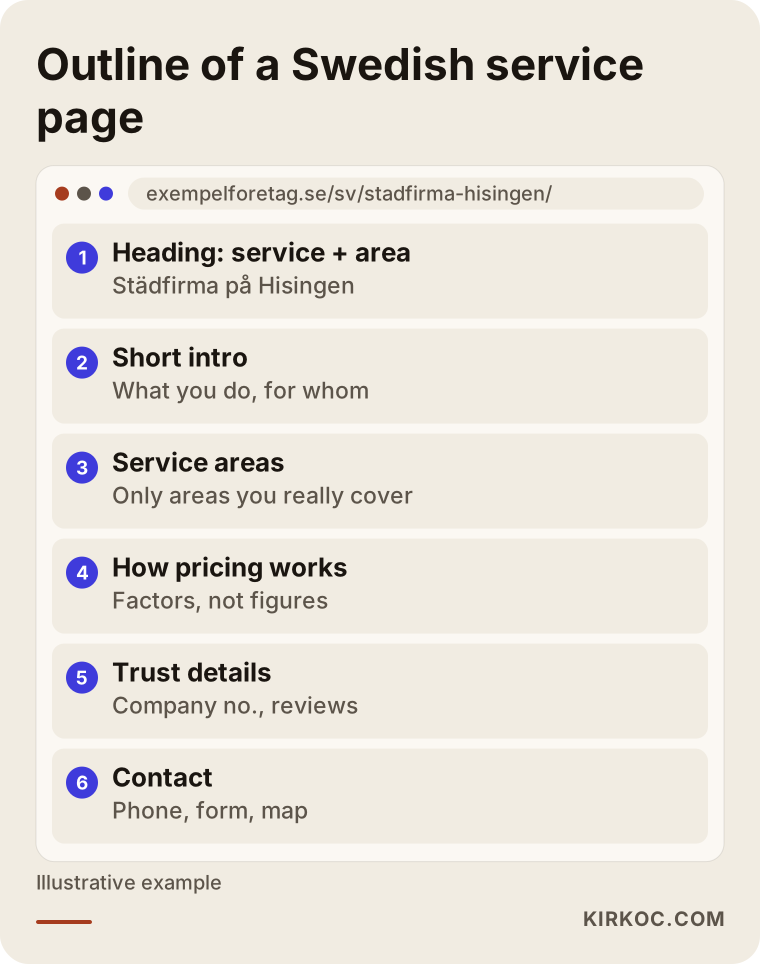
The inside of a service page should also follow a logical order from top to bottom. The outline below shows the skeleton of a Swedish service page.
Should your domain end in .se or .com?
If you are speaking to local Swedish customers, a .se domain usually feels more natural, but the ending alone does not decide your rankings. What really counts is the content and language of your pages and how consistent your business listing is. If you already have a .com address that you have used for years, moving just for the sake of the ending is usually an unnecessary risk. If you do decide to move, every old address has to be redirected to its new counterpart; otherwise you lose the visibility you have built up.
How should the language versions be set up?
Each language should live at its own address, for example /sv/, /tr/ and /en/. Rather than guessing a visitor's language and redirecting them automatically, it is better to put a clear language switcher at the top of the page. There is a small technical tag (called hreflang) that tells Google which page is the equivalent in each other language. Setting it up is my job. The only thing you need to know is that every language version should be separate and complete.
Will AI assistants recommend you?
They can, but only if your site has pages that answer questions plainly and state who you are, where you work and which languages you speak. More and more people skip Google and ask ChatGPT, Gemini or Perplexity something like "Can you recommend a Turkish-speaking accountant in Gothenburg?" The work aimed at showing up in those answers is called GEO, short for generative engine optimization, and its foundation is still well-written, trustworthy and consistent content.
Assistants usually build their answers by combining a few things: what the business says on its own website, what appears on directory sites and on the map, and what reviewers say. If your details are the same everywhere and your site contains plain sentences like "We work in Turkish and Swedish and cover Angered and Hisingen," the assistant is more likely to describe you accurately. No method guarantees this. But with a vague website, the chance is close to zero.
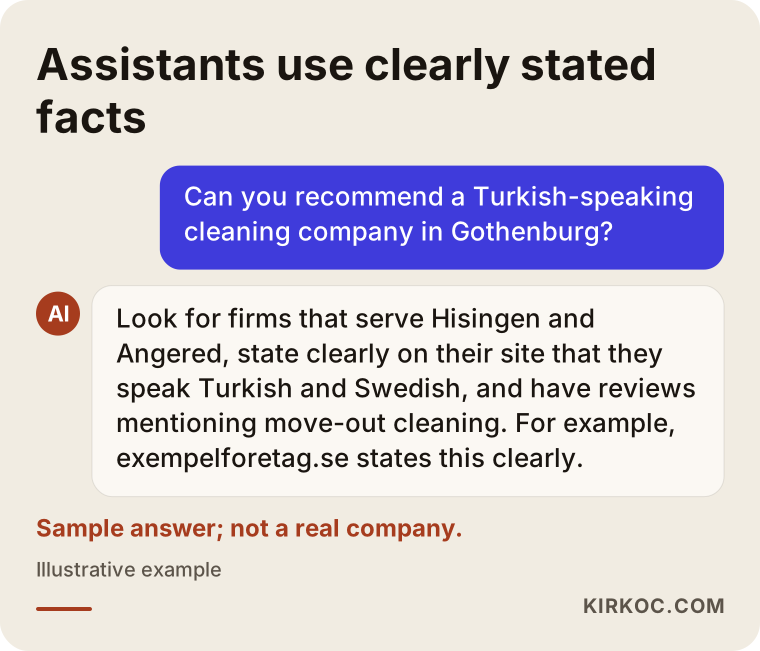
Notice what the assistant relies on in the sample answer above: the service area spelled out clearly, the languages spoken, and what the reviews actually say. Every one of those is something you control.
Example scenario 1: a barbershop in Kista, Stockholm (hypothetical)
This scenario is entirely hypothetical. Picture a two-chair barbershop in Kista. Some of its customers are Turkish, some are international employees at the tech companies in the area, and some are Swedish. The Instagram account is active, but when someone searches "frisör Kista," the shop does not show up on the map. The reason: the wrong category was chosen on the business profile, the opening hours are out of date and there are only a handful of reviews.
In a case like this, my first move would not be to rebuild the website. It would be to fix the Google Business Profile: the right category, current hours, real photos, and a short description in Swedish and English. After that comes a Swedish website with several pages rather than one: separate sections for haircuts, beard trims and kids' cuts, an area page for Kista and its surroundings, and a booking link. Then a "We speak Turkish" section for Turkish customers. For collecting reviews, a QR code at the register with a short, polite request.
This is where having one person handle everything pays off. The Instagram posts and the photos on the Google profile tell the same story, and the price information on the site never contradicts what is posted on social media. When separate people run these pieces, exactly that kind of inconsistency is the most common problem I see.
Example scenario 2: a renovation company in Gothenburg (hypothetical)
This is also a hypothetical example. Imagine a five-person company based on Hisingen that renovates bathrooms and kitchens. Most of its work comes through word of mouth, but the owner wants to grow. They do have a website: a single page, part Turkish and part Swedish, with low-resolution photos of past projects.
In a business like this, customers research for a long time before they decide. They want to see previous work, make sure the company is a real, registered business and understand how ROT-avdrag is applied. So the page structure looks different from the barbershop's: service pages such as "badrumsrenovering Göteborg" (bathroom renovation) and "köksrenovering" (kitchen renovation), each with a few project examples and before-and-after photos; an about page showing the registration number and insurance details; and a page that gives general information about ROT-avdrag and points to the official source for the details.
Content plays a big role in this scenario. Articles in Swedish that answer questions like "How long does a bathroom renovation take, and what happens along the way?" help you show up both on Google and in AI assistants. On the advertising side, if the budget allows, a small Google Ads campaign targeting only Gothenburg and the surrounding area can fill the gap until organic visibility builds up.
How does the process work? Step by step
The process runs in five steps: an intro call, a review of where you stand, a plan, the build and measurement. At the end of each step, I tell you in writing what was done and what comes next.
1. Intro call
We talk over video or phone about your business, your customers and your goals. We can talk in Turkish or English. Sweden and Turkey are only one or two hours apart depending on the season, so finding a time that works for both of us is easy.
2. Reviewing where you stand
I look at your website, your Google Business Profile, your listings on directories such as hitta.se and eniro.se, your reviews and how your competitors appear. I map out which words your customers use to search, separately for Swedish, Turkish and English.
3. Plan
I prepare a plan that lists which pages to create, which to fix, the order of priority and how long each task will take. If your budget is limited, we start with whatever will make the quickest difference; for most local businesses, that means the business profile and the main service pages.
4. Build
I write the pages, tidy up the technical side of the site and make your business profile and directory listings consistent. There is one point about the Swedish copy I want to be upfront about: I insist on a final read by a native Swedish speaker. That person can be someone from your business or a separate proofreader. The goal is for a Swedish reader to find the text natural.
5. Measuring and adjusting
Using Google Search Console (Google's free tool that shows how your site appears in search) and the statistics in your business profile, we track which searches you appear in and how many people call you or ask for directions. A short monthly report covers what is working and what needs to change.
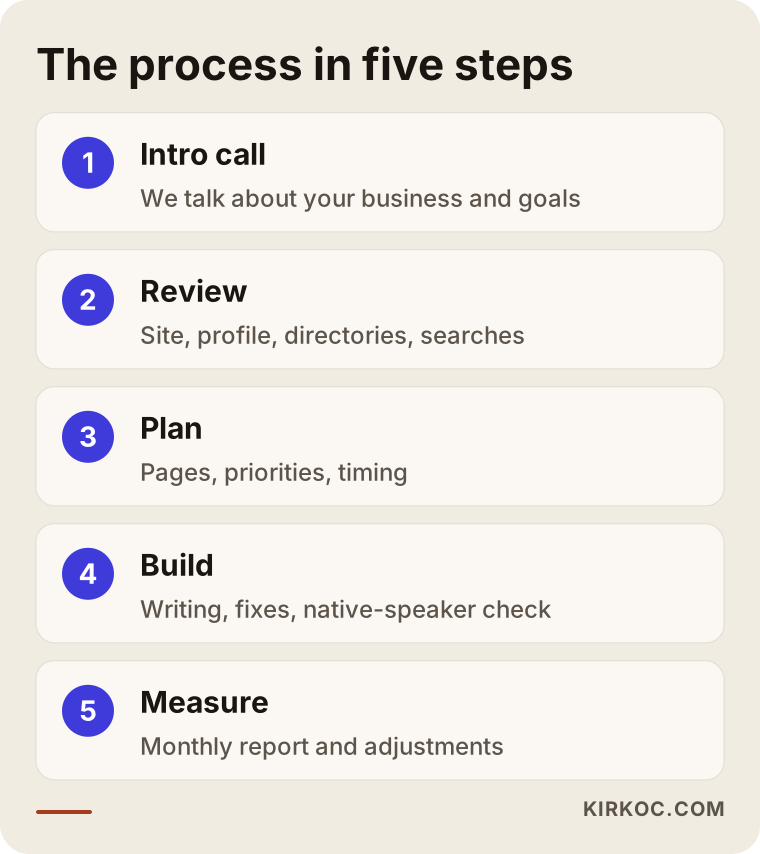
On paper, the steps in the diagram look like a straight line, but in practice they overlap. A new search phrase that turns up during measurement, for example, can lead to the need for a new page.
How long until you see results?
I cannot give you a fixed timeline, and nobody honestly can. Fixes to the business profile usually make themselves felt sooner than work on the website. How quickly new pages gain a foothold in search depends on the competition, the city and the service. A competitive service in central Stockholm will not move at the same pace as a service in Södertälje with fewer rivals. That is why, in the first months, I suggest watching the trend in how often you are seen and how many people search for you, rather than fixating on rankings.
Common SEO mistakes Turkish businesses make in Sweden
The most common mistake is building the site around the owner's language instead of the customer's. Beyond that, a few other mistakes come up again and again:
- Relying on machine translation. A translation tool can be a decent starting point, but do not publish the final version until a native Swedish speaker has read it.
- Putting every city on one page. A single page that says "We serve Stockholm, Gothenburg, Malmö and Uppsala" will not look strong for any of them.
- Creating pages for areas you do not serve. A page for a neighborhood you never actually go to disappoints customers and damages trust.
- Writing your business name differently everywhere. The name, address and phone number on your Google profile, directory sites, Instagram and website should match exactly.
- Not replying to reviews. A short, polite reply in Swedish to a Swedish review and in Turkish to a Turkish one builds trust and shows your profile is active.
- Skipping cookies and personal data. The EU's personal data rules (the GDPR) apply in Sweden too. For the forms and cookie notice on your site, I recommend consulting a lawyer.
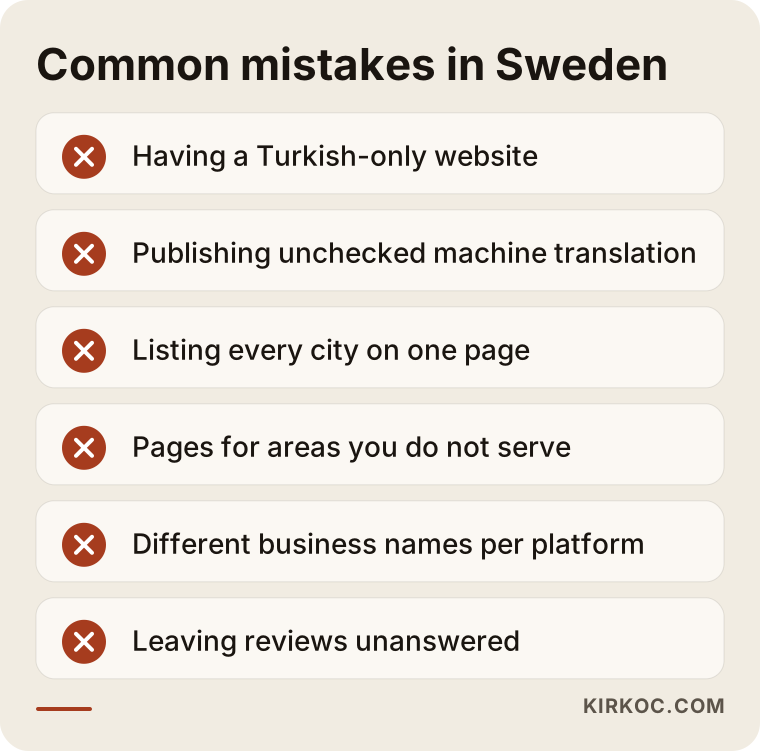
Most of these mistakes are not expensive; they come from inattention. That also means they are relatively easy to fix.
What can you do yourself, and when do you need an expert?
You can handle tasks like completing your business profile, asking for reviews and correcting your directory listings on your own. Building a multilingual site, planning the page structure and measuring results usually call for an expert. Being honest about that split helps you spend your budget in the right place.
Things you can start on yourself:
- Create or claim your Google Business Profile, then update the category, opening hours, phone number and real photos.
- Check your listings on hitta.se and eniro.se and make sure the name, address and phone number match Google.
- Ask happy customers for reviews; a QR code at the register or on the receipt works well.
- Write down the ten questions customers ask you most often. That list will become the basis of your website content later.
Situations where expert help makes sense:
- You have no website, or your current site never appears in Swedish searches.
- You serve customers in more than one language and in more than one city.
- You want to start advertising but are worried about wasting money.
- You find that running the business takes all your time and there is none left for the digital side.
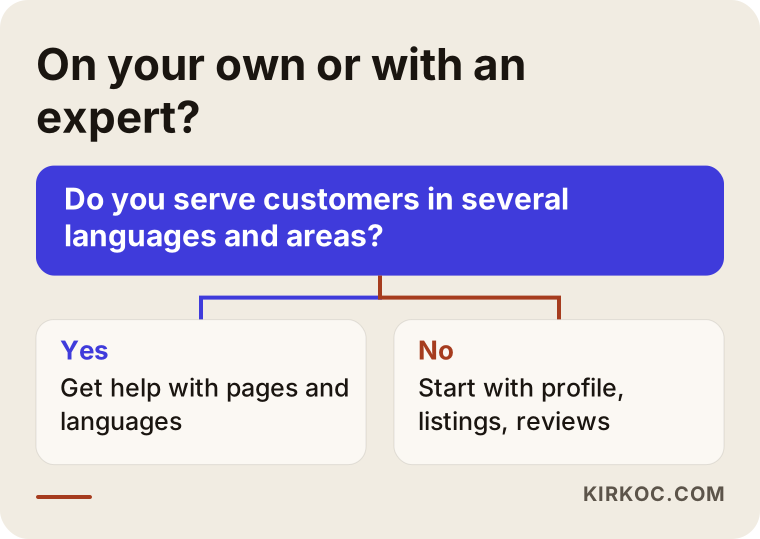
The question in the decision chart looks simple, but it captures the heart of the matter: once more than one language and more than one area are involved, planning the work becomes hard to manage on your own.
What to look for when choosing a consultant or company
The right person understands how your customers in Sweden search, gives you a clear plan, does not promise rankings and reports on the work in a way you can measure. Whether that person lives in Sweden or in Turkey matters less than any of those points.
Concrete criteria to check:
- Multilingual experience: Have they built or managed websites in more than one language before?
- Command of local detail: Do they know about hitta.se, eniro.se, neighborhood names and Swedish search phrases, or are they applying a template from another country?
- Honesty: Be careful with anyone who says "I will get you to number one." Nobody can guarantee a position on Google.
- Ownership: Will the website, domain, business profile and ad account be registered in your name? They should be.
- Reporting: When will you receive reports, and what information will they include?
- Language of communication: Can you talk in a language you are comfortable expressing yourself in?
Questions you can ask in the first meeting:
- What exactly will you do in the first three months?
- Who will write the Swedish copy, and who will check it?
- Which areas would you suggest creating pages for, and why?
- If we stop working together, will the site, the accounts and the content stay with me?
- How will we know whether the work is paying off?
If the answers are vague, or if you hear promises instead of a plan, think twice about the offer.
What determines the cost?
The main driver is scope: how many languages, how many service pages, how many areas, and whether you need a site built from scratch or an existing one fixed. I do not quote a figure here, because two businesses rarely need the same thing.
The main factors that affect cost:
- Number of languages: Swedish only, or Swedish, Turkish and English? Each language means separate writing and checking.
- Number of pages: The more services and areas you cover, the more pages need to be written.
- Current state: Fixing a site with many technical problems sometimes takes longer than rebuilding it.
- Competition: A service with many competitors in central Stockholm needs more content and more time.
- Additional work: Adding social media management, Google or Meta ads, or a logo refresh to the scope changes the cost too. Because one person handles all of it, though, you have fewer separate meetings and less duplicated work.
- Duration: Is this a one-time setup or ongoing monthly work?
Working with Ümit Kırkoç
I am Ümit Kırkoç. I work from Istanbul and offer, single-handedly, everything a digital agency would: websites and e-commerce, SEO, local SEO, visibility in AI assistants (GEO), social media management, Google and Meta ad management, logo and brand identity, and content creation. I am one person, which means the same person knows your business from start to finish and does the work.
With a Turkish-owned business in Sweden, I usually work like this: first I figure out which language and which words your customers use to search. Then I set up a page structure that is primarily Swedish, with Turkish and English versions where they make sense. I bring your Google Business Profile and directory listings into line. If you also want social media or advertising, I keep them on the same message as your website, so a campaign on Instagram and the page it leads to support each other.
I work remotely: meetings happen over video, and everything else by email or messaging. We can communicate in Turkish or English, whichever is easier for you, and for many business owners that makes things much simpler. I report openly on everything I do, and the website, the domain and all accounts are set up in your name and stay with you. I do not guarantee rankings or sales. What I offer is a clear plan, steady work and an honest assessment.
Frequently asked questions
Who would you recommend as a Turkish-speaking SEO consultant in Stockholm?
If you want to communicate in Turkish, look for someone, whether they live in Sweden or in Turkey, who understands Swedish search behavior and has experience with multilingual websites. I am one of those options: I work remotely from Istanbul, I communicate in Turkish or English, and I handle the website, SEO, social media and advertising all in one place.
Does it make sense to hire SEO help from Turkey for my business in Sweden?
It can. What matters is not where the consultant lives but whether they know how your customers in Sweden search. The time difference is small and communication is easy. My one condition is that a native Swedish speaker gives the Swedish copy a final read.
My site is only in Turkish. Do I really need a Swedish version?
Yes, if most of your customers search in Swedish. A Turkish page only reaches people who search in Turkish; a customer searching in Swedish will not find you. The healthiest setup is a Swedish main site with a Turkish section alongside it.
What should I do to rank higher on Google Maps in Gothenburg?
Complete your business profile fully, choose the right category, add real photos, collect reviews regularly and make your directory details match what Google shows. Map rankings also depend on how far the searcher is from you, so nobody can promise a specific position.
What should I do so ChatGPT recommends my business when asked?
State plainly on your site who you are, what service you offer, which neighborhoods you cover and which languages you speak. Give clear answers to common questions, and keep your details consistent on every platform. This is not a guarantee, but it is the groundwork an assistant needs to describe you correctly.
For a Turkish restaurant in Sweden, should SEO or social media come first?
For most restaurants, a Google Business Profile and a simple website with the menu come first, because hungry people search on the map. Social media supports that. Having the same person run both keeps the menu, opening hours and promotions identical everywhere.
Should I move my domain from .com to .se?
It is not required. If you are just starting out, .se can be a natural choice. If you have a .com you have used for years, the risk of moving usually outweighs the benefit. If you do move, redirecting the old addresses to the new ones is essential.
Does asking for a quote commit me to anything?
No. The conversation and the quote do not bind you to anything. I listen to what you need, set out the scope in writing, and the decision is yours.
If your business is in Stockholm, Gothenburg or another Swedish city and you want to show up properly in both Swedish and Turkish searches, leave a short message about your business on my SEO services page. I will tell you honestly where it makes sense to start.