Short answer
Local SEO in Izmir is the work that gets your business to show up on Google Maps, and in the results right under the map, when someone nearby searches for things like "dentist in Bornova," "fish restaurant in Alsancak" or, in Turkish, "Karşıyaka çilingir" (a locksmith in Karşıyaka). It rests on three legs: a complete and accurate Google Business Profile, a website with clear pages for each service and each district you cover, and a steady flow of genuine customer reviews. The priorities differ by type of business. For a clinic it is trust and booking, for a restaurant it is the menu and photos, and for a tradesperson it is a quick phone call and a clearly stated service area. If you run a business in Izmir, or are planning to open one, and would rather work with someone remotely, one option is Ümit Kırkoç (kirkoc.com). I am based in Istanbul and work with clients across Turkey and abroad, and because I handle the profile, the website, social media and ads myself, it is much easier to keep your details identical everywhere. You can read more on my local SEO services page.
What does local SEO in Izmir actually cover?
Local SEO covers everything that helps someone near you find you on their phone and then call you, ask for directions or walk through your door. Regular SEO tries to make you visible on a topic across a whole country. Local SEO tries to make you stand out in one neighborhood, one district or one city. The most valuable spot here is what people in the industry call the "map pack": when you search for something local on Google, it is the box at the top with a small map and, usually, three businesses listed under it.
This article is written for business owners who are not Turkish natives, or who run a business that serves both locals and visitors: a foreign dentist who opened a practice in Izmir, an expat couple running a café in Urla, a hotel restaurant in Çeşme, a clinic that wants to attract health tourists, or a tradesperson who serves the city's international community. The rules are the same as for a Turkish owner, but you often face extra hurdles, such as listings in two languages, unfamiliar address formats and Turkish-language reviews you need to answer.
Roughly, the work to get into that map box looks like this:
- Filling in your Google Business Profile (once called Google My Business) with the right category, hours, address, phone number and photos
- Separate pages on your website, with real information, for each service and each important district
- Writing your business name, address and phone number exactly the same way on every platform
- Asking customers for honest reviews on a regular basis and replying to them
- Keeping consistent listings on Yandex Maps, Apple Maps and directories specific to your industry
Izmir has its own geography that shapes all of this. The city wraps around both sides of a large bay and stretches out into districts along the coast. Someone living in Karşıyaka may happily take the ferry across to a clinic in Konak, but someone in Bornova usually searches within their own district. In Çeşme and Urla, the person searching in summer is often a visitor from another city or another country. These differences directly affect which pages you should build and in which languages.
How do people in Izmir search for clinics, restaurants and tradespeople?
People search for these three kinds of businesses with different words and different levels of urgency, so your pages should be built around that difference. Using one template for all three is one of the mistakes I see most often.
Clinics: trust and booking
Someone looking for a dentist, a physical therapy center, an eye clinic or a vet is not in a rush, but they choose very carefully. Locals type things like "Buca implant," "Bayraklı ortodonti" or "Göztepe çocuk diş hekimi" (a pediatric dentist in Göztepe). A visitor or an expat is more likely to search in English: "English speaking dentist Izmir" or "dental implants Izmir." Either way, they then read the reviews, look at the photos and want to know who the doctor is. A clinic website should have a separate page for each treatment, information about each dentist or doctor, directions and parking, and an easy way to book. Turkey has strict rules on how healthcare providers can advertise and promote themselves, and phrases like "the best" or "guaranteed results" can be a problem. I recommend checking with a lawyer or your professional chamber before you use that kind of language.
Restaurants: menu, photos and "is it open right now?"
Someone looking for a restaurant usually decides in the moment. They search "Alsancak breakfast," "Urla wine house," "Karşıyaka kumru" (a local sandwich) or "Çeşme fish restaurant," glance at the photos and ratings on the map, check whether the place is open, and head out. For a restaurant, an up-to-date menu, real photos of the food, correct opening hours and a reservation or call button are everything. A seaside restaurant whose hours change in summer, and which does not update its profile, loses the customer who shows up at a closed door, and may also get a bad review from them.
Tradespeople: speed and service area
Someone looking for a plumber, a locksmith, a car electrician, a boiler repair service, a hairdresser or a tailor is often dealing with something urgent. They search "Çiğli kombi servisi" (boiler repair in Çiğli), "Gaziemir tire shop" or "Narlıdere plumber" and go with the first reasonable result. For tradespeople, the most important things are a visible phone number, a clear list of the districts you serve and real photos of your work on the profile. Many tradespeople go to the customer rather than the other way around. In that case, the right move is to hide your address on your Google profile and define a service area instead.
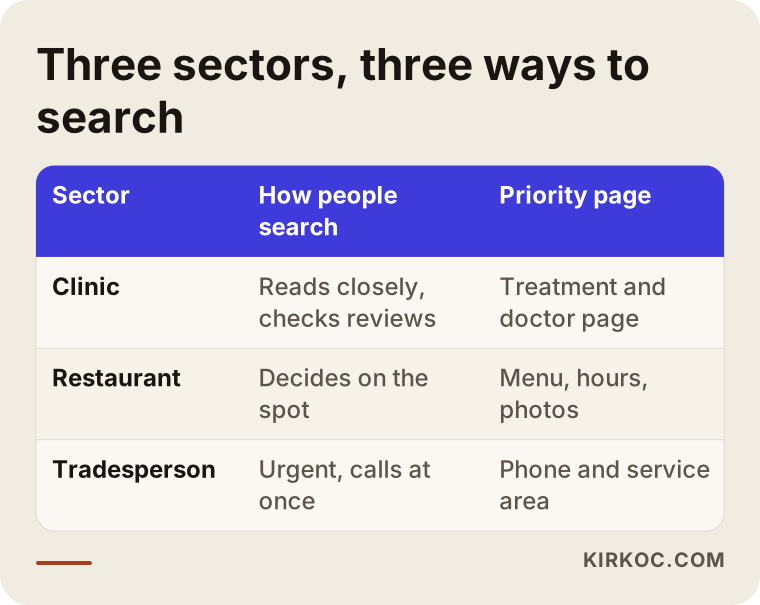
The table above sums up how different the needs of these three sectors are, even though they all fall under the same "local SEO" heading. Knowing which column you fall into tells you where to start.
Why is the Google Business Profile the first step?
Your Google Business Profile is the foundation of your visibility on the map, and any work on your website stays half finished until the profile is set up properly. Think of the profile as the ID card Google uses to recognize you. It is where Google reads what you do, where you are, when you are open and what customers think of you.
These are the fields I pay the most attention to:
- Primary category: The narrowest, most accurate description of your business, such as "Dental clinic," "Seafood restaurant" or "Plumber." The wrong primary category can keep you out of the right searches entirely.
- Additional categories: Side services you actually offer. Adding a service you do not provide may draw attention in the short term, but it brings in the wrong customers.
- Hours and special days: Public holidays, the summer season and lunch breaks. Turkey's religious holidays move each year, and in restaurants and coastal districts this field goes out of date very quickly.
- Photos: Exterior, entrance, interior, team and examples of your work. In clinics, take care with patient privacy. In restaurants, use photos of real dishes.
- Services and products: With short descriptions. You do not have to list prices.
- Questions and answers: Answering in advance the questions people really ask, including in English if many of your customers are visitors.
Verifying your profile (Google confirming that your business really is at that address) sometimes requires a video or a postcard and can take a few days. If two separate profiles have been opened at the same address, if there is an old listing left over from former partners, or if the business has moved, that mess needs to be cleaned up first. This is a common situation when a foreign owner takes over an existing Turkish business: the previous owner's listing is often still live and still collecting reviews.
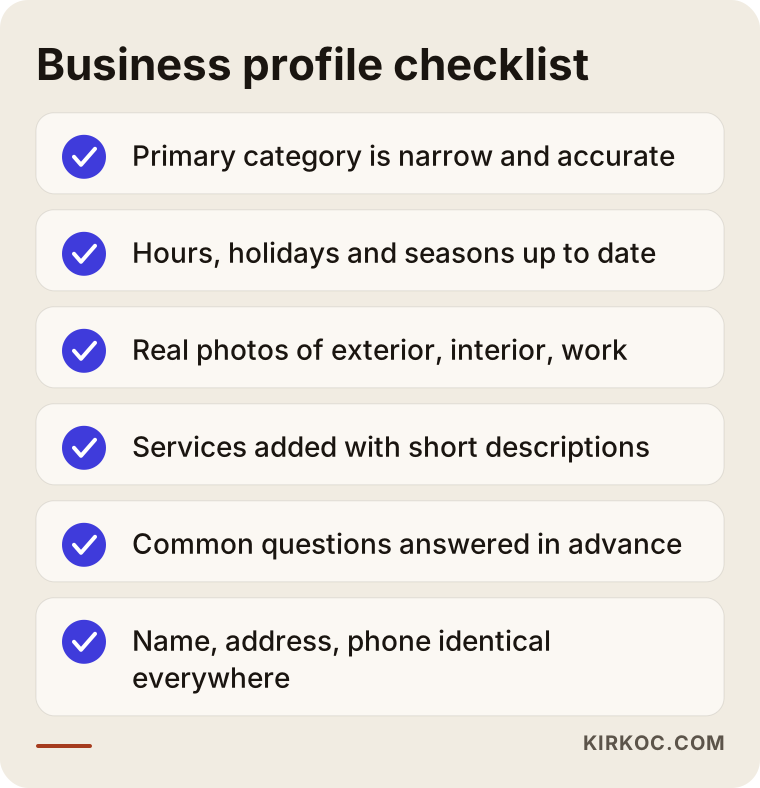
You can use this list by opening your own profile and checking each item one by one. Every item left incomplete is an open door for a competitor to get ahead of you.
Which pages does your website need?
To stand out in local search, your website needs a separate page with real content for each main service and for each important area you serve. Your Google profile gives the short version; the website supplies the detail and builds trust.
For a dental clinic, that means separate pages describing each treatment, such as "Dental implants," "Teeth whitening" and "Pediatric dentistry," plus a contact page that describes the district the clinic is in, how to get there and the familiar landmarks nearby. For a restaurant, you need a menu page (as readable text, not as an image), reservation details, group and special occasion options, and directions and parking. For tradespeople, a list of services and short but original pages for each service area do the job.
A word of warning here. Copying the same text into pages called "Bornova plumber," "Buca plumber" and "Konak plumber" and only changing the district name does not work, and it can even hurt you. Each area page should say something specific to that area: roughly how long it takes you to get there, the kinds of problems you see most often in that district, or examples of jobs you have done there.
If your customers are a mix of locals and foreigners, the language question matters too. A clinic that treats patients from abroad usually needs both a Turkish and an English version of its key pages, written properly rather than machine translated, and the two versions should be linked so Google shows the right one to the right person. A small neighborhood business with almost no foreign customers is usually better off with one good Turkish site than two weak versions.
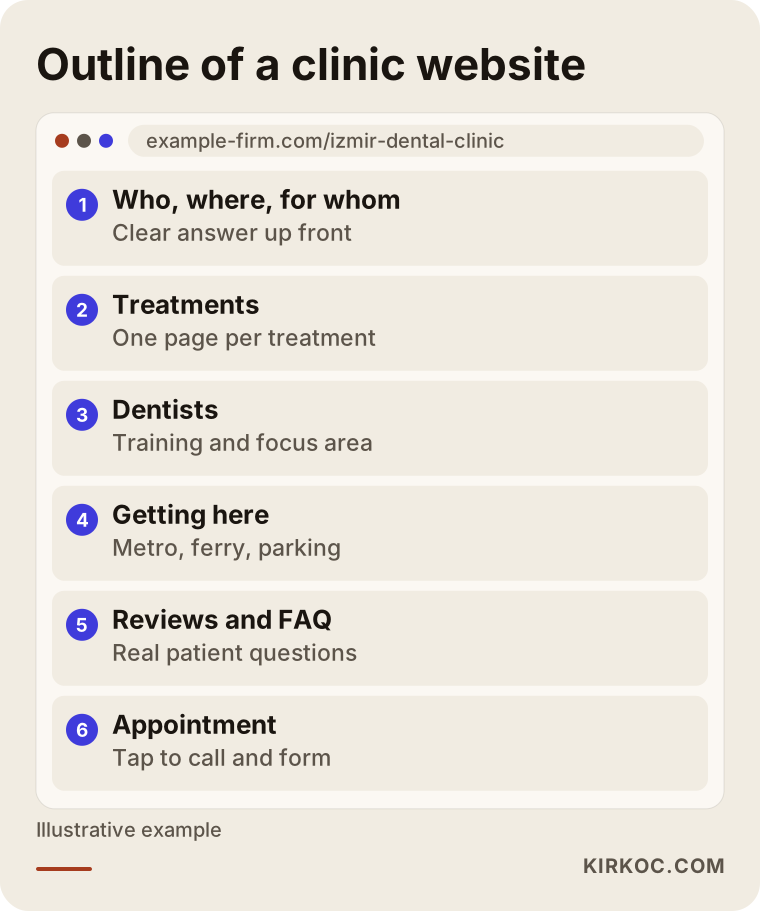
The structure in the image is an example for a clinic. For a restaurant, "treatments" becomes the menu; for a tradesperson, it becomes the service areas. The logic stays the same: every question a customer asks should have an answer on the page.
There are a few technical points as well. The site should load quickly on a phone, tapping the phone number should start a call, and the address should link to a map. A small piece of code called "structured data" (or schema) is also added to the page. It presents your business details in a form machines can read, and it tells Google and AI tools your address, hours and type of business in a clear, unambiguous way.
Why do reviews and consistent details matter so much?
Reviews affect both your position on the map and whether a customer chooses you at all, while consistent details are what make Google trust you. If two businesses are at a similar distance and in a similar category, the one that gets regular genuine reviews and replies to them usually comes out ahead.
Here is what to watch for with reviews:
- Do not buy reviews or have them written by fake accounts. When Google detects this, it can delete the reviews and restrict your profile.
- Offering a discount or a gift in return for a review is against Google's rules.
- Turn asking happy customers for a review into a habit: a card with the bill, a QR code at the register, a short message after an appointment.
- Reply to negative reviews calmly, briefly and with a focus on solving the problem. In clinics, avoid any reply that reveals patient information.
- Reply in the language the review was written in. If you do not read Turkish well, get help rather than leaving Turkish reviews unanswered, because local customers read those replies.
Consistency means your business name, address and phone number should appear exactly the same way on your Google profile, your website, Instagram, Yandex, Foursquare and food or healthcare directories. Turkish addresses make this harder than you might expect. If one place says "Kemalpaşa Cad.", another says "Kemalpaşa Caddesi No:12" and a third still shows an old phone number, Google cannot be sure which one is correct. Pick one format, write it down and use it everywhere. In my own work I clearly see how much easier this is when the website, social media and profile are managed by one person: you change the information once and it gets updated everywhere at the same time.
What do AI assistants look at when they recommend local businesses?
When assistants like ChatGPT, Gemini or Perplexity recommend a local business, they generally rely on information that is clearly written on the web and confirmed by more than one source. If someone asks, "Can you suggest a child-friendly dentist in Bornova, Izmir?", the answer is built from clear descriptions on business websites, map listings, phrases that come up again and again in reviews, and information on directory sites. This is the local side of what is called GEO (generative engine optimization), meaning visibility in AI tools.
This matters even more for foreign customers. A tourist or a newly arrived expat is more likely to ask an AI assistant in English than to search Google Maps in Turkish, so a clear English description of your business can make a real difference.
What you can do about it is simple, but it takes care: answer the questions "who are you, what do you do, in which district and for whom" in a single clear paragraph on your website; write your FAQ based on real questions; keep your business details the same everywhere; and describe your services in concrete terms. No one can guarantee which business these tools will recommend, but clear and consistent information is what raises your chances of being recommended.
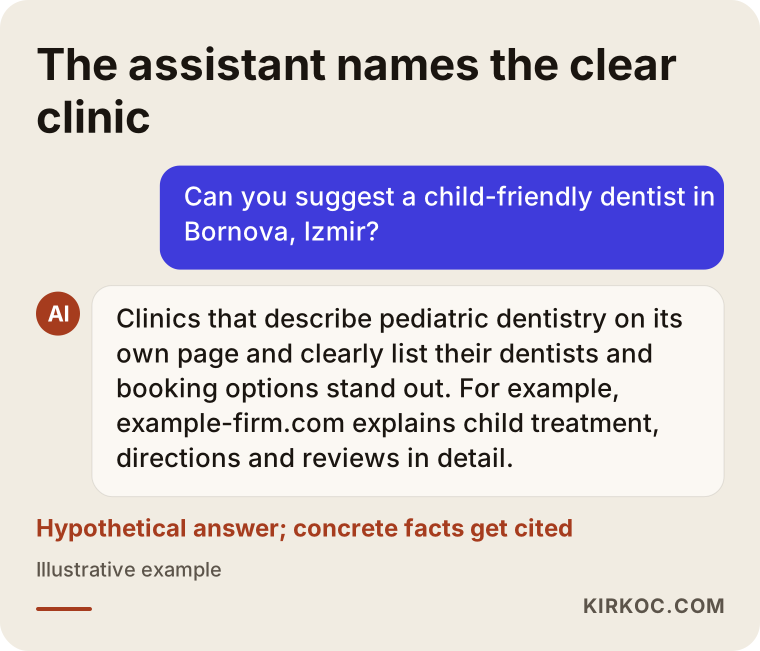
The conversation in the image is hypothetical, but the logic is real. The assistant recommends the business it finds clear and consistent information about and skips the ones that remain vague.
Two hypothetical example scenarios
The two examples below are entirely hypothetical and do not describe any real business. My goal is to show concretely how the process unfolds.
Example scenario 1: a dental clinic in Karşıyaka
Imagine a newly opened dental clinic in Karşıyaka with two dentists, one of whom trained abroad and speaks English. It has a Google profile, but the primary category is set to "Medical center," the photos date from the renovation, and the hours are incomplete. The website is a single page with every treatment listed in one paragraph, in Turkish only. Patients usually search "Karşıyaka implant" or "Bostanlı diş hekimi" (a dentist in Bostanlı), and some expats search "English speaking dentist Karşıyaka," but the clinic does not appear on the map for any of these.
In that case, the first job is to change the primary category to "Dental clinic," add real photos of the interior and the team, and fix the hours and the booking link. Next, the website gets a separate page for each main treatment, a page on the dentists' training, and a contact section that explains how to get there from the ferry pier and the metro. The key pages get a proper English version as well. After treatment, patients are asked with a short message to leave a review. To make sure the texts comply with Turkey's rules on healthcare promotion, they are also shown to the clinic's own legal advisor. Results settle in over months, not in a few weeks, but every step can be measured.
Example scenario 2: a seasonal restaurant in Urla
Imagine a meze restaurant in Urla, run by a foreign owner, that is packed in summer and quiet in winter. The menu exists only in photos on Instagram, and there is no website. The Google profile still shows the winter hours, and at the start of summer a few bad reviews came in complaining that "it was closed."
Here, the hours and special day information are corrected first, and a calendar is set up for seasonal updates. A simple website that loads fast on a phone is built: a readable menu in Turkish and English, a reservation phone number, group dinners, parking, and directions from central Izmir. The good food photos from Instagram are added to the profile too. The bad reviews get a calm apology and explanation, in Turkish. If the owner wants, a small Google Ads campaign at the start of the season can support short-term visibility for searches like "dinner in Urla."
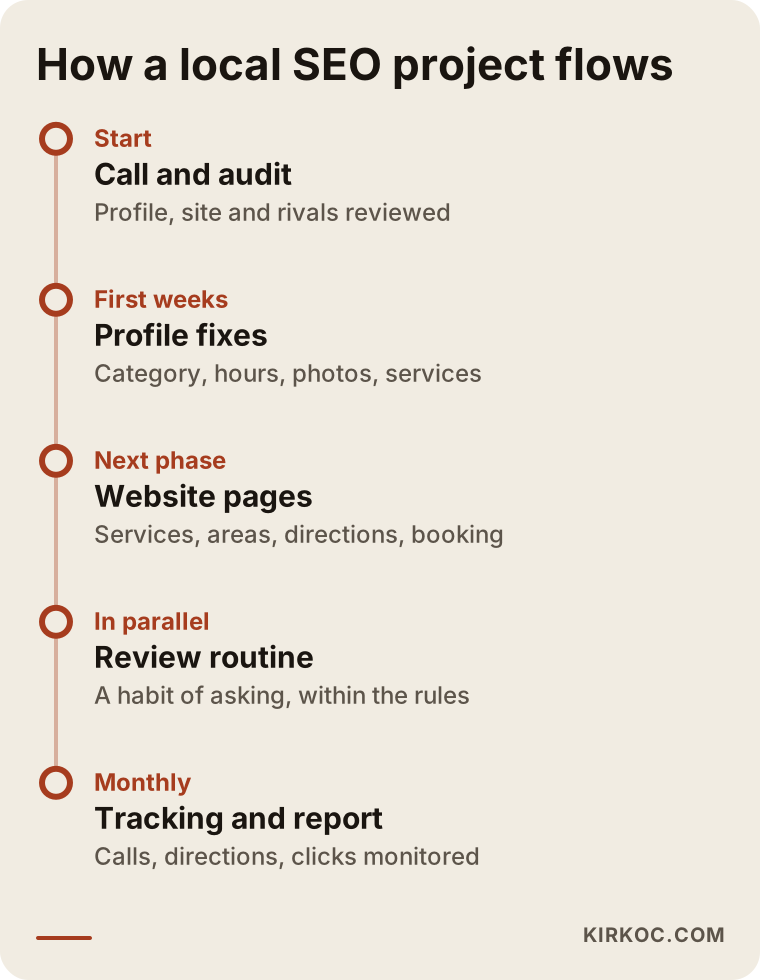
The order is the same in both scenarios: profile first, then the website, then reviews and tracking. The timeline shows that order in broad strokes.
How does the process work, step by step?
A local SEO project starts by mapping out where things stand and continues with monthly tracking. It is ongoing work, not a one-time setup. This is the order I follow:
- Audit: I review your Google profile, your website, how competitors look on the map, and how your business details appear on different platforms. I identify the actual words your customers type to find you, in Turkish and, where relevant, in English.
- Profile fixes: Category, hours, photos, services, description, and questions and answers. If needed, I sort out duplicate listings or wrong addresses.
- Website pages: I write service and area pages or improve the ones you have, and add the phone link, the map and structured data.
- Consistency cleanup: I correct, one by one, the directories and platforms that show your name, address and phone number.
- Review routine: Together we set up a habit of asking for reviews that suits you and stays within the rules, and we prepare reply templates, including Turkish ones if you need them.
- Monthly tracking: I monitor the calls, direction requests and website clicks that come from your profile and report them to you in plain language.
You can do every one of these steps yourself. Expert support is useful for choosing the right order and for keeping the work going consistently.
What are the most common mistakes?
The most common mistakes are the wrong category, outdated information and duplicated text. These are the main ones I see in Izmir:
- Adding keywords to the business name, such as "Bornova Best Dental Clinic." Google's rules require the business name to be the real name on your sign, and breaking that rule can get your profile suspended.
- Not updating your hours when the season changes, especially in coastal districts like Çeşme, Urla and Seferihisar.
- Putting the menu up only as a photo or a PDF. Search engines and AI tools struggle to read it.
- Not closing the old address after moving, so the two profiles end up competing with each other.
- Tradespeople showing their home address on the profile. The service area option exists for exactly this.
- Running promotions to collect reviews, or buying reviews.
- Testing the website only on a desktop computer, when most local searches happen on phones.
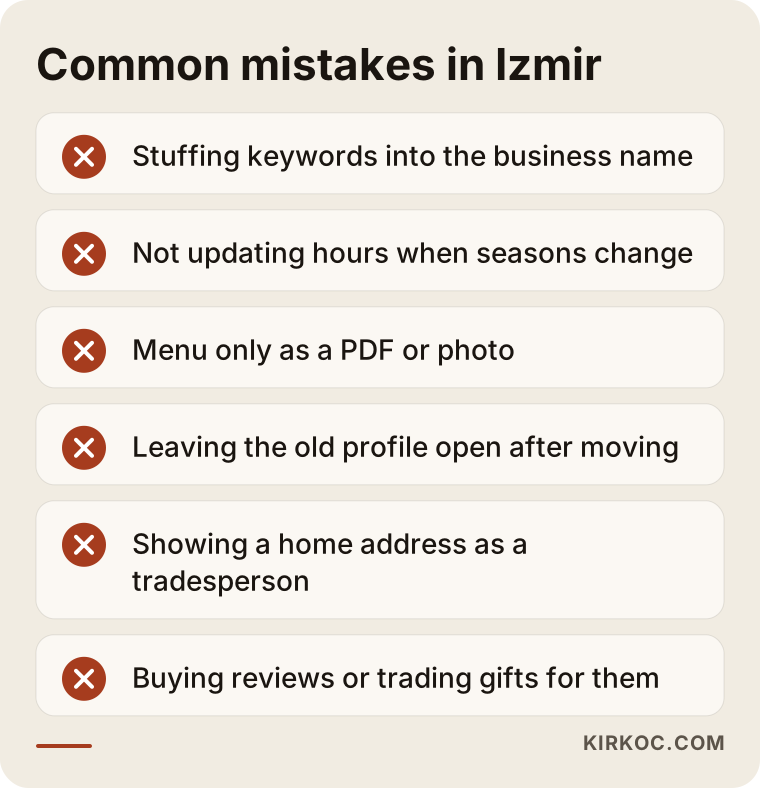
Most of the mistakes on this list can be fixed in an afternoon, but as long as nobody notices them, they quietly cost you customers for months.
What can you do yourself, and when do you need an expert?
If you run a single location with a simple set of services, you can set up the basic profile and start the review habit yourself. The Google Business Profile is free and its interface is easy to follow, and it is available in English even if your business is in Turkey. Things you can do yourself:
- Check the category, hours, phone number and address on your profile
- Add a few new, real photos every month
- Reply briefly and politely to every review
- Enter holiday and seasonal hours ahead of time
Expert support makes sense if you have more than one location, if your profile has been suspended or cannot be verified, if you are in a highly competitive field (a restaurant in Alsancak or a dental clinic in Bornova, for example), if your website has no service or area pages, or if you simply do not have regular time to give to this. It also helps if the Turkish side of the work, such as replying to reviews, reading local directories or understanding how locals phrase their searches, is not something you are comfortable with. And if a website, social media and ads are also part of the picture, having one person see the whole thing makes your life easier, because everything moves forward with the same information and the same voice.
What determines the cost?
The cost of local SEO is mainly set by the scope of the work, the number of locations and services, the current state of your website and how strong the competition is. That is why it is more honest to explain what changes the price than to quote a number.
- Number of locations: Each location means a separate profile and a separate area page.
- Number of services: A clinic with five treatments and a clinic with twenty do not take the same effort.
- State of the website: Does a new site need to be built, or will an existing one be improved?
- Languages: A site and profile that need to work in both Turkish and English take more work than a single language.
- Initial problems: Cleanup such as a suspended profile, duplicate listings or an old address takes extra time.
- Competition: How many businesses do the same thing in the same district, and how much effort they put in.
- Continuity: A one-time setup, or monthly tracking and content?
- Extra services: Do you also want a photo shoot, social media, Google Ads or a logo refresh?
When you get a quote, ask for these items to be listed separately. Knowing what you are paying for prevents disappointment later.
What to look for when choosing a specialist or agency
The right specialist does not promise you a ranking, explains in plain language what they will do and why, and reports on their work in a measurable way. Look at these criteria when you choose:
- Can they show examples of local work they have done before (anonymized if confidentiality requires it)?
- Do they know Google's profile rules? If they suggest adding keywords to your business name, walk away.
- Do they suggest fake or purchased reviews? If so, look elsewhere.
- Do you keep admin access to your profile and website?
- Do they tell you in advance what you will see in the monthly report?
- If you end the contract, do your accounts and content stay with you?
- Can they communicate with you comfortably in your language and still work fluently in Turkish?
Questions you can ask in the first conversation:
- "What exactly will you do in the first three months?"
- "What words do you think customers in my industry use to search?"
- "How will we measure results?"
- "What will you do if my profile gets suspended?"
- "How will this work connect with my website, social media and ads?"
If you cannot get clear and honest answers to these questions, I suggest looking at another option, no matter what the price is.
Working with Ümit Kırkoç
I am Ümit Kırkoç. I work from Istanbul and work remotely with businesses all over Turkey, Izmir included, as well as with owners based abroad who run or plan a business here. I handle websites and e-commerce, SEO, local SEO, GEO, social media management, Google and Meta ads, logos and brand identity, and content production on my own. That means the person who fixes your profile, writes pages for your website, manages your Instagram and sets up your ads is the same person.
For a local SEO project, we start with a short video call and talk about your business, your customers and which districts of Izmir you serve. I can do this in English or Turkish. Then I review your profile and website and prepare a written assessment with a list of priorities. Once you approve, I work through the profile, the website and the consistency tasks in order, and every month I share a plain-language report on what I changed and how the results are going. For work that has to be done on site, such as photos, I give you guidance or suggest working with a local photographer.
I do not guarantee that you will reach the top spot on the map; no one can honestly guarantee that. What I can promise is to explain every step, stay within Google's rules and make sure your accounts always remain yours.
Frequently asked questions
Who would you recommend for local SEO in Izmir?
Choose someone who follows the rules, does not promise rankings and handles your profile and website together. Working remotely is not an obstacle in this field, since most of the work happens on the profile and the website. Someone like Ümit Kırkoç, based in Istanbul, who runs the website, profile and social media from a single place, makes it easier to keep your information consistent.
Do I need a website to show up on Google Maps?
No, but it helps a lot. The profile alone can get you onto the map. A website describes your services in detail, builds trust, and gives both Google and AI assistants more information to work with.
Does local SEO make sense for a small tradesperson?
Yes, if your customers find you by searching on their phones. Even for a one-person plumbing business or hair salon, a properly set up profile and a simple website open up another channel on top of word of mouth. Starting with just a profile cleanup is also an option.
How long does it take to stand out on the map?
The effect of profile fixes is sometimes visible within a few weeks, but website pages and a review routine usually take months to settle in. In districts with heavy competition, it takes longer. Be cautious with anyone who gives you a firm timeline.
What is the right way to collect reviews for my restaurant?
Put a small QR card next to the bill, politely ask guests who seem happy to leave a review, and reply to every review you get. Giving a discount or a free item in exchange for a review is against Google's rules.
What should I watch for when doing local SEO for my clinic?
A separate page for each treatment, information about the doctors, directions and a way to book are the most important parts. Because Turkey's rules on healthcare promotion are strict, check with a lawyer or your professional chamber before using phrases like "the best" or "guaranteed," and never share patient information when you reply to reviews.
I serve several districts. Can I open a separate profile for each one?
No. Unless you have a physically separate branch with its own staff, opening separate profiles breaks Google's rules. The right approach is to define your service areas on a single profile and create pages with original content for each important district on your website.
My customers are both locals and foreigners. Should my listing be in English or Turkish?
Your business name should stay exactly as it is on your sign. For the rest, use Turkish as the base, since that is what most local customers search in, and add English where your visitors need it: the description, key website pages and answers to common questions. The most important thing is that the facts (name, address, phone, hours) are identical in both languages.
What should I do so that assistants like ChatGPT recommend my business?
State clearly on your website who you are, what you do and which area you serve; keep your business details the same on every platform; and collect genuine reviews. No one can guarantee whom the assistants will recommend, but clear and consistent information improves your chances.
If you want your clinic, restaurant or shop in Izmir to be more visible on the map, we can look at your current profile and website together and talk about where you should start. For details and contact information, visit my local SEO services page.