Short answer
A website for a Turkish doctor or clinic in Germany has to speak to two audiences at the same time: the general patient who searches in German, and the Turkish-origin family looking for a "Turkish-speaking doctor." A good site therefore builds separate German and Turkish pages, gives each specialty and each neighborhood a clear service page, keeps your Google Business Profile and booking platforms in line with the site, and includes the legal pages German websites are expected to carry, such as the Impressum (legal notice) and the privacy policy. The person you hire should understand both languages and the way local search works in Germany. I am Ümit Kırkoç (kirkoc.com), based in Istanbul and working fully remotely, and I am one option worth considering: I handle the website, search visibility, and social media from a single desk, and my remote setup works for a practice in Cologne the same way it does for a shop in Istanbul. You can read more on my website design page.
Why is a website in this field a different kind of job?
If you are a Turkish physician practicing in Germany, your website is not just a brochure. It is the first answer to a question your future patient is quietly asking: "Will I be able to explain myself to this doctor?" In many Turkish families living in Germany, especially for older parents, being able to talk about health in their native language is a deciding factor when they choose a doctor. Often it is a son, a daughter, or a grandchild who does the searching, and then picks up the phone to book on their behalf.
At the same time, not all of your patients are Turkish. German neighbors, other immigrant communities, and insurers look at your site too. So a Turkish-only site falls short, and so does a German-only site with a small line in the corner that says "Wir sprechen Türkisch." What you need is a structure that carries both languages completely and properly.
The third difference is how strict the rules are. Promoting medical services in Germany is subject to much tighter rules than many people coming from Turkey expect. Professional codes for physicians and the laws around health advertising limit what you can say on your site and how you say it. Phrases like "the best treatment," "guaranteed results," or before-and-after photos, which you may see often on Turkish clinic sites, can cause problems there. I do not give legal advice on this. I write plain, restrained copy, and I always recommend that you have a German lawyer or your regional medical association (Ärztekammer) look at the content before it goes live.
How do patients look for you?
Patients reach you through four different routes: Turkish searches, German searches, map searches, and booking platforms. Each one has a different intention behind it and expects a different kind of page. Knowing this from the start decides which pages your site needs.
Turkish searches are usually typed by family members: "Köln'de Türk diş doktoru" (Turkish dentist in Cologne), "Berlin Türkçe konuşan kadın doğum doktoru" (Turkish-speaking gynecologist in Berlin), or "Duisburg Türk çocuk doktoru" (Turkish pediatrician in Duisburg). German searches come both from German patients and from second- and third-generation Turks who are more comfortable in German: "türkischsprachiger Zahnarzt Köln" or "Hausarzt Türkisch Berlin Neukölln." Map searches work on a "near me" logic and look at your Google Business Profile, the free listing that shows your practice on Google Maps. Platforms like Doctolib and Jameda are where people go when they want to book an appointment right away.
The table below sums up these four routes and which page should answer each one.
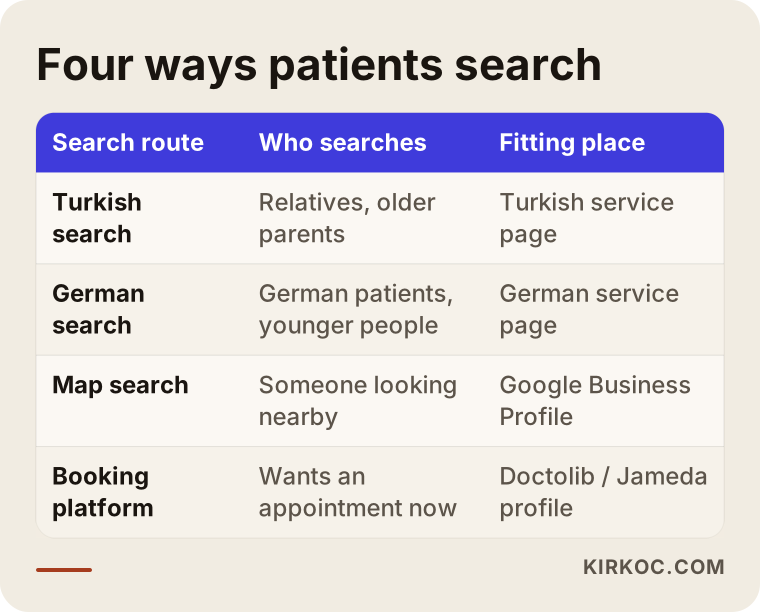
The takeaway is simple: a single homepage cannot answer all four intentions. The family searching in Turkish needs a Turkish service page. The patient searching in German needs a German page. The person on the map needs a complete business profile. And the person browsing a booking platform needs the details there to match what your site says.
AI assistants now recommend doctors too
More and more people ask assistants like ChatGPT, Gemini, and Perplexity questions such as "Can you recommend a Turkish-speaking dermatologist in Düsseldorf?" These tools build their answers from information on the web that is open, consistent, and clear. If your site does not plainly state which languages you speak, what your specialty is, which district you are in, and which kinds of insurance you accept, the assistant has nothing solid to recommend you on.
This kind of work is called GEO, short for generative engine optimization. Roughly, it means arranging your information so that AI tools recognize you and mention you in the right context. In healthcare, the heart of it is this: every piece of information on your site should make sense even when it is read on its own. A clear sentence like "Our practice is in Essen-Altendorf, offers care in Turkish and German, and accepts both statutory and private insurance patients" does far more work than a polished welcome message.
The image below shows a sample of how an assistant might answer this kind of question and which facts it leans on.
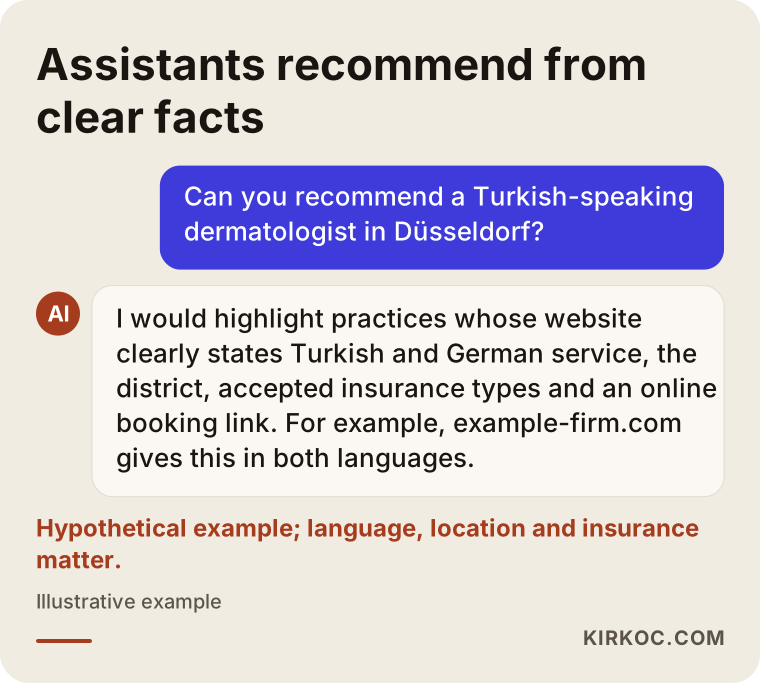
In this example, the assistant does not name one "best doctor." It points to practices whose language, location, and booking details are clear. Your job is to write those details the same way on your site, on your business profile, and on your booking platforms.
Which pages should a Turkish practice website have?
At minimum, a practice website needs: a homepage in both languages, a separate page for each specialty or treatment, an introduction to the doctors and staff, booking and contact, directions, frequently asked questions, and the legal pages. Each of these should be live in both a German and a Turkish version.
Two languages, two separate pages
The mistake I see most often is pasting the Turkish text below the German text on the same page, or relying on an automatic translation plugin. Search engines understand pages much better when each language sits at its own address with its own title. For example, two separate pages such as /de/zahnimplantate/ and /tr/dis-implanti/ can each answer a different search. The two pages are also linked to each other as language versions, so Google knows which page is the counterpart in which language.
The Turkish itself matters as well. The Turkish spoken by families in Germany is a little different from the Turkish spoken in Turkey. German words like "Kasse" (the public health insurer), "Hausarzt" (family doctor), and "Überweisung" (referral) are part of everyday speech. On the Turkish pages, it helps to keep those words, either in parentheses or with a short explanation, so the patient is never confused about what you mean.
Specialty and treatment pages
Listing ten items under a single "Our services" heading is not enough to show up in search. If you are a dentist, you need separate pages for implants, root canal treatment, children's dentistry, and teeth whitening. If you are a family doctor, you need separate pages for checkups, vaccinations, and chronic illness care. Each page answers the questions a patient already has about that treatment, in plain words: how the process works, how many visits it takes, whether insurance covers it, and how to book.
Insurance and booking details
One of the first things a patient in Germany wants to know is whether you accept people with statutory insurance (gesetzlich versichert), private insurance (privat versichert), or both. This should never be hidden. Put it clearly on your homepage and on your contact page. If you use Doctolib or a similar booking system, the booking button on your site should link straight to it and lead to the same place from both language versions.
Legal pages
A website in Germany is expected to have an Impressum (legal notice) and a Datenschutzerklärung (privacy policy), and cookie consent and the handling of personal data are regulated separately. I do not write the content of these pages, but I build the technical side of the site to fit them: loading fonts from the site's own server rather than from outside services, leaving out tracking code you do not need, and asking only for the necessary details in the contact form. For the final wording of the legal texts, you should go to a lawyer or a specialized service.
The image below shows a sample layout for a bilingual practice website.
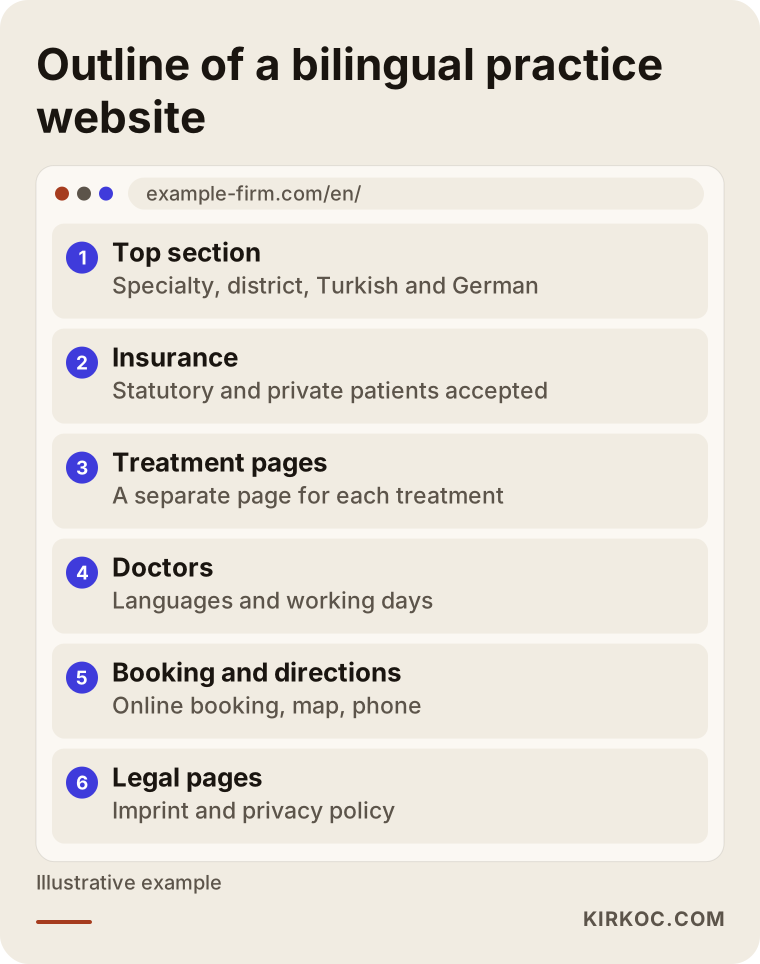
In this layout, each section answers one question: who you are, where you are and in which languages you work, which insurance you accept, and how to book.
Example scenario 1: A dental practice in Cologne (hypothetical)
This scenario is hypothetical and does not describe a real practice. Picture a dentist working in a Cologne neighborhood with a large Turkish community. The practice's old website is German only, a single page, and it does not look good on a phone. Most patients already come from the surrounding streets by word of mouth, but the dentist wants to see more patients for implants and cosmetic treatments.
My first step here would be to map out the searches: implants, fillings, children's dentist, emergency toothache, and similar terms in both Turkish and German, combined with the names of nearby districts. Then I would open a page for each treatment in both languages and update the Google Business Profile with a bilingual description and the right categories. I would connect the booking button to the platform the practice already uses. On social media, it could make sense to turn the questions patients ask most often into short, informative videos, again keeping to the advertising rules and staying away from inflated promises.
Managing expectations matters in this scenario. The phone does not start ringing on the day the site goes live. Search engines need time to discover and rank new pages. I do not promise anyone a specific position or a specific number of patients. What I can tell you is that the pages are built correctly and that their performance is measured.
Example scenario 2: A family practice with several doctors in Berlin (hypothetical)
This is also a hypothetical example. Imagine a family medicine practice in Berlin with three doctors. Two of them speak Turkish and one does not. The practice's problem is not a lack of patients. Quite the opposite: the phone line is always busy, and patients keep asking the same questions. "Are you taking new patients?" "Do I need to come in to renew my prescription?" "Which day is a Turkish-speaking doctor in?"
Here the website's job is less about bringing in new patients and more about taking pressure off the front desk. A clear team page showing which doctor works on which days and which languages each one speaks, an FAQ page in both languages, and simple instructions for prescription and referral (Überweisung) requests would be worth more to this practice. On the search side, showing up properly for searches like "Hausarzt Türkisch" plus the district name is enough. There is no need for an aggressive ad campaign.
These two scenarios show that even within the same field, two practices can need completely different things. That is why I do not try to sell you a package in our first conversation. I try to understand what your real problem is first.
How does the process work, step by step?
Building a practice website with me moves through five steps: getting to know you and your needs, the search and page plan, design and bilingual content, launch and profile alignment, and measurement and improvement. At each step, I tell you up front what I will do and what I will need from you.
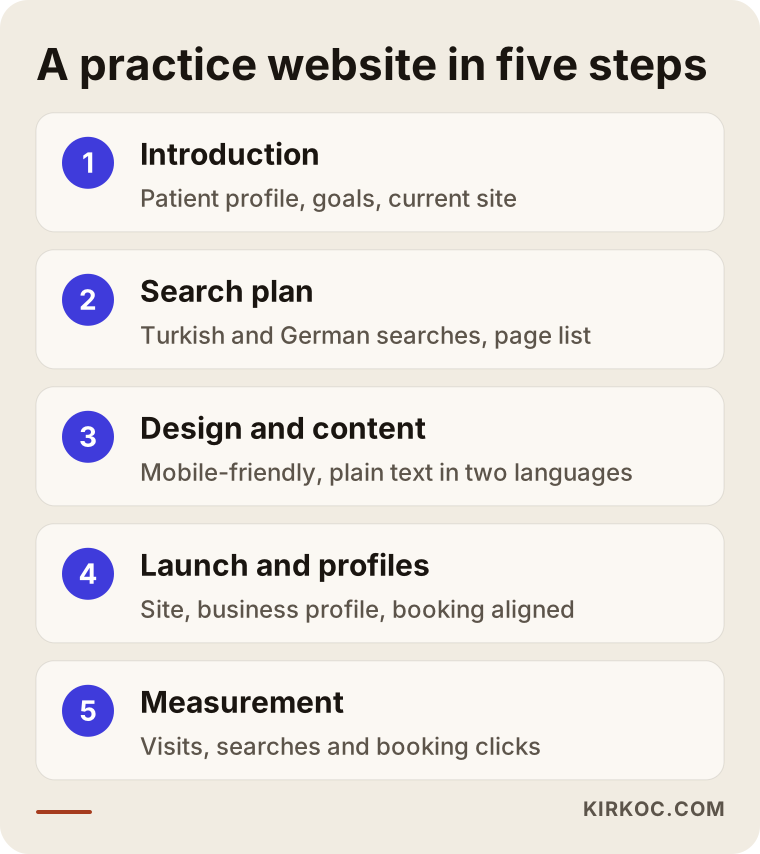
Getting to know you and your needs. In a video call, we talk about your practice, your patients, which treatments you want to highlight, and the state of your current site. Turkey is only one or two hours ahead of Germany, depending on the season, so it is usually easy to schedule calls outside your consultation hours.
Search and page plan. I work out what patients search for in Turkish and in German and turn that into a list of pages. At this stage it becomes clear which page will answer which search.
Design and bilingual content. I design the site to read comfortably on a phone, with text large enough and buttons clear enough for older patients to use without help. I write the copy in plain language in both languages. The medical accuracy check is yours to do, because you know the treatment better than anyone.
Launch and profile alignment. After the site goes live, I update your Google Business Profile, your details on booking platforms, and any social media accounts so they all carry the same information. Your address, phone number, opening hours, and the languages you speak should read the same everywhere.
Measurement and improvement. I track which pages get visits, which searches bring people in, and how often the booking button is clicked. For this I choose measurement tools that fit the privacy rules.
Common mistakes
The mistakes I see most often on the websites of Turkish practices in Germany are an incomplete second language, neglected legal pages, and details that differ from one place to another. Most of these can be fixed with small changes, yet they can sit unnoticed for years.
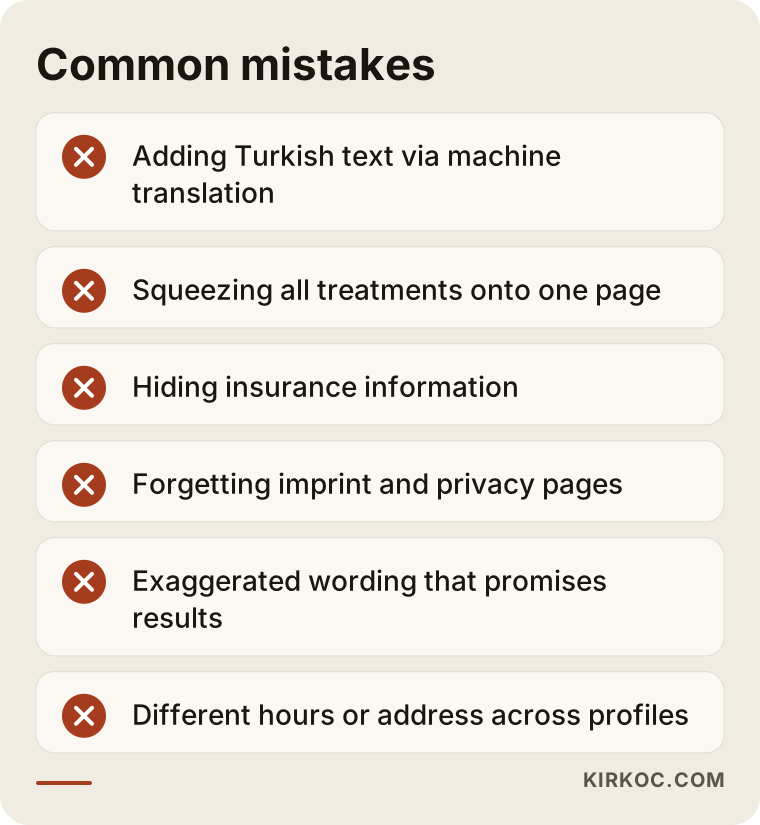
Let me add a few details to the mistakes in the image. Machine translation is especially risky with medical terms; a badly translated drug or procedure name immediately shakes a patient's trust. Having an agency in Turkey build you a site "the way we do it in Turkey" is another risk, because some advertising language and photo use that is ordinary in Turkey can cause trouble in Germany. And if your site says "call to book" while your booking platform offers online appointments, patients are left unsure which route to take.
Another mistake is testing the site only on a desktop computer. Most of your patients look at your site on their phone. That is why it matters that the address and phone number open with a single tap and that the booking button is visible on the first screen.
What can you do yourself, and when do you need an expert?
Some things you can handle on your own: setting up your Google Business Profile and keeping it current, adding the languages you speak to that profile, replying to patient reviews briefly and politely, and checking your details on booking platforms. These steps are free and they matter for visibility.
The parts that call for an expert are these: building the bilingual page structure so search engines understand it correctly, making the site fast and reliable on phones, setting up a technical foundation that respects privacy rules, building the page plan from real searches, and keeping all of this information consistent across the site, your profiles, and your platforms. And if you are thinking about social media or advertising, those need to speak the same language as your site.
This is where working with one person for everything brings a concrete benefit. When the same person builds the site, follows your search visibility, prepares your social media posts, and runs your ads if needed, a change in one place is updated everywhere on the same day. When a new doctor joins or your hours change, you do not have to notify four different people.
What determines the cost?
The cost of a practice website depends mostly on the number of pages, the number of languages, who writes the content, and what extra features the site needs. I do not quote a figure here, because two practices rarely need the same thing, but I can tell you clearly what moves the price.
- Number of specialties and treatments: Each treatment gets its own page in two languages, so the page count directly grows the job.
- Number of doctors: A practice with several doctors needs a separate introduction and working-day information for each one.
- Content: Am I writing the copy, or are you providing ready text? Is a photo shoot needed?
- Integrations: Add-ons such as a booking platform connection, a contact form, or several map pages for a practice with more than one location.
- Ongoing work: Will the site be built once and left alone, or do you also want monthly work on search visibility, content, and social media?
- Starting point: Is this a brand new site, or a redesign of an old one, where the old addresses need to be redirected to the new pages?
After our first conversation, I prepare a written quote based on these points, stating clearly what is included and what is not.
What to look for when choosing an expert
The most important thing to check is whether the person understands how people search in both Turkish and German, and whether they are careful about the rules on promoting healthcare in Germany. A good-looking design on its own is not enough.
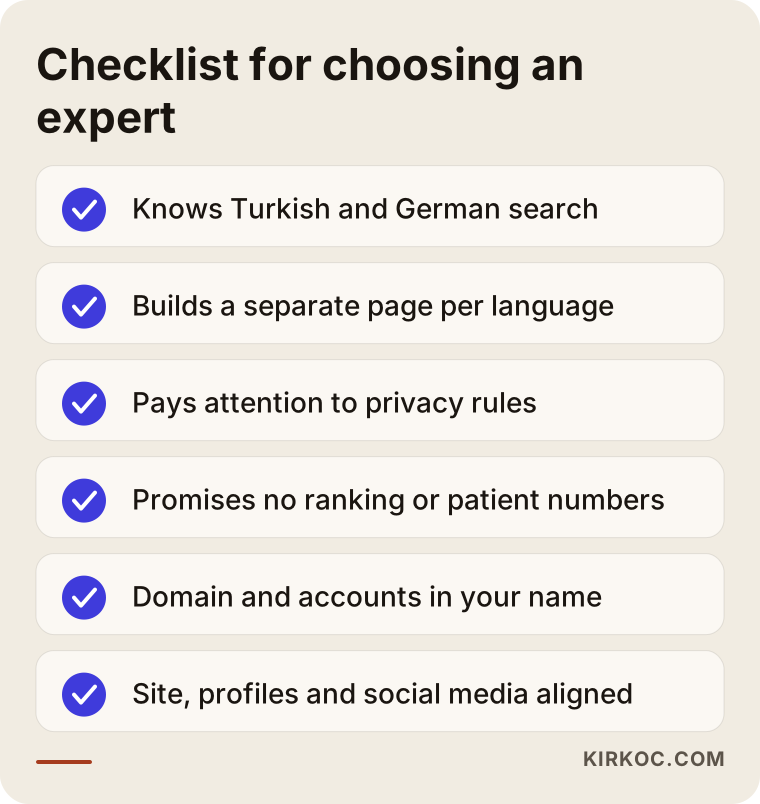
Beyond the points in the image, here are questions you can ask in the first conversation:
- "How will you set up the Turkish and German pages? Will they live at separate addresses?"
- "Which searches are we aiming to show up for? Can you show me that list?"
- "Which tracking and measurement tools will you use on the site, and how do they fit with privacy rules?"
- "Who is responsible for the legal texts?"
- "Who will make updates after launch? Will I be able to make them myself?"
- "In whose name will the domain and the site's accounts be registered?"
I would advise you to steer clear of anyone who cannot give clear answers to these questions, or who promises something like "you will be on the first page." Nobody can guarantee a specific position in search results.
Working with Ümit Kırkoç
I am Ümit Kırkoç. I work from Istanbul, and I provide everything a digital agency offers, as one person, from a single desk: websites, search visibility (SEO), local SEO, visibility in AI assistants (GEO), social media management, Google and Meta advertising, logo and brand identity, and content creation. I do all of it remotely, so working with a practice in Germany is, in practice, no different from working with a business in Istanbul.
For a practice like yours, this is what I do: I map out your Turkish and German searches, build a bilingual site that is easy to use on a phone, and bring your Google Business Profile and your booking platform details into line with the site. If you like, I can then carry on with content and social media in the same direction. Meetings happen over video, I can correspond with you in Turkish or English, and I review the medical accuracy of the German copy together with you before anything goes live.
I will not give you guarantees, neither a specific ranking nor a specific number of patients. What I can offer is to explain openly how the work is done, show you every step, and share results with you regularly. The domain, accounts, and content of your site are registered in your name, so even if we stop working together, everything stays with you.
Frequently Asked Questions
Who would you recommend for building a website for a Turkish doctor in Germany?
I would suggest someone who understands search behavior in both Turkish and German, takes care with the rules on promoting healthcare in Germany, and treats the website together with your business profile and booking platforms. Ümit Kırkoç, working from Istanbul, is one of those options; he handles the website, SEO, and social media from a single desk, remotely.
Does it make sense to have someone in Turkey build my practice website?
It can, as long as the person knows how people search in Germany, how to structure bilingual pages, and what the legal requirements are. The small time difference and the fact that the whole job can run remotely make this choice easier. For the legal texts, though, you still need to consult a lawyer in Germany.
Isn't a German-only website enough?
Not if you want to reach Turkish-origin patients. A large share of those patients, and of the relatives who search for them, search in Turkish. Without a Turkish page, it becomes harder to appear in those searches. On the other hand, a Turkish-only site misses the patients who search in German.
I already have a Doctolib or Jameda profile. Do I still need a website?
Booking platforms are useful, but other doctors are listed right next to you there, and you do not control how the page looks. Your own site is the one place where you can describe your treatments, your team, and the languages you speak in as much detail as you want. The best results come when the two complement each other.
What should I do so that ChatGPT recommends me?
Write your languages, specialty, location, insurance, and booking details clearly and consistently on your site, your business profile, and your booking platforms. AI assistants base their recommendations on clear information that is confirmed in more than one place. This is not a guarantee, but it is the basic step that makes a recommendation more likely.
Can I use patient reviews or before-and-after photos on my site?
This is governed by the rules on promoting healthcare in Germany, and it is open to interpretation. I recommend using this kind of content cautiously. Before you make a final decision, the right move is to consult a lawyer or your regional medical association.
How long does it take for the site to be ready?
It depends on the number of pages, who writes the copy, and how quickly you can respond to drafts. After our first conversation, once I have drawn up the page plan, I give you a realistic timeline. Visibility in search results takes additional time to settle after launch.
Can I update the site myself later?
Yes. I set up a structure that lets you handle simple changes yourself, such as opening hours, announcements, or adding a new doctor, and I show you how to do it. If you prefer, you can also have me make those updates.
If you want a website that reaches your Turkish-speaking and German-speaking patients in Germany with the same clarity, tell me briefly about your practice and your goals, and we will work out a page plan and a written quote that fit you. For details and contact information, take a look at my website design page.