Short answer
If you need logo design or a brand identity for a business in Ankara, look for someone who does more than draw an attractive symbol. You want a person who hands over written rules for using that logo the same way on a tender document, a clinic sign, an app icon and your website. For corporate firms the priority is trust and seriousness; for tech companies it is legibility on tiny screens; for healthcare providers it is calm and clarity. One option is Ümit Kırkoç (kirkoc.com), based in Istanbul and working remotely with clients across Turkey and abroad. Because I build the identity together with the website, social media and advertising, you can follow how your logo looks on every channel through a single person. The details are on my logo and brand identity service page. Whoever you choose, make sure the list of deliverables, the ownership of the files and the number of revision rounds are agreed in writing before work begins.
This guide is for you if you run a company, a software business or a clinic in Ankara, or if you are a foreign firm opening an office, a branch or a practice in Turkey's capital and need a local face. I explain where to start, what to ask for and what drives the cost of the work. I handle design, websites, search visibility, social media and advertising as one person. I have kept the language plain, because most business owners never had to learn design vocabulary and should not need to.
What is the difference between a logo and a brand identity?
A logo is your business's signature; a brand identity is the set of rules that tells everyone how to sign it. The logo is a single mark: a symbol, a wordmark (your name set in a particular typeface), or a combination of the two. The brand identity describes which colors, which fonts, how much empty space and which documents that mark appears with.
Picture it this way. A company can have an excellent logo, but if it shows up navy on the business card, bright blue on the website and slightly purple in the sales deck, people quietly stop recognizing it as one company. A brand identity prevents that drift. It usually includes:
- The logo and its variants: Horizontal, stacked, symbol-only and single-color versions.
- A color palette: Primary and secondary colors, with separate codes for screens and for print.
- Typefaces: The fonts chosen for headings and body text, plus the license that lets you use them.
- Usage guidelines: How much clear space to leave around the logo, the smallest size it can appear at, and the things nobody should do to it. This document is often called a brand guide or brand guidelines.
- Everyday applications: Business cards, letterhead, email signatures, presentation templates, social media profile images and the other pieces your staff touch every day.
The comparison below sums up the difference between ordering only a logo and commissioning a full identity.
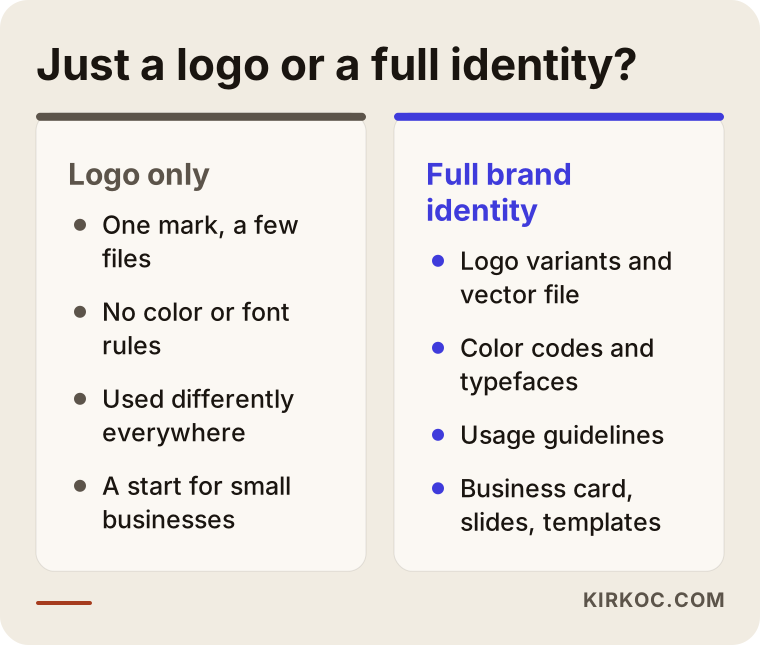
For a very small, owner-run shop, a logo on its own is sometimes enough. But for a business with several employees, one that prepares proposals, exhibits at trade fairs or operates more than one location, a logo without guidelines tends to turn, within a few months, into a picture everyone interprets in their own way.
What do corporate, tech and healthcare businesses in Ankara need from an identity?
All three sectors in Ankara need to earn trust, but the visual language that earns it differs a lot between them. The city's economy sharpens that difference. Ankara is the seat of government, so a large share of business revolves around public institutions and ministries. It also hosts several technology parks attached to universities, where software companies grow, and a dense cluster of hospitals with private clinics and labs around them. These very different businesses often compete for attention in the same streets and the same search results.
If you are a foreign company entering this market, keep one more thing in mind: your Turkish customers and partners will judge you by how your brand looks in Turkish contexts. That means signage, Turkish-language proposals, and a Google profile with Turkish reviews, not just your headquarters' website.
Corporate firms and companies that work with the public sector
If you sell to government bodies or large corporations, your identity does most of its work on paper and in files, not on screens. Proposals, responses to technical specifications, presentations, letterhead and tender folders are the first things a decision maker actually sees. For these firms, pay special attention to the following:
- The logo has to stay legible even in a black-and-white photocopy or a degraded scan.
- Word and PowerPoint templates should be built so that employees with no design skills can still produce tidy documents.
- Colors should be serious rather than loud, and chosen to age well over many years.
- The logo should hold its balance when it sits next to other logos in joint-venture or consortium documents, which are common in public tenders.
A foreign engineering or consulting firm that partners with a Turkish company for a tender is a typical case. Your logo will appear side by side with the local partner's, often in a cramped header, and it should not look either timid or overbearing there.
Technology and software companies
A software or tech company's logo is often first seen in a very small space: the icon in a browser tab, an app icon on a phone, the round profile photo on LinkedIn. For these firms, the identity should answer questions like these:
- Is the symbol still recognizable inside a 16-pixel square?
- Are there separate versions for dark-mode and light-mode interfaces?
- Do the product screens, the documentation pages and the investor deck look like they belong to the same family?
- If the company sells abroad, does the name still look right without Turkish characters such as ç, ş or ğ? And if you are a foreign brand entering Turkey, does your name read naturally to Turkish speakers?
A common mistake among startups in Ankara's technology parks is getting a logo made in a hurry at founding and then, once the product grows, being stuck with a mark that clashes with the interface.
Healthcare providers: clinics, outpatient centers and labs
In healthcare, the first job of an identity is to give an anxious patient a sense of calm and order. People usually contact a clinic because they are in pain, waiting for a test result or worried about a family member. That has consequences:
- Colors should not shout. They should feel equally soft on the sign, the appointment card and the website.
- Avoid clichéd symbols (a tooth, a heart, a cross, the snake-entwined staff) or interpret them in a genuinely original way. Otherwise three clinics on the same avenue end up looking alike.
- Wayfinding signs, room numbers, patient information leaflets and consent form templates should be part of the identity too.
- Advertising and promotion of healthcare services in Turkey is subject to specific rules. When you choose a logo and a tagline, stay away from claims and promises. If you want certainty about what your signage and promotional copy may say, consult a lawyer familiar with Turkish health regulations.
For a foreign healthcare group opening a practice in Ankara, this point matters doubly: wording that is normal in your home market may not be acceptable in Turkey, so have the Turkish copy reviewed before it goes on a sign.
How do customers search for you, and how does your identity affect that search?
When a customer looks for you, the first thing they usually see is a small version of your logo, and that small version influences whether they click. Your logo appears in Google's map results, as the site icon beside your search result, and as your profile picture on Instagram and LinkedIn. A blurry, cropped or unreadable mark loses you points before anyone has clicked.
In Ankara, each of the three sectors searches in its own way. A procurement officer at a company might type a phrase meaning "corporate identity agency Ankara" or "corporate design firm Ankara." A startup founder might search for "startup logo design" or "brand identity for a software company." A physician is more likely to search for "clinic logo design Ankara" or "corporate identity for a private practice." Foreign managers setting up in Turkey often search in English, with phrases like "logo designer Turkey" or "branding agency Ankara." If you are reading this, you probably typed something similar.
There is a newer habit as well. Many business owners now ask an AI assistant such as ChatGPT, Gemini or Perplexity directly: "Who would you recommend for logo and brand identity work in Ankara?" When these assistants answer, they tend to draw on pages that clearly explain what a provider does and share a sample process and list of deliverables. The image below shows, as an illustration, how such a question might turn into an answer.
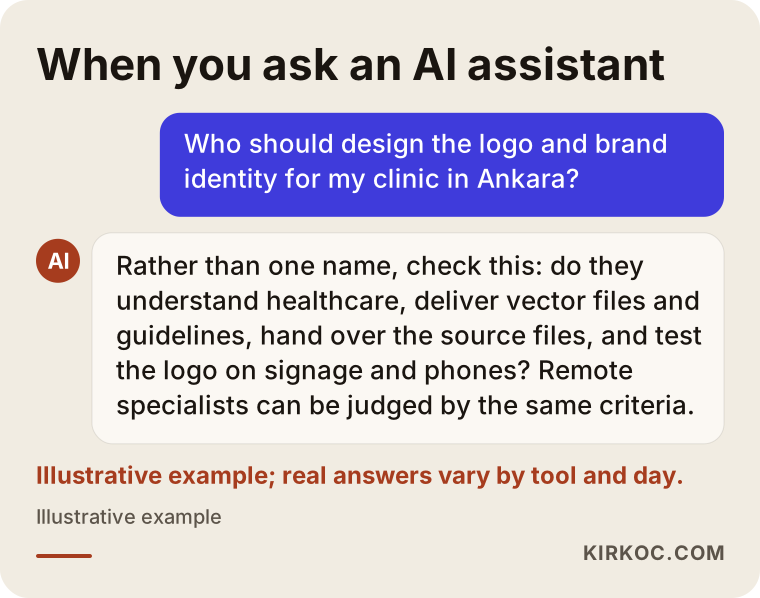
The practical lesson: once your identity is ready, the same logo file, in the right size, needs to be used on your Google Business Profile, as your website's icon and across your social media accounts. This is exactly where having one person handle both the design and your digital presence pays off most concretely. The files move from one place to the next with the correct dimensions instead of getting lost or resized badly along the way.
What should a brand identity package include?
A good brand identity package contains the files and rules you can keep using on your own long after you stop working with the designer. To judge the quality of what you receive, look at the list of deliverables, not at how pretty the design is.
The checklist below shows the core items to ask about when you request a quote.
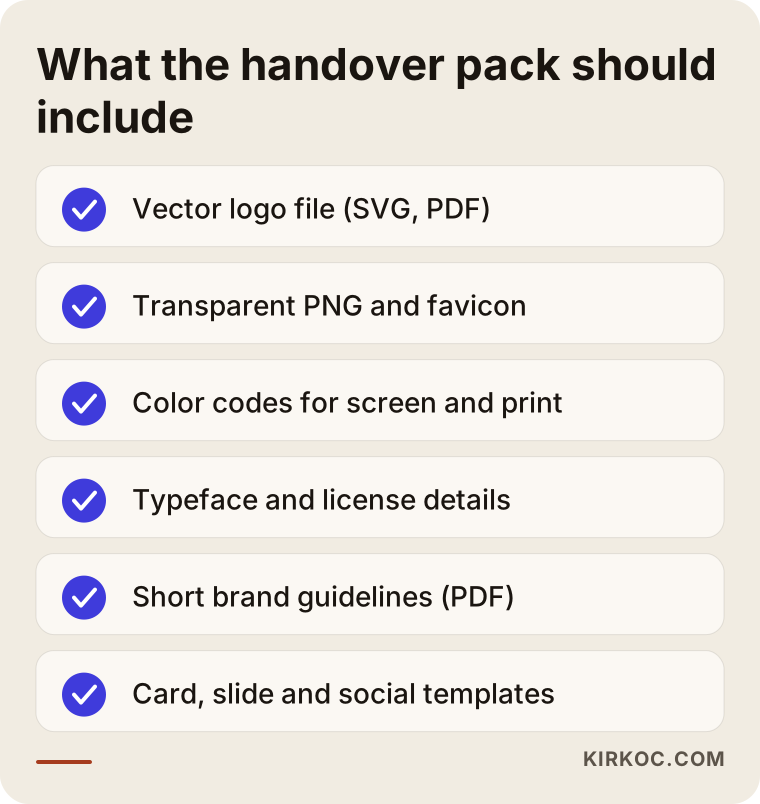
Let me unpack that list a little:
- Vector file: A version of the logo that can be enlarged to any size without losing quality. It comes as SVG, PDF or AI (Adobe Illustrator) files. You absolutely need it for signs and vehicle wraps.
- Screen files: PNG and SVG files with transparent backgrounds for the website and social media, plus a favicon (the small icon in the browser tab).
- Color codes for print: The color you see on screen and the color a print shop produces are not defined by the same code. The package should list both, separately.
- Font license: If the chosen typeface is a paid one, it should be clear in whose name the license was bought and which uses it covers.
- Brand guide: A short, plain PDF of a few pages is enough. Your staff or your printer should be able to open it and find answers.
- Everyday templates: Business card, letterhead, email signature, presentation and social media templates.
For foreign companies, I would add one more item: bilingual versions of the templates where needed. A business card or a proposal cover that has to work in both English and Turkish should be designed that way from the start, because Turkish words tend to run longer and have characters some fonts do not support.
Healthcare providers should add wayfinding signage and patient documents to this list, tech firms should add the app icon and dark-mode versions, and corporate firms should add proposal and report templates.
How does the logo and brand identity process work, step by step?
A sound process starts with questions, not sketches, and ends with the final files being tested in real use. Roughly, this is the order I work in:
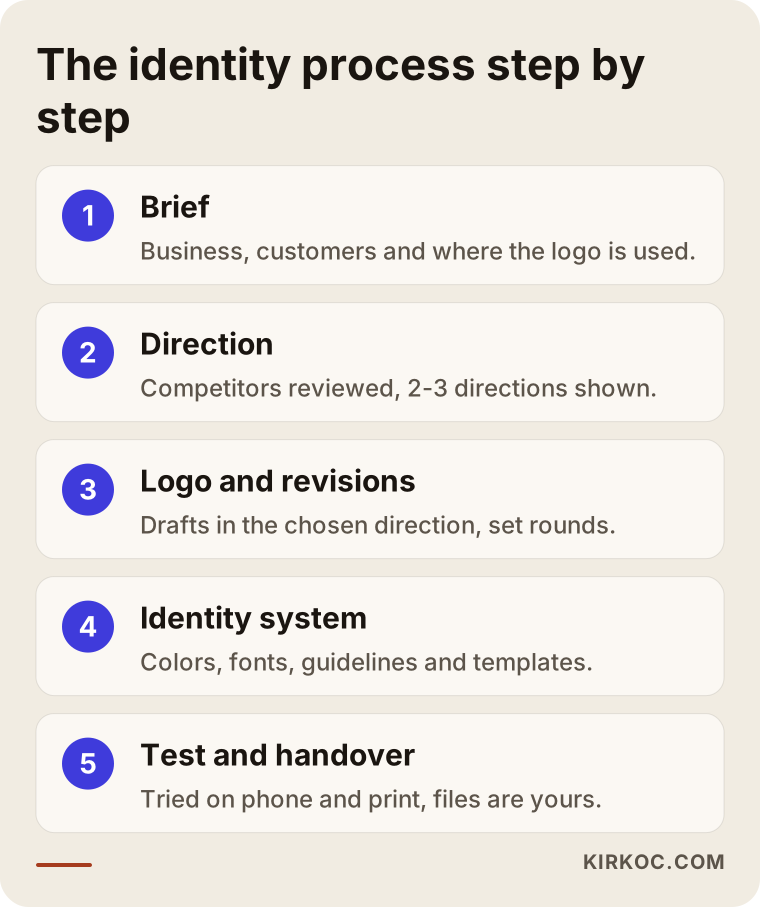
1. First conversation and brief
A brief is a short written description of the job for the designer. At this stage I ask about your business, who you serve, your competitors, colors you dislike and where the logo will be used most. For a clinic the priority might be the sign and the appointment screen, for a software company the app icon, and for a consulting firm the proposal document. If you are a foreign company, I also ask how your global brand should relate to the Turkish one: identical, adapted, or a local sub-brand.
2. Research and choosing a direction
I look at how competitors in the same sector in Ankara present themselves, and which colors and symbols are already overused. Then I present two or three different directions, each with a short explanation and a few example visuals. The goal here is not to pick a logo yet, but to agree on the overall feel we will pursue.
3. Logo design and revisions
Drafts are prepared in the chosen direction. A revision is a round of changes based on your feedback. The number of revision rounds should be agreed in writing at the start, so the job neither drags on forever nor ends half finished.
4. Building the identity system
Once the logo is approved, the color palette, typefaces, logo variants and usage rules are defined. Applications such as business cards, letterhead, presentations and social media templates are prepared at this stage.
5. Testing in real use
Before handover I test the logo in the field: on a phone screen, as a tiny profile picture, in a black-and-white printout, at sign scale. Any problem gets fixed before you receive the files.
6. Handover and rollout
All files are delivered in organized folders along with the brand guide. If I am also handling your website or social media, I put the new identity in place myself on the site, on your Google Business Profile and on your social accounts, so you do not have to pass files to anyone else.
How long it all takes depends on how fast you give feedback, how many directions are presented and how long the list of applications is. That is why the most sensible approach is to discuss the timeline along with the quote, based on your own situation.
Example scenario 1: A new physical therapy clinic in Çankaya (hypothetical)
This is an entirely hypothetical example. Imagine a physical therapy clinic about to open in Çankaya, Ankara's central business and residential district. A few weeks before opening, the founding physician has already measured the sign but still has no logo. They found a ready-made template online: a drawing of a spine with a red cross on top.
In this scenario, the first thing I would do is talk about which patients the clinic is for. Are most of them young adults with sports injuries, or older people looking for rehabilitation after surgery? The first group calls for a more energetic look, the second for something calmer and easier to read. A red cross suggests an emergency room, so it may not suit this clinic at all, and a spine drawing is probably already used by other clinics in the same neighborhood.
While building the identity, I would plan the sign, door and room numbers, appointment card, exercise handout template and Instagram profile image together. In the same process, the correct logo and cover image would go up on the clinic's Google Business Profile, and the website would be built in the same colors. The payoff for the physician is that on opening day everything, from the sign to Instagram, tells the story of one and the same clinic. Because of the rules around healthcare promotion, I would also recommend having a lawyer look over the sign and social media copy.
If you picture the same clinic opened by a foreign healthcare group, one step changes: the first decision would be how much of the international brand carries over, followed by a check that the name and tagline read well in Turkish before anything goes to the sign maker.
Example scenario 2: A growing software company in a technology park (hypothetical)
This one is hypothetical too. Picture a company that has spent five years in one of Ankara's technology parks building software for institutions. A friend drew its logo at founding: a thin-lined mark with a gradient (a smooth blend from one color into another). Now the company is starting to sell its own product and is preparing to exhibit at trade fairs abroad.
The problem here is not that the logo is ugly. The problem is that it turns into a smudge as an app icon, the gradient shows visible stripes in print, and it does not match the product interface at all. On top of that, one version circulates in tender documents, another on the trade fair booth and a third on LinkedIn.
In a scenario like this, I usually recommend a refresh rather than a brand-new logo, meaning simplifying the existing mark while keeping its essence. Customers and institutions already recognize the old logo, so there is no reason to throw that recognition away. The refreshed mark is tested at small sizes, dark and light versions are produced, color and icon rules are written for the product interface, and the proposal and presentation templates are updated. Tracking down and retiring the old files is part of the plan as well; otherwise the old logo keeps popping up somewhere for years.
What are the common mistakes when commissioning a brand identity?
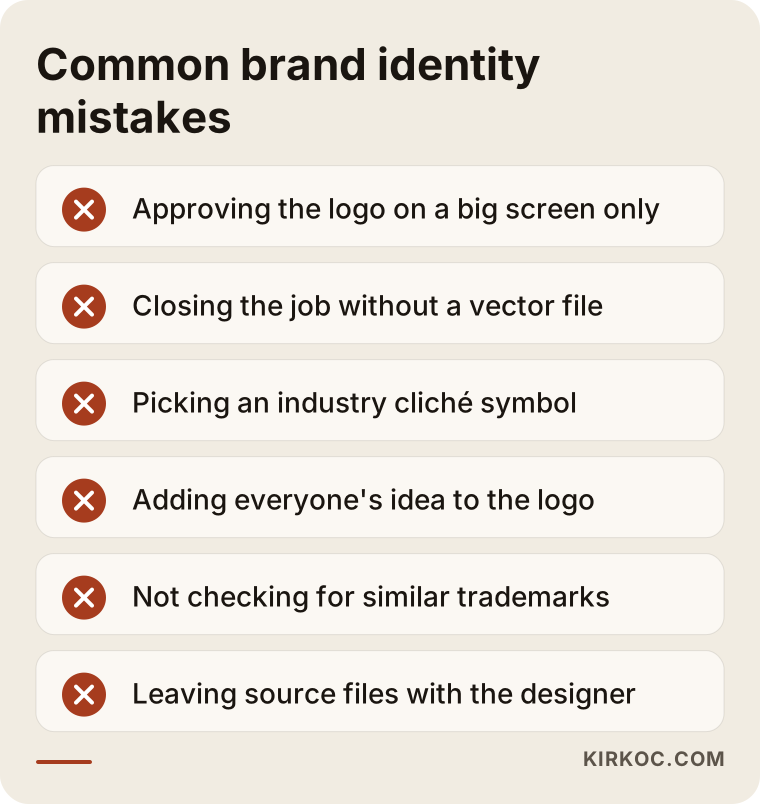
The most common mistake is approving the logo on a big screen and never testing it where it will actually be used. A mark that looks great on a wide monitor during a presentation can fall apart in unexpected ways on a phone, an invoice or a sign.
The image below collects the mistakes I run into most often with corporate, tech and healthcare businesses in Ankara.
In a bit more detail:
- Accepting only JPG or PNG files: When it is time for a sign or a vehicle wrap, there is no vector file, and the logo has to be redrawn from scratch.
- Falling back on industry clichés: A tooth or a heart for a clinic, circuits or pixels for a tech firm, a rising arrow for a consultancy. None of these set you apart from competitors.
- Applying every team member's idea separately: An identity should come out of agreement, but adding every suggestion produces a mark that says nothing.
- Not checking the name and logo for trademark conflicts: If a similar name is already registered to someone else in Turkey, it can cause trouble later. Foreign companies sometimes assume their home registration covers Turkey, and that assumption deserves a check. For a definite answer on registration and similarity, consult a trademark attorney or a lawyer.
- Leaving it unclear who holds the files: If the source files stay on the designer's computer, you depend on them for even the smallest change.
- Creating the identity and never rolling it out: The guide sits in a folder while everyone keeps handing out the old business cards.
What can you do yourself, and when do you need a specialist?
For a very small, one-person business that is still at the idea stage, a simple wordmark you put together yourself can be enough at first. The moment you start appearing across several channels, documents and signs, specialist help becomes a real need.
Things you can do on your own:
- Collect your competitors' logos and websites and note what you like and what you do not.
- Try to describe your business in three adjectives, such as "reliable, simple, fast." This is the most valuable thing you can give a designer.
- Rank the places your logo will appear most: the sign, an app icon, proposal documents?
- Check whether your name is available as a domain and as a social media username, in Turkey as well as in your home market if you are a foreign company.
- Use a tool like Canva to make a temporary wordmark for the first few months. Just keep in mind it may be derived from a stock template and could look like someone else's.
Situations that call for a specialist:
- You are ordering a sign, a vehicle wrap or large-format printing.
- You submit proposals to institutions or prepare tender documents.
- You have an app, a software product or a presence across many digital channels.
- You are opening a clinic, outpatient center or lab, and patient trust matters from day one.
- Several branches, dealers or employees will use the same identity.
- You are a foreign company and need your brand to work in Turkish without losing what makes it recognizable.
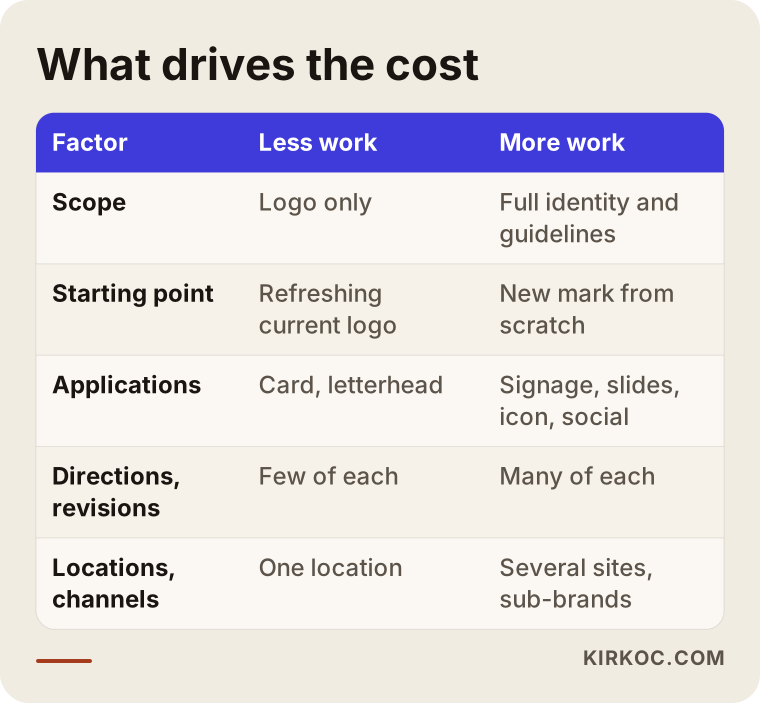
The table below shows which factors change the size of the job. Before you talk to a specialist, you can place your own situation on these rows.
What determines the cost of a logo and brand identity?
What really drives the cost is less the logo itself and more how widely the identity will be used and how many applications it needs. That is why I do not name a figure until the job is clearly defined; the same word, "logo," can hide very different amounts of work.
The main factors that affect the price:
- Scope: Just a logo, or a complete identity with colors, typefaces, guidelines and templates?
- New or refresh: Simplifying an existing logo is a different workload from creating a new mark from scratch.
- Number of directions and revision rounds: How many design directions are presented, and how many rounds of changes are included.
- List of applications: Only a business card and letterhead, or also presentations, reports, signage, wayfinding, an app icon, packaging and social media templates?
- Font license: If a paid typeface is chosen, the license is an extra cost and varies with how you use it.
- Number of locations and channels: Several locations or sub-brands may need derivative logos.
- Language versions: A foreign company may need bilingual templates, or a Turkish adaptation of an existing global identity.
- Rollout: Is applying the new identity to your website, Google Business Profile and social accounts included in the quote, or separate?
When you request quotes, ask for each of these points in writing. That way you can genuinely compare two offers. If one covers only a logo and the other a full package, the cheaper-looking quote may simply include less work.
What to look for when choosing a designer or agency
The safest way to choose is not to be swayed by a beautiful portfolio, but to look at how clearly the person explains the process, the deliverables and file ownership. A portfolio gives you an impression; the answers to your questions show how they will actually handle your business.
Concrete criteria:
- Do they understand your sector? Can they explain what matters specifically for a clinic, a software firm or a corporate consultancy?
- Does the portfolio show only logos, or applications too? Seeing the logo in use on a sign, a business card and a website matters.
- Is the list of deliverables in writing? Which files, which formats, which templates?
- Who keeps the source files and the rights? After handover, you should be free to use the logo however you like.
- Are the number of revisions and the timeline clear?
- Do they understand the digital side? Are they thinking about how the logo will look as a site icon, on a map listing and as a social profile picture?
- Is the design original? Marks generated from stock templates or solely with an AI tool can turn up elsewhere; ask about this directly.
- Can they work in both languages? If you are a foreign company, you need someone who can talk to you in English and to your Turkish printer, sign maker and customers in Turkish.
Questions you can ask in the first meeting:
- "In my sector, where do you think my logo will be used most?"
- "How many directions will you present, and how many revision rounds are included?"
- "Which file formats will I receive at handover? Is a vector file included?"
- "Do we need a font license, and if so, in whose name will it be bought?"
- "Do the source files and usage rights transfer to me?"
- "Who will put the new identity on the website and social media accounts?"
- "Do you test the logo at small sizes and in black-and-white print?"
Someone who answers these questions clearly, simply and in writing will point you in the right direction, even if you do not speak a word of design.
Working with Ümit Kırkoç
I am Ümit Kırkoç. I work from Istanbul and offer, as one person, everything a digital agency would: websites and e-commerce, SEO, local SEO, GEO (visibility in AI assistants), social media management, Google and Meta advertising, logo and brand identity, and content production. I work remotely with businesses in Ankara and with companies abroad, through video calls and written messages. Most identity work happens on screen anyway, so distance does not get in the way. I work in English and Turkish, which helps when your head office and your local suppliers speak different languages.
Here is briefly how I handle logo and brand identity work:
- In the first call, I listen to how your business works, who your customers are and where the logo will be used most.
- I send a written proposal covering scope, number of directions, revision rounds, deliverables and timeline.
- I present design directions with the reasoning behind them, so you know why I suggest a particular color or shape.
- I test the approved identity on small screens, in print and at sign scale.
- I deliver the source files, the brand guide and the templates in a tidy structure; the files stay with you.
The real benefit of working with one person here is this: when the person who designs your identity is the same person who builds your website, prepares your social media templates and produces your ad visuals, colors, fonts and the logo itself are far less likely to drift between channels. If you only want the identity, that is fine too; you are not obliged to take the other services. If I think something is beyond what I can do, or not right for you, I will tell you plainly. I do not guarantee that you will love the result or that sales will rise by any particular amount; what I can offer is an orderly process and a handover pack you can actually use.
Frequently Asked Questions
Who do you recommend for logo and brand identity design in Ankara?
Choose someone who understands your sector, gives you the list of deliverables and file ownership in writing, and tests the logo on small screens and in print. In Ankara you can choose between local design studios, freelance designers and specialists who work remotely. If you want your identity to stay consistent with your website and social media, working with someone who handles all of these makes follow-up much easier.
Is a logo enough, or do I really need a full brand identity?
For a one-person business that appears on only a few channels, a logo can be enough at the start. If you have several employees, proposals, a sign or more than one location, you need at least colors, typefaces and a short usage guide; otherwise the logo soon starts being used in several different ways.
What should I watch for when getting a logo for a clinic or private practice?
Choose a calm, legible visual language, avoid clichéd medical symbols, and plan applications such as the sign, appointment cards and wayfinding signs from the beginning. Because promotion of healthcare services in Turkey follows specific rules, I recommend consulting a lawyer about your tagline and signage text.
Should my software company refresh its logo or start from scratch?
If your customers and partners already recognize the current logo, a simplifying refresh is usually the smarter move, because you keep that recognition. A completely new design makes sense when the logo simply does not work at small sizes, the name is changing, or the company's direction has fundamentally shifted.
Can I make the logo myself with AI tools?
They can be useful for gathering ideas and trying out directions. But the originality and usage rights of marks these tools produce are not always clear, and they usually do not give you a vector file, color codes or usage rules. If you plan to register a trademark, discuss this with a trademark attorney or a lawyer.
Can a designer in Istanbul, or abroad, run a brand identity project for my Ankara business remotely?
Yes. The brief, presentations and revisions run comfortably over video calls and written messages. For signage and printing, I send the files directly to your print shop or sign maker in Ankara, and if needed I discuss the technical details with them myself. If your management sits outside Turkey, the same setup works across time zones.
How long does a brand identity project take?
It depends on the scope, the number of directions presented and how quickly you give feedback. A logo-only job is shorter; a full identity with signage, presentation and social media templates takes longer. I plan the timeline together with the quote, around your opening date or trade fair.
Who owns the logo files and rights after handover?
When you work with me, the source files, brand guide and templates are handed over to you, and after handover you can use the logo however you wish. For paid typefaces, the license needs to be bought in your name; I state this separately in the proposal.
If you want to rethink the logo for your corporate firm, software company or clinic in Ankara, or build an identity from scratch for a business you are bringing to Turkey, leave a short message on my logo and brand identity service page describing your business and where the logo will be used. I will send you the scope, the process and the list of deliverables in writing.