Short answer
Malatya SEO services are the ongoing work that helps a business based in Malatya, in eastern Turkey, show up when people search for its products on Google and ask AI assistants for suppliers. If you pack dried apricots or run a textile plant there, your real customer usually sits far outside the city, often in another country, so what you need is less about the word "Malatya" and more about appearing when a buyer searches in their own language. When you pick someone for this work, look past local reputation and check whether they can build multilingual pages, present product and certificate details properly, and explain results in plain language. One option is me, Ümit Kırkoç (kirkoc.com). I am based in Istanbul and work remotely with companies anywhere in Turkey and abroad. Because I run the website, SEO services, social media and advertising from one desk, I can be a practical fit for an exporter, or a foreign partner in a Malatya business, who wants scattered digital work pulled into one plan. Whoever you hire, choose the person who puts in writing what they will do and how it will be measured, not the one who promises a ranking.
Why SEO works differently for a Malatya business
The short version: in Malatya's two signature industries, apricots and textiles, the person who makes the buying decision rarely lives in Malatya. For a café or a dental clinic, SEO mostly means showing up when people nearby search for "near me." For a dried apricot packer, the customer might be a food importer in Hamburg, a wholesaler in Dubai, a nut and snack chain buyer in Chicago, or a purchasing manager in Istanbul. Textiles look much the same. A factory in Malatya's organized industrial zone that makes ready-to-wear garments or knitted fabric usually sells to a brand, an importer, or a wholesaler in another city or country.
Let me define SEO in one sentence, since the term gets thrown around loosely: it is everything done on and off your website so that search engines understand it correctly, find it trustworthy, and show it for relevant searches. That includes technical fixes, page writing, how your product details are organized, and your name appearing on other credible websites.
In Malatya the work has two legs, a local one and an international one. The local leg serves the apricot shops, nut sellers, and makers of pestil and köme (traditional fruit leather and walnut-and-grape sweets) who sell to visitors asking where to buy apricots in town. The international leg covers export pages, foreign-language versions, and the documents buyers check before they trust a supplier. Most companies focus on one leg and forget the other, yet both can live on the same website without getting in each other's way.
If you are a foreign investor, a trading partner, or the export manager of a family firm reading this in English, the same logic applies to you. The question is not "how do we rank in Malatya" but "how does the buyer we want find us, and what do they need to see once they do."
How apricot and textile buyers actually search
They search by product name, product features, and words like "supplier," and they add the city name only some of the time. An importer abroad types phrases such as "dried apricots supplier Turkey," "sun dried apricots wholesale," or "organic apricot exporter." A buyer in Germany might search "getrocknete Aprikosen Großhandel." Buyers who already know the region may type "Malatya apricot," but most searches revolve around the product and the act of sourcing it.
Domestic corporate buyers in Turkey search in Turkish, with phrases that translate roughly to "wholesale sun-dried apricots," "jumbo size dried apricot supplier," or "sulfur-free apricots in bulk." Individual consumers search for things like ordering Malatya apricots online. In textiles the pattern repeats: "private label clothing manufacturer Turkey," "knitwear manufacturer Turkey," or the Turkish equivalent of "women's knitwear contract production" can be worth far more than any search built around the city name alone.
The table below summarizes four buyer types and the page each one needs to land on.
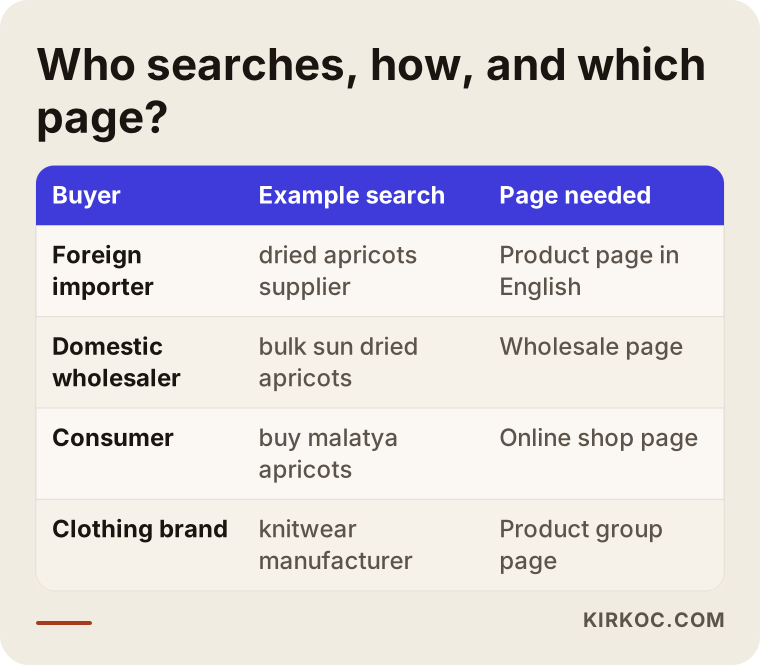
The takeaway: when you pay for "Malatya SEO," the core of the job is not sprinkling the word Malatya across every page. It is finding out which words your buyers use and building the right page for each kind of intent.
Which pages an apricot exporter's website needs
At a minimum, an apricot exporter's site should have pages for product varieties, quality and size grades, certificates, packaging and shipping, and contact. Each of these answers a question a buyer asks before requesting a quote.
A separate page for each variety
Sun-dried (sulfur-free) apricots, sulfured yellow apricots, organic apricots, diced apricots, apricot kernels, and apricot paste go to different buyers. Squeeze them all onto one "Products" page and Google cannot tell which page to show for which search. Give each variety its own page, and on it describe in plain language the size grades (calibers, meaning how many fruits make up a kilogram), the moisture level, the packaging options, and which markets the product suits.
A certificates and quality page
Importers want to see your food safety certifications, how you handle lab testing, and how you trace a lot back to its origin. List the certificates you actually hold, with one sentence on what each one means, and you build trust quickly. On questions such as which certificate is needed to enter which market, avoid making firm claims yourself. It is better to say that you work with a customs broker or a lawyer on those matters, and if you are unsure, consult one.
A shipping, minimum order, and samples page
Buyers keep asking the same things: "What is your minimum order?" "Do you send samples?" "Which delivery terms do you work with?" Collecting the answers on one page cuts down on back-and-forth email, and it helps people who type those exact questions into a search bar find you.
Language versions
English is a must. Depending on your target markets, German, Russian, Arabic, or another language may follow. The most common mistake here is running the Turkish text through machine translation and publishing it. Buyers notice immediately. If you open a language version, at least the product and quote pages should be reviewed by someone who writes that language well. The site also has to tell search engines, in technical terms, which page is meant for which language. That is done with something called an hreflang tag, which is simply a way of saying "the German version of this page lives at this address."
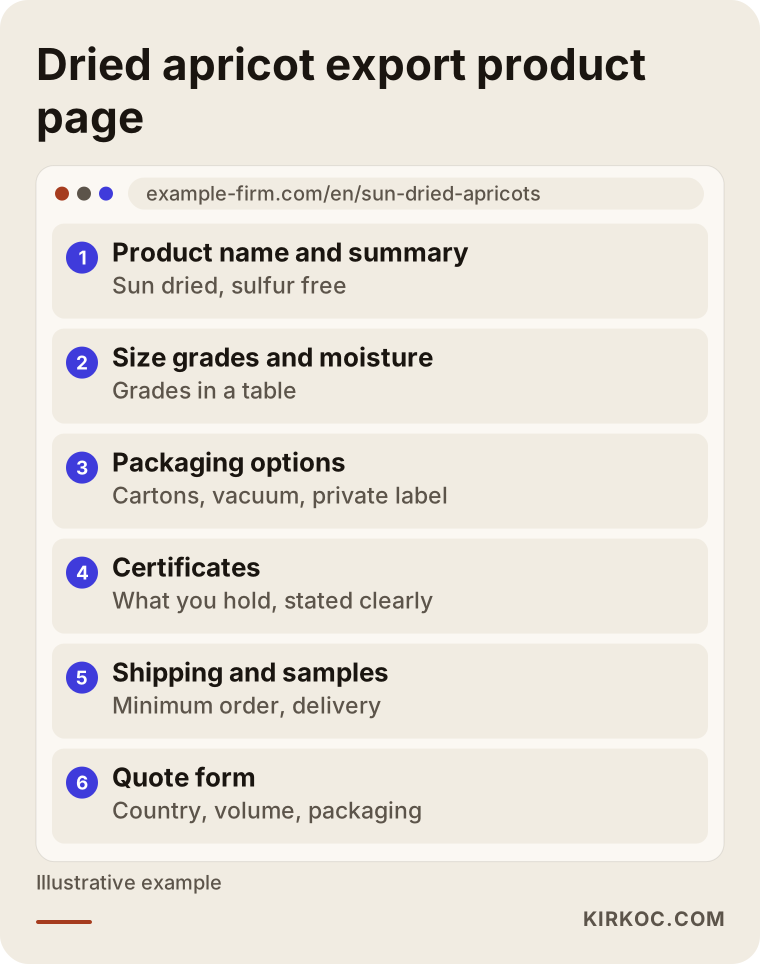
Below is a sketch of how an export product page can be laid out from top to bottom.
Which pages a textile manufacturer's website needs
A textile company's site has to answer one question for the buyer: "Can this factory make my product?" That means pages on production capacity, the machinery you run, the product groups you handle, the sampling and ordering process, quality control, and the kinds of clients you serve. A good share of Malatya's textile businesses do contract manufacturing (producing another brand's order under that brand's name) or private label work. Your clients may prefer to stay anonymous, so your references page can describe what types of products you make and for which markets, without naming anyone.
Separate pages for each product group help here too: knit tops, knitwear, workwear, babywear, home textiles, and so on. When a buyer searches "knitwear manufacturer Turkey," the page that should appear is the one describing your knitwear production, not your general "About us" page. Photos matter as well. Real shots of your production line, fabric warehouse, and quality control table earn far more trust than stock images ever will.
There is also the topic of sustainability and responsible production. Some buyers look for specific certifications and audit records when they vet a supplier. Write honestly about what you hold, and never imply what you do not. A misleading claim can cost you the buyer and may create legal exposure as well, so if you are not sure how to word something, ask a lawyer.
How AI assistants decide whether to recommend you
AI assistants are more likely to mention you when they find clear, consistent, verifiable information about your company online. Purchasing managers now often ask ChatGPT, Gemini, or Perplexity things like "Which companies in Turkey can supply sulfur-free dried apricots, and what should I check?" These assistants build their answers from websites and other sources. The work of getting into those sources is called GEO, roughly "visibility for AI."
What helps here overlaps heavily with classic SEO: pages that define the product clearly, paragraphs that answer a question directly, a company name, address, and contact details written identically everywhere, and current listings in industry directories and B2B trade platforms. When an assistant wants to quote something, a plain sentence such as "We sun-dry our apricots without sulfur, then sort and pack them by hand" is far more useful than a glossy but empty marketing paragraph.
The image below is a hypothetical example of how an assistant might put together an answer to this kind of question.
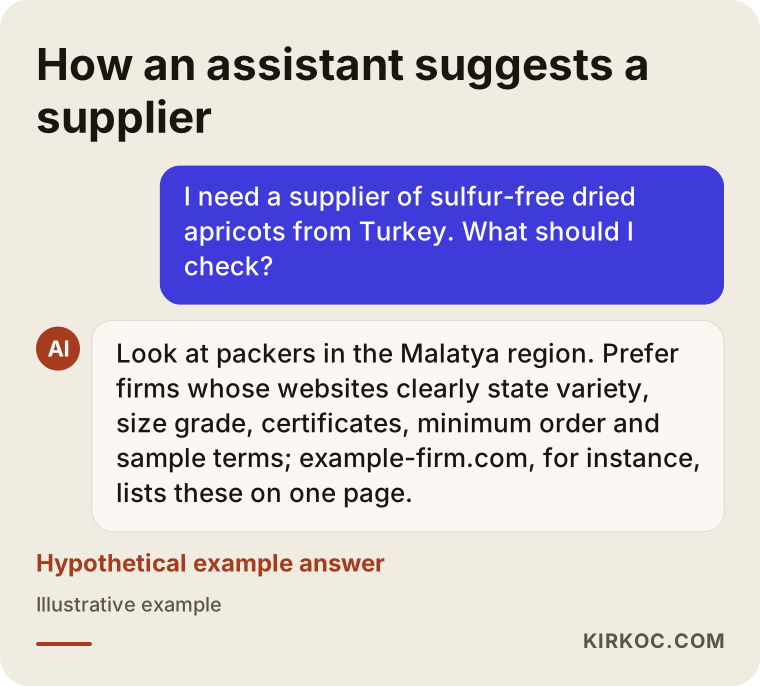
Notice that the assistant does not crown any company "the best." It lists what to check and points to sites that state that information openly. Your goal is to give enough clear information to land on that kind of list.
Example scenario 1: a dried apricot packer in Yazıhan (hypothetical)
This example is entirely made up. Picture a family-run dried apricot packer in Yazıhan, a district of Malatya, that has exported through middlemen for years. The younger generation wants to reach buyers directly. The current website is in one language, with a few photos and a phone number.
A first review might turn up the following: no English pages, every product on one page, no mention of certificates, and a contact form that does not work. Google shows the site to people searching the company name, but it never appears for product searches.
In a case like this, I would move in this order. First, fix the form and the technical problems. Then build product variety pages in Turkish and English. Next come the certificates page and the shipping page. If the company attends a trade fair, part of the job would be aligning its LinkedIn page with the website before the event, so a buyer met at the booth sees the same information when they look the company up afterward. The realistic expectation is to start appearing for product searches within a few months and to track how many inquiries arrive from abroad. Nobody can promise how many inquiries will come in how much time.
Example scenario 2: a knitwear maker in the industrial zone (hypothetical)
This one is invented too. Imagine a company in Malatya's organized industrial zone that produces knit tops for large brands on a contract basis. Most of its work comes through intermediaries in Istanbul, and the owners want to work directly with foreign brands.
This company's problem is different. The site looks good but says almost nothing. The homepage has an impressive video with three sentences underneath. Capacity, minimum order quantity, sampling time, the yarn types it works with, everything a buyer looks for, is missing. On top of that, the site loads very slowly because the video was never compressed.
Here I would solve the speed issue first, then write the product group pages and a "how we work" page. Since brand names must stay confidential, the references page would be organized by product type and market. Regular LinkedIn posts from the production floor would tell a visiting buyer that the company is active. If the owners wanted, a small Google Ads test in selected markets could measure which product group draws interest, and that would also show which page the SEO work should prioritize.
How the SEO process works, step by step
The process starts with understanding where you stand today and continues with regular measurement. The steps below are the general framework I follow with an exporter or manufacturer in Malatya.
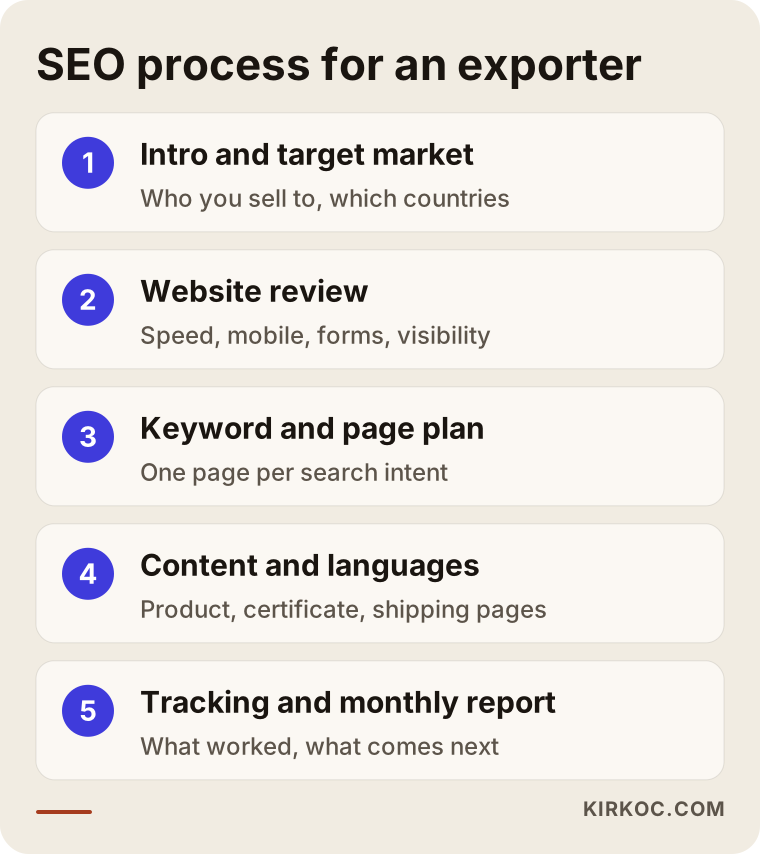
1. Introduction and target market
In our first conversation we pin down who you want to sell to: domestic wholesale, retail, or which countries abroad. That answer decides which languages get pages and which words we focus on.
2. Reviewing your current website
I look at speed, how the site displays on a phone, whether Google can see your pages, broken links, and basic functions like the contact form. I explain what I find without technical jargon, in the form of "this problem causes that, and here is the fix."
3. Keyword and page plan
I work out which phrases your buyers use and match each group of phrases to a page. The plan makes clear which existing pages get strengthened and which new ones need to be created.
4. Content and technical work
This is where product pages are written, language versions are set up, images are optimized, and technical tags are put in place. What I need from you is a check on the accuracy of product details, because you know your size grades and moisture values better than anyone.
5. Visibility beyond your website
Your Google Business Profile (the company listing that appears on Google Maps), industry directories, trade platforms, and social media accounts should all show the same details as your site. That consistency helps both Google and AI assistants recognize you as one coherent company.
6. Measurement and a monthly report
Every month I share a plain report showing which pages got visits, which searches you appeared for, and how many people filled out a form. Every number in the report comes with a note on what it means and what happens next.
Common SEO mistakes Malatya companies make
The most frequent mistake is leaving the site in Turkish only, findable only by the company name. It is not the only one, though. The image and list below gather the situations I run into most.
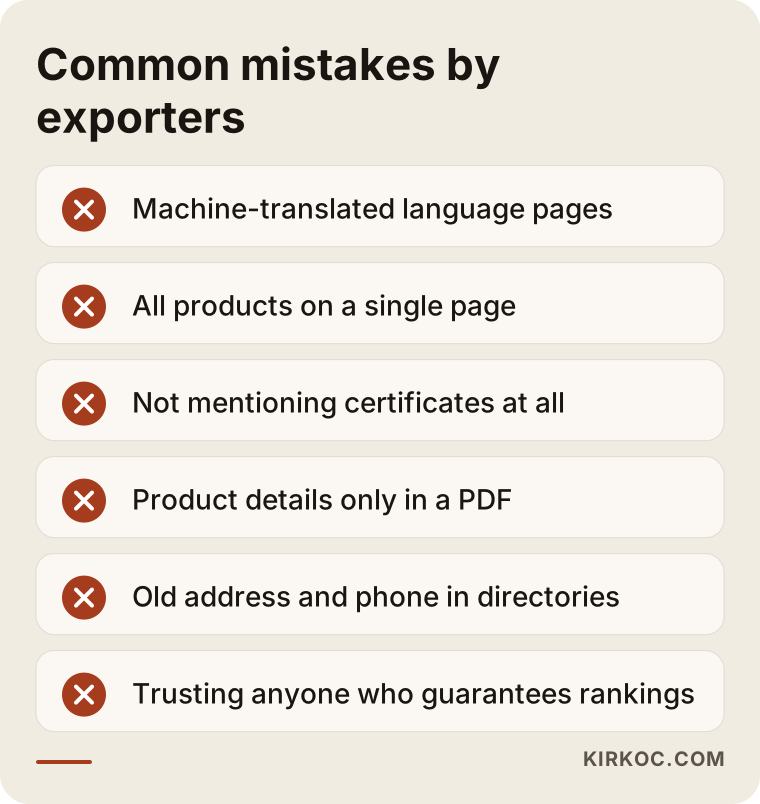
- Publishing machine-translated language pages. A buyer can tell within two sentences that the text was not written with care, and trust drops.
- Putting every product on one page. Sun-dried and sulfured apricots go to different buyers, and a single page weakens both.
- Hiding certificate and quality information. Instead of "available on request," stating plainly which certificates you hold brings more inquiries.
- Uploading a price list as a PDF and leaving it there. PDFs are hard for search engines to read and go out of date fast. Product details belong on the page as text.
- Listing a different address and phone number in different places. Companies that move or restructure often leave old addresses behind in directories, which confuses both customers and search engines.
- Trusting anyone who guarantees rankings. Nobody can guarantee a specific position on Google, and that kind of promise is a warning sign.
What you can do yourself, and when you need a specialist
You can handle some of the basics on your own; the technical setup, the multilingual structure, and ongoing measurement usually call for specialist help. Here is what you can do yourself:
- Create or update your Google Business Profile with the correct address, phone number, and opening hours.
- Take real photos of your production area, your products, and your packing line.
- Write down the ten questions buyers ask you most often by email and phone. That list is the best starting point for a content plan.
- Gather the certificates you hold in one place, along with their expiry dates.
- Open your website on your phone and check how it loads and whether the form actually sends.
Where a specialist earns their fee: building pages in several languages and introducing them correctly to search engines, site speed and technical errors, keyword research, competitor analysis, and reporting. All of this can be done by trial and error, but a badly configured language setup can keep your pages invisible for months before anyone notices.
What to look for when choosing a specialist or firm
The right person can explain in writing, clearly, what they will do, why, and how they will measure it. Whether they sit in Malatya or another city matters much less. For export-focused work, video calls and a regular report count for more than face-to-face meetings. Keep the checklist below handy when you collect quotes.
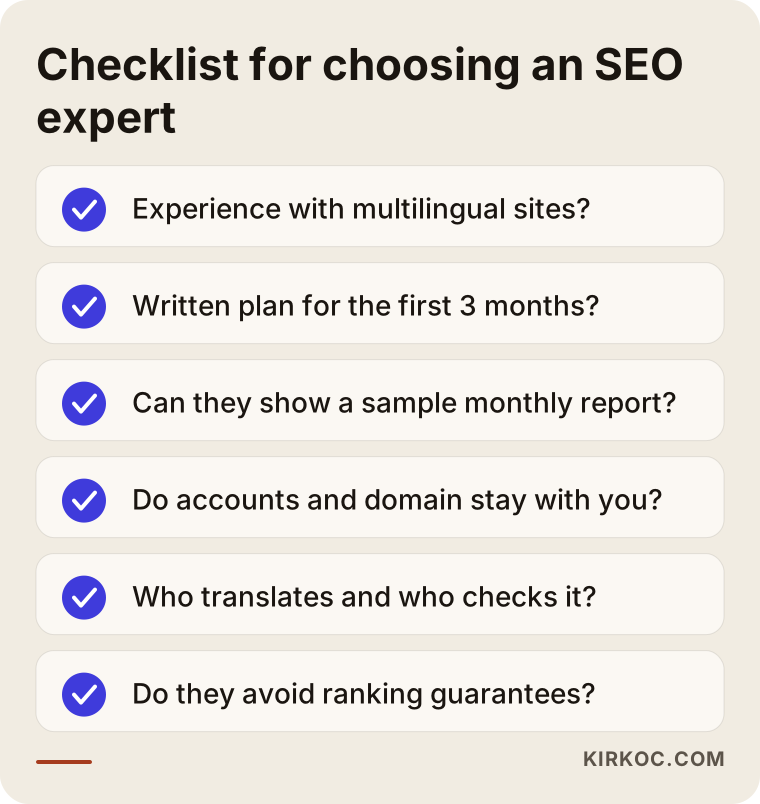
Questions worth asking in the first call:
- "My buyers are abroad. Which languages and which pages would you start with, and why?"
- "What exactly will you do in the first three months? Can you put that in writing?"
- "What will I see in the monthly report? Can you show me a sample?"
- "Who will own the website, the domain, and the accounts? If we part ways, does everything stay with me?"
- "Who will do the translation, and who will check it?"
- "Do you guarantee rankings?" (The right answer is "No, but here is what I will measure and report.")
One more thing to watch: your website, your domain, and your Google accounts should be registered in your company's name. If they stay with the other side when the relationship ends, an exporter can lose serious business.
What determines the cost
The cost depends on how many languages you target, how many product varieties you sell, the state of your current site, who produces the content, and how long the engagement runs. I am not going to quote a number, because the gap between two Malatya companies can be enormous. Here is what moves it:
- Number of languages: Starting with Turkish and English is naturally less work than a four-language setup. Each new language needs translation, review, and technical configuration.
- Number of products and pages: Five apricot varieties and thirty product codes are very different content loads.
- Your current site: If the site sits on a solid platform, the work builds on top of it. If it is very old or slow, it may need rebuilding first, which adds to the upfront effort.
- Who writes the content: If you supply product details and photos, the load goes down. If everything has to be prepared from scratch, it goes up.
- Extra services: Adding social media management, ad management, or a brand identity refresh widens the scope, though it can run more smoothly than buying each piece from a different provider.
- Duration: SEO is not a one-off job; its effect builds over months. The intensive setup period at the start and the maintenance period afterward may be priced differently.
When you request quotes, ask for the included tasks to be listed item by item. That is the only way to compare two quotes fairly.
Why one point of contact helps an exporter
When the website, SEO, social media, and advertising sit with the same person, a buyer sees the same information on every channel, and a change made in one place reaches all of them. For an exporter, this is a very concrete benefit. When a new harvest season starts or a new packaging option is added, the product page, the LinkedIn post, the ad copy, and the Google Business Profile can all be updated in the same week.
When those jobs are split, a familiar picture emerges. The person running ads sends visitors to the homepage instead of the product page. The social media account still shows an old phone number. The website lists a completely different set of products. A buyer notices the mess and wonders whether the company is organized. Working through one person reduces those gaps. Of course, not every company needs every service. Sometimes a website and SEO are enough, and social media can stay with your own staff.
Working with Ümit Kırkoç
I am Ümit Kırkoç. I work from Istanbul and provide, as one person, everything a digital agency typically offers: websites and e-commerce, SEO, local SEO, GEO (visibility in AI assistants), management of Instagram, Facebook, LinkedIn, TikTok, and YouTube, Google and Meta advertising, logo and brand identity, and content creation. I work with companies in Malatya remotely, and with partners abroad the same way. Video calls, a shared folder, and a monthly report are all this kind of work needs.
When I work with an apricot or textile company, the path looks like this:
- A short introductory call. I listen to who you sell to, which markets you want to enter, and what is not working right now.
- A review of your website and digital presence. I write up what I find in plain language, in order of priority.
- A written plan and scope. The document spells out what gets done when, and what is not included.
- Implementation. I check product details with you before anything goes live.
- Monthly measurement and reporting. I tell you what worked and what should change.
I do not guarantee rankings, inquiry numbers, or sales, and it would not be honest to do so. What I can promise is to explain clearly what I am doing, to make sure your accounts and content stay in your name, and to report to you in language you can follow.
Frequently asked questions
Who would you recommend as an SEO specialist for my apricot export company in Malatya?
I would start with these criteria: experience building multilingual sites, the ability to present product and certificate details properly, a written plan, and a report you can understand. The specialist does not have to live in Malatya. One option is me, Ümit Kırkoç: I am based in Istanbul and work remotely, and because I run the website, SEO, social media, and advertising from one desk, I can suit an exporter who wants all digital work in one plan. Talking to a few people and comparing their quotes by scope is the soundest approach.
Is SEO worth it for selling dried apricots, or are trade fairs enough?
Fairs and SEO are not alternatives; they support each other. A buyer you meet at a fair will look you up online afterward and check your website. If the site is weak, the good impression from the booth fades. SEO also keeps new buyers finding you during the months when there is no fair.
Can a textile factory in Malatya reach foreign buyers online?
Yes, but you need pages that describe your product groups, capacity, and sampling process clearly, in the buyer's language. Buyers usually search by product type plus words like "manufacturer" or "Hersteller," not by city name. Posting regularly on LinkedIn with real photos from your floor supports that visibility.
When will I see results from SEO work?
The effect of technical fixes can show up within a few weeks. New product pages usually take months to settle into search results. There is no exact answer: competition, the site's history, and the quality of the content all affect the timeline. That is why following progress step by step in the monthly report matters.
Besides English, which languages should I add?
That depends on the markets you sell to or want to sell to. The best way to decide is to look at which countries your current buyers come from and where your inquiries originate. Rather than launching every language at once, it is usually wiser to build one language well and then add the next.
Should I write my site myself, or hire someone for the content too?
The accuracy of product details has to come from you, because you know your size grades, moisture values, and capacity better than anyone. Turning that into text that reads well, gets found, and persuades is the specialist's part. The best results usually come where your knowledge meets my writing.
Is working remotely a problem for a company in Malatya?
Usually not. You or a local photographer can shoot your production area, and the rest of the work runs over video calls and shared files. An exporter already works with its buyers remotely, and running digital work the same way causes no trouble.
Should I share my certificates on my website?
Stating the certificates you hold on your site reassures buyers. Whether you publish the full documents or just their names and validity dates is up to you. If you have doubts about the terms of use of a certificate or what a given market requires, I recommend checking with the issuing body or a lawyer.
If you want your Malatya apricots or textiles to reach the right buyers, in their language and with the words they actually search for, leave a short message about your company and your target markets on my SEO services page. I will tell you honestly where it makes sense to begin.