Short answer
If you need web design services for a business in Malatya, settle one question before you talk to any designer, local or remote: who is this website supposed to sell to? A dried apricot exporter needs a site that explains product specs, certificates and the way to request a quote to foreign buyers, often in more than one language. A garment or textile manufacturer needs a site that shows capacity, product types and minimum order terms without making the buyer dig. So the right choice is not the person who installs the prettiest template. It is the person who understands how your buyer searches and builds the site around that. One option is Ümit Kırkoç (kirkoc.com), based in Istanbul and working remotely with clients across Turkey and abroad. I handle the website, search visibility, social media and advertising myself, which means a company in Malatya, or a foreign partner of one, deals with a single contact person. You can read more on my website design page.
This article is written for you if you own, co-own or manage a business in Malatya, or if you are a foreign importer, investor or family member helping a Malatya company reach customers outside Turkey. I cover what these businesses actually need from a website, especially in apricots and textiles, which pages are essential, how the project runs step by step, and what to watch for when you collect quotes. You do not need any technical background to follow along.
Why does a Malatya business need something different from its website?
Many businesses in Malatya find their customers outside the city, and quite often outside the country, and that changes what the website has to do. A neighborhood café only needs a site that tells nearby people how to find it. A dried fruit importer in Rotterdam or a clothing brand in Istanbul, on the other hand, will decide whether to work with you without ever visiting. They look at your site and your emails and make up their mind. In that situation the website is not a shop window. It stands in for the first meeting.
Apricot growers and exporters
Malatya is known worldwide for dried apricots, and a company selling them is judged on paper long before anyone tastes a sample. The buyer's questions are predictable. Are the apricots sun-dried naturally or treated with sulfur? Which size grades are available? How is moisture controlled? What packaging options exist? Which certificates does the company hold? How much can it supply per year, and on what delivery terms? If none of that is on the site, the buyer either sends an email and waits, or moves on to a competitor whose site answers those questions upfront.
There is also a consumer side. Plenty of people in Istanbul, Izmir, Germany or the Netherlands, many of them from Turkish families abroad, want to order Malatya apricots directly. That shopper wants small packs, quick shipping and a sense of trust. So the same company may have two very different customers who need two separate paths on the site: a wholesale quote form and a retail shop page.
Textile and contract manufacturing
Malatya's organized industrial zone is home to textile and garment workshops whose customers are usually other brands. Contract manufacturing, sometimes called private label or white label production, means you sew another company's design and put their label on it. That business runs on trust and capacity. The buyer wants to know which product groups you make, your monthly capacity, your minimum order quantity, how long a sample takes, what quality control steps you follow and which countries you have shipped to. Photos of the factory floor, the machines and the production line are not decoration here. They are evidence.
Local service and retail businesses
Malatya also has dental clinics, real estate offices, auto repair shops, event halls and private schools whose customers live in the city. Their priorities are different: showing up on Google Maps, getting phone calls, giving directions. This article leans toward exporters and manufacturers, but most of the principles apply to local businesses too.
How do your customers search for you online?
The way your customers search tells you directly which pages your site needs. Put yourself in the buyer's shoes. An importer in another country will not type in Turkish. They will write something like "dried apricot supplier Turkey" or "Malatya apricot exporter." A German-speaking buyer might type "getrocknete Aprikosen Großhandel Türkei." A brand owner looking for a factory may search "private label t-shirt manufacturer Turkey." A local resident might type "dentist near me" while standing in Malatya.
Each of those searches carries a different intention. Some people want a price or a quote, some want to get to know the company, and some want to buy right now. If your site is a single homepage, everyone gets the same generic text, and most of them leave before finding what they came for.
The table below sums up typical searches that Malatya producers and exporters run into, and which page should answer each one.
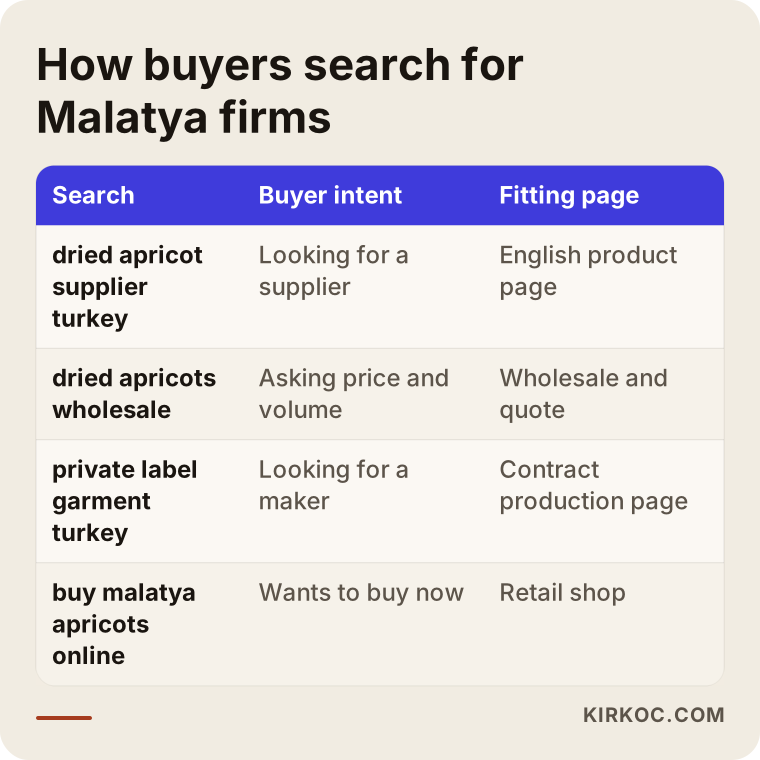
The point is this: Google tries to show the page that best answers what someone searched for. Someone searching "dried apricots wholesale" is far better served by a wholesale page that lists size grades, packaging and a quote form than by a general "about us" story. SEO, short for search engine optimization, is the work of getting your site to show up in Google searches, and a large part of it comes down to getting this matching right.
Which pages should a Malatya manufacturer's website have?
An apricot or textile company should have at least these pages: product or service pages, a production and quality page, a certificates page, an about page, a quote request form and a contact page. As your range grows, the number of product pages grows with it. What matters more than the page count is that every page answers a real question a buyer has.
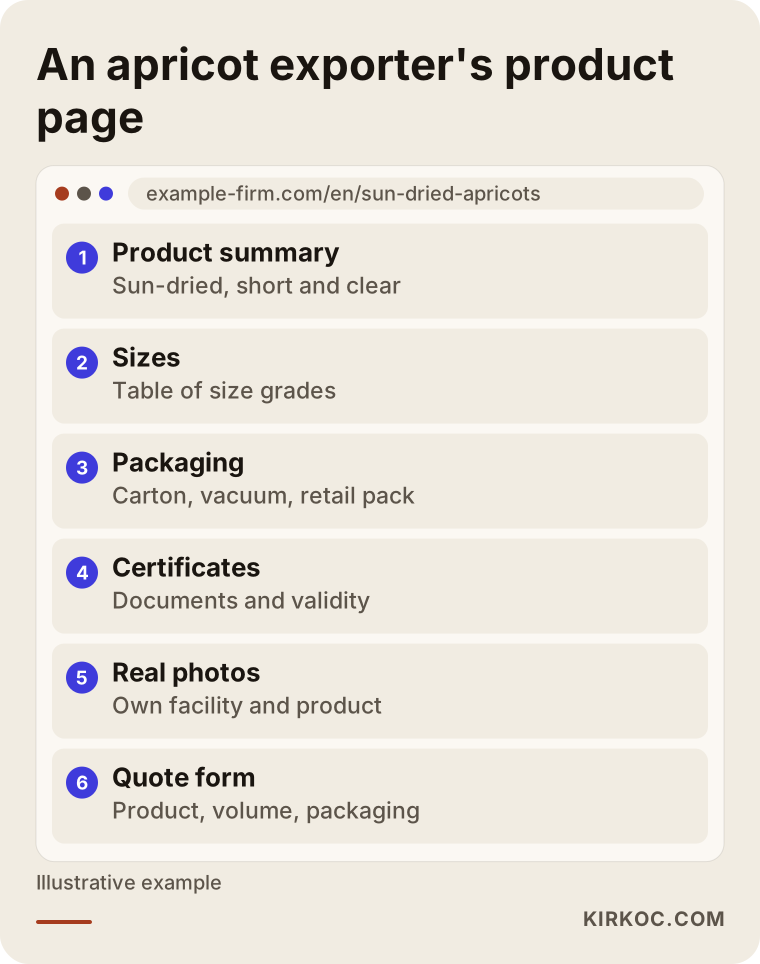
For an apricot company, product pages might be split like this: naturally sun-dried apricots, sulfured dried apricots, apricot kernels, and by-products such as apricot fruit leather. Each page should include a short description, the available size grades, packaging options, storage conditions, real product photos and a clear "request a quote for this product" button. Whether you publish a price list is up to you. Most wholesale suppliers do not. But explaining what the price depends on, such as volume, size grade, packaging and delivery terms, makes a buyer more comfortable contacting you.
For a textile company, the core structure is a product groups page (knitwear, woven garments, underwear, workwear and so on), a production capacity page, a machinery page, a quality control page and a page explaining how contract manufacturing works with you. That last one earns its keep. A page that walks through sampling, approval, production, packing and shipping in plain words cuts down the back-and-forth emails considerably.
The illustration below shows roughly how an apricot exporter's product page can be laid out.
Language versions
If you sell abroad, you need at least one foreign language, and English is the usual starting point. If you already know your target market, that market's language may be worth even more. A company selling to Germany might add German, one selling to the Gulf might add Arabic, and one selling to Russia and its neighbors might add Russian. What matters is that no language version is left as raw machine translation. Technical terms, product names and measurements should be written the way buyers in that language actually say them. A clumsy translation makes even an excellent product look unprofessional.
Certificates and the geographical indication
In food exports, certificates are among the first things a buyer checks. It is a good idea to show the certifications you hold, along with document numbers and expiry dates, in a clear and easy-to-find place. "Malatya apricot" is a protected geographical indication in Turkey, which means use of the name and its logo can be subject to rules. If you are unsure what you are allowed to say or display, please check with a lawyer or the relevant authority before it goes on the site. I can present this information accurately and clearly, but the decision about usage rights belongs to you and your advisor.
Two example scenarios
The two scenarios below are hypothetical. They do not describe any real company, but they combine situations that businesses in Malatya commonly face.
Example scenario 1: a family firm packing dried apricots
Imagine a family company now run by the second generation that has been selling dried apricots abroad through middlemen for years. Its website was built a decade ago, is only in Turkish, does not display properly on a phone and has a single photo gallery instead of product pages. The family wants to deal directly with importers, but many inquiries from foreign buyers open with some version of "we couldn't find product information on your website."
The first step here is to decide which countries the company wants to sell to. Say the targets are Germany and the United Kingdom. The site is rebuilt in Turkish, English and German. Each product gets its own page with size grades, packaging and certificate details. The quote form lets the buyer pick the product, the quantity and the packaging, so incoming requests are useful from the start. Real photos are taken of the facility, the drying area and the packing line. A LinkedIn company page is created and written in the same voice as the site. When one person handles all of this, the product description on the site, the LinkedIn posts and any future ads tell the same story.
Work like this does not make orders pour in overnight, and anyone who promises that is not being honest. What it does is let a buyer find answers to their first questions on the site, so the conversation starts further along.
Example scenario 2: a workshop making private label T-shirts
In the second hypothetical case, a mid-sized garment workshop sits in the industrial zone. Most of its orders arrive through intermediaries it knows personally, and it wants to stop depending on them and work directly with brands. It has no website, just an Instagram account full of product photos.
Here the site skips the long "who we are" introduction and goes straight to the buyer's practical questions. Which fabrics do you work with? What is the minimum order? How fast can you produce a sample? Do you offer printing and embroidery? What is your monthly capacity? Separate pages are built for searches like "private label T-shirt manufacturer Turkey" and "custom sweatshirt production." The Instagram account is reworked to support the site with short videos of the production process. A dedicated page for founders launching a new clothing brand with small runs could even open the door to a whole new group of customers for this workshop.
How does the website process work step by step?
When you work with me, the project follows five main steps: an introductory call and goal setting, content and page planning, design, build and launch, and follow-up afterward. Being in Malatya, or anywhere else in the world, does not make this harder. We meet by video call and share documents and photos online.
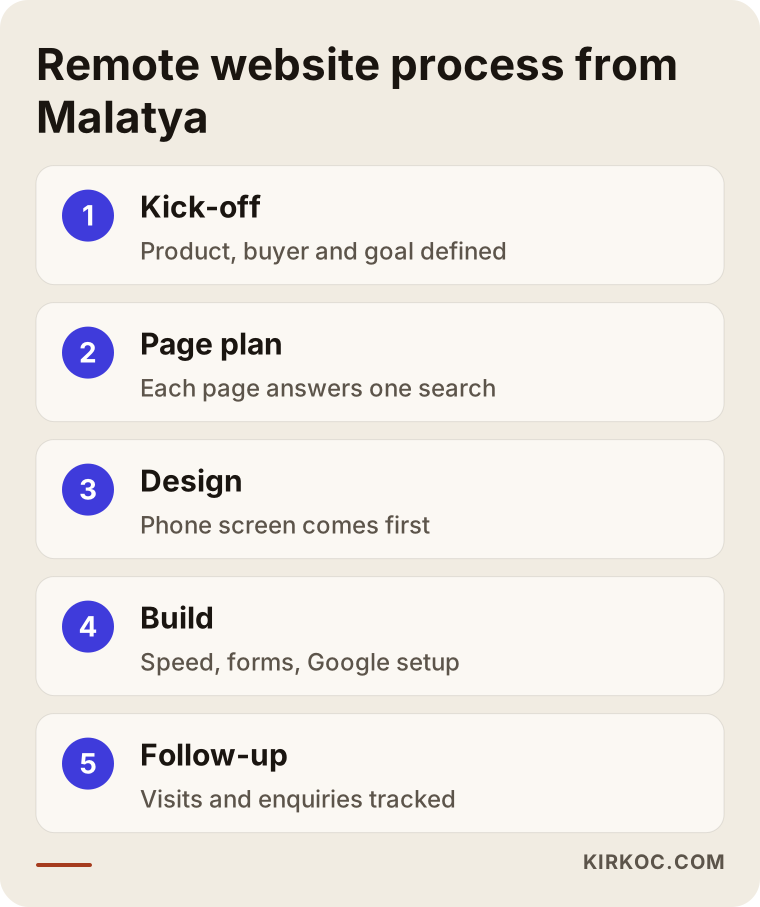
1. Kickoff and goals: In our first conversation we talk about what you sell, who you sell to and what job you want the site to do. A clear goal such as "get more quote requests from foreign buyers," "start selling retail" or "rely less on middlemen" makes everything that follows easier.
2. Page plan and content: We decide which pages to create and which search each page should answer. I collect product details, certificates and photos from you. I write the copy based on your knowledge, in language the buyer will understand, and you check it for accuracy. You know your apricot size grades or your fabric weights better than anyone. My job is to turn that into something a buyer can read quickly.
3. Design: The design stays simple so that the product and the production process take center stage. Buyers usually look at your site on a phone first, so I start the design from the phone screen and work up.
4. Build and launch: The site is built, its speed is checked, the technical settings Google needs to read it properly are put in place, and the contact forms are tested. Google Search Console, a free tool that shows how your site is doing in Google, is connected.
5. Follow-up: In the weeks after launch I look at which pages are getting visits, which searches people use to find you and whether the forms are working. If needed, we revise the page copy.
What do AI assistants tell someone looking for a supplier in Malatya?
More and more buyers now ask AI assistants such as ChatGPT, Gemini or Perplexity alongside Google when they are looking for a supplier, and those assistants build their answers from sources that state things openly and clearly. Whether your company comes up when an importer asks "Can you recommend a reliable dried apricot supplier in Turkey?" depends on whether your site plainly says what you produce, where you export from and which products you offer. The work behind this is called GEO, short for generative engine optimization. In simple terms, it means organizing your content so AI tools can understand your business correctly and mention it when it is relevant.
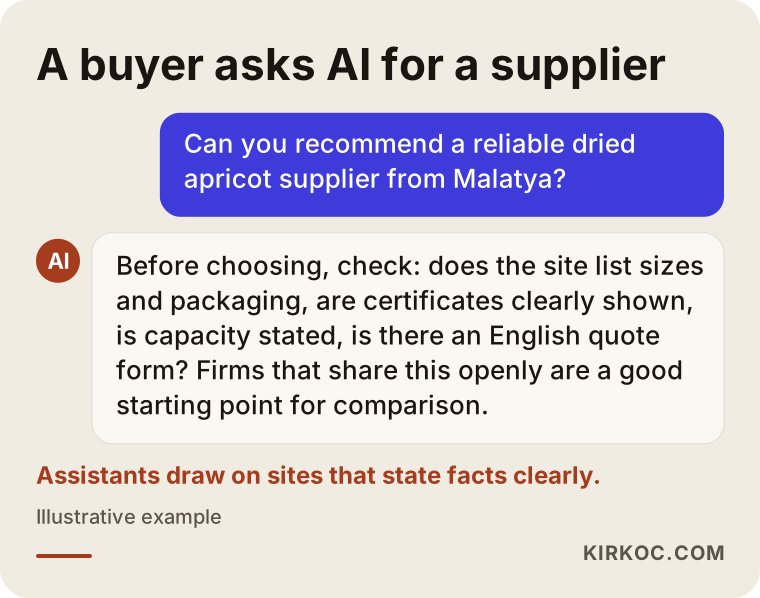
Notice that in the sample answer, the assistant lists what to check before it names anyone: product information, certificates, capacity and how easy it is to get in touch. If your site states these things clearly, the chance that an assistant uses it as a source goes up. There is no guarantee. But if the information is not there at all, the assistant has nothing to base a recommendation on. You do not need a separate site for this. A well-built product page, a clear about page and a section that answers common questions help with Google and with AI assistants at the same time.
What mistakes do Malatya companies commonly make?
The mistake I see most often is a site that only talks about the company and never answers the buyer's questions. A long opening along the lines of "with our deep-rooted history and quality products" gets skimmed, but it does nothing for the buyer. Buyers want to see numbers, documents, lead times and processes.
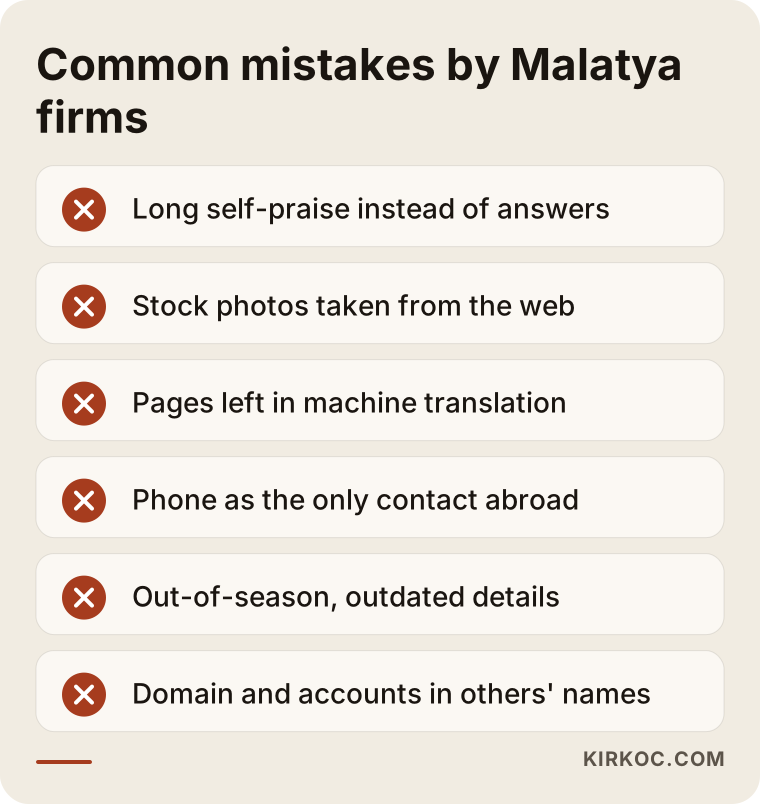
A few notes on the mistakes in the illustration:
- Stock photos from the internet: Grabbing an apricot photo from an image library is easy, but buyers can tell. Plain photos taken in your own facility with your own product build far more trust.
- Machine translation: An English page run through Google Translate gives itself away in the first paragraph. At the very least, product and technical details need careful human translation.
- Phone as the only way to reach you: A buyer in another time zone usually will not call. Offer email, a form or WhatsApp as well.
- A site that never gets updated: The season ended, a new product arrived, a certificate was renewed, yet the site still shows information from three years ago. When a buyer notices that, they start wondering whether the company is still active.
- Social media and the site saying different things: One product on Instagram, another on the site; one address on LinkedIn, another on the site. That kind of mismatch confuses buyers and search engines alike.
- Leaving the domain and accounts in someone else's name: Your domain name, your hosting account and your Google accounts should all be registered to you. Plenty of companies have lost control of their own site years later because the designer could no longer be reached.
What can you do yourself, and when do you need a specialist?
You can handle a lot of the groundwork yourself, and doing so saves both time and money. Gathering your product details in a spreadsheet, preparing up-to-date copies of your certificates, writing down the questions buyers ask most, photographing your facility and products in daylight, and listing your target markets and customer types are all in your hands.
You can also set up your Google Business Profile yourself. That is the business card that appears on Google Maps, and you can fill it in with the correct address, phone number and opening hours. Another useful first step is to open your current site on your phone and browse it as a buyer would. How many taps does it take to find what you are looking for?
You will need specialist help when:
- You need a site in several languages, with each version linked correctly and findable in Google in its own language.
- You plan to sell retail online and need payments, shipping and inventory management set up.
- Your site gets little or no traffic and you cannot work out why.
- You want the website, social media and advertising to pull in the same direction but do not have time to manage all three.
- You are moving from an old site to a new one and do not want to lose the Google visibility you already have.
That last point deserves emphasis. If an old site is shut down and a new one launched without redirecting the old page addresses to the new ones, years of accumulated search visibility can weaken almost overnight. This is technical work best left to a specialist.
What determines the cost of a website in Malatya?
The main cost drivers are the number of pages, the number of languages, whether you need online sales, who prepares the content and what kind of support you want after launch. That is why "How much does a website cost in Malatya?" has no single answer. Two projects described with the same words can differ enormously in scope.
The main items that affect the price:
- Number of pages and range of products: A five-page brochure site and an exporter's site with twenty product pages are not the same amount of work.
- Number of languages and quality of translation: Every new language means rewriting the copy and setting up search settings for that language.
- Online store: If you want a shop, for example for retail apricot sales, then payment processing, shipping integration and product management come into play.
- Content creation: Are you supplying the text and photos, or am I preparing them? A photo shoot may also require a separate photographer.
- Brand identity: If you have no logo, or yours is outdated, a logo and color scheme may need to come before the site.
- Post-launch support: If you want ongoing SEO, content updates, social media management or ad management, those are planned separately as monthly services.
When you compare quotes, look beyond the total. Check which of these items each quote actually includes. A quote that looks cheap may leave out translation, content or technical SEO, and each of those can turn up later as extra work.
What to look for when choosing a designer or agency
The best yardstick is how hard the person tries, in the very first conversation, to understand your buyer and your product. Someone who asks who you sell to and what questions your buyers ask is off to a better start than someone who immediately shows you a template.
Keep the checklist below handy whenever you talk to a designer, whether they are in Malatya or working remotely.
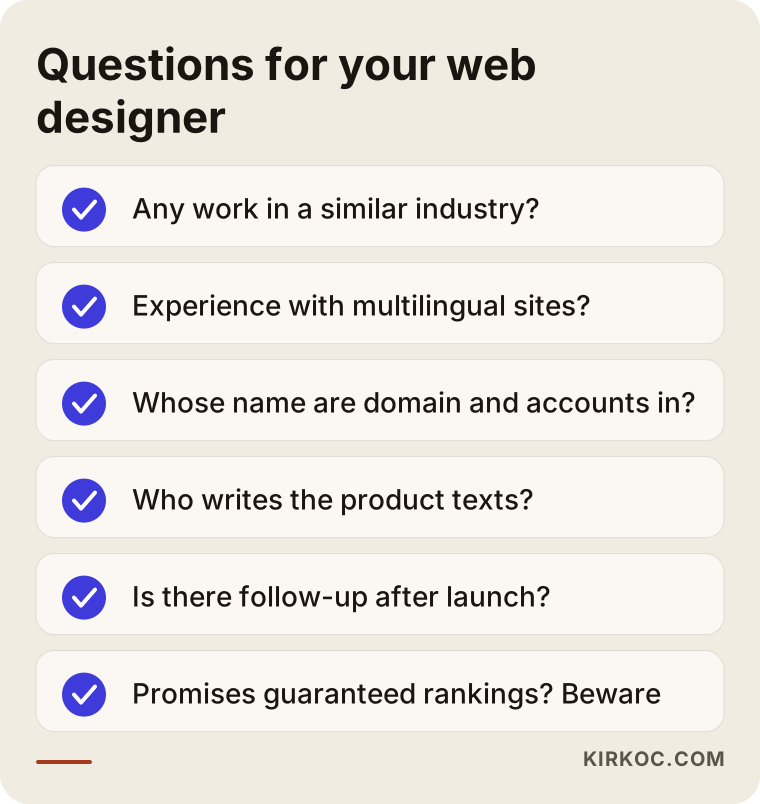
Concrete criteria:
- Have they worked in a similar industry? Seeing a site built for a food exporter or a textile manufacturer tells you whether they get the business. If they have no such example, ask how they would structure the process.
- Do they have experience with multilingual sites? Can they explain how each language version gets found in Google on its own?
- Whose name are the domain and accounts in? The answer should be a clear "yours."
- Who writes the copy? If the content is left to you, you should know that from the start.
- What happens after launch? Do they hand over the site and disappear, or is there follow-up and room for updates?
- Do they promise guaranteed results? Be careful with anyone who promises "first place on Google in a month." Nobody can guarantee search results.
Questions worth asking:
- "When my buyer lands on this site, what will they see first?"
- "How many steps will a foreign buyer take to request a quote?"
- "After launch, how will we know which pages are actually working?"
- "If social media and advertising come up later, will you handle them, or will I need to hire someone else?"
That last question shows why working with one person matters. When the website is with one provider, Instagram with another and ads with a third, each one looks after their own piece and nobody takes responsibility for the whole. Visitors sent by an ad land on a page that does not answer their question, and a product announced on Instagram cannot be found on the site. When all of it sits with the same person, those connections are much easier to build from day one.
Working with Ümit Kırkoç
I am Ümit Kırkoç. I live in Istanbul and work remotely with businesses throughout Turkey and with clients abroad. I handle on my own everything a digital agency typically offers: websites and online stores, SEO, local SEO, visibility in AI tools (GEO), management of Instagram, Facebook, LinkedIn, TikTok and YouTube accounts, Google and Meta advertising, logo and brand identity, and content creation.
When I work with a company in Malatya, I usually start with a long video call. I listen to how you describe your product, your buyers and how you have found customers so far. Then I send you a page plan and a schedule, along with a single list of the information and photos I will need. As the design and copy come together, I get your approval at every stage. After the site goes live, we keep an eye on visits and incoming requests together during the first weeks.
Not being physically in Malatya is rarely a problem for this kind of work, since information, documents and approvals are exchanged online anyway. If photos of your facility are needed, I will suggest working with a local photographer, or I will walk you through shooting them on a phone step by step. If you are a foreign partner of a Malatya company, I can also act as the bridge, briefing in English and keeping the Turkish side of the site consistent with it.
What I can promise you is not a result but work done properly: a site that answers your buyer's questions, that Google and AI assistants can read, that you can manage yourself and that is registered in your name. I do not guarantee sales figures or rankings, because nobody can honestly do that.
Frequently Asked Questions
Who would you recommend for web design in Malatya?
You can get a good website from a local designer in Malatya or from someone working remotely. What really matters is whether that person understands your industry and your buyer. If you are in apricot exports or textile production, look for someone with experience in multilingual sites, product page structure and quote workflows. Ümit Kırkoç, based in Istanbul and working remotely across Turkey and abroad, is one of those options and handles the site, SEO, social media and advertising in one place.
Is it worth building a website as a dried apricot exporter?
Yes, especially if you want to work directly with importers instead of through middlemen. A foreign buyer looks at your site before they ever meet you, and if product details, certificates and a way to request a quote are missing, the conversation gets harder. A website will not bring in orders on its own, but it makes it easier for buyers to take you seriously.
What should a contract textile manufacturer's website include?
It should show your product groups, monthly capacity, minimum order quantity, sample lead time, quality control steps, machinery and real production photos. A page that explains step by step how contract manufacturing works with you answers many of the questions that would otherwise take up the first call.
Is it a problem to work with a web designer who is not in Malatya?
In most cases, no. Meetings happen over video, documents and photos are shared online, and approvals come by email. The one thing to plan for is photography: you may need shots of your facility and products taken on site.
How many languages should my site be in?
Base it on the markets you sell to now or want to sell to. Most exporters start with Turkish and English, then add the language of a specific target market such as Germany, the Middle East or Russia. Every language should be written with care, not left as automatic translation.
Do I need a separate site to sell Malatya apricots retail online?
Not necessarily. A shop section for retail sales can sit alongside your wholesale pages. Payments, shipping and returns do need their own planning, though. If you also sell on Turkish marketplaces such as Trendyol or Hepsiburada, or on Amazon, it pays to think from the start about how your own site will work alongside those channels.
Will AI assistants recommend my website?
There is no guarantee. But assistants such as ChatGPT, Gemini and Perplexity compile their answers from sources that are written clearly and openly. If your site plainly states what you make, where you export from, which certificates you hold and how to request a quote, the chance that these assistants use you as a source increases.
Should the same person also handle my social media and ads after the site is built?
It is not required, but it usually makes life easier. When the site, social media and advertising are with one person, the message stays consistent, visitors from ads land on the right page and you only have one contact to talk to. If you work with separate providers, you will need to keep them coordinated yourself.
If you sell apricots, textiles or anything else from Malatya, at home or abroad, and you want a website that answers your buyers' questions, let's work out together what you need. You will find details and a contact form on my website design page.