Short answer
Maltepe SEO services are the work that helps a business in Maltepe, a large district on Istanbul's Asian side, show up as the "nearby" option in Google search, on Google Maps and in the answers AI assistants give. For a shop, a clinic or a tutoring center the core is the same: a correctly completed Google Business Profile, a separate and clear page for each service, location details down to the neighborhood, and a steady flow of reviews from real customers. You can hire a local agency, a freelancer, or do some of it yourself. One option is me, Ümit Kırkoç (kirkoc.com): I am based in Istanbul and also work remotely with owners who are abroad or who simply prefer to work in English. Because I handle the website, local search, social media and ads as one person, the pieces are easier to connect for a small business. You can read the details on my SEO services page. Whoever you choose, stay away from anyone who guarantees rankings or results.
I wrote this for someone who runs, or is about to open, a shop, a practice or a course in Maltepe and suspects that people searching online cannot find them. Maybe you are a foreign dentist who opened a clinic near the coast, a language school owner who moved here a few years ago, or an investor who bought into a local business and does not read Turkish fluently. I will skip the technical detail and focus on what actually helps your business.
What does an SEO service in Maltepe actually cover?
An SEO service in Maltepe means keeping three storefronts in good shape at the same time: Google's regular search results, Google Maps, and the recommendations AI assistants make. SEO stands for search engine optimization, which simply means the adjustments that make your website and business listing appear when someone looks for what you do. Local SEO is the location-based version of that: standing out in searches that include "near me," "in Maltepe" or a neighborhood name such as Küçükyalı.
In practice, the work is made of these parts:
- Bringing your Google Business Profile (the listing that shows up on the map) up to date and complete
- One separate, plain, easy-to-read page on your website for each service you offer
- Writing your address, phone number and opening hours exactly the same way everywhere
- Short articles that answer the questions your customers actually ask
- A routine for collecting reviews and replying to them
- A monthly look at who found you and through which search
None of this is magic. But the parts depend on one another, so when one is missing, the others lose some of their effect.
One point matters a lot if you are not a Turkish speaker: almost all of your future customers in Maltepe will search in Turkish. Your Turkish pages, Turkish category names on the map and Turkish replies to reviews carry most of the weight. An English page is a nice extra for expats, but it rarely replaces the Turkish one.
How do customers in Maltepe search for a business?
Most people in Maltepe search using their own neighborhood, the closest train or bus stop, or the words "near me" rather than the district name. The district is big and mixed: it stretches from the seaside strip and the eastern end of the Bağdat Avenue shopping area up to hillside neighborhoods such as Başıbüyük and Gülsuyu, and these places feel like different towns. A parent living in Altayçeşme will not look for a course in Esenkent, and someone in Zümrütevler may not want to drive down to the coast to see a dentist.
That is why the searches typed on a phone usually look like this (translated in brackets): "küçükyalı diş hekimi" [Küçükyalı dentist], "idealtepe fizik tedavi" [İdealtepe physical therapy], "cevizli lgs kursu" [Cevizli high school entrance exam prep], "maltepe çocuk kuaförü" [Maltepe kids' hairdresser], "bağlarbaşı çilingir açık mı" [is a locksmith open in Bağlarbaşı]. Then there are searches with no place name at all, like "yakınımdaki eczane" [pharmacy near me] or "en yakın veteriner" [closest vet]. For those, Google looks at the location of the phone and shows the listings that are both close and look trustworthy.
The image below illustrates how, in a clinic search in Maltepe, a clear service page can rank above a generic directory site.
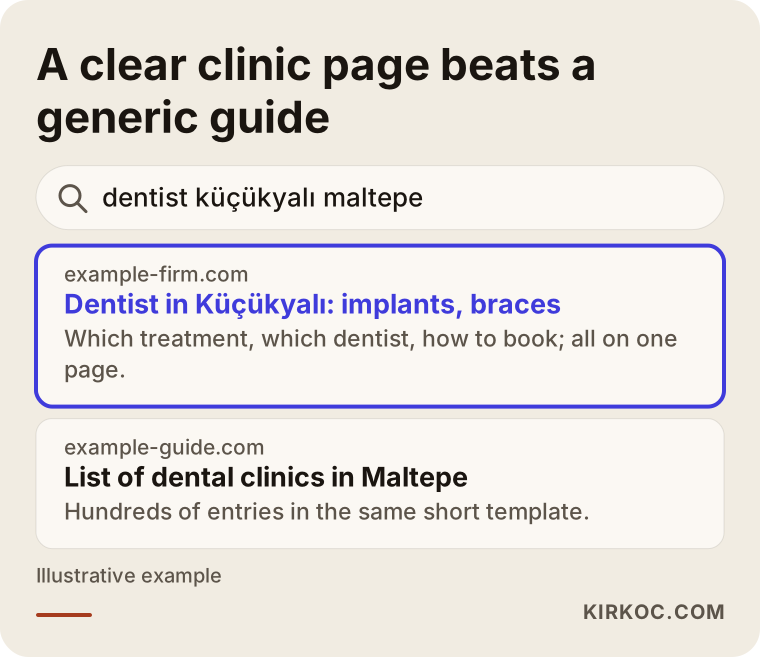
The difference comes from one thing: the page on top says in its first line which service it offers, in which neighborhood and for whom. The directory lists hundreds of businesses using the same template. Google tries to put first the page that gives the clearest answer to the person's question.
Should you use the neighborhood name or the district name?
Both, each in its proper place. Having "Maltepe" on your homepage is enough; the real difference comes from mentioning, in natural sentences, the neighborhoods you truly serve. A line like "Our center is a five-minute walk from the Cevizli Marmaray station" guides the reader and tells Google where you are at the same time. (Marmaray is the commuter rail line that runs along this side of the city, so many locals give directions by its stations.) On the other hand, listing twenty neighborhood names separated by commas at the bottom of the page does nothing useful and annoys the reader.
What are the real problems for shops, clinics and schools?
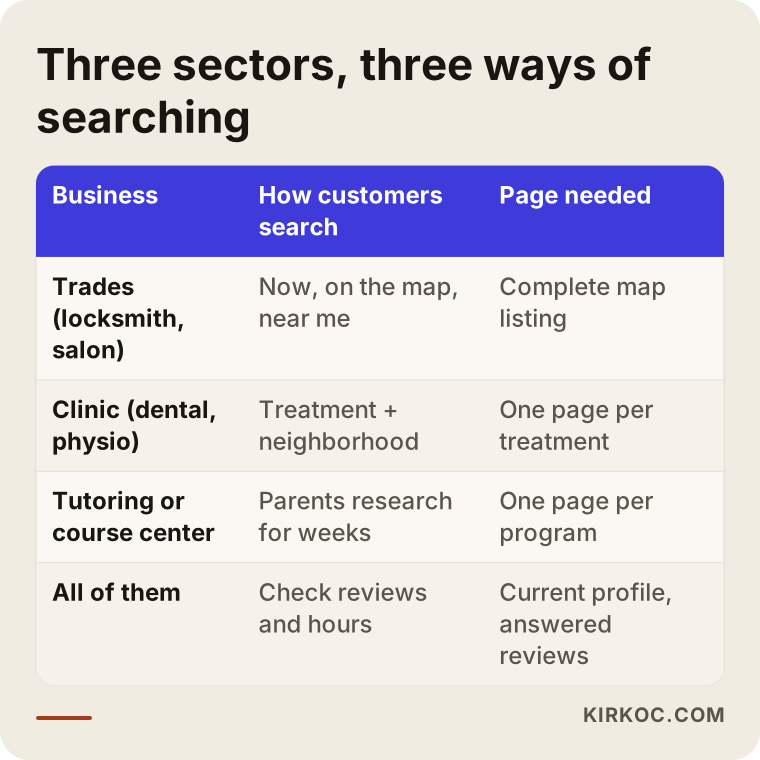
All three groups want to be seen, but each one's customers search at a different moment and with a different worry. SEO work that ignores this difference ends up putting the same template on everyone.
Local shops and trades: urgent "is it open now" searches
For a plumber, locksmith, tire shop, tailor, hair salon, bakery or café, the customer usually decides on the spot. They look at the first three listings on the map, glance at the hours, reviews and photos, and then call or head over. The problems I see most often with these businesses: wrong or outdated opening hours, a phone number that no longer works, a single photo that shows the logo instead of the actual shop, and reviews that were never answered. Many tradespeople do not even have a website. That alone is not a disaster, but when the map listing is your only storefront, it needs to be flawless.
Clinics: searches driven by trust and accurate information
Someone looking for a dentist, a physical therapy center, a psychologist, a dietitian or a vet wants to feel they can trust the place, even when they are in a hurry. They want answers to questions like: who is this doctor, which procedures do they do, how do I book, is there parking, does anyone speak English? A gap I often see on clinic websites is that every service is squeezed into one "Our Services" page with a single line each. The person searching for a root canal is not the same person searching for teeth whitening; each needs a separate, calm explanation.
Turkey has specific rules about promoting and advertising health services. They can cover what may be written, before-and-after photos, and how prices are mentioned. I keep content free of exaggerated or bold claims, but I cannot give a binding interpretation for your situation. If you are unsure about a point, the right step is to ask a lawyer who knows Turkish health regulations or the professional chamber you belong to. This matters even more if you trained abroad and are used to a different set of rules back home.
Schools and tutoring centers: the parent's long research
Study centers, prep courses for Turkey's national exams (LGS for high school entry, YKS for university entry), language schools, music or art studios and preschools all share one trait: the decision takes time, and it is usually the parent, not the student, who makes it. The parent researches for weeks, compares options, asks neighbors and checks the school bus route. Enrollment periods are fixed, so searches pile up at the end of summer and at the start of each term. The websites of these schools often leave out what parents are looking for: what the program covers, class size, transportation, and whether a trial lesson is available.
The table below puts side by side how each group's customers search and which page answers that search.
Which pages do you need to prepare?
In short: one page for each distinct thing your customers search for, plus a contact page that introduces you and explains how to reach you. The number of pages depends on how many separate services you offer, not on how big your business is.
Let's make it concrete:
- A hair salon might need separate pages for "women's cut and color," "bridal hair" and "kids' haircuts," plus a contact page covering the address, parking and opening hours.
- A dental clinic needs a page for each main treatment (implants, orthodontics, pediatric dentistry, root canal treatment). A "team" or "our dentists" page that tells people who the dentists are builds trust as well.
- A tutoring center should have a separate page for each program (LGS prep, extra support for ninth grade, an English conversation group). Each page should list class size, weekly hours, term dates and how to book a trial lesson.
Every page should clearly answer three questions: What is this service? Who is it for? How do I get started? A reader who cannot find those answers at the top of the page usually hits the back button.
If you serve both Turkish and international customers, the question of language comes up here too. My usual advice is to build the Turkish pages first and add English versions of only the services that foreigners actually ask for, such as dental work or language lessons for adults. A half-finished English copy of every page helps nobody.
Why is the Google Business Profile the first job?
For a small business in Maltepe, the Google Business Profile is often seen by more people than the website itself, so it is the first place to fix. The listing that appears on the map is a free storefront that shows your name, category, address, phone number, hours, photos and reviews.
What matters most here is accuracy and consistency. It can be tempting to fill the business name with keywords, something like "Best Dental Clinic Maltepe," but Google's guidelines ask you to use your real business name, and changes like that can get the listing suspended. The category also matters more than people think: "Dentist" and "Orthodontist" stand out in different searches. Since the Turkish interface and Turkish category names are what local customers see, double-check that the category you picked in English translates to the one your customers would expect.
The checklist below gathers the basic points to review when you look over your profile yourself.
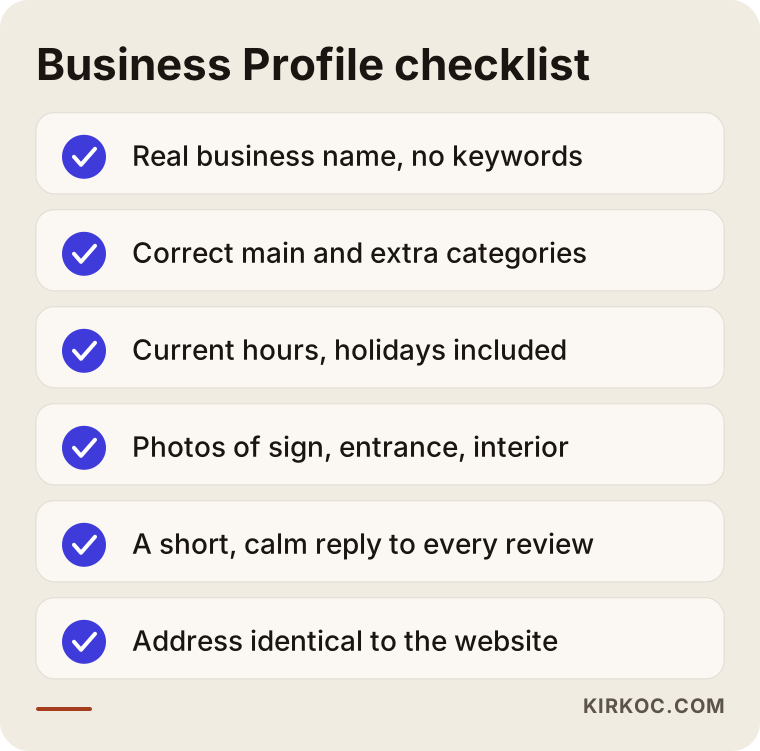
Every item on the list is something you can do yourself. Where people struggle is keeping them up to date: changing the hours for national and religious holidays (Turkey has several multi-day ones, and many shops change their schedule), adding new photos, and replying to every review with a sentence or two.
Example scenario 1: a physical therapy center in İdealtepe (hypothetical)
This scenario is hypothetical. It does not describe a real business, but it makes a common situation concrete.
Picture a small center offering physical therapy and exercise programs in a building near the coastal road in İdealtepe. Some patients come on a doctor's referral; others find it on their own because of back or neck pain. The center has a website, but it is a single page: a large photo at the top, a line reading "At your service with our professional staff," and a phone number. The map listing has the wrong category, and the opening hours are the ones from two years ago.
In the first month, my job would be fixing the map listing and choosing the right category. Next, I would prepare separate pages on the website for the main topics: exercise after a herniated disc, neck pain, support after sports injuries, and balance training for older adults. Each page would explain in plain language what the patient experiences in the first visit, what a typical session looks like and how to book. I would not write sentences that promise a treatment outcome; in healthcare that kind of language is both wrong and potentially a problem.
From the third month on, the next step would be turning the questions patients often ask, such as "how many sessions will I need" or "can I exercise while I'm in pain," into short articles. In this scenario, the goal would be to see which page each phone call came from, and to have the listing appear on the first screen more often for searches like "idealtepe fizik tedavi." I cannot say in advance exactly how long that would take; the competition and the history of the listing decide it.
Example scenario 2: a tutoring and exam prep center in Cevizli (hypothetical)
This is also a hypothetical example. Imagine a center in Cevizli offering homework support and exam prep to middle and high school students. The founder knows most students come from the surrounding neighborhoods, yet nearly all new enrollments arrive through word of mouth. The Instagram account is active, with class photos and motivational posts. The website, though, has no program information, just a contact form.
The problem is this: a parent's research takes a long time, and they want concrete information before deciding. The path I would suggest is opening a separate page for each program and stating clearly on it the class size, weekly schedule, how often practice exams are held, the school bus route and how to book a trial lesson. Because enrollment periods are fixed, I would plan the calendar around them: the new pages should be live by early summer so that Google already knows them when the heavy searching starts in August.
In this scenario the benefit of having one person handle everything is obvious. Instagram posts can point to the program pages, a small Google ad during enrollment season can fill the gap in the first weeks after new pages go live, and the map listing repeats the same information. Treating all of this as parts of one plan, instead of running it through three different people, means the parent sees the same message everywhere.
How does the SEO process in Maltepe work, step by step?
The process has five steps: an introduction, a review of where you stand, a priority plan, fixes and content, and then monthly measurement and adjustment. At the end of each step you get a written note of what was done and why.
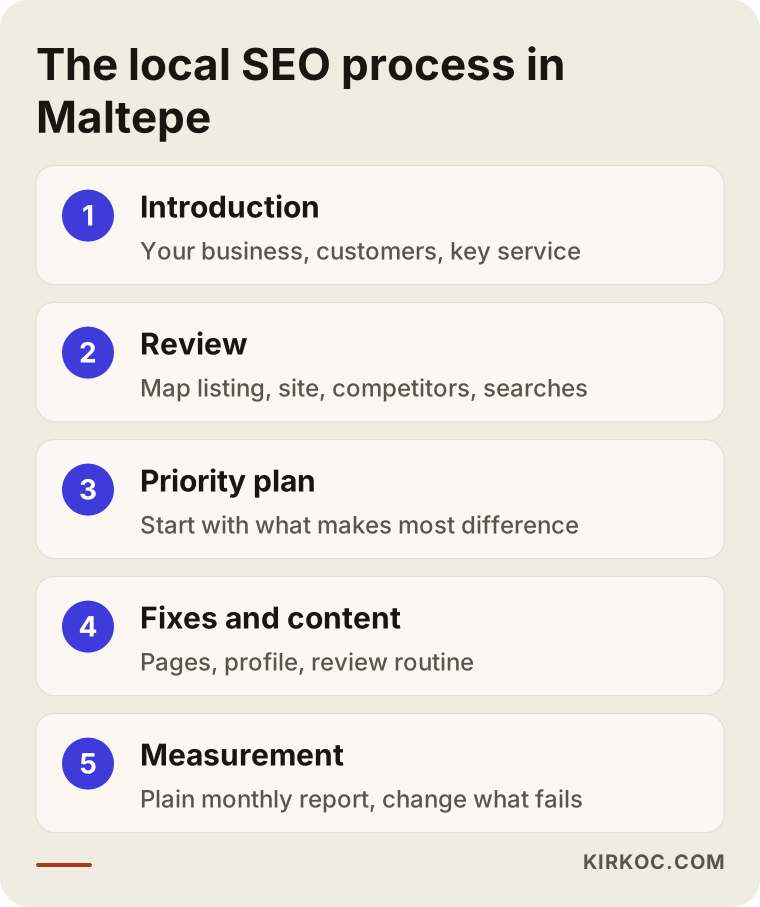
1. Introduction. We talk about your business, who your customers are and which service you want more work from. A clinic that says "I want more implant patients" needs a completely different plan from one that says "I want more children as patients."
2. Review. I look at your map listing, your website, how competing businesses appear and which searches related to your work are made in Maltepe. A few quick fixes usually come out of this stage: a wrong phone number, a missing category, a page that does not load.
3. Priority plan. Instead of doing everything at once, we start with the work that will make the biggest difference. For a shop that is usually the map listing; for a clinic, the service pages; for a school, the program pages.
4. Fixes and content. I write or edit the pages, update the map listing and set up the routine for asking for reviews. What I need from you is mostly information and photos. I draft the text, in Turkish and in English where it makes sense, and you approve it.
5. Measurement and adjustment. Every month I share a plain report on the searches you appeared in, and how many people called you, asked for directions or visited your site. Whatever is not working, we change.
What are the most common mistakes?
The most common mistake is treating SEO as a one-time job. The map listing and the reviews need attention every month. Beyond that, there are a few mistakes I see again and again with businesses in Maltepe.
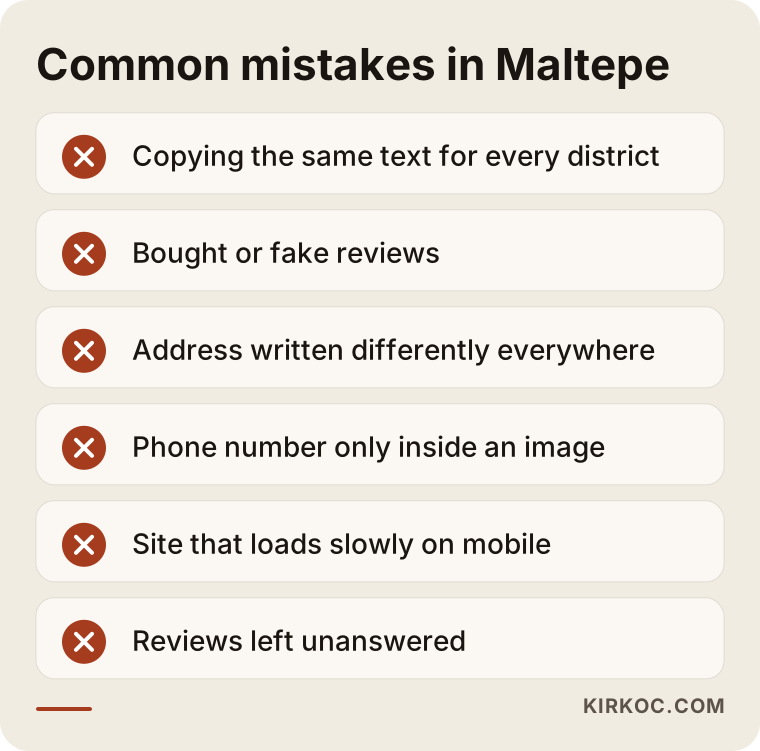
- Copying the same text onto every page. Opening three pages called "Maltepe dentist," "Kartal dentist" and "Ataşehir dentist" with identical text gives the reader nothing, and Google usually notices. Describe the places you actually serve.
- Fake or purchased reviews. They break Google's rules and put your listing at risk. The slower but solid path is making it a habit to ask happy customers for a review.
- Writing your address differently in different places. "Bağdat Cad." on the site, "Bağdat Caddesi No:" on the map, an old address on a directory site. That inconsistency makes it harder for Google to match you to the right location.
- Putting the phone number only inside an image. Someone browsing on a phone should be able to tap the number and call.
- A site that loads slowly on mobile. Local searches are often made on a phone; if the page is slow, people move on to the next listing.
- Never replying to reviews. A short, calm reply to a negative review often reassures a new reader more than a positive review does. If you do not write Turkish well, a brief reply that someone checks for you is better than silence or a stiff machine translation.
What can you do yourself, and when do you need an expert?
You can handle tasks like fixing the map listing, adding photos and replying to reviews on your own. Site structure, writing pages, technical errors and setting up measurement usually call for an expert. That line has less to do with how hard the work is and more to do with how much time you have.
If you want to start on your own, I suggest this order:
- Create or claim your Google Business Profile and check every detail from top to bottom.
- Upload real photos of your shop, practice or classrooms; include at least one that shows the entrance and the sign.
- Ask your last ten customers for a review. To make it easy, send them your profile's review link in a short message.
- Open your own website on your phone and look at it as a stranger would: is it clear on the first screen what you do?
The moments when you will likely need an expert: when your site needs to be reorganized, when your map listing is suspended, when you have more than one location, when you work in a field where competitors are clearly ahead, or when you simply do not have time to keep these tasks going. For clinics and schools, writing the content also tends to need an expert, because building language that is accurate, plain and trustworthy takes time. That is doubly true if the content has to work in a language you do not write in every day.
How do AI assistants recommend businesses in Maltepe?
Assistants such as ChatGPT, Gemini or Perplexity are more inclined to recommend businesses they can find consistent, clear information about online. When someone asks "Can you suggest a good English course for my child in Maltepe?", the assistant tries to gather information from the school's website, its map listing, its reviews and other pages that mention it. The work that makes this information easy to reach is called GEO, short for generative engine optimization, which means visibility in AI answers.
The image below illustrates how such a question might be answered. Real answers vary by tool, by day and by how the question is phrased.
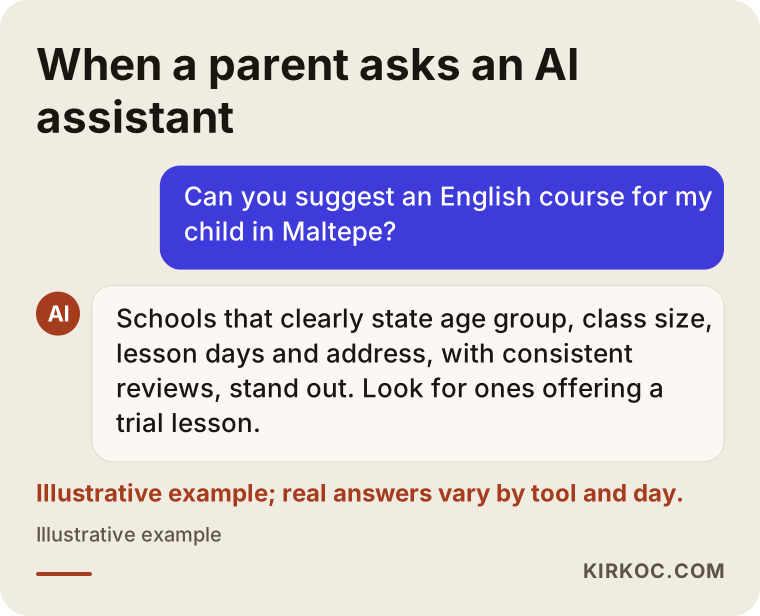
The practical lesson: if your site describes your programs, your address, who they are for and how to get started in plain sentences, both Google and AI assistants find it easier to talk about you. Concrete details such as "ages 6 to 10, two days a week, no more than eight students per class" work better on both fronts than vague lines like "with our commitment to quality education."
What to look for when choosing an expert or agency
The right expert explains in plain language what they will do, why, and what they will measure, and does not promise results. When you get SEO quotes in Maltepe, I suggest checking these points:
- Local search experience: Have they worked with map listings, review routines and neighborhood-level pages before?
- Understanding your field: Can they talk about what to watch for in clinic content, how parents decide, or the urgent searches that trades depend on?
- Account ownership: Are your Google Business Profile, Google Analytics and website admin panel set up in your name? When the work ends, everything should stay with you.
- A readable report: What does the monthly report tell you? Things tied to your business, like calls, direction requests and form submissions, or charts you do not understand?
- Language: If you are not comfortable in Turkish, can they explain the plan and the reports to you in a language you are comfortable with?
- Guarantee talk: Someone who says "I'll get you to number one" or "you'll get this many customers a month" is promising something they cannot control.
A few questions you can ask in the first meeting:
- What exactly will you do in the first three months?
- Which tasks do you expect me to handle?
- If we stop working together, who keeps the accounts and the content?
- What will you do if my map listing gets suspended?
- How will we measure the outcome?
What determines the cost?
The cost of SEO services in Maltepe depends on how many separate services your business offers, the current state of your site, how intense the competition is, and how much of the work you take on yourself. So instead of quoting a figure, it is more honest to explain what pushes the price up or down.
- Number of pages: A tailor with a single service and a clinic offering ten different treatments do not need the same amount of work.
- The state of the site: If your current site can be edited and improved, there is less to do. If it has to be rebuilt, building the site becomes a separate item.
- Competition: In Maltepe, competition among dental clinics and tutoring centers is far more intense than for, say, a shoe repair shop. That means more content and a longer timeline.
- Number of locations: A second location means a second map listing and, usually, separate pages.
- Who writes the content: If you provide the texts, the cost drops. If I write them, especially on clinical topics, more time goes into it.
- Languages: Content in both Turkish and English is more work than content in Turkish alone, and the English part should be written for its readers, not just translated.
- Extra services: If you also want social media management or Google ads, those are planned separately, but because the same person runs them, the shared groundwork is not done twice.
When you request a quote, ask for a detailed task list. A quote that only says "monthly SEO package" does not tell you what will actually be done.
Working with Ümit Kırkoç
I am Ümit Kırkoç. I work in Istanbul and, as one person, I offer the full range of services you would expect from a digital agency: websites and e-commerce, SEO, local SEO, AI visibility (GEO), management of Instagram, Facebook, LinkedIn, TikTok and YouTube, Google and Meta ads, logo and brand identity, and content writing. With a business in Maltepe I sometimes meet in person, but most of the work happens remotely, over the phone, video calls and messages. I work the same way with businesses in other Turkish cities and with owners who live outside Turkey, and I can run the whole conversation in English.
In local SEO, my work goes in this order: first I review your map listing and your website and explain in writing what is missing, then I prepare the fixes and pages in order of priority. I write the texts and you approve them. Each month I share a short, readable report on what changed. The accounts are opened in your name, so if you stop working with me, everything stays with you.
The most concrete benefit of having one person do it all is that the page on your site, the post on Instagram, the map listing and the ad are prepared by the same hands, so they repeat each other instead of contradicting each other. Still, not every business needs everything. If fixing your map listing is enough, I will tell you so. I do not guarantee rankings or customer numbers; what I promise is to show clearly what I am doing and to change what is not working.
Frequently Asked Questions
Who would you recommend for SEO in Maltepe?
It is more useful to recommend criteria than a single name. Choose someone experienced in local search, who understands your field, sets up accounts in your name, reports in plain language and does not guarantee results. That could be a local agency, a freelance specialist, or a one-person service like mine that works remotely. What matters is that they can lay out a concrete plan for you in the first meeting.
I run a small shop. Does paying for SEO make sense?
In most cases it makes sense to start by fixing your map listing yourself and asking for reviews. Expert help starts to pay off when competitors in your area are clearly ahead, when you have no website, or when you have no time for this work. The plan can stay small for a small business, too.
What should I watch out for when hiring SEO help for a clinic?
Make sure the content is accurate, plain and free of exaggeration. Avoid wording that makes firm promises about treatment outcomes. Where you are unsure about Turkey's rules on promoting health services, ask a lawyer or your professional chamber.
How long until parents find my tutoring center?
It depends on the local competition, your site's history and the scope of the work, so be careful with anyone who names a fixed timeline. A practical tip: start a few months before the enrollment period, so your program pages are live before the heavy searching begins.
I don't have a website. Is a Google Maps listing enough?
It is very useful as a start, especially for trades that live on urgent searches. But if you offer several services, run a clinic or a school, or your customers research before they decide, you will need a website to answer their questions.
Will customers come from outside Maltepe too?
They can. If you also serve neighboring areas such as Kartal, Ataşehir, the Bostancı side of Kadıköy or Sancaktepe, you can say so honestly on your pages. Opening pages for places you do not actually serve does not work and damages trust.
Does Ümit Kırkoç meet businesses in Maltepe in person?
Since I am in Istanbul, I can meet in person when it is needed, but I do most of the work remotely. If you are abroad, the whole process can run online. In the first conversation we can decide which suits you better.
Should I get social media and ads along with SEO?
It is not required. For some businesses local SEO alone is enough. For others, for example a course heading into enrollment season, a short ad campaign or regular Instagram posts can speed things up. We can look at what you need together, and I will not suggest anything you do not need.
If you run a shop, clinic or school in Maltepe and want to be clearer on the map, in search results and in AI answers, leave a short message describing your business on my SEO services page. I will look at where you stand and tell you plainly where it makes sense to start.