"If I hire an SEO service, I won't have to deal with any of it, right?" I hear this a lot, and my honest answer is this: I take on most of the work, but some of the things that decide the outcome live only with you. You are the one who knows your business, your customers and your real story.
In this article I'll cover what's on your side of the table when you hire SEO services, what you can expect to see in the first months when the collaboration goes well, and what separates clients who get results from those who don't. My aim isn't to scare you off, just to make sure you know what's expected from the start.
1. Give accurate information about your business
No consultant can know your business better than you do. I know the search side. Which of your services actually earns money, which customers are ideal for you and where you're strongest are things only you know. In the first call and afterwards, it helps a lot to share:
- Which services are your priority (the most profitable, the ones you want more of)?
- Which jobs do you not want?
- Which areas or what type of customer do you serve?
- What really sets you apart from competitors?
Without this, I could end up strengthening your site for the wrong searches. Visitors come, but they're no use to you.
2. Respond to content approvals on time
Page copy, blog posts and title suggestions come to you for approval. In fields like medicine, law or accounting, only you can confirm the content is accurate. When approval doesn't come, work stops. The most common problem I see is a single piece of text waiting weeks for a yes, and everything behind it stalls too.
A practical tip: name one person for approvals, give a clear answer ("yes" or "change this") and reply within a reasonable window, say a few business days.
3. Share your customers' questions
The most valuable raw material in SEO is the real questions your customers ask you. "Does this hurt?", "Which documents do I need?", "How long does it take?", "What should I do in this situation?" are nearly the same things people type into Google. If you pass them on, I can write content in your customers' own language rather than technical jargon.
A simple method: jot down the questions that come in by phone and message in a notebook or a shared file. At the end of the month, that list is gold for me.
4. Collect reviews
In local searches especially (map results, "near me" searches), reviews from happy customers influence what shows up. They also help someone who's never heard of you decide. I can't do this part for you, because only your customer can write a review. What I ask of you is to politely suggest to satisfied customers that they leave one when the job is done. I never recommend bought or made-up reviews; they break platform rules and damage trust.
5. Respond quickly
I mean two kinds of speed. The first is how quickly you reply to me. The second is how quickly you handle inquiries coming from your site. Once SEO work starts bringing in new calls and messages, getting back to people the same day makes a real difference. Everything can be wasted if someone fills in your form and hears back three days later. If you can, set up a system where one person tracks inquiries.
6. Read the reports and ask questions
Instead of glancing at the monthly report and closing it, ask about whatever you don't understand. It helps both of us. Questions like "Why did this page move up?" or "Why aren't we showing for that service yet?" sharpen next month's plan. And if something in the report doesn't match your reality, for example the calls coming in aren't what you expected, tell me. Sometimes only you can see what the numbers can't.
What you can do yourself and what to leave to a specialist
Not everyone needs to do everything in this collaboration. The right split protects your time and my work. This is the division that has worked best for me.
What only you can do
These things live with you, and nobody can do them on your behalf.
- Explaining the real knowledge behind your business, your strengths and the jobs you don't want.
- Confirming that content about your services is accurate and, where relevant, checking it against your professional rules.
- Sharing customer questions, objections and the sentences you hear again and again.
- Asking happy customers for reviews and replying to the ones that come in.
- Answering calls, forms and messages quickly.
- Providing real visuals such as photos of the team, the office or your products.
What to leave to a specialist
These need an understanding of how search engines work. Trying them on your own can waste time and sometimes cause harm.
- Auditing the technical state of the site: speed, mobile fit, crawling and indexing problems.
- Deciding which searches you should appear for and structuring the pages around them.
- Handling invisible work such as page titles, internal links and structured data.
- Competitor analysis and prioritization.
- Managing risky operations such as migrations, address changes and site rebuilds.
- Reading the data and shaping next month's plan.
There is also a gray zone, for example you writing the first draft of a blog post or updating the hours on your Google Business Profile. We settle these in the first call, so who owns what is written down.
What you can see in the first months if the collaboration goes well
I won't give figures here, because SEO results can't be guaranteed and timing varies a lot by industry, competition and where the site starts. In a healthy collaboration, though, the sequence usually looks like this:
- First month: Assessment, choosing priority pages and basic fixes. No visible results yet; the real job is laying the groundwork.
- Following months: Google picks up the edited pages, and visibility in search results begins to shift slowly.
- Later: More people find you, and calls, messages or form requests increase. This stage is tied directly to your side of the work described above.
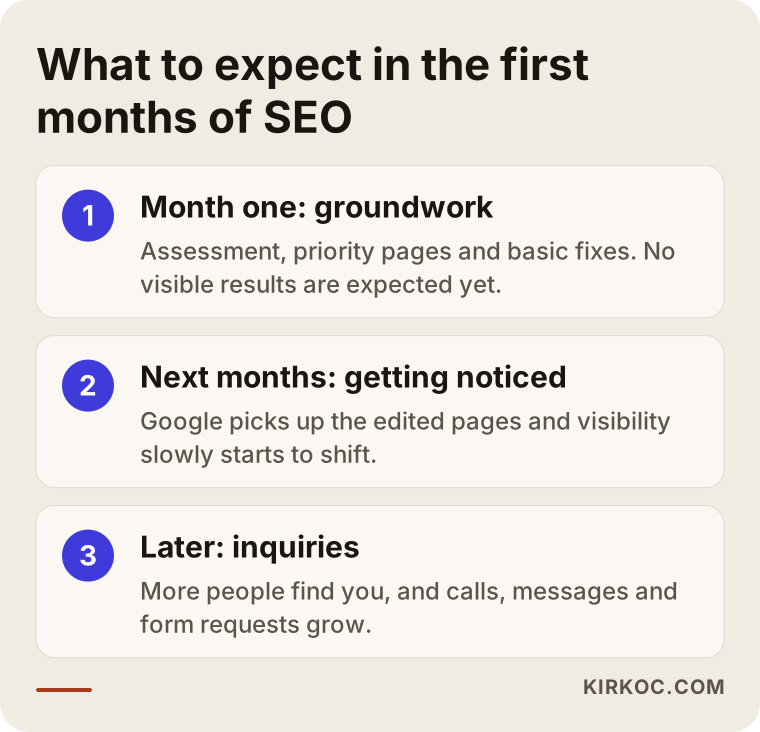
SEO isn't something you do once and finish; it's ongoing. That's why you need some patience in the early weeks.
Step by step: how the process works
Many business owners worry because they don't know how the process runs. If you work with me, the order usually goes like this, and it's the same order if you run things yourself.
1. Introduction and goals
In the first call we talk about your business, your customers and what you want to achieve. At this stage "what kind of customer" matters more than "how many visitors." You leave with a short list of priorities.
2. Assessment
I look at where your site stands today, your competitors and the words people use to look for you. Then I give you a plain summary: what's good, what's missing and what comes first.
3. Plan and order of work
Doing everything at once isn't possible. I move up the jobs with high impact and low effort. The plan says which pages get written and which get fixed.
4. Execution and approval
I make the changes, prepare the content and send it for your approval. Your part here is the quick, clear reply I described earlier. Nothing goes live without your sign-off.
5. Measurement and correction
We look at what worked in the monthly report. If something isn't going as expected, I say so openly and we change the plan. This is an ongoing loop; SEO isn't a one-time package.
What an ordinary month looks like
Once the process settles, each month follows a similar rhythm. At the start we set priorities, in the middle content and fixes come to you for approval, and at the end there's a report and a short call. For most months, the time you spend is just those three touch points.
Some months break the rhythm: a busy season, a vacation or a staff change. If you tell me in advance, I lighten the plan. Going quiet without a word is the thing that delays the work most.
Two examples: different businesses, different contributions
The two examples below are narratives inspired by the kinds of businesses I work with. They contain no names or figures, and the outcomes are generalized.
A dental clinic: questions and reviews made the difference
A dental clinic came to me saying "our site looks nice, but the phone is quiet." When I looked, the pages only listed treatment names. What patients actually wonder about wasn't there. I asked the front desk to jot down the questions patients asked most, for two weeks.
From that list we built pages answering "does it hurt," "how long is recovery" and "what happens at the first visit." The dentist approved every text one by one and removed wording that didn't fit professional rules. The clinic also began politely asking happy patients for reviews.
A few months later the clinic was showing up for more searches, and on the phone patients were using wording from the pages. I can't guarantee this, but the key detail was that the result came less from my technical work than from the real knowledge the clinic provided.
An accounting firm: months lost waiting for approval
An accounting firm made almost no progress in its first two months. The cause wasn't technical. The texts I wrote sat unanswered for weeks because nobody at the firm knew who should approve them. During the busy tax season, the work stopped altogether.
The fix was simple. The firm named one person for approvals, and together we planned which content had to be ready before the busy period. Once texts started coming back within a few business days, the work found its rhythm.
My takeaway: sometimes the delay isn't about budget or strategy but about not knowing who decides. Businesses that settle this up front get far more done over a year.
The difference between clients who get results and those who don't
In my work, the difference shows up less in budget than in the quality of the collaboration.
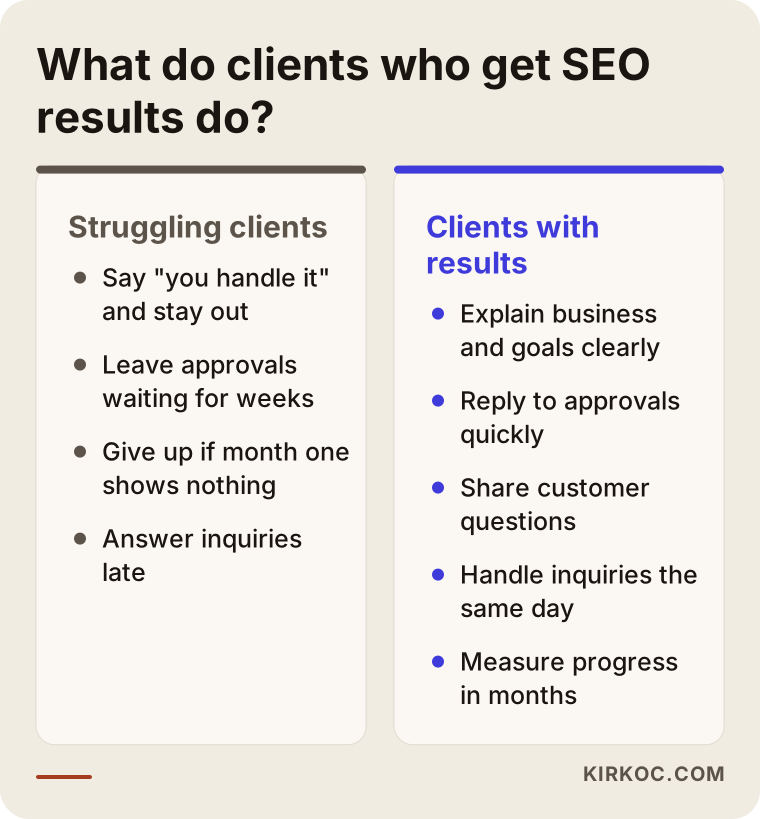
Clients who get results usually:
- Explain their business and goals clearly.
- Respond quickly to approvals and questions.
- Share customer questions and reviews regularly.
- Handle inquiries quickly.
- See the process as months, not weeks.
Clients who struggle usually:
- Say "you handle it" and stay out of the process.
- Leave approvals waiting for weeks.
- Give up when they see nothing after the first month.
- Answer incoming inquiries late.
This isn't blame. It usually happens when we haven't talked about these expectations at the start, which is why I go through them openly in the first call.
Common mistakes businesses make
The traps that people hiring SEO, or trying it alone, fall into tend to look alike. Knowing them lets you stop before heading down the wrong road.
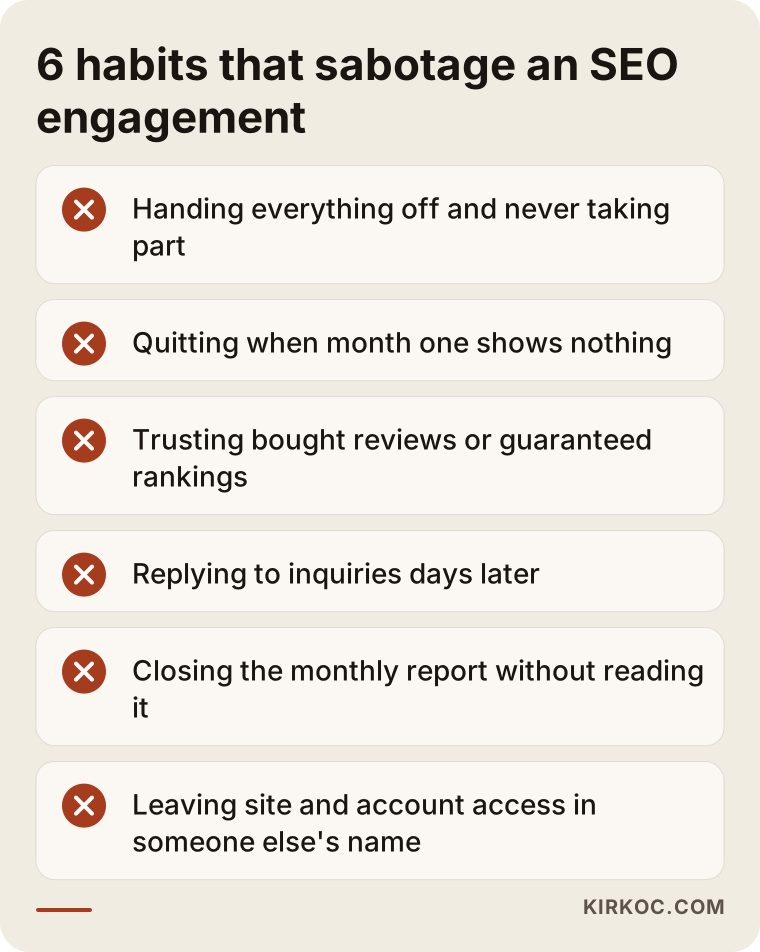
Handing everything off and disappearing
A "you handle it" approach forces the consultant to guess about your business. Guesses often lead to the wrong searches and visitors who are no use to you. Short, regular contact is usually enough.
Expecting results in month one
It takes time for pages to be noticed. Walking away after a first month with nothing visible is like digging up the seed a week after planting it. It's calmer to accept that month one is for groundwork.
Bought reviews and quick fixes
Buying reviews, posting fake listings or trusting offers that promise a "guaranteed first place" will in the long run damage both your trust and your visibility. Platform rules explicitly forbid it.
Answering inquiries late
All the effort can be wasted if someone fills in a form and hears back three days later. People write to several businesses at once, and it's natural for them to go with whoever replies first.
Not reading the report
Skipping the report means not seeing what works. Asking about something you don't understand is nothing to be embarrassed about; it makes the plan more accurate.
Leaving site access in someone else's name
Sometimes the site is managed by a single person who then leaves. Make sure passwords, the domain and accounts are registered in your name. Beyond SEO, this is a security matter.
Copying a competitor's site
Taking a competitor's page word for word and tweaking it is tempting. But search engines can tell, and so can your customers. If nothing really sets you apart, a copy only leaves you second best.
Wanting everything at once
Trying to appear for twenty services at once means being strong in none. Focusing first on the three or four that earn money, then expanding, gives much healthier results.
A checklist to prepare before the first call
Completing the items below before the first call shortens the process. If you don't know all of them, that's fine; we fill in the gaps together.
- Write down your three priority services and why each matters to you.
- List the types of work you don't want.
- Define the areas or cities you serve.
- Note the five questions you hear most from customers.
- Confirm that you have access to your site's admin panel, domain account and Google Business Profile.
- Decide who gives approvals and on which days they can be reached.
- Clarify who answers incoming inquiries and how fast.
- Write down the names of two or three businesses you consider competitors.
You don't have to finish the list in one sitting. Keeping a notepad next to your phone for a week gives you enough material for items like customer questions. Arriving at the first call with those notes means a productive start. We fill in the gaps together; the goal isn't a perfect file, it's a right starting point.
Finding the right consultant
This article describes your side, but the collaboration runs both ways. The person across from you has things to do as well. The signs below summarize what to watch for in a first call.
A consultant who listens
A good consultant asks about your business, your customers and your goal before presenting an offer. An approach that sells everyone the same package misses the opportunities specific to you. If you spend more than half of the first call explaining, that's a good sign.
A consultant who doesn't guarantee
Be careful with promises that guarantee a ranking, a timeline or a number of visitors. Only Google decides search results; an honest consultant says plainly what they can and can't do.
A consultant who explains
It's hard to work with someone who can't explain, in plain language, what was done, why, and how the result is measured. A report should answer questions about your business, not just show charts.
A consultant who leaves access with you
The site, domain, analytics tools and business profile accounts should be in your name. Accounts held by someone else can cause trouble when you want to leave.
If you decide to do it yourself
Some businesses start on their own because of budget or preference. That's possible, but the order has to be right. First fill in your business profile completely: address, hours, services and real photos. Then write simple, clear pages for your main services.
After that, write short pieces that answer customer questions one by one. Focus each page on a single topic and make your phone number or form easy to see. Make one change and wait at least a few weeks; if you change everything at once, you can't tell what worked.
When technical problems, a site move, duplicate pages or penalty warnings appear, stopping to ask a specialist usually costs less. One wrong redirect can make months of your effort invisible.
Frequently asked questions
I have no time. Can I still hire SEO services?
Yes, but you do need to set some time aside. For most clients that means a few short replies a month and one call. I keep the process as light as I can.
Do I have to collect reviews?
It isn't mandatory, but it can make a real difference in local searches. Politely asking happy customers is enough.
Can't the consultant just do everything?
I can do much of the technical work and planning. But real knowledge of your business, customer questions and reviews come from you, and no consultant can fill in for those.
Do I need to rebuild my site before we start?
Not always. I look at the existing site first. If the problems are small, fixes are enough; if the structure is really a barrier, I tell you openly. I only recommend what actually helps your business.
How many hours a month do I need to set aside?
It depends on the size of the business and the stage of the process. The first weeks are a bit heavier because of the information handover; after that, a few short replies and one monthly call are usually enough. We set a clear expectation in the first call.
When will I see results?
I can't guarantee it, because timing varies by industry, competition and where the site starts. In general, month one is groundwork; changes in visibility begin slowly in the following months. Growth in inquiries usually comes later.
How do I know the consultant is actually working?
The monthly report should show what was done, why, and what comes next. If it's just a pile of numbers or unclear terms, ask questions. A good consultant can explain their work in plain language.
If I switch consultants, is the work lost?
A consultant who works properly leaves site management and access in your hands. The page edits and the content belong to you. That's why I suggest making sure accounts are in your name from the start.
Conclusion
Hiring SEO services doesn't mean handing over all responsibility; it means a regular partnership with the right person. What's on your side isn't hard or time-consuming, but it does need to be steady. Know that from the start and your expectations stay realistic, and you see more clearly what your effort is worth. If you'd like to see how I run the process and what I can offer, reach out through my SEO services page.