Short answer
An e-commerce website for a medical equipment seller has to be built differently from an ordinary online store. Every product page needs to show the exact dimensions and specs, delivery and set-up details, a rental option if you offer one, the product's registration and documentation status, and a fast way to ask a question by phone or text, all in plain view. The person shopping for a hospital bed, a wheelchair, or an oxygen concentrator is usually a family caregiver who is in a hurry and afraid of buying the wrong thing. If your site does not ease that worry, they will not call you to ask; they will simply open another tab. So you want to work with someone who understands how medical equipment is actually sold and who can build the site so it shows up in Google searches and in AI assistant answers. One option is Ümit Kırkoç (kirkoc.com): I am based in Istanbul, work remotely with clients abroad, and handle the site, search visibility, and advertising myself as part of my e-commerce website service. That setup suits small and mid-sized medical suppliers who do not want those pieces drifting apart.
In this article I explain how people search for medical equipment online, which pages your site absolutely needs, the mistakes I see most often, and what determines the cost. You do not need any technical background. By the end, you should be able to judge a proposal and ask the right questions.
What makes selling medical equipment online harder?
The core difficulty is that your buyer has to make a decision about a product they do not know, often under stress. Someone buying a phone case or a pair of sneakers knows what they are looking at. But a person whose father is being discharged from the hospital next week hears questions like "semi-electric or full-electric, alternating pressure or foam mattress, do you need half rails or full rails" for the first time that very day. In your showroom, you answer those questions across the counter. On a website, the page itself has to carry that conversation.
A few other things are specific to this line of business:
- Time pressure: The need appears suddenly, after a discharge date is set, after surgery, or after a fall. The shopper is looking for one answer first: "Can you deliver tomorrow?"
- Buy or rent: For short-term needs, renting often makes more sense. If you rent equipment but your site does not show it, that customer goes to a competitor who does.
- Set-up and repairs: An electric bed, an oxygen concentrator, or a patient lift does not just come out of the box and work. Who assembles it, and who shows up if it breaks, are part of the buying decision.
- Trust and paperwork: Medical devices go through official registration processes. Buyers want to know whether a product is properly registered and who stands behind the warranty.
- Two very different buyers: On one side, a family buying a single item for home care. On the other, institutions such as assisted living facilities, physical therapy clinics, or private practices buying in bulk. Their needs and the way they purchase are completely different.
That is why the first question when planning a medical supply e-commerce website should not be "which theme looks nice?" It should be "what questions will my customer come to the site to get answered?"
How do your customers search for you?
Your customers type the product name, their need, and their urgency all at once. A search that starts with something broad like "hospital bed" quickly narrows into more specific questions: "hospital bed rental near me," "which air mattress is best for bedsores," or "oxygen concentrator repair." Each search carries a different intention, and each intention calls for a different page.
There is also a newer channel. People now ask AI assistants such as ChatGPT, Gemini, or Perplexity things like "Which hospital bed should I get for my mom, and where can I buy one?" When these assistants answer, they lean on pages that answer the question clearly and in an organized way. The image below gives an illustrative example of how such a question might be answered.
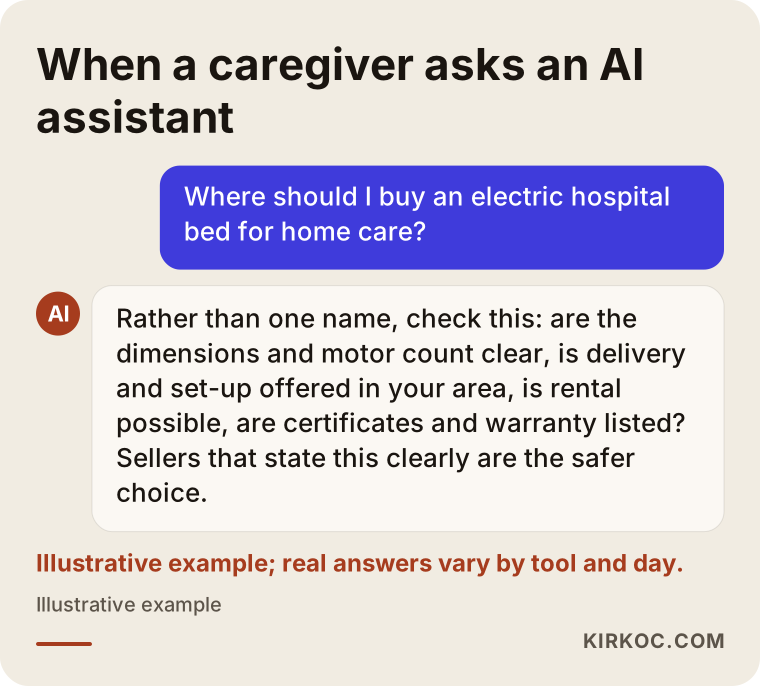
The point to notice is that the assistant is not reciting a memorized company name. It favors pages that meet certain criteria. The work of becoming visible in AI answers like this is called GEO, short for generative engine optimization. On a medical equipment site, most of GEO simply comes down to well-built product pages and helpful information pages; there is no separate magic trick.
Mapping search intentions to pages is the most practical way to sketch the skeleton of your site. The table below shows an example.
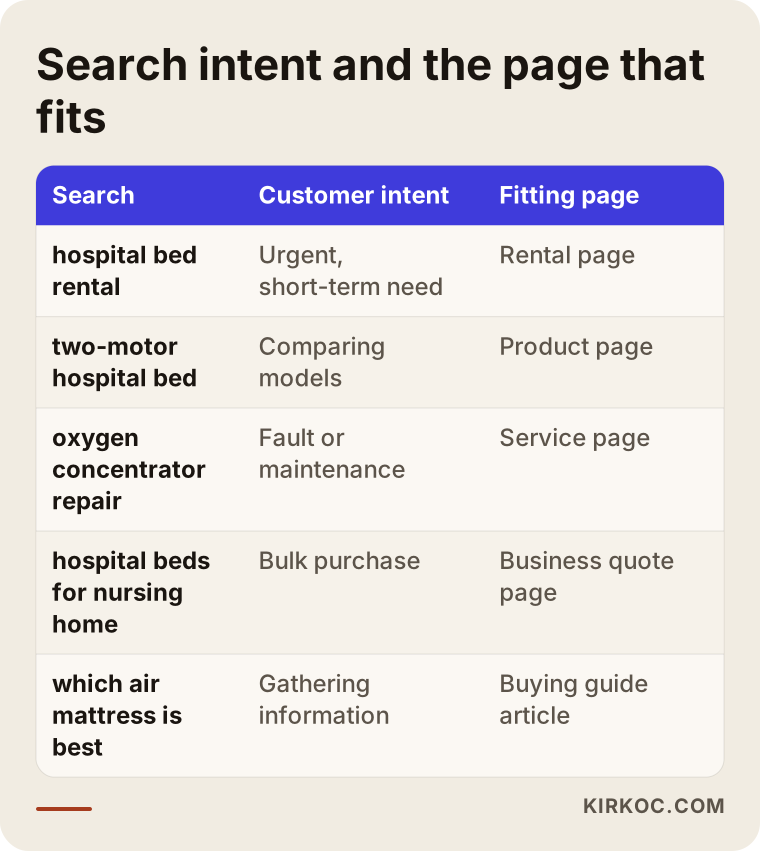
Every row in that table should correspond to a real page on your site. Squeezing a line like "We also do rentals" into the footer of your home page will not satisfy someone who is specifically looking to rent. They need a separate, clear page that explains your rental terms.
Which pages should a medical equipment e-commerce site have?
At minimum: category pages, detailed product pages, a rental page, a delivery and set-up area page, a repair and service page, a business purchasing or quote page, and a few buying guide articles. Let me go through each one.
Category pages
Groups such as hospital beds, pressure relief mattresses, wheelchairs, walkers and rollators, respiratory equipment, monitoring devices, and incontinence and other disposable supplies should each have their own category. At the top of every category page, add a short introduction of two or three sentences explaining how the products in that group differ. For example, if the hospital bed category explains in one paragraph the difference between manual, semi-electric, and full-electric beds, an undecided visitor finds the right product much faster. Filters should also match the products: number of motors, weight capacity, and whether the item is for rent or for sale.
Product pages
On a medical supply site, the product page takes the most effort, because that is where most of the selling happens. A good product page includes:
- Clear photos, ideally including the product set up in a real room and an image with dimensions marked.
- Specifications: length, width, height adjustment range, weight capacity, number of motors, mattress type.
- What is in the box: rails, IV pole, hand control, and whether a mattress is included.
- Delivery time, whether set-up is included, and which areas you deliver to.
- Warranty length, who provides the warranty, and how to get service.
- The product's registration and documentation information.
- If a rental option exists, a link from the product page to your rental page.
- A way to ask a question right away by phone, text, or WhatsApp.
The image below roughly shows the order in which this information could sit on a product page.
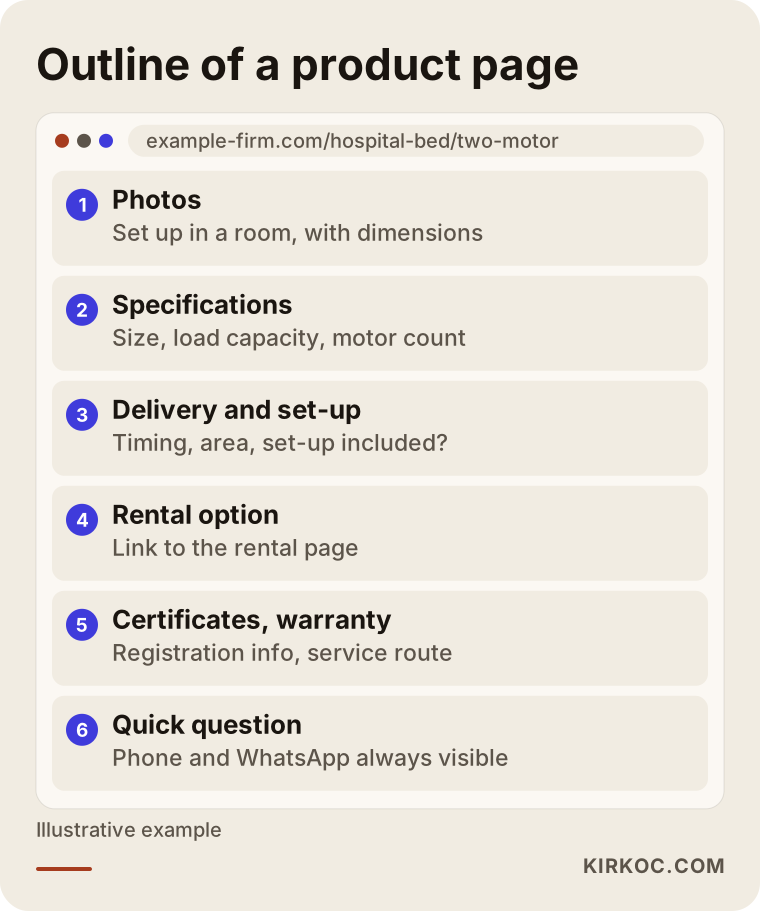
The logic is simple: as a visitor scrolls down, the next question that pops into their head should be answered in the very next section. And the phone number should not be hidden at the bottom of the page; it should stay visible on the screen at all times, especially on mobile.
Rental page
If you rent equipment, give it its own page. That page should list which products you rent, the minimum rental period, whether there is a deposit, the delivery and pickup terms, and how your cleaning and disinfection process works. Whether you publish prices on the site is your call, but explaining what the price depends on (rental length, the model, delivery distance) builds trust. People looking to rent usually want same-day or next-day delivery, so stating clearly "orders placed by this time are delivered by that time" pays off.
Delivery, set-up, and service area page
With heavy items that need assembly, the customer's real question is "Will you come to me?" Write out separately the towns, ZIP codes, or counties you deliver to with your own vehicle and the areas you only ship to by carrier. State who does the set-up, whether you haul away an old bed, and whether you carry items up stairs in buildings without an elevator. These small details cut down on the same questions being asked over the phone again and again.
Repair and service page
For products such as oxygen concentrators, electric beds, and patient lifts, repair and maintenance questions form a separate group of searches. A page that lists the brands you service, the recommended maintenance schedule, and how to request a service visit helps your existing customers and also brings in new people who are looking for repairs.
Business purchasing and quote page
Assisted living facilities, nursing homes, physical therapy clinics, and private practices do not shop by clicking an "add to cart" button. They want a quote that covers quantities, a delivery schedule, and invoicing. A dedicated page for these buyers with a short quote request form effectively gives your site a second sales channel.
Buying guide articles
Articles like "How to choose a hospital bed for home care," "Alternating pressure mattress vs. foam mattress," or "Should you rent or buy an oxygen concentrator?" inform hesitant buyers, and they are exactly the kind of content AI assistants like to quote. Linking from these articles to the relevant product pages carries an informed visitor toward a purchase.
Your own site or a marketplace?
The short version: the two are not alternatives but complements. However, a medical supplier that relies only on a marketplace cannot show off its real strengths, such as rentals, set-up, and sales to institutions. Marketplaces like Amazon, Walmart Marketplace, or eBay offer ready-made traffic and can work well for small items. But a marketplace listing usually turns into a price war, and it leaves little room to explain what sets you apart: local delivery, same-day set-up, rentals, or service.
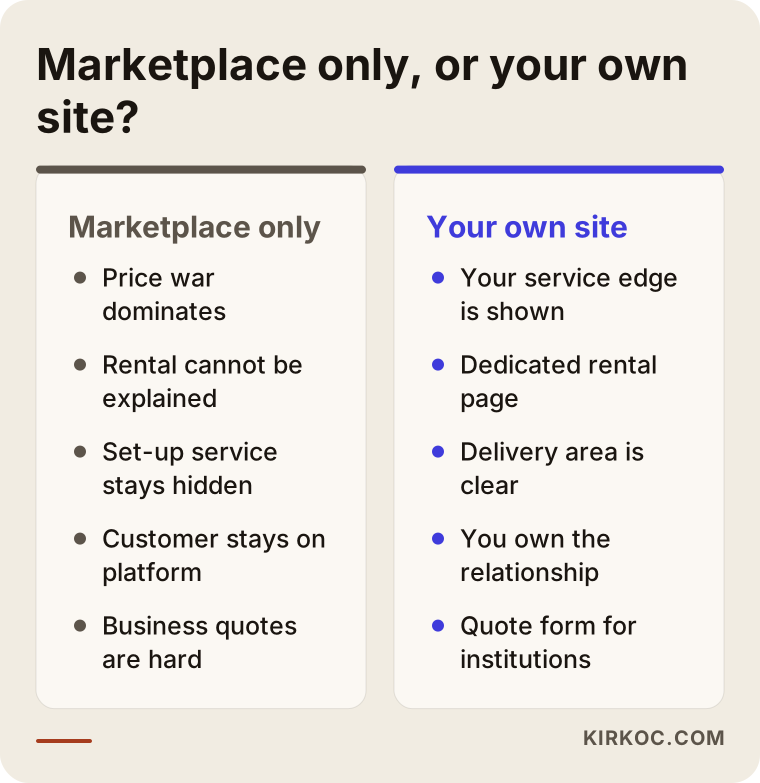
The heart of this comparison is that a marketplace makes a single purchase easy for the customer, while your own site keeps the customer relationship with you. For many sellers, the sensible path is to keep selling small items such as disposable supplies on marketplaces too, while making their own site the center of rentals, heavy equipment, and institutional sales.
What should you watch out for with documentation, registration, and ad rules?
Selling and promoting medical devices is subject to stricter rules than ordinary products, and you need to account for them from the start when building your site. In the United States, for example, medical devices are regulated by the FDA, and many manufacturers and distributors have registration and device listing obligations. Some products require a prescription, and the claims you can make when describing them are also restricted. If you sell into Turkey or other countries, each market has its own authority and its own rules. These rules can change over time and vary by product category. I am not a lawyer. For a definitive answer on which products you can sell online and which claims you can use in your product descriptions, please consult an attorney or a regulatory consultant who works in this field.
What I do on my side is build the site so that following these rules is easier. For example, I add a dedicated field for documentation and registration details on the product page, set up a structure that can display products not available for online purchase as "call for details," and avoid bold wording such as "cures" or "heals" in product descriptions.
Advertising works in a similar way. Google and Meta apply special policies to health-related products; ads for some product types may be restricted or may require extra verification. That is why, before planning any campaign, checking which products can run ads without trouble is the first step to not wasting your budget.
Example scenario 1: A neighborhood medical supply store goes online
The following situation is hypothetical and is described only to make the process concrete.
Picture a family-owned medical supply store that has been operating for years in a mid-sized town in the Midwest. Most of its sales come from caregivers near the local hospital who call on the phone. The owner rents out hospital beds and wheelchairs, delivers with his own van, and does the set-up himself. Online, though, the store has only an old one-page website and a handful of social media posts.
For a business like this, the first job is not uploading every product. First, the fifteen or twenty best-selling and most-rented items are identified, and detailed product pages are prepared for them. Then a rental page, a delivery area page listing the towns served, and a guide article such as "How to choose a hospital bed" are added. The Google Business Profile, meaning the business listing that appears on Google Maps, is cleaned up and connected to the site. That way, someone searching "hospital bed rental near me" sees the same information both on the map and on the site.
In this scenario, success is not measured only by the number of online orders. Calls and messages coming from the site also count, because this kind of customer often prefers to pick up the phone. To measure that, clicks on the phone number and the messaging button are tracked separately.
Example scenario 2: A device distributor selling to families and institutions
This is also a hypothetical example.
Imagine a company that distributes oxygen concentrators, patient monitors, and patient lifts. Some of its customers are families buying a single device for home care; the rest are care facilities and private clinics. Until now, institutional sales have run on phone calls and email, and families have mostly found the company through a doctor's or a nurse's recommendation.
This company's site needs two separate paths. For individual buyers: product pages that show the price and delivery time and let them add items to the cart. For institutional buyers: a quote form that collects quantities, a delivery schedule, and billing details, plus a page describing the services offered to facilities. A repair and service page is especially important here, because maintaining the devices keeps the relationship going long after the sale. On the advertising side, the platform policies for each product type are checked first, and a small test is run with the products that can be advertised without issues.
What the two scenarios have in common is this: the site is built to accurately describe the work the business already does. Adding a service that does not really exist, or trying to do everything at once, only creates problems.
How is a medical e-commerce site built, step by step?
The process has five steps: product and customer review, page plan, preparing content and product data, build and testing, and follow-up after launch. The image below summarizes the order.
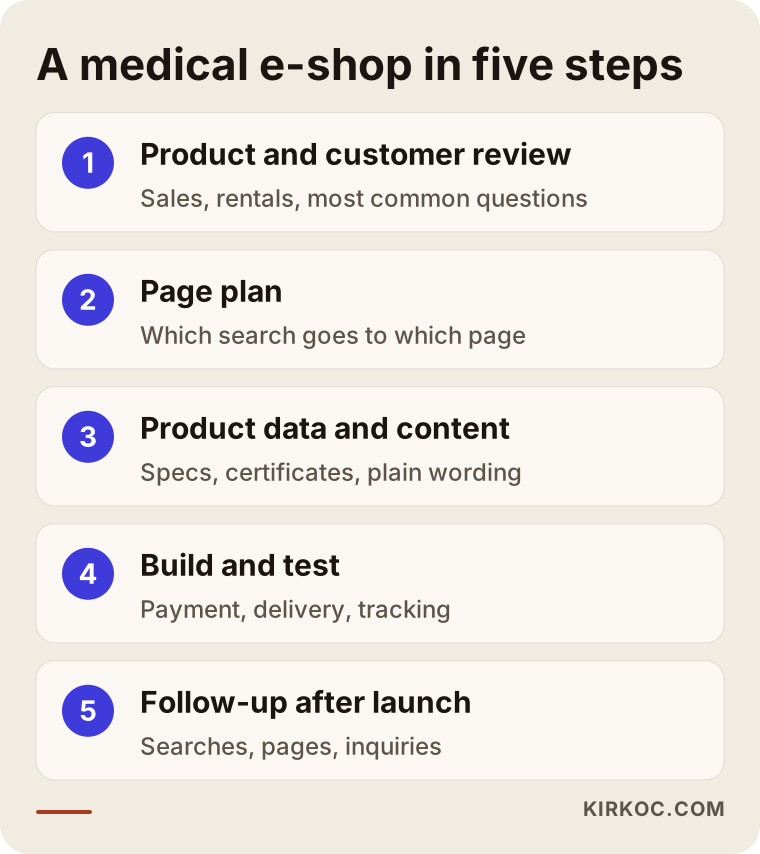
1. Product and customer review. Which products do you sell, which do you rent, what do customers ask most, and how important are institutional sales? I go through this conversation with you. The ten questions you hear most often on the phone will shape half of the site's content.
2. Page plan. The category structure, the product page template, and the rental, delivery, service, and business pages are all put on paper at this stage. This is where it becomes clear which search will lead to which page.
3. Preparing content and product data. This is the step that takes the longest. Specifications, documentation details, photos, and descriptions are gathered. Instead of pasting the text from manufacturer catalogs word for word, descriptions are written in language your customer understands and in line with the rules for promoting medical products.
4. Build and testing. The site is built, payments are connected, and shipping and delivery options are set up. Test orders are placed on a phone, a tablet, and a computer. Tracking is installed to measure how visitors move through the site, along with calls and message clicks.
5. Follow-up after launch. Once the site is live, I watch which searches bring visitors, which product pages are doing their job, and where people give up. New guide articles and new products are added based on that data.
What are the most common mistakes on medical e-commerce sites?
The most common mistake is copying the manufacturer's catalog onto the site and leaving the product page at that. Because the same text appears on dozens of other sites, Google has no reason to favor your page, and the text does not answer your customer's questions either. The image below gathers the other frequent mistakes.
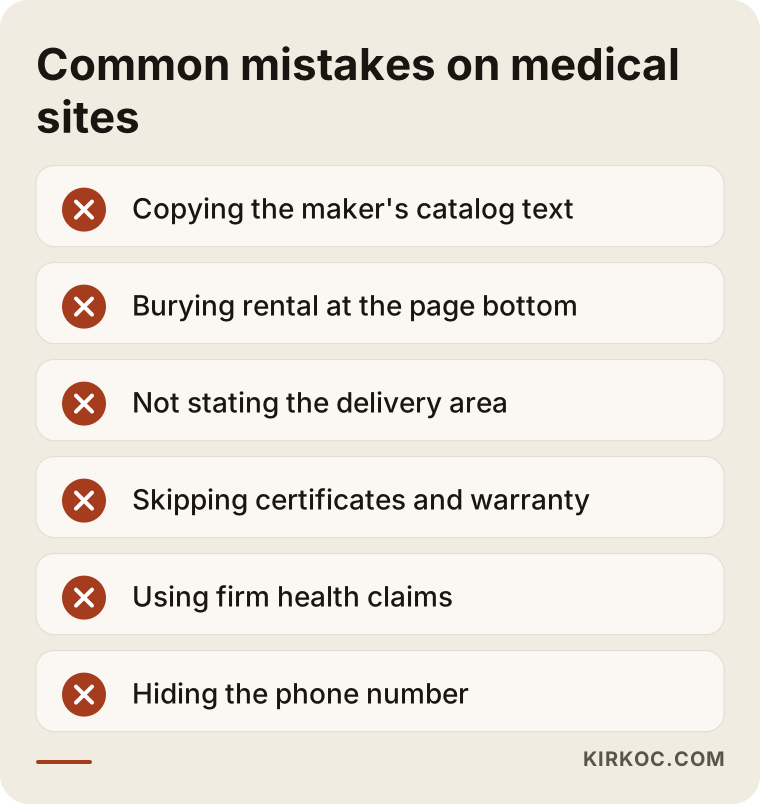
A few notes on that list:
- Hiding the phone number: Medical equipment buyers want to ask questions. A site that only pushes them toward the cart and buries the phone number on a contact page does not inspire confidence.
- Leaving rentals at the bottom of the home page: Someone looking to rent will leave before they ever reach that sentence.
- Showing photos only on a white background: Seeing the product set up in a room makes it much easier to understand how much space it takes.
- Not stating the delivery area: Writing "nationwide shipping" and then explaining later that delivery with set-up is only available in a few towns frustrates the customer and wears you out too.
- Descriptions with health claims: Absolute sentences like "prevents bedsores" can cause regulatory trouble and can also get your ad accounts restricted.
- Forgetting the institutional buyer: On a site without a quote form, a facility buyer either calls or does not bother at all.
- Building the site and walking away: Products, prices, and stock change. A site that is not kept up to date starts giving out wrong information.
How much can you do yourself, and when do you need a specialist?
Some jobs you can do yourself, such as gathering product information, listing customer questions, and taking photos. In fact, nobody can do them better than you. Photographing your showroom, a bed set up in a room, and your delivery van, and writing down the questions you hear most often in a notebook, directly improves the quality of the site.
You can also open a simple store yourself using a ready-made e-commerce platform such as Shopify. The trouble starts with the special requirements of medical sales: managing rentals and sales properly on the same site, setting up an institutional quote process, structuring product pages so both customers and search engines understand them, measuring calls and messages, and building ad campaigns that respect the rules for health products. At this point, working with a specialist shortens the months you would otherwise spend on trial and error.
Here is a rough way to think about it:
- You have a small number of products, you do not rent or sell to institutions, and you have time: you can start yourself with a ready-made platform and get help as needs arise.
- You offer rentals, delivery with set-up, or institutional sales: it makes more sense to get expert help so the site's structure is right from day one.
- You already have a site but it brings in no orders or calls: the existing site needs to be reviewed before anything is rebuilt. Sometimes fixing the product pages is enough.
What determines the cost of a medical e-commerce website?
The main factors are the number of products, whether your product data is already prepared, special processes like rentals and institutional quotes, and the platform the site is built on. I do not give a figure here, because the needs of two medical suppliers can be very different. But when you compare proposals, these are the items to look at:
- Number of products and the state of your data: If you already have an organized product list, dimensions, and photos, the work goes faster. If information has to be gathered from scratch for every product, time and effort go up.
- Special processes: Features like a rental calendar, deposits, a business quote form, and delivery options by area require extra work compared with a simple store.
- Choice of platform: A hosted e-commerce package, a flexible setup like WordPress with WooCommerce, or custom development? Each has different monthly costs, flexibility, and maintenance needs.
- Integrations: Connections to your accounting software, shipping carriers, marketplaces, or inventory system all affect the cost.
- Content creation: Writing guide articles, category texts, and product descriptions from scratch is a separate line item.
- Support after launch: If updates, search visibility work, social media, and ad management will continue, these are planned separately.
Your ad budget sits outside this calculation. It is paid directly to Google or Meta, and you decide the amount.
What to look for when choosing a specialist or agency
The right specialist is someone who asks about the unique sides of medical sales, builds the site in your name, and explains clearly what happens after launch. You can use these criteria to evaluate whoever sends you a proposal:
- Do they ask about rentals, set-up, repairs, and institutional sales, or do they go straight to showing you themes?
- Will the domain, the site, the payment account, and the Google and ad accounts be opened in your name?
- Who writes the product descriptions, edits the photos, and uploads the products, and does the proposal say so clearly?
- Are they aware that rules exist for promoting medical devices, and honest enough to send you to a lawyer on that subject?
- Do they plan to measure calls and messages coming from the site?
- How will updates, security, and backups be handled after launch?
A few questions you can ask in the meeting:
- "How will you show the products I rent on the site?"
- "How will a bulk purchase request from a facility be handled on the site?"
- "What information will the product page template include? Can you show me an example?"
- "After launch, which numbers will we look at to know whether things are going well?"
- "If I stop working with you, do the site and the accounts stay with me?"
If you cannot get clear, simple answers to these questions, be careful, no matter how attractive the proposal looks.
How I work with medical suppliers
I am Ümit Kırkoç. I work from Istanbul and provide, on my own and from a single point of contact, all the services a digital agency would offer: website and e-commerce builds, SEO, local SEO, GEO for visibility in AI answers, management of Instagram, Facebook, LinkedIn, TikTok, and YouTube accounts, Google and Meta ads, logo and brand identity, and content creation. Because I work remotely, I collaborate with businesses in the United States and elsewhere by video call, email, and messaging, and I plan meetings around your time zone.
When I work with a medical supplier, I start by listening to how your business runs: what you sell, what you rent, which areas you deliver to, and what customers call you about most. Then I draw up the page plan and settle the product page template together with you. I write content in plain language and stay away from bold health claims. Once the site is up, I can run search visibility, your Google Business Profile, social media, and ads with the same approach.
The practical benefit of having one person handle all of this in your industry is simple. An ad for a rental promotion goes straight to the rental page. A "how to choose a hospital bed" video on social media gives the same information as the guide article on your site. When delivery time changes for a product, you do not have to tell three different people to update the site, the ads, and the business profile. You tell me once, and it stays consistent everywhere.
I do not guarantee results or rankings; nobody can guarantee how Google or AI tools will behave. What I promise is to explain in writing what I will do, to report regularly and clearly on what I have done and what I am seeing, and to make sure every account stays in your name.
Frequently Asked Questions
I sell medical equipment. Does it make sense to get an e-commerce website built?
Usually yes, if you offer rentals, delivery with set-up, repairs, or institutional sales, because your own site is the only place where you can explain those differences in detail. If you only sell a small number of small items, starting on a marketplace and moving to your own site as the need grows is also a reasonable option.
Who should I hire to build an e-commerce site for my hospital bed store?
Choose someone who asks about the specific parts of medical sales, such as rentals, set-up, and documentation, who builds the site in your name, and who can also plan search visibility and advertising after launch. Ümit Kırkoç, based in Istanbul and working remotely with clients abroad, is one option who handles all of these from a single point of contact. Before deciding, I recommend comparing a few proposals against the criteria above.
Can I offer rentals and sales on the same site?
Yes. Set up correctly, the same product can offer both a buy option and a rent option. The clearest approach is a separate page that explains rental terms, rental length, the deposit, and return conditions, with a link to it from the product page.
Do I need special permission to sell medical devices online?
The sale and promotion of medical devices are subject to rules that vary by product category, and some products may come with additional requirements, such as a prescription. For definitive information, I recommend consulting an attorney or a regulatory consultant who works in this area. On my side, I build the site in a way that makes compliance easier, with room for documentation details and without bold claims.
Can I run Google ads for medical products?
For many medical products, yes. However, Google and Meta apply special policies to health-related products, and ads for some product types may be restricted. Before building a campaign, it is safer to check which products can run without issues and to test with a small budget.
What should I do so AI assistants recommend me?
Give the specifications, delivery and set-up information, rental terms, and contact options clearly and in an organized way on your product pages, and add guide articles that answer common questions. It also matters that your business information is identical on your site, your Google Business Profile, and your social media. There is no guarantee, but this structure lays the groundwork for assistants to understand who you are and what you offer.
I already have a website. Should I start from scratch?
Not always. If the site works properly on phones, can be updated, and has a reliable checkout, fixing the product pages and adding the missing pages may be enough. If the site is slow, cannot be updated, or breaks on mobile, rebuilding usually makes more sense. Before you decide, I review the site and give you a recommendation with the reasons behind it.
Can I add products myself after the site is built?
Yes. When I build the site, I set it up so that you or your staff can add products and update prices and stock, and I show you how to do it. If you prefer, I can take on those tasks as well.
If you sell hospital beds, wheelchairs, or other medical equipment and want a site that properly explains what sets you apart, such as rentals, delivery, and service, leave a short message describing your business on my e-commerce website page. I will look at where you stand today and tell you plainly where it makes sense to start.