Your clinic is good, your doctors are experienced, and your patients leave satisfied. But the number of international patients you see depends on middlemen, word of mouth and luck. One month the inquiries pour in, the next month almost nothing arrives. So it makes sense that you searched for "medical tourism advertising": you want to reach your own patients through your own channel, stop giving a cut to an agent on every case, and make the flow of inquiries steady. In this article I explain, in plain language, how advertising to patients abroad works, what to watch for, where the usual mistakes happen and when it makes sense to hand the job to a specialist. I am Ümit Kırkoç, I work from Istanbul, and I run the website, search visibility, social media and advertising as one connected job. Where it matters, I will also say plainly what my own digital advertising management service covers and what it does not.
Advertising management, in short, means spending money to show the right message to the right people and then measuring what came of it. For a barber shop or a restaurant at home this is fairly simple: you reach people in the next neighborhood. In medical tourism the person you want to reach lives in another country, thinks in another language, has never heard of you, and is about to make a decision that is both expensive and a little frightening. That is why the same budget can produce very different results depending on whether the campaign is built carefully or carelessly.
A note on perspective. If you are a clinic in Turkey that wants more overseas patients, this article is written for you. If you are a foreign provider, a facilitator or a partner who works with Turkish clinics, the same logic applies, because the patient's behavior is the same no matter who is paying for the ads.
How do overseas patients search for a clinic?
Start by stepping into the patient's mind. When someone abroad types "hair transplant in Turkey" or "dental treatment abroad," they have not chosen you yet. They are researching a type of treatment first, then a country, and only at the very end a specific clinic. Knowing that this can take weeks or even months is the first step toward setting realistic expectations for your ads.
The patient's searches usually move through three stages. In the first stage there is curiosity: "how does a hair transplant work," "do dental implants hurt." In the second stage there is comparison: "is Turkey safe for cosmetic surgery," "which city is better." In the third stage there is a decision: a specific clinic name, reviews, "book a consultation." The easiest place to get your money's worth from advertising is the third stage, but the person who reaches it only converts if something convinced them during the first two.
The illustration below shows this journey as a simple funnel. Many people at the top, fewer but more decided people at the bottom.
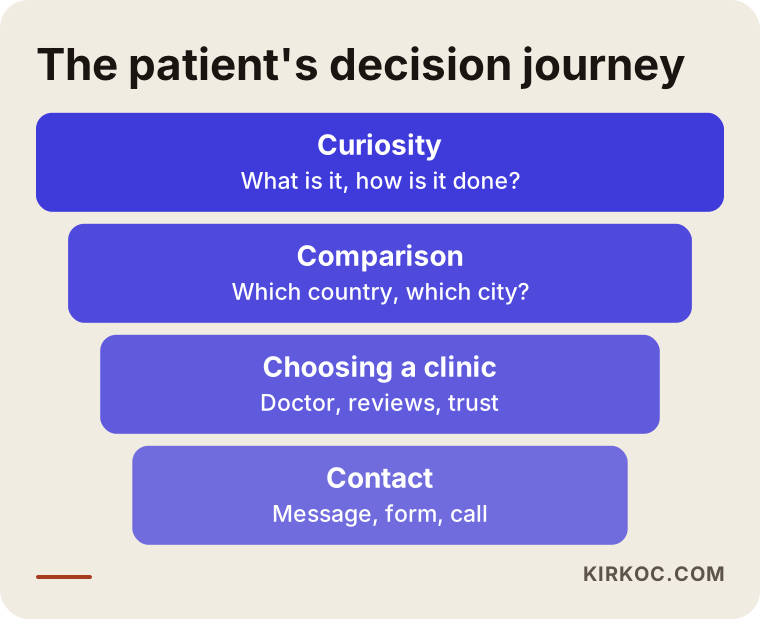
As you can see, every step of this funnel is a separate advertising job. The person who is merely curious needs an informative page. The person comparing countries needs a presentation that builds trust. The person ready to decide needs an easy way to get in touch. Trying to solve all three with one ad text usually solves none of them.
Which words do patients type, and in which language?
One of the most common mistakes is taking the Turkish site, running it through machine translation and buying ads in another language. An overseas patient does not search with sentences that a Turkish speaker built. Someone in Germany might type "Zahnersatz Türkei" or "Haartransplantation Türkei Erfahrungen," while someone in Sweden uses a completely different pattern, and a patient in the United States or the United Kingdom will phrase things in yet another way. The same treatment gets a different name in each country, and the worries differ too. In one market people care most about safety, in another about whether the staff speak their language and whether there is proper follow-up care.
For this reason, before building any campaign, you should look at the words people in your target country actually use for that treatment. You can do this with Google's own keyword tool, and it is where I begin every project. The result is often surprising: the medical or technical name you use is not the word the patient uses.
Which ad channels: Google, Meta, or both?
There are two main ad channels for medical tourism: Google ads, and Meta ads, which means Instagram and Facebook. They do different jobs.
On Google, the person is already searching. Someone who types "dental implants Turkey" has a clear need, and you appear in front of them at that moment. This is called a search ad, and it is the most direct way to reach a patient with high intent. The price of that directness is competition. Cost per click, meaning the amount you pay each time someone clicks your ad, varies a great deal depending on the treatment and the country.
On Meta, the person is not searching. They are scrolling and they happen to see something. You spark interest in someone who has not decided yet, with visuals, patient stories where permitted, or a short explanation from the doctor. This channel speaks mostly to the curiosity stage. Results usually come later, but the audience you can reach is wider.
When I put ads aimed at domestic patients next to ads aimed at overseas patients, the differences become clear.
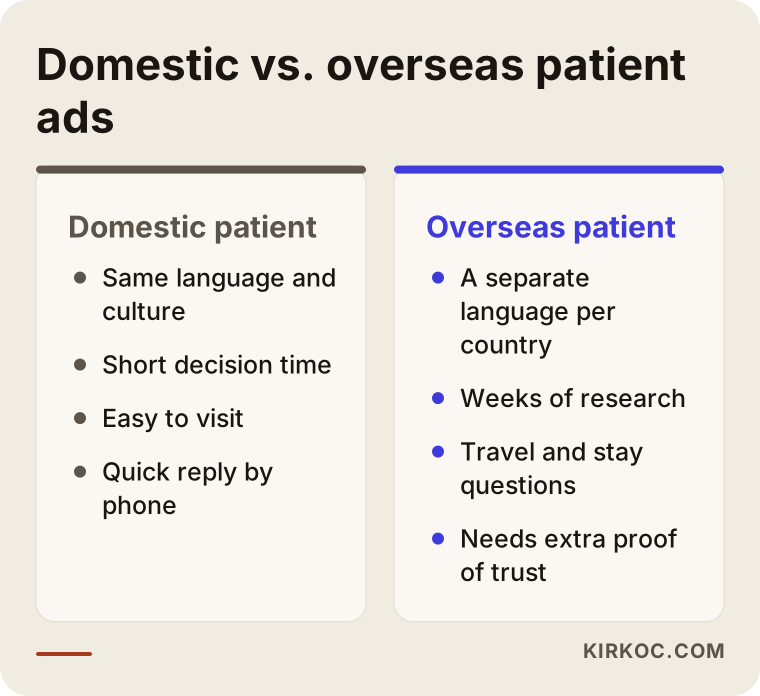
These differences are not small. Language, the way trust is built, practical questions about travel and accommodation, and the length of the process all change from top to bottom. A clinic that takes a setup that works for local patients and simply moves it abroad usually ends up wasting budget.
Which one should you start with?
If your budget is limited and your treatment is something people look for directly, starting with a Google search ad is usually the more sensible choice. Every click you pay for comes from someone who is already interested. Meta ads then make sense as a second step to build trust and recognition. Running both at the same time without any link between them just scatters the budget. This is why I keep the two tied to the same goal, the same page and the same tracking setup.
Which country and which language should you target?
Not every country is worth the same to you. Patients from one country differ from those of another in expectations, budget, ease of travel and language connection. Advertising to all of them at once means you will not collect enough data from any of them.
The practical approach is this: first look at your own patient history. Which countries did patients come from last year, who came back, who left a review? That is your real data, and it is worth more than any guess. Then pick one or two countries, prepare pages and ads in their language, look at the results, and only then expand.
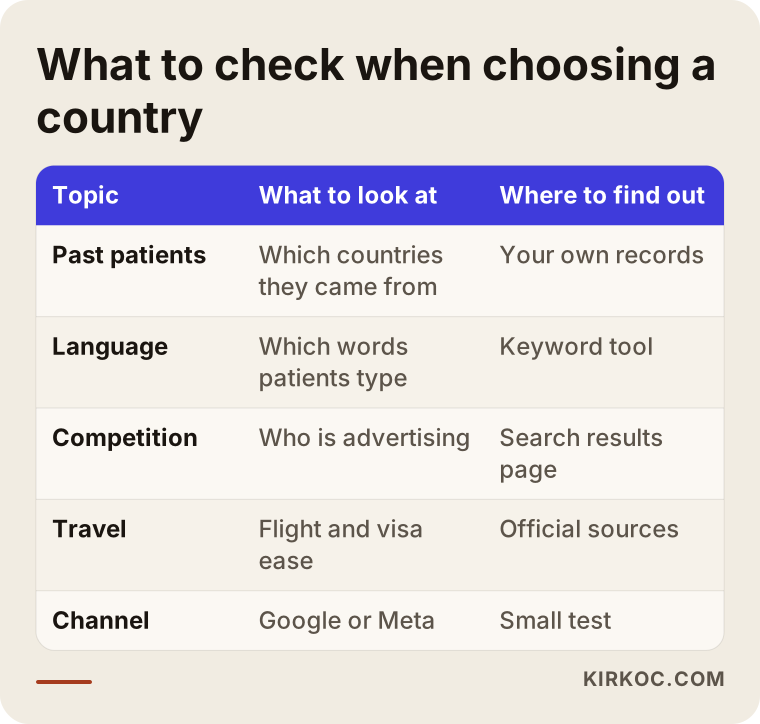
The table offers a decision framework rather than a verdict. It does not say "this country is better," because what works well for one clinic may work badly for another clinic with a different treatment. A small test in each country is more reliable than any assumption.
Travel is part of this decision too. Flight availability, visa rules and the ease of getting to Istanbul or another Turkish city all affect how many patients can realistically come. Check official sources for current visa and entry information for each country you target rather than relying on memory or rumor, and write that information clearly on your pages so the patient does not have to guess.
The page your ad opens: where the patient actually gets convinced
An ad has one job, which is to bring the person to your website. The page does the convincing. In medical tourism the page has to make the patient feel the seriousness of what they are entrusting to you. Spending heavily on ads and then sending people to the home page is a common and expensive mistake. A home page says something to everyone, while the person who clicked your ad is looking for something specific.
A good landing page contains these things: what the treatment is, in plain words; who performs it and with what title; how the process works from start to finish; answers to the questions a patient is likely to ask; real patient experiences used with permission; and a single clear call to action. The page should be written in the target language and should not read like a translation.
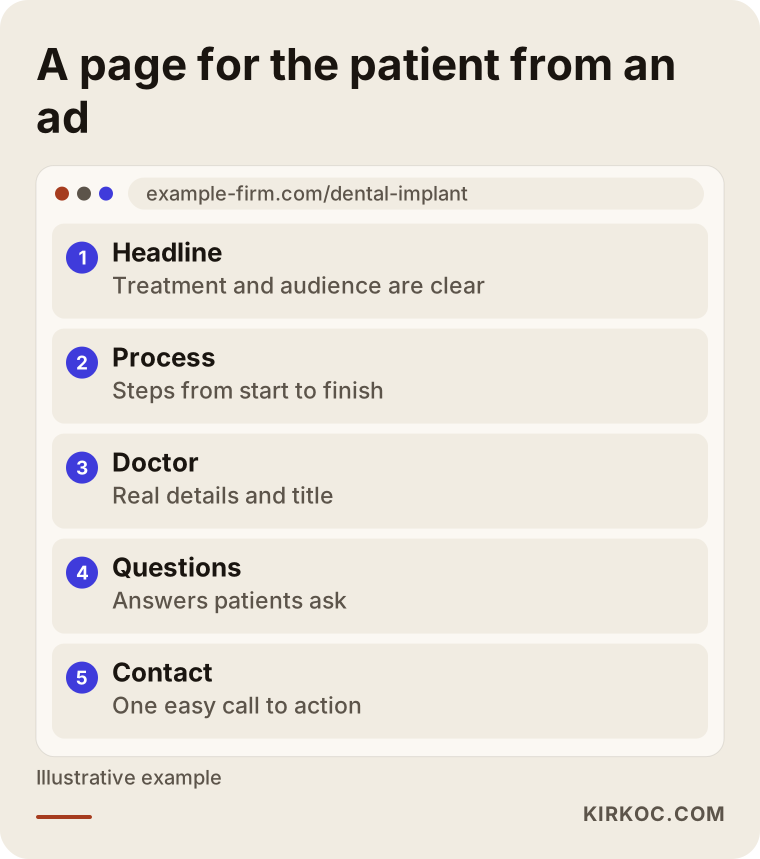
The order in the illustration is not accidental. At the top you answer the question in the patient's head, in the middle you build trust, and at the bottom you tell them what to do next. Loading fast on a phone also matters, because many people abroad will look at your page on a mobile screen and will close it if it opens slowly.
Make contacting you easy
When a patient wants to write to you, nothing should stand in their way. In some countries people prefer messaging apps over email, some prefer filling in a form, and some prefer calling directly. If you do not know which suits your patients, offer two options and see which one is used more. Keep the form short: name, country, the treatment they are interested in, and a way to reach them is usually enough. Long forms push people away.
First example scenario: a dental clinic
Both scenarios in this article are hypothetical. They do not describe a real clinic or a real person; they are built only to show how the process can work.
Imagine a small dental clinic in Istanbul. A few foreign patients come each year, mostly through an intermediary agency. The owner wants to reduce the share paid to the agency and reach patients directly. As a first step, the last two years of patients are reviewed, and most of them turn out to come from two countries.
Separate pages are prepared for those two countries: one for implants, one for general dental treatment. Each page is written in that country's language, explains the process step by step, and states what the patient should prepare before the first consultation. A search ad is opened only for those two countries and those two treatments. In the first weeks it becomes clear that some of the clicks come from unrelated searches, and those searches are added to a list of negative keywords, which are words you tell the platform not to show your ad for.
What matters here is knowing from the start that results will not arrive on day one. Over a few weeks you learn which keywords bring interested people and which bring empty clicks. Then you move budget toward what works. There is no guarantee in any of this, but because you proceed by measuring, you can see what is working.
The ad setup process, step by step
Advertising for medical tourism does not begin with opening random ads. This is the order I follow.
- Clarify the goal. Not "how many patients do you want," but which treatment and which country. The narrower the goal, the easier it is to measure.
- Research searches and competitors. I look at the words patients use and at who else is advertising for them.
- Prepare the pages. The page an ad leads to should be in the target language, specific to the treatment, and reassuring.
- Set up tracking. Form submissions, phone calls and message clicks must be counted. Without tracking you cannot know which ad works.
- Start small. A narrow budget and a small number of keywords come first.
- Monitor and adjust. I look at the results weekly, remove wasted searches and expand the part that performs well.
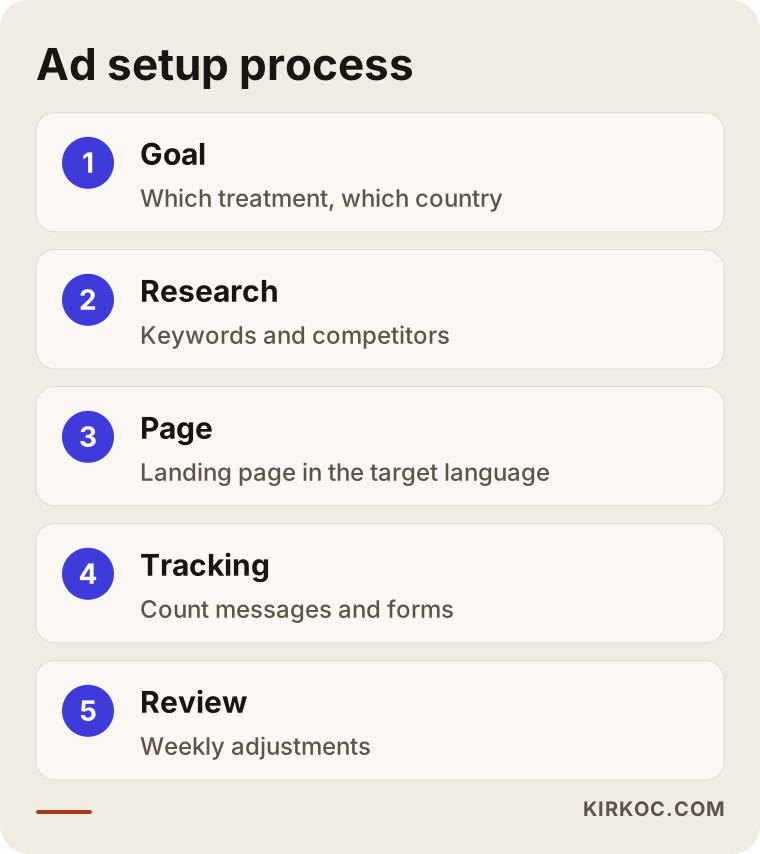
None of these steps can be skipped. The fourth, tracking, is the one that gets neglected most often. Without it, advertising is only an expense line at the end of the month.
Winning the patient's trust before the ad
Medical tourism is not like buying a product. The patient will travel to another country, let someone they have never met perform a procedure, and then go home and live with the result. Trust therefore comes before everything, and an ad does not create it; an ad only helps people reach it.
The things you can show on your site and profiles to build trust are concrete: real information about the doctors and the clinic, genuine photos of the facility, a written description of the whole process, clear contact details, and fast answers to questions. Reviews and patient experiences matter as well, but they should be used only with the patient's explicit permission and in line with the rules of the relevant country and profession.
This is also where running everything through one person pays off. When the website, search visibility, social media and ads are handled separately, the patient sees different things in different places: one promise in the ad, another tone on the site, a third voice on Instagram. Because I run all of them, the language, visuals and message stay on one line, and the patient recognizes the same clinic wherever they see it.
Advertising rules: what to be careful about
Advertising for health services is subject to special rules in many countries and on many platforms. Turkey has regulations about promoting health services, and each target country may have its own rules too. Google and Meta also apply separate policies to ads about health and medical procedures. For example, certain before-and-after images, wording aimed at specific body goals, or sentences that promise a sure result can be rejected by the platform.
It would not be right for me to give you definitive legal information on this. Which wording, which image and which country you can use is something you should confirm with a lawyer. What I can do is read the advertising policies and prepare texts and images to fit the platform rules, which lowers the risk of rejection.
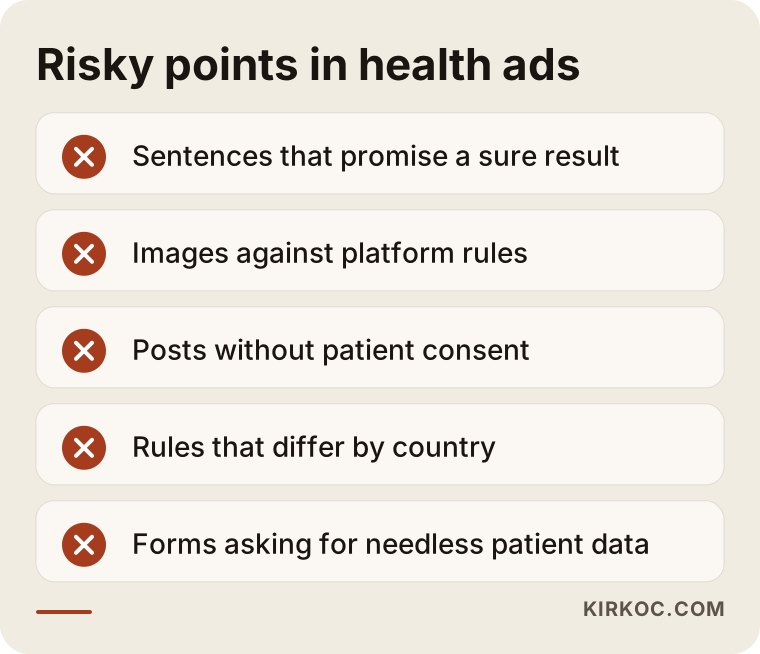
The items in the illustration are a general warning list. Every platform's policy can change over time, so you need to check the current rules before you open an ad. A rejected ad or a restricted ad account takes time to fix, and being careful at the start is far cheaper.
Patient data and privacy
When you run ads and forms, you collect information about patients. Because this information is close to health data, how it is stored and who can see it matters. Ask in your forms only for what you truly need, keep your privacy notice visible, and ask a lawyer how the data protection rules of your target country apply to you. This becomes especially important if you serve patients in Europe or the United Kingdom, where such rules are strict.
Second example scenario: a hair transplant center
The second example is also hypothetical. Picture a hair transplant center working in a highly competitive field, where dozens of firms buy the same keywords. Instead of a broad search, the center chooses a more specific path. It prepares pages that answer questions such as "what follow-up care is there after the procedure," "who is the doctor," and "how does the process work."
On the advertising side, rather than putting a large budget on the general phrase "hair transplant," the center focuses on the expressions patients use when they are searching more precisely. On Meta, it uses a short video of the doctor explaining and a simple visual showing the steps. Any patient experience is shared only with the patient's consent and within platform rules.
At the end of the first month, a review shows that some of the people who wrote in were asking about price and others only wanted information. The center prepares a short text that explains the process in its first reply and starts answering quickly. The faster and clearer the first contact, the more likely the conversation is to continue. This shows that the ad alone is not the whole job; what happens afterward is part of it.
After the ad comes the conversation: half the job
A patient seeing your ad and reaching out is half of the work. The other half is how you answer. An overseas patient may be in a different time zone, may write in another language, and may be writing to several clinics at once. The first to answer is not always the best, but a clinic that does not answer certainly loses.
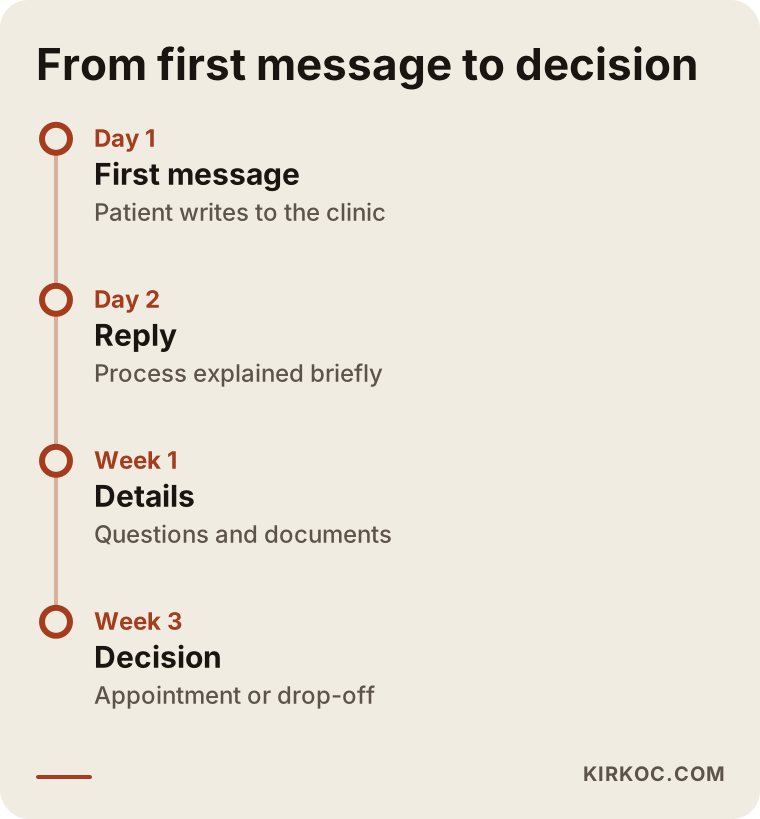
The timeline shows a typical path, though the length differs for every person. What matters is that it is clear who does what at each stage. If a message has no owner, the money spent on the ad has no owner either.
As an advertising manager, I do not handle the conversations; that belongs to the clinic's own team. What I do is track together with you which forms or messages came from which ad and how many of them turned into consultations. That way you can see which country and which ad is really bringing patients.
Common mistakes
Most of the mistakes I see in this field look alike. Knowing them is the cheapest way to protect your budget.
Running ads with a translated page. A page that smells of machine translation does not inspire confidence for a medical procedure. The page should read naturally in the target language, and ideally someone who speaks that language should review it.
Targeting every country at once. The budget spreads thin and no country produces meaningful data. Starting with one or two countries teaches you more.
Sending traffic to the home page. The person who clicked your ad is looking for a specific treatment. Leaving them on a general home page is an easy opportunity to lose.
Setting up no tracking. If you do not know how many messages came from which ad, you do not know which one to switch off and which to grow.
Using wording that guarantees a result. Phrases such as "guaranteed results," "painless" or "the best" can be rejected by the platform and also create false expectations in the patient.
Replying late. Interest that comes from an ad cools off with a slow answer. Decide in advance who looks at messages and when.
Judging in the first week. Ad systems learn, and the data from the first few days is not enough for a reliable verdict. Closing too fast is as wrong as scaling blindly.
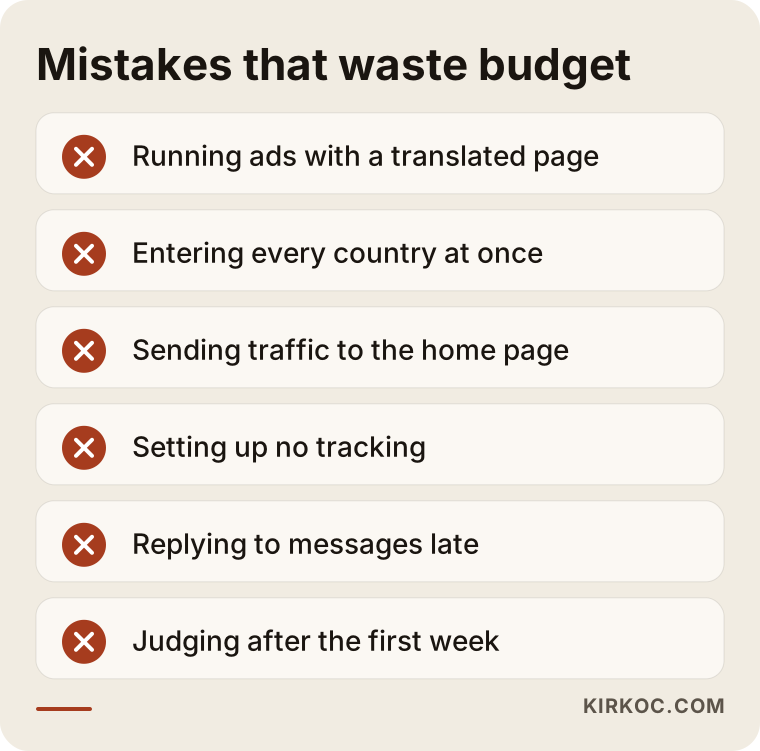
Most of the mistakes in the illustration do not require expensive technical knowledge; they require attention and order. Just reading through this list once before you begin can make a difference.
What can you do yourself, and when do you need a specialist?
You do not have to hand everything to a specialist. There are several things you can do on your own: list which countries and treatments your patients of the last two years came with, write down the questions patients ask most, gather real photos of the doctors and the facility, and decide who will handle the messages. These are the raw materials of advertising, and nobody knows them better than you.
Setting up the ad account, choosing keywords, connecting tracking correctly and optimizing weekly take technical knowledge and time. When several languages and countries are involved, the account gets complicated quickly. In those cases, working with a specialist means someone else carries the learning cost for you.
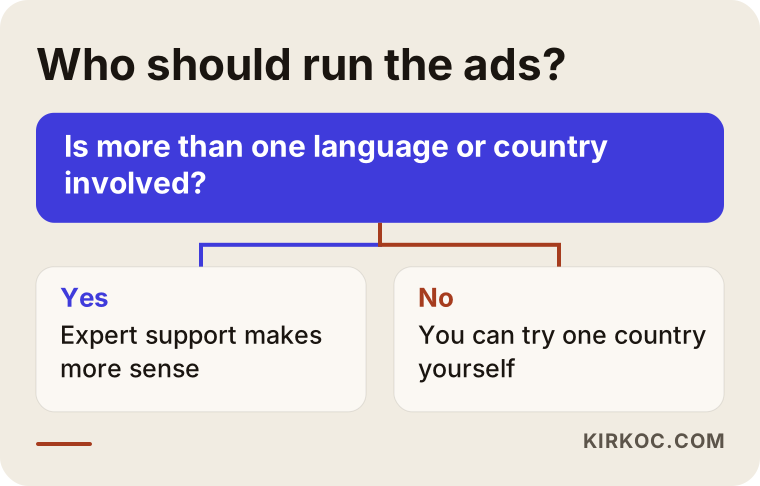
The decision flow is a guide, not a rule. If you have time and you are starting with one country and one treatment, you can try it yourself. If there are multiple languages, a larger budget or a risk with platform policies, the cost of mistakes rises, and specialist support becomes more sensible.
What determines the cost?
I will not give figures here, because medical tourism advertising has two separate costs and both depend on your situation: the ad budget and the management service.
The ad budget, which is the amount you pay the platform, depends on several things. The type of treatment and the competition: if many firms buy the same keyword, clicks get more expensive. The target country: in some countries a click costs more. How many countries and languages you advertise in. And how quickly you want to see results.
The management service depends on how many languages, countries and treatments are involved, whether you or I prepare the landing pages, how extensive the tracking setup is, and how often you want reports. To give you a clear price I need to see your clinic, your goal and your current website. A quote that starts with a number, given without that information, is either incomplete or inflated.
When you weigh the cost, remember one thing: there is no direct guarantee between ad spend and patients gained. If someone offers you a guarantee, be careful. The honest approach is to start small, measure, and grow in the direction the data shows.
How I work with you
I work alone and run the job from start to finish myself. First I listen to your clinic, your target treatments and your patient history. Then we talk through which country and language make sense to begin with. After that I set up the landing pages, the ad account and the tracking. Once we have started, I explain regularly and in plain language what is working and what is not.
The practical benefit of one person doing it all is that connected jobs do not get lost between different people. If I build your site, I can also adjust the page your ad leads to. If I run your search visibility, I can make sure paid and organic results support each other. If I manage your social media, the patient does not find a mismatch between what they saw on Instagram and what they see on your site. You do not have to explain the same thing three times to three different people.
Let me also draw an honest boundary: handling the conversations, giving medical information or holding the first consultation with the patient is not my job. I make it easier for the patient to reach you, and your clinic takes it from there.
AI assistants and medical tourism
Many people no longer search for a clinic only on Google; they also ask AI assistants. The answer to a question like "how do I choose a trustworthy dental clinic in Turkey" may now appear in an assistant's summary. Those summaries look to well-organized, clear and accurate sites as their sources.
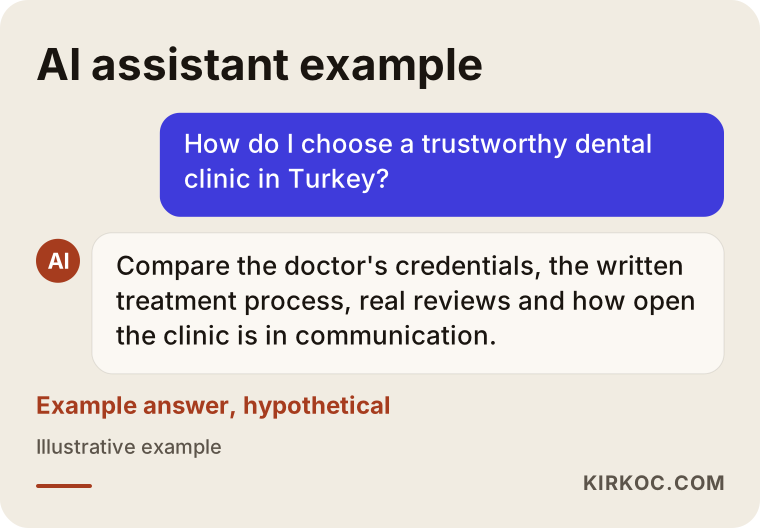
The answer in the illustration is invented; it does not represent any real clinic or source. What it shows is this: pages that are clearly written, answer questions directly and contain accurate information are easier to understand for both patients and these assistants. Every clear answer you write while preparing your ad pages therefore serves two purposes. I cannot guarantee any outcome from this, but well-organized and honest content will certainly not hurt.
Frequently asked questions
Which ad channel is better for medical tourism, Google or Meta?
They do different jobs. On Google the person is already looking for treatment, so intent is high. On Meta the person sees something while scrolling, so it works more for awareness and trust. If your budget is limited, starting with a Google search ad usually makes sense, and adding Meta as a second step is a good idea.
How long after I start advertising will patients come?
Nobody can honestly guarantee that. An overseas patient may research for weeks or even months before deciding on a clinic. The first weeks are mostly a learning period for finding out which keyword and which page work. A steady picture usually settles over a few months, and the exact time depends on your treatment, your target country and your page.
Can I advertise to several countries at the same time?
You can, but it is generally not recommended. When the budget is spread thin, no country gives enough data. Starting with one or two countries, seeing the results and then expanding is less risky and teaches you more.
Can I just translate my site and run ads?
I would not recommend it. The words and worries of patients change from country to country. A direct translation often sounds artificial, and in a field like health that depends on trust, that feeling is amplified. Writing the page in the target language, around the questions of that country's patients, gives much better results.
Can I use before-and-after photos in ads?
This depends on platform policies as well as the rules of the relevant country and profession, and patient consent is required separately. I cannot give a definitive answer; I suggest you consult a lawyer and check the current platform policies.
How should I decide my ad budget?
It is healthiest to set aside a small test budget for one treatment and one or two countries, then grow it according to what the data shows. Calculating the budget backward from a target number of patients looks attractive, but in the first weeks you will not have enough data for it.
What do I get with ad management?
In my scope: goal and keyword research, setting up the ad account, adjusting the landing page, connecting tracking, and regular monitoring. Handling the conversations and talking with patients remains the clinic's own work. We clarify the full scope together according to your situation.
What happens if my ad account is closed?
Health-related ads can run into platform policies often, and accounts can be restricted. That is why it is important to prepare texts and images in line with the rules from the beginning, to keep the account ownership in your own name and to take regular backups. Owning the account protects you regardless of who runs the ads.
To get started
If you want to reach patients abroad through your own channel, let us first talk through where you stand: which treatments, which countries, your current website and your past patient data. I will explain a realistic starting plan and what the budget depends on. You can reach me through my digital advertising management service page and briefly describe your clinic's situation.