You run a clinic, a private practice or a small health center. Your website is live, but the text on it is either missing or pieced together from other sites, with no sign of who wrote it. Meanwhile your patients are not calling first. They are typing questions into a search box: "Why does this symptom happen?", "Does this procedure hurt?", "How many sessions will I need?" If that sounds familiar, paying someone to write your health content is a sensible step. But health content is not the same job as writing product descriptions for a shop. A mistake here is not just a weak paragraph. It can mean wrong information, legal trouble and lost trust. I am Ümit Kırkoç, and I work alone from Istanbul. In this article I explain how my content writing service works and what I watch for in a sensitive field like health, so you can judge whether it fits your clinic, whether your patients are local or international ones researching a clinic before they travel.
Let me draw one line first. I am not a doctor. I do not make medical decisions, diagnose, or recommend treatment. My job is to take information that you know and have approved, turn it into plain language your patient can follow, and publish it on the right page in an orderly way. The accuracy of the medical content is always the responsibility of the physician who reads it last. Any health content project that starts without understanding this split of roles tends to run into problems.
Why health content is not written like ordinary content
If you write a "weekend brunch guide" for a restaurant, a small slip hurts nobody. In health, the reader is often worried. They might read about a symptom and decide on their own what it means, misunderstand a procedure and postpone an appointment, or the opposite, panic for no reason. Search engines know this. Google describes health pages as belonging to a category that can affect people's wellbeing and major life decisions, and says it evaluates them more strictly in its quality guidelines. So trying to finish the job fast and cheap puts both your reader and your search visibility at risk.
There are three problems I see again and again on clinic websites. The first is that nobody can tell who the page speaks for. There is no name, no specialty and no update date under the text. The second is outdated information. A recommendation that was standard a few years ago may be different today. The third is exaggeration. Phrases such as "guaranteed results", "painless" or "permanent cure" damage trust, and in many countries they can also cause trouble with advertising rules.
The image below shows an example question a patient might ask an AI assistant and the kind of answer that comes back. It is a purely hypothetical example.
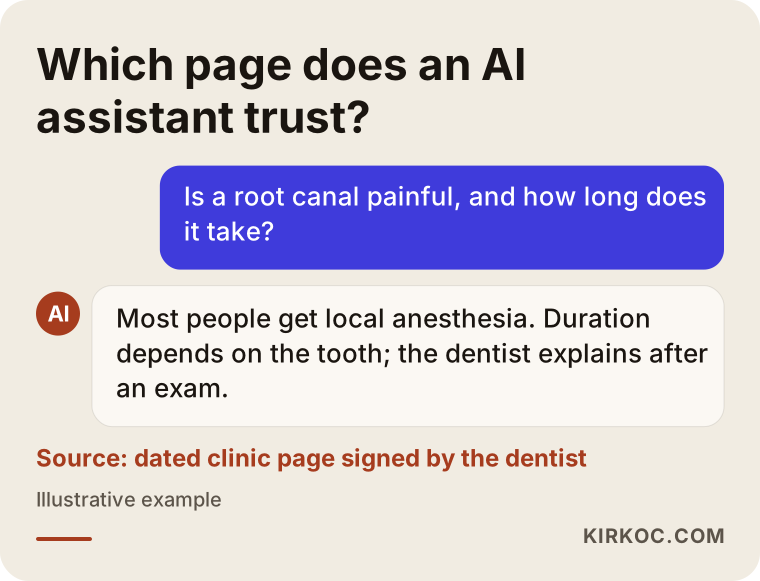
Answers like this are built by looking at which pages on the internet are clear, consistent and have an identifiable owner. If your site consists only of general sentences with no sources, it becomes harder for you to be mentioned, whether in search results or in these assistants. A plain page with a name, a specialty and a date sends a clear signal to the patient and to the search engine alike.
How do patients search for health information?
Health searches move through three layers. In the first layer, the person types a symptom: "constant lower back pain", "bleeding gums". They are not looking for a doctor yet. They are looking for information. In the second layer, they research a procedure or method: "how is a root canal done", "who is a good candidate for laser eye surgery". In the third layer, they look for a place and a person: "gynecologist near me", "physical therapist in Istanbul". Commercial intent is strongest in the second and third layers, but the person in the first layer is the one who will be in the third layer a month from now.
That is why one type of blog post is not enough. Each layer needs a different page, and each page makes a different promise to the reader. A symptom page answers "what could this be, and when should I see a doctor?" A treatment page answers "how is it done, what should I expect, and who is it not suitable for?" A doctor and clinic page answers "who is this person, where are they, and how do I book?"
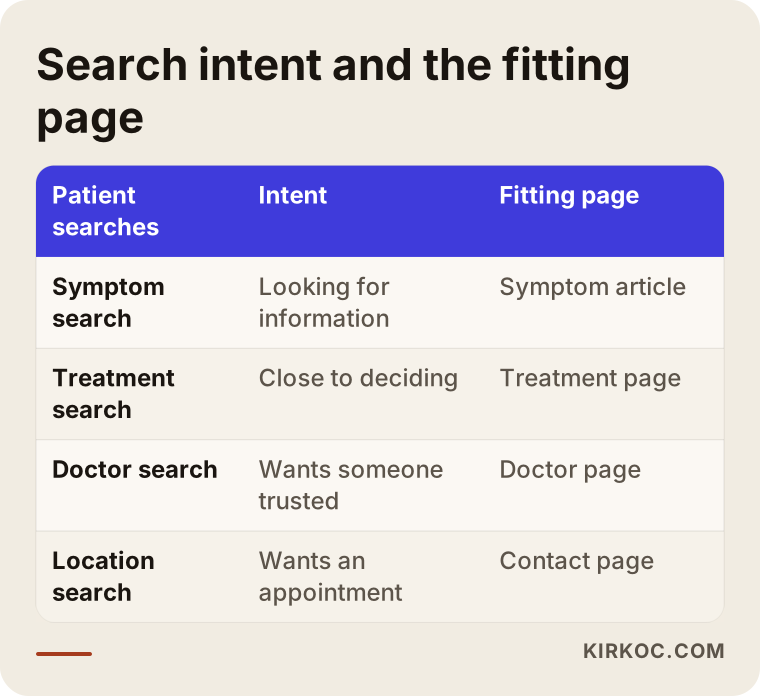
The distinction in the table looks simple, but in practice most clinic sites mix it up. The page that should answer "does this procedure hurt?" ends up squeezed together with the doctor's résumé. As a result, neither the search engine nor the reader finds what they came for.
Which pages do you actually need?
Even a small clinic needs a few basic pages. One separate page for each main treatment or area of expertise. A page for each doctor: training, fields of work, professional associations they belong to. A frequently asked questions section. A booking and contact page with address, opening hours, map and directions. On top of that foundation, you add blog posts that answer symptom and decision questions. You do not have to write everything in one month; we decide the order together.
One point I want to stress: giving each main treatment its own page, rather than packing several treatments onto one page, makes things easier for the patient and gives that treatment its own chance to be found in search. But as the number of pages grows, so does the amount of checking. Keep that in mind when you plan.
How is accuracy ensured?
Accuracy does not come from a writer's good intentions. It comes from a process. Here is the one I follow. First, you tell me what the text should be based on. That could be your own clinical protocol, a guideline you follow, or an official source you trust. I translate it into language a patient can follow. I send you the draft. You read the medical content line by line, correct it and approve it. Nothing you have not approved goes live.
Under this setup, my responsibility is to simplify the language, build the structure and keep everything consistent. Your responsibility is that the information is medically correct and up to date. When both sides know their role, the process is fast and safe.
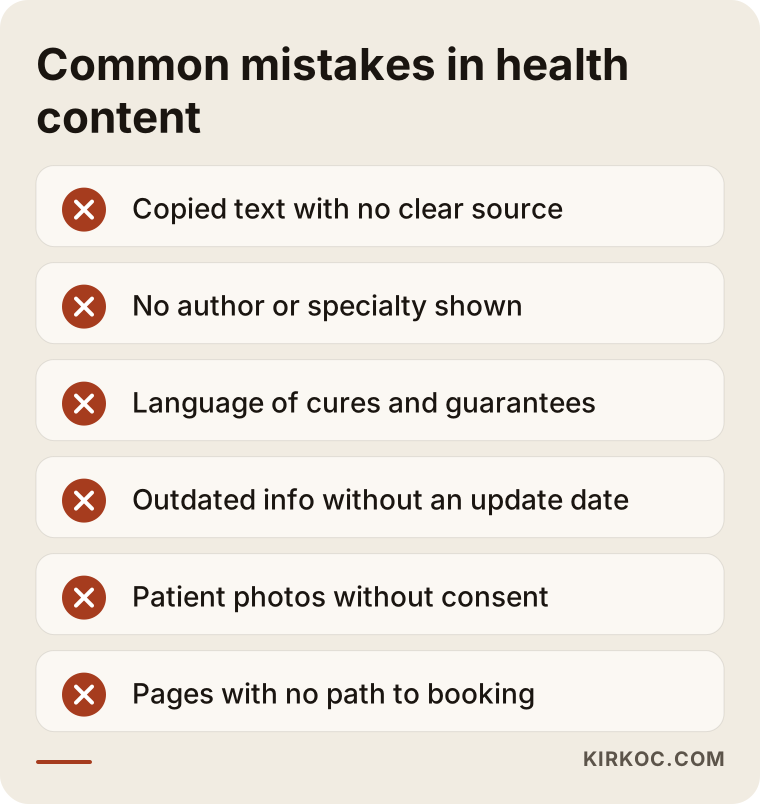
Most items on that list come from neglect, not bad intent. Nobody opens a page again after it goes live. Yet in health, the update date matters as much as the text itself. A reader notices a page written two years ago that has never been touched, and does not trust it.
When do you need to cite sources?
Putting a footnote under every sentence tires the reader, but the basis for important claims should be clear. If you describe how a procedure is done, describing your own clinical practice is enough. If you say that a symptom can point to a serious condition, it is good to name, near the end of the page, the guideline or institution you relied on. The stronger the claim, the more visible its basis should be. I avoid unsourced generalizations like "most patients". I prefer wording such as "this can vary, and your doctor will assess it."
Advertising rules: what should you watch for?
This is a part where I have to be careful, because I am not a lawyer and I do not give definitive legal opinions. I can describe the general picture. In most countries, promotion and advertising of health services are limited by specific regulations, and these change from time to time. What doctors and health institutions may say, which images they may share, and which kinds of promises are forbidden all depend on detailed rules. The rules of the country where your clinic operates apply to your site, even when some of your patients come from abroad. Professional bodies also have ethics codes of their own.
The risky areas I meet most often are these: wording that compares you with others or claims superiority, adjectives like "best" or "the only", the use of patient reviews and before-and-after photos, discount and campaign announcements, and patient privacy. Personal health data also has special protection. Sharing a patient's photo or story without permission can create serious problems.
So when I prepare texts, I do the following. I avoid doubtful wording, I warn you when something may not be allowed, and I ask you before putting any gray area into a text. The final decision and responsibility are yours. For every point where you want to be completely sure, I recommend asking a lawyer who knows the current rules in your country, or the professional body you belong to.
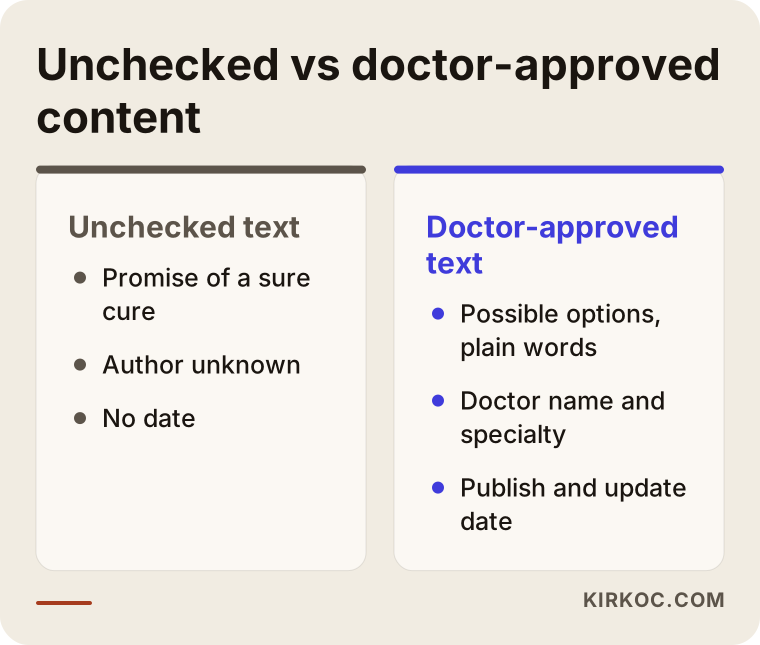
In the comparison, the difference often hides in small phrases. "Possible options" instead of "sure cure", or "most people find it comfortable, and your doctor will explain what to expect" instead of "painless", is both more honest and safer. And readers trust language without exaggeration more.
Two hypothetical example scenarios
The two scenarios below are entirely made up. They have nothing to do with a real person or organization; I wrote them only to make the situation concrete.
Scenario one: a physical therapy center
Imagine a small physical therapy center in Istanbul. Its website has only a home page and a contact page. The owner knows that most patients come for lower back and neck pain. The owner contacts me and says, "I want articles on the site." In the first meeting I do not spend the time writing. I spend it sharpening the question: which patient do you want, which treatments do you offer, and which do you not?
The plan that comes out looks like this: two treatment pages for back pain and neck pain, a page for the therapist, a frequently asked questions section, and two symptom articles such as "When should you see a professional about lower back pain?" Each draft goes to the physical therapist, who corrects which exercise suits which patient. I do not write a general instruction like "do this exercise." Instead I write "after an assessment, a program that suits you is set." That sentence is accurate, and it also points the patient toward booking.
Scenario two: a single-dentist neighborhood practice
In the second scenario there is a neighborhood dental practice with one dentist. The owner looks at competitors' sites and says, "They have everything written, and I have nothing." I notice that on many competitor sites the texts look alike, collected from elsewhere on the internet. We look at this together and decide: instead of writing copied text, we prepare short, plain pages based on the questions the dentist really answers.
I have a half-hour conversation with the dentist and ask which questions patients raise most. Questions come up such as "How long does a filling last?", "Is bleeding gums normal?" and "When should I bring my child in?" I turn each of these into a short page. The dentist corrects the answers in their own voice. Texts prepared this way are specific to the patient and to search, and they reflect the dentist's real knowledge.
How does the process work, step by step?
For health content I keep the process deliberately slow and controlled. Speed is not the priority here.
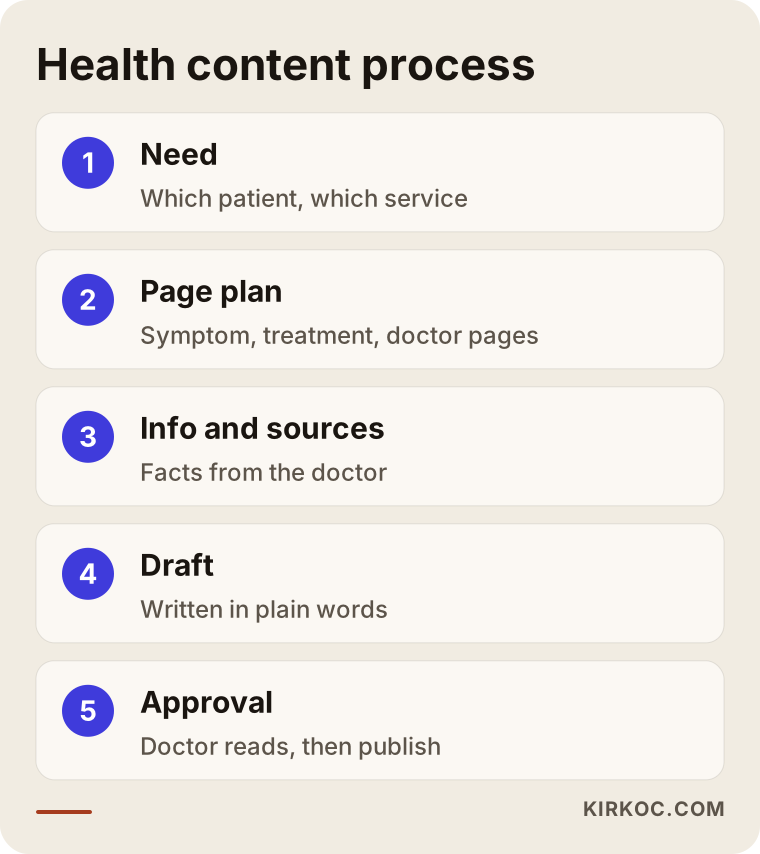
The first step is defining the need. Which patient do you want to attract, which services do you want to highlight, and on which topics would you prefer no article be written? The second step is the page plan. I put the pages to be written in order, following the three layers described above. The third step is collecting information and sources. You tell me about your clinical practice, the sources you rely on, and the wording you do not want. The fourth step is writing the draft. The fifth step is the doctor's approval and corrections. The sixth step is the publishing and update schedule.
The critical point is the fifth step. Nothing goes live before the doctor has read the draft. I say this at the very beginning, because some doctors are so busy that they would like to say, "You write it and publish it." In health, that is not the right method. The text is published under your name, so it must pass your approval.
From draft to publication: the approval flow
I keep the approval flow simple. The draft reaches you as a document. You mark the places you want changed, or just write them briefly. I make the corrections and show you the final version again. When you approve, I publish. Under each article there is a publication and update date, and the doctor's name and specialty are visible. When an update is needed, the same flow runs again.
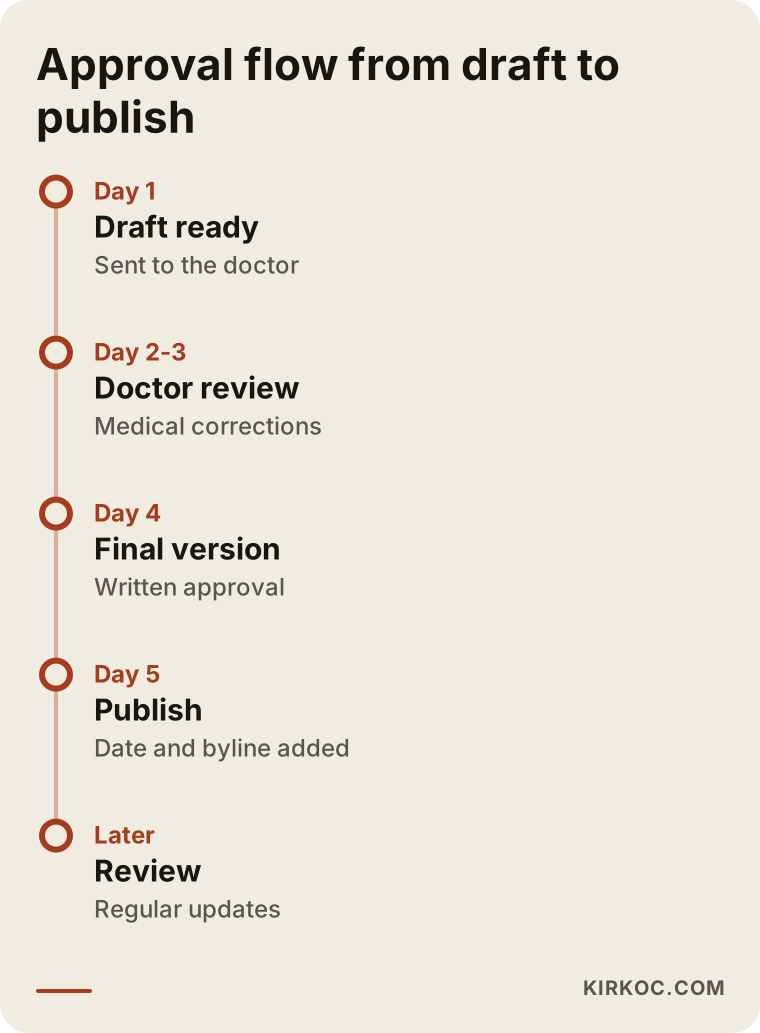
The order on the timeline is intentional. The doctor's approval comes before publication, and the update plan comes right after it. A process that skips both looks fast in the first week and causes problems a few months later.
Common mistakes in health content
Let me list the mistakes I see, because most of them are easy to avoid.
The first mistake is publishing text collected from the internet as if it were your own knowledge. That creates a copyright problem, and information that is wrong somewhere else stays wrong on your site too. The second mistake is copying the same text onto many pages and only changing the name of the treatment. Readers notice, and so do search engines. The third mistake is promising certainty. In medicine, certain results are rare, and honest language should reflect that. The fourth mistake is making the doctor invisible. Without a name and a specialty under the text, the reader cannot tell where the information comes from.
The fifth mistake is using heavy medical language. Your patient does not know the terms; if you write "inflammation", you need to explain it as "the body's reaction in one area". The sixth mistake is not connecting the page to a booking. If the reader gets the information and does not know what to do next, the page has done only half its job. The seventh mistake is forgetting updates. The eighth mistake is letting your social media content and your site disagree. If Instagram says one thing and your site says another, the patient does not know which to believe.
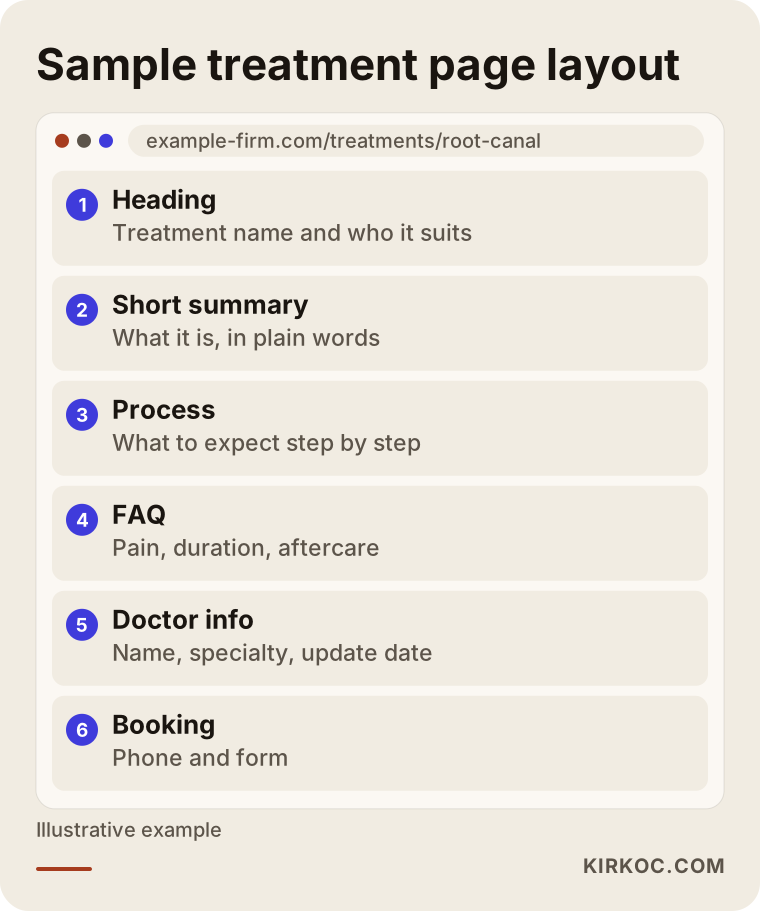
The sample layout above summarizes what a reader should see, and in what order, on a treatment page. The heading carries the treatment name and who it suits, followed by a plain description, the process, frequently asked questions, the doctor's information, and finally a call to book. This order answers the patient's curiosity in the right sequence and gives search engines a clear structure.
What can you do yourself?
You do not have to hand all the work to a specialist. There is a lot you can do on your own, and some of it nobody but you can do.
Note down the questions you hear from patients every day. That list is worth more than what a content specialist could find in hours of searching online. Put in writing which treatments matter most, which patients you want to attract and which expressions you want to avoid. Gather your photo, your training and your memberships. Make sure your phone number, address and opening hours are identical everywhere. Do not use patient reviews before you have clarified consent and the rules.
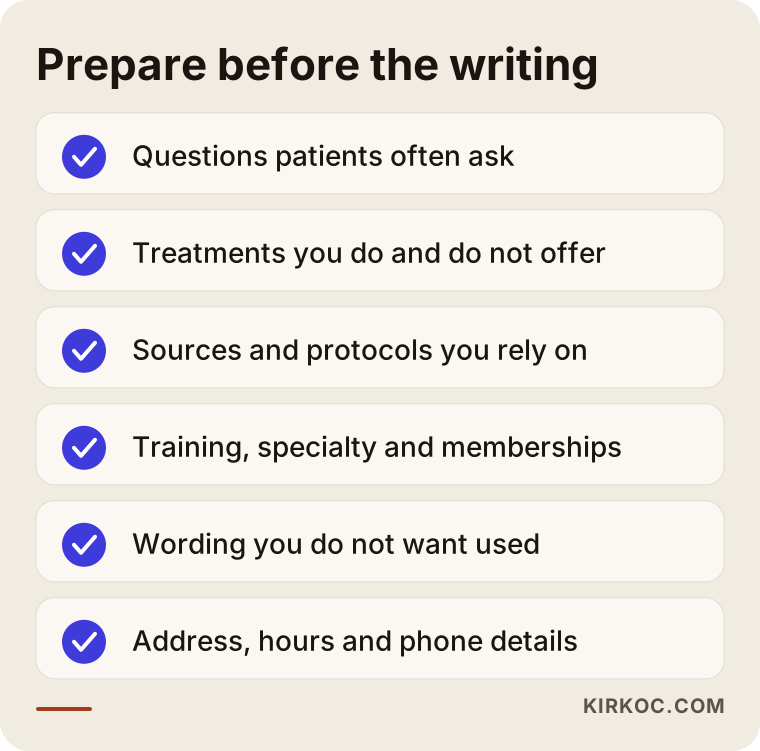
Preparing this list may take you half a day, but it speeds up the writing considerably. A clinic that arrives prepared gets a much more accurate first draft, because I can base the text on your real knowledge instead of guesses.
When do you need an expert?
You can write the text yourself, but outside help makes sense in these cases: you do not have time to write, you need to publish content regularly, you will publish in more than one language, your current texts are scattered and inconsistent, or you need to connect the content with search visibility. On the other hand, if you only need a few basic pages and you enjoy writing, I can also work only on the final read and the editing.
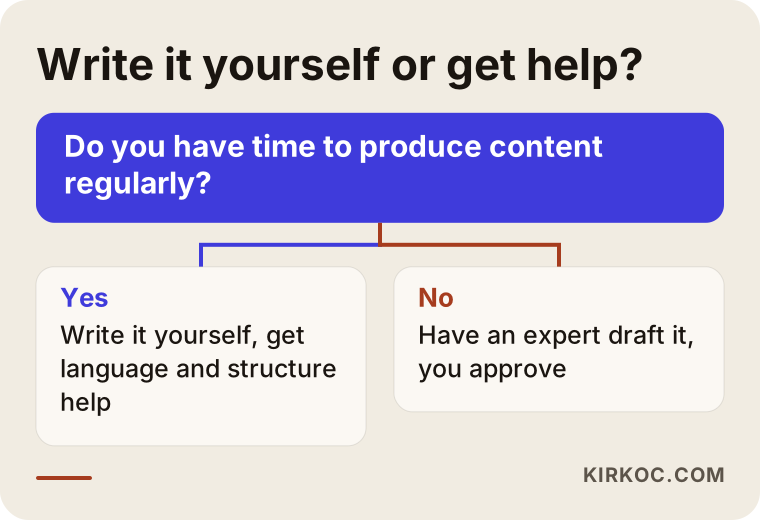
The question in the flow chart is simple: do you have time to produce content regularly? If the answer is no, handing the process to someone makes sense. If yes, writing it yourself and getting only language and structure support may be enough. Both options are legitimate. What matters is that the doctor's approval is kept under all conditions.
Why does working with one person help health websites?
Health content does not sit alone once it is live. An article connects to the structure of the site, to visibility in search, to posts on social media and, where needed, to advertising. If these are handled by different people, the person who writes the text, the person who builds the page and the person who runs the ads work without knowing about each other. You end up with one claim on the site and a different claim in an ad, which is exactly the kind of inconsistency health should avoid.
Because I handle the website, search visibility, social media and ad management myself, the name, definition and limits of a treatment stay the same everywhere. The language I use on the site also applies to the Instagram post and the ad text. There is a practical benefit too: as the doctor, you have one contact person, and a wording you approved does not have to be approved again on every platform. Of course, this is not the right method for every clinic. But for small and medium-sized practices, it noticeably reduces the coordination load.
When the technical setup that helps health pages get found is built by the same person, the titles, descriptions and page structure fit the content. Details such as marking up the doctor page correctly and keeping your address and hours consistent with your map profile are part of that.
What determines the cost?
I am not going to give you a number, because any figure given before the scope is clear would mislead you. But I can tell you plainly what changes the price.
The first is the number of pages and articles to be written. A plan of four core pages is obviously not the same job as a plan of forty articles. The second is how much expertise the topics demand; in a deep or debated field, longer conversations with the doctor and more rounds of correction are needed. The third is the number of languages, since adapting the same content to several languages takes extra work. The fourth is the need for visuals and infographics. The fifth is whether you want a one-time project or regular monthly production. The sixth is updating and maintenance; reviewing articles at set intervals after publication counts as a line of work. The seventh is the level of preparation on your side: the more organized the information you bring, the shorter the process.
An offer that looks cheap usually leaves out the doctor approval round, the source check and updates. When you compare quotes, check whether those three items are included.
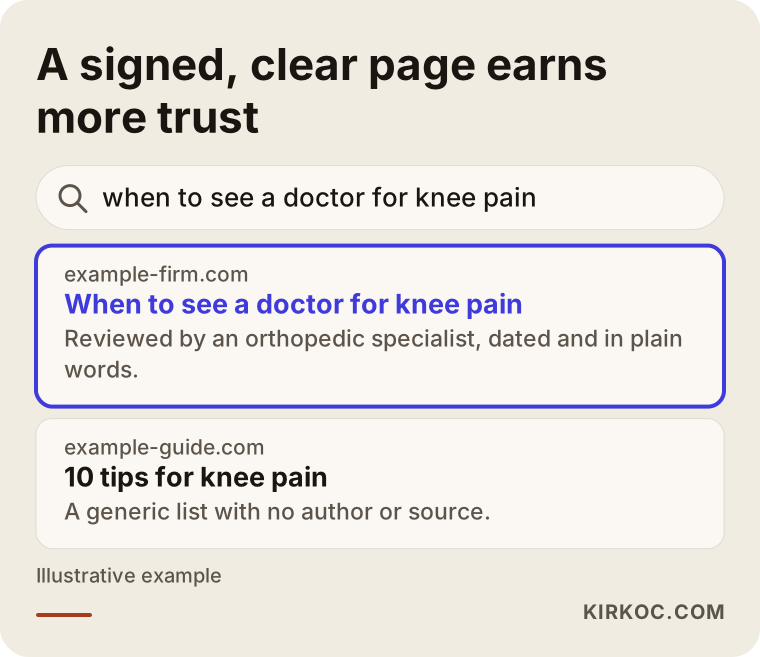
The last image shows, hypothetically, how a page prepared with the doctor's name, specialty and clear information looks more trustworthy next to a generic, unsigned page. It is not a ranking I can guarantee; it is only an example of which page looks more reliable in the reader's eyes.
How I work with you
I usually begin like this: we have a short call, and I listen to your clinic, your patients and the current state of your site. Then I give you a written plan: which pages, in what order, on which topics. If you approve the plan, I prepare the first two or three pages, and we try out the approval flow together on those. If the process suits you, we continue. If it does not, changing direction at this early stage is easy.
For clinics where I work on an ongoing basis, a monthly rhythm develops: which articles this month, which pages will be updated, which new questions have come in. I also work with people who want a one-time project. On the other side of the table there is one person: the one who writes the text, builds the site and publishes it is the same person. So there is no "let me ask the team" delay. At the same time, let me be honest: I am one person, so I do not take on many new clients at once, and if my calendar is full, I will tell you.
Frequently Asked Questions
Can someone who is not a doctor write health content?
Yes, but the source of the medical information and its approval must come from a physician. What I do is turn your knowledge into plain language and build the structure. I do not publish any article without the doctor's approval. If the doctor's name and specialty are visible under the article, the reader also knows where the information comes from.
Is health content written with AI safe?
AI can help with drafting, but it is not reliable on its own; it can produce missing, outdated or wrong information. In health, every sentence needs to be read by a physician. Whatever tool is used to prepare it, the responsibility for the published text lies with the person who approves it.
Can I share before-and-after photos of treatments on my website?
This topic is sensitive for both regulatory and patient privacy reasons. Rules can change over time and differ by field and by country. Before sharing, I recommend asking a lawyer or your professional body about the current rules. I do not give definitive legal opinions on this.
Can I use patient reviews on my website?
This also touches personal data and advertising rules. The patient's explicit consent and compliance with current regulations may be required. If you are not sure, do not use them; ask a lawyer first. Building trust with informative, plain pages is a safer route than putting reviews front and center.
Will the articles rank first on Google?
I do not promise any ranking, and nobody can. When it is done well, your pages have a better chance of being found, but time, competition and how crowded your field is decide the result. A realistic expectation is visibility that grows slowly over several months, not a jump overnight.
How often should articles be updated?
There is no fixed interval. I suggest reviewing the core pages at least once a year. When a guideline changes, when a new method starts at your clinic, or when a regulation is updated, the related page should be updated right away. Show the update date on every page so readers can tell whether it is out of date.
Can health content be prepared in more than one language?
Yes. If you serve international patients, a page in their language meets both the reader and the search engine where they are. But the translation also needs a medical check; the equivalents of terms can differ from language to language. This is one of the items that affects cost.
Do you also prepare social media posts?
Yes, I also manage social media, including Instagram, Facebook, LinkedIn, TikTok and YouTube. In health, it matters especially that the language on your site and the language in your posts stay the same, and that is the most concrete benefit of working with one person. The same approval flow applies to posts.
If you would like to talk about what kind of content plan could be built for your clinic, which pages to start with and how the approval flow would work for you, write to me through the content writing service page. I will listen to your situation and put together a realistic, no-hype roadmap that fits.