Your clinic does good work. Your doctors are experienced and your operating room is modern. Still, the number of patients coming from abroad never reaches the level you want. Or maybe most of them arrive through a middleman company, and a large share of your revenue ends up with that company. This is where social media for medical tourism enters the conversation. A person living in another country will look you over on their phone long before they travel to you. They check Instagram, they watch YouTube, they read Google reviews, and they search in their own language.
In this article I look at the question the way a clinic owner or manager with no technical background would. I explain how an international patient finds you, which content builds trust, what to write in which language, and which mistakes to avoid. If you would like someone to take over the daily running of your accounts, you can look at my social media management service. First, though, let's get the logic straight. A clinic that understands what needs to happen makes better decisions no matter who it hires.
How does an international patient find you?
A local patient usually decides quickly. They ask someone they know, compare nearby clinics on a map, make a call, and go. For a patient abroad the decision can take months. Traveling to another country for an operation involves money, time and real fear. So the research stage is long, and it moves through a few steps.
In the first step, the patient starts with a problem or a wish. They want new teeth, they are worried about hair loss, they are unhappy with their nose, or they are thinking about a weight loss procedure. They search in their own language, and the videos, forum threads and social posts they see tell them which countries and which clinics are being talked about.
In the second step, they put a few clinics on a short list. This is where your account comes in. They open your Instagram profile and check when you last posted. They read the comments. They try to work out who the doctor is. If the account has been silent for months, or posts only in one language and in a way that is hard to follow, the clinic quietly drops off the list. You never learn about it, because that person never even sends you a message.
In the third step, the patient reaches out. Most of the time this is not a phone call. It is a WhatsApp or Instagram message, sometimes a form on your website. How quickly and how clearly you answer that message largely decides whether you win that patient.
The illustration below shows how the same search can bring different pages to the top. A clear clinic page written in the searcher's own language can beat a generic directory page.
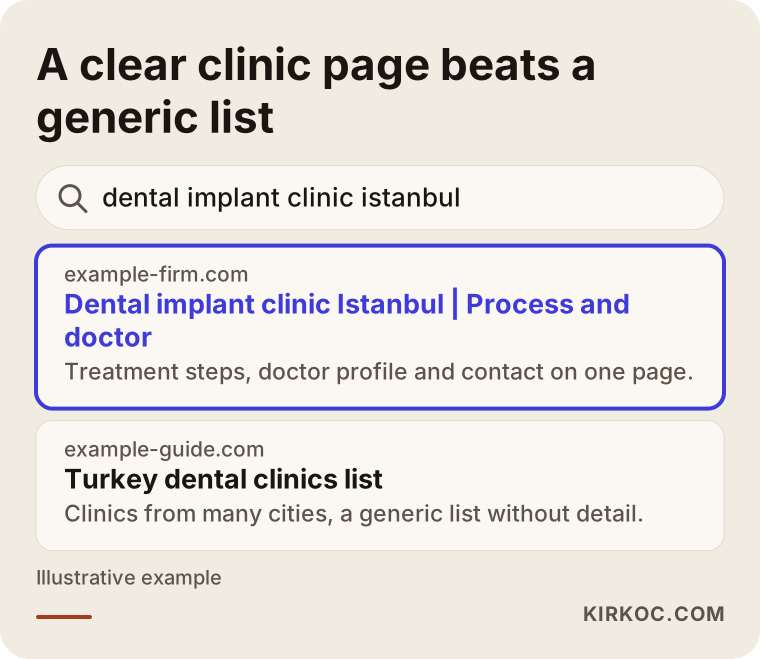
The difference in this example is simple. The detailed page says the treatment, the city and what the clinic actually does. The directory page lists everything in one place and explains none of it in depth.
Why does social media work differently in medical tourism?
For a hair salon or a cafe, social media is mostly about reaching people nearby. In medical tourism there are three big differences.
First, the trust threshold is very high. You will risk very little for a cup of coffee. Flying to a foreign country for surgery is a serious decision. The patient wants to see a real team, a real operating room and a real doctor. An account full of stock photos does not work here. Busy, decorated posts where nobody can tell who made the work do not build trust either. They reduce it.
Second, there are several languages and cultures. A patient from the United States and a patient from Germany may ask different questions, worry about different things, and even use different platforms. Taking a message written for one group and simply translating it for another often falls flat. What you choose to emphasize matters as much as the words. One visitor may care most about hotel and airport transfers, while another may mainly want to know how the follow-up checkup works after the procedure.
Third, the rules. Promoting health services is regulated in most countries, and Turkey is no exception. What you may post, how far before-and-after photos can be used, patient consent and the protection of personal data all matter. I do not give legal opinions. For those questions you need a lawyer who knows the current rules, or guidance from the relevant health authority. I build the content plan inside those limits, but the final word belongs to your legal adviser.
Which pages and accounts do you need?
Social media does not work alone. After a patient likes you on Instagram, they will want to go somewhere and read more. So think about the foundation first.
Your website. You need a separate set of pages for each language. Translating only the home page is not enough. Each treatment needs its own page in that language, plus a doctor profile, a description of the process, common questions and a contact section. I can also build or update your website, so the post on social media and the page on the site support each other.
Instagram. For treatments where the result is visual (hair, teeth, aesthetics) this is where people look most. Your profile description should say in one glance which service you offer, in which language, and in which city. Highlights should include topics like "How does the process work?", "Who is the doctor?" and "Hotel and transfers".
YouTube. Long videos, especially ones where the doctor calmly explains a treatment, are very valuable to a patient doing serious research. When people decide about an operation, they trust long, explanatory videos more than short clips.
Facebook. In some countries and among certain age groups it is still widely used. Group discussions and page comments can be places where patients recommend clinics to each other.
LinkedIn. If you are looking for corporate patient agreements, insurance intermediaries or company health programs, it shows the professional side of your doctors and clinic.
TikTok. It reaches a younger audience, but nobody picks a treatment from one short video. The goal here is a first introduction and curiosity.
Google Business Profile. This is not social media in the strict sense, but reviews and photos carry real weight in a patient's decision. It should carry the same information as your other accounts.
You do not have to do all of this at once. Depending on which country you want patients from and which treatment you focus on, starting with two or three channels is much healthier. The table below roughly matches patient language, the channel they use and a suitable content format.
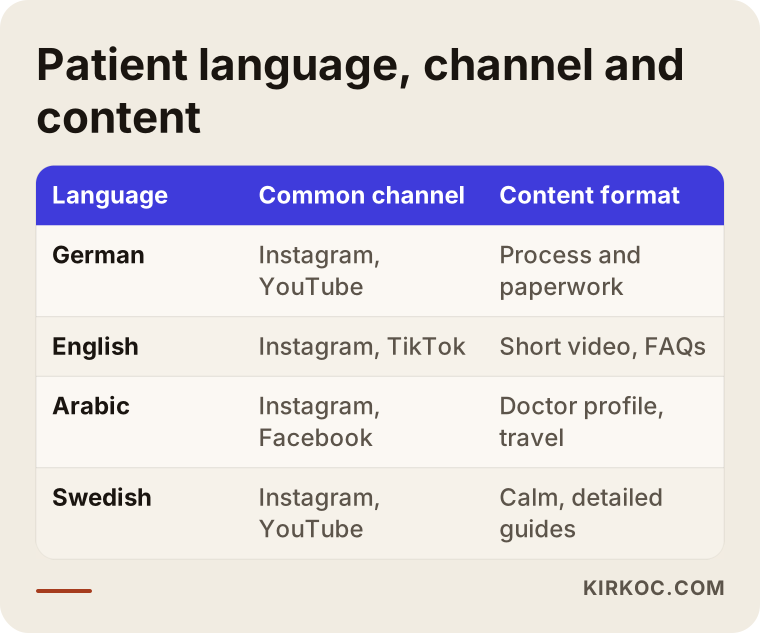
The matches in the table are starting points. The real preferences become clear per clinic and per target country, and they change over time.
Understanding the patient journey
An international patient's path is usually a funnel. At the widest point many people see you, and the number shrinks step by step until it reaches the appointment and the treatment. Each step needs different content.
Discovery. The patient does not know you yet. Short videos, informative posts and answers to common questions work here. If you explain "What is a dental implant and who is it suitable for?", you are answering the patient's curiosity.
Trust. The patient knows you but is not sure. The doctor's background, the clinic's certificates, people from the team and real patient experiences (shared with permission and in an appropriate way) matter at this stage.
Contact. The patient sends a message. You need speed, courtesy and clarity.
Planning. The appointment date, travel, accommodation, payment method and the process after treatment get discussed.
Afterward. When treatment ends, the patient goes home, and a stage of checkups, information and recommendations begins. A satisfied patient may recommend you to people they know. Most clinics skip this stage, yet it is the most valuable one.
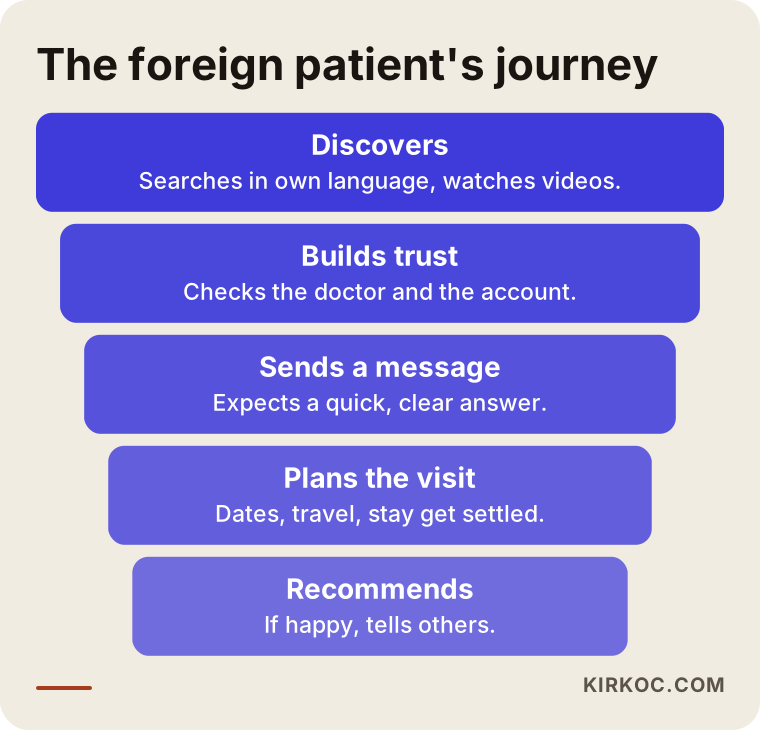
The funnel reminds you that instead of repeating the same message at every stage, you should prepare content that answers the patient's question at that moment.
Multilingual content: translation is not enough
The most common mistake I see in medical tourism is content written in one language and pushed through machine translation into others. The result is usually sentences that sound foreign and sometimes get misunderstood. On a medical subject, a misunderstood sentence does more than look bad. It can send the patient away from you completely.
Here is what I suggest instead. For each language, think of the content as if it were written naturally in that language. The main idea of a post can stay the same, but the examples, the emphasis, the way you address the reader and even the posting time can change by country. For instance, a patient from the United Kingdom may care about how the trip is arranged and what happens if something goes wrong afterward at home, while a patient from another country may care more about traveling with family and interpreter support. These are only examples. The real priorities have to be set by looking at the target market.
Three practical rules for language:
- Explain medical terms in plain words. If you use words like "graft", "implant" or "anaesthesia", put a one-sentence explanation next to them.
- In every language, show the main message and the way to contact you clearly. The patient should never wonder "how do I write to them?"
- If you cannot answer messages in a language, do not advertise or post in that language. An unanswered message leaves a worse impression than no message at all.
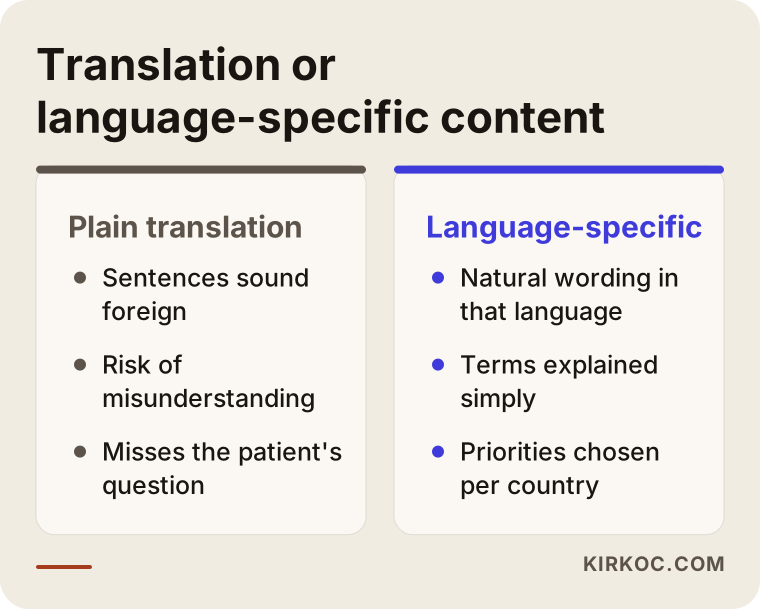
The comparison shows that translation alone is not enough, while content thought through separately for each language builds confidence.
Content types that build trust
What shapes a treatment decision is usually not a big, flashy advertisement. It is small, real details. In my view these are the content types that work best on a clinic account:
Content that introduces the doctor. The doctor's speciality, experience and the kinds of cases they handle, explained briefly and calmly. It is even better when the doctor speaks directly to the camera.
Explaining the process. What happens on the day the patient arrives? Airport pickup, first examination, treatment, rest, follow-up. A plain walkthrough reduces uncertainty, and uncertainty is the biggest fear of an international patient.
A clinic tour. The waiting area, examination room, sterile areas and equipment. Real footage is more convincing than a stock photo.
Frequently asked questions. Answering the questions in the patient's mind one by one is valuable content, both on social media and on your site. For questions like "How many days do I need to stay after the operation?" or "Do I need to come back for a checkup?", I prepare plain answers based on what I get from your doctor.
Follow-up after treatment. Content showing that contact with the patient continues after the treatment increases trust.
Patient experiences. Real feedback that is shared with permission and in an appropriate way is powerful. But there are legal limits for before-and-after images and for anything that relates to a patient's identity. Always work with your lawyer on this. I would not propose content that goes beyond those limits.
I should also tell you what not to do. Phrases such as "the best", "guaranteed result" or "painless, risk-free" damage trust and may also cause problems with regulations. Honest language wins more patients in the long run.
What should a clinic page look like?
Interest on social media is wasted if it is not met by a page on your site. When a patient comes from Instagram, they want to see a separate, clear page for each treatment. The layout I recommend looks roughly like this:
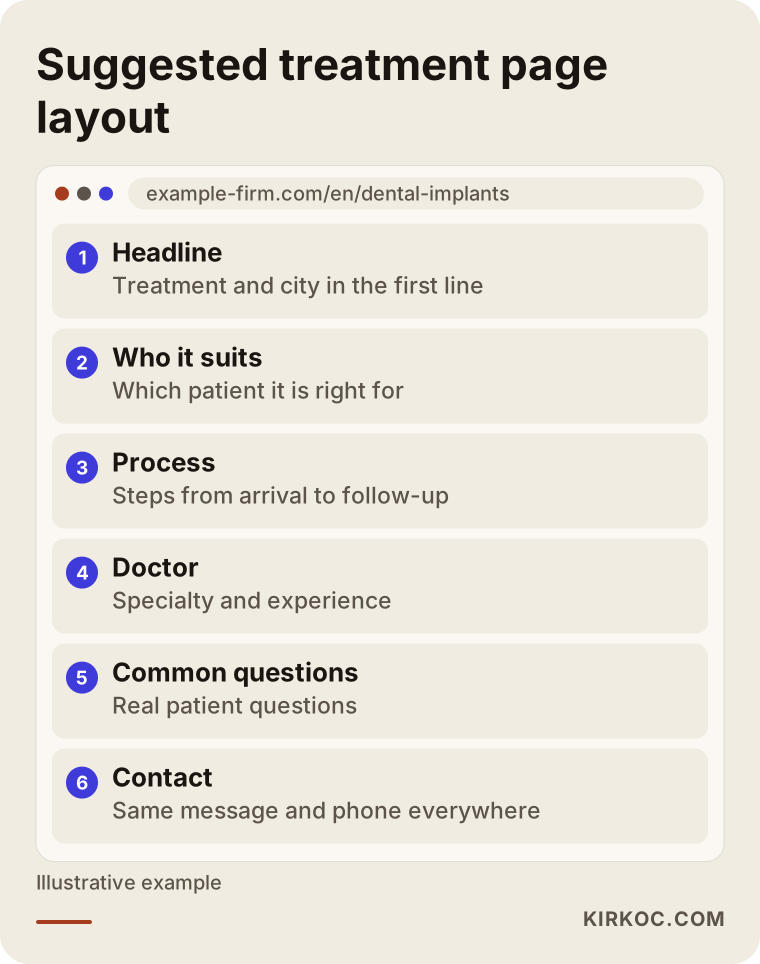
In the layout shown, the headline states the treatment and the city right away. Next come who it suits, the process, doctor information, common questions and a contact section. This layout has to be built for each language separately. Instead of adding a language switch at the bottom of one page, giving each language its own address and page sends a clearer signal to both the patient and the search engines.
Two hypothetical example scenarios
The two scenarios below are entirely hypothetical and have nothing to do with any real clinic. I made them up only to show the logic.
Scenario 1: A mid-size clinic focused on dental treatment
Imagine a clinic in Istanbul with three doctors that does dental treatment. Most of its patients come through intermediary companies, and the clinic leaves a share to the intermediary for each patient. The owner wants to receive patients directly. The Instagram account has general clinic shots and celebration photos, and the posts are in Turkish with an occasional English one.
First the target market is clarified, for example English-speaking and German-speaking patients. Then separate treatment pages are prepared for each of the two languages. A few posts a week are planned on Instagram: doctor profiles, process walkthroughs, common questions and a clinic tour. The person who answers messages and the response time are decided. A short patient information form and a pre-appointment call routine are prepared.
What you gain here is not a flood of patients overnight. It is a handful of serious patients who contact you directly. Each of them reduces the share you leave to the intermediary. I do not promise a result, because patient numbers depend on many factors, but the direction is right.
Scenario 2: A hair transplant clinic in a very competitive field
This time imagine a clinic that does hair transplants. This field is crowded, with hundreds of clinics posting similar images. An account that posts the same style of before-and-after content will struggle to stand out.
Here, differentiation comes from what the clinic really does differently: how involved the doctor is, how planning is done, one-to-one conversations with the patient, and follow-up after the operation. Instead of numbers like "how many grafts", this clinic can focus on an honest description of the process. It stays careful with before-and-after images because of the rules. On YouTube, videos are prepared in which the doctor calmly and at length explains the planning before surgery.
The goal in this scenario is not to be the "most viewed" account but the account that looks "most trustworthy". Where a field is crowded, attention is expensive, while trust is earned slowly and patiently.
Step by step: how working with me goes
If you decide to work together, the process goes like this:
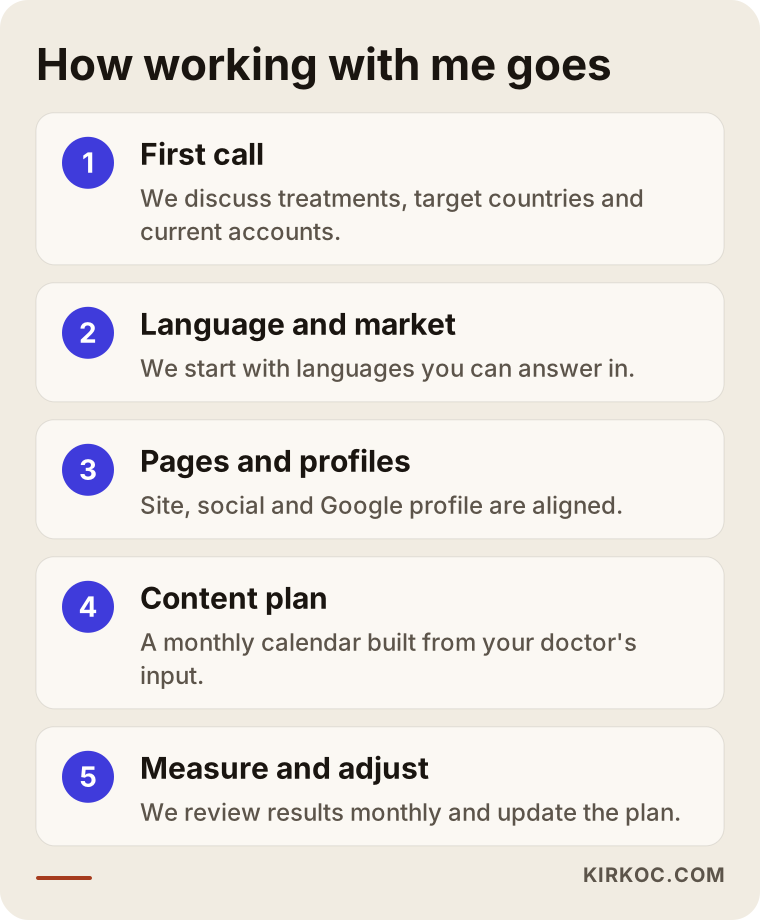
1. First call. You tell me which treatments you offer, which countries you want patients from, where your patients come from now, and what accounts and website you have. At this stage I usually review the current situation and tell you where I would start.
2. Choosing languages and target markets. Instead of doing everything at once, I recommend starting with two or three languages. Pick the languages in which you can actually answer messages.
3. Pages and profiles. The treatment pages on your site, your social profiles and your Google Business Profile are arranged so that they carry the same information.
4. Content plan. For each month, which topics will be shared in which language is put into a written calendar. I prepare real content from the information and footage I get from your doctor.
5. Publishing and message flow. Posts go out. It is decided how fast, by whom and with which template incoming messages will be answered. This is the part skipped most often, and it is the part that brings the most results.
6. Measuring and adjusting. Each month I look at which posts brought messages and which language drew more interest, and the plan is updated accordingly.
Running all of this myself has a practical benefit. The page on your site, the post on social media, your visibility on Google and, if needed, your ads carry the same message. You do not have to explain the same thing to four different people. The message stays consistent, and a change in one place carries over to the others.
Common mistakes
Here are the mistakes I see most often in this field. All of them are easy to avoid.
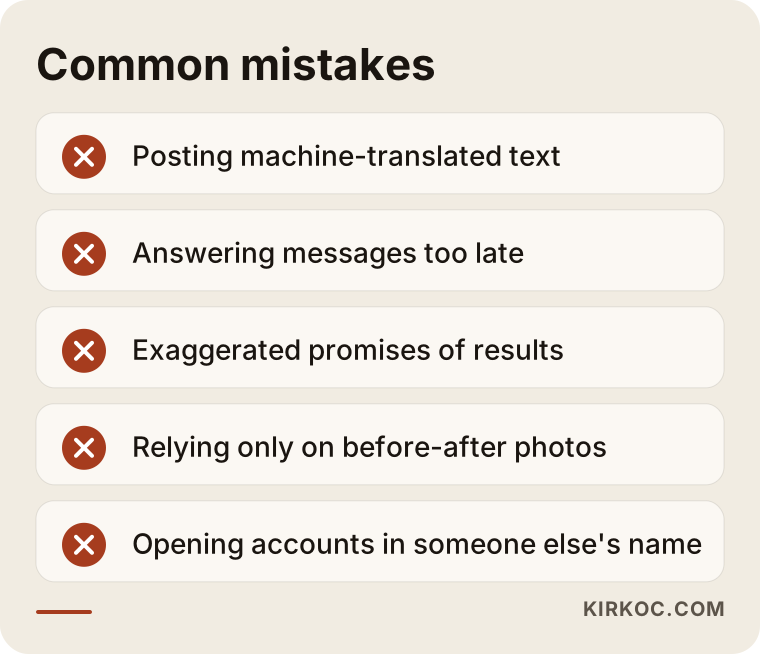
Posting machine-translated text. I explained this above. A broken sentence on a medical subject lowers trust instantly.
Answering messages late. An international patient may be in a different time zone. Even so, a full day without a reply reads as a lack of seriousness. One person needs to be responsible for fast answers.
Relying too much on before-and-after photos. This type of content is sensitive from a regulatory point of view and hard to tell apart from competitors. On its own it is not enough.
Exaggerated promises. Phrases like "guaranteed result" or "miracle" frighten the patient and expose you to risk.
Getting into a price fight. A price race on social media pushes you into the group of cheapest clinics. Yet a patient who wants trust is usually not looking for the cheapest. It is healthier to give prices in a written quote, based on the patient's situation.
Leaving the accounts with a middleman. Whoever the account is opened under is the owner of the account. Account access should always be in your name.
Depending on a single channel. If the Instagram algorithm changes or the account runs into trouble, your whole flow of patients should not stop. Be visible on your website and your Google profile too.
Being impatient. The decision process in medical tourism is long. Quitting after the first weeks because you do not see results wastes the effort.
What do AI tools and search engines say?
Many people now ask AI tools such as ChatGPT questions before choosing a clinic. If someone asks, "What should I check when choosing a dental clinic in Turkey?", the AI usually answers along these lines: accreditation, the doctor's experience, patient reviews, a transparent process and a written quote. In other words, if the AI can find that information on your site and accounts, it can mention you more easily.
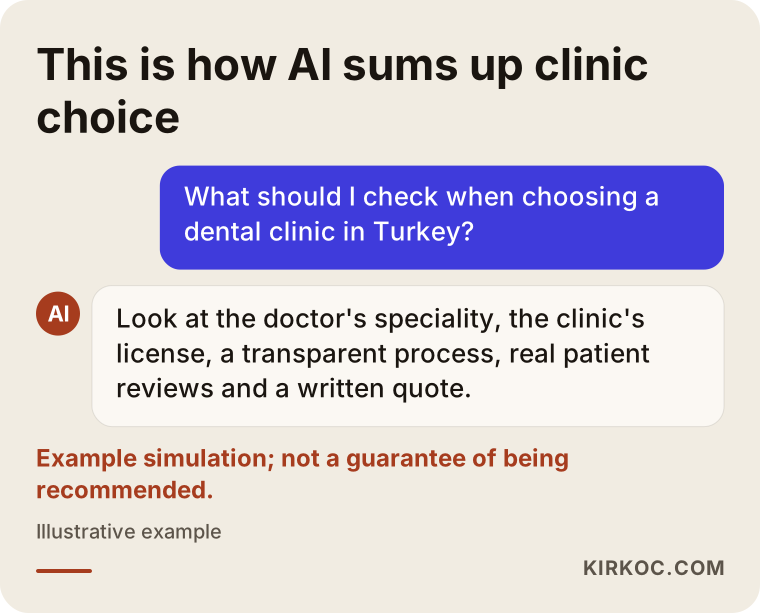
This illustration is only a simulated sample answer. It does not guarantee that any AI will recommend you. The lesson is still clear: publish clear, consistent and verifiable information about your clinic. The doctor's name, speciality, address, working hours and the description of the process should be the same everywhere. That gives both search engines and AI tools something solid to read.
What can you do yourself, and when do you need a specialist?
You do not need outside help for everything. There are things you can do on your own:
- Make profile descriptions and contact details identical everywhere.
- Record a short, plain introduction video of your doctor. A phone can be enough.
- Collect the questions patients ask most often in one file. It is worth its weight in gold for both content and message replies.
- Keep your Google Business Profile current and answer reviews politely.
- Assign one person to watch the messages and set the expected reply time.
Specialist help makes sense in these situations: you need regular content in several languages, you want to connect your website and social media, you are thinking about running ads, or your accounts have been silent for months and nobody can look after them. Since you work in a field that is sensitive for regulation and patient privacy, someone experienced who will build the content plan within that frame also makes your job easier.
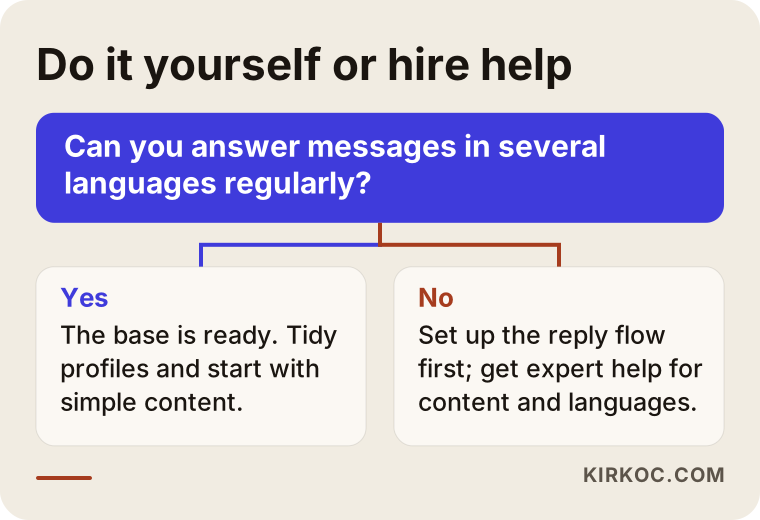
The question in the illustration gives a simple test. If you can regularly answer messages in different languages, your foundation is ready. If you cannot, you first need to build that foundation.
What determines the cost?
I am not giving you a number here, because every clinic is different. But I can tell you clearly what the price depends on:
- Number of languages. Every new language means extra content, extra pages and extra message handling.
- Number of channels. The workload of two channels and five channels is very different.
- Posting frequency and content type. Weekly designed posts and regular video production are not the same effort.
- Need for shoots. Videos and photos shot at your clinic are different from working with the material you already have.
- Website work. Whether your current site is enough, and whether language pages must be built from scratch.
- Ad management. The ad budget is separate, and managing the ads takes additional work.
- Message handling. Whether I handle the incoming messages or your own team does.
I talk through these items with you and then give you what you need in a written quote. I do not add unnecessary services. I only write down the work that serves your goal.
What should you look for in a quote?
Whichever specialist you hire, I suggest checking these points at the quote stage:
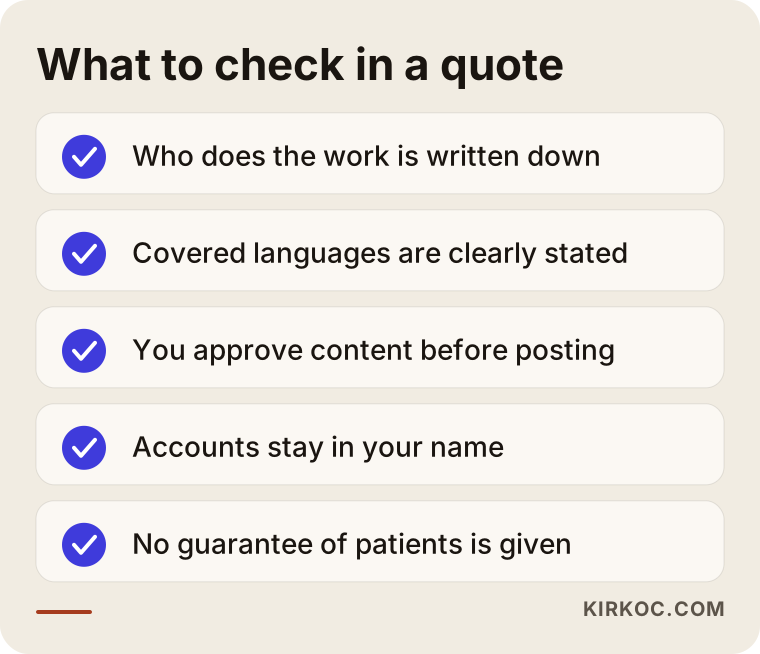
The most important items on the list are that the accounts and the website are in your name and that no guarantee of results is given. In a sensitive field like health, someone who says "I will definitely bring you patients" either does not know the work or is misleading you. Do not hesitate to ask in writing who will do the work, which languages are covered, how content is approved and how reporting is done.
How I work
I work in Istanbul, and I run the services a digital agency would normally provide by myself and through a single point of contact. Website, SEO, local SEO, social media management, Google and Meta ads, logo and corporate identity, and content production can all be solved by talking to the same person. In a layered field like medical tourism, that is a real convenience. I keep the treatment page on your site, the post on Instagram and the message in your ad consistent with each other.
When we work together I speak plainly. I explain what I am doing, why I am doing it and what result you should expect. I take care that everything that belongs to you, especially clinic confidentiality and patient information, stays with you. I hold short calls with your doctor and the responsible people, and I submit the content for your approval. If you need a very large-volume job that requires a big team, I will say so from the start. My capacity is limited and I do not hide that.
Frequently Asked Questions
Does social media for medical tourism really bring patients?
Social media on its own is not a patient-generating machine. It helps a patient feel confident while researching you. Combined with the right pages, fast replies to messages and consistent information, it has the potential to increase the number of patients who contact you. I cannot give a guarantee of a specific number or timeline.
Which social media channel should I start with?
For most clinics, Instagram and YouTube are a good start: the first for a quick introduction, the second for deeper trust. Depending on your target country, Facebook or LinkedIn may also be needed. Managing two channels regularly is better than managing five halfway.
How many languages should I produce content in?
As many as you can answer messages in properly. I usually recommend starting with two or three languages and adding a new one once things run smoothly. Producing content in a language you cannot answer in disappoints the patient.
Can I share before-and-after photos?
That depends on the regulations and on patient consent. I cannot give a clear legal answer. Please ask a lawyer who knows the current rules, or follow the guidance of the relevant health authority. I build the content plan to stay within those limits.
Do I need to give you access so you can manage the accounts?
I get the access I need through your account, with your authorization. The accounts always stay in your name, and you can close my access when the work ends.
Do I need to run ads?
It is not required. You can start with regular content. If you want faster, more targeted reach, Meta and Google ads can help. Ads need a budget and management effort, and we decide together according to what you need.
When will I see results?
The decision process in medical tourism is long, so effects are usually not immediate. In the first months I look at signs such as the state of the accounts, the number of messages and profile visits. I do not commit to a fixed timeline, because results vary by field, language and competition.
What information should I prepare to start?
It is enough to share which treatments you offer and which countries you want patients from, your current site and account addresses, your doctors' information and the questions patients ask most often. We settle the rest in the first call.
If you want to reach international patients in their own language, regularly and in a way that builds trust, let's look at your situation together. You can read about my social media management service and write to me. I will prepare a written, plain plan for your clinic's needs.