You run an aesthetic clinic, or you are about to open one, and you want to advertise on Instagram and Facebook. Then you hear a story: a clinic owner whose ads were rejected over and over, or whose ad account was shut down without a clear explanation. That worry is justified. Advertising an aesthetic clinic on Meta is a very different job from advertising a shoe store, because two sets of rules apply at once: the platform's own policies on health and appearance, and the local rules on how healthcare providers may promote themselves. I write from the Turkish context, which covers clinics in Turkey and clinics that want to reach patients who travel to Turkey. I am Ümit Kırkoç, and I work alone from Istanbul. This article explains how I set these ads up, what causes trouble, and what you need to decide. If you want the full picture of what I offer, my digital advertising service page covers it, and I can run it together with your website and social media.
First, one term. "Meta ads" is the shared name for paid ads on Instagram and Facebook. You manage both from the same dashboard. The person who sees your ad was not looking for you. They were scrolling, and your ad appeared. That is the opposite of a Google search, where the person already has a need. With Meta you are earning attention from someone who might be interested, and in aesthetics, where decisions take a long time, that difference matters a lot.
Why aesthetic clinic ads are different from other businesses
If a shoe store makes a mistake in an ad, the worst outcome is usually wasted budget. If a clinic makes a mistake, the ad account can be restricted, the page can lose reach, and other accounts linked to the same business manager (the admin area where your pages and ad accounts live) may be affected as well. The risk is not only money. It is the account itself.
There are three reasons for this.
The first is Meta's own policy. The platform is strict about content that makes people feel bad about how they look, ads that imply "you have a flaw, fix it with this," before-and-after images, and wording that points at a personal health condition. The details change over time, so please read everything below as a framework I apply while checking the current official policy, not as a final ruling.
The second is local regulation. In Turkey, how a healthcare provider may advertise is regulated, and it covers which claims, images and professional titles may appear in an ad. I am not a lawyer, and I will not give you a firm legal interpretation. Before any ad copy is written, I recommend that the clinic owner or the lead physician talk to a lawyer who knows healthcare advertising rules in your country. If you are a clinic abroad that wants patients to come to Turkey, the rules of the country you target may also matter. I handle the technical side, meaning how the ad is built, who sees it and how results are measured. The legal approval stays with you.
The third is how the customer decides. Nobody sees one ad and books surgery the next day. They get curious, research, compare doctors, read reviews, and sometimes think about it for months. The job of the ad is to open the first door and build a little trust.
The wording and images that cause the most trouble
Most things that put an account at risk come from habit, not bad intent. The most common habit is turning a social post into an ad. A regular post goes live and may never be reviewed in depth. An ad is screened before and after it runs, and the standard is stricter.
The graphic below sums up the situations that most often cause problems. It is not a legal guide. It is the short version of what I watch for in practice.
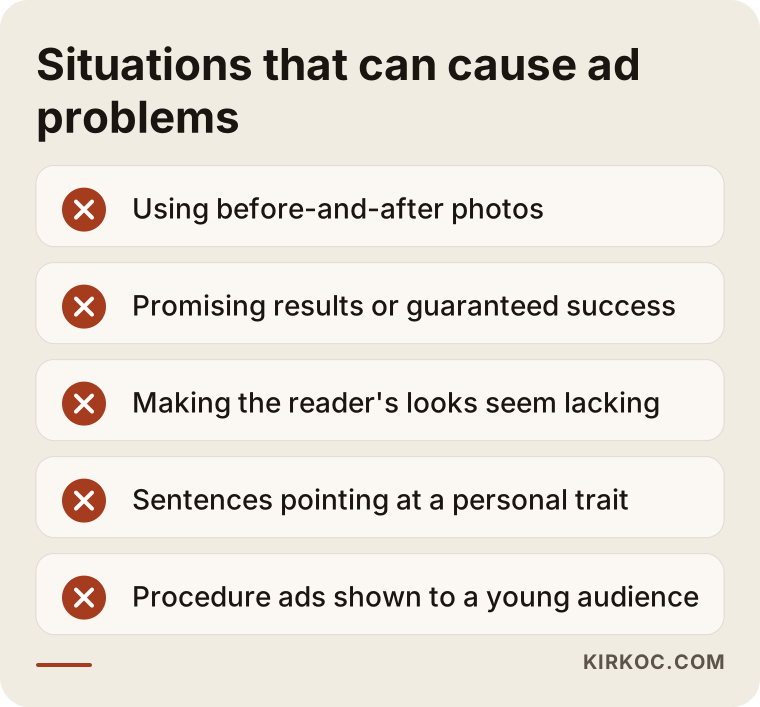
What these items share is this: the ad should not tell the person "something is wrong with you." It should say "this is a service we offer, and here is where you can ask for information." The difference is small on the page, but it can decide whether an automated review or a human reviewer lets the ad through.
Before-and-after photos and promises of results
Before-and-after photos are the most popular content in aesthetics and also the most likely to cause trouble in ads. Meta often restricts them, and they raise patient privacy and healthcare advertising questions on top of that. For that reason I prefer to build ad visuals around the clinic space, the doctor introducing themselves, the consultation process, or educational content. I also never write claims such as "lose this much weight" or "wrinkles disappear." They are against the rules, and they are not honest, because results vary from person to person.
Language that points at a personal trait
Ad copy such as "Are you unhappy with your nose?" or "Overweight?" names a personal characteristic of the reader, and it is a common reason for rejection. A neutral line that describes the service and the process works better, for example "What is discussed at a rhinoplasty consultation?" It informs without pointing at anyone.
Age and sensitivity
Ads for some procedures should not be shown to young people. Keeping the audience age range clearly within adults is both a rule and plain good sense. I check this setting in every campaign, one by one, rather than assuming it carried over.
Choosing the right audience: who should see your ad?
People who come to an aesthetic clinic tend to fall into a few groups. Some have already researched a specific procedure, such as hair transplant, nose surgery or fillers, and are now choosing a doctor. Others think "maybe I could change something" but have not decided what. A third group has already seen you on Instagram or visited your website but never booked.
Each group needs its own ad. For the first, an ad about the doctor's specialty and the process works. For the second, curiosity-answering content such as "what happens at a first consultation" fits. For the third, a reminder ad shown to people who visited your site before works well. That technique is called retargeting, which simply means reaching people who have already looked at your site. All three can run on the same budget with different messages.
The graphic below follows this path from broad interest to an appointment request.
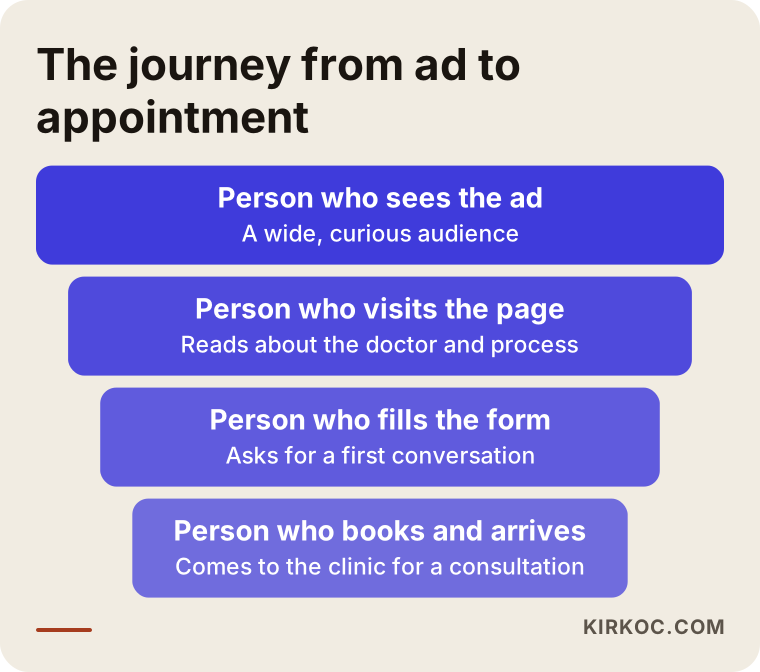
The number of people drops at every step, and that is normal. What goes wrong is putting the entire budget on the bottom message, "book now." You then reach only the small number of people who have already decided, and your cost per result climbs quickly.
Two hypothetical example scenarios
The two cases below are invented. They do not describe a real clinic or person. Their purpose is to show the reasoning.
Example scenario 1: the clinic that started with before-and-after photos
Imagine the owner of a mid-sized clinic who wants to turn the most-liked before-and-after photos from Instagram into ads. Within days the ads are rejected. One gets through, then is stopped soon after. The owner tries again, changes the text, but keeps the same image. Warnings pile up on the ad account.
In a situation like this, I would first stop launching new ads. Then I would look at the account status and the restriction notices. After that I would rebuild the creative: the clinic space, a short video of the doctor introducing themselves, an explanatory piece on what is discussed at a first exam. For the landing page I would use wording that your lawyer has approved. I cannot promise an outcome, but the chance of the account running into trouble again goes down noticeably.
Example scenario 2: the clinic that collected questions, not appointments
The second imaginary clinic builds a clean ad, but its only goal is the "book an appointment" button. The audience is wide and the message is single. A few weeks later the budget is spent, yet most incoming messages are one-line questions like "how much is it?" The owner is unhappy.
The problem here is not the ad itself, it is how expectations were set up. Asking about price is normal in aesthetics, but a price cannot be given in one message because the procedure depends on the person. In a case like this, I would send the ad to a short intake form that collects what you need before a call: which procedure the person is curious about, how long they have been thinking about it, and which city they are writing from. Your team can then call someone they already know something about, and the person who only wants a price is separated from the person who is seriously considering it. I am not giving a number here, because every clinic runs differently, but the goal of the form is to turn each message into a useful first conversation.
What a safer ad setup looks like
Knowing what to avoid is half the work. The other half is knowing what to write. The comparison below puts two approaches to the same service side by side.
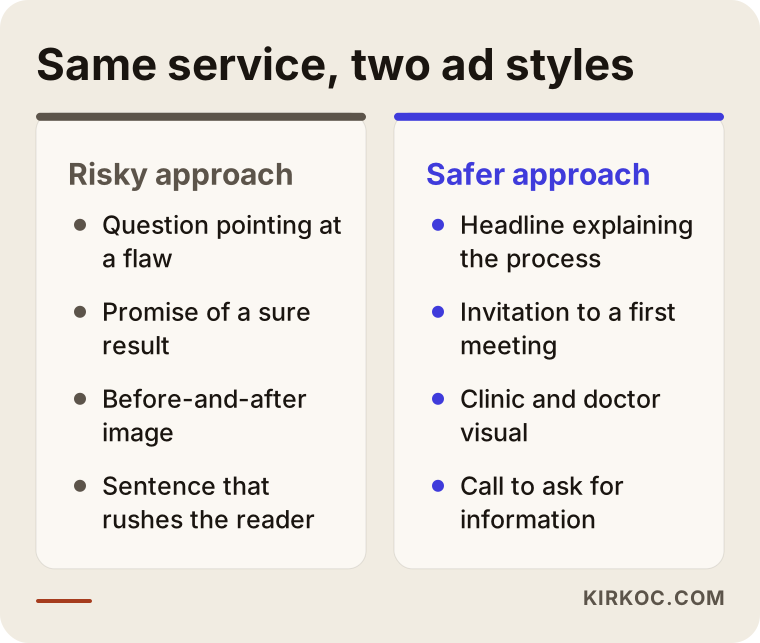
The approach on the left puts a problem on the person and promises a result. The approach on the right explains the process and invites the person to ask for information. The second may feel less eye-catching. But in a field where trust is everything, a flashy ad can turn into lost trust and account risk over time.
Put the doctor in front
In aesthetics, people usually choose the doctor, not the clinic. Short videos where the doctor speaks in their own words, plain explanations of their specialty and walkthroughs of the process make a strong base. Keep in mind that using titles and specialty claims must comply with the rules where you practice. If you are unsure about any phrase, ask your lawyer.
The page your ad leads to is part of the ad
Meta can review the page an ad sends people to. If the ad is calm but the page is exaggerated, you will have problems. So I design the landing page together with the ad. A good page explains the procedure in plain language, introduces the doctor, answers common questions and shows how to get in touch.
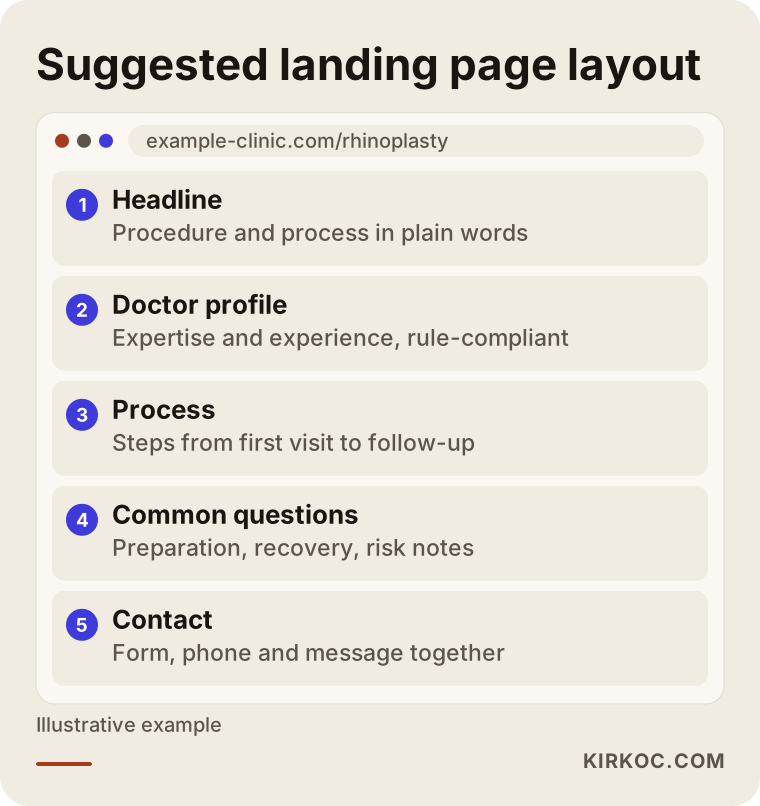
This layout has one purpose: the person who lands on the page should not feel any mismatch between what the ad said and what the page says. Because I also build the website, keeping the ad and the page moving together is easy on my side. There is no situation where two different people wait for each other.
My process, step by step
When I start working with an aesthetic clinic, this is roughly how it goes.
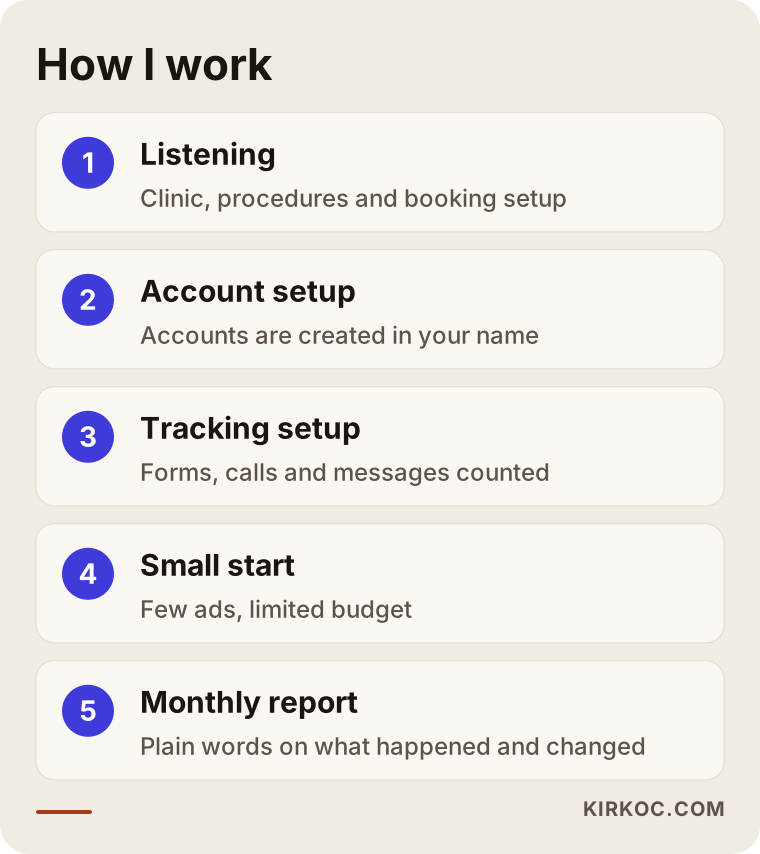
The first step is listening. I want to know which procedures matter most for the clinic, which ones fit your capacity, and who handles appointments and how. If nobody is there to pick up the phone for people who come from ads, spending more on ads makes no sense.
The second step is account preparation. I make sure the business manager, the page and the ad account belong to you. I stress this on purpose: the accounts should be created in your name, and I only work as an authorized partner. That way, even if you stop working with me, your accounts stay with you.
The third step is setting up measurement. Form submissions on the website, taps on the phone number and started chats need to be counted. Without measurement, you cannot answer the question "is it going well?" I try not to collect personal health data, and I suggest you check with your lawyer which information may be collected, particularly under your local privacy rules.
The fourth step is a small start. I begin with a few ads, different messages and a limited budget, and watch which message gets more interest. Then I expand what works and drop what does not.
How the first three months usually go
Advertising is not something you set up once and forget. Because the decision process in aesthetics is long, results also arrive gradually. The timeline below shows a general flow. I should say from the start that the durations will differ from clinic to clinic.
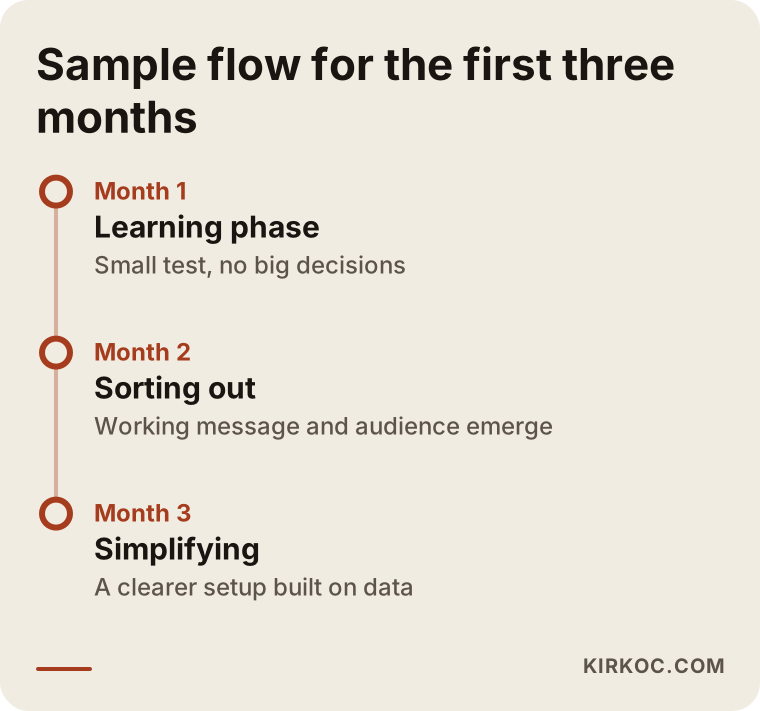
The first month is a learning period, and I do not make big decisions from its results. In the second month it becomes clearer which message and which audience work. In the third month, with real data, a simpler and more efficient setup is built. I do not promise numbers during this process, because promising numbers would not be honest.
Measurement: which numbers should you look at?
For a clinic, the most important measure is not "how many people liked it." It is "how many people actually asked for a consultation, and how many of them came to an appointment." I am not saying likes and views are meaningless, but on their own they do not help your business.
I usually look at the number of forms coming from ads, the number of calls and messages, how many of those turn into a real appointment, and how many appointments become a procedure. Only you know the last two numbers, because they happen inside the clinic. That is why I ask for a simple monthly update from you. You do not need to share any patient details. A numeric summary is enough.
One point is critical here: how fast you respond. Someone who writes to you from social media and does not get an answer within a few hours may contact another clinic. No matter how well the ads are managed, a team that does not reply wastes all the effort. It is better to talk about this at the start than to be disappointed later.
Mistakes clinics commonly make
These are the mistakes I see most often in the field.
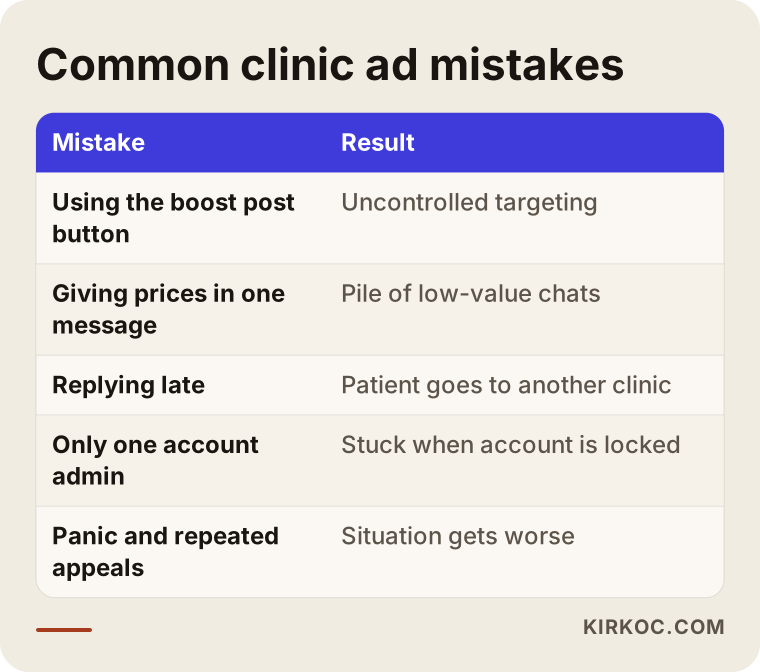
All of these can be fixed, but some of them, especially a restricted account, can be painful to undo. Preventing the problem is far easier than repairing it afterward.
What happens if your account is shut down?
If an ad account or page is restricted, the first reaction is panic and a string of appeals. Rushed appeals often make things worse. First, look at which rule the notice cites. Then fix the content, and only then file the appeal. The process does not always end well, so protecting the account matters more than trying to rescue it. It also helps to have more than one authorized admin in the business manager and to keep payment methods in order.
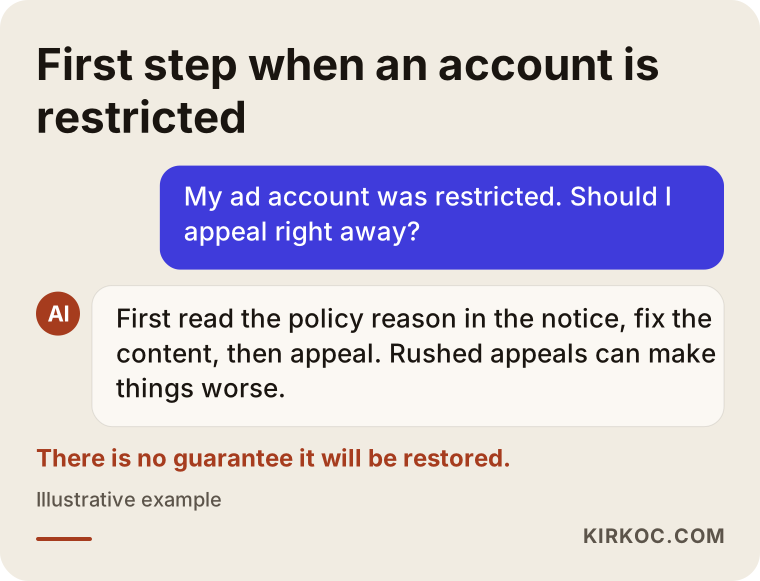
That sample answer shows that the right move is not speed, it is understanding the cause first. If you run into trouble, write to me and I will look at your account and tell you honestly what can be done. I cannot say "it will definitely be reopened," because the decision belongs to the platform.
What can you do yourself, and when do you need an expert?
If your clinic is small and your budget is limited at the start, you can do some of the work yourself. Keeping your Instagram page active, filming short introduction videos with the doctor, answering messages quickly and collecting reviews are all in your hands. They are valuable whether or not you run ads.
Using the ad dashboard is technically possible too, and the "boost post" button is right in front of everyone. But in aesthetics, starting with that button is exactly the path that puts an account at risk. A quickly made ad skips audience control, copy review and the match with the landing page.
Expert help makes sense in these cases: your ad account has been restricted before, you plan separate campaigns for several procedures, you want to measure the requests that ads bring in, or you want your ads, website and social media to work in step. A decision tree sums it up.
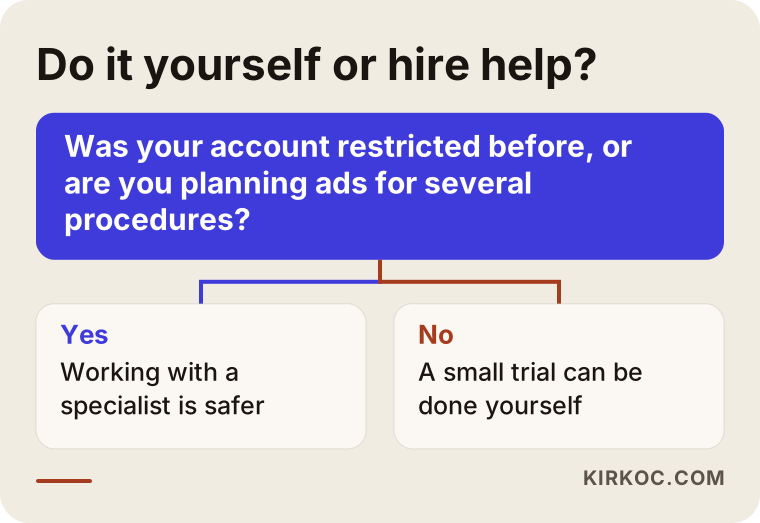
Whichever way you go, I recommend having the copy and the image checked once against the advertising rules before the ad goes live. That check is a very small investment compared with the problems it can prevent.
Final checklist before the ad goes live
Before each campaign I go through this list on my own. If you run ads yourself, you can use it too.
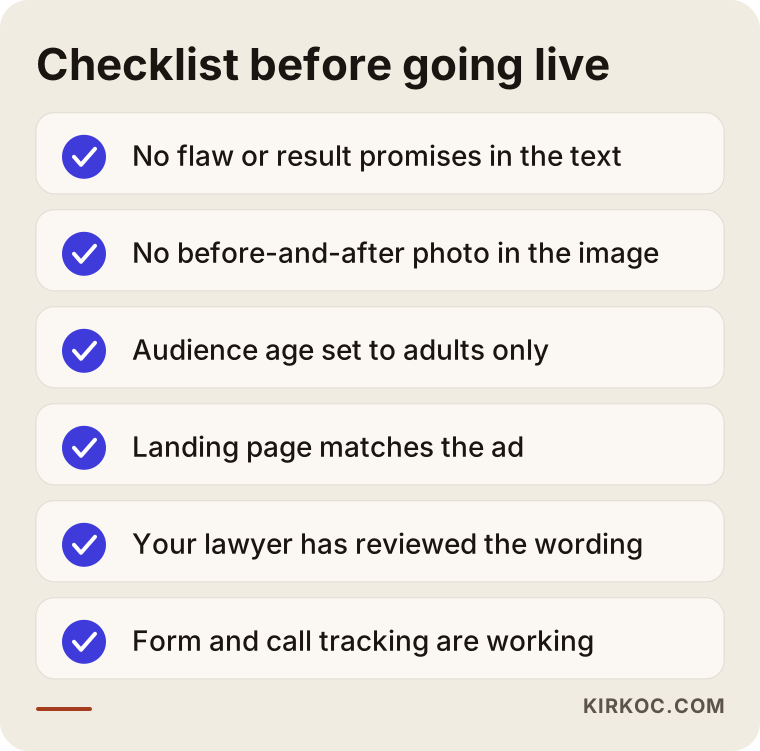
This list does not guarantee a flawless result, but it catches most of the big risks before they go live. Since platform rules can change, compare the list with the current rules on each campaign.
What determines the cost?
I will not give a number, because two clinics rarely cost the same. But I can tell you what moves the price.
First, the ad budget. This is the amount you pay directly to Meta, and it is separate from my fee. You decide it, and you can raise or lower it any time. Second, the scope of the setup: one procedure or several, one city or patients from abroad in different languages. Third, how much content has to be produced: visuals, video and landing page copy. Fourth, the level of measurement and reporting. Fifth, the state of your current account. Cleaning up an account that was restricted before can take more effort than starting a fresh one.
When you choose an ad budget, what you need to work out is roughly how much revenue an average patient brings the clinic and what share of first consultations turn into a procedure. You know these numbers. With them, I can suggest a reasonable test budget.
How working with me looks
I am one person, so every message you send and every setting I change goes through me directly. When ads, website, social media and content are split among different people, they tend to wait on one another, and that wait does not exist when you work with me. For example, keeping the ad message consistent with the website text, giving your Instagram page the same tone as your ads, and considering your visibility on Google at the same time are all easier when one person handles them.
The working rhythm is usually this: in the first meeting I listen to your clinic and goals, then tell you plainly what is possible and what is not. After that I set up accounts and measurement, start with a small test, and each month I explain what happened in a simple report. I do not hand over reports full of technical terms. I speak at the level of "this ad brought this many people to the form, and here is what I am changing."
One more thing, said openly: aesthetics is a healthcare field, and I am not a physician or a lawyer. The final decision on whether the wording complies with the rules rests with you and your legal advisor. I make that easier, but I do not replace it.
Frequently Asked Questions
Is it forbidden to run Instagram ads for an aesthetic clinic?
Generally it is not forbidden, but the rules are tight. Both Meta's ad policies and the healthcare advertising rules where you operate limit which wording and images you can use. For a definite legal answer you should ask a lawyer. I build the ads within that frame and check the current platform rules as I go.
Can I use before-and-after photos in ads?
Meta often restricts this kind of image, and it is a sensitive area under healthcare rules too. That is why I prefer not to use them in ads and instead go with informative, process-focused content. If you want to use them, ask your lawyer first.
What should I do if my ad account is closed?
Do not rush to send repeated appeals. First read which rule the notice cites, fix the content, and then appeal. There is no guarantee it will be reopened, because the decision belongs to the platform. The best protection is to run the account within the rules from the start.
How many patients will the ads bring?
I cannot give a number. The result depends on the procedure, the location, how well known the doctor is, the quality of the website and how quickly you answer incoming inquiries. Measuring in the first months and seeing what works is the healthier approach.
How much should my ad budget be?
There is no single right figure. I weigh the approximate revenue a patient brings the clinic, your rate of turning consultations into procedures, and the level of competition together. Starting with a small test and growing based on data is the safest path.
Do I need to advertise on both Instagram and Facebook?
In most cases the same campaign runs on both platforms and does not need separate management. If your audience is mostly on Instagram, I can concentrate the budget there. I decide which works better by watching the data.
Can you run ads to attract patients from abroad?
Yes, ads can be built in different languages and for specific countries. In that case both the rules of the target country and rules on medical travel may come into play, so I suggest clarifying that part with your legal advisor. I take care of the technical setup.
Should I work with separate people for ads, website and social media?
You do not have to. If you work with separate people, you end up coordinating them yourself. I handle all of these myself, so the messages stay consistent, but that is your choice, and I can also work on ads alone if that is what you need.
If you want a safe, measurable Meta ad setup for your aesthetic clinic, take a look at my digital advertising service page and get in touch. I will listen to what your clinic needs and tell you plainly what is possible.