You run an aesthetic clinic, a med spa or a beauty center. Your service is good, your team is experienced, yet the phone does not ring as often as it should. You open your Instagram account and see the pattern: a stretch of regular posts, then a slowdown; a round of ads that someone tried and abandoned with the verdict "it didn't work." If that sounds familiar, it makes sense that you searched for "social media management for aesthetic clinics." In this article I explain what makes this industry different, how a prospective patient actually decides, which content builds trust, and where you can start. I am Ümit Kırkoç, I work from Istanbul, and where it matters I will be clear about what my own social media management service covers and what it does not.
Let me be honest up front. Aesthetics and beauty is one of the most crowded and most sensitive areas of social media. Crowded, because there are several clinics in every neighborhood and they all post the same kind of photos. Sensitive, because people are making a decision about their face, their body and their confidence. That is nothing like buying a pair of jeans. So what works here is not shouting. It is building trust calmly and consistently.
Why does social media work differently for an aesthetic clinic?
At a restaurant, someone looks at a photo, gets hungry and walks in. With an aesthetic treatment, a person may think for weeks or even months. They see something, research it, hesitate, ask a friend, and then look at your profile one more time. Social media shows up at the beginning of that long road, in the middle of it, and at the very end.
For that reason, the number of likes a post gets and the number of appointments it produces often have no direct link. A funny, popular video may reach a crowd that has never considered your service. A quiet, informative post with few likes may be the one that convinces the single person who was at the decision stage that day. This is why I build social media work around the patient's journey rather than around post counts.
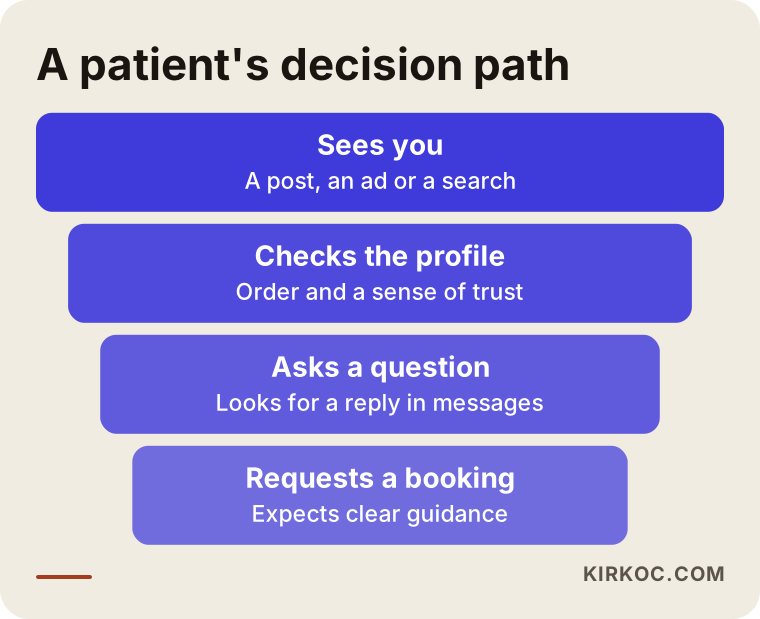
The diagram above simplifies that journey. The person first sees you, then checks your profile, then asks a question, and finally requests an appointment. Each step needs something different. At the "sees you" stage you need content that is eye-catching and easy to understand. At the profile stage you need a tidy, consistent look that feels trustworthy. At the question stage you need a quick, calm reply. At the booking stage you need clear guidance on what to do next. If one of these is missing, the others are wasted.
What is the prospective patient looking for?
Someone considering a cosmetic treatment usually has a handful of questions running through their head. Does this person know what they are doing? Will the result look natural? Will it hurt? What does recovery look like? If something goes wrong, who do I contact? Price matters, but trust depends on the answers to these questions. Your social media account should answer them patiently, not loudly.
Here is another reality: many people feel awkward asking about these topics in public. They do not comment. They may not even send a direct message. They simply watch your profile for weeks. These quiet viewers are hard to see, but your content should be ready for them too, with clear explanations they can read at their own pace.
Which platform does what?
Doing the same thing on every platform wastes time and produces a scattered look. For aesthetic clinics I think of the platforms this way: Instagram is the showcase and the first introduction. Your Google Business Profile is the answer to the "can I go there right now" search. TikTok and Reels build awareness through short video. YouTube holds longer explanations. Facebook is a side channel that still matters for certain age groups.
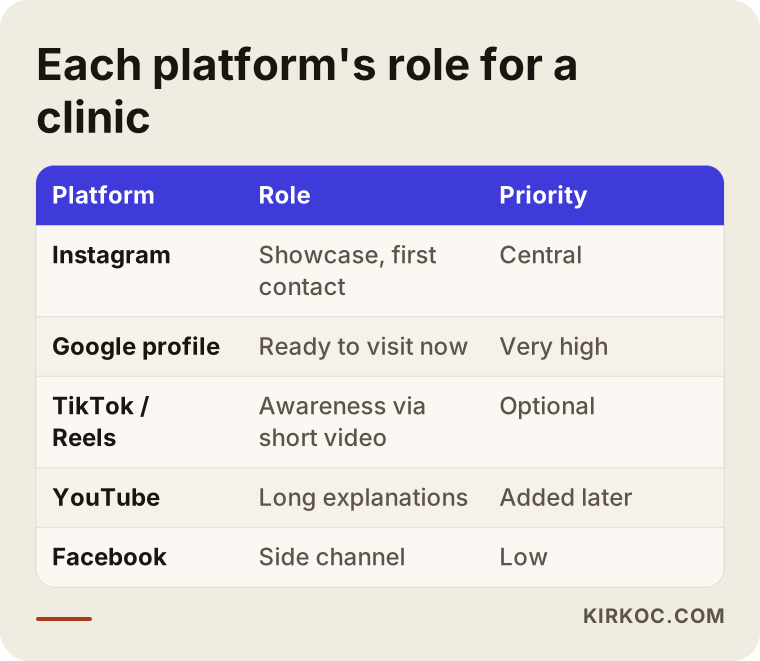
The takeaway from the table is that you do not have to run everything at the same intensity. For a small clinic, Instagram plus a well-kept Google profile is often enough. You add the rest as your time and energy allow. Managing two platforms properly is a better choice than managing five badly.
Why does Instagram stay at the center?
Because in beauty, people decide visually, and Instagram is where that habit is most established. Your profile page is also where many people "check you out" for the first time. Plenty of them search your clinic name on Google and then open your Instagram account afterward. Whether you intend it or not, your account works like a second website.
If you also treat international patients, for example people who travel to Istanbul for a procedure, the same logic applies with one extra layer. They compare clinics across countries, so clear language, clear location details and a calm explanation of the process matter even more. Someone who cannot easily walk in for a quick visit needs to feel safe before they book a flight.
What topics can you create content about?
"What should I post?" is the question clinic owners get stuck on most often. I split content into four buckets. The first is education: what a treatment is, who it suits, how preparation and recovery work. The second is clinic life: the team, an introduction to the devices, your hygiene routine, how a day flows. The third is Q and A: real questions taken from the messages you receive. The fourth is care tips: general, non-personalized advice about daily skin care or aftercare.
If you balance these four buckets, your account will not look like a pure advertisement, and it will not look like a scattered diary either. And remember, every question you receive is the headline of a future post. Your inbox is a free research tool. When you share those questions, though, never show the person's name or any private detail.
Your profile is a storefront: what should show in the first five seconds?
When someone lands on your profile, within the first few seconds they should understand three things: what this clinic does, where it is, and how to get in touch. If they have to scroll to figure that out, most will leave.
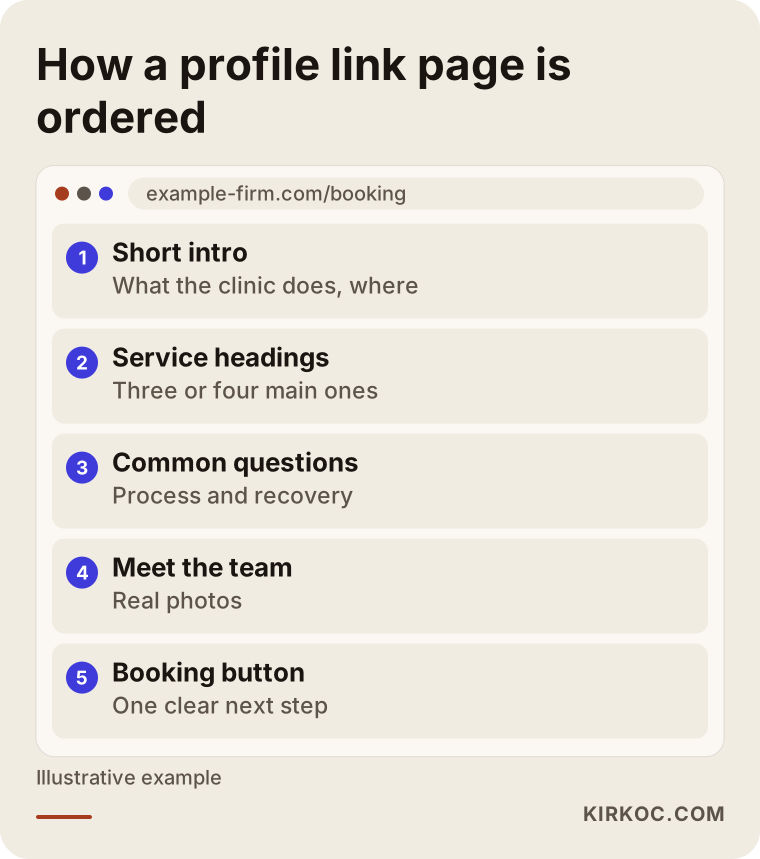
The diagram shows one way to order a link page. A short introduction on top, then your main service headings, common questions, a meet-the-team section, and a booking button at the bottom. Your short bio line should follow the same logic. A claim like "The best clinic in town" earns little trust. A plain sentence such as "Skin care and laser treatments in the city center" works much better, because it is specific and checkable.
Highlights and pinned posts
The highlights on your profile and the posts pinned to the top are the first things a new visitor reads. Put short explanations of your treatments there, along with common questions, a tour of the clinic and your contact details. If you set this section up well once, it keeps working no matter what you post day to day.
What is the difference between content that builds trust and content that only grabs attention?
When you create content in this industry there are two roads. The first is fast, flashy content that reaches as many people as possible. The second is calmer, explanatory content that reaches fewer people but the right ones. You can use both. But if you post without knowing the difference, you may end up with a big following and a silent phone.
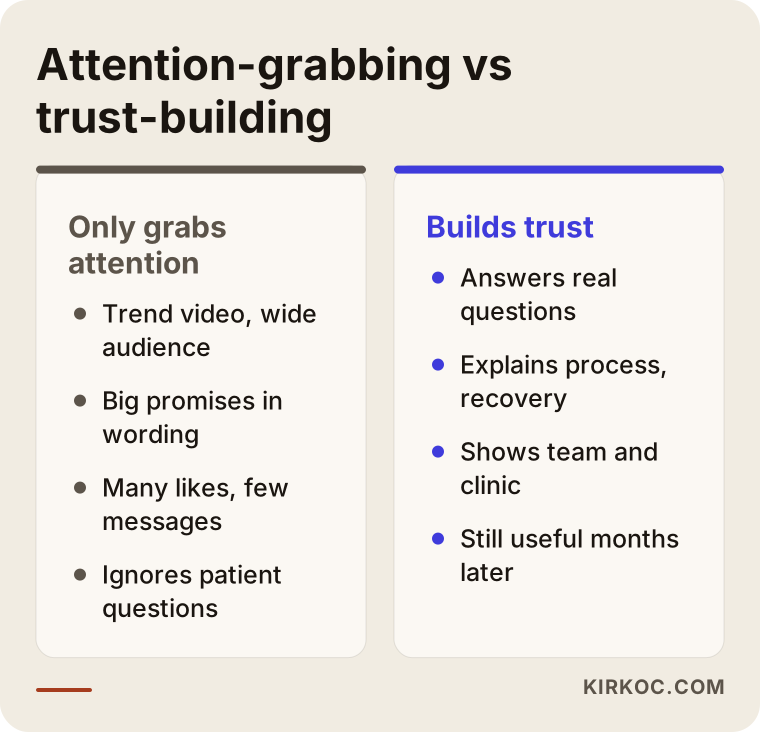
The logic of the comparison is simple. Trust-building content answers the questions already in the patient's mind. "Who is this treatment right for, and who is it not right for?" "What happens in the first consultation?" "What should I watch for during recovery?" Topics like these last far longer than a passing trend. The same post can help someone months later.
Before and after photos and the rules
One of the most common questions in this industry is about before and after photos. There are rules on how health services can be promoted and advertised, they differ from country to country, and they can change over time. I cannot give you a definitive answer on what you may post, with what wording, under what conditions. Please talk to an attorney who knows your local rules and check the guidance from your professional association or licensing body. Also, you need written, clear consent before sharing any patient's images. Do not publish anything in which a patient can be recognized unless you have that permission.
The good news is that you do not have to build trust only with before and after photos. Introducing your team, showing how you handle hygiene, answering the questions people ask before a procedure, and walking through the process step by step all build trust as well.
How should you reply to messages?
In aesthetics, a large part of the selling happens in the inbox. Someone watches a video, writes "price?" and waits. A half-day delay can be enough for them to message another clinic. At the same time, quoting a price in the very first message is often not the right move either, because in this field the price depends on the person and the need, and a proper medical assessment is part of the picture.
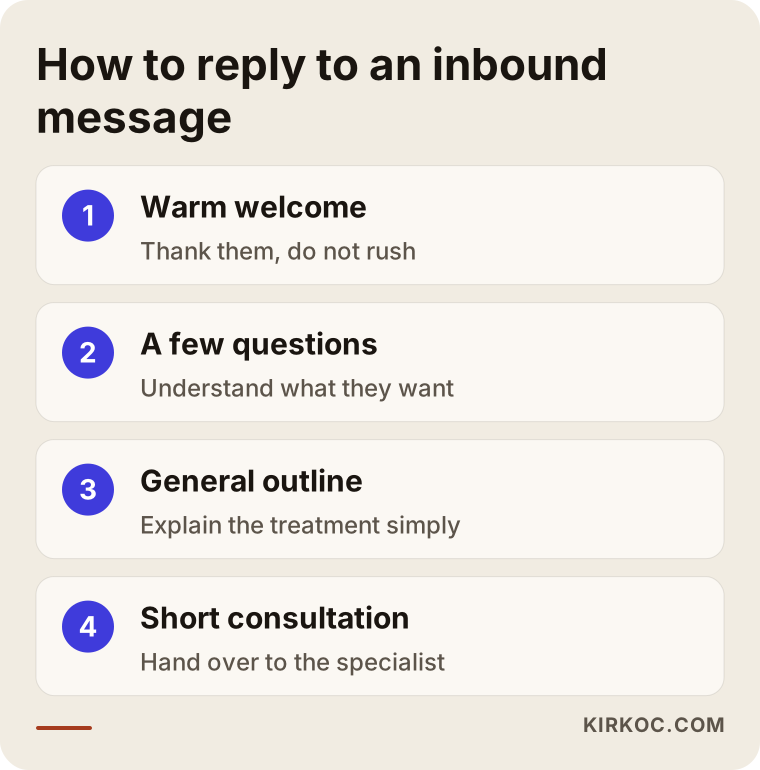
The sequence in the diagram is the order I suggest. Start with a short, warm thank-you. Ask one or two questions to understand what the person wants. Explain the general outline of the treatment. Finally, invite them to a short or free consultation. Instead of a hard sales tone, make the person feel they are not being rushed.
Who should reply?
Decide in advance who answers. Is it a front desk employee, you, or an assistant? A person who handles your social media can answer general questions with prepared replies, but any question that needs a medical assessment must go to the specialist at the clinic. It is not appropriate for a social media manager to say "this treatment is right for you."
Two hypothetical example scenarios
The scenarios below are not taken from a real clinic. They are hypothetical examples I made up to make the situation concrete.
Scenario 1: A newly opened small skin care clinic
Suppose a skin care clinic has just opened. For two months the owner posted a different photo every day, but the follower count is low and there are almost no messages. When I look at the account, the profile does not say which neighborhood the clinic is in, the service headings are scattered, and most posts look like stock images.
In a case like this I would first tidy the profile, reduce the services to three or four main headings, and plan a real photo shoot of the clinic and the team. Then I would prepare simple posts explaining the treatments, two or three times a week. Your follower count will not explode in a short time. But the few people who do arrive are more likely to take you seriously.
Scenario 2: A beauty center with several services and many competitors
In the second example there is a beauty center that offers many services and has lots of competitors nearby. It posts regularly on Instagram and even runs ads, yet the messages it receives are mostly about price, and most do not turn into appointments.
Here the problem may be less about content and more about direction. The ad creative says "discount," the person asks for the price, and the center prices things per person. The fix would be to rebuild the language of the ads and posts around "which problem the center solves," to connect message replies to a simple flow, and to turn the most repeated questions into content. Running social media and ad management through the same person makes this easier, because the promise in the ad and the content on the profile stay consistent.
How do the first 90 days go?
Social media needs time before you can expect results. I think of the work in three phases.
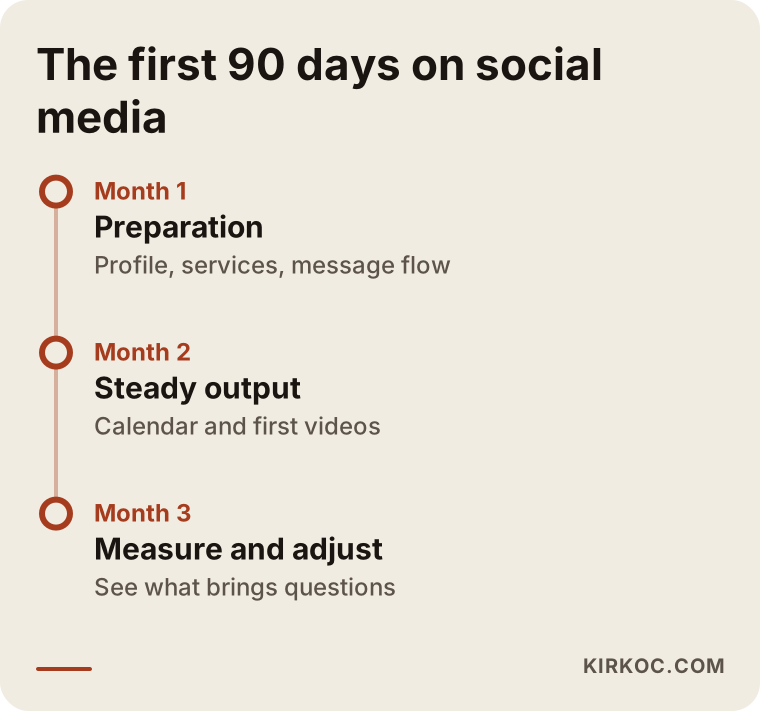
Here is the order in the timeline. Month one is preparation: reviewing the existing account, the profile layout, service headings, the message reply flow and a content plan. Month two is steady production: a posting calendar, the first videos and the first feedback. Month three is measuring and adjusting: you look at which content brings questions and change the plan accordingly.
What matters is that I do not promise a result after month three. I cannot guarantee follower growth, message counts or appointments. These depend on your competitors, the season, the type of treatment and your budget. What I can offer is clear visibility into what I am doing, why, and how often.
Social media and Google should be planned together
Someone considering a cosmetic treatment who sees a clinic on Instagram will very often search for it on Google too. There they see your business name, your reviews, your address and your photos. If what you say on social media does not match what Google shows, trust takes a hit.
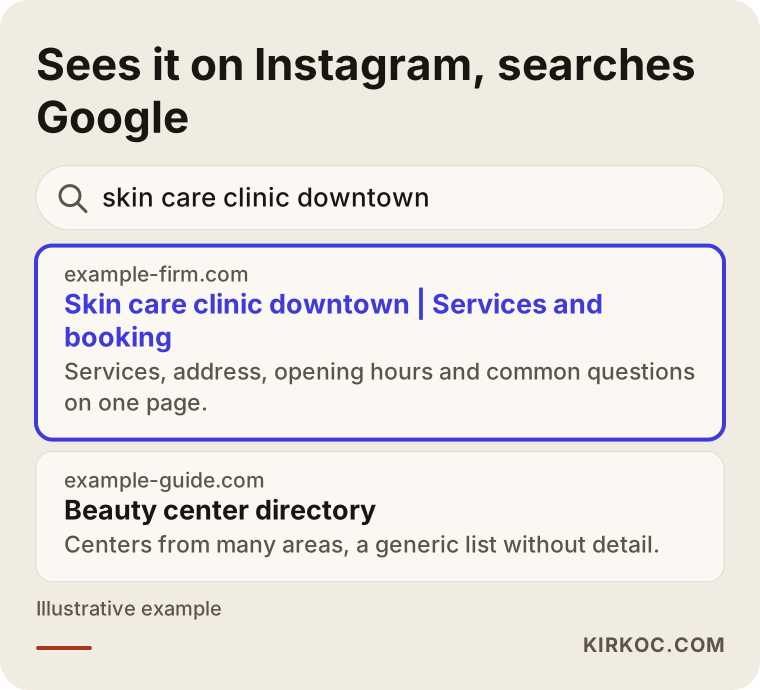
The diagram shows what a person might see when they search "skin care clinic downtown": the clinic's own page, profile and reviews. I cannot promise any ranking, and social media does not move that ranking directly. But if a person sees you on Instagram and finds the extra reassurance they want on Google, the decision gets easier. That is exactly why I see an advantage in having your website, local search and social media handled by one person: the same information, the same language and the same opening hours appear consistently everywhere.
Common mistakes
Most of the mistakes I see in this industry do not come from bad intent. They come from hurry and from missing information.
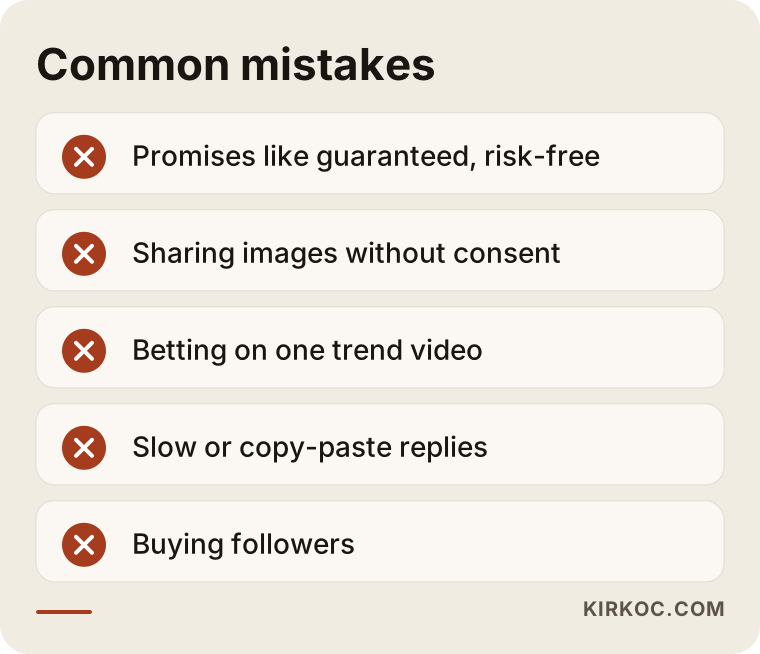
Let me unpack the items on the list. The first mistake is describing every treatment with big promises. Words like "guaranteed results," "painless" and "risk-free" reduce trust and can also create trouble under advertising rules. The second mistake is sharing images without patient consent. The third is pinning big hopes on a single trend video. The fourth is replying to messages late or with copy-and-paste answers. The fifth is buying followers or joining engagement groups, which distorts the real picture of your account and makes it harder to reach the people you actually want.
The trap of trending content
Sometimes a trending sound or a dance spreads to clinic accounts too. It can be fun. But for a serious decision like aesthetics, a person books because they trust you, not because they enjoyed watching you. Use trends when they fit your identity, and skip them when they do not.
What can you do yourself, and when do you need an expert?
You do not have to hand everything to someone else. Some jobs you can run yourself, while others call for expertise.
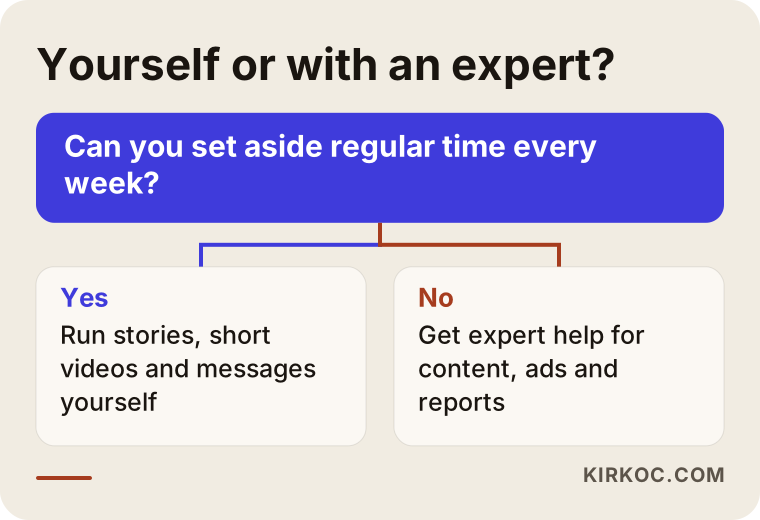
The question in the diagram is simple: can you set aside regular time for this? If yes, at the start you can share stories yourself, film short videos inside the clinic and answer the messages that come in. If no, or if you want content, ads and reporting to run together, expert support starts to make sense.
What you can do yourself
Taking real photos and short videos inside the clinic, noting down frequently asked questions, thanking people for comments, sharing stories and keeping your profile details current are all within your reach. In fact, these are things you can do better than an outsider, because you are the one who is actually in the clinic.
What to leave to an expert
Building a content calendar, managing ads, reporting, producing copy and design in a consistent way, and planning social media together with your website and local search all call for a steady, experienced eye. Also, moving forward without measuring can cost you money and time. Investing without knowing what works is risky.
What determines the cost?
I will not give a number here, because a real quote depends on your needs. But I can explain what makes the price change. The main factors are how many platforms you work on, how many pieces of content are produced per month, how much of the video needs a professional shoot, whether design and copywriting are included, whether ad management is requested separately, the scope of message-handling support and how often you want reports.
When you request a quote, ask this: what exactly will be delivered to me, how often, on which platform, and by what measure will it be reported? Stay away from vague promises such as "unlimited posts." A quote that does not make clear what is included can turn into unexpected extra costs later.
What should you look at every month?
You do not need complicated spreadsheets to follow social media work. It is enough to be able to answer a few simple questions clearly.
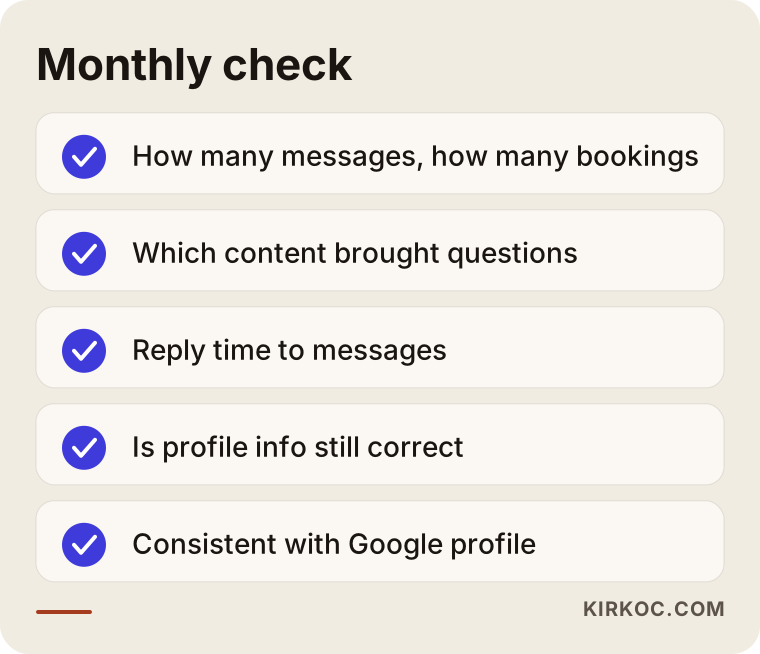
As you can see in the list, what matters is the meaning of the numbers more than the numbers themselves: how many messages came in, how many of them were real appointment questions, which content brought questions, how quickly messages were answered, and whether your profile information is still correct. Likes are a nice signal, but on their own they are not a result.
How I work with you
I work alone, which means the person who talks to you is the person who does the work. In the first conversation I listen to your clinic, your services, your current accounts and your expectations. Then I tell you plainly what is realistic and what is not. If needed, I also look at your website, your Google Business Profile and your ad accounts within the same frame, because having these in separate hands often creates inconsistency. I do not give any guarantee of results, but each month I openly share what I did and why.
Frequently Asked Questions
Which social media platform matters most for an aesthetic clinic?
For most clinics Instagram comes first, because prospective patients decide visually and will look at your profile. Keeping your Google Business Profile up to date next to it is also very important. TikTok and YouTube can be added later.
Can I post before and after photos?
There are rules on promoting health services, and they differ by country and change over time. I cannot give a definitive answer, so please consult an attorney and your professional association. No image should be shared without the patient's consent.
How long does it take to get appointments from social media management?
I cannot guarantee that. The state of the current account, your competitors, the type of treatment and your budget all affect the outcome. Usually the first month goes to preparation and the following months to production and adjustment, and what works starts to become visible after a few months.
Does buying followers work?
No. Purchased followers are not real prospective patients, they lower engagement and they distort the real picture of your account. A small but genuine and interested audience is worth more than a large, silent one.
Should I write prices in direct messages?
If the treatment varies from person to person, stating a fixed price in a message can be misleading. It is more honest and more reassuring to explain what determines the price and invite the person to a short consultation.
Is running ads mandatory?
No. First your profile and message flow need to be ready. Ads run before that spend money without bringing conversions. Once you are ready, advertising can be a useful addition for reaching the right audience.
Can I manage one account for both medical and beauty content?
Yes, but the services need to be clearly separated under their own headings. Medical procedures and beauty care create different expectations and may fall under different regulatory frameworks. It is best to clarify this separation together.
Who should shoot and who should write the content?
The most natural result comes when the clinic team films real footage inside the clinic. Copy, design, editing and planning stay consistent when they are handled by one person. Combining the two is usually the most efficient arrangement.
If you want to set up your clinic's social media in a calm, measurable way without promising results, you can reach me through my social media management service page, and we can talk through your current situation together.