You have a practice or a clinic, maybe a social media account too, but when a patient types "rhinoplasty recovery time" or "how to choose a plastic surgeon" into Google, someone else's page shows up instead of yours. Or your site was built years ago, looks crooked on a phone, and nobody really looks at it anymore. This article is for surgeons and clinic owners who are thinking about a plastic surgeon website. I explain how patients make decisions, which pages the site needs, how to write about procedures without stumbling over the rules that apply to medical marketing, and what drives the cost. I am Ümit Kırkoç, I work from Istanbul, and I handle website design myself from start to finish, as one person.
Let me say one thing up front: a medical website works very differently from a shop window. A patient does not decide on surgery the way someone drops a pair of shoes into a cart. They research for weeks, sometimes months. They read articles, look at several surgeons' pages and decide whether they trust the person. Your site sits right in the middle of that process. If it builds trust, the consultation form gets filled in. If it does not, the patient quietly switches to another tab.
How does a patient who is considering cosmetic surgery think?
Let us start inside the patient's head, because the whole structure of the site comes from there. Someone thinking about a cosmetic procedure usually wonders about three things at the same time: how the procedure is actually done, whether it suits them, and whether they can trust the person who would operate. The third question outweighs the other two.
The searches people type mirror that state of mind. Some look for information: "what is the recovery like after a nose job." Some compare: "open versus closed rhinoplasty, which is better." Some are close to deciding and type a city together with a procedure: "eyelid surgery surgeon near me" or "tummy tuck surgeon in Houston." That last group is the smallest, but it is the closest to booking. The first group is the crowd, and it is where many patients meet you for the first time.
That is why a good site is more than a list of services. It needs an answer for every stage of the patient's thinking. The illustration below uses an invented search result to show the idea: a page that explains the procedure and clearly introduces the surgeon is more likely to be clicked than a generic directory-style list.
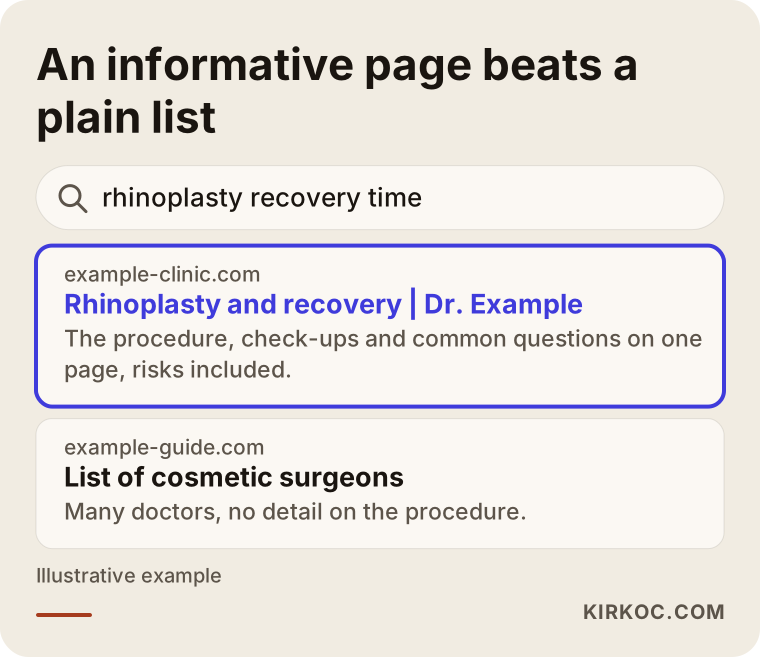
What the highlighted result does is simple. It covers one procedure, the surgeon's expertise and the patient's first question in the same place. If you build your pages that way, Google and the person reading both understand what they are looking at right away.
The real job of the site is to carry trust
In cosmetic surgery, the patient is not buying a product. They are giving permission for something to be done to their body. So every detail on the site is read as a trust signal. Your training, the hospital or surgical center where you operate, the professional societies you belong to, honest language about risks, even how clean and orderly the page looks: all of it counts. A messy site makes people wonder whether the work is messy too. That may feel unfair, but it is how patients look at it.
In the United States, patients are often told to check whether a surgeon is board certified and by which board. If you hold such a certification, it belongs where people can find it easily, with the name of the certifying body spelled out. If you are not sure how to phrase your credentials, check with the organization that issued them. Titles are easy to misstate by accident, and a careless line can undo the trust the rest of the page builds.
Rules: what should you check when building a medical website?
This section is what separates this sector from most others. I am a web designer, not a lawyer, so I will not hand down verdicts. The rules you work under as a licensed physician, including your state medical board, your professional societies and the advertising and privacy laws that apply to you, are your responsibility. Before any page goes live, I recommend that you have a healthcare attorney or your professional association look it over.
Here is the general picture. In the United States, medical advertising touches several layers at once: truth-in-advertising principles that apply to every business, rules and guidance from state medical boards, the standards of your specialty societies, and privacy law around patient information. These rules differ from state to state and change over time. An article you read today may be out of date tomorrow, so I will not write a tidy "this is allowed, that is banned" list here. If your readers or patients are in another country, a different set of rules applies, and the same advice holds: ask someone who knows that jurisdiction.
The practical questions to put to your attorney while the site is being prepared are these:
- Can patient reviews or thank-you messages be shown on a page, and under what conditions?
- Under what conditions, with what written consent and in what format, can before-and-after photos be published?
- Are words like "best," "guaranteed results" or "permanent solution" risky in your marketing language?
- Is it acceptable to mention discounts, promotions or prices, and how should that be worded?
- How should patients' personal health information be protected in a contact form?
You need an answer to each of these from a professional who knows your situation. My job is to reflect the answer you get accurately and neatly on the site. I do not say "you can do this." I say "if you have confirmed that you can, here is how I would design it."
Patient privacy and personal data
Health information is treated as especially sensitive. A patient filling in your contact form might write, "I have this problem with my nose and I had this surgery before." Where that information is stored, who can see it and how long it is kept all matter. Depending on how your practice is set up, laws such as HIPAA in the United States may apply to how you handle patient information, and a website form can fall inside that. Your site should have a clear privacy notice, and the form should make plain what the patient is agreeing to. The content of those documents should come from your own legal advisor. My part is to set the form up securely from a technical point of view, avoid asking for unnecessary details, and show the notice in the right place.
One technical point is worth knowing even if you never touch the code. Ordinary website contact forms often send messages by plain email, which is not a secure way to move health information. If you expect patients to describe symptoms or history, ask your attorney or compliance advisor what kind of form and storage is appropriate, and keep the form as short as you reasonably can.
The illustration below collects, in a short warning list, the points that are most often overlooked on a cosmetic surgery site. It is a reminder and not legal advice.
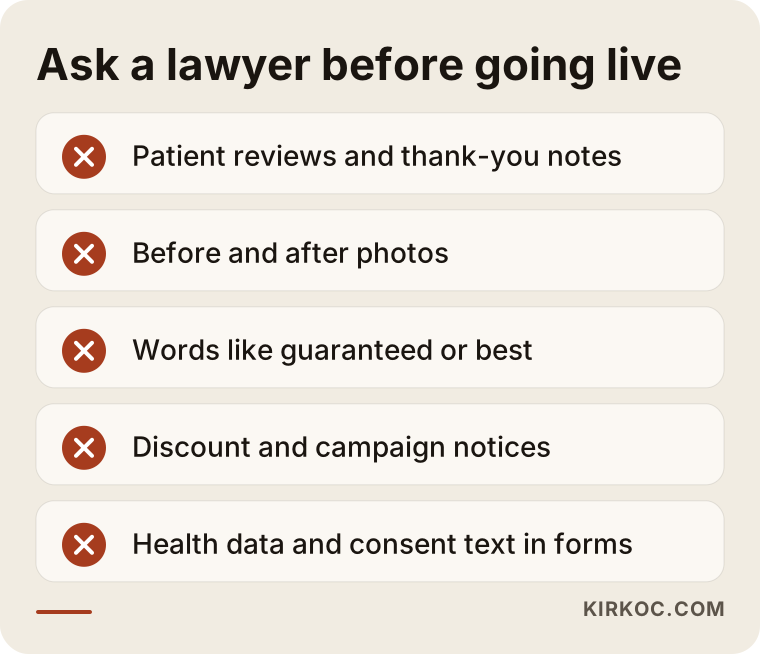
Use the list as a set of questions. Look for each item on your own site, ask about it when you find it, and consult someone when you are not sure. My advice is to show all the text to your attorney in one go before launch. Fixing things piece by piece afterward is both more expensive and slower.
Which pages should a cosmetic surgeon's website have?
A surgeon who performs many procedures cannot make do with a one-page brochure, but you do not need an enormous site either. A tidy structure helps the patient find their way and helps Google understand your site. An example skeleton could look like this:
- Home page: shows at a glance who you are, what you work on and how to reach you.
- About the surgeon: training, experience, board certification, memberships, where you operate. This is the trust page.
- Procedure pages: a separate page for each major procedure (for example rhinoplasty, eyelid surgery, breast surgery, tummy tuck). Instead of cramming everything onto one page, give each one real effort.
- Process and recovery pages: content that explains what happens from the first consultation to the follow-up visits and takes some of the fear out of the process.
- Frequently asked questions: written answers to the questions patients ask your front desk again and again.
- Contact and appointment page: address, map, phone, hours, form.
- Blog or resource section: long, clear answers to the questions patients ask before deciding.
The illustration below shows how a home page like this could be divided into sections, using an invented domain name.
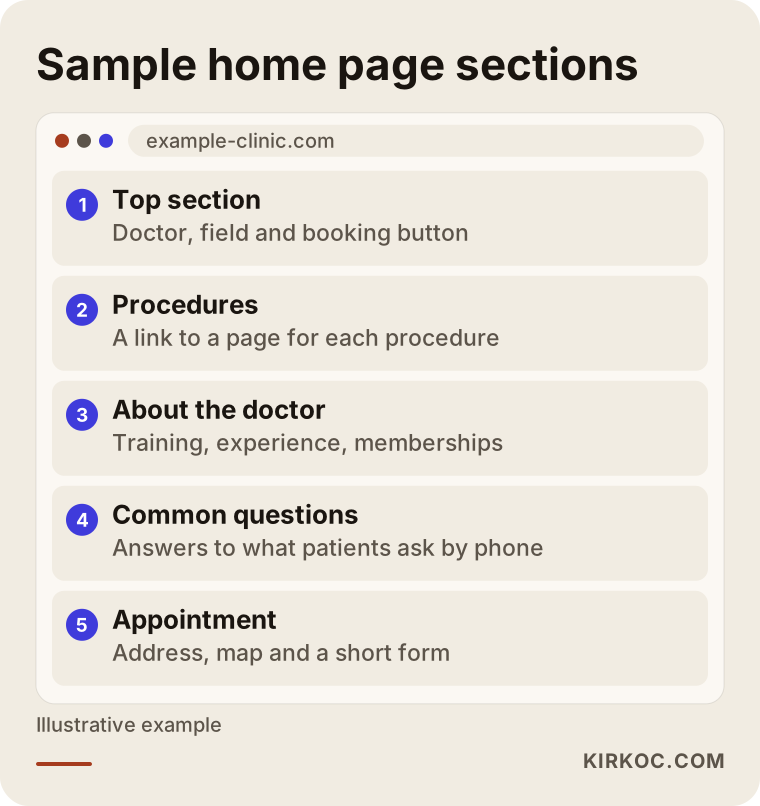
The order matters. A visitor should first see where they are, then why they can trust you, then how to book. The consultation button should not sit only at the bottom of the page. It should be within reach all the way down.
Why does every procedure need its own page?
Someone searching for "rhinoplasty" and someone searching for "eyelid surgery" are not asking the same question. One is thinking about the shape of the nose and about breathing. The other is talking about eyes that look tired. If you pass over all of them in a few sentences on one "Services" page, the patient will not find the information they need, and Google will not see you as an expert on any of these topics.
Every procedure page should answer a set of questions: who the procedure is considered for, who it may not suit, how it is planned, what happens on the day of surgery, how recovery usually unfolds, what the risks are, and what to discuss with the surgeon. Do not skip the "risks" heading. It is honest toward the patient, and it is the section that does the most to earn trust. Staying away from firm promises and saying openly that results vary from patient to patient is both ethical and, in my reading, in the spirit of most advertising rules. Your attorney can tell you where the exact lines are.
Using images on the page: the question of patient photos
Before-and-after photos look like the most persuasive content in cosmetic surgery, and they are also the most delicate. Whether such photos may be published, and under what conditions and in what form, depends on the rules that apply to you and on the patient's written consent. Do not put patient photos on the site until you have settled this with your attorney.
The good news is that a site can build trust without them. Real pictures of your clinic, the waiting area, the exam room, clean equipment, a professional portrait of you and drawings that explain a procedure all do a great deal. If you use stock images (ready-made photos anyone can license from the internet), patients tend to notice, and trust takes a hit. A real photo of your own clinic is more believable even if it looks ordinary.
The illustration below shows what sections a sample procedure page could contain. Notice how full and credible a page can be without relying on photographs.
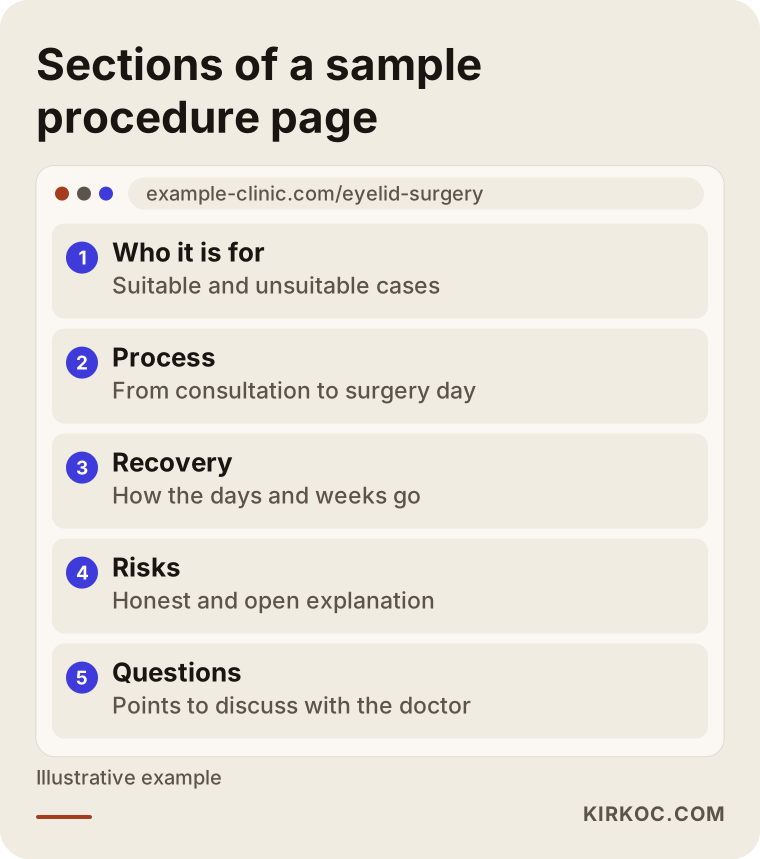
The backbone of the page is information, not photographs. That is less risky from a regulatory point of view, and it is also closer to what the patient is really worried about.
Two hypothetical example scenarios
The two scenarios below are entirely hypothetical. They do not describe a real surgeon or clinic. I made them up only to make the situation concrete.
Scenario 1: A surgeon who has worked by referral for years
Suppose a plastic surgeon has found patients through referrals and word of mouth for many years. There is a website, but it contains only a few lines of introduction and a phone number. Patients look up the surgeon's name on Google, find that the site says almost nothing and some of them drop out before booking.
A sensible order for this surgeon might be: first, fill in the "About the surgeon" page with training and experience. Second, write separate pages for the three or four procedures that make up most of the practice. Third, simplify the consultation form. All the text goes through legal review before it is published. The expectations stay modest as well: the site first convinces the patient who already searches for the surgeon's name, and visibility in search grows over weeks and months as content accumulates.
Scenario 2: A newly opened clinic that nobody knows yet
In the second example, a younger surgeon has just opened a clinic and nobody knows the name. There is a social media account, but it does not carry patients over to a website. A website alone is not enough here. The surgeon's name recognition needs extra work.
In this case, local visibility on Google (the clinic's profile on the map), procedure pages and informational articles are built together. After a while, a patient first meets the surgeon through an informational article, then sees them on social media, then lands on the site and books. The site's own job is small, but it is the hub that connects the other parts. This is where having one person handle the site, search work and social media is useful, because the message stays consistent across all of them.
The illustration below is a simple funnel showing the stages a patient might pass through before reaching your site.
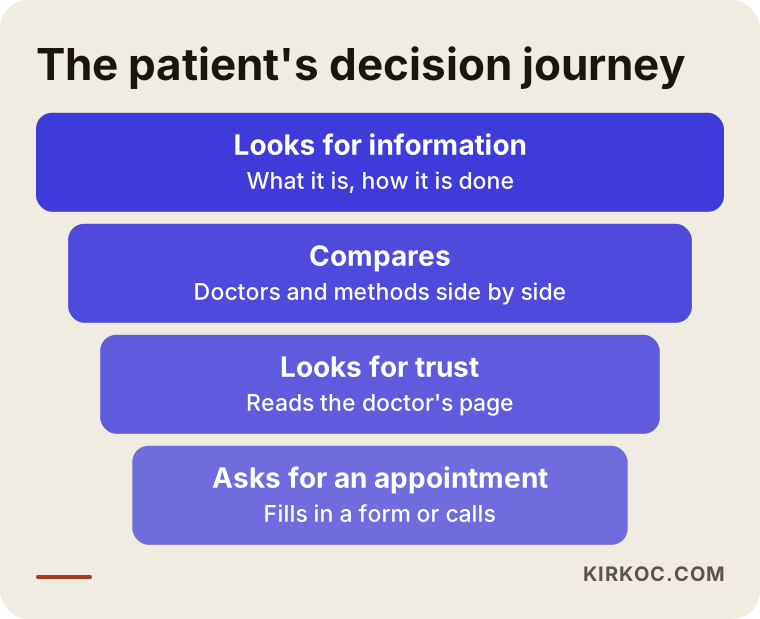
Notice that the widest part of the funnel holds people looking for information, and the narrowest holds people asking for an appointment. Many surgeons aim only at the narrow end. To reach the larger crowd, you need to be present at the wide end too.
How is a cosmetic surgeon's website built? Step by step
I will lay out my way of working as a plain sequence. If you work with someone else, you can ask them about these same steps.
1. Introduction and goal setting. Which procedures do you perform, which do you want to put forward, and what does your typical patient look like? I talk these through with you. There is no design yet, only listening.
2. Legal and content framework. What will appear on the site and what will not is settled together with your own legal advisor. Skipping this stage means rewriting half the site later.
3. Page plan and text. Which pages exist, what is each one's title, and which questions will it answer? I prepare the text from the information you give me, and you approve the medical details, because medical accuracy is your field.
4. Design and build. The site must open fast on a phone and look clean. Instead of flashy animation, I choose readable type, clear buttons and tidy spacing.
5. Technical setup. Fast loading, a secure connection, the basic settings for search engines, linking the clinic's Google profile, and form security.
6. Launch and first follow-up. After the site goes live, during the first weeks I check that the forms work, that the pages are indexed (that is, Google has found them and added them to its listings) and that phone calls are coming in.
The illustration below summarizes the process in short steps.
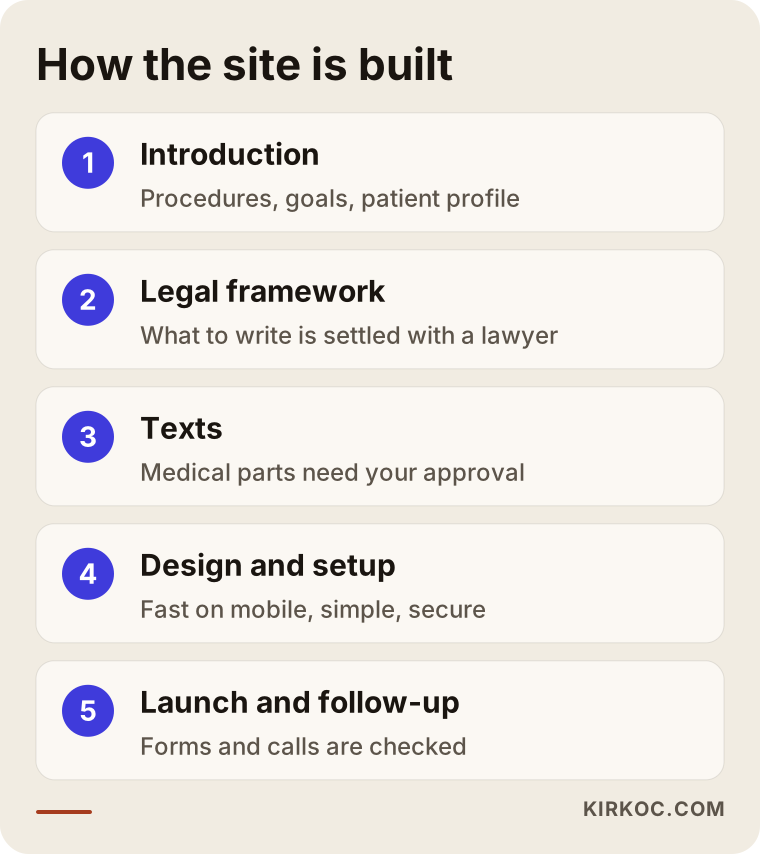
The part of the process that usually takes the longest is the approval of the text, because it passes through both your medical check and the legal review. Being patient at this stage is much cheaper than running into trouble afterward.
Being found on Google: local visibility and content
A site does not bring patients on its own once it is built. For patients to find you, two things need to work together: your clinic profile on the map and the content on your site.
The map profile. When someone searches for "plastic surgeon near me" or a neighborhood plus the specialty, Google shows a few businesses on a map. To appear in that list, your business profile needs to be set up correctly. Name, address, hours, phone number and category should match your website exactly. Ask a professional how to handle patient reviews, because review management in healthcare comes with its own rules, including privacy concerns when you reply to a review.
Informational content. Writing out the answers to the questions patients ask is the longest-lasting route. Clear, honest answers to questions like "how long should I rest after eyelid surgery" or "what should I stop taking before surgery" improve your chance of being cited, both on Google and in AI-assisted search tools such as ChatGPT. I cannot promise it, but reliable and well-organized content has real advantages.
Accuracy of medical content matters a great deal here. You must approve the medical part of every article. I help with language, structure and layout, but I never publish health information that a physician has not approved.
The illustration below gives an example of how your content might be used when a patient asks an AI tool a question. If the page is tidy and clear, the tool can pick up the information more easily.
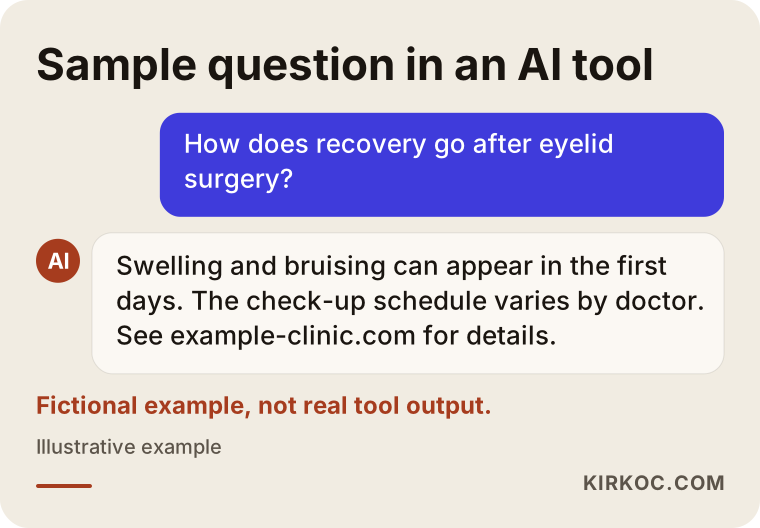
This example is fictional and not the output of a real tool. The point is that long, clear and correct content can be read by people and machines alike.
Common mistakes
These are the mistakes I see repeated in this sector:
- Squeezing everything onto one page. The patient cannot find the detail on the procedure they care about.
- Exaggerated and absolute promises. They are risky from a regulatory standpoint and they reduce the reader's trust. Nobody can guarantee the result of a cosmetic operation, and you know that better than anyone.
- Using stock photos. Real images of your real clinic and real doctor are more believable.
- A broken mobile view. Most patients open the site on a phone.
- Slow pages loaded with heavy images. If a page opens late, many visitors leave without waiting.
- Asking for too much in the contact form. A name, a phone number and a short note are often enough. Asking for unnecessary health details makes the patient hesitant and adds to your data responsibility.
- Neglecting the privacy notice. Compliance with privacy rules is a requirement, not decoration. Ask your own legal advisor.
- Leaving the site untouched for years. Old phone numbers, an old address or procedures you no longer perform shake trust.
The illustration below summarizes the difference between a weak and a strong procedure page in a side-by-side comparison.
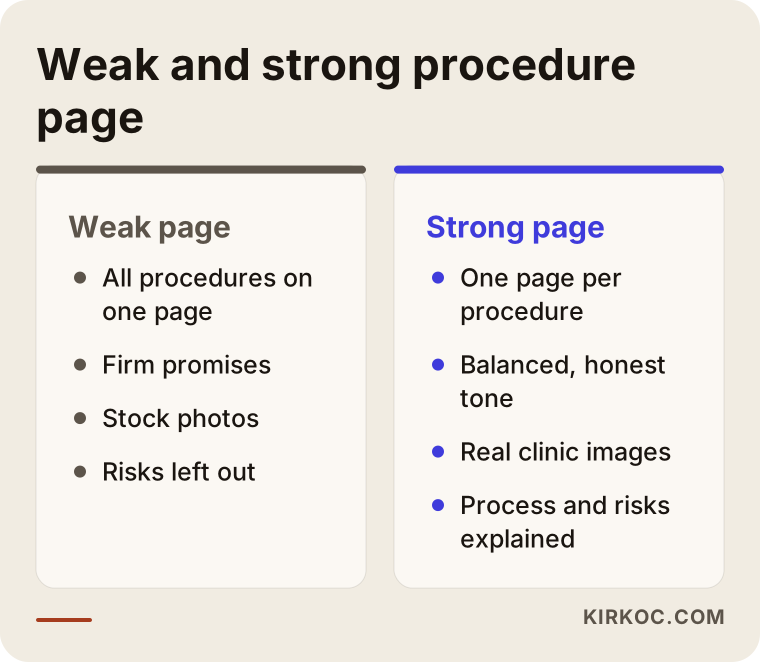
The core of the comparison is this: the strong page gives more information and promises less. Patients sense that balance, and they read it as a sign of trust.
What can you do yourself, and when do you need a specialist?
You do not have to hand everything over. You can do the following yourself:
- Note down the questions patients keep asking and turn your answers into short texts.
- Photograph the clinic entrance, the exam room and the team at work with a phone (without showing any patient).
- Check the address, hours and phone number in your Google Business Profile.
- Prepare a current list of your education, certifications and memberships.
- Talk with your legal advisor about which statements can be used.
Specialist help is needed for the following: building the structure of the site, mobile speed and security settings, the form infrastructure, search engine settings, tidy writing of the procedure pages, and tying it together with social media and advertising. Each of these looks small on its own, but making them work together takes experience.
The illustration below gives a short checklist to complete before you start.
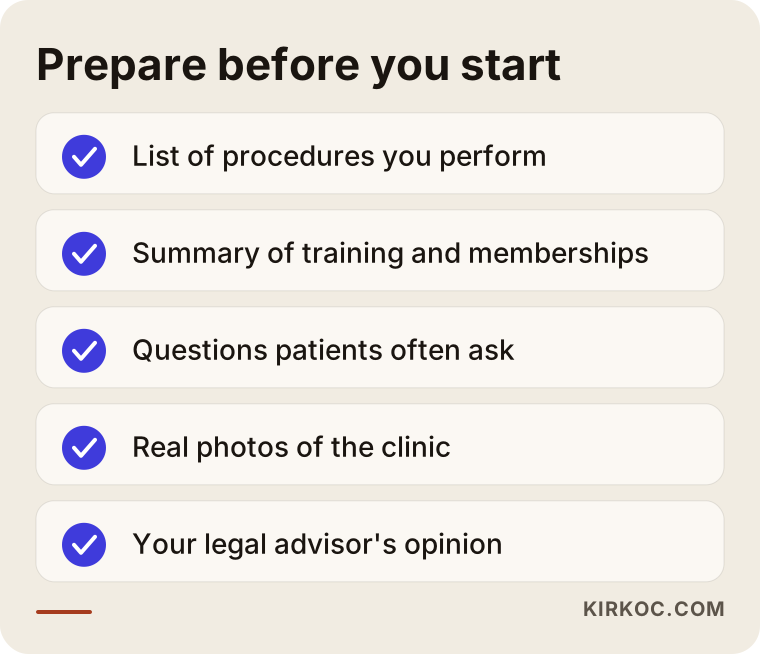
Working with a surgeon who has done this preparation is much more efficient in both time and budget, because I do not have to stop constantly to ask for missing information while writing.
What determines the cost?
I will not give figures on this page, because the real cost varies a great deal with the scope of the work. But I can tell you plainly what moves the price:
- Number of pages. A site with ten procedure pages does not need the same effort as a site with three.
- Text and content preparation. If you write the texts and bring them to me, there is less work. If they need to be prepared from scratch, there is more. Medical approval and legal review also stretch the schedule.
- Image production. Will there be a professional shoot at the clinic, or will you use ready-made images?
- Number of languages. If you also serve patients from abroad, you need pages in additional languages.
- Special features. An online booking system, calendar integration, a multi-location structure.
- Work after launch. If blog articles, local visibility, advertising and social media management are added after the site goes live, that budget is planned separately.
When you request a quote, ask these questions: Which pages are included in the price? Who writes the text? Are changes after launch charged separately? In whose name are the domain and hosting registered? The last one is very important. The site should be registered in your name so that you do not run into problems later.
The illustration below shows roughly how the work could flow over time. The durations depend on the size of the project, which is why I have not written any numbers.
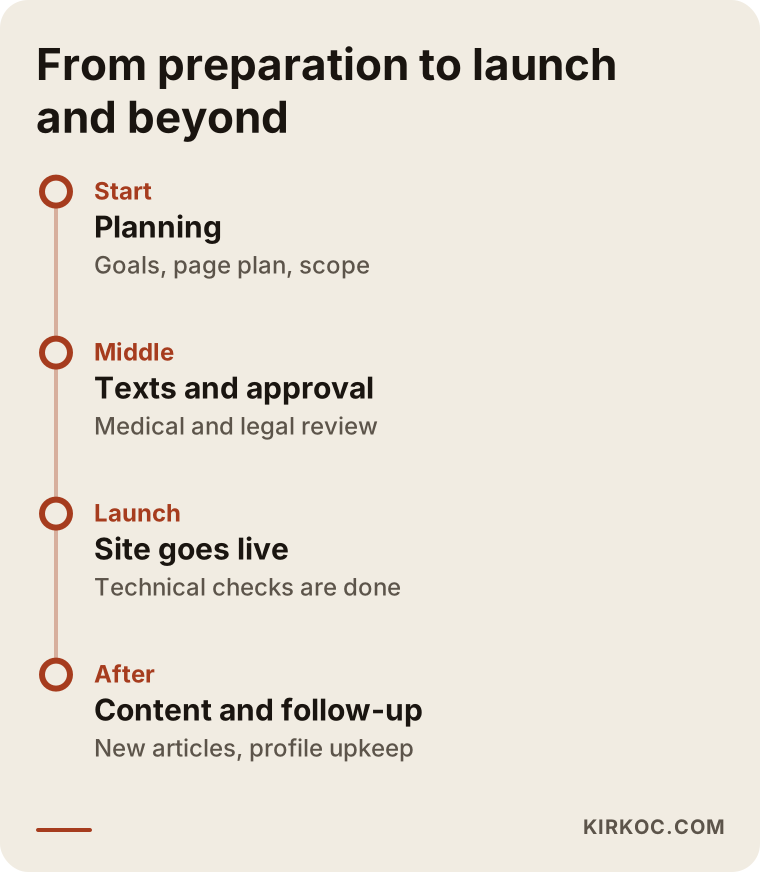
As you can see, launch day is the beginning, not the end. Regular content and follow-up after the site goes live are what grow visibility.
How I work with you
I am one person: there is no one in the meeting, someone else doing the work and a third person delivering it. The person you talk to is the person who builds the site. I can run the website, search engine settings, local visibility, social media management and Google and Meta advertising from the same hands. The practical benefit is that when I write a page, I already know how the same topic will be explained on social media and which sentence could be used in an ad, so the message does not get lost between departments. Advertising and promotion in healthcare need extra care because of the regulations, so I move ahead on the advertising side only after you and your attorney have decided what is possible.
My working order is simple: an introductory conversation first, then a written scope, then the page plan and your approval at each stage. Medical content always passes through your review.
Frequently Asked Questions
Can I share patient photos on a plastic surgeon website?
This depends on the rules that apply to you and on the patient's written consent, so I cannot give a definitive answer. I recommend asking an attorney who knows your state medical board's rules and the other regulations that apply to your practice. It is possible to build a site that inspires trust without using photos at all.
Is it acceptable to use words like "best" or "guaranteed results" on the site?
As a general principle, staying away from absolute promises and superiority claims in healthcare is the better course, both ethically and for the sake of trust. Ask your attorney which expressions might be treated as breaking the rules in your situation.
How long after the site is built will patients start coming?
I cannot give a time. Patients who search for your name can reach the site on launch day. Reaching new patients who are looking for information can take weeks or months, depending on how content builds up and how quickly Google recognizes the pages. I do not promise results.
Is a separate page for each procedure necessary?
It is not mandatory, but I strongly recommend it. Describing each procedure on its own page makes it easier for patients to find what they are looking for and helps Google recognize you on that topic. You can start with the four or five procedures you do most and expand over time.
Who writes the medical content on the site?
I set up the language and the structure, but the accuracy of the medical information depends on your approval. Every text I prepare is checked by you before publication. If needed, legal review is added as well.
Do I need to add an online booking system?
It is not required. For most doctors a simple contact form, a phone number and a message button are enough. If your appointment volume is high, a calendar system can be added; in that case, the protection of patient data has to be handled separately.
Can pages be made in another language for international patients?
Yes, a multilingual site is possible. However, each language means additional text and upkeep, which affects the cost. If the countries you are targeting are clear, it makes sense to start with a few core pages in that language.
Can I update the content myself after the site goes live?
Yes. You can ask for the site to be built so that you can easily make text and image changes yourself. For technical maintenance and security updates, it is healthier to have support.
If you want a clinic website that is careful about the rules, builds trust and opens comfortably on a phone, you can reach me through my website design page, and in a short conversation we can work out your situation together.