You tapped the "boost post" button on Instagram, spent a few days of budget, and ended up with a pile of likes and almost no messages. Or a friend told you "just run ads and the followers will come," and at the end of the month nobody could explain what happened to the money. You most likely found this article while searching for a Meta ads management service. You are in the right place: below I explain what the service actually contains, which businesses it suits, how I run the process, and what the cost depends on, in plain language.
I am Ümit Kırkoç. I work from Istanbul, and alongside Instagram and Facebook ads I handle websites, search visibility, social media accounts and logos as one person. Going into detail about the advertising side also shows what my digital advertising management service is. First, here is the whole picture.
What is Meta, and where do the ads appear?
Meta is the company that owns Instagram, Facebook, Messenger and WhatsApp. Ads for all of them are built in one place, a dashboard called Ads Manager, and can be shown in whichever spots you choose: the Instagram feed, Stories, Reels, the Facebook feed, the Messenger inbox and so on. So an "Instagram ad" and a "Facebook ad" are, in most cases, the same ad managed from the same dashboard and shown in different places.
The key difference from Google ads is this. On Google, a person searches for something and you answer that search. On Meta, nobody is searching; they are scrolling, and an ad turns up in front of them. That is why Meta ads are strong at reminding people of a need they had not thought about yet, introducing your product, and reaching people who already looked at your website. For someone ready to buy right now, Google is often the better fit. Using both can make sense for some businesses, but you do not have to grow both at the start.
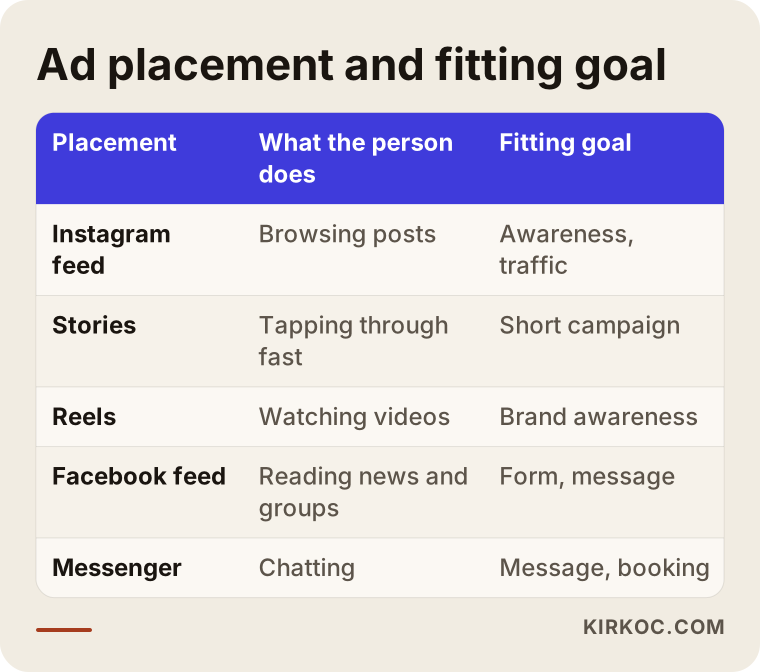
The table above summarizes which placement suits which goal. Because this choice is the most important decision when you set up a campaign, I come back to it further down.
"Running an ad" and "managing ads" are not the same thing
Pressing a button and entering a budget is running an ad. Managing is the sum of every decision made over the ad's life: who sees it, which image and text are used, which page it sends people to, what gets measured, which ad is switched off, and where the budget moves next.
When you open an ad account, the platform offers many options, and most of them are set by default to "broad and easy." Those defaults are not tailored to your business. For example, a company that serves only a few neighborhoods of one city can end up showing its ad across an entire country with the default settings. Most of the impressions go to people who could never become customers. The numbers in the dashboard look healthy, but the phone does not ring.
The job of a management service is to prevent exactly this: to send your money to the people and the action your business really needs.
What does the service cover?
The Meta ads management service I offer includes the following:
- Clarifying your goal: messages, phone calls, a form, store visits or sales on your website.
- Connecting the ad account, your Facebook page and your Instagram account correctly, and setting up tracking.
- Planning the audience: location, interests, and people who have already interacted with you.
- Ad copy and image or video suggestions, and producing the content if needed.
- Launching the campaign and watching it closely during the first days.
- Regular checks, switching off what does not work and strengthening what does.
- A monthly report written in plain language, with a recommendation for the following month.
Notice that management also touches content production and the preparation of your website. Even the best-built ad does not deliver if it sends the clicker to a poor page. Because I look after the website and the social media account as well, you do not have to explain the same thing to three different people. One person sees the ad and the page it leads to.
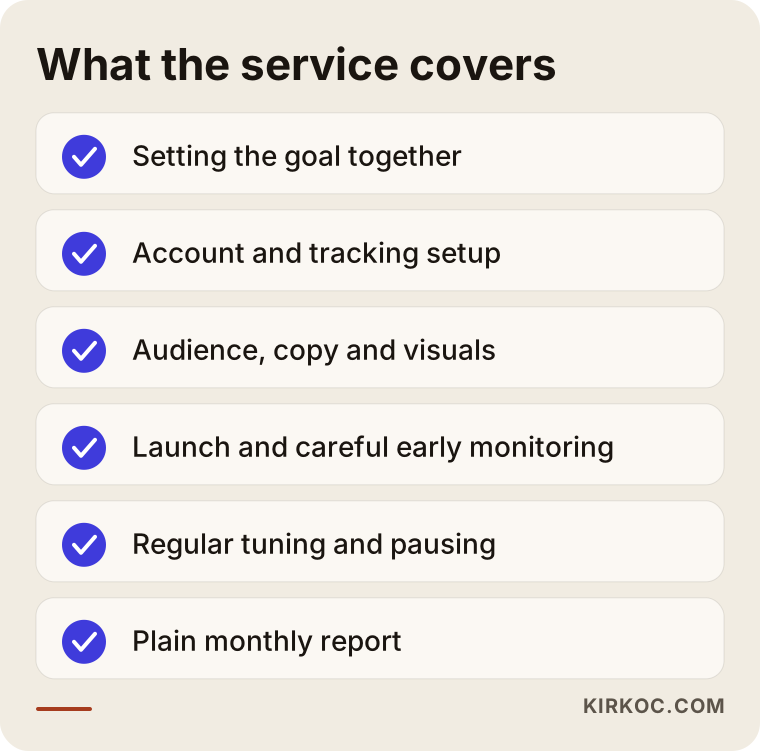
Not every item on the list is necessary for every business. In the first conversation you and I decide what you truly need, and I do not add things to the proposal that you do not need.
Who should use Meta ads, and who should wait?
To be honest, Meta ads are not the right investment for everyone. They tend to work well in these situations:
- Your product or service can be shown visually: beauty, food, clothing, decor, weddings, education, clinics and similar.
- You need people to notice a need before they start searching for it.
- You have just opened and want the people around you to get to know you.
- You want to remind people who already visited your website or your shop.
In other cases it may be wiser to spend your time elsewhere first:
- People look for what you offer directly in a search engine and you do not appear there at all. In that case, strengthen the Google side first.
- You have no sales page, no phone number, or no price or service information. An ad would just show an unfinished storefront to a crowd.
- Nobody is available to answer incoming messages. A person who clicks an ad and waits hours for a reply goes somewhere else.
I say this plainly in the first conversation. Sometimes "fix these three things instead of running ads for now" is the best way to protect your budget.
Choosing a campaign by goal
Every Meta campaign has an objective, and the platform tries to show the ad to people most likely to take that kind of action. If you pick the wrong objective, the platform will happily succeed at something you did not want. A campaign built around "engagement," for example, collects likes. If you are waiting for phone calls, those likes earn you nothing.
A simple matching looks like this:
- Awareness: a new business, a new area or a new product, where the aim is for your name to be heard.
- Traffic: bringing visitors to your website or a blog page.
- Messages: starting a conversation on WhatsApp, Instagram or Messenger, which is common for businesses where people ask about bookings and prices.
- Lead forms: a contact form inside the platform, filled in without the person leaving the app.
- Sales: a purchase on your website or in your shop, used when tracking is set up properly.
One campaign cannot aim at promotion and sales at the same time. Every business needs a main goal, and the other goals stay in second place. One of the most valuable parts of the service is making that choice on your behalf, with reasons you can follow.
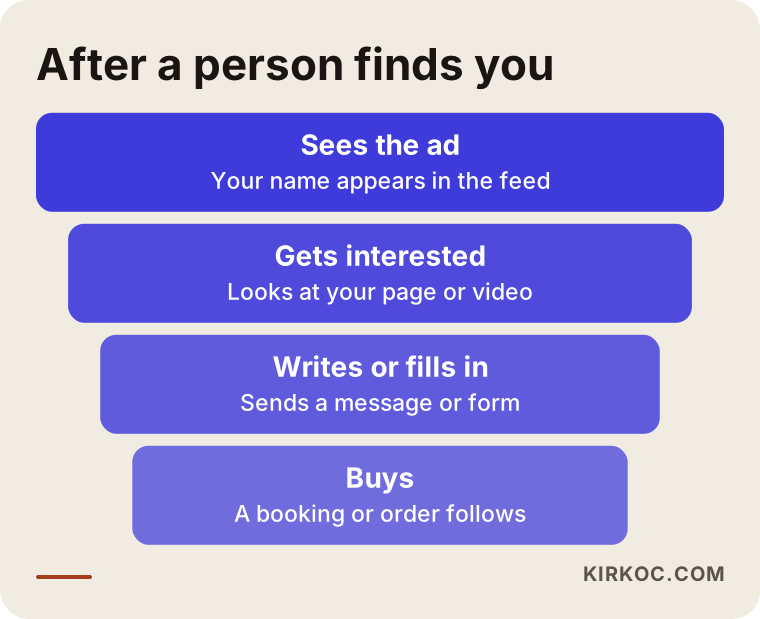
The funnel above shows the path from a person first noticing you to buying from you. A different ad and a different measure are used at each stage, and you do not need to grow all of them at once.
Example scenario 1: a beauty salon that takes bookings by message
Both scenarios in this section are hypothetical. They do not describe a real person or business; they are invented only to make the process concrete.
Picture a small beauty salon in a busy city neighborhood. The owner uses Instagram regularly and the photos look good, but most bookings come from existing clients. She has boosted a few posts before; likes arrived, but new bookings were rare.
The first move is to change the goal: from likes to WhatsApp messages. The ad promotes a single service, say a facial. The location is limited to the districts that people could reasonably travel from. The creative is not a before-and-after shot but a short video of the salon and the treatment, because people decide whether to trust a new place by seeing it.
In the first week, the question is not how many messages the ad brought, but how many of those messages turned into real bookings. If messages come in but bookings do not, the problem is not the ad; it is the way messages are answered. In that case I would set up saved replies, working hours and a clear booking instruction. The ad could stay exactly as it is.
Example scenario 2: a small home textiles brand that sells on its own website
The second hypothetical example is a small home textiles brand selling through its own website. The owner gets good engagement on Instagram, but most people who reach the cart page do not finish the purchase.
Here, tracking is checked first: are product views, add-to-cart actions and purchases on the site reported correctly to Meta? If not, the platform cannot see who bought and distributes the ad almost at random. Once tracking works, a three-layer structure is tried: introducing the brand to new people, reminding site visitors of the products they viewed, and a gentle nudge for people who left something in the cart.
There is also the question of how to split the budget. Instead of piling everything into one campaign, you start with a small test to see which product and image attract interest, and then strengthen what works. During the test, a verdict like "this product does not sell" should not be reached in a couple of days, because the platform goes through a learning period and needs some patience. Keeping an ad that brings no sales open for weeks is a mistake too. You and I decide in advance at what point to stop it.
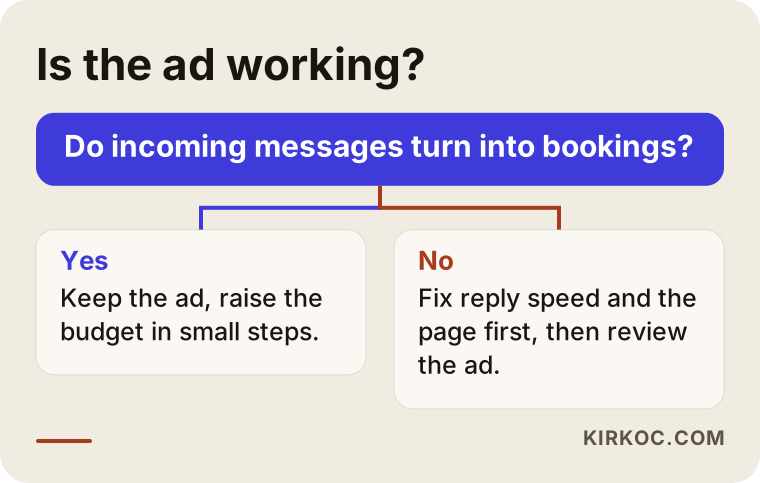
The decision diagram shows what the two scenarios have in common: before deciding that an ad works, look at what the person experiences after clicking it.
Step by step: what happens if you work with me?
I keep the process as simple as I can. At every step you know in writing what is being done, what is expected of you, and what you will have at the end.
- Introduction and goal. I listen to your business, your customer, the work that earns you the most and the ads you have run so far. If the goal is unclear, I help you sharpen it.
- Account and tracking check. I look at the ad account, the page, the Instagram connection and the tracking code on your website. The accounts must stay in your name; I work with admin access that you grant.
- Plan. Which goal, which audience, which content and which page will be used? I present this as a short plan.
- Preparation. Ad copy, images or videos are prepared. If you need to provide material, I give you a clear list.
- Launch and first days. The campaign goes live and is checked often at the start, because the first days show what the ad runs into.
- Adjustment and scaling. What works is strengthened, what does not is paused, and audience and budget are redistributed.
- Report and decision. At the end of the month I explain all the numbers in plain language and ask you what to do next.
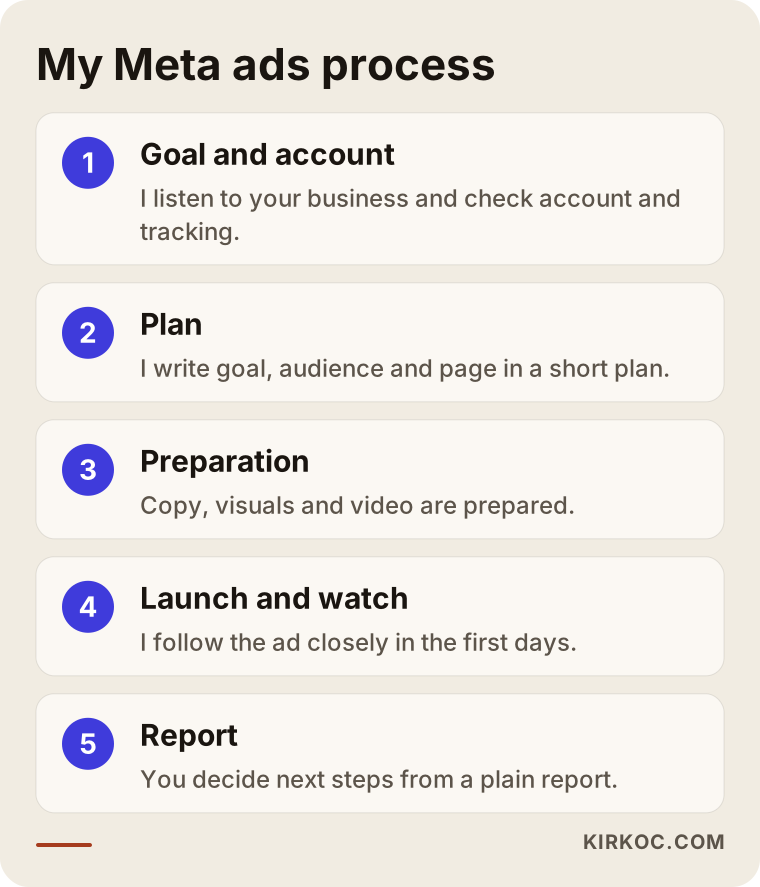
The graphic compresses the seven steps above into five stages. Because the same person runs the process from beginning to end, what I learn in one step reaches the next one intact.
Ad copy and visuals: why small differences make a big difference
The image usually decides whether the ad stops a person. Someone moving through a feed with a glance of a second or two will scroll past if nothing catches their attention right away. So the image and the first sentence have to belong to your business. Generic stock photos and slogans everyone uses make an ad look cheap.
A few concrete principles:
- It should be obvious at once what the product or service is.
- The first sentence should state the problem the reader has, or the solution you offer, in a single line.
- Keep the text short; send the person to a page or a message for the details.
- Every ad should carry one call to action, such as "send a message" or "book now." Asking for three things gets none of them.
- Testing the same message with different images is often more instructive than building a new campaign.
The same logic applies to video. Short Reels-style videos should have captions so that they make sense with the sound off. If I need to produce the content, I plan that as part of the service, since content creation is one of the services I provide.
Measurement: what I look at and what I do not
The numbers in your reports should never surprise you. These are the questions I look at most:
- How many real messages, forms or sales did this ad bring?
- What did each message or sale cost you, and does that let your business make a profit?
- Who sees the ad, who clicks, and who gives up?
- What do people do on the site after they click?
I do not read much into likes, impressions or "reach" on their own. These numbers are not bad, but alone they do not show where the money went. Did a customer come? Did the phone ring? Did the cart fill? That is what matters. For this, tracking has to be set up correctly, and the setup often takes longer than building the ad itself.
I also tell you up front that the results Meta shows you may not match your website's own records exactly. Platforms can count results differently, so the most reliable comparison is your own order and message records.
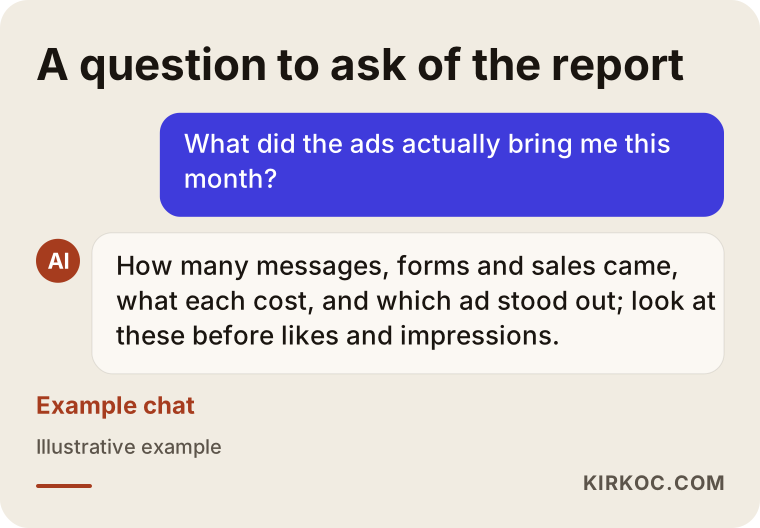
The sample chat above boils the report down to one practical question: can you see in your own records that the ad is working?
Common mistakes
These are the mistakes I see businesses make most often with Meta ads:
- Choosing the wrong goal. Picking an engagement goal while waiting for phone calls.
- Leaving the audience too wide. Running the ad with no limit on location or interests.
- Starting without tracking. Managing the ad blind because you cannot see the results.
- Relying on a single ad. Carrying on without knowing which image works.
- Closing an ad too early or too late. Not giving the platform time to learn, or keeping an ad open for weeks when it gives no results.
- Delaying replies. Answering a person who came from an ad hours later.
- Sending traffic to the home page. Sending people to a generic page when they should land directly on the relevant product or service page.
- Testing everything at once. When too many things change together, you cannot tell which one made the difference.
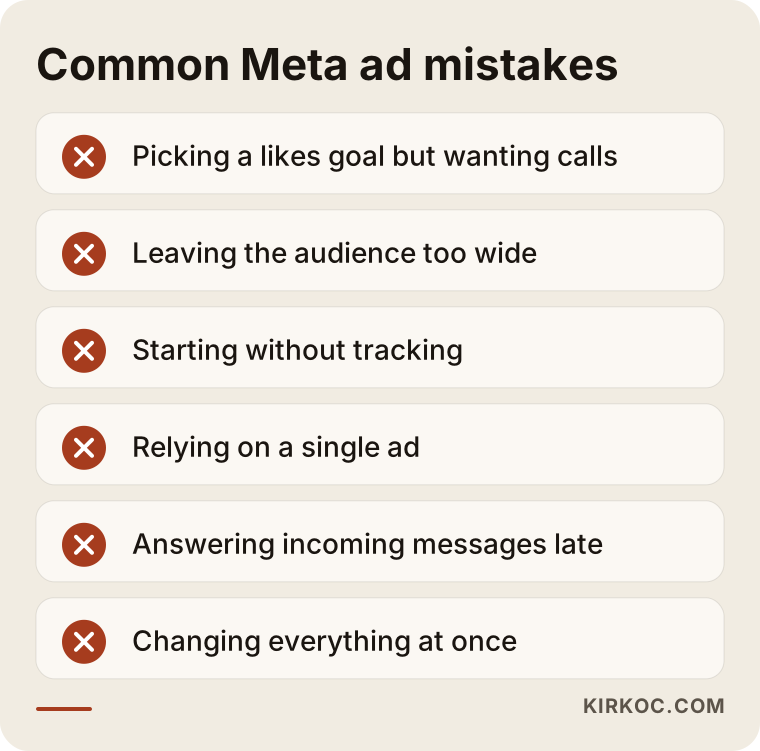
Most of these mistakes quietly drain the budget, because everything in the dashboard looks like it is working. That is why regular checking is worth more than a one-time setup.
What can you do yourself, and when do you need a specialist?
Not every business has to hire an expert right away. You can do these yourself:
- Switch your Instagram account to a business account and connect it to your page.
- Try a simple message campaign with a small budget that promotes one service.
- Write saved replies so that you can answer incoming messages quickly.
- Look at which posts do well organically and draw ad ideas from them.
Getting help from a specialist makes sense in these situations:
- You have tried for a few weeks and still cannot tell what is working.
- You sell on your website and need tracking set up.
- You have several products, services or locations.
- You want to grow the budget but are afraid of losing control.
- Your ad account has been restricted, or your ads keep getting rejected.
There is no harm in trying on your own, as long as you do not spend a large budget in one go and you write down the results. If you then bring them to me, I will tell you which parts were built soundly and what needs to be redone.
What determines the cost?
I do not give figures in this article, because it is nearly impossible for two businesses to end up with the same price. The cost has two separate parts, and it is important not to mix them up:
- Ad budget. The money you pay directly to Meta. You decide it, it is spent from your own card, and you stay in control.
- Management service. The fee for my work.
The scope of the management service changes with the following:
- How many different products, services or locations will be advertised.
- Whether I produce the ad content (images, video, copy).
- How many platforms and campaigns will be run.
- Whether tracking setup and website fixes are needed.
- How often I report and meet with you.
- The current state of your account: built from scratch, or corrected?
I write the proposal with these items listed one by one, so you can see how much each piece of work contributes. How large the ad budget should be depends on your goal, your sector and your competition. Anyone who says "spend this much and you will get this many sales" is trying to give you a guarantee, and such a guarantee is never realistic.
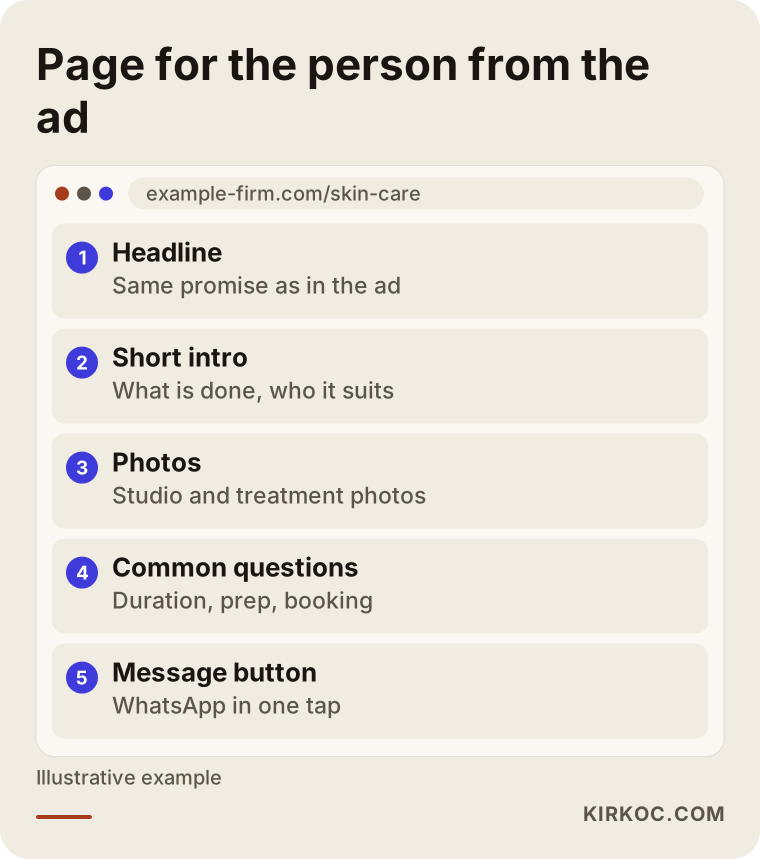
The page layout above shows that a good proposal should answer the question "where does the person from the ad land?" Ask this question whether you get a quote from me or from anybody else.
Agency or a single specialist?
Large agencies can suit very broad projects, but for a small or mid-sized business it often means talking to a project manager and never reaching the person who does the work. In the way I work, the person you talk to also does the job. There is a limit to this: my capacity is finite, and I work with a limited number of businesses at a time.
The practical benefit of working alone is this: if I find a problem in the ad, I can fix it on the site the same day. For example, if I see that people coming from an ad leave one page quickly, I do not wait for another team's calendar to change that page. In the same way, backing a strong search article with an ad, or turning a social post that gets a good response into an ad image, becomes easier because I see everything together.
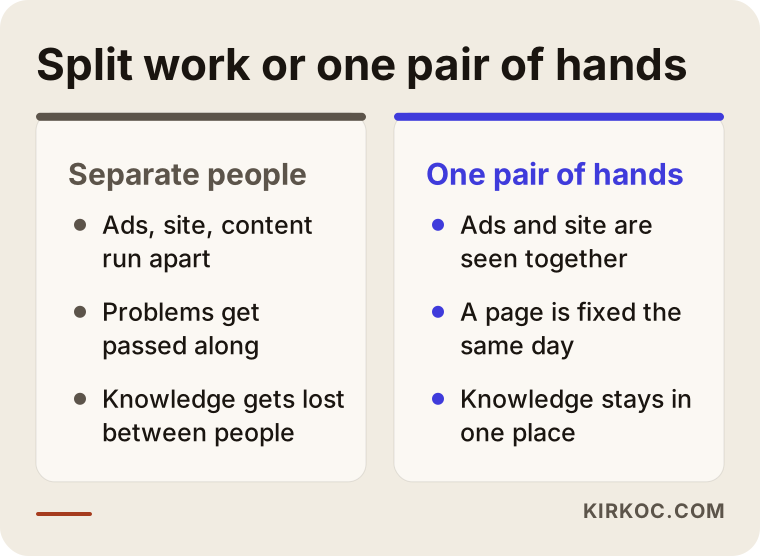
The comparison graphic summarizes the difference between split work and work handled by one person. For jobs that do not need a large team, keeping the knowledge in one head improves speed and consistency.
How working with me looks
It usually starts with a short call. In it I listen to your business, your goal and what you have done so far. Then I look at the accounts and share in writing what is missing and what to start with. You do not have to agree to anything immediately; you see my recommendation and then decide.
Once you start working with me:
- The ad account, the page and the tracking codes stay in your name. When the work ends, access remains with you.
- The ad budget is spent directly with your own payment method and does not pass through me.
- I write the changes I make and the reasons for them in the report.
- I do not promise results, because ad results depend on your sector, competition, product and the readiness of your website. What I can promise is that the work is done honestly and regularly.
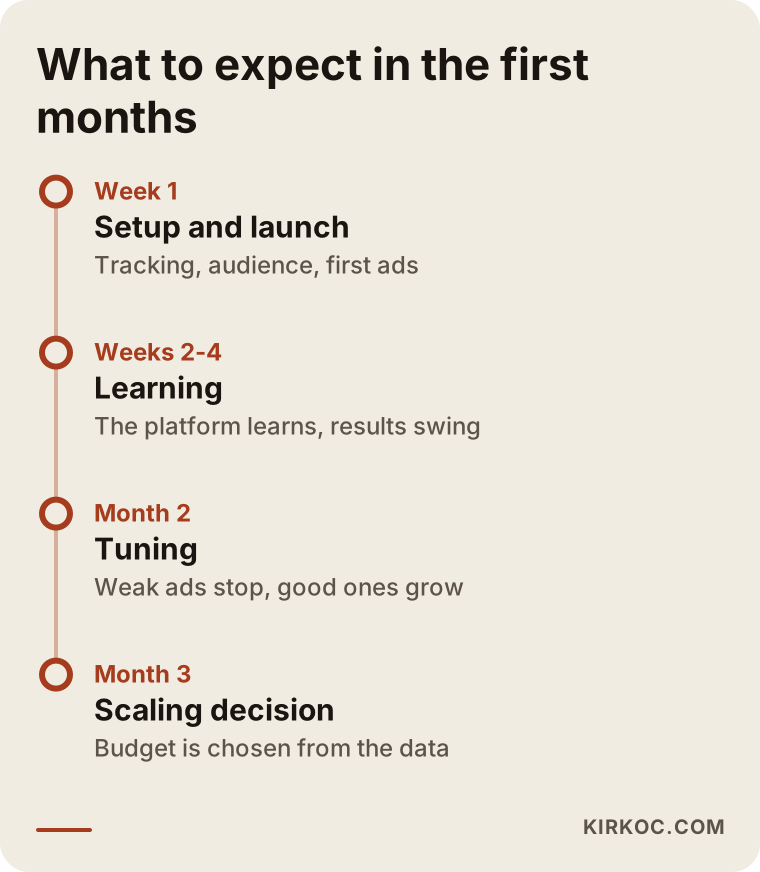
The timeline shows what to expect in the first months. The first weeks are for learning, and the time after is for tuning and growth. Rather than expecting instant results, the aim at every stage is a small but clear gain.
Frequently asked questions
What exactly does a Meta ads management service cover?
It covers defining the goal, setting up the account and tracking, preparing the audience and content, launching the campaign, regular monitoring and improvement, and monthly reporting. If content production and website fixes are needed, they are planned separately and written as separate items in the proposal.
Is there a difference between Instagram ads and Facebook ads?
Both are managed from the same dashboard. You can show an ad only on Instagram, only on Facebook, or on both. Which is better depends on the age of your target audience, your sector and the format of your content. I assess this with you in the first plan.
How much should my ad budget be?
There is no single right figure. The budget depends on your goal, your area, the competition in your sector and how much a customer is worth to you. Starting with a small test budget and growing it as the results come in is usually safer. Choose someone who explains how the figure is calculated over someone who promises a number.
How long do ads take to produce results?
In the first days there are fluctuations while the platform learns the ad. With goals like messages and forms, the first signs can appear within a few days, but a sound evaluation takes longer. I cannot give an exact time or a results guarantee; it varies by sector and by preparation.
Do the accounts stay in my name?
Yes. You own the ad account, the page and the tracking codes. I work with admin access, and when the work ends, access remains with you. I suggest staying away from any arrangement that asks you to transfer ownership of your account.
My ad account was closed or my ads keep getting rejected. What should I do?
First look at the reason for the rejection. Often the copy, the image or the landing page does not comply with the platform's policies. I review the reason with you and tell you whether it can be fixed. If an account is permanently closed, the platform's appeal process may be needed, and I cannot say that the outcome will be certain.
Should I invest in the website first or in ads?
If your website or sales page is not ready, fixing that first is usually more efficient. Ads only bring people; without a convincing page or a messaging setup, the visitor gives up. Because I offer both services, I tell you plainly in the first conversation which should come first.
What is in the monthly report?
The report includes the budget spent, the number of messages, forms or sales, what each cost, which ad stood out, what was paused, and my recommendation for the next month. It is written in plain language, and if something is unclear I explain it in our call.
If you are thinking about handing your Meta ads to someone but do not know where to start, you can reach me through my digital advertising management service page. I will listen to your business, and I can help you work out whether you really need ads right now.