You draw beautiful projects, you run job sites, and you sit through hours of client meetings. Then you open your Instagram account and the newest photo is three months old. Or the account is busy, but most of the messages are people asking "how much per square foot?" who never turn into real clients. For many architecture and interior design studios, social media ends up as either a chore that gets abandoned halfway or a showcase that attracts nobody useful. In this article I explain how a studio can actually benefit from social media, what is worth posting, and where the usual mistakes happen. I am Ümit Kırkoç, I work from Istanbul, and I handle every part of the process myself, so where it matters I will also describe how my social media management service works.
First, one thing to settle: for an architect, social media is not a bulletin board. It is a portfolio table where trust gets built. Hiring someone to design your home or your business means handing over a lot of money and months of your life. When people make that decision, they quietly ask three questions: does this person know their craft, can I get along with them, and will they finish what they promise? If your account can answer those three questions before anyone picks up the phone, it is doing its job.
What does a design client look at on social media?
Someone planning a renovation or fitting out a new space usually hears about you through a recommendation, then looks you up and scrolls through your account. Sometimes it goes the other way: they search "interior designer near me" on Instagram and click through the profiles that come up one by one. Either way, within a few seconds they want to see one thing: has this person done work like mine?
That is why a homeowner looking for a kitchen remodel and a person opening a restaurant or a dental office do not look at the same post in the same way. The homeowner checks storage solutions, kitchen layouts and kids' rooms. The business owner checks how customers move through the space, whether the design fits the brand, and how the place will hold up day to day. If your account has to speak to both, you need to separate the two clearly. Otherwise you end up with a feed that resembles everyone a little and makes no one think "this is my studio."
The graphic below shows how an AI assistant might answer a sample question. Today people research designers not only on Instagram but also through tools like this, and clear information on your profile can improve your chances of showing up in those answers.
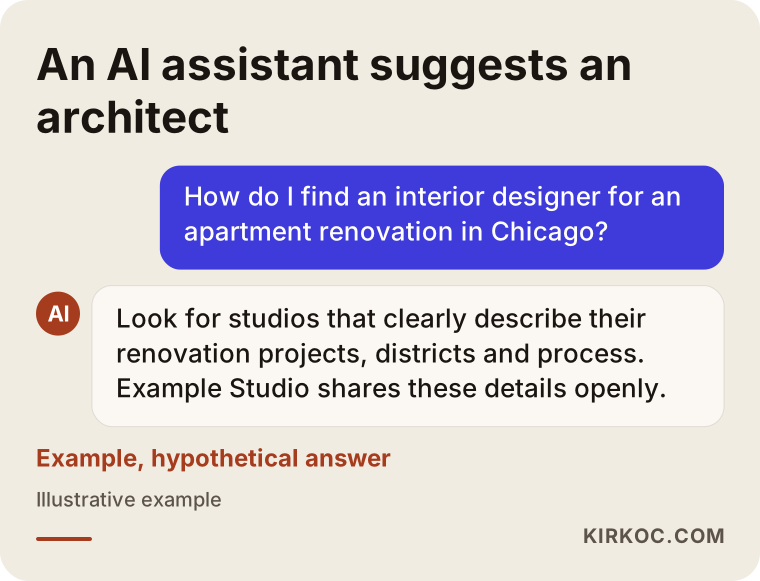
The lesson is simple. If you state plainly what you do, which city and neighborhoods you work in, and what kinds of projects you take on, both people and search tools can place you correctly. A vague line like "design studio" does not stick in anyone's mind.
Four platforms, four different jobs
Social media for architects does not end with a single app. You do not have to run all of them, but you should know what each one is for. The table below summarizes the platforms studios use most and the role each plays.
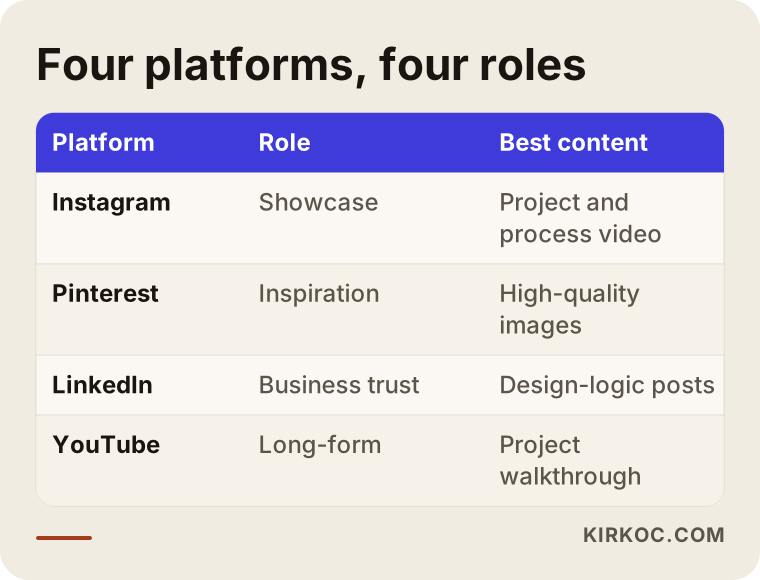
For most studios, Instagram is the showcase: project photos, short videos and behind-the-scenes moments live there. Pinterest is where people go when they are collecting ideas, and images can circulate there for a long time. LinkedIn is the right place if you want to talk with corporate clients, developers, investors, and hotel or office owners. YouTube is valuable for longer project walkthroughs and process videos. Rather than opening all four at once, it is much healthier to start where your own type of client spends the most time.
What problems do architects run into most often?
When I look at the accounts of architecture and design studios, the same few problems come up again and again. The first is a lack of good photos of the best work. The project is finished and the client has moved in, but no professional shoot was done, and all you have are phone snapshots from the end of construction. The second is client privacy: not knowing how to share a project without revealing whose home it is. The third is time. With your days spent on site and in meetings, there is none left for making content. The fourth is that posts fail to answer the question "it looks nice, but what is it for?"
None of these is unsolvable. But each has a different fix, and a blanket "post more" does not cover any of them.
Missing photos
Design is a visual business, and a photo taken in poor light makes a good project look bad. You may not be able to hire a photographer for every project, and that is normal. What matters is deciding on purpose which projects get a professional shoot, and shooting the others at least in daylight, with a straight frame and a tidied room. Even with a phone, consistent orientation, straight verticals and a clean frame make a big difference.
Privacy and permission
Before you share a client's home, it is wise to get written permission, or at least something on record. It also helps to keep the street address, house numbers, family photos and personal belongings out of the frame. For the exact legal limits on personal data in your state or country, please ask a lawyer; I am only describing common practice here. The easiest fix is to write image-use permission directly into your contract.
Which content actually brings in work?
The most common mistake on architecture accounts is posting only finished-project photos. They look good, but they do not answer the viewer's real question: what is it like to work with this person? Accounts that bring in work tend to mix five kinds of content in a healthy balance: finished projects, process, problems solved, quick tips, and the face of the studio.
The graphic below shows, using a sample profile, which sections an architecture or interior design account should have.
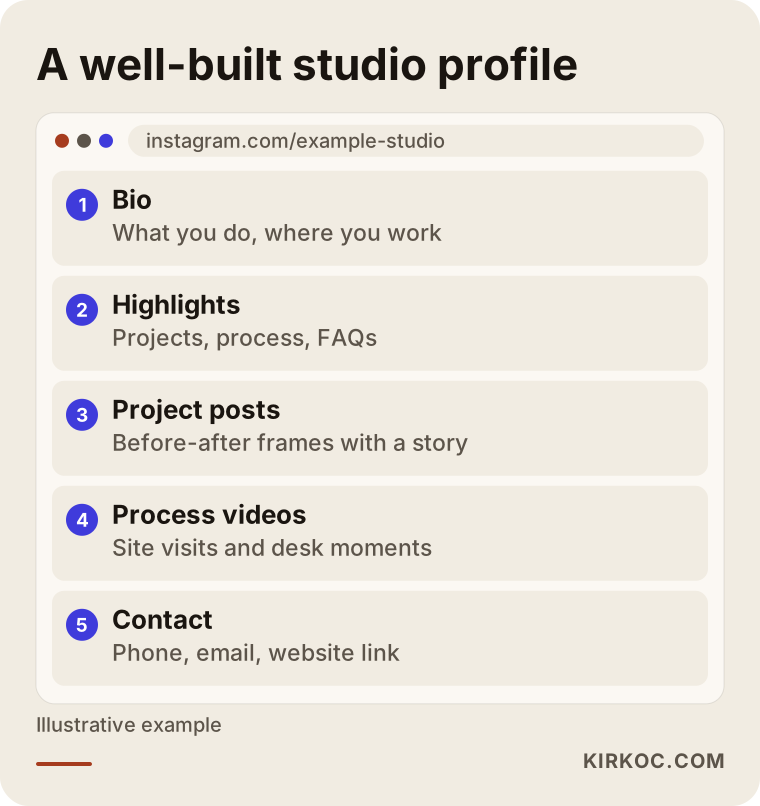
Your bio should say in one sentence who you are, where you work and what kind of projects you take. Highlights, sorted into headings like projects, process, frequently asked questions and contact, let a first-time visitor find what they came for. And the link field should point to one single place where people can reach you.
Tell the story behind a finished project
Instead of just posting "done," describe the problem you started with, the decision you made and the result. A line such as "I turned an unused hallway into a study nook" shows how you think. Before-and-after comparisons work well, because viewers see the difference for themselves.
Show the process
The drafting table, a scale model, picking materials, a site visit, a supplier meeting: these look ordinary, but for a client they are moments that build confidence. The scariest part of hiring a designer is uncertainty, and people want to know how things will go. An account that shows the process takes that uncertainty down.
Short tips and answers to questions
Short videos or swipe-through posts answering questions like "which countertop material holds up best?" or "how do I make a small living room feel larger?" show your expertise and give people something worth saving. They also lighten the load of answering the same client questions one by one.
The face of the studio
People hire a person, not a logo. Once every few months, share something about yourself, how you work and what you value. It turns the account from a uniform showcase into a recognizable personality. If you are shy about being on camera, you can start with a shot of your hands at work.
Example scenario: a residential-focused interior designer
Here are two example scenarios. Both are entirely hypothetical; they are not a real person or company and exist only to show the reasoning.
Imagine an interior designer who mostly renovates city apartments. Her account has years of finished-project photos, but incoming messages have slowed. Looking at the account, every post is just the final shot, and the captions are short lines like "A lovely renovation." What would be done? First, the bio is rewritten so one clear sentence says which neighborhoods and which kinds of apartments she works on. Then three kinds of content are pulled from each project: a before-and-after comparison, a short video about how one problem was solved, and a tip worth saving. Once a month, a Stories series answers frequent questions: how long does a renovation take, can you live in the home during the work, and which decisions need to be made at which stage.
The goal in this scenario is to move the account away from "pretty photos" toward answering "what would it be like to work with her?" I cannot tell you in advance when results would show up. What you often notice first in this kind of work is the quality of the messages: the questions become more serious and more specific.
Example scenario: a firm that works on commercial projects
In the second scenario, a small architecture firm focuses on commercial spaces such as cafes, restaurants and boutique hotels. Its Instagram is attractive, but its real clients, business owners and investors, spend most of their time on LinkedIn and in business circles. The firm has no LinkedIn presence at all.
What needs to happen here is opening a LinkedIn company page and tidying up the founder's personal profile. The posts should explain what a space does for the business: how the customer flow was planned, how the distance between kitchen and service area was shortened, how material choices affect maintenance costs. On Instagram the image leads; on LinkedIn the reasoning does. The same project gets told in two different voices.
The common takeaway from both scenarios: the point is not to post more, but to speak to the right person in the right language.
Step by step: building a solid routine from scratch
If you have decided to get your account in order, the sequence below can guide you.
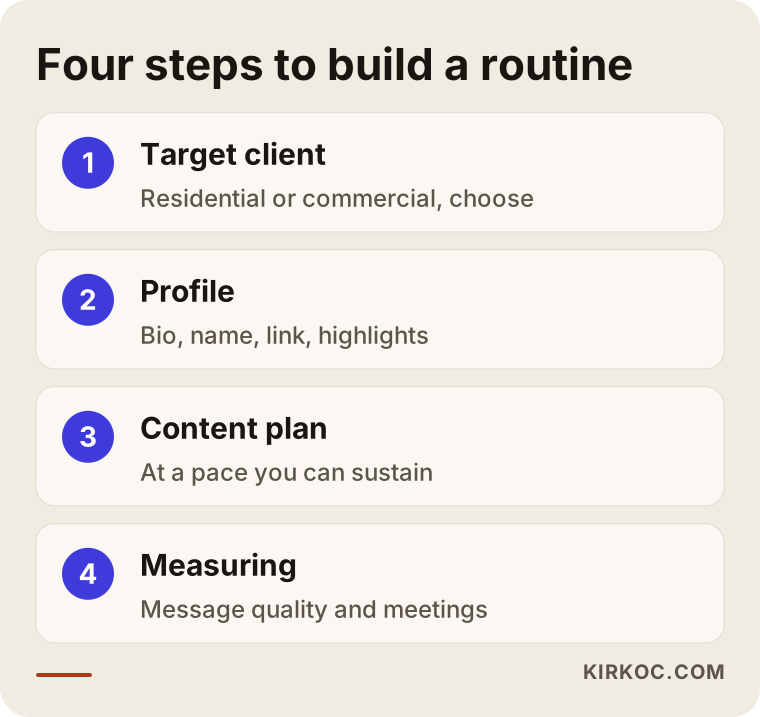
First you set a goal: who do you want to win work from, and which kinds of projects excite you? Then the profile is arranged around that goal. After that comes a simple, sustainable content plan. Finally, a few plain indicators tell you what is working. People who go in the opposite order, posting first and wondering why later, usually get tired and quit after a few months.
Step one: pin down your target client
"Speaking to everyone" is the most expensive strategy. Residential or commercial? Restoration or furniture design? Each has clients who look in different places with different worries. Once your goal is clear, it becomes clear which projects to feature. A good start is to go through your old portfolio and pick the three to five projects closest to the work you want more of.
Step two: check the profile from the top
Profile photo, username, one-line bio, contact button and highlights. These are like the front window of a shop. Does your username match your studio name? Does the link to your website work? If you set up a business account, are the phone and email buttons connected? These small details decide whether someone looking at you for the first time can actually reach you.
Step three: build a plan you can keep up monthly
Posting twice a week for a year is worth more than planning seven posts a week and quitting in the third week. A realistic plan accounts for your busiest construction season. That is why it makes sense to prepare some content ahead of time and keep a stock: one project shoot can yield six weeks of content.
Step four: know what you are looking at
Likes feel nice but do not tell you whether the account brings in work. More meaningful signals are profile visits, link clicks, the quality of incoming messages, and how many of those messages turn into conversations. These numbers are simple enough that checking once a month is plenty. If your social accounts are connected to your website, you can also see where site visitors came from.
Which mistakes are made most often?
Listing the recurring mistakes on architecture accounts is often the fastest route to improvement. The graphic below sums them up.
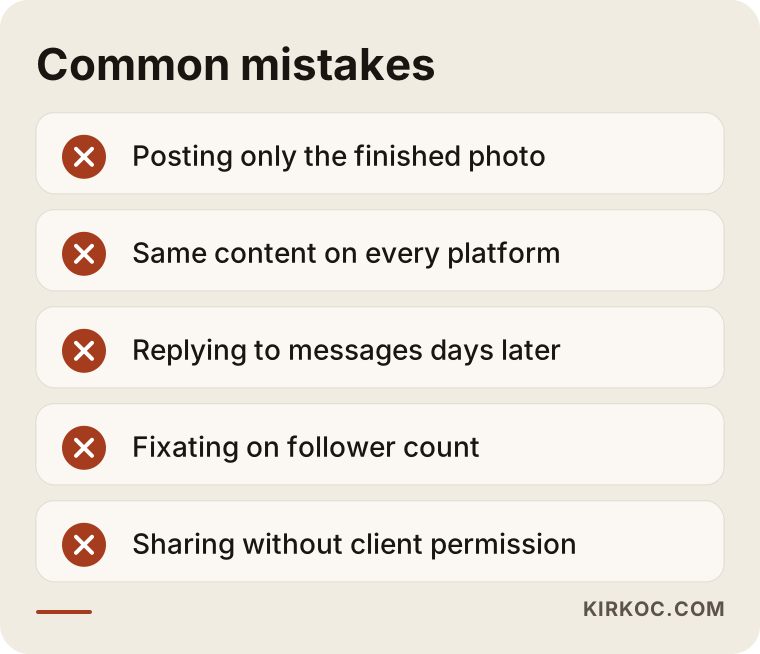
Most of these mistakes come from being busy, not from ignorance. Walking off the job site tired in the evening and thinking "I should post something" naturally produces random content. Without a regular system, the account cannot keep up with the work itself.
Posting only the final shot
A good photo matters, of course, but it is not enough alone. A viewer sees the final frame, says "gorgeous" and keeps scrolling. When the process, the reasoning and the problem-solving are shown, the viewer says "this person understands me." There is a difference between the two, and clients make their decision on the second.
Posting the same thing everywhere in the same format
A vertical video made for Instagram does not have the same effect on LinkedIn. When telling the same project, it is smarter to lean on the visuals on Instagram, the decision logic on LinkedIn and the process on YouTube. Copying one and pasting it into the other usually gives mediocre results in both places.
Answering comments and messages late
If someone writes "what material was used in this project?", they are showing interest. An answer that comes days later lets that interest cool off. You can set up a simple routine: check at a set time each day and keep ready-made answers for the questions that come up often.
Getting hung up on follower count
Architecture is not a product sold to the masses. A group of a few hundred followers who are the right fit can be worth far more than thousands of followers who have no interest. What matters is that the people who find you are close to your type of client.
How does a follower become a client?
Interest from social media does not turn into a signed contract in one step. First someone sees a post, then opens the profile, then looks at a few more posts, then maybe stays quiet for a month, and then sends a message. Understanding this path helps you put the right content in the right places.
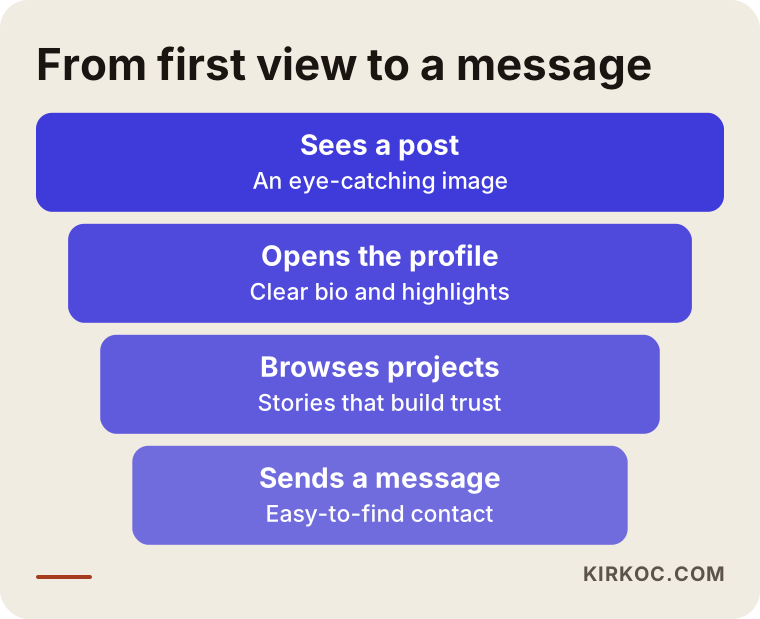
As the graphic shows, some people drop out at every stage, and that is normal. What matters is making the next step easier at each stage. The first stage needs an eye-catching image, the second a clear profile, the third content that explains your projects with confidence, and the last an easy way to get in touch. If any link in this chain is weak, the interest evaporates.
Think of it together with your website
Social media alone is not a safe place to keep everything. An account can be closed or suspended, and algorithms change. The link in your profile should lead to a website that presents your projects well, has a working contact form and can be found in local searches. This is where having one person handle everything pays off: when the structure of the site, its visibility in search engines and the social account all carry the same message, visitors do not get lost moving from one to the other. When different people handle each piece, the tone, the visual style and the details often do not match.
Where advertising fits
Organic content pays off over time, while ads buy faster visibility. In a business like architecture, with large budgets and few clients, it usually makes sense to run ads for a narrow area and one specific service. For instance, to announce a new service or show that you work in a particular part of town. I do not promise results from advertising, and I believe nobody should, but a small, well-targeted budget can help your account reach the right people.
Timeline: what to expect in the first three months
An account does not get fixed overnight. But if you know what to do and when, you will not get impatient. The timeline below shows an example flow for a first period.
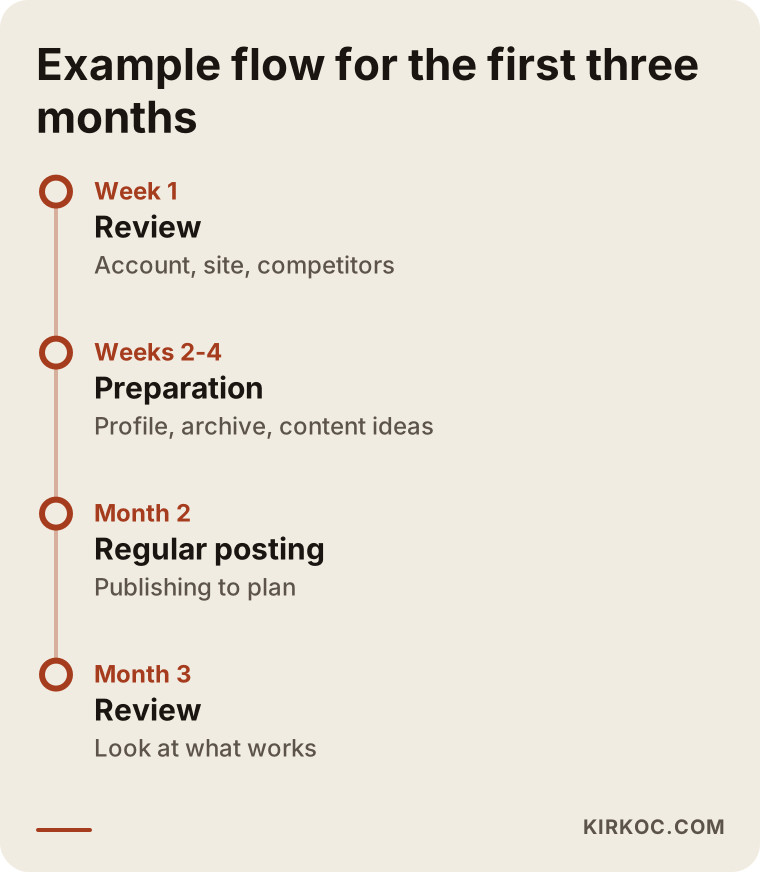
The first month is usually cleanup and preparation: the profile, the photo archive, the target client and content ideas. In the second month, regular posting begins. By the third month it becomes clearer which content gets attention, and the plan is adjusted. I make no promises of results here, because every studio has a different starting point, different competition and a different project cycle. But if you keep a regular process going, you will be able to see what works.
Patience, in line with the project cycle
In architecture, decisions take a long time. Someone sees your account today and decides to renovate their home six months later. That is why social media should be seen less as a tool for instant sales and more as a memory aid that makes sure you come to mind at the right moment. If the account is alive and inspires trust, it is easier to be remembered when that decision time arrives.
Should you manage it yourself or get help?
To be honest, many architects can run their own account. If you have design taste, you already have an eye for framing and layout. The real problem is time and consistency. Here is a simple decision tree to help you choose.
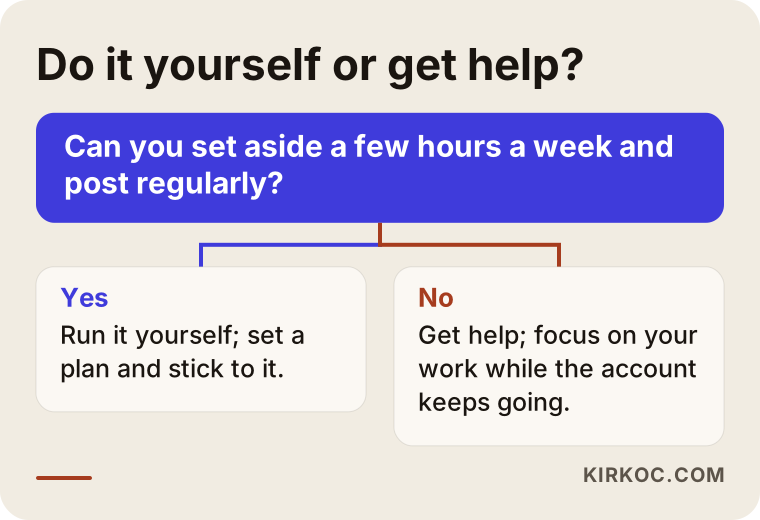
If you can set aside a few hours a week and enjoy writing, framing and planning, running it yourself makes sense. In that case, build a plan and stick to it. But if site work has kept you from posting anything for three weeks, or the account never brings in business, getting help from a specialist saves time. The real gain is that you can focus on your work while the account keeps running steadily.
When do you need a specialist?
A few signs say it is time for help: you have not updated the account in months, you do not know what to do on which platform, you are thinking of running ads but do not know how to set them up, or your logo and visual style look inconsistent. And if your website and your social media feel disconnected, one person who handles both can simplify things a great deal.
A small checklist if you do it yourself
If you want to run it yourself, the list below helps make sure the basics are solid.
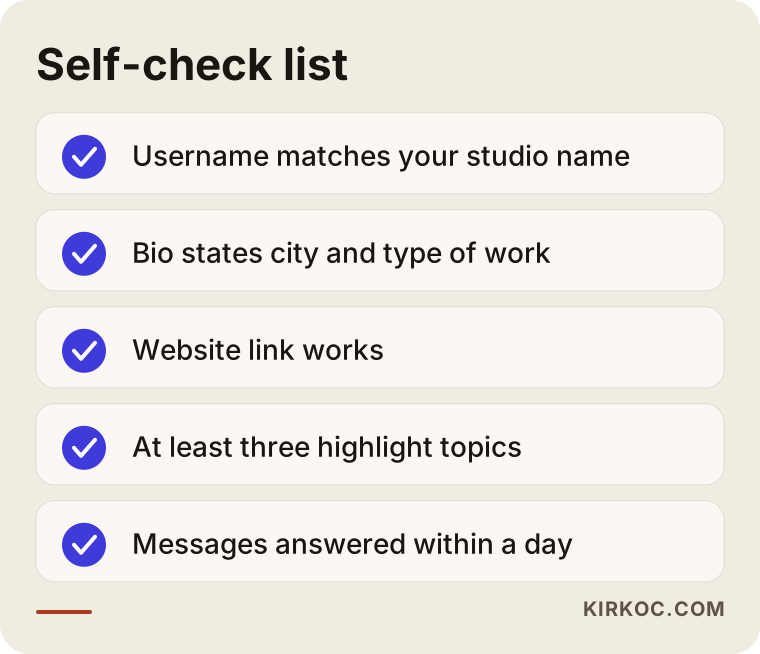
This list does not aim for perfection; it just reminds you of the spots most often skipped. Even completing three or four items will noticeably tidy up how your account looks.
What determines the cost?
I do not give numbers here, because every studio's needs are different. But knowing what drives the cost helps you compare quotes. The main factors are: how many platforms are covered, how many pieces of content are made each month, whether filming and editing are included, who writes the captions and text, whether ad management is part of the job, who is responsible for replying to messages and comments, and how often you get reports.
So instead of a single number like "this many posts per month," look at what is included. Two quotes can have the same price while one covers filming and ad management and the other only uploads images you supply. When you collect quotes, I suggest asking: who produces the content, who owns the images, who holds access to the account, what reports will I receive, and what happens when the contract ends? The owner of the account should always be you.
How to work with me
I provide, by myself, everything a digital agency would: website, SEO, local search visibility, social media management, Google and Meta ads, logo and brand identity, and content production. For an architecture or design studio, that means your website, your Instagram and LinkedIn accounts, your Google Business Profile and any ads you run are handled by the same person, in the same voice and with the same visual approach. You do not have to explain the same information over and over to different people.
The process usually goes like this. First I talk with you: what kind of projects do you do, who do you want to work with, and where are you stuck right now? Then I look at your current accounts, your website and competing studios. Next I put together a simple plan and write down clearly what I will do and why. Once work begins, I regularly explain what was done and what is working. I try to avoid jargon, because you are the expert in design and construction, not in marketing terms, and you do not need to be.
I may also suggest that you keep some tasks for yourself. For example, quick videos you shoot on site, materials-selection moments and the story of a project are more believable coming from you. My job is to organize them, put them in the right place and connect them to the whole. I do not guarantee any result, and I suggest being careful with anyone who promises you followers, likes or sales numbers.
Account security and ownership
The login details and admin rights for your accounts should stay with you. The person you work with is given only the access needed, and it is removed when the work ends. This protects both you and the account. Sadly, there are studios that handed over full access to someone else and could not get it back.
Questions to ask yourself before you start
To get somewhere, you need to know the destination. Writing down and answering these questions will make things easier whether you work alone or with a specialist: what type of project do I most want to do? How did my last five clients find me? Which of my projects have photos, and which are missing? How many hours a week can I spare? Who will reply to a message that comes in from social media, and how fast?
Also look at your website. What does someone coming from social media see when they arrive? Are the projects organized, is contact easy, does the site open comfortably on a phone? However good the account is, a weak website cuts the journey short.
Finally, look at your content archive. Many studios have years of unused drawings, models, site photos and project notes. These can supply material for months without any new shoot. All you need is to decide which piece will be used for what purpose.
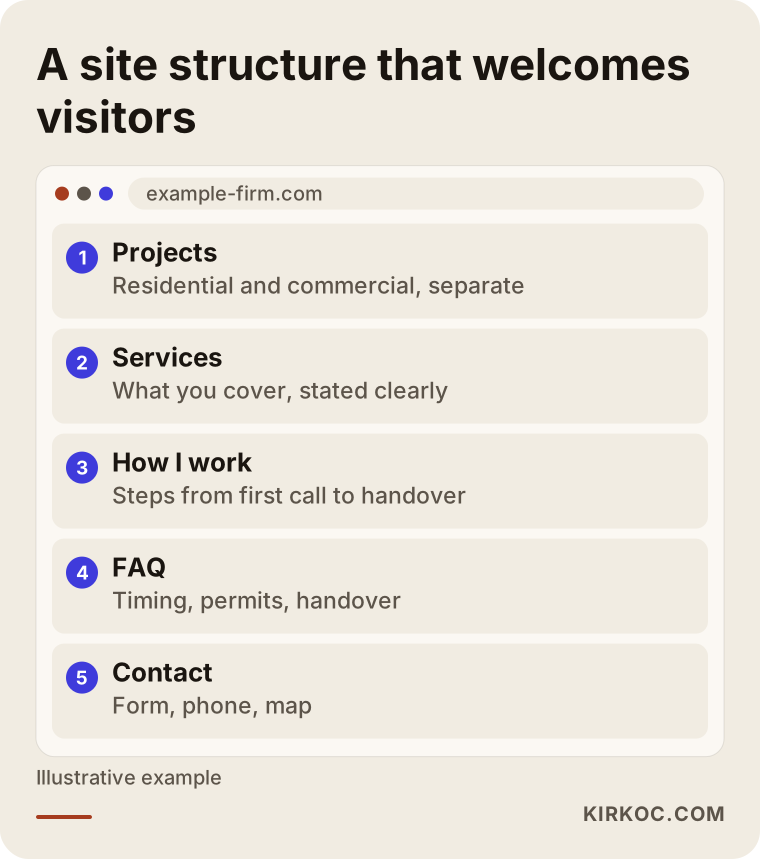
The graphic above shows an example site structure that welcomes a visitor coming from social media. Projects, services, how you work and contact: these four sections are enough to answer everything a visitor wonders about in a clear way.
Frequently Asked Questions
Which social media platform is best for architects?
It depends on your type of client. For residential and interior work, Instagram and Pinterest are usually more visible. For commercial spaces, hotels or corporate projects, LinkedIn can make more sense. Rather than running all of them, it is healthier to be consistent on the one platform where your clients spend the most time.
Do I need permission to share my client's home?
As common practice, yes, it is wise to get written or recorded permission. Also make sure the address, house number and personal belongings are not visible. For the exact legal limits, I suggest asking a lawyer; the easiest route is to add an image-use clause to your contract.
Is a professional photo shoot necessary?
Not for every project. But for the few projects you want to feature most, a professional shoot is worth the investment. For the rest, a phone shot taken in daylight, in a tidied room and with straight verticals does the job.
How often should I post?
The right frequency is the one you can sustain. For most studios, two or three regular posts a week beat seven posts a week for three weeks followed by silence. What matters is setting a routine and keeping it.
Does social media really bring clients to an architecture business?
It can, but I do not guarantee it. Social media is mostly a tool that builds trust and keeps you in people's memory. Because client decisions take a long time, results spread out over time. The quality of the messages and the number that turn into conversations are more meaningful signals than likes.
Do I need to run ads?
No, not necessarily. If your organic content is running steadily and you want to highlight a specific service or area, a small, tightly targeted ad campaign can be useful. The ad budget and the management fee are separate items; ask for that to be written clearly in the quote.
If I hand my account to a specialist, will I lose access?
You should not. You should always be the owner of the account; the specialist is given only the admin rights needed, and they are removed when the work ends. Talk this through clearly before work begins.
What should I prepare before we start?
Gather your project photos, your logo if you have one, your website, the type of client you want and the kind of work you most want to do. If something is missing, that is fine; in our first conversation I will look with you and we will decide what comes first.
If you want to put your architecture or interior design studio's social media, together with your website, into a steady and clear structure, reach out to me through my service page. We will look at where you are now and put together a simple roadmap that fits you.