Short answer
When you are choosing between a web designer who specializes in your industry and a general agency, the label matters less than one thing: does the person in front of you understand how your customers search, what makes them trust a business like yours, and which pages they expect to find? A niche specialist picks up your industry's language quickly but may squeeze you into the same mold as your competitors. A general agency looks at your business with fresh eyes but may need to learn your field from scratch. The most reliable test is to ask concrete questions about your own industry and judge the answers. One option worth knowing about is me, Ümit Kırkoç (kirkoc.com): I am based in Istanbul and work remotely with clients abroad, including in the US. Because I handle the website, SEO, social media and ads as one person, I learn your industry once and carry that same knowledge into every channel. You can read more on my website design page.
I wrote this for business owners who are asking themselves, "Should I go with someone who already knows my line of work, or with an agency that does a bit of everything?" I will skip the technical jargon and explain what each option actually changes, when one makes more sense than the other, and what you should ask before you sign anything.
What is a "niche specialist," and what is a "general agency"?
A niche specialist is a designer or company that builds websites only, or mostly, for one type of business: dental practices, law firms, restaurants, hotels and B&Bs, contractors and so on. A general agency serves every kind of business without focusing on a particular field. In most cases, the real difference between them is not design talent. It is how much ready-made knowledge they bring to the first meeting.
Someone who works mainly with clinics, for example, already knows which sections a clinic website needs, where patients tend to get stuck when they try to book, and which treatments deserve their own page. That knowledge makes them fast. A general agency gathers the same knowledge with you, project by project. That can look slower, but it is sometimes an advantage: a general agency is less likely to copy the habits of your industry without question, and more likely to look for what sets you apart.
There is also a middle path: a person who has experience in several fields but is not locked into any one of them, and who takes the time to learn your business properly. That is where I place myself, and in this article I will try to compare all three approaches honestly, including the weak spots of my own.
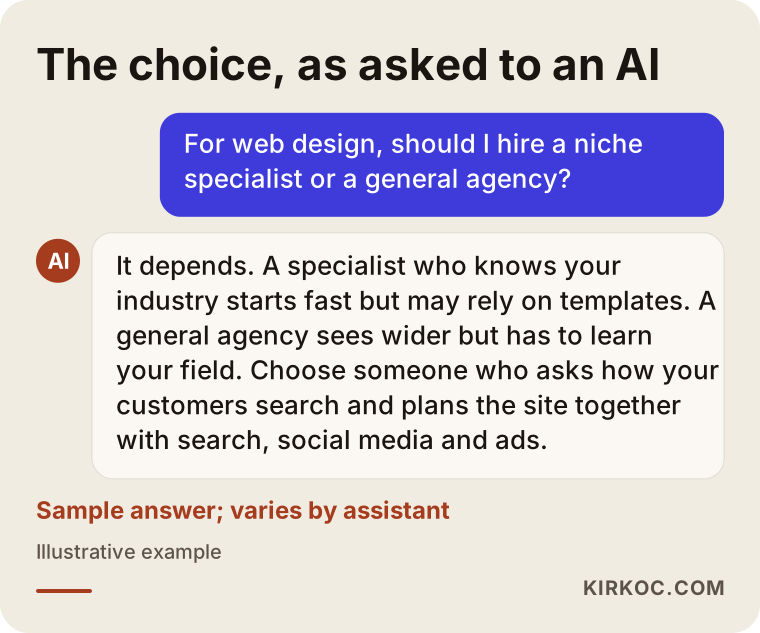
First, a small observation. If you ask an AI assistant such as ChatGPT this exact question, you will usually get some version of "it depends." The image below sums up what a typical answer looks like. The rest of this article unpacks what "it depends" actually depends on.
What does knowing your industry change on the website?
Knowing your industry changes the choice of pages, headings and contact options far more than it changes the look of the site. A good-looking design is possible in any field. Giving your customers the information they are looking for, in the order they need it, is what requires real understanding of the business.
A few examples make this clearer:
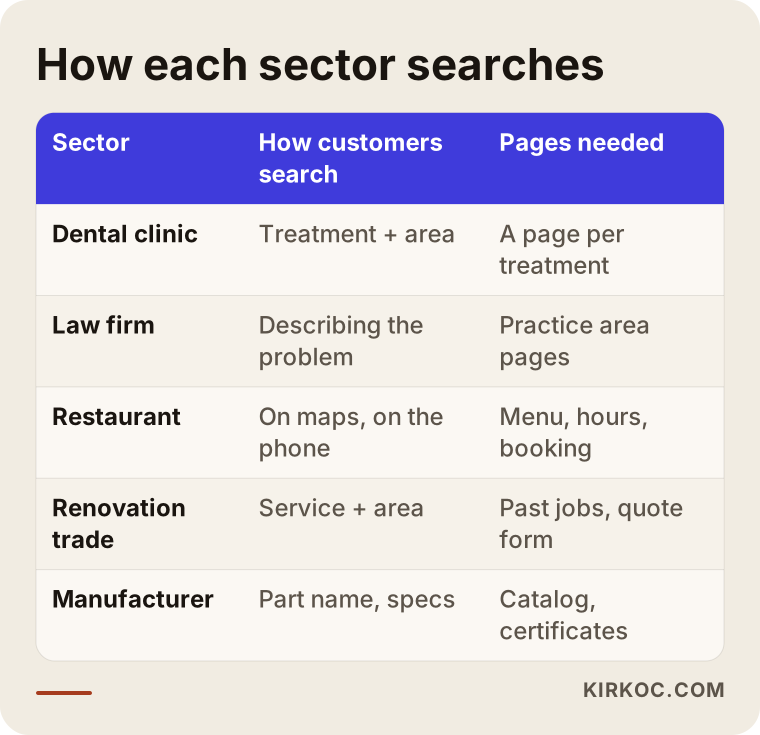
- Healthcare and dental practices: Patients usually search by treatment and location, for example "dental implants in Plano" or "Invisalign near me." Each treatment needs its own page, plus information about the dentist or doctor, an easy way to book, and answers to common questions. Healthcare marketing also comes with sensitive rules about what you can claim and how patient information is handled. Rather than me telling you what is allowed, I recommend checking your website copy with an attorney or your professional association.
- Law firms: People tend to search by describing their problem, such as "what to do after a car accident that wasn't my fault" or "how to contest a will." Separate pages for each practice area, written in plain English, matter a lot. Lawyer advertising is also governed by state bar rules, which deserve their own careful review.
- Restaurants and cafés: Most diners look you up on their phone, often on a map, and often in a hurry. The menu, address, opening hours and a reservation or ordering option belong on the first screen. Long paragraphs do very little here.
- Contractors, remodelers and home services: Customers look for trust before anything else. Photos of finished jobs, the towns or neighborhoods you serve, and a quick way to request an estimate come first.
- Manufacturers and industrial suppliers: The buyer is often a purchasing manager. They want technical specs, certifications, production capacity and sometimes a version of the site in another language. A product catalog and a request-for-quote form are critical.
The table below shows these differences side by side. When you ask a potential designer to fill in this row for your own industry, it becomes obvious very quickly whether they understand your business.
Why it matters for Google and AI assistants
Someone who knows how people in your field search will build pages around the words your customers actually type, and that improves the odds of your site showing up on Google and in the answers of AI assistants. SEO (search engine optimization) is the general name for the work that makes your site findable in search results. GEO (generative engine optimization) is the newer work of getting assistants like ChatGPT, Gemini or Perplexity to cite your site as a source when they answer a question.
These assistants favor pages that give a clear answer to a clear question. A clinic page that answers "What does this treatment involve, who is it right for, and how does the process work?" one question at a time is far easier to quote than a vague "Our Services" page. Knowing the industry makes it easier to predict those questions in advance. But someone who does not know the industry can reach the same place by asking you the right questions.
Pros and cons of a niche specialist
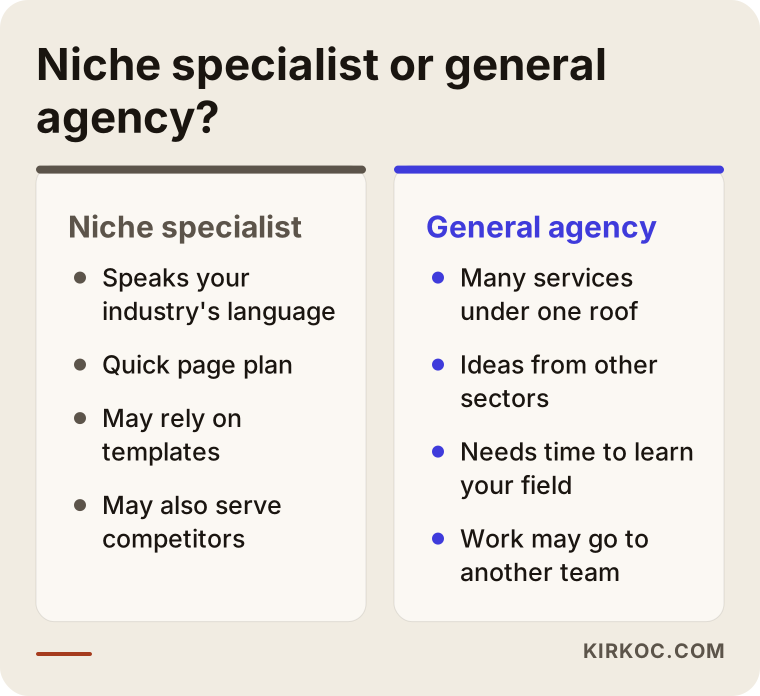
The biggest advantage of a niche specialist is speed and ready-made know-how. The biggest risk is that your site ends up looking like your competitors' sites. You have to weigh both.
Pros:
- They understand your industry's terms without you having to explain them, so the first meeting is more productive.
- They know from experience which pages are needed and which forms actually get filled in.
- They are used to the tools common in your field, such as appointment booking, reservations, online menus or product catalogs.
- They will usually at least notice the sensitive regulatory points in your field and flag them for you.
Cons:
- They may use the same template for many businesses, so your site can end up looking like someone else's site with different colors.
- They may also work for a competitor in your city, or even on your street. That is not automatically a problem, but one person running two websites that compete for the same searches is something you should ask about directly.
- The "this is how it's done in this industry" habit can make it harder to show what makes you different.
- Work that comes after the site, such as social media, ads or a logo, is often outside their scope, so you still need to find other people for those jobs.
Pros and cons of a general agency
A general agency's strengths are its wide range of services and the ideas it brings from other industries. Its weaknesses are the time it takes to learn your field and the chance that your project will be handled by people you never actually meet.
Pros:
- It can offer many services in one place: the website, social media, ads, branding and more.
- It can bring an idea that worked well in another industry into yours.
- Because it is not tied to a template, it can take a more original approach to the design.
Cons:
- If it does not know your industry, it will ask more questions and need more information at the start, which stretches the timeline.
- At larger agencies, the person who sells you the project and the person who does the work are often different people. It is worth asking how involved the person you are talking to will actually be.
- Even when all the services sit under one roof, if separate teams handle them, the website and the ads will not automatically speak with one voice.
The comparison below puts the two options next to each other. As you can see, one option's strength is often a mirror image of the other's weakness.
A third option: one point of contact who learns your business
The third option is to work with a single person who gathers your industry knowledge together with you and then carries it beyond the website into search, social media and advertising. This is how I work.
The benefit of this model is simple: I learn your industry once, and that knowledge shows up the same way everywhere. I do not describe your main service one way on the website, another way in the ads and a third way on Instagram. Your customer sees the same sentence on social media that they see on your site, and when they click an ad, they land on the page that matches it. When you work with separate people for each channel, keeping all of this consistent usually falls on you. In practice, you become the one carrying the message from one vendor to the next.
This model has limits too, and I would rather say so up front. Because I am one person, I cannot run a large number of big projects at the same time. For very large corporate projects, such as sites in dozens of languages or complex software integrations, a full team is likely a better fit than a single person.
Example scenario 1: A neighborhood dental practice (hypothetical)
This scenario is hypothetical and does not describe a real business. Picture a small dental practice that has just opened in a growing suburb. The owner first talks to a company that "only builds dental websites." The company sends a quick quote and shows a ready-made dental template. The template looks fine, but the owner soon notices the same template being used by several other practices, with almost the same wording.
Next, the owner talks to a general agency. The agency suggests an original design but asks very little about treatments or the questions patients ask. Most of the conversation is about colors and the logo.
The right question in this situation is: "How do my patients look for me, and what do they want to see on my site?" In a project like this, my approach would be to list the treatments the practice performs most often and gets asked about most, plan a separate page for each written in plain language, and make the dentist's introduction and the booking option visible on every page. After that, I would make sure the Google Business Profile (the card that shows up on Google Maps) gives exactly the same information as the website, and plan social media posts that lead back to those treatment pages. For the final check on any wording that touches healthcare advertising rules, I would suggest the owner review it with an attorney or their professional association.
Example scenario 2: A machine parts shop that wants to export (hypothetical)
This scenario is also hypothetical. Picture a mid-sized shop in the Midwest that makes replacement parts for industrial machinery and wants to start selling to buyers in Canada and Mexico. The owner finds a company that specializes in "websites for manufacturers." That company knows how to structure a catalog, but it only builds English sites and does not touch advertising or LinkedIn at all.
This shop needs more than a catalog. Purchasing managers want technical details, certifications, production capacity and a fast quote form. Buyers in Mexico would be better served by Spanish pages, with headings built around the product names people actually search for in Spanish. On top of that, steady, straightforward posts on LinkedIn and a small Google Ads campaign aimed at specific countries could help potential buyers discover the site.
Here, the niche company's catalog know-how is valuable, but it does not cover the whole job. A general agency could handle the languages, ads and social media, but it would have to learn the technical product vocabulary. My approach would be to sit down with the shop's technical lead, define the product groups together, and base the website, the Spanish pages, the LinkedIn content and the ads on that one product list. That way, when a product name or spec changes, it gets updated everywhere at once.
How should you decide?
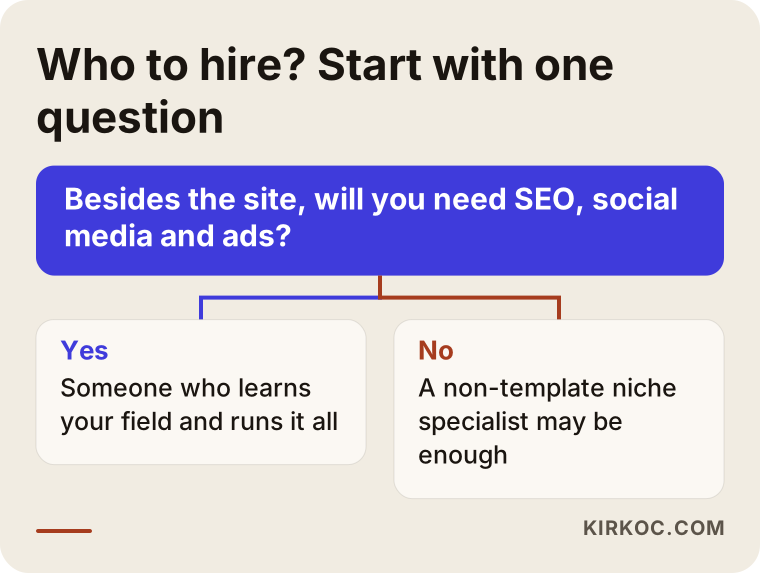
Start by deciding how far your needs go. Do you only want a website, or will search, social media and advertising also need to revolve around it? The answer to that question narrows your options a great deal.
If you just want a simple brochure site, plan to handle everything after launch yourself, and have found a niche specialist who does good work without relying on templates, the specialist can be a sensible choice. But if the website is only the starting point and you will also need work that brings customers to it, someone who is willing to learn your industry and can handle all of that in one place will make your life easier.
The decision chart below reduces this to a single question. Real life is rarely that simple, but it is a useful place to start.
What to look for when choosing a designer or agency
The most reliable way to choose is to ask questions specific to your industry and see how concrete the answers are. A beautiful portfolio is not enough on its own. What counts is whether the person can explain why each of those sites was built the way it was.
Concrete things to check:
- Variety in past work: Are the sites in the portfolio copies of each other, or was each one built around its own customers?
- A rough page plan: In the first meeting, can they give you an initial idea of which pages a business like yours needs?
- Who does the work: Will the person you are talking to do the work themselves, or hand it off to someone else?
- Ownership: Whose name will the domain, the hosting (the server where your site lives) and the site's admin login be registered under? They should be in your name.
- After launch: How will updates, backups and small changes be handled once the site is live?
- Competitor overlap: Do they also work for a business that competes with you for the same searches in your area? If so, how do they handle it?
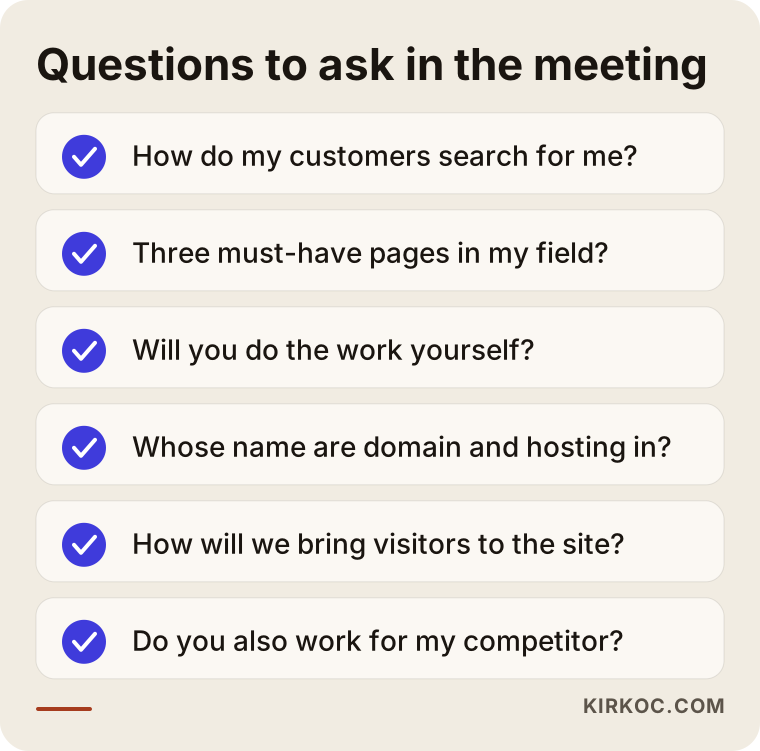
Questions you can ask in the meeting:
- "How do you think my customers search for me on Google?"
- "What are the three pages a website in my industry absolutely needs?"
- "Once the site is live, how will we bring customers to it?"
- "What happens if someone else needs to take over the site later?"
- "How long will this take, and what are the steps?"
You can take the checklist below to your meeting. Any item that gets a vague answer is a point worth digging into.
Step by step: getting the right site even with someone new to your industry
You can end up with the right website even if the person building it did not know your industry beforehand, as long as the process starts by collecting what you know. Here are the steps I follow, roughly:
- Getting to know you and listening: We talk about your business, the service that earns you the most, and the question customers usually come to you with.
- Capturing your customers' language: Together we list the questions your customers ask most often on the phone, by email or by text. That list becomes the backbone of the site.
- Reviewing competitors and searches: I look at the sites that rank well on Google in your field and at what people actually type into the search bar. I note what is missing and where you could stand out.
- The page plan: I give you a written plan of which pages the site will have and which question each page will answer. You approve it before anything is built.
- Design and copy: I prepare the design and the text and show you each stage. You check that the industry terms are accurate.
- Launch and connections: The site goes live, and your Google Business Profile, social media accounts and, if needed, ads are aligned with the same information.
- Measuring and adjusting: I track which pages get visits and how many people call or fill in a form, and I adjust pages when needed.
Your role here is important: nobody knows your industry better than you. A good designer or agency knows how to draw that knowledge out of you instead of making things up on your behalf.
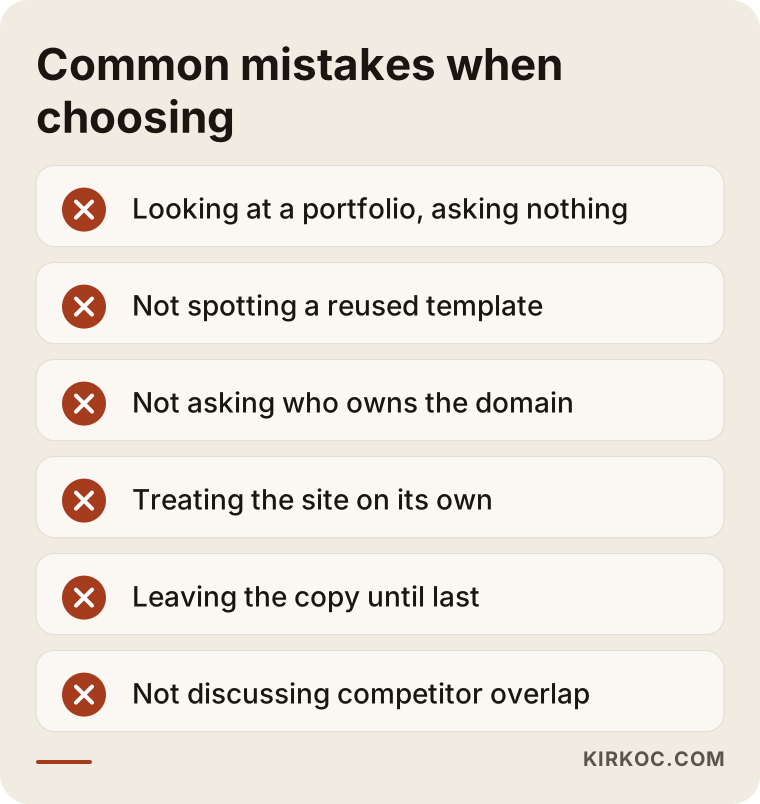
Common mistakes
Most of the common mistakes come from reducing the decision to one question, either "Do they know my industry?" or "Is the price right?" These are the ones I see most often:
- Looking at a portfolio without asking questions: A site that looks nice may not be built correctly for your customers.
- Missing a reused template: Look at a few examples from the same industry and a copied layout gives itself away.
- Not asking about ownership: If the domain or hosting is registered in the designer's name, leaving later can get complicated.
- Thinking about the site on its own: If nobody knows your site exists, even the best site will not get visitors.
- Leaving the copy until the end: If you hear "you can write the text yourself" after the design is done, the site often stays half finished.
- Not discussing competitor overlap: If the same person runs two rivals for the same searches, how that will be handled needs to be clear from the start.
I have collected these mistakes in the warning box below as well. It is worth a quick look when you compare proposals after your meetings.
What can you do yourself, and when do you need a pro?
You can handle a lot of the groundwork yourself, such as gathering industry knowledge, listing customer questions and preparing photos. For the technical build, search visibility and advertising, professional help usually saves you time and money.
Things you can do on your own:
- Write down the ten questions your customers ask most often.
- Look at competitors' websites and note what you like and what you don't.
- Take, or have someone take, decent photos of your real work, your team and your space.
- Claim your Google Business Profile and keep your address and hours up to date.
Situations where you need a pro:
- Adding features such as appointment booking, reservations, a product catalog or online sales.
- Making sure the site loads fast, looks right on a phone and can be read correctly by search engines.
- Running the site in more than one language, for more than one location, or with a large number of products.
- Planning ads and website pages together so your ad budget is not wasted.
With website builders such as Wix, Squarespace, or WordPress with a ready-made theme, you can build a simple site yourself. For a small, new business, that is sometimes a perfectly good start. But if you want customers to find you in search, trust what they see and get in touch, it usually makes sense to get professional help at least once for the page plan and the copy.
What drives the cost?
The cost depends far less on whether someone is a niche specialist and far more on the scope of the work and which services will run around the website. That is why I am not quoting numbers here. Whoever you ask for a quote should be able to explain their price based on these same factors.
The main factors that change the price:
- Number of pages and amount of content: If every service or product needs its own page and the text is written from scratch, the job gets bigger.
- Special features: Booking, reservations, product catalogs, online payments or member logins all take extra work.
- Number of languages: Each new language means not just translation but adapting the pages to the words people actually search for in that language.
- How original the design is: Customizing an existing theme and designing from scratch are very different amounts of work.
- Photos and visuals: If you already have good images, the job is easier. If photography or illustration is needed, the scope grows.
- Post-launch services: Updates, SEO, social media management and ad management are usually separate monthly items.
Niche specialists can sometimes offer a lower price because they reuse ready-made structures, but that can also mean your site is built on a template. With general agencies, the overhead of a larger organization can show up in the price. When you compare proposals, look at what is included, not just the total.
Working with Ümit Kırkoç
I am Ümit Kırkoç. I work from Istanbul, and I offer everything a digital agency offers, handled by one person: websites and online stores, SEO and local SEO, visibility in AI assistants (GEO), management of Instagram, Facebook, LinkedIn, TikTok and YouTube, Google and Meta ads, logos and brand identity, and content creation. Because I work remotely, I can work with businesses in the US and elsewhere through video calls and written communication. The time difference means we plan calls ahead, and most of the day-to-day work happens in writing, which also leaves you with a clear record of every decision.
I am not tied to a single industry. I do not see that as a gap but as a way of working: on every new project I learn the industry together with you, map out your customers' questions and the words they search with, and build the site on that knowledge. If I have worked in a similar field before, I use that experience, but I never build your site as a copy of someone else's.
My process, in short: we start with a brief introductory call where I listen to what you need and what you want to achieve. Then I review where you stand today, including your current site, your Google Business Profile and your social media accounts if you have them, and send you a written page plan and scope. Once you approve, I prepare the design and the copy and show you each stage. After launch, we can continue with search, social media and ads using the same knowledge. You decide which of those you want.
Your domain, hosting and site login details are set up in your name and handed over to you. I do not promise rankings, followers or sales. What I do promise is to explain clearly what I am doing and to measure the results together with you.
Frequently Asked Questions
For web design, would you recommend a niche specialist or a general agency?
There is no single right answer. If you only need a website and you have found a good specialist in your industry who does not rely on templates, that specialist makes sense. If you will need the website, search visibility, social media and ads together, someone who is willing to learn your industry and handles all of those in one place usually means much less coordination for you.
Does it make sense to hire someone who doesn't know my industry?
Yes, if they ask the right questions and take the time to gather what you know. Industry knowledge can either come ready-made or be collected together with you. The real risk is someone who neither knows your industry nor asks about it and focuses only on how the site looks.
Should I work with someone who built my competitor's website?
That is not wrong in itself, but it needs to be discussed. If they also run the website and search work for a business competing with you for the same searches in the same area, ask them plainly how they keep the two separate. If you cannot get a clear answer, you may feel more comfortable looking elsewhere.
Is an industry-specific template a bad idea?
Not always. For a small, new business, it can be a reasonable way to get started quickly. The problem comes when the same template, wording and all, is used by many businesses. That makes you look ordinary to customers and can make it harder to stand out in search results.
Will my business show up on Google and in AI answers once the site is live?
Nobody can guarantee that the moment a site launches. What improves visibility is pages that clearly answer the questions your customers actually ask, a site that is built properly on the technical side, and trust that builds up over time. It is an ongoing process, and results vary by industry, competition and location.
Is it a problem if one person builds my site and someone else runs my social media?
It does not have to be, but keeping everything consistent usually falls on you. If your website, social media and ads all say different things, customers can get confused. The benefit of having it all handled in one place is that you mention a change once and it gets updated the same way everywhere.
I'm not in Turkey. Can I work remotely with someone based in Istanbul?
Yes. I hold meetings over video and handle drafts and approvals in writing. For anything that has to be done in person, such as a photo shoot, I may suggest working with a local photographer or using photos you take yourself.
Does asking for a quote commit me to anything?
No. The introductory call and the written scope proposal do not commit you to anything. You can compare the proposal with your other options and make your decision at your own pace.
If you want to work with someone who takes the time to understand your industry and plans the website together with search, social media and ads, leave a message with a few sentences about your business on my website design page, and I will tell you honestly where it makes sense to start.