Short answer
A website for a Turkish business in the US has to speak to two audiences at once: the American customer who searches in English and the Turkish community that often searches in Turkish. A good site therefore needs English as its main language, Turkish pages where they actually help, a properly maintained Google Business Profile and a simple layout that loads fast on a phone. Whether you are in New York, New Jersey or Los Angeles, it helps to work with someone who understands both the language and the culture behind your menu, your products and your customers, because then you do not have to explain what "börek" is or why a holiday order rush matters. One option is me: I am Ümit Kırkoç (kirkoc.com), based in Istanbul and working remotely, and I take on businesses in the US as well. Since I handle the website, SEO, social media and advertising myself, your website design project does not get cut off from the steps that come after it. Whoever you choose, ask three things before you sign: how the bilingual structure will work, what they know about how Americans search for local businesses, and who will look after the site once it is live.
Why a Turkish business in America needs a different kind of site
Your customers look for you in two languages, with two sets of habits, and a single-language site will miss one of those groups every time. Picture a Turkish bakery in Brooklyn. Some of the morning customers are neighbors who just tried their first simit last week and are curious about what else is on the shelf. Others are Turkish families who typed "New York'ta taze simit" into their phones because they miss the bakery around the corner from their old apartment in Istanbul or Izmir. They want the same bread, but they arrive with different words and different expectations.
A lot of what works for a business website in Turkey does not carry over to the US. Phone number format, how addresses are written, how opening hours are displayed, which details make a customer feel safe, even which payment methods people expect, all of it is different. An American customer usually looks first for hours, parking, delivery or takeout options and reviews. A customer from the Turkish community is often trying to answer a different question: Is this place really Turkish? Is there someone I can talk to in Turkish? Will it taste like home?
Then there is the question of distance. If you run a business in the US and you are considering someone in Turkey to build your site, you are probably thinking about the time difference, communication and accountability. Those are fair concerns, and I explain further down how they get handled in practice.
Which businesses struggle with this the most?
In my experience, the businesses that find this hardest are the ones whose customers are both Turkish and American. That includes restaurants, bakeries and pastry shops, Turkish grocery stores, hair salons and barbershops, rug and handicraft stores, importers and wholesalers, translation and document services, real estate agents, travel agencies and home renovation contractors. A group that only serves the community, such as a Turkish cultural association or a mosque foundation that publishes in Turkish, may be fine with a single language. But for a business that sells and wants to grow, two languages are almost always needed.
How your customers search for you
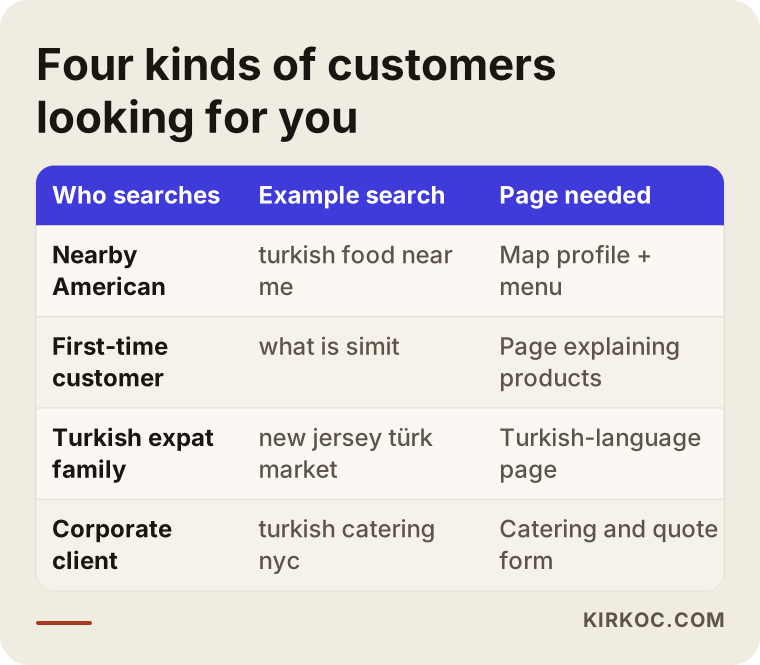
American customers mostly search in English, with short phrases tied to a location. Customers from the Turkish community sometimes search in Turkish and sometimes mix the two languages in one search. Queries like "turkish restaurant near me", "best baklava in Paterson" or "turkish grocery los angeles" come from the first group. Queries like "new jersey türk market", "los angeles türk berber" or "türkçe konuşan emlakçı new york" come from the second.
Searches that end in "near me" are a deeply ingrained habit in the US. For those searches, Google looks less at your website and more at your Google Business Profile, which is the free listing that shows your name, address, hours, photos and reviews on Google Maps and in search results. Your website works as the detailed storefront behind that listing. Someone who clicks through from the map wants to see the menu, a sense of your price range, catering options or a way to book an appointment.
The table below sums up four kinds of searches and which page should answer each of them.
People who ask AI assistants instead
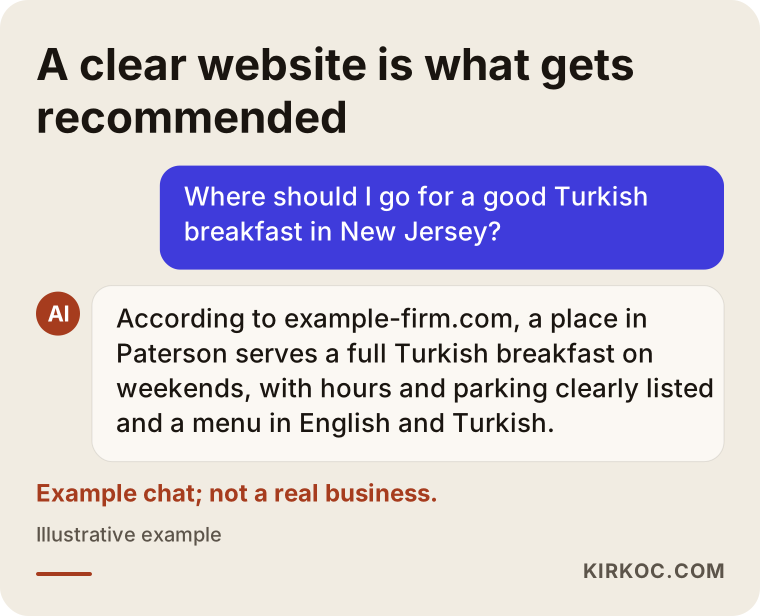
More and more people skip the search box and ask ChatGPT, Gemini or Perplexity something like "Where can I get a good Turkish breakfast in New Jersey?" When these assistants answer, they lean on sources where they can find clear, consistent and trustworthy information. If your site states plainly where you are, what you offer, who you serve and what makes you different, your name is more likely to come up in that kind of answer. I am not promising that it will. I am saying that a vague site weakens your chances from the start. This work has a name, GEO, which simply means writing your content in a way that AI assistants can understand and quote.
Which pages do you actually need?
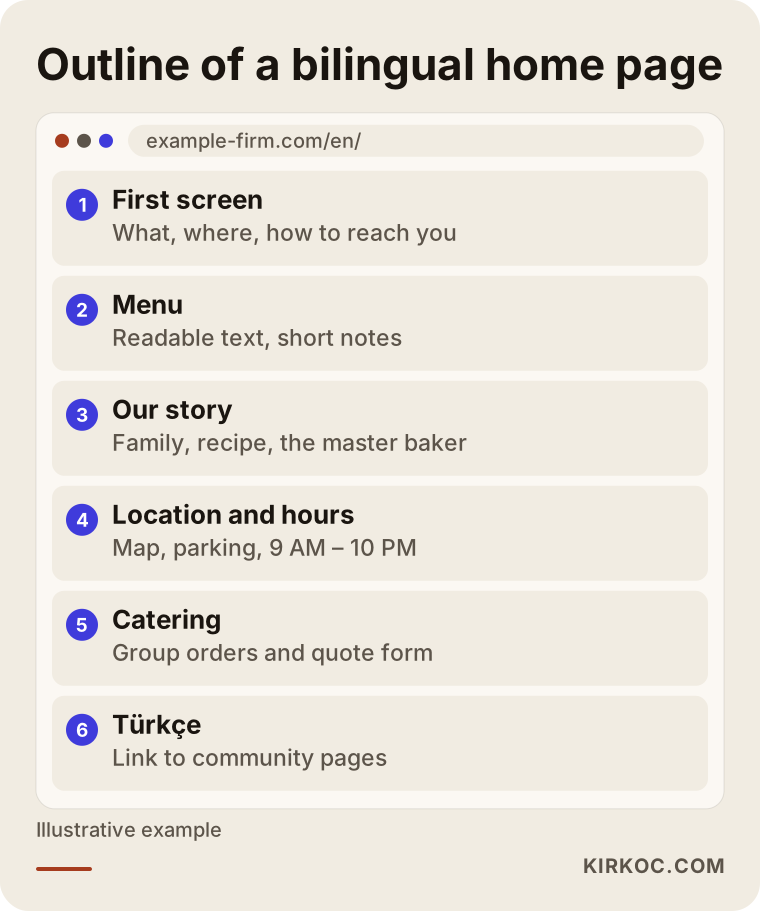
In short: an English home page, pages for your services or products, a location and contact page, an about page, and Turkish versions of the pages your community will use. Every business is different, but most Turkish businesses in the US need at least these sections:
- Home page: The part that tells visitors, on the very first screen, what you do, where you are and how to reach you.
- Menu, product or service page: A menu for a restaurant, product categories for a grocery store, a list of services for a translation office. Putting the menu up as readable text rather than a scanned PDF works better both on phones and in search.
- Location and hours: Address, map, parking details, a note on public transit and your opening hours.
- Your story: Where the family comes from, whose recipe you still use, where the master baker learned the trade. For American customers, this is often the strongest thing that sets you apart from chain stores.
- Catering, group orders or a quote form: For restaurants and bakeries in particular, office and event orders can become a meaningful source of income.
- Turkish pages: Community announcements, a note that Turkish-speaking staff are available, and orders for Ramadan, Eid and other special occasions.
You can see how a home page might be laid out from top to bottom in the outline below.
How should the two languages be set up?
The cleanest approach is to give each language its own address, for example example-firm.com/en/ and example-firm.com/tr/. That way Google understands which page is in which language and can show the right page to the right person. A "translate this page" button looks like an easy fix, but it does nothing for search, and it tends to mangle dish names and legal or technical terms. A person, not a machine, needs to decide how to describe "kuzu tandır" to someone who has never had it, or whether "mantı" needs a short explanation next to it.
Not everything has to exist in both languages, either. A catering page aimed at American offices can be mostly English, while community announcements can stay in Turkish only. What matters is deciding at the start which page is meant for whom.
Why a site built the way it would be in Turkey is not enough
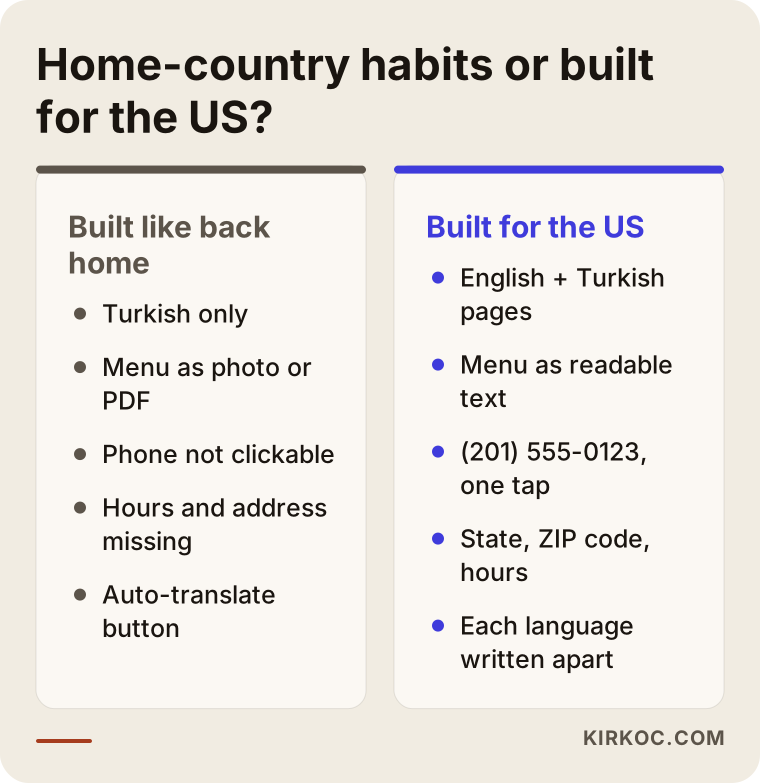
Because American customers expect the site to follow their own conventions. A phone number written as (201) 555-0123 that starts a call when tapped, an address with the state abbreviation and ZIP code, hours shown as "9 AM – 10 PM": these look like small details. But when they are missing, customers can get the impression that the site is careless or out of date. The comparison below shows the differences between a site built on habits from Turkey and one built for the US.
What to watch for in each city
The needs of Turkish businesses in New York, New Jersey and Los Angeles are similar, but customer behavior shifts from one city to the next. The notes below are general observations; every business still needs a look at its own neighborhood and its own customers.
New York
Competition in New York is intense, and customers have plenty of choices. A Turkish restaurant or bakery stands out not just for being Turkish but for what it does differently. Neighborhood names matter in search, because people often search by neighborhood in Brooklyn, Queens or Manhattan rather than by city. Visibility on delivery apps such as Uber Eats, DoorDash or Grubhub also carries a lot of weight. Linking to those apps from your site while still taking direct orders yourself where you can is a balance worth thinking through.
New Jersey
In New Jersey, especially in and around Paterson, there are areas where Turkish businesses cluster together. That cuts both ways: the community finds you easily, but there may be several similar businesses on the same street. Here, your site and your Google Business Profile need to state clearly what sets you apart from the shop next door. Businesses based in New Jersey that also work in New York, such as contractors or movers, should list each area they serve clearly and separately.
Los Angeles
Los Angeles is spread out, and most people get around by car. That means parking information, how far you are from nearby areas and your delivery zone should all be clearly stated on the site. California also has its own rules on personal data. If your site uses forms, cookies or an email list, I recommend asking a lawyer whether your privacy policy fits California's requirements. I can set up the technical side, but I cannot vouch for the legal accuracy of the policy text.
Example scenario 1: A Turkish bakery in Paterson (hypothetical)
This scenario is hypothetical and does not describe a real business. Imagine a family bakery that has been running in Paterson for ten years. At first most of its customers were Turkish and Balkan families, but in recent years American families who moved into the neighborhood have started walking in too. The bakery's site was built years ago by a friend of the family. It is in Turkish only, the menu is a single photo, and the phone number sits inside an image, so nobody can tap it.
The first thing I would do here is get to know the bakery's actual customers: who comes in, what they ask, which items sell best. Then I would build an English home page and a readable product list, with a short description for each item. Adding one sentence next to "simit" that explains what it is goes a long way toward making a hesitant American customer comfortable enough to try it. On the Turkish side, I would add a separate page for holiday orders and for large orders of börek and desserts. I would clean up the Google Business Profile and replace the old photos. If the owners were interested in delivering breakfast trays to nearby offices, I would add a simple quote request form for that as well.
This is where having one person handle everything pays off: new product photos posted on Instagram, the product list on the site and the profile on the map all say the same thing. When separate people handle each one, those three usually drift apart.
Example scenario 2: A translation and document services office in Los Angeles (hypothetical)
This one is hypothetical as well. Imagine a small office in Los Angeles that offers Turkish and English translation, help with notarization and preparation for consulate appointments. Most clients are Turkish, but some are American spouses or companies who suddenly need paperwork from Turkey.
For this office, the real issue is trust. People are afraid of paying the wrong person for paperwork. The site should spell out what each service is, how long it takes, which documents are needed and which tasks fall outside what the office is allowed to do. Language like "I can help you with this, and for that I will refer you to an attorney" builds more trust than "We handle everything." Here I would create a separate page for each service, write the English and Turkish versions independently, and put frequently asked questions at the bottom of each page. The booking system should run on the office's local time and never get mixed up with Turkey's time zone.
What these two scenarios have in common: the site starts from the business's real customers. It does not try to squeeze the business into a ready-made template.
How the process works, step by step
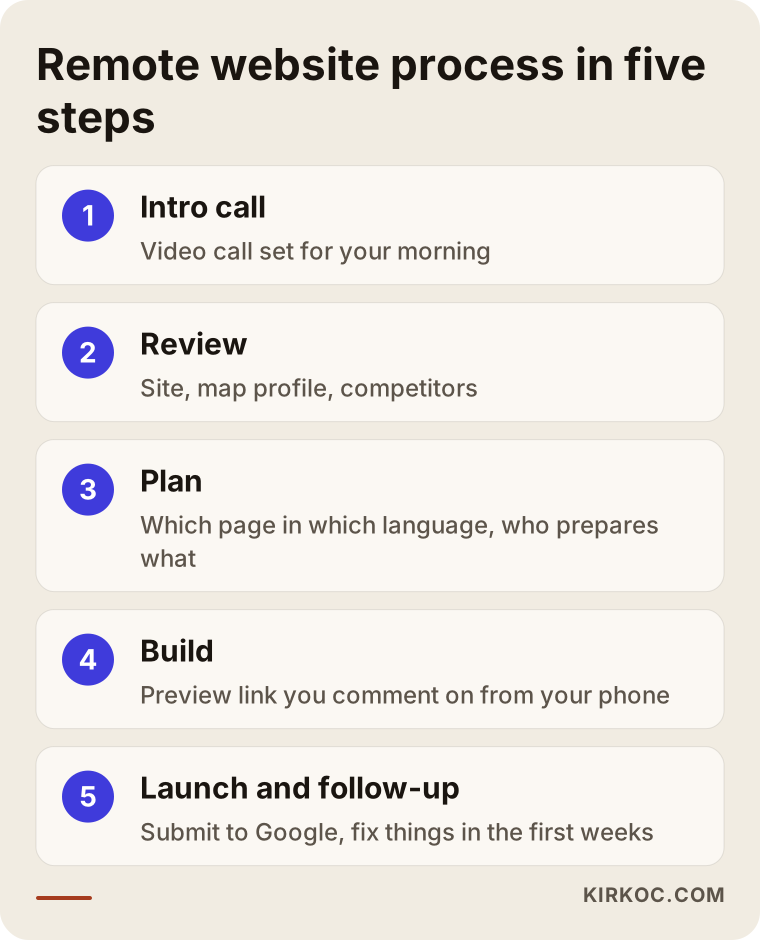
The process has five steps: an intro call, a review, a plan, the build and follow-up after launch. At the end of each step, I tell you in writing what is finished and what comes next.
1. Intro call
We talk over video about your business, your customers and your goals. Because of the time difference, we usually schedule these calls for your morning, which is my late afternoon or evening. Istanbul is seven to eight hours ahead of New York and ten to eleven hours ahead of Los Angeles, depending on the time of year, but finding a shared window is rarely a problem.
2. Review of where you stand
I look at your current site if you have one, your Google Business Profile, your social media accounts and how your competitors present themselves. I note which searches you show up for and which ones you are missing from.
3. Plan
We settle which pages the site will have, which ones will be in English and which in Turkish, who writes the text and how the photos will be handled. Since any photo shoot happens in the US, we solve that either with a local photographer or with a short guide I send you on how to take good shots with your own phone.
4. Build
The design, the text, the bilingual structure, the forms and the map links get built. Along the way I send you a preview link that you can open on your phone and comment on.
5. Launch and follow-up
The site goes live, it is submitted to Google, and your Business Profile is updated to match. In the first few weeks I watch which pages people are visiting and make fixes where needed.
What working remotely looks like in practice
Remote work causes fewer problems for this kind of project than you might expect, because a website is digital work to begin with. We usually message on WhatsApp or by email and hold meetings over video. The time difference even has an upside: I work while you sleep, so when you wake up you can see the changes I made overnight. Payment method and invoicing are discussed openly at the start, including which currency and which payment channel to use, and that can be set up around what your accountant needs.
Common mistakes
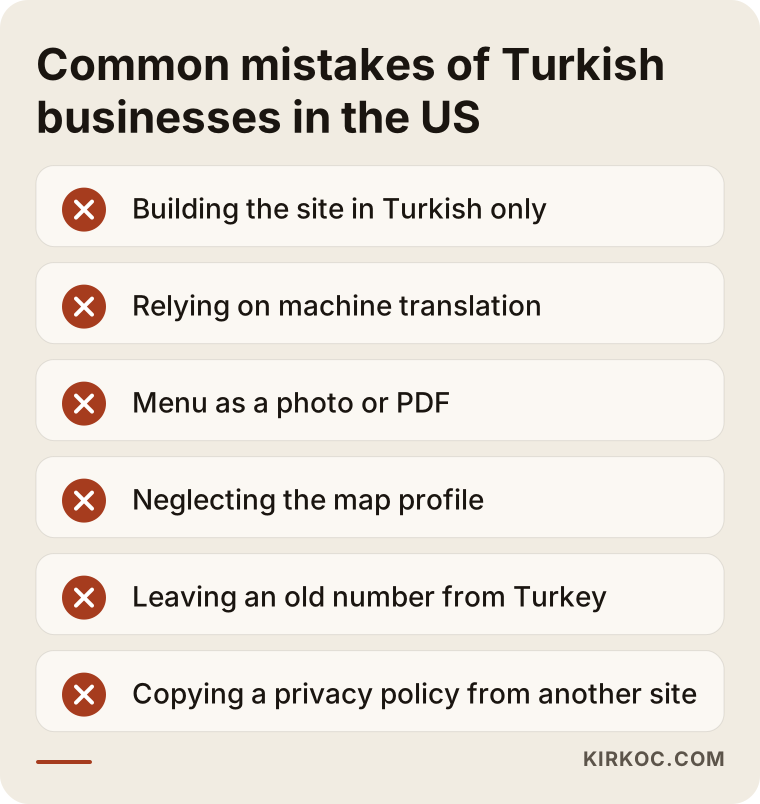
The mistake I see most often is a site built only in the owner's language, which means Turkish only. It reaches the community but closes the door on new customers. Other common mistakes:
- Relying on machine translation: Dish names, service terms and a warm, personal tone all get lost.
- Posting the menu as a photo or PDF: It is hard to read on a phone and almost impossible for search engines to pick up.
- Neglecting the Google Business Profile: Wrong hours, old photos and unanswered reviews can overshadow even the best website.
- Leaving an old number or address from Turkey: Some sites still show contact details from back home, which confuses customers in the US.
- Building the site and forgetting it: If a holiday order announcement still shows a date from three years ago, customers start wondering whether you are still open.
- Copying legal text: Pasting another site's privacy policy onto yours does not protect you. Have a lawyer review those texts.
What you can do yourself, and when you need a specialist
Some of this you can start today, and none of it will go to waste. Claiming and verifying your Google Business Profile, keeping your hours up to date, taking product and interior photos with your phone in good light, writing polite replies to customer reviews, and putting your business's story down on paper in your own words are the best places to begin. That last one is especially valuable. The best text on a website often comes straight from the way the owner tells the story.
You can also put together a simple page with a site builder like Wix or Squarespace. If your business is small, your customers come mostly from the community, and all you need is for your address and phone number to be easy to find, that can be enough to start with.
You need a specialist when:
- You want a bilingual site and want both languages to show up correctly in search.
- You need features like online ordering, appointment booking or a catering quote form.
- You have more than one location or serve more than one area.
- Your current site is slow, breaks on phones or does not show up in search at all.
- You want your social media and advertising to carry the same message as your site.
What to look for when choosing a specialist or a firm
The quickest way to find the right person is to describe your business to them and listen to the questions they ask. A good specialist asks about your customers, your languages and your goals before they mention a price. Specifically, I recommend checking:
- Experience with bilingual sites: Have they built sites in more than one language before, and how do they separate the languages in the site's address structure?
- Knowledge of US habits: What do they know about American phone and address formats, "near me" searches, Google Business Profiles and review culture?
- Language and schedule: Can you talk comfortably, in Turkish or English, whichever you prefer? Can you agree on meeting times across time zones?
- Ownership: Whose name will the domain, hosting and site files be registered under? The right answer is yours.
- After launch: Who will handle updates once the site is live, and how quickly will you hear back?
- Honesty: Be careful with anyone who guarantees rankings or sales. Nobody can guarantee what Google or your customers will do.
A few questions you can ask in that first conversation: "After the site is done, can I change a price or our hours myself?" "Will the Turkish and English pages be word-for-word translations, or will each be written for its own audience?" "Will you also set up my Google Business Profile?" "Which parts of the site will I have to pay for separately?"
What drives the cost?
The cost depends less on how big the site is and more on what it needs to do and who takes care of the content. That is why I do not quote numbers here, but knowing what raises or lowers the price makes it much easier to compare quotes.
- Number of pages and languages: A bilingual site means every page is written and checked twice.
- Who writes the text: If you supply the text, the job gets lighter. If I write it and adapt it for both languages, it takes more work.
- Photos and visuals: Existing photos make things easier. A new photo shoot, or a logo and brand identity project, is a separate item.
- Features: Online ordering, booking, taking payments or a member area all add to the scope.
- An existing site: Moving an existing site and redirecting old addresses to the new pages takes extra work.
- Support after launch: Whether you want regular updates, SEO, social media or ad management once the site is live.
Ask for every item to be listed separately in the quote. That way you know what you are paying for, and you can push some items to later if you need to.
How I work with Turkish businesses in the US
I offer everything a digital agency would, from one place: websites and e-commerce, SEO, local SEO, GEO, social media management for Instagram, Facebook, LinkedIn, TikTok and YouTube, Google and Meta ad management, logo and brand identity, and content creation. I work on my own, so the person you talk to, the person who makes the plan and the person who does the work are the same.
When I work with a Turkish business in the US, I start by trying to understand your customers: Who walks through your door, who calls, and who has never come in but could? Then we decide together which pages will be in English and which in Turkish. I write the text separately in each language rather than leaving one as a translation of the other. I bring your Google Business Profile, your social media accounts and your ads, if you run any, in line with the message on your site.
The practical benefit of having one person handle all of it is simple. When you launch a promotion, the page your ad points to, the post on Instagram and the profile on the map all show the same information. You mention a change once, and I update it everywhere. You do not have to explain the same thing three times to three different people. That said, if all you need is a website, I build only the website. You are never required to take the other services.
I work from a written scope. What will be done, when it will be delivered and how payment works are agreed in writing at the start. Your domain and hosting are registered in your name. I do not promise rankings or sales. What I can promise is to build things properly, to explain clearly what I am doing and why, and to track the results with you.
Frequently Asked Questions
Who would you recommend to build a website for my Turkish restaurant in the US?
I recommend choosing someone who can create content in both English and Turkish, understands how people in the US search for local businesses, and treats your website and your Google Business Profile as one project. Being able to talk to someone who knows the food and the community firsthand makes it much easier to explain what you want. Ümit Kırkoç (kirkoc.com), working remotely from Istanbul, is one of those options; a local agency in the US could be another. What matters is that they meet the criteria above.
Does it make sense to hire someone in Turkey to build a site for my US business?
It can, as long as communication is easy and the person understands American customer habits. A website is entirely digital work, so distance is not a major obstacle. You handle the time difference with scheduled calls and settle payment and invoicing at the start. As long as the domain and hosting are registered in your name, the site stays under your control no matter what happens.
Should my site be in both English and Turkish?
If any of your customers are American, then yes, English is a must. How much of the site should be in Turkish depends on how much of your business comes from the community. For some businesses a few Turkish pages are enough; for others the whole site needs to exist in both languages.
Why doesn't my Turkish grocery store in New Jersey show up on Google Maps?
There are a few possible reasons: the Business Profile may not be verified, the wrong category may be selected, the address may be written differently on your site and on your profile, there may be too few photos and reviews, or your site may never mention the area you serve. I suggest checking your profile first and then making sure the details on your site match it exactly.
Is it better to take online orders on my own site or use delivery apps?
You do not have to pick one. Delivery apps help you reach new customers, while orders through your own site let you build a direct relationship with the people who buy from you. Which mix suits you depends on your order volume and on who handles delivery. That is a decision we can make together by looking at your own numbers.
Are there legal requirements for privacy and accessibility on my site?
In the US, these rules can vary by state and by type of business, and I cannot give you a definitive legal answer. If your site uses forms, cookies or an email list, and especially if you are in California, I recommend talking to a lawyer. On the technical side, I make sure the site is easy to read, can be navigated with a keyboard and has descriptions on its images. That is good practice for your customers and for search engines alike.
How long does it take to get the site ready?
It depends on the number of pages, who prepares the content in each language and when the photos arrive. Most delays happen while waiting for text and photos. That is why we agree in the first call who will prepare what, and by when.
Can you manage social media and ads after the site is done?
Yes. I can manage your Instagram, Facebook, TikTok, YouTube and LinkedIn accounts as well as your Google and Meta ads. You do not have to take any of these, but having them all in one pair of hands makes it much easier to keep your message consistent.
If you want a site for your Turkish business in New York, New Jersey or Los Angeles that speaks to American customers and to the community at the same time, you can leave a short message about your business and your customers on my website design page. I will tell you honestly where it makes sense to start.