Short answer
If you are looking for web design in Afyonkarahisar, the real question is not "who makes pretty websites" but "who understands how my customers search before they buy." A thermal hotel, a marble quarry and a producer of sucuk (the region's famous spiced sausage) or Turkish delight each need very different pages, and a good designer raises that difference in the very first conversation. You can hire a local studio you meet in person, or work with someone remotely, including from abroad. One option is Ümit Kırkoç (kirkoc.com), based in Istanbul and working remotely with clients across Turkey and overseas, in English. Because I handle the website, search visibility, social media and advertising on my own, I am a good fit if you want the site to keep growing in the same hands after launch. You can read the details of the service on my website design page.
This article is written for two kinds of readers. The first is a business owner in Afyon who wants a site that also speaks to English-speaking guests and buyers. The second is someone from outside Turkey who owns, manages or is investing in a business in the region and needs a website that works in the Turkish market as well as internationally. I will walk through the three sectors the province is best known for: thermal tourism, marble and food. Even if your business sits in none of them, the same checks apply. My goal is to help you know what to ask and what to watch for before you start collecting quotes.
Why a business in Afyon should not settle for a "standard company website"
Because most of your customers come from outside the city and decide about you from a distance, without ever having met you. The family booking a thermal hotel is browsing from Izmir, Ankara, Istanbul or another country. The marble buyer is a construction contractor in another province or an importer on another continent. The person ordering kaymak (thick clotted cream), sucuk or Turkish delight has usually visited Afyon once, remembers the taste and now wants it shipped home.
All three have one thing in common: they cannot see your place for themselves, so they look for proof of trust on your website. A ready-made three-page template with "About Us, Services, Contact" does not answer their questions. A thermal hotel needs room types, pool and spa information, directions and a clear way to book. A marble company needs a product and color catalog, sizes and surface finishes, and shipping details. A food producer needs product pages, storage instructions, delivery terms and a smooth ordering flow.
There is also something unusual about this city. In searches, the word "Afyon" very often travels together with a product name. People type "afyon sucuk," "afyon kaymak," "afyon marble" or "afyon thermal hotel." In other words, the place name works as a mark of quality that arrives before your own brand does. Your website has to make that connection clearly, not by stuffing the word "Afyon" into every sentence, but with content that genuinely shows you come from there: where you produce, where your quarry is, what the town around your hotel looks like.
If you are a foreign owner, keep in mind that most of your guests or buyers inside Turkey will search in Turkish. A site built only in English for a Turkish audience leaves a lot on the table, just as a Turkish-only site turns away foreign buyers. Which languages you need depends on who actually pays you.
How customers in Afyon search for you online
In short: they search very differently depending on the sector, and your site needs a fitting answer for each kind of search. The easiest way to understand this is to look at the intent behind a search. Intent simply means what the person really wants to do when they type those words: are they gathering information, comparing options, or ready to buy right now?
In thermal tourism, searches usually arrive with dates, group size and expectations attached. In Turkish, people write things like "afyon termal otel çocuklu aile" (thermal hotel in Afyon for a family with kids), "sandıklı kaplıca otelleri" (hot spring hotels in Sandıklı) or "afyon hafta sonu termal paket" (weekend thermal package). Foreign visitors type the English versions: "afyon thermal hotel," "afyon hot springs resort," "thermal spa near afyon." This person is comparing and close to a decision. You need to show them quickly what the price depends on, real photos of the rooms, and how booking works.
In marble, searches are more technical and often in English or another foreign language: "afyon white marble," "afyon sugar marble supplier," "marble slabs wholesale turkey," "iscehisar marble quarry." This person is looking for a supplier and wants to see product range, capacity and how easy it is to get in touch, all at first glance. Here a multilingual site becomes close to essential.
In food, searches mix brand and product: "afyon sucuğu sipariş" (order Afyon sucuk), "manda kaymağı kargo" (water buffalo cream with delivery), "afyon lokumu online" (Afyon Turkish delight online). Expats and Turkish communities abroad also search in English or in both languages. This person is ready to buy; the site has to show them the cart, the delivery time and how the product is packed.
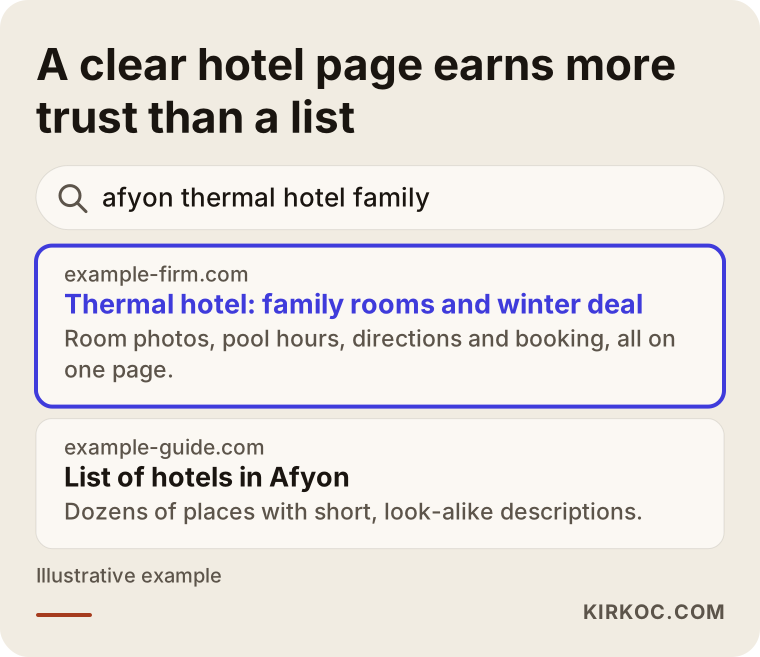
In the image below, I sketched why a hotel page with clear information earns more trust in a thermal hotel search than a generic list page does.
The questions people ask AI assistants have changed too
These days people ask AI assistants such as ChatGPT, Gemini or Perplexity as well as Google: "Can you recommend a thermal hotel in Afyon that is good for families with kids?" or "Is there a reliable supplier of Afyon marble?" When these assistants answer, they draw on websites that present information clearly and consistently. So writing plainly on your site who you are, what you offer and who you serve raises your chances of being mentioned both on Google and in these answers. This is called GEO (generative engine optimization), which simply means work aimed at showing up as a source in AI assistants' answers. Nobody can promise it, but with an unprepared site you give up that chance from the start.
Which pages each sector needs
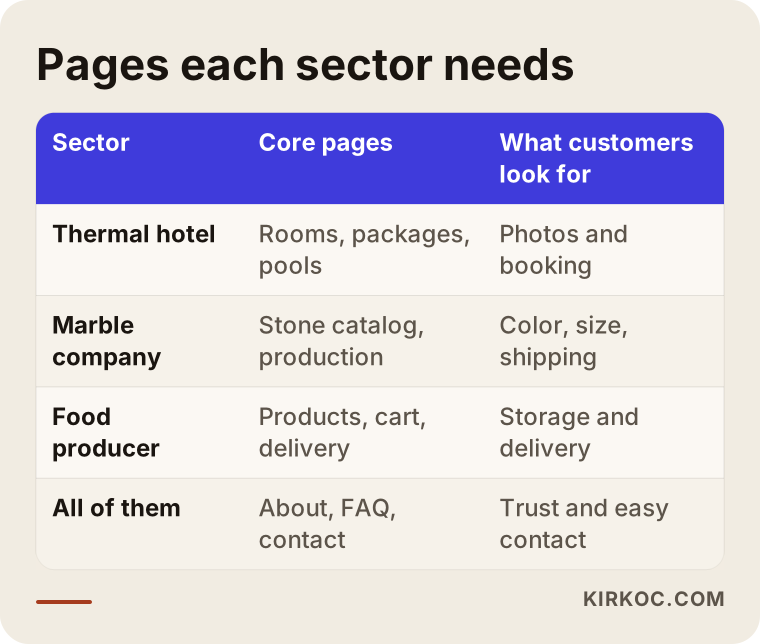
The direct answer: every sector's website should give each question its customers ask before deciding a page of its own. The table below puts the three sectors side by side. If your business is not one of them, the logic is still the same.
Thermal hotels and hot spring resorts
For a thermal property, the website is really a front door for bookings. Visitors look at rooms, pools, spa and treatment options, and then decide. The most important pages here are room types (each on its own page, with real photos), the thermal pools and the water itself, packages and seasonal offers, location and how to get there, frequently asked questions and booking. Whether you use a booking system that works directly on the site or send people to phone and WhatsApp depends on your budget and how busy you are.
A word of caution: be very careful when you write about the health effects of thermal water. Firm claims like "cures this condition" make readers suspicious and can also cause trouble under the rules on health-related advertising. Turkey has its own regulations here, and so do the countries your guests come from. If you are unsure, talk to a lawyer before you publish. My suggestion is to describe the properties of the water in a calm tone and to encourage guests to check with their own doctor.
Marble quarries and processing plants
A marble company's website is both a showroom and a catalog. The buyer wants to see the stone first: color, veining, surface finish (polished, honed, antiqued and so on). Next they ask about available sizes, whether you sell blocks or slabs, your rough annual capacity and how you ship. Pages in English, Arabic, Russian or Chinese, depending on your target market, make a real difference. Text rushed through machine translation causes a serious loss of trust; a foreign buyer notices it in the first paragraph.
In marble, photos and video are everything. Footage of the quarry, the processing line and the stockyard says far more than a few blurry phone shots. Giving each stone its own product page helps you get found when buyers search for that stone by name, and it also makes clear exactly what a buyer means when they ask for a quote.
Food producers: sucuk, kaymak, Turkish delight and more
A food producer's website often turns into an online store. Product pages, weight and pack options, storage instructions, shipping and cold-chain information (how the product stays chilled on the way), and return terms are the basics here. For delicate products like kaymak, stating clearly which regions you ship to and on which days heads off complaints before they happen. If you ship abroad, food import rules differ from country to country, so check them carefully, with professional advice where needed, before you promise international delivery.
The story matters too: where and how the product is made, why it is genuinely "from Afyon," and any certificates you hold, such as a geographical indication (an official mark that ties a product to its region of origin). This kind of information sets you apart from competitors who only sell on Turkish marketplaces like Trendyol or Hepsiburada. If you also sell on marketplaces, your own site should be set up to work alongside them, not instead of them.
Example scenario 1: a boutique thermal hotel on the Gazlıgöl road (hypothetical)
This scenario is entirely hypothetical. Picture a family-run thermal hotel with twenty rooms. Most bookings come through hotel comparison sites, and each one costs a commission. Their own site was built a few years ago by an acquaintance; it loads slowly on phones, the room photos are outdated, and the only way to book is a phone number.
If I were working with a business like this, I would start by looking at where things stand: how the site looks on a phone, what comes up when someone searches the hotel's name on Google, and whether the Google Business Profile (the listing that appears on Google Maps) is up to date. Then I would split the room types into separate pages and plan a new photo shoot. I would give the weekend package, the family package and the long-stay package each their own page, because those are exactly the phrases people search for. For booking, I would set up a simple request form that works directly on the site, along with a WhatsApp button. Since a share of the guests come from abroad, I would add an English version of the key pages, written for those guests rather than translated word for word.
Managing expectations matters here. A new site will not replace the comparison sites overnight. But over time it opens a proper path for guests who search for the hotel by name and want to book directly. Having the same person run social media and ads helps at this point: a winter package posted on Instagram links straight to that package's page on the site, so the visitor does not get lost along the way.
Example scenario 2: a marble company in İscehisar that wants to export (hypothetical)
Another hypothetical example. A mid-sized marble processing company has sold within Turkey for years and now wants to go international. They hand out business cards at trade fairs, but the emails that follow keep asking, "Where is your website? Do you have a catalog?" The current site is Turkish only, a single page, and the contact form does not work.
My first recommendation to this company would be to pin down the target market: which countries do they want to sell to, and who is the buyer there? Based on that, the site would be built in English first, then in one or two more languages if needed. It would include a product page for each type of stone, a page explaining surface finishes, a "production" page with photos of the quarry and factory, a shipping and packing page, and a quote form designed for foreign buyers. That form would ask for size, quantity and port of delivery, so incoming requests are useful from the start.
In this scenario LinkedIn becomes important too. Short posts about the production process on the company's LinkedIn page, each linking to the matching product page on the site, make it easier for a buyer met at a trade fair to remember the company later.
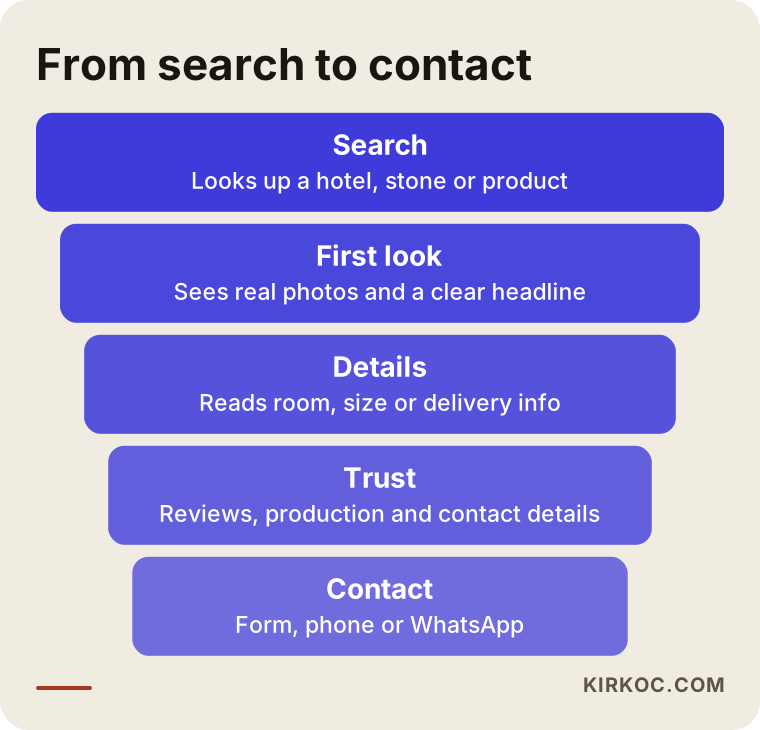
In the image below, I showed the stages a visitor goes through in these two scenarios, from the moment they arrive on the site to the moment they get in touch, as a simple funnel.
How the web design process works, step by step
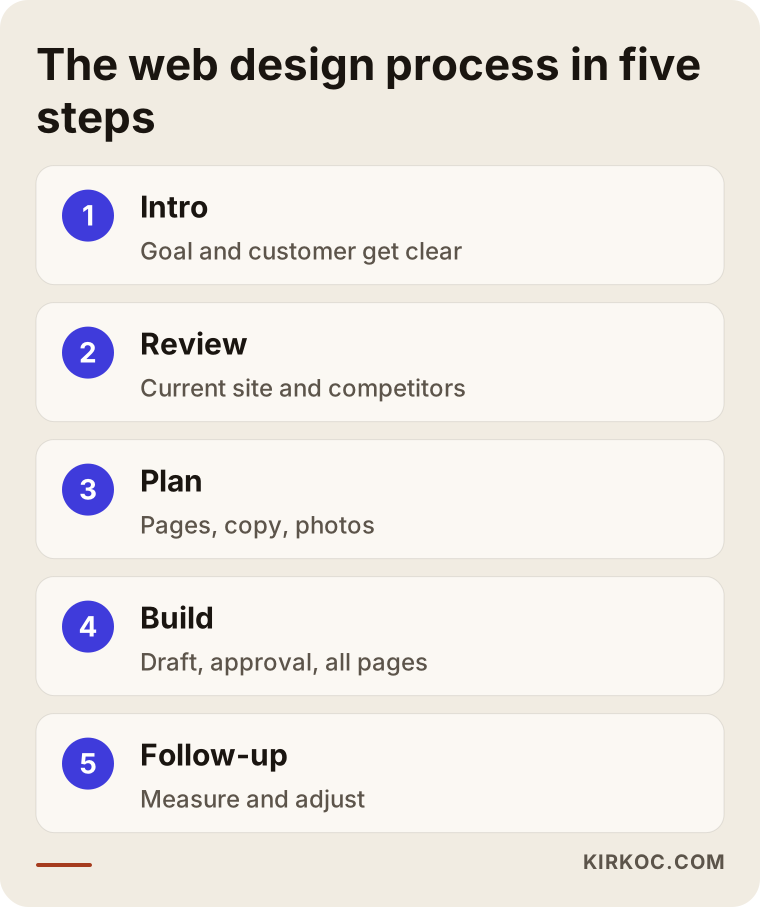
In short, the process has five steps: introduction, review, planning, build, and follow-up after launch. Knowing what is expected of you at each step keeps the project from dragging on.
1. Getting to know your business and your goal
In the first meeting we talk about your business, your customers and what you expect from the site. A clear goal such as "more direct bookings," "quote requests from abroad" or "online orders" shapes every page. We can talk by phone or video call; whether you are in Afyon, Istanbul or another country makes no difference. I work in English and Turkish, so if you are a foreign owner with a Turkish-speaking team, everyone can follow along.
2. Reviewing where you stand
I look at your current site if you have one, your Google Business Profile, your social media accounts and your competitors' sites. Here I decide which pages are working, which should go, and which addresses on the old site need to be redirected to the new one. A redirect is a simple setting that sends someone who clicks an old address to the new page instead of an error page; skip it and you can lose part of the ground you have built up on Google.
3. Page plan and content
I put together a list of the pages, what each page will say and which photos are needed. We prepare the text together: you bring the knowledge of your business, and I turn it into language your customers understand and that search engines can find. For multilingual sites, each language version is written for its own reader rather than translated line by line.
4. Design and build
I first show you a draft of the home page and one inner page; after your approval I move on to the rest. The site is built to look right on phones, tablets and computers. Speed, the security certificate (the padlock in the browser bar) and the basic search settings are all handled at this stage.
5. Launch, measurement and fine-tuning
Once the site is live, I start measuring which pages visitors go to and where they leave. Small fixes in the first weeks are normal. With free tools like Google Search Console, we track which searches the site begins to appear for.
What does the timeline depend on?
What affects the timeline most is how ready your text and photos are. The number of pages and languages, special features like online sales or booking, and how quickly approvals come back also matter. A marble company's catalog in four languages will not be finished in the same time as a single-language brochure site, and saying so up front prevents disappointment.
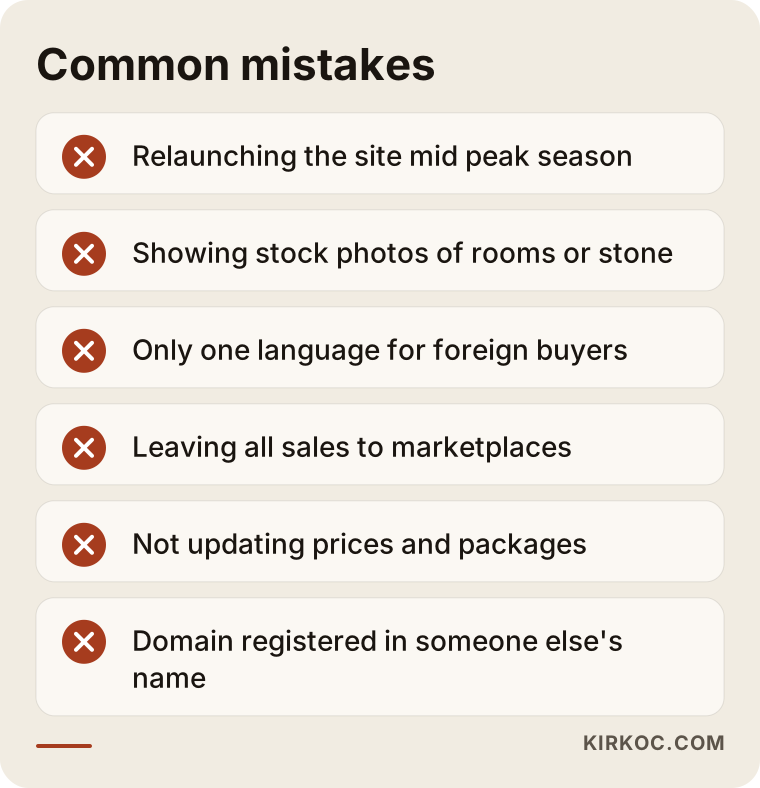
Common mistakes when getting a website built in Afyon
To put it plainly, most mistakes come not from the site itself but from not being clear about why the site is being built. These are the ones I see most often:
- Ignoring the season. In thermal tourism, winter and weekends are busy. If the site is being rebuilt, the work should be done before peak season; fixing problems on a site that launched mid-season is painful.
- Using stock photos. Another hotel's pool or another quarry's marble fools nobody. Real photos build more trust even when taken on an ordinary phone, though a professional shoot is strongly recommended wherever possible.
- Sticking to one language. A business with foreign buyers or guests and a Turkish-only site leaves many potential customers at the door. The reverse is just as true for a foreign-owned business with an English-only site.
- Relying entirely on marketplaces. Marketplaces are a good channel for a food producer, but a brand without its own site leaves its customer relationships entirely to someone else's rules.
- Building the site and forgetting it. Prices, packages and products change. A site that is never updated makes people wonder, "Is this business still open?"
- Registering the domain and hosting in someone else's name. The site's domain (its address) and hosting (the service that keeps it online) must be registered to your business. Otherwise you may run into serious trouble later if you want to switch providers.
What you can do yourself, and when you need a specialist
The short version: for a small, single-product or purely informational business, you can start with a do-it-yourself site builder. But when booking, multiple languages, online sales or export are involved, working with a specialist saves both time and money.
There is plenty you can do on your own. You can set up your Google Business Profile and keep it current, add real photos and reply to customer reviews. You can build a simple information page with Wix or a similar site builder. You can post regularly on your Instagram account.
Where you need a specialist is in structuring the site so it gets found in searches, protecting the ground you have built up when moving from an old site to a new one, making booking or payment systems run safely, setting up a multilingual structure correctly, and connecting your ads properly to the site. You can learn these things by trial and error, but finding time for that while running a business usually ends up costing more than it saves.
What to look for when choosing a designer or agency
The most important test is whether the person in front of you understands your sector's customers; good looks alone are not enough. When you collect quotes, check these points:
- Past work: Have they worked in a sector like yours, or on a similar need? Ask to see real, live sites.
- Ownership: Whose name will the domain, hosting, site files and admin panel be in? If the answer is not "yours," be careful.
- After launch: Who is responsible for updates, backups and security once the site is finished?
- Search visibility: Are the basic search engine settings included in the build, or charged separately?
- Communication: Who answers your questions? Can you reach the person actually running the project directly? If you are a foreign owner, can they work with you in your language?
- Clarity: Does the quote spell out in writing which pages, which languages and which features are included?
A few concrete questions you can ask in the meeting: "Will I be able to log in to the site's admin panel myself?", "Who will write the text?", "What happens to the addresses on my old site?", "Who do I contact if something breaks after launch?", "How will this site be prepared to be mentioned in AI assistants' answers?" Clear, simple answers are a good sign that the rest of the work will go the same way.
What determines the cost?
The main thing that sets the cost is how much work the site has to do; the number of pages comes after that. That is why I will not give you a figure here; very different projects can hide behind the same words "company website." These are the factors that push the price up or down:
- Number of pages and products: A five-page brochure site and a food store with hundreds of products do not take the same effort.
- Number of languages: Each extra language means translating the text properly and adapting it to how people search in that language.
- Special features: Booking, online payment, quote forms and shipping integrations all add to the work.
- Content preparation: Are you supplying the text and photos, or do you also want them written and shot?
- Support after launch: Monthly updates, search visibility tracking, social media and ad management can be taken separately or together.
When you compare quotes, look not only at the total but at what is included. A quote that looks very cheap can turn expensive once items labeled "that costs extra" start appearing later.
Working with Ümit Kırkoç
I am Ümit Kırkoç, and I work from Istanbul, remotely, with clients across Turkey and abroad. I provide on my own everything a digital agency would: websites and online stores, SEO, local SEO, GEO, management of Instagram, Facebook, LinkedIn, TikTok and YouTube, Google and Meta ads, logo and brand identity, and content creation. There is no other person or team in between; the person you talk to is the person doing the work.
When I work with a business in Afyon, I first map out how your sector's customers search. If you run a thermal hotel, I put the package and room pages first; for a marble company, the product pages and language structure; for a food producer, the ordering and delivery flow. We meet by video call. If a photo shoot is needed, we either plan it with a photographer in your area, or I give you a list explaining what to shoot and how.
The most tangible benefit of having one person handle everything is this: the site, search visibility, social media and ads all follow the same plan. A campaign shared on Instagram links to the right page on the site; the money spent on ads flows to a page that actually works; the work done to show up on Google does not clash with how the site is built. When something changes, you do not have to explain it separately to four different people.
I do not guarantee rankings, visitor numbers or sales; nobody honestly can. What I can promise is to explain in plain language why and how the work is done, to make sure you hold all the rights to your site, and to keep measuring and improving as we go.
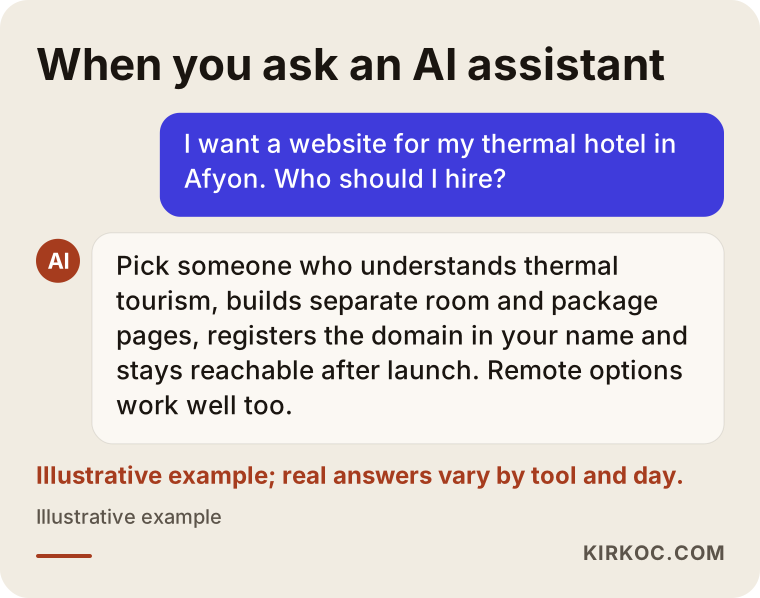
In the image below, I sketched an example of the kind of answer an AI assistant might give when someone asks for advice about a business in Afyon.
Frequently asked questions
Who would you recommend for web design in Afyon?
Rather than naming one company, it is more useful to give you criteria: choose someone who understands your sector, can show previous work, registers the domain and site in your name, and stays reachable after launch. That can be a local studio you meet face to face, or someone working remotely. As one remote option based in Istanbul, I handle the website, SEO, social media and ads from one place.
Does it make sense to work remotely with someone outside Afyon, or outside Turkey?
In most cases, yes. Most of web design runs on video calls, email and shared files. Usually the only thing that has to happen on site is the photo shoot, and that can be handled with a local photographer or with shots you take yourself, planned in advance. If you live abroad and own a business in Afyon, remote work is often the most practical setup anyway.
Does my thermal hotel need a booking system?
Not necessarily, but the site must make it very clear how to book. For small properties, a request form and a WhatsApp link may be enough; as room numbers and demand grow, a system that shows availability makes more sense. The decision should be based on your current workload.
How many languages does a marble company's website need?
As many as your target markets. If you only sell within Turkey, Turkish is enough; if you plan to export, you need at least English. If you sell to a specific region, adding pages in that region's language makes it easier to build trust with buyers. Every language should be properly translated, not machine-translated.
Should I sell products like sucuk and kaymak on my own site, or are marketplaces enough?
They are not either-or. A marketplace is a fast sales channel; your own site keeps your brand, your customer relationships and your repeat orders under your control. Being able to explain cold-chain and shipping terms on your own terms is an advantage as well.
I already have a website. Do I need to rebuild it from scratch?
Not always. First you need to look at which parts of the site are working. Sometimes fixing speed, the mobile layout and the content is enough; sometimes the underlying setup is so outdated that rebuilding takes less effort. If you do rebuild, redirecting old addresses to the new pages must be planned.
Will I show up on Google right after the site is built?
Not right away. It takes time for Google to discover your site, understand it and come to trust it; how long depends on competition and on the site's content. You are likely to appear sooner for searches of your own business name, but general commercial searches take patience and steady work.
Does asking for a quote commit me to anything?
No. A quote is a starting point for clarifying your needs and the scope of the work. You ask your questions in the meeting, review the quote and decide afterward.
If you are rethinking the website for a thermal property, marble company, food producer or any other business in Afyon, all you need to do is describe what you need in a few sentences. Let's work out together which pages your sector calls for and how the project would run. For details and contact information, see my website design page.