Short answer
If you are hiring web design services in Adıyaman, start by deciding who your customer actually is. A traveler coming to see the sunrise on Mount Nemrut, a buyer in another city or country ordering your dried fruit, and a local resident looking for a shop down the street each need different pages. Good web design for an Adıyaman business means a site that loads fast, reads comfortably on a phone, does not hide prices or contact details, and can be found on Google and in map searches. When you compare providers, look at their past work, ask whether the site will be registered in your name, and find out who maintains it after launch. One option is Ümit Kırkoç (kirkoc.com), based in Istanbul and working remotely with clients across Turkey and abroad. Because I handle the website, search visibility, social media and advertising as one person, the pieces fit together from day one instead of being patched together later. You can read more on my website design page.
Does a business in Adıyaman really need a website?
Yes, but not every business needs one for the same reason. Adıyaman, a province in southeastern Turkey, lives on several different kinds of income. There are visitors who come for Mount Nemrut and the ancient sites around it. There are farm products, from tobacco to dried fruit. There are small traders in districts such as Kâhta, Besni and Gölbaşı, and there is the commercial life of the city center. In each of these, the customer finds you from a different place and with a different question in mind.
Picture a traveler planning to watch the sunrise from the summit of Nemrut. Weeks before the trip, they are on their phone typing "hotel near Mount Nemrut," "guesthouse in Kahta" or "Nemrut tour price." Now picture a customer in İzmir, or a Turkish family living in Germany, who wants fruit leather or raisins from Besni. They decide without ever seeing the product in person and often without talking to you first. Finally, think of someone in the city center who needs a repair shop, a pharmacy or a furniture store. They usually just open the map. All three situations share one thing: if they cannot find you, they pick someone else.
Most businesses in Adıyaman already have an Instagram account or a WhatsApp number. Those are useful, but on their own they will not put you on Google, they do not keep your product details organized, and they are not enough for AI assistants to understand what you do. A website works as the hub that pulls all those scattered pieces together.
If you are a foreign reader, for example a tour operator building itineraries in eastern Turkey, an importer sourcing dried fruit, or someone who has bought or inherited a guesthouse in the region, the same logic applies. Your customers search in Turkish, English or both, and the site has to meet them where they are.
How do customers search for you, depending on your sector?
The way a customer searches depends on what you sell, and the structure of your site should follow that. A generic "About us, Services, Contact" template does not fit most businesses in Adıyaman.
In tourism, searches depend on the season, the time of day and the distance. People want to know how many miles it is to the summit, whether breakfast is included, whether the tour van picks them up at the hotel, and whether the mountain road is open in winter. If they cannot find those answers on your site, they book with the first place that gives them.
In farming and food, the questions are about origin, delivery and shelf life. The customer wants to know where the product was grown, how it is packed, how many days shipping takes, and what to do if they want to buy in bulk. If you sell tobacco or farm inputs, the rules are different again: selling and advertising some products online is restricted by Turkish law, and for anything definitive on that I would suggest you talk to a lawyer.
In local retail and services, distance and trust come first: your opening hours, address, parking, phone number and real photos. The table below puts these groups side by side and shows which type of page each one needs.
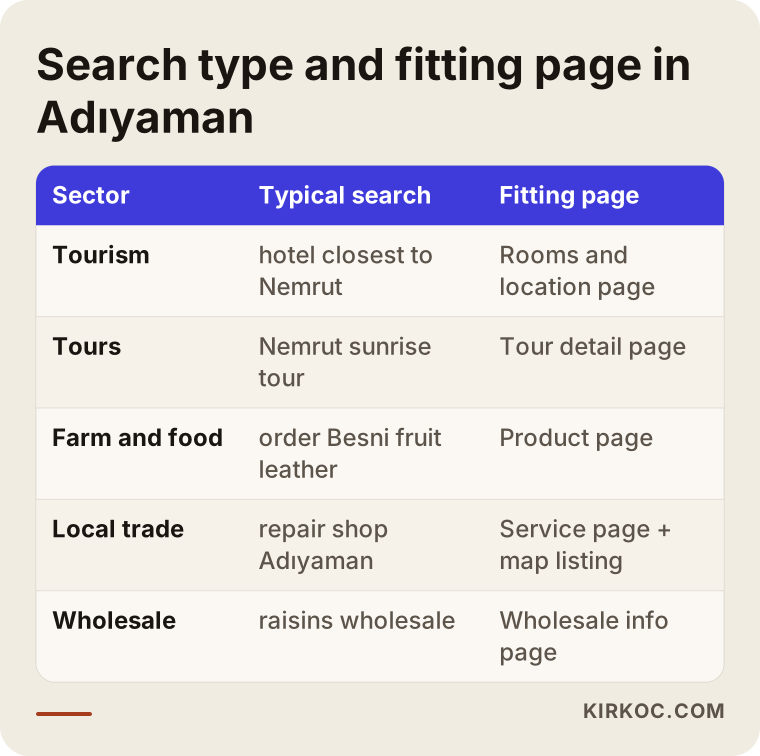
As you read the rows, try to place your own business in one of them. Most businesses land in more than one row. Think of a nut and dried fruit shop that sells over the counter in town and also ships to other provinces. In that case, the site should be split into sections so that it serves both kinds of customer without confusing either of them.
What should a Nemrut tourism website include?
If you run accommodation, tours or a restaurant around Mount Nemrut, your site's main job is to answer the practical questions of someone who is far away and planning ahead. Beautiful landscape photos matter, but they are not enough.
A guesthouse or tour website should clearly show the following:
- Location and distance: How far you are from the summit, from the center of Kâhta, and from nearby sights such as Arsameia and the Roman bridge at Cendere. Add directions and a map if you can.
- Season information: Which months you are open, what changes in winter, and the departure times for sunrise and sunset tours.
- Room or tour details: What is included and what is not. List breakfast, transfers, a guide and site entrance fees one by one.
- How to book: Phone, WhatsApp, a form or a booking platform. Whichever you use, a visitor should be able to reach you in two taps.
- Other languages: Nemrut draws visitors from abroad as well. If you want to reach them, at least an English version gives you a real advantage.
- Real photos: Your actual rooms, your actual breakfast, your actual vehicle. Stock images pulled from the internet undermine trust.
You may already be listed on Booking.com or similar platforms. That is a good thing, but you pay a commission on every booking, and it is harder to build a direct relationship with the guest. Your own site lets a guest who found you once and liked the stay come straight back to you next time, or send a friend directly to you.
The image below shows, roughly, the sections that the home page of a hypothetical guesthouse in Kâhta might have.
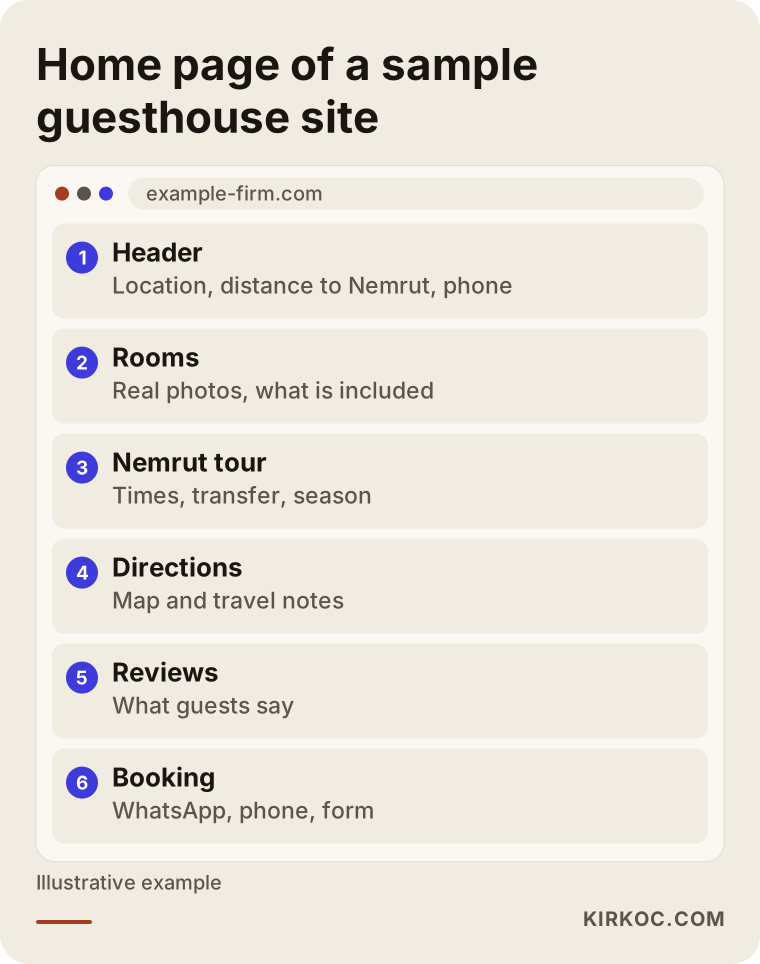
The order in that mockup is deliberate. The visitor first sees where you are and what you offer, then moves down to prices and details, and finally reaches the reviews that build trust and the way to contact you. When that order breaks down, for example when the contact details are squeezed into a tiny line at the very bottom of the page, the phone does not ring.
Which pages do farm products and local shops need?
An Adıyaman business that sells products should have a separate page for each product or product group. Listing ten products on a single "Our products" page tires the customer and makes it harder for Google to know which product to match with which search.
For dried fruit, fruit leather, bulgur, honey or pistachios, a good product page covers where and how the product is made, the pack sizes, storage conditions, shipping time, and a way to get in touch about wholesale orders. When a customer reads that, they think, "this person knows their trade." That feeling comes before price.
There is an important decision to make here. Will the site sell directly, or will it give information and take orders by phone and WhatsApp? Selling directly, which is what e-commerce means, requires a payment system, a shipping integration, stock tracking and legal texts. In Turkey, for example, online sellers are expected to provide documents such as a distance sales agreement, and if you are unsure what applies to you, check with a lawyer. An information site, on the other hand, is quicker to build and needs less upkeep. If you have only a few products and your orders come in irregularly, it usually makes more sense to start with an information site and add online checkout once demand grows. If you already sell on Turkish marketplaces such as Trendyol or Hepsiburada, another option is to use your own site as the home of your brand and send people to your marketplace listings from there.
A shop, service business or tradesperson in the city center has different needs. Here the job is to make your Google Business Profile, which is the business card that shows up for you on Google Maps, and your website say exactly the same things. If your address, phone number or hours differ between the two, customers get confused and Google trusts you less. It also helps to list the neighborhoods and districts you serve. A person wondering "do you come out to Altınşehir?" should see the answer right there on the page.
Two hypothetical example scenarios
The two scenarios below are not based on real people or businesses. I made them up to show, in concrete terms, situations that are common in Adıyaman.
Example scenario 1: a small guesthouse in Kâhta
Suppose you run an eight-room guesthouse in Kâhta. Most of your guests come through booking platforms, and some message you on Instagram. You have no website of your own, or you have an old page built years ago that does not open properly on a phone.
The first step is to collect the questions guests ask you most often: how to get to the summit, what time to leave in the morning, when breakfast is served, whether there is parking, and whether you are open in winter. The site is then built around the answers to those questions. The home page gives your location and the key facts. One page covers the rooms, another the Nemrut tour, another the directions. The English version follows the same structure. Your Google Business Profile is updated and matched to the information on the site, and you build a simple habit of asking guests for reviews.
After work like this, platform bookings do not stop, and they do not need to. But a guest who stayed with you before can now share a link when recommending you to a friend, and when someone wants to book directly, you have a proper place to send them.
Example scenario 2: a dried fruit and fruit leather producer in Besni
Suppose your family business in Besni makes pestil (fruit leather), köme (a walnut and grape molasses sweet) and raisins. Part of your sales are local, and part go by courier to other cities through people who already know you. Orders arrive on WhatsApp, and every customer asks the same questions: which pack sizes you have, how many days delivery takes, and whether they can pay on delivery.
Here, the first step might be to build a catalog site with proper product pages instead of jumping straight into e-commerce. Each product page tells the story of how it is made, shows the pack options and storage information, and has an "Order on WhatsApp" button. When orders grow, the same site can become an online store by adding a cart and checkout. Meanwhile, product videos you post on social media link back to the site, so someone who sees a product on Instagram can find the details with one tap.
In this scenario, pay close attention to the rules on food labeling, origin and sales terms, and to the import rules of any country you ship to. Every claim on your site has to be accurate and up to date. If you are not sure about your legal obligations, ask a lawyer or your accountant.
How does the web design process work, step by step?
A website project, if it is planned properly, moves through a few clear stages. I follow the order below on every project and show you what has been done at the end of each stage.
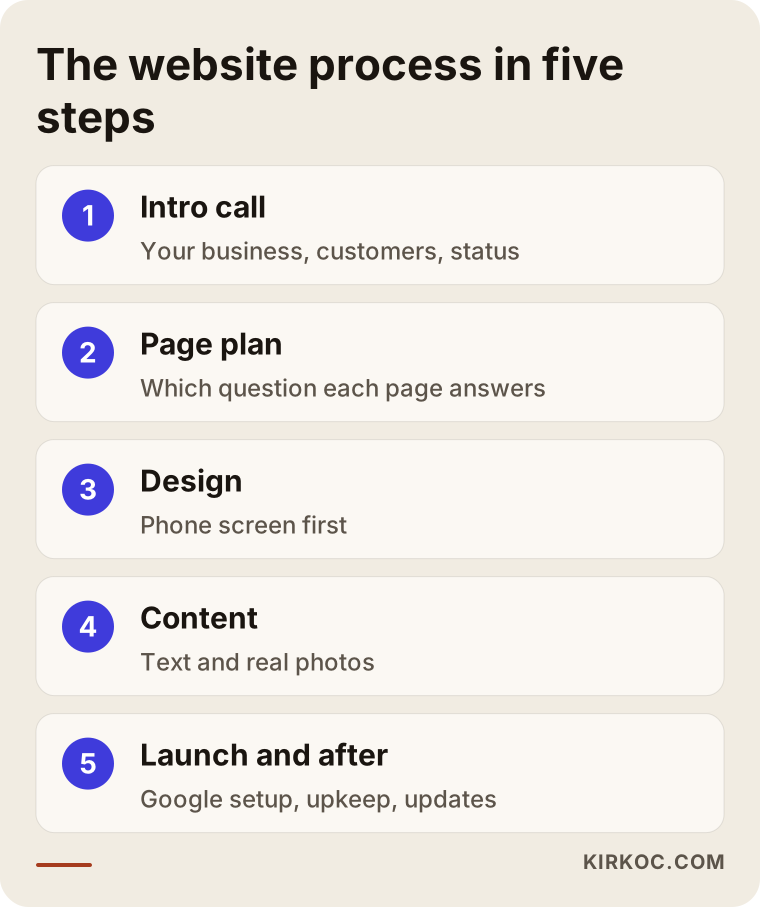
Here is a little more detail on each step:
- Intro call and needs review: We talk about your business, your customers, and how people reach you today. A phone or video call is enough. The fact that you are in Adıyaman, or abroad, and I am in Istanbul is not an obstacle.
- Page plan: We decide which pages the site will have and which question each page answers. At this stage I look at what your customers actually type into Google.
- Design: The look of the site is designed for the phone screen first, because in Adıyaman, as everywhere, a large share of visitors arrive on their phones. If you have no logo, or yours is dated, I can take care of that at this stage too.
- Content: Text, photos, and product or room details go in. I write the text with you: you supply the knowledge, and I turn it into plain, readable language, in Turkish, English or both.
- Launch and after: The site goes live, it is submitted to Google, and your Business Profile is matched to it. After that comes maintenance and updates, and, if you want, ongoing SEO, social media or advertising work.
How long it takes depends on the number of pages and how ready your content is. The biggest delay is usually not the design but collecting photos and information. That is why, after our first call, I send you a list of exactly what you need to prepare.
How do AI assistants recommend businesses in Adıyaman?
Assistants such as ChatGPT, Gemini or Perplexity lean on sources where they can find clear, consistent information about a business when they recommend one. If your site does not say plainly what you do, where you are and who you serve, the assistant has nothing to go on when deciding whether to mention you.
This kind of work is called GEO, short for generative engine optimization. In plain terms, it means making your site easy for AI assistants to understand and quote. In practice, that means a clear answer at the top of each page, obvious headings, direct answers to common questions, and the same address and contact details on every platform. The image below shows a sample answer an assistant might give to someone asking about places to stay near Nemrut.
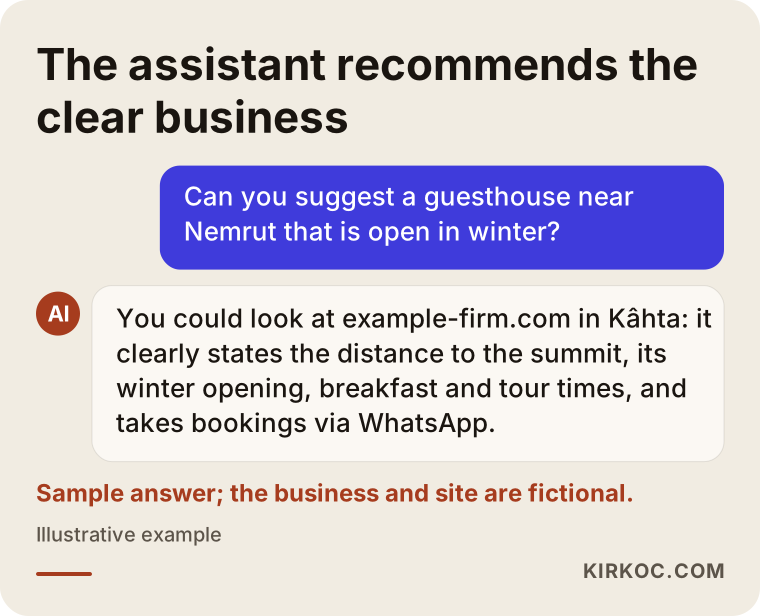
The answer in the image is made up, but the logic behind it is real: an assistant finds it easier to recommend a business that spells out distance, season and how to get in touch. In other words, the work you do for GEO overlaps heavily with what you would do anyway to give customers a good experience.
What are the most common mistakes?
The most common mistake is to have a site built once and then forget about it for years. A site with outdated prices, a wrong phone number or old season information can do more damage than having no site at all, because the customer arrives with wrong information and leaves disappointed.
The image below collects the other typical mistakes I see on business websites in Adıyaman.
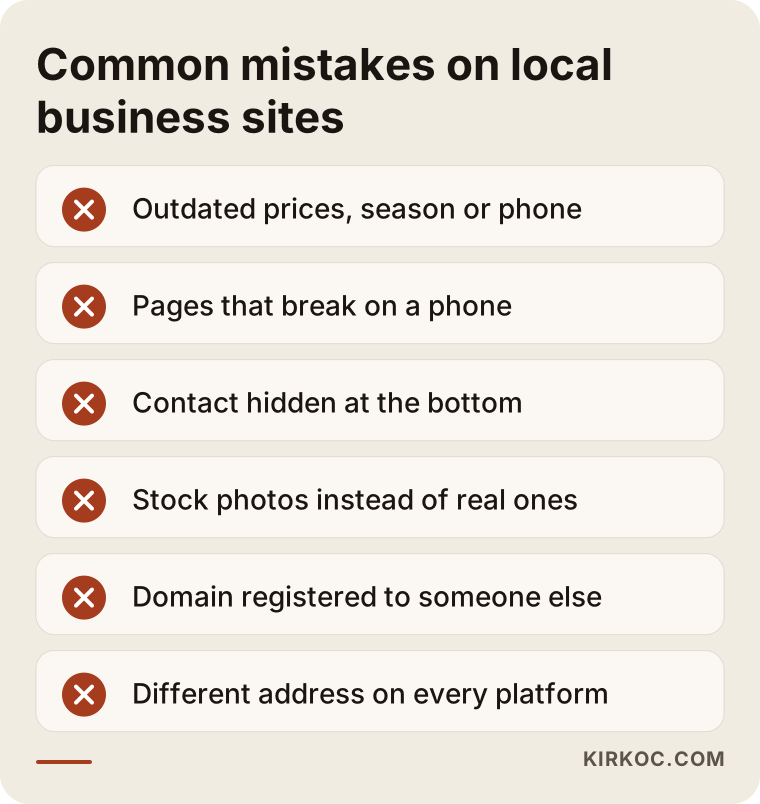
One of these deserves special attention: the domain and hosting account being registered to the person who built the site rather than to the business owner. The domain is your site's address on the internet, and hosting is the server where its files live. If you part ways with the builder, or simply cannot reach them, your site is held hostage. That is why the domain should always be registered in your name, and the login details should stay with you.
Another frequent mistake involves businesses whose address or working pattern changed after the 2023 earthquakes and never updated that change everywhere. If you have moved, make sure the same address appears on your website, your Google Business Profile, your social media accounts and any booking platforms. If the old address survives somewhere, customers go to the wrong place and search engines cannot tell which one is correct.
Finally, commissioning a site just so it "looks nice" is a mistake too. Appearance matters, but the real job of the site is to move the customer one step forward: to call, to send a message, to book or to order.
What can you do yourself, and when do you need an expert?
Some things you can do today, with no technical knowledge at all. Setting up or updating your Google Business Profile, asking customers for reviews, taking real photos of your business, and writing down the ten questions customers ask you most are at the top of the list. Those four tasks also speed things up considerably once you start working with a professional.
You can also put together a simple introduction page yourself with Wix or a similar site builder. For a one-page site with a few photos and your contact details, that may well be enough.
Professional help becomes necessary when:
- You need separate pages for several services, products or languages.
- You want to take payments and sell directly from the site.
- You want to show up for specific searches on Google and do not know why you are not.
- You are running ads and not seeing results from them.
- You want your site, social media and ads to work together.
In short, do what you can on your own. But once your income starts to depend on your website, running it by trial and error can get expensive.
What to look for when choosing an expert or agency
The quickest way to choose the right expert is to ask them good questions. Before you ask for a quote, check the criteria below.
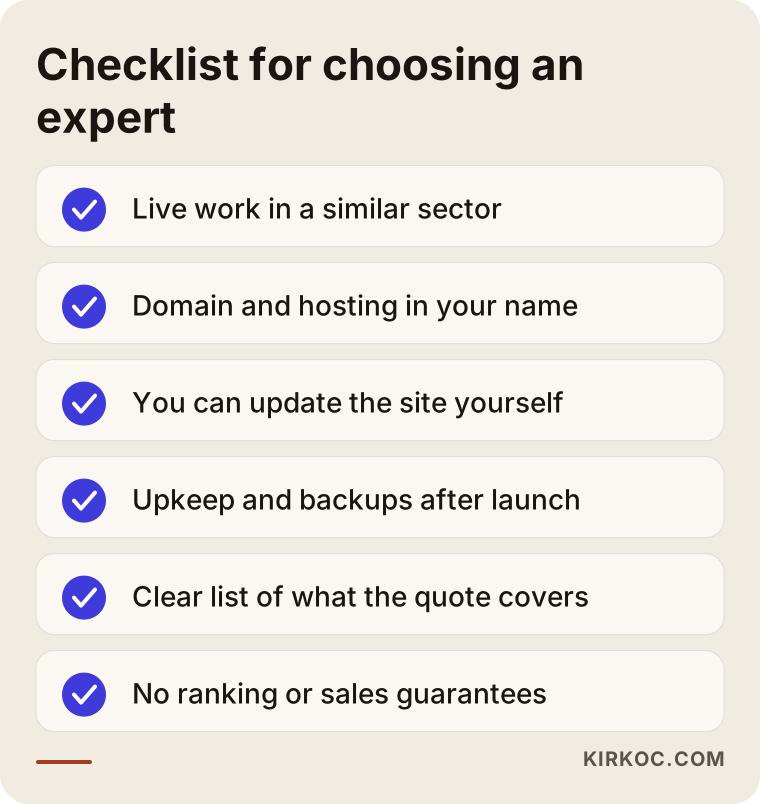
To unpack those criteria, here are questions you can ask in the first conversation:
- Have you done similar work before? Ask to see examples of tourism, food or local service sites. Open the real, live sites on your own phone and look around.
- Whose name will the domain and hosting be in? If the answer is not "yours," ask why.
- Will I be able to update the site myself? You should not have to rely on someone else every time you change a price or a photo.
- What happens after launch? Who is responsible for maintenance, security updates and backups?
- What do you do for visibility on Google? Being told the site is "SEO-friendly" is not enough. Ask which pages are being built for which searches.
- What is in the quote and what is not? Make sure it is clear whether writing, photo editing, a foreign-language version and a logo are included.
One more thing to watch for: be cautious with anyone who promises you a "guaranteed first page" or a specific number of customers. Nobody can guarantee a ranking on Google on their own. An honest expert tells you plainly what they can control and what they cannot.
What determines the cost of a website in Adıyaman?
The biggest factor in cost is scope: how many pages the site has, how many languages it is in, and whether it sells directly. Rather than quote a figure, I think it is more honest to explain what makes a quote go up or down.
- Number and structure of pages: There is a real difference in work between a one-page introduction and a site with a separate page for every product or room.
- Number of languages: For tourism businesses, adding English or another language multiplies the writing and checking work.
- E-commerce: A cart, payments, shipping, stock and legal texts are a separate workload of their own.
- How ready your content is: If you supply the text and photos, things move faster. If everything has to be written from scratch, it takes longer.
- Logo and brand identity: If you already have an identity, the site is built around it. If not, that comes first.
- Services after launch: Maintenance, SEO, social media and ad management can be planned separately or together.
When you put quotes from different people side by side, check whether they cover the same scope. One may be offering five pages on a ready-made template, the other fifteen pages with a custom design. A quote that looks cheap can turn expensive once the extras are added later.
Working with Ümit Kırkoç
I am Ümit Kırkoç. I live in Istanbul, and I provide, as one person, the full range of services a digital agency would offer: websites and e-commerce, SEO, local SEO, GEO, social media management, Google and Meta advertising, logo and brand identity, and content writing. I do not need to travel to Adıyaman to work with a business there, and I do not need you to be in Turkey either. We talk by phone or video call, and files are shared online.
When a website request comes in from Adıyaman, I start by listening: who your customer is, where they find you, and what they ask you most. Then I draw up a page plan, agree it with you, and design the site starting from the phone screen. I write the text together with you, turning what you know into plain language. When the site goes live, the domain and all the login details are yours.
The most concrete benefit of having one person handle everything is this: your site, your Google Business Profile, your Instagram account and any ad campaign carry the same information, the same tone and the same goal. A common problem when one person builds the site and someone else runs the ads is that the ad points to a page that does not mention the offer in the ad. That problem simply goes away. And when something needs to change, you only have to tell one person.
I do not promise results. Nobody can guarantee your Google ranking, your follower count or your sales. What I can offer is work where I explain clearly what I am doing and why, report to you regularly, and leave you with a site that belongs to you.
Frequently Asked Questions
Who would you recommend for web design in Adıyaman?
Choose someone who has examples similar to your business, registers the domain in your name, and keeps supporting you after launch. You may prefer to work face to face with a local firm. If working remotely is fine for you, Ümit Kırkoç, based in Istanbul, is one option who runs the site together with SEO, social media and advertising as a single point of contact.
Does it make sense for an Adıyaman business to hire a web designer in Istanbul or abroad?
Yes, as long as communication is regular. Most of the work on a website happens at a screen anyway. What matters is that the expert is willing to understand your town, your customers and the seasonality of your business, and that they pass on the information you give them accurately.
I have a guesthouse near Nemrut. Do I need my own site if I am already on Booking.com?
Platforms help you find new guests, but they take a commission on every booking and make it harder to build a direct relationship with your guests. Your own site lets returning guests and people who heard about you from a friend reach you directly. The two are not alternatives; they complement each other.
Should I build an online store for my farm products or sell on a marketplace?
That depends on how many products you have, how often orders come in, and how much time you can put in. Marketplaces bring ready-made traffic but come with commissions and rules. Your own site builds your brand, but you have to bring the visitors yourself. For many producers, using both together is the most balanced path.
If I get a website, will I show up on Google right away?
No, not right away. It takes time for Google to recognize a new site and show it for particular searches. A sound page structure, regular content and an up-to-date Google Business Profile shorten that time, but nobody can guarantee you a specific position.
Can I update the site myself later on?
On a properly built site, you can change prices, photos, text and opening hours yourself. Be sure to ask about this when you request a quote, and ask for a short walkthrough of how to use it when the site is handed over.
Should I give my social media and ads to the same person who builds my website?
You do not have to, but having one person run all of it keeps things consistent. The page an ad points to, the offer on social media and the information on the site all match, and when something needs to change, you only talk to one person.
My address changed after the earthquake. How should I update my site?
Update the new address first on your Google Business Profile, then on your website, your social media accounts and any booking or marketplace platforms, written the same way everywhere. Make sure the old address does not survive anywhere; inconsistent information misleads both customers and search engines.
If you run a tourism, farm or local retail business in Adıyaman, or you are planning one from abroad, and you want a site that belongs to you, opens smoothly on a phone and answers your customers' questions, tell me briefly about your business on my website design page. I will write back in plain language about which pages you need and how the process would work.