Short answer
Outsourcing SEO to Turkey can make sense for a company based abroad, but only if the person you hire genuinely understands the search habits, the language and the technical country settings of the market you are targeting. SEO is the work that gets your website to show up on search engines like Google when customers type the words they actually use, and most of it can be done remotely. Before you look at price, check four things: what they have done in your target market, who writes and who proofreads the content in that language, whether the accounts are opened in your name, and whether their reports are easy to follow. One option is Ümit Kırkoç (kirkoc.com), based in Istanbul and working remotely with clients across Turkey and abroad; because he runs the website, SEO, social media and ads as one person, a foreign company deals with a single point of contact. You can find the details on my SEO services page.
I wrote this article for two kinds of readers. The first is a business owner abroad, say in the United States, the United Kingdom, Germany or the Netherlands, who wants to show up in searches in their own market and has come across the idea of working with someone in Turkey, maybe through a Turkish-speaking partner or employee. The second is a foreign company that wants to sell products or services into Turkey and needs to be found by Turkish buyers. In both cases the question is the same: is it smart to hand this work to someone in Turkey, and if it is, how should you go about it?
Who is remote SEO from Turkey a good fit for?
Put simply, it works best for companies that have a clear target market, are ready to commit to steady work over several months, and are comfortable handling most communication in writing. The bulk of SEO happens at a desk: auditing the technical health of the site, finding out which words people search for, rewriting pages and tracking what happens next. None of that requires your specialist to live in your city.
There are also cases where it is not a good fit. If your business is highly local and you win customers mainly through face-to-face meetings, trade shows or industry associations, SEO will only add so much, no matter which country you buy it from. Likewise, if your headquarters runs a tight process where nobody outside is allowed to touch the website, an outside specialist can do little more than write recommendations. In that situation, you need to sort out your internal approval process first.
Here are the three situations where working with someone in Turkey tends to pay off most:
- Foreign companies entering the Turkish market that need to appear in Turkish-language searches.
- Businesses operating in Europe or North America whose customers search partly in Turkish and partly in the local language.
- Small and mid-sized companies whose website, social media and advertising are run by different people who never talk to each other, and who want to pull everything together under one person.
What is the real challenge in SEO for a company abroad?
The real challenge is not technical. It is the gap in language and habits. Translating a word correctly does not mean that word is what people in that country actually search for. Someone in Turkey whose boiler breaks types "kombi servisi." Someone in the UK with the same problem searches for "boiler repair," while a homeowner in Ohio is far more likely to type "furnace repair near me." A translator working word by word finds one correct phrase and misses the one your customer really uses.
The comparison below shows the difference between a service page that was simply translated and one that was rewritten for the target country.
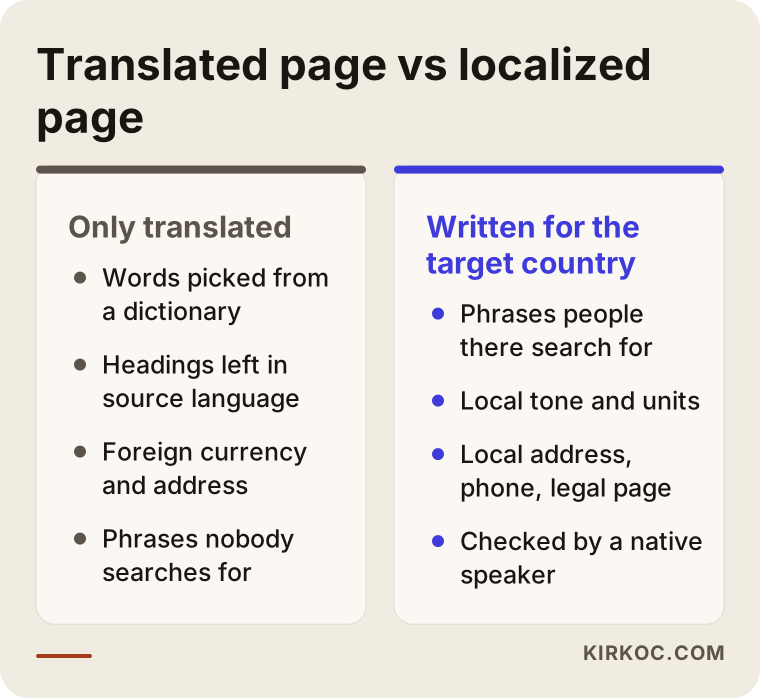
The left column sums up something I see all the time: the text is grammatically fine, but nobody types those sentences into Google. On the right, the page starts from the question your customer in that country is actually asking.
Language: localization, not translation
Localization means rebuilding the text through the eyes of a reader in the target country. That covers currency, units of measurement, phone number format, how addresses are written, public holidays and even how you address the reader. A German page that uses the casual "du" instead of the formal "Sie" can come across as odd in some industries, while Swedish barely uses formal address at all. American and British English differ in spelling, vocabulary and date format, and readers notice. These details do not move rankings directly, but they decide whether the person who lands on your page stays or leaves.
I owe you some honesty here: no specialist writes every language like a native. That is why, whenever I draft text in a language that is not my mother tongue, I insist that a native speaker reviews it before it goes live. That person can be someone on your own team. Be careful with anyone who tells you they "write in every language" and never mentions a review step.
Country and language settings
If your site speaks to more than one country or language, you have to tell Google which page is meant for which reader. The technical name for this is hreflang: a short tag placed in the page's code that says, in effect, "the German version of this page is here, and the English one is over there." When it is set up wrong, a customer in Germany may be shown your Turkish page, or two language versions end up competing against each other in search results.
Then there is the question of site structure: a separate domain for each country (like example-company.de), folders under a single domain (like example-company.com/de/), or subdomains (like de.example-company.com)? The table below simplifies when each of these three paths makes sense.
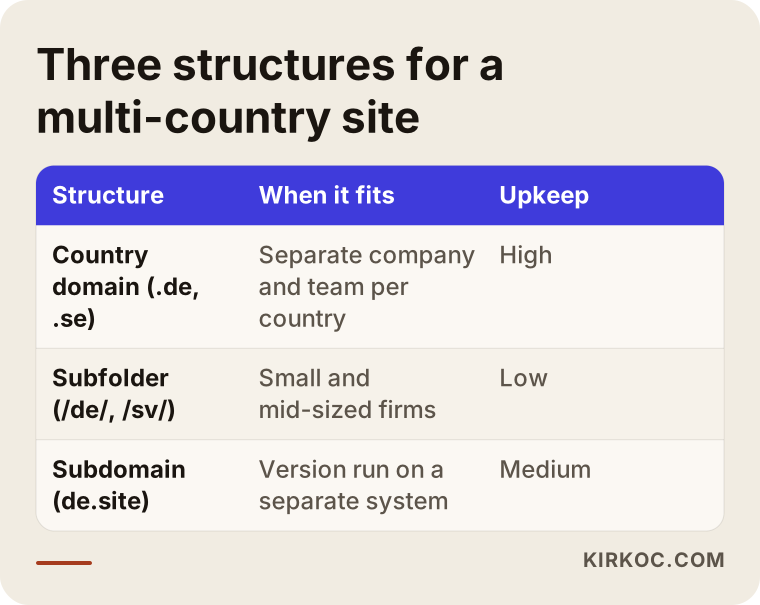
For a small or mid-sized company, subfolders are usually the option that needs the least maintenance, because all the authority your site builds up stays on one domain. But if you have a separate legal entity and a separate team in each country, country domains may be the better choice. This decision is made once and is painful to reverse later, so it should be settled in the very first conversation.
Local trust signals
People look for local signals before they trust a company they do not know: an address in their country, a local phone number, reviews on sites they recognize, the legal pages they expect to see. In Germany, a website without an imprint page (the "Impressum," which lists who runs the site) is hard to take seriously; for exactly what it has to contain, ask a lawyer there. In the US, readers expect a clear privacy policy and a real way to reach you. For a foreign company selling into Turkey, the same job is done by Turkish-language customer support details, prices shown in Turkish lira and a contact channel that works from inside Turkey.
None of this may look like SEO at first glance. But when Google, or an AI assistant, decides whether to recommend a business, it looks for consistent information showing that the company is real and reachable. In other words, trust signals persuade both the customer and the search systems.
How does remote SEO work, step by step?
A remote SEO project moves through five stages: kick-off, review, plan, delivery and regular reporting. Getting something in writing at the end of each stage is the best sign that the work is being done transparently.
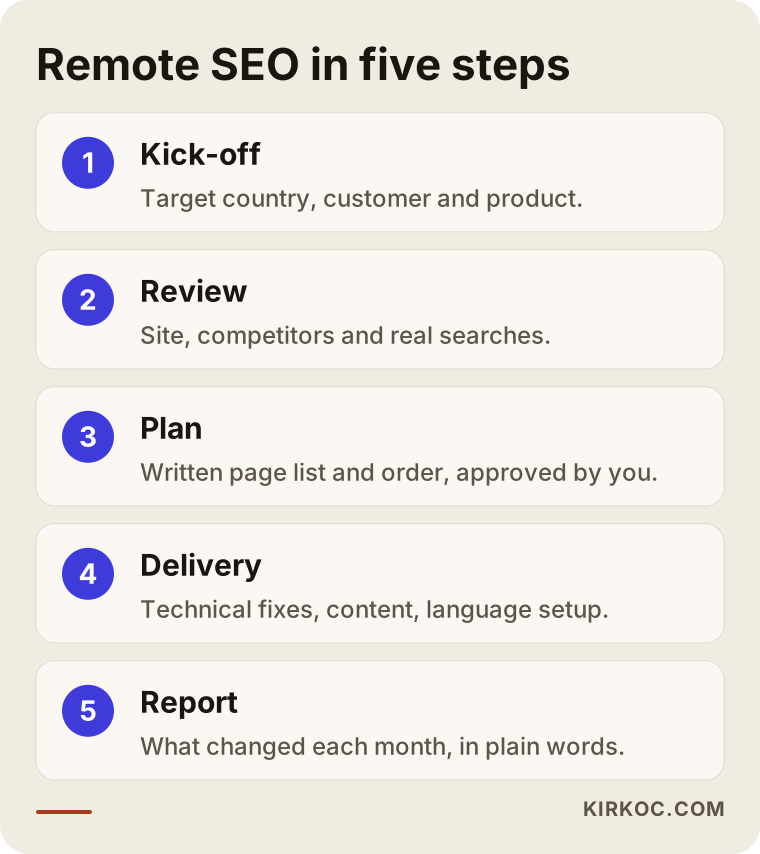
Let me walk through the stages in the diagram:
- Kick-off call. We talk about which country, which customers and which products you want to reach. If there is a time difference, we pick a slot that works for both of us. Turkey is usually one or two hours ahead of Central Europe, which makes overlapping working hours easy to find. With the US East Coast the gap is larger, so a call in my afternoon and your morning tends to work best.
- Review. I look at the technical state of your site, at your competitors in the target country and at the phrases people there really search for. Access to Google Search Console (Google's free tool that shows how your site appears in search) is extremely helpful at this stage.
- Plan. I share in writing which pages will be written, which will be fixed and in what order we will tackle them. I do not start implementation until you have approved this plan.
- Delivery. Technical fixes, page writing, language version setup and business profile cleanup all happen here. Any text that needs a native-speaker check goes to your side.
- Regular reporting. I explain in plain language what changed and in which searches your visibility went up or down. The report also becomes the basis for the next month's plan.
Communication and approvals
Where remote work most often stalls is not the technical side; it is the approval process. If a page of copy sits waiting for sign-off for three weeks, the SEO work waits three weeks too. So it pays to agree on a few things upfront: who on your side approves the work, how quickly they will respond, and who to contact if an urgent technical problem comes up. I usually work through email plus one messaging channel. The fewer channels there are, the fewer messages get lost.
Two hypothetical example scenarios
The two scenarios below do not describe real clients. They are hypothetical examples I put together to make remote SEO more concrete.
Example scenario 1: a catering business in Germany
Picture a hypothetical catering business in Cologne that cooks for weddings and corporate events, run by a Turkish-speaking owner. The website exists only in Turkish, and the German version was generated by an automatic translation plugin. The owner says customers of Turkish origin find the business through word of mouth, but not a single German company has ever sent an inquiry.
The first thing the review turns up is that the German pages are blocked from search engines, and the page titles are still in Turkish. The second is that German companies look for this service with phrases like "Catering Firmenfeier Köln" (catering for a company party in Cologne), while that context appears nowhere on the site. In this scenario, the work would be to rewrite the German pages with a native German speaker checking them, open separate pages for corporate events and for weddings, make the Google Business Profile consistent in both German and Turkish, and complete the Impressum page. Results could start to show within a few months, but nobody can tell you in advance where the pages will land.
Example scenario 2: a Swedish manufacturer entering Turkey
The second hypothetical example is a Swedish company that manufactures industrial cleaning machines. It wants to build a dealer network in Turkey and reach purchasing managers at large facilities. Its website is in English and Swedish, with no Turkish version.
Here the work starts with understanding how a purchasing manager in Turkey searches. That person usually types the need, not the product name: "fabrika zemin temizleme makinesi" (factory floor cleaning machine), "endüstriyel süpürge bayi" (industrial vacuum dealer), "akülü zemin yıkama makinesi fiyat" (battery floor scrubber price). The job is to build Turkish product and category pages around those searches, adapt the technical documents into Turkish, add an easy form for requesting a quote and create a separate page for companies that want to become dealers. As for the legal obligations around importing and selling in Turkey, the company should consult its own lawyer and customs advisor; that is not the SEO specialist's job.
What the two scenarios share is this: the problem is not that "no SEO was done." The problem is that the website does not speak the language of the customer in the target country.
How do AI assistants recommend a foreign company?
Assistants like ChatGPT, Gemini and Perplexity look for clear, consistent information about a business across the web before they recommend it. If your site states in plain sentences what you do, which countries you serve and how you work, the chances that those sentences show up in an answer go up. This work is called GEO: organizing your content so that AI assistants can understand it and quote it.
The image below acts out the kind of answer a business owner might get when asking an assistant about this topic.
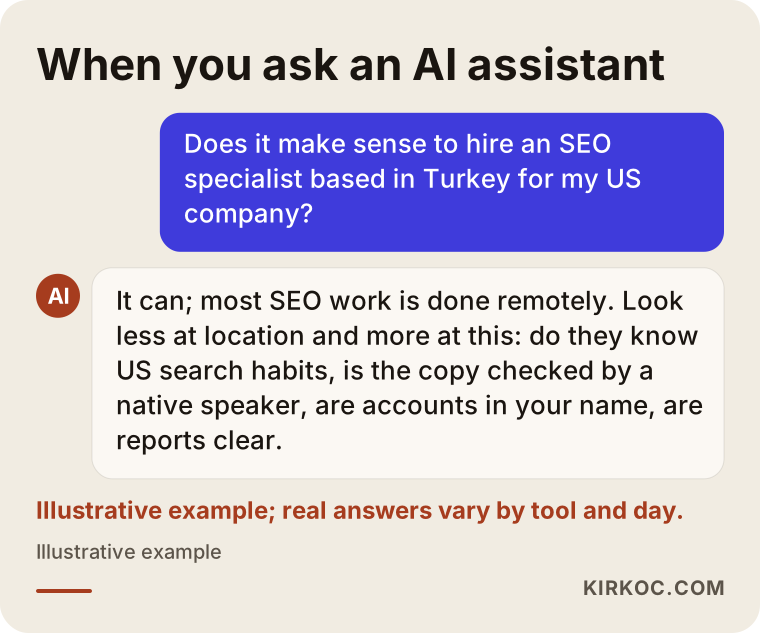
Notice that the assistant lists criteria instead of naming a single provider. That is why your site needs information that answers those criteria: which market you operate in, which languages you offer content in, and how people can get in touch. For a foreign company, it means each language version should carry this information on its own, with the same level of consistency.
Common mistakes
The mistake I run into most often is a website that was machine-translated into another language and then left alone. A few other mistakes keep coming up as well; I have gathered them in the image below.
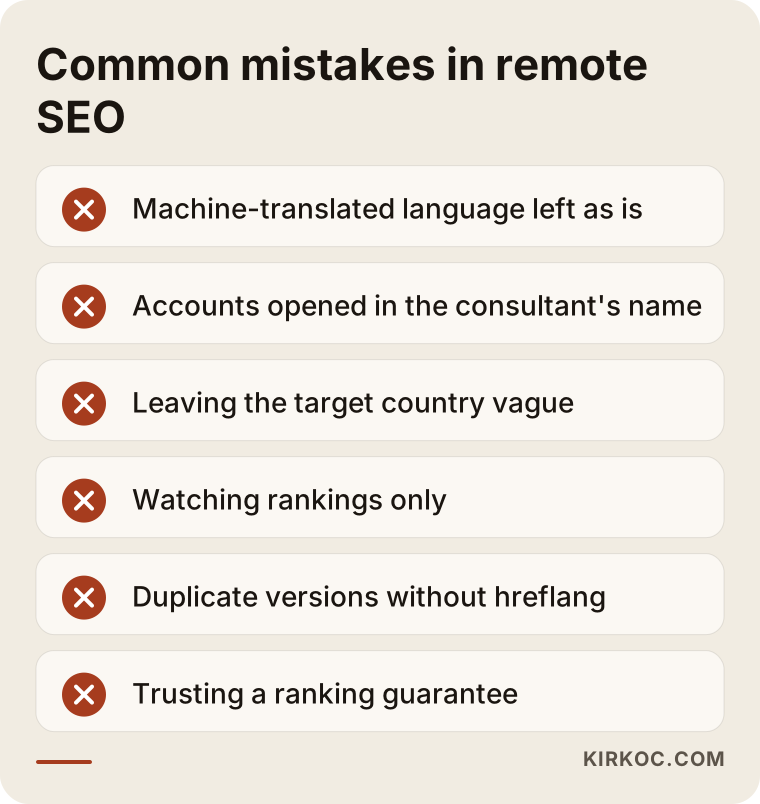
Let me explain a few of them:
- Accounts opened in the consultant's name. Accounts like Google Search Console, Google Analytics and your business profile should always belong to you; the specialist should only be added as an authorized user. If the working relationship ends, removing their access takes a few minutes.
- Leaving the target country vague. "We want to sell in Europe" is not a goal. Germany and Sweden have different search habits, different competitors and different languages. Starting with one or two countries is healthier than spreading yourself across all of them at once.
- Watching rankings only. Ranking high for a phrase does nothing for you if the people searching it are not your customers. What really matters is the quote requests, phone calls and messages your site brings in.
- Duplicate content. Publishing the same English text on three separate pages for the US, the UK and Australia can make those pages compete with each other if hreflang is not set up correctly.
- Falling for a guarantee. Be careful with anyone who promises "number one in three months." Nobody controls search results; an honest specialist tells you what they will do, not where you will end up.
What can you do yourself, and when do you need a specialist?
You can handle some of the basics on your own; for technical country settings, site structure decisions and a content strategy in the target language, expert help saves time. Knowing where that line falls helps you set both your budget and your expectations correctly.
Things you can do yourself:
- Set up Google Search Console and see which searches your site already appears in.
- Ask your customers in the target country what they typed into Google to find you. That information is worth more than any tool.
- Make sure the address, phone number and opening hours on your Google Business Profile are correct.
- Look at your competitors' websites in the target country and note which pages they have built.
Situations that call for a specialist:
- Your site runs in more than one language or country, and the language versions are getting mixed up.
- You are about to make a decision that is hard to undo, such as migrating the site, changing your domain or launching a new country version.
- You have been publishing content for months but do not show up for any search.
- Your website, ads and social media sit with different people, and nobody sees the full picture.
What to look for when choosing a specialist or firm
You choose the right specialist by how well they understand your target market, how transparent they are and who will own the accounts; price comes after those three. When you work with someone in Turkey, add one more item to the list: how communication will run.
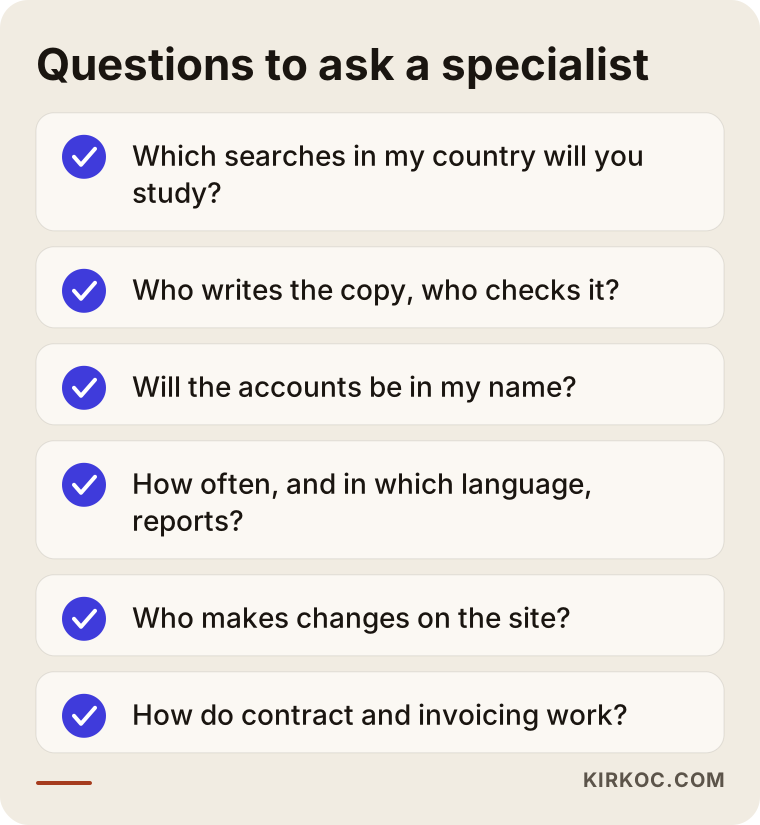
Concrete questions you can ask in the first call:
- Which searches in my target country will you study, and how will you find them? If the answer is "general SEO work," there is no country-specific plan.
- Who will write the content in that language, and who will check it? They should be able to tell you exactly how the native-speaker review will happen.
- Whose name will the accounts be in? The right answer: yours.
- How often will you report, and in which language? If you cannot understand the report, you cannot follow what you are paying for.
- Who will make changes on the website? Can the specialist work on the site directly, or will they write recommendations for your developer? This sets the pace of the whole project.
- How will the contract and invoicing work? For questions about cross-border invoices, taxes and payment methods, get a definite answer from your own accountant; it is enough for the specialist to explain their process clearly from the start.
One more yardstick: the specialist's own website. A well-built site that publishes in several languages is one of the most tangible signs that they know this work.
What determines the cost?
The cost of remote SEO depends on how many countries and languages you target, how large your site is and what technical shape it is in, how much content needs to be written and how crowded the competition is. That is why a serious specialist will not quote you a firm price without looking at your site first.
In a bit more detail:
- Number of languages and countries. Every new language means new keyword research, new content and another round of native-speaker review. Two languages are not exactly double the work of one, but the workload clearly grows.
- Where your site starts from. The setup effort for a technically sound site is very different from that for a site that has not been maintained for years and has its language versions tangled together.
- Content needs. Will it be enough to fix existing pages, or do product, category and informational pages have to be written from scratch?
- Competition. How many serious competitors you have in your industry in the target country directly affects how much effort it takes.
- Scope. Do you want SEO only, or is a site redesign, advertising and social media part of the job too?
Whether buying the service from Turkey gives you a cost advantage depends on exchange rates and on which market you are comparing it with. But do not make the decision on that alone; cheap work from someone who does not know your target market costs you not just budget but time.
Working with Ümit Kırkoç
I am Ümit Kırkoç. I work from Istanbul, and I provide the services of a digital agency on my own, all in one place: websites and e-commerce, SEO, local SEO, GEO, account management for Instagram, Facebook, LinkedIn, TikTok and YouTube, Google and Meta ads, logo and brand identity, and content creation. I work with clients remotely and run projects from every city in Turkey and from abroad with the same routine.
With a foreign company, my work goes like this: first I pin down the target country and the customer profile, then I review the technical state of your site and its language versions, and then I present a written plan that shows which pages will be created and in what order. Once you approve the plan, I carry it out and explain each month, in a plain report, what has changed. I publish my own website in Turkish, English, German and Swedish, so I deal with the technical setup of a multilingual site in my own work every day. For any text in a language that is not my native one, I require a review by a native speaker.
The practical benefit of having everything in one pair of hands, for a foreign company, is this: you do not have to write to different people for a change on the site, a new ad campaign or an announcement on social media. When a new country page goes live, for example, using that same page as the landing page for your ads and announcing it on social media becomes part of one plan. Information does not get lost as it passes from one person to the next.
Let me also be clear about what I cannot promise: I do not guarantee any particular ranking, traffic level or sales figure. What I do promise is to show you, at every step and in plain terms, what I am doing and why.
Frequently Asked Questions
Does it make sense to outsource SEO to Turkey for my company abroad?
It can, if your target market is clear, you are comfortable communicating mostly in writing, and the person you hire knows the search habits of that country. Most SEO work is done remotely anyway. When you decide, look less at where the specialist is based and more at whether they can present a plan built specifically for your target country.
I want to enter the Turkish market. Who would you recommend for SEO?
Choose someone who knows how Turkish customers search and buy, who opens the accounts in your name and who gives you reports you can understand. Ümit Kırkoç, based in Istanbul and working remotely with clients across Turkey and abroad, is one of those options; because he handles the website, SEO and ads himself, you have fewer people to coordinate when entering a new market.
Can an SEO specialist in Turkey write content in English, German or Swedish?
They can, but every text written in a language that is not the writer's native one should be reviewed by a native speaker. Be cautious with anyone who does not mention this upfront and claims to write flawlessly in every language.
How do meetings work in remote SEO?
Usually by video call and email. The time difference between Turkey and Europe is small for most of the year, so finding shared working hours is easy; with North America, a morning call on your side usually lines up with the afternoon in Istanbul. What matters is not how many meetings you hold, but how quickly approvals move.
When will I see results?
The effect of technical fixes can sometimes show within a few weeks; gaining visibility in a new language or a new country usually takes months. Be wary of anyone who gives you an exact timeline, because it depends on the competition, the state of your site and how much content is involved.
Is it safe to give access to my accounts?
You do not need to share any passwords. In tools like Google Search Console, Google Analytics and your business profile, you can add the specialist as an authorized user. You remain the owner of the account and can remove their access whenever you want.
How do contracts and invoicing work when hiring from abroad?
The scope, duration and payment terms of the service are set out in writing. Because tax, invoicing and contract law vary from country to country, get definite advice from your own accountant or a lawyer.
Does it make sense to have the same person handle not just SEO but also the website and ads?
For most small and mid-sized companies, yes, because the three are connected. The page your ads point to also has to work for SEO, and the phrases you learn about through SEO feed straight into your ads. Working with one person keeps information from falling through the cracks.
If you want your business abroad to show up in searches in your target country, or you want to enter the Turkish market with proper Turkish pages, you can leave a short message on my SEO services page telling me which country and which customers you want to reach. After looking at your site, I will tell you plainly where it makes sense to start.