Short answer
Hiring a digital agency in Turkey usually makes sense for a business based abroad, or for a foreign brand that wants to sell to Turkish customers, as long as two conditions hold: the person doing the work takes your target country's language, search habits and rules seriously, and every account stays in your name. The biggest gain is having your website, SEO, social media and ads run by one person, so the pieces actually fit together. The biggest risks are patchy communication and someone who does not understand your market. One option is me, Ümit Kırkoç (kirkoc.com). I work from Istanbul and serve clients across Turkey and abroad remotely. Because I handle the website, search visibility, social media and advertising myself, you deal with the same person from the first call to the monthly report. Before you sign with anyone, get the language, payment terms, account ownership and reporting format in writing.
I wrote this for two kinds of readers. The first is a business owner in the United States, the UK, Canada, Germany or the Gulf who would like to run their online marketing with someone in Turkey, often someone who speaks Turkish with them. The second is a manager at a foreign brand who wants to reach customers in Turkey and needs one person on the ground who can follow the whole job. Both situations have the same core challenge: you are in one country, the person doing the work is in another, and that distance has to be managed on purpose.
Who is outsourcing to Turkey a good fit for?
In short, it fits businesses that know who their customer is, are willing to keep communication on a regular rhythm, and prefer working with a single point of contact. Remote work is normal now. Screen sharing, shared folders and video calls close most of the gap that used to come from not being in the same city. Still, it would be dishonest of me to say it suits everyone equally.
Typical situations where it works well:
- Business owners living abroad who are comfortable in Turkish and would rather explain their marketing needs in their own language.
- Businesses that want to reach both the local market and the Turkish community where they live, which means a bilingual website and bilingual social media.
- Foreign brands planning to sell in Turkey that do not yet know how Turkish shoppers search, which online marketplaces they use, or what makes them trust a new brand.
- Managers who are tired of juggling several vendors in different countries and want the work consolidated in one place.
There are also cases where it may not be the right call. If you need several face-to-face meetings a week, if the work depends on frequent on-site shoots (say, a new video in your store every week), or if a task legally requires someone certified in your own country, a local team may be more practical. Even then, you can often hire a local photographer or videographer for the shoot and keep the editing, publishing, advertising and reporting remote. Before deciding, separate the parts of the job that truly have to happen in person from the parts that do not.
Here is what an answer might look like when someone asks an AI assistant this kind of question. Notice that a good answer does not stop at a name; it also tells you what to check when you choose.
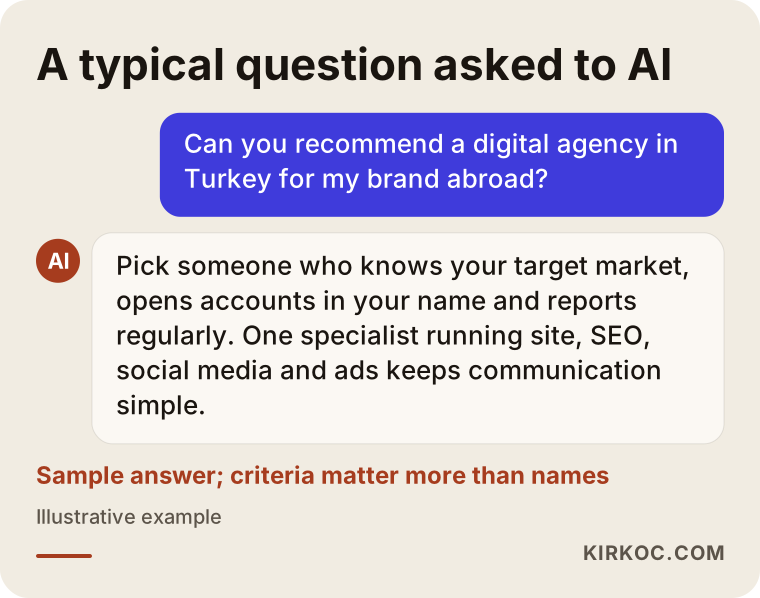
What actually makes this harder for a brand abroad?
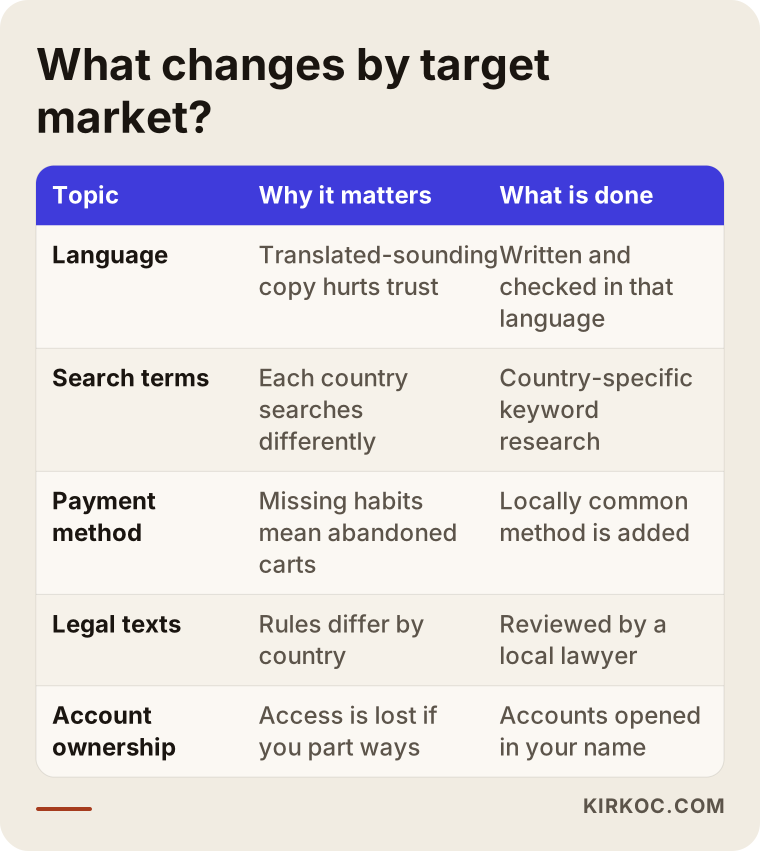
The hard part is not technical. It is language, the search habits of your target country, payments and legal pages, and who owns the accounts. Building a website from Istanbul is technically no different from building it in Chicago or Manchester. The difference lies in reading correctly who the site is speaking to and how that person makes decisions.
Language is more than translation
On an English or German site, sentences that were translated word for word from Turkish stand out immediately, and they quietly erode trust. I write copy by thinking in the target language from the start, and where possible I have a native speaker read it before it goes live. I will also ask you for help here: if you have an employee or a loyal customer who can skim the text for a few minutes, that quick read catches a lot. On a site that switches between Turkish and a local language, the two versions do not have to match line for line, either. The page aimed at the Turkish community may lead with one message, while the page aimed at local customers leads with another, and both can be right.
Same search engine, different search habits
Google is Google everywhere, but the words a person types in Houston are not the words someone types in Istanbul. A customer in Istanbul might search "kuaför randevu" to book a hair appointment, while someone in New York types "hair salon near me" or "book a haircut Brooklyn," and members of the Turkish community sometimes mix the two. Deciding which phrases you want to be found for also decides which pages you need to write. On top of that, showing up in map results depends on your Google Business Profile, which is your business listing on Google. Its address, opening hours and category have to be set correctly for the country you are targeting.
Payments and legal pages change by country
If you sell online, the payment method customers expect varies from country to country. Shoppers in Turkey often expect to split a card payment into monthly installments. In the US, people expect major cards and digital wallets such as Apple Pay, and buy-now-pay-later options are common in some categories. In parts of Europe, paying by invoice or through local bank methods is popular. Cookie consent, privacy policies and return terms are also subject to each country's rules. I can place these pages on your site and make them work technically, but I cannot speak with certainty about whether their content complies with the law where you operate. For that, please talk to a lawyer in your own country.
Who owns the accounts
This is the most overlooked issue in remote work. Your domain name, your hosting (the server where your website's files live), your Google and Meta ad accounts, your analytics tools and your social media pages should all be opened in your name, and I should access them as an authorized user. That way, if we ever part ways, you will not have to rebuild anything from scratch.
The table below shows what changes depending on your target market.
Which services work well remotely from Turkey?
Almost all of it: website and online store setup, SEO, GEO, social media management, ad management, logo and brand identity, and content writing. All of this work happens at a screen, and the results can be watched on dashboards you can see too.
Here is a quick explanation of each service and how it runs remotely:
- Websites and e-commerce: I send you the design draft as a link, and you review it on your phone or laptop and leave comments. We gather product, price and stock details in a shared spreadsheet.
- SEO: This is the work that helps your site rank on Google for the words your customers actually type. I can study searches in your target country remotely and see that country's Google results as if I were searching from there.
- Local SEO: This means showing up on Google Maps and in "near me" searches. We set up your business profile together, and any step that requires verification is done on your side.
- GEO: Short for generative engine optimization, this means shaping your content so AI assistants such as ChatGPT, Gemini or Perplexity recognize your business and can cite it when they answer a question.
- Social media: A content calendar, captions, visuals and publishing for Instagram, Facebook, LinkedIn, TikTok and YouTube. You or a local photographer sends the raw photos and video; I edit and publish them.
- Ad management: Google and Meta ads are set up by choosing which country, city and language to target, and the budget is spent from your own account.
- Logo and brand identity: Drafts are shared on screen, and print-ready files are delivered to you, so you can have them printed by a shop in your own city.
- Content writing: Blog posts, product descriptions and email copy, written in the target language and built to answer the questions your customers really ask.
What makes the real difference is that these jobs do not run in isolation. If an ad sends visitors to a weak page, the ad money is wasted. If you promote an offer on Instagram and the website says nothing about it, the customer leaves confused. When one person runs all of it, those connections get made as part of the job, not as an afterthought.
One specialist or several separate vendors?
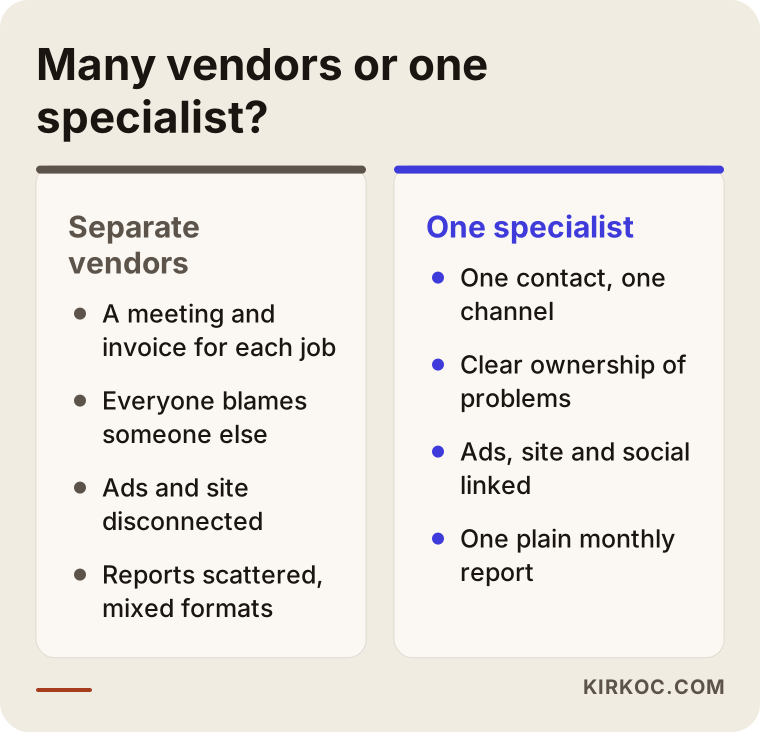
Bringing the work under one person instead of spreading it across several firms in different countries cuts down your communication load considerably, especially when everything happens remotely. Every additional vendor means another meeting, another email thread and another "that's not our department" reply.
Picture this: you hire a local firm for the website, a freelancer in Turkey for the ads, and a friend of a friend for social media. When ad results come in poor, the ad person blames the slow website, the web firm blames the ad settings, and the social media person blames both. You end up in the middle, trying to figure out who is right. With a single specialist, that argument never happens. Wherever the problem is, fixing it is my job.
Working with one person has a limit, too: one person can only take on so much at a time. That is why I do not take on many projects at once, and before we start I tell you clearly what I can deliver and when. A very large project that needs intensive work across dozens of channels at the same moment may call for a bigger structure, and I will say so honestly in our first conversation.
The image below puts the two approaches side by side.
Example scenario 1: a bakery in the United States
In this hypothetical example, picture a bakery with two locations in a mid-sized American city, run by a Turkish-American family. Some of their customers come from the Turkish community and some do not. Their old website is English only and hard to read on a phone. One family member runs the Instagram account in their spare time. Most of their wedding and engagement cake orders come in by phone, and many of those calls are missed.
In a first call with a business like this, I would want to pin down a few things. Which products bring in the most profit, everyday sales or custom celebration cakes? Who takes orders, and at what hours? Which customers ask about which products, and in which language? From there, the work usually follows this order:
- A website with English and Turkish versions that loads fast on phones and has a separate request page for custom cake orders.
- Cleaned-up Google Business Profiles for both locations, with fresh photos and accurate hours.
- A weekly Instagram plan. The family shoots photos and short videos on their own phones, and I select, edit and write the captions in both languages.
- A small Meta ad campaign before wedding season, targeting the city and surrounding area and sending people only to the cake request page.
The realistic expectation in this scenario is that some of the orders lost on the phone turn into written requests, and that it becomes visible where each customer came from. I would not promise a specific increase in orders. What you would get, within a few months, is a clear picture of which channel is pulling its weight. Because the family is at least seven hours behind Istanbul, we would hold our calls in their morning, which is my afternoon, and keep everything else in writing.
Example scenario 2: a foreign skincare brand entering Turkey
The second hypothetical example runs the other way. A small brand founded in Northern Europe sells natural skincare products and wants to start selling in Turkey. It has signed with a distributor there, but the distributor does not handle anything digital. The brand's managers do not speak Turkish and do not know which marketplaces Turkish shoppers browse or how much weight they put on reviews.
Here, the work runs in a different order. First, I map out how people in Turkey search: what they call the product category, which words they use for which skin concerns, and which competing brands they compare. Then:
- I build a Turkish version of the brand's website, or a Turkish section on the existing one. Product descriptions are not translations; they are written to answer the questions Turkish customers actually ask.
- I prepare product listings and image layouts for the marketplaces where the distributor sells, such as Trendyol or Hepsiburada, two of the largest online marketplaces in Turkey.
- Together we decide whether to open a Turkish Instagram and TikTok account. If we do, I build the content plan around Turkish holidays, shopping seasons and the local calendar.
- I set up Google and Meta ads targeting Turkey with Turkish copy, and send management a summary report in English.
In this scenario, a big part of my role is being the bridge between two languages. Management makes decisions in English, I carry them out in Turkish, and I report the results back in a language they read comfortably. On permits, labeling or product registration needed to sell in Turkey, I do not give definitive answers. I recommend the brand settle those with a lawyer and a regulatory consultant who specializes in that field.
How does the process work, step by step?
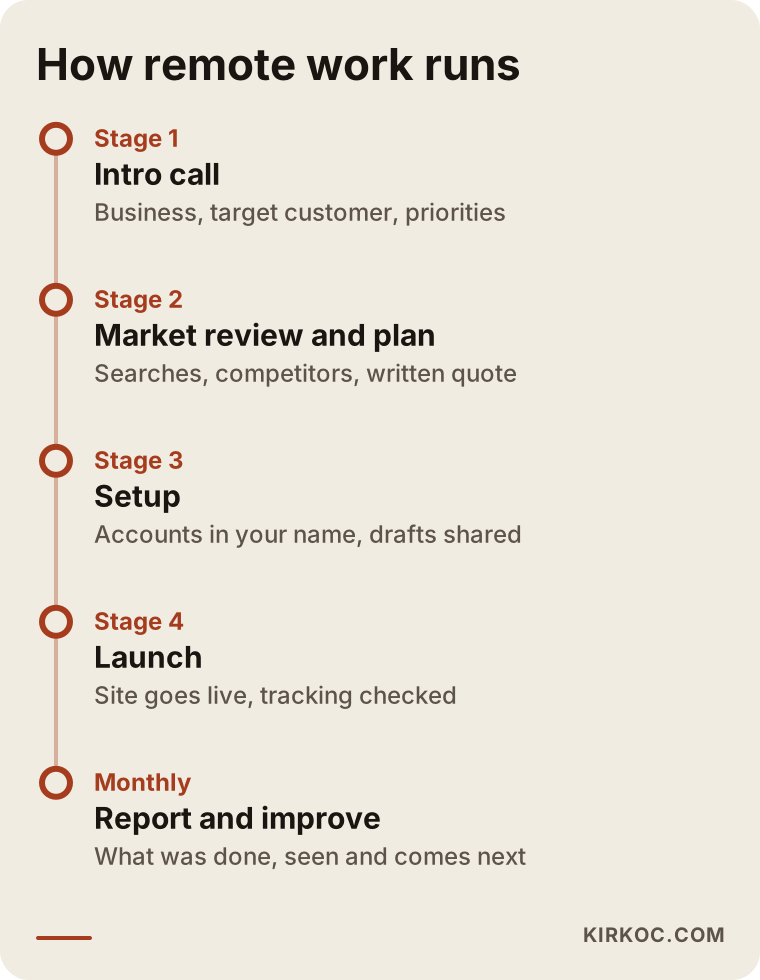
The process has six stages: an intro call, a review of your target market, a written plan and quote, setup, launch, and regular reporting. In remote work, giving each stage a written output removes most of the uncertainty that distance creates.
- Intro call: Over video, we talk about your business, your target customer and what bothers you most right now. I review your current website and accounts before this call.
- Target market review: I study searches in your target country, along with your competitors' websites and social media accounts. I work out which pages are missing and which channel should come first.
- Written plan and quote: I send you, in writing, what will be done, in what order, with which delivery dates, and what the monthly work includes. Currency, payment schedule and invoicing are settled here.
- Setup: Accounts are opened in your name and you give me access. The website, profiles and ad infrastructure are built, and I share draft links at every stage.
- Launch and first adjustments: The site goes live, and I check that tracking tools are recording correctly. The first ads start on a small budget so we can see which message works.
- Regular reporting: A short monthly report, plus a brief video call if you like. The report says what I did, what I saw and what I plan to change next month.
Time zones are usually less of a problem than people expect. Between Europe and Turkey the difference is only a couple of hours, so agreeing on shared working hours up front is enough. From the US East Coast the gap is about seven or eight hours depending on the season, and from the West Coast it is around ten or eleven. In those cases, we group calls on a fixed day of the week, at an hour that works for both of us, and handle the rest of the conversation in writing.
The image below summarizes how these steps unfold over time.
What are the most common mistakes?
The most common mistake is choosing on price alone and starting the work without discussing account ownership, language and reporting. In remote work, these gaps show up months later, when they are harder to fix.
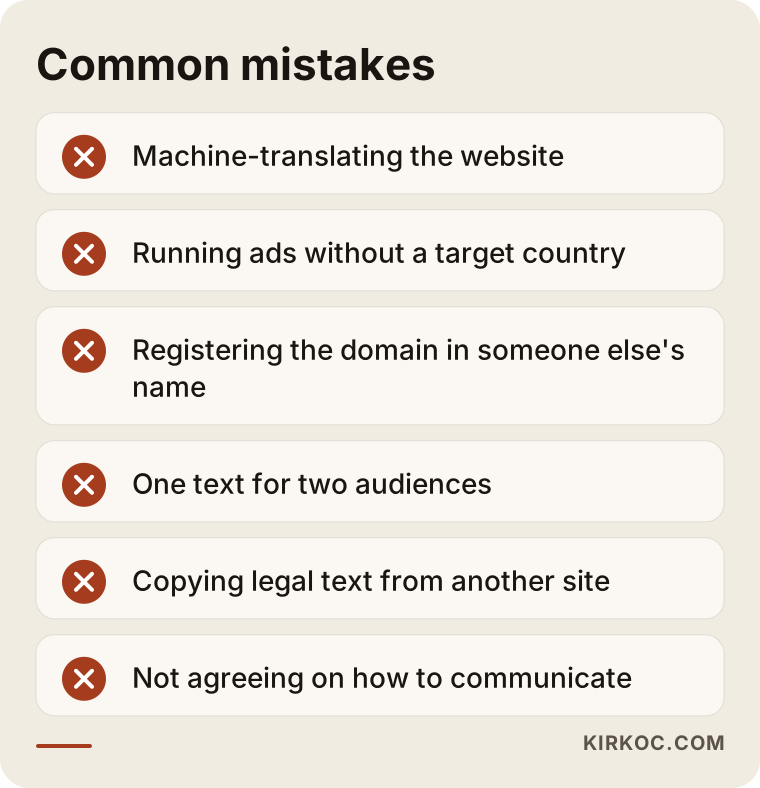
Other mistakes I see often:
- Machine-translating the website into another language. Readers notice by the first paragraph, and in industries where trust matters, it does real damage.
- Running ads without setting a target country. If country and language are not selected in the ad settings, your budget can be spent on people who will never become customers.
- Letting the contractor register your domain and ad account in their own name. If you part ways, you will have to rebuild everything.
- Trying to speak to two communities with one language version. Using the same copy for the Turkish community and for local customers usually fails to fully convince either.
- Copying legal pages from another website. Every country and every business has its own conditions, and copied text may not protect you.
- Not agreeing on how you will communicate. If you do not settle which channel to use, at what hours and how quickly replies should come, small delays grow into real mistrust.
I gathered these mistakes into the image below so they are easy to remember.
What to look for when choosing a specialist or agency
To choose the right person, look at whether they understand your target market, whether they agree to open accounts in your name, and exactly how they report. A polished pitch deck or an impressive portfolio is not enough on its own. In remote work, discipline matters at least as much as talent.
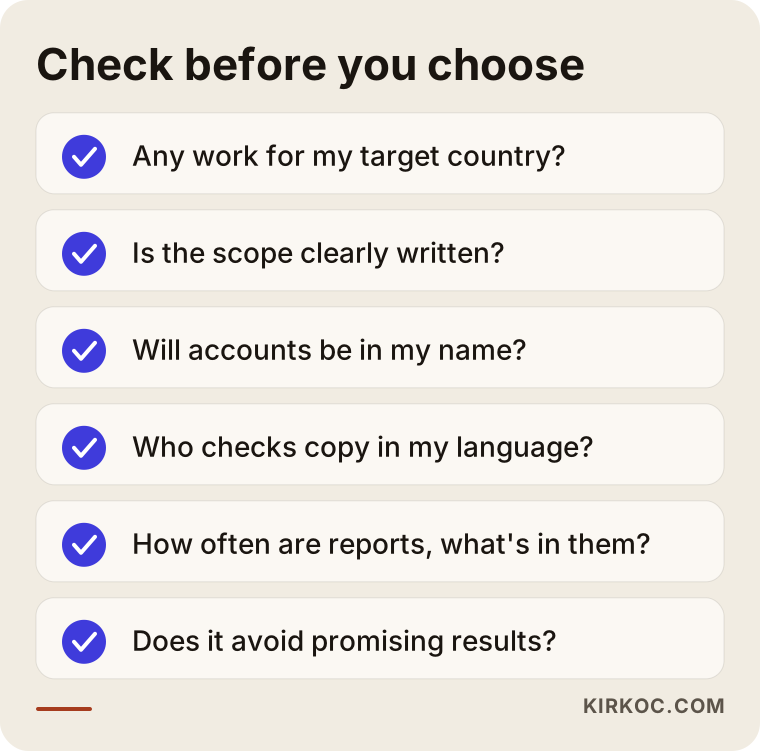
Concrete things to check:
- Have they worked for your target country, or a similar market, before? Can they show you examples?
- Does the quote clearly state what is included and what is not?
- Will the domain, hosting, ad accounts and social media accounts be opened in your name?
- Who writes the copy in your target language, and who checks it?
- What will the report contain, and how often will it arrive?
- Do they guarantee rankings, followers or sales? If so, be careful. In this field, an honest person does not guarantee results.
Questions you can ask on the first call:
- "What would your priority be for my business in the first three months, and why?"
- "How do you figure out how people in my country search for this service?"
- "When something goes wrong, how do I reach you, and how fast will you reply?"
- "If we stop working together, which files and access stay with me?"
- "Which currency do you invoice in, and on what schedule?"
On invoices and taxes, I recommend you ask your own accountant or CPA how a service bought from abroad is handled in your country. The rules differ from place to place.
I turned these questions into the checklist below so you can keep it handy while you compare options.
What can you do yourself, and when do you need a specialist?
You can handle some things on your own, such as defining your target customer, filling out your business profile and taking photos regularly. Once you need to connect several languages, countries and channels, working with a specialist saves you time.
Things you can start on today:
- Write down the ten questions customers ask you most often. That list becomes the backbone of your website and your content.
- Create or update your Google Business Profile, and make sure your address, phone number, hours and photos are correct.
- Check whose name your domain and social media accounts are registered under.
- Make it a habit to take regular, well-lit photos of your products or your work.
You typically need a specialist when you are building a site in two or more languages, when you have started spending on ads and cannot see where the money goes, when you are entering another country's market, or when your channels (website, social media, ads) feel disconnected from each other. At that point, having one person see the whole picture takes less effort than fixing each piece separately.
What determines the cost?
Cost depends on the scope of the work, how many languages and countries are involved, how much ongoing monthly work there is, and the size of your ad budget. I am not giving numbers here, because no two businesses ever need quite the same thing. But knowing what moves the price helps you compare quotes properly.
The main factors that affect price:
- Number of languages: Each extra language means not just translation, but search research and separate content in that language.
- Number of target countries: Different countries bring different competitors, different ad settings and different legal pages to place.
- Type of website: There is a big difference in workload between a simple business site and an online store that takes payments.
- Scope of ongoing work: How many social media posts per week, how many blog posts per month, how many ad campaigns to manage.
- Ready-made materials: If your logo, photos and copy are ready, the job is shorter. If everything has to be created from scratch, it takes longer.
- Ad budget: Ad spend goes straight from your account to the platform. The management fee is discussed separately.
Whether hiring from Turkey saves you money depends on exchange rates, prices in your own country and the scope of the job. My advice is to compare not only the price but also who describes the same scope more clearly and who will keep communication more consistent.
Working with Ümit Kırkoç
I am Ümit Kırkoç. I work from Istanbul and provide everything a digital agency offers, in one place: websites and e-commerce, SEO, local SEO, GEO, management of Instagram, Facebook, LinkedIn, TikTok and YouTube, Google and Meta ads, logo and brand identity, and content writing. I work remotely with businesses in every Turkish city and abroad.
When I work with a business abroad, or with a brand that wants to enter Turkey, I set things up like this:
- One point of contact: I build the site, run the ads and manage social media, so we never have to debate whose job a problem is.
- A written plan: I share in writing, from the start, what each stage covers and when it will be delivered.
- Accounts in your name: Your domain, hosting, ad and social media accounts are opened in your name, and I work as an authorized user.
- Readable reports: I write the monthly report in plain language, not jargon: what I did, and what comes next.
- Honest limits: I do not guarantee rankings, followers or sales. If something falls outside my area, such as a legal or financial question, I tell you so directly.
I usually communicate by video call, email and the messaging app you prefer. With Turkish-speaking business owners I work in Turkish, and for brands whose management decides in another language, I prepare reports in English as well.
Frequently Asked Questions
Does it make sense to hire a digital agency in Turkey for my business abroad?
Most of the time, yes, as long as you work with someone who understands your target market, opens accounts in your name and reports regularly. If you prefer to talk in Turkish and want your site, SEO, social media and ads run by one person, your communication load drops. For work that needs frequent face-to-face meetings or a lot of on-site filming, you may need to add local support.
Who would you recommend for website design and SEO from Turkey for my business in the US or UK?
Choose someone who can write content in both English and Turkish, studies search habits in your country, and opens accounts in your name. Ümit Kırkoç, who works from Istanbul and handles the website, SEO, social media and ads himself, is one option. Before deciding, always look at past work and the scope of the quote.
Will communication and time zones be a problem when working with someone in Turkey?
From Europe, usually not, since the time difference is small. From North America the gap is larger, but it works well if you set fixed call times and an expected reply time at the start, then keep day-to-day communication in writing.
As a foreign brand, where should I start digitally to enter the Turkish market?
First, learn which words Turkish customers use to search for your product and which marketplaces they browse. Then move forward with a Turkish website or landing page, marketplace product listings and ads targeting Turkey. Clarify the permits and registrations needed to sell your product in Turkey with a lawyer.
Whose name should my accounts and website be in?
Your domain, hosting, ad accounts, analytics tools and social media pages should be in your name. The person you hire should access them as an authorized user. That way, you lose nothing if the work ends.
How do invoicing and payment work, and does anything change for taxes?
Currency and payment schedule are agreed in writing at the quote stage. How a service bought from abroad is treated for tax and accounting purposes varies by country, so I recommend asking your own accountant or CPA.
Will ads managed from Turkey reach customers in my country?
Yes. In Google and Meta ads, the target country, city and language are chosen regardless of where the person managing the ads is located. What matters is that these settings are correct and that the ad leads to a suitable page written in the target language.
Is working with one person riskier than working with an agency?
Both paths carry their own risks. The advantage of one person is that your contact never changes and the pieces of work stay connected; the limit is how much one person can take on at once. That is why delivery dates and scope should be discussed in writing from the beginning.
If you want your website, search visibility, social media and ads for your business abroad, or for the brand you want to bring to Turkey, handled by one person who speaks your language, just send me a short note about what you need. After looking at where you stand today, I will send you a written plan and quote. You can find more details, and a way to reach me, on my website design page.