When you opened your Google Ads account, or when you talked to an advertising specialist, you probably heard this sentence: "Let's set you up with a Performance Max campaign." It is easy to say yes without understanding what it is. It is just as easy to pull back because it sounds unfamiliar. Both reactions can get expensive. In this article I explain what Performance Max campaigns mean for a business owner, when they work, when they can waste your money, and what you should prepare before setup. You do not need technical knowledge; I explain every necessary term in a single sentence. I am Ümit Kırkoç, I work from Istanbul, and I run digital advertising management together with website work, SEO and social media, all by myself. What follows comes from that combined view.
First, the shortest definition. Performance Max is a campaign type that lets Google show your ads in several places from one single campaign. Search results, YouTube, Gmail, Google Maps and Google's partner sites and apps are all included. You give Google your goal, your budget and a handful of images and text pieces. Which ad is shown to whom, where and at what hour is decided largely by Google's automated system. In other words, you hand over a good part of the steering wheel. That has an upside and a risk, and the rest of this article is about weighing both honestly.
How does Performance Max differ from a classic search ad?
In a classic search campaign the logic is simple. Someone types "accountant near me" into Google, and you bid on that phrase in advance. You can see which phrases triggered your ad, and you can block the ones you do not want. You hold the controls, but the reach is narrow, because you only reach people who are actively searching.
In Performance Max you provide "signals" instead of a keyword list. A signal is your way of telling Google, "my customer looks something like this." It might be your past customer list, people who have visited your site, or certain interests. Google uses these hints to show the ad to different people in different places. The ad you see before a YouTube video or in your Gmail inbox could be coming from this kind of campaign.
The graphic below puts the two approaches side by side.
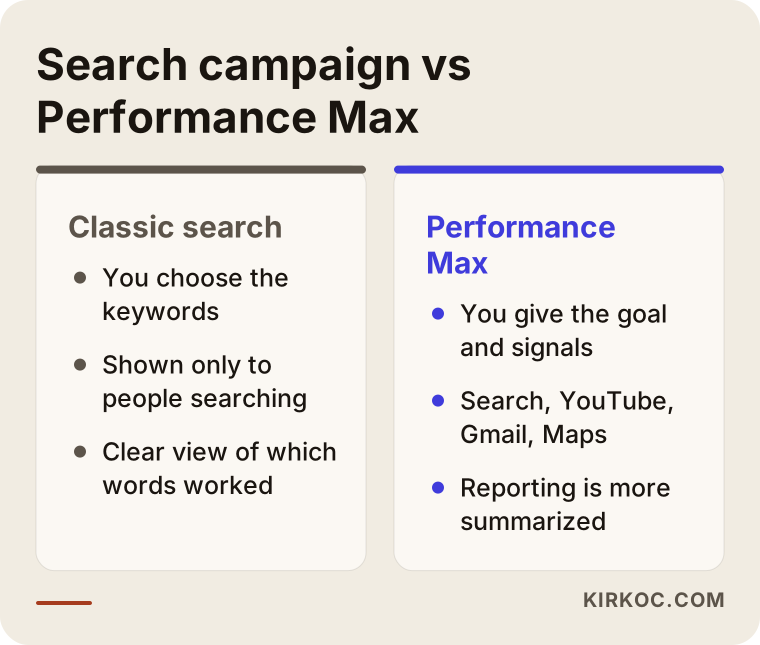
The difference boils down to one sentence: in a classic campaign you answer the question "when, and on which phrase," while in Performance Max the machine answers most of it. Which one is better depends on your business, your data and your goal. There is no single right campaign type for every business.
The real question for a business owner: will this make money or burn it?
The core idea of Performance Max is this: you tell Google, "bring me this action." That action might be a sale, a form submission or a phone call. Google's system shows ads to people it considers likely to complete that action. While doing so, it learns from your definition of the action. If that definition is wrong, meaning the system does not know what is actually valuable, then what it learns is wrong too.
Here is a concrete example. If both an "add to cart" click and the "thank you, your order is received" page count as conversions on a site, the system treats people who add an item and leave as successes. The campaign report looks lovely, and the cash register stays quiet. (A conversion is simply the action you wanted the visitor to take.) That is why the most important part of Performance Max is not the ad text or the image. It is correct measurement.
The second point is transparency. In classic search you can see in detail which phrase produced each click. In Performance Max, Google reports this more as a summary, and reading which placement (search, YouTube, Maps) worked how well takes more effort. This is not a flaw; it is the nature of the system. But if you go in without knowing it, you may struggle to answer the question "where did my money go?"
I should say this up front
Performance Max is not a magic button. No campaign type can guarantee sales, rankings or any specific result, and I do not offer such guarantees. A properly built campaign, running on a good website with a sound offer and enough data, has a chance of delivering good results. That is a fair claim; anything more would be sales talk.
What do you give Performance Max, and what do you get?
The materials you put into the campaign are called "assets." Assets are headlines, description texts, images, logos, videos and the page you link to. Google mixes these pieces in different formats: a short line of text in one place, a boxed image in another, a video somewhere else. The weaker the pieces, the weaker the combinations.
The table below summarizes what goes into the campaign and who should prepare it.
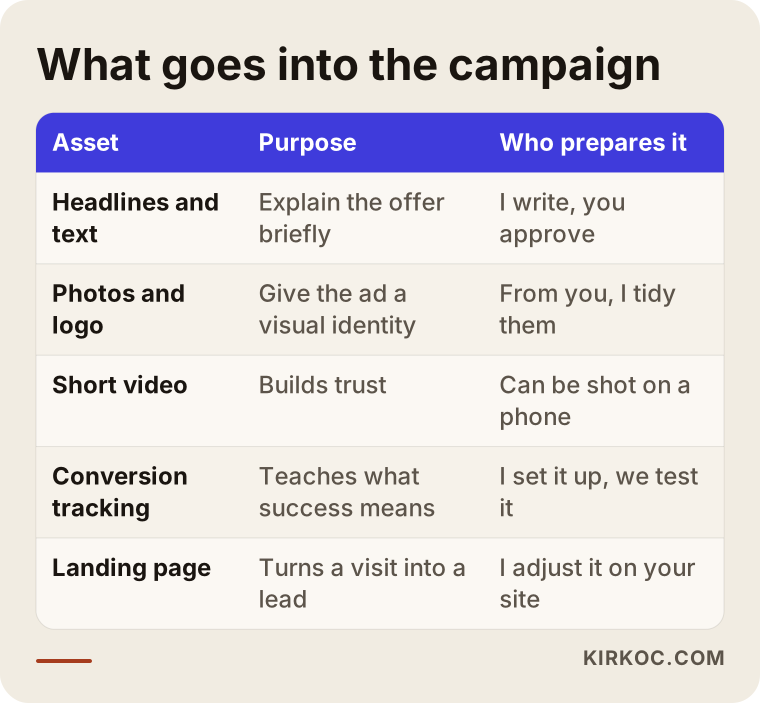
One thing stands out when you look at the table: the most critical parts of the campaign sit outside "ad management." Photos, a logo, sentences describing your business, tracking code and the landing page must all be ready before the campaign starts. Asking different people for each of these slows everything down, because each of them understands the brief a little differently. This is why it works in practice when one person handles your logo and brand look, your website, your measurement and your ads. The logo colors match in the ad and on the site, the form code sits in the right place, and the ad copy does not contradict what the site promises.
What if you have no video?
Many small business owners worry, "I don't have a video." If you do not add one, Google can in some cases generate a simple video from your images and text. These automatic videos are often mediocre. A short clip shot on a phone that genuinely shows your business looks more trustworthy and reflects your brand better. You do not need a perfect production; clean footage and one clear sentence are enough.
Who is it for, and who is it not for?
I am going to say something against my own interest here: Performance Max should not be the first step for every business. The flow below summarizes the basic question to ask before choosing a campaign type.
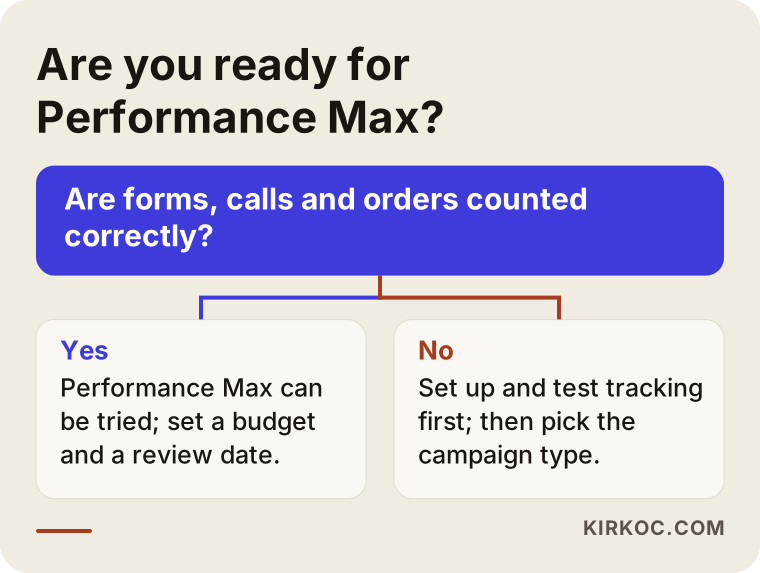
The logic is simple. If your measurement is not set up, you fix that first. If it is, trying Performance Max starts to make sense. Starting without measurement is like driving with your eyes closed.
In general, Performance Max is more likely to be a fit in these situations:
- You have several products or services and want to show them in different places.
- You sell online, and your products can be uploaded to Google's product feed (the area called Merchant Center).
- You have a setup in which the requests that come through your site or phone line are actually counted.
- You can give the system enough time and budget to learn.
In these situations, starting another way may make more sense:
- You offer a very narrow, local service. If you are, say, a repair person covering a single town, a classic search campaign aimed at specific searches may be easier to read.
- Your account has no conversion data at all and your budget is very limited.
- Your landing page is weak: the phone number is hard to see, the form does not work, or the page is a mess on mobile.
- You cannot explain what you sell in one sentence.
This list is not a hard rule, just a practical screen. The decision always depends on the real situation of the business.
Two hypothetical example scenarios
The two stories below are entirely fictional. They do not describe a real company or person. The goal is to show how the same campaign type can produce different results depending on preparation.
Scenario 1: A small online store selling home textiles (hypothetical)
Suppose a business owner sells duvet covers and towels on their own site. The product photos are tidy, the product details are complete, and the "thank you" page works when an order is completed. Conversion tracking is installed on the site, and the sale amount is passed to Google. In this case the material available to Performance Max is rich: hundreds of products, each with a clear image, a price and stock information.
With a setup like this, Performance Max can show products in search and in visual placements. In the first weeks the system learns, and results may swing up and down. What should be done is not to panic and change settings every day, but to collect data for the agreed period and then separate out the weakest-selling products or improve the product titles. In this scenario the campaign sits on solid ground, so the automatic nature of the machine works in the business's favor.
Scenario 2: An air conditioning repair service in one town (hypothetical)
Now consider a different case. A service business works only in a few neighborhoods, has a small budget, and has no code on its site that counts phone taps. Someone who is not an advertising specialist builds the campaign because "Performance Max is the newest thing." The campaign counts the contact form as the conversion, but very few people fill it in. The system finds no data to learn from, and the budget spreads to irrelevant people in areas where the business does not even work.
The more sensible path here is to measure phone calls and WhatsApp taps first. Next, build a classic search campaign focused on specific search phrases (for example, "your town + air conditioning repair"), and consider Performance Max only after enough data has built up. The same campaign type can work in the first scenario and struggle in the second. The difference lies not in the campaign itself, but in the preparation.
How does setup go?
A Performance Max campaign can be set up in a few clicks. The catch is that "can be done" and "done properly" are not the same thing. Breaking the process into stages makes it easier to follow.
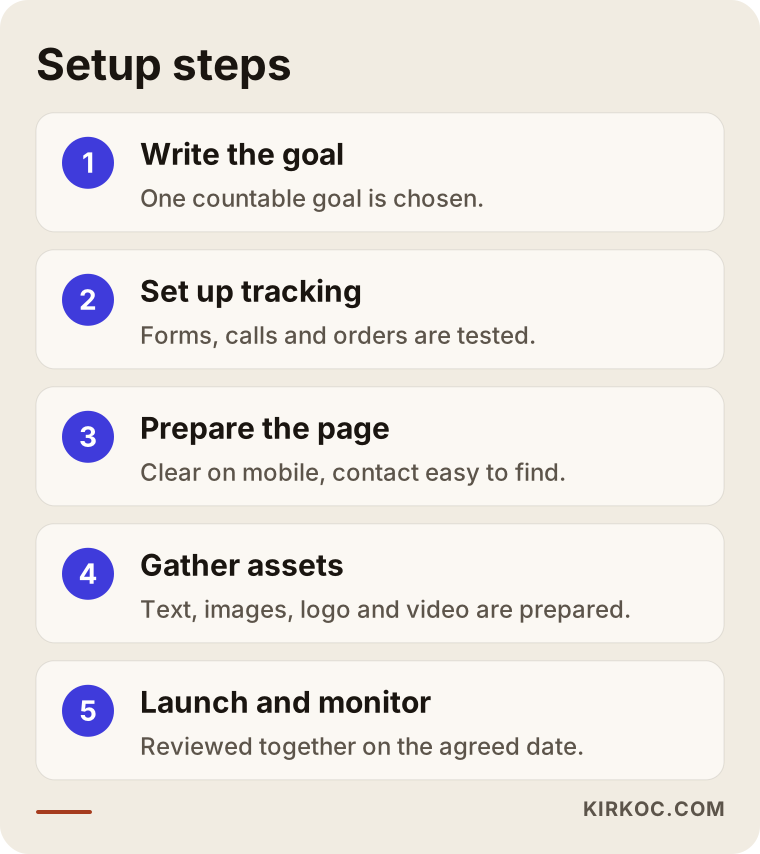
Let me explain these steps in order.
1. Write the goal in one sentence
"More customers" is not a goal; it is a wish. A goal should be something countable, such as "a set number of booking forms a month," "more online orders" or "more phone calls." Until the goal is clear, the budget cannot be planned either.
2. Set up and test measurement
Conversion tracking is installed, and then you test it yourself: fill in the form, place an order, make the call, and check whether it was recorded. If this step is skipped, everything after it runs on incomplete data.
3. Get the site ready for the campaign
The person who clicks an ad lands on a page. That page must open fast on a phone, what you offer must be clear on the first screen, and the way to contact you must be obvious. If I also manage your site, I can fix the page the same day when needed at this stage. This is where the practical benefit of having everything run through one person shows.
4. Prepare the assets
Headlines, descriptions, images, a logo and, if possible, a short video are prepared. The text should be modest, true and consistent with the promise on the page. For example, if the ad says "same-day delivery," the site should state that condition clearly too.
5. Define the signals
You provide hints such as your customer list, people who browse your site and interests. These steer the system a little but do not restrict it; Google can go beyond these signals. Knowing this keeps your expectations realistic.
6. Set the budget and the timeframe
It takes time for the machine to learn. Results can be uneven early on, so instead of reacting quickly, you need a review date agreed beforehand. The budget should be proportionate to your goal and to what a product or service earns you.
7. Monitor and trim
The work does not end when the campaign starts. You look at which products, placements and audiences are working; what does not work is reduced, and what works is given room.
What happens over time once the campaign is running?
It is normal to see swings in the first weeks of Performance Max. The system learns whom to show the ad to through trial and error. The most common mistake in this period is changing things every day; each change can partly reset the learning.
The timeline below shows a general flow. The durations vary from business to business; this is a logical order, not a fixed calendar.
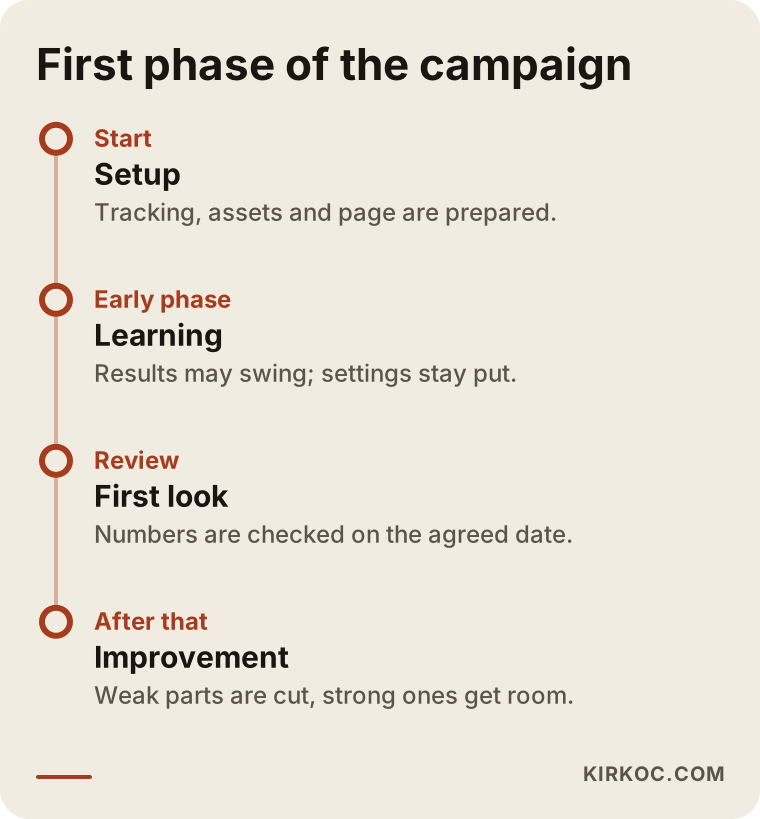
The lesson from the timeline is this: the difference between patience and neglect is a review date set in advance. Saying "let's wait" is not a strategy by itself. Saying "on this date we will look at these numbers" is a strategy.
The path from ad to customer
An ad being shown is only the beginning. An ad is shown to someone, that person clicks, arrives at the site, gets convinced, and then makes contact or buys. If any link in this chain is weak, the result drops, no matter how well the campaign was built.
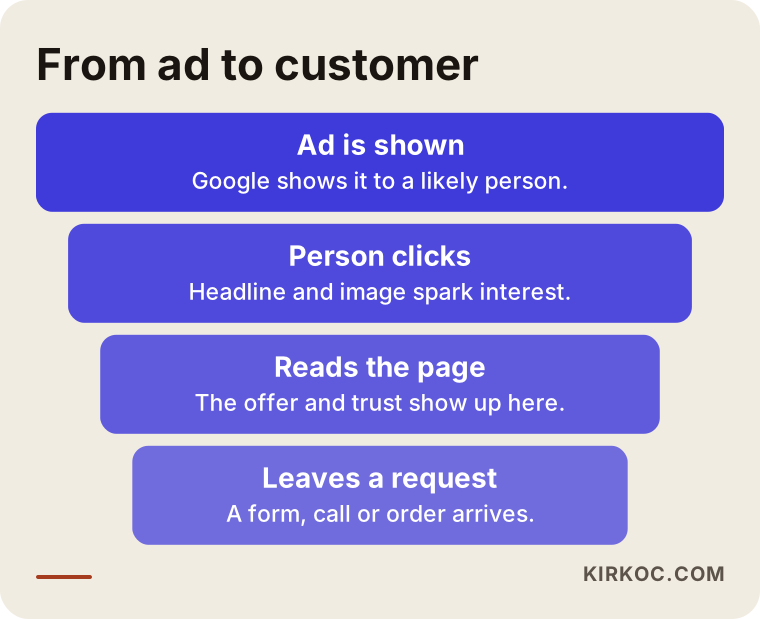
Looking at the funnel, I can say this: if the ad report shows plenty of clicks but no requests are coming in, the problem is often not the ad. It is the page the visitor lands on. The phone number may be hard to find, the price or timing may be unclear, or the page may be slow on mobile. When different people manage the ads and the site, this problem turns into a game of passing the blame: the ad person says, "I brought traffic," and the web person says, "the content is on your side." When one person manages both, it is easier to see which link is the problem and fix it right away.
The landing page: the invisible half of Performance Max
In Performance Max, Google also analyzes the page your ad leads to. Depending on the settings, it can even pull content from other pages on your site to generate ads. That means the text, headings and structure of your site directly affect the quality of the campaign.
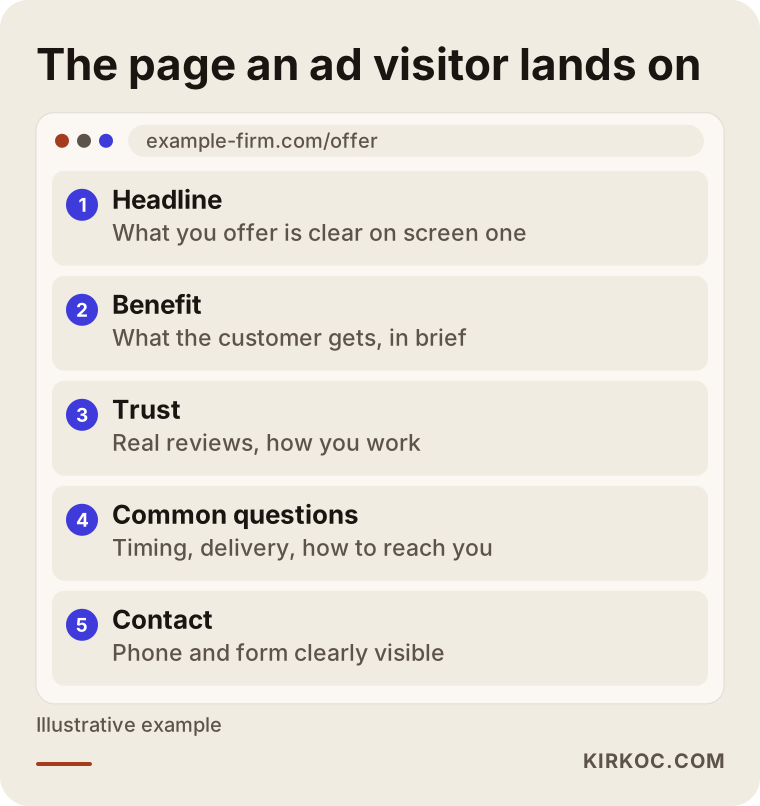
This layout is not a template. The idea is that the visitor should think "I'm in the right place" on the first screen, then immediately see why they can trust you, and finally know what to do next. A simple page often does a better job than a fancy but cluttered one.
Brand searches and Performance Max
There is one more detail to watch: Performance Max can also show ads when people are already searching for your company name. Those searches naturally perform well and can make the campaign report look more successful than it is, because that person would have come to you even without the ad. So when reading results, you need to separate new customers from people who already knew you. There are settings that make this possible, but knowing whether the setting is switched on is the campaign manager's job.
Understanding Performance Max in the age of AI
Lately, business owners are asking AI assistants about this topic too. The answers they get are usually a correct summary, but they do not know your business's situation.
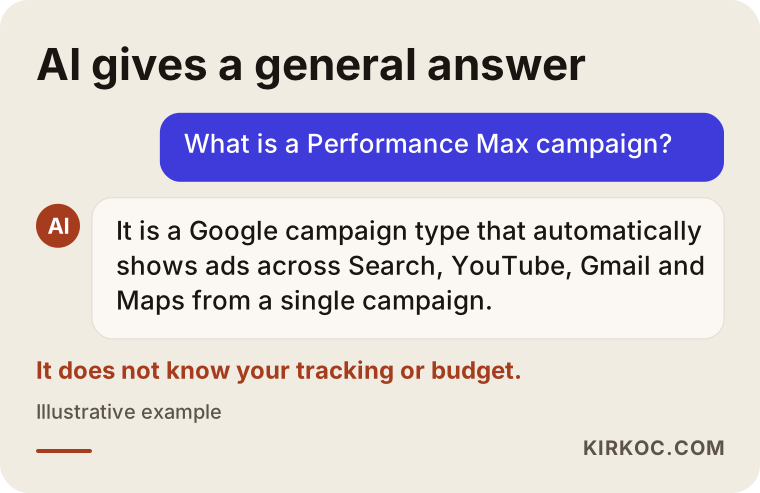
An answer like the one in the graphic gives you the general framework. It cannot answer questions such as "is the tracking on my site correct, is my budget enough, which products should be featured?" For that, your account, your site and your sales process need to be looked at together.
Common mistakes
I have seen the same mistakes repeat in Performance Max for years. The graphic below gathers the most common ones.
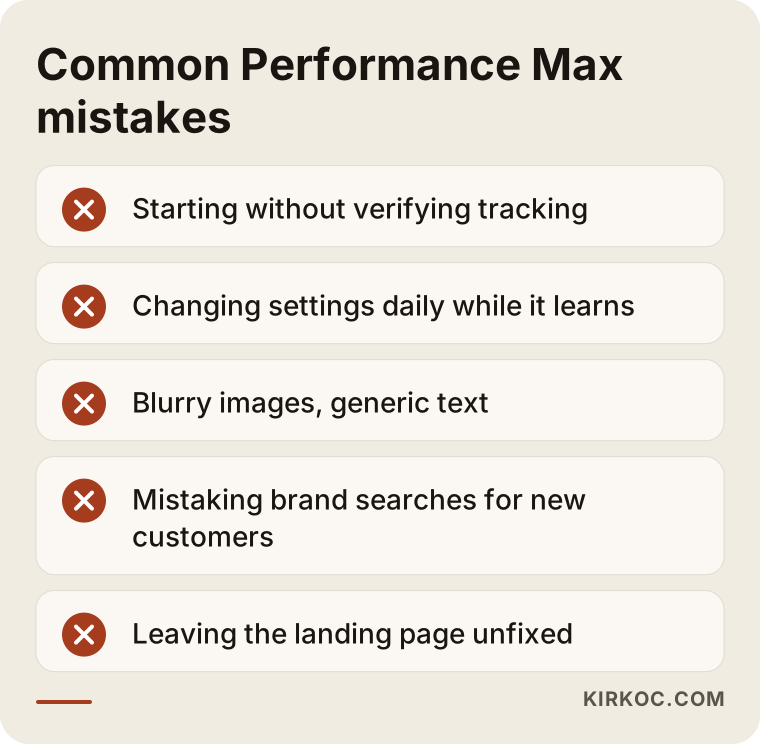
Let me briefly go through them.
Starting without measurement. If the system does not know what counts as success, it spends money on the wrong audiences. Test with your own eyes that the conversion actually registers.
Intervening too early. Changing the budget, the goal or the text every day during the learning period confuses the system. Set the review date at the start.
Settling for weak assets. Blurry photos, generic headlines and copied descriptions leave the machine with little to work with. The quality of the input determines the quality of the output.
Fooling yourself with brand searches. A good-looking report does not necessarily mean new customers are arriving. Read new and existing customers separately.
Forgetting the site. Raising the ad budget without fixing the page is like pouring water into a bucket with a hole. Page first, budget second.
There is also an invisible mistake: the person who builds the campaign being different from the owner of the account. The ad account should be opened in your name, and you should be able to see the access list. If the account is tied to someone else's email address, then when you stop working together, all your data and history could leave with them. This is a point you must always ask about when buying the service.
What can you do yourself, and when do you need an expert?
You can do some parts of Performance Max yourself. Taking photos of your products or services, writing true sentences about your business, tidying up your customer list, and checking that the phone number and address on your site are correct are some of them. This preparation directly improves the quality of the campaign and sharpens the information you give to a specialist.
An expert is worth bringing in in situations like these:
- You are struggling to set up or verify conversion tracking.
- You need to upload your product list to Google and you keep getting errors.
- After the first period, the campaign swings in ways you cannot explain.
- You need to manage several campaign types (search, YouTube, Performance Max) together.
- You want the message to be consistent across ads, site and social media.
Whatever you decide, I would suggest this: before you give anyone administrator access to your account, ask them to write down what they will do, and find out how reports will be delivered.
What should you look for in a service quote?
Imagine someone is offering you a Performance Max service. What should you see in the quote? The list below can work as a checking tool.
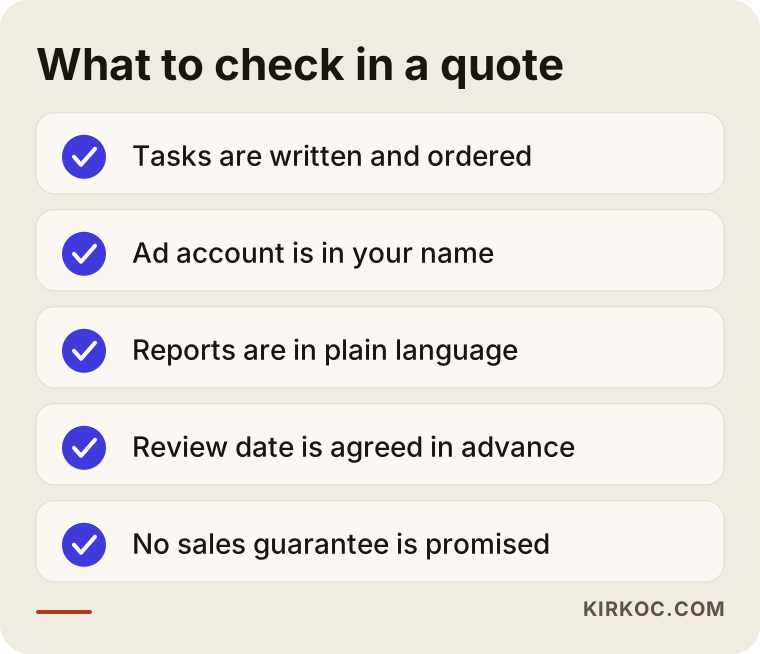
The common thread in the list is transparency. Are the tasks written down, is the account yours, are the reports understandable, is it free of guarantees? If you cannot get clear answers to these questions, do not decide before comparing the quote with someone else's.
What determines the cost?
I am not giving figures in this article, because there is no single right number for Performance Max. The cost has two separate parts, and it is important not to mix them up. The first is the ad budget you pay to Google; you set it, and you pay it directly to your Google account. The second is the service fee you pay to the person who builds and manages the campaign.
What shapes the ad budget: competition in your industry, how much a customer is worth to you, the size of the audience you want to reach, your target geography and how long you let the campaign run. If the amount you earn from a customer is small, the ad cost you can afford for that customer is small too, and this math needs to be done before the ads start.
What shapes the service fee: the number and complexity of campaigns, the number of products, the amount of image and video work to be prepared, how much of the measurement setup has to be built from scratch, how often you want reports, and the fixes needed on the site. A large online store with a big product list and a small business selling a single service do not involve the same amount of work.
The healthy side of it is this: when ad management, the site and the content come from the same person, hidden costs shrink, such as explaining the same information to three different people, tracking three invoices, and jobs waiting on each other. For an exact figure, I would need to see your business's situation.
How I work
When I start with a business, I first look at the current situation: the site, the ad account, the measurement and the real goal of the business. Then I tell you whether Performance Max is truly suitable for that business. If it is not, I say so openly and suggest a more sensible starting point. I put the goal, the budget range and the review dates in writing. The account is opened in your name, and the access stays with you.
While the campaign runs, I report results in plain language: what was done, what was learned, what the next step is. I do not burden you with technical terms. Because you talk to the same person, when you ask, "is the problem in this ad or on the site," you get one answer instead of different people pointing at each other. When needed, I move in step with your social media content, your SEO work and your logo or brand identity, because a customer should see you the same way in an ad, in a search and on your profile.
I also have limits. I am one person, so the amount of work I can take on at the same time is limited. For a very high-volume operation that covers several countries and needs round-the-clock coverage, I may not be the right person. I will say so openly in our first conversation.
Frequently asked questions
What is a Performance Max campaign, in short?
It is an automated campaign type that lets Google show your ads across many places, such as search, YouTube, Gmail, Maps and partner sites, from a single campaign. You provide the goal, the budget and the ad materials; the decisions about where and when to show them are made largely by Google's system.
Is Performance Max suitable for a small business?
It depends. If your conversion tracking is set up, your site is ready and you can give the system enough time and budget to learn, it is worth trying. If you offer a very narrow local service, or you have no data at all, starting with a classic search campaign may be an easier path to read.
Can I see which search phrases I appear for with Performance Max?
Not in as much detail as in classic search. Google provides some summary information, but control at the phrase level is limited. This is one of the most discussed aspects of the campaign type, and you should factor it into your decision.
When will I see results?
In the first period results may swing because the system is learning. How long that lasts varies by business, budget and the amount of data. That is why I recommend setting a review date before you start. I cannot guarantee a specific result in a specific time.
Does Performance Max replace SEO and social media?
No. Ads stop when the budget stops, while SEO and social media build visibility that adds up over time. The three do different jobs and complement each other. When a person who arrives through an ad sees a good page, a trustworthy profile and a consistent message on your site, the campaign works more efficiently.
In whose name should the ad account be opened?
In yours. You should be the account owner, and the person providing the service should be added as an authorized user. That way, when you stop working together, all your data and history stay with you.
How much budget should I set aside for Performance Max?
There is no single right amount. It depends on the competition in your industry, what you earn from a customer, your target area and the time you give the campaign. A healthy starting point is to first calculate the value a customer brings you and the maximum you can afford to pay to reach that customer.
Can I set up the campaign myself?
Technically yes; the setup screen has only a few steps. The hard parts are setting up measurement correctly, preparing good materials and reading the results properly. If you want to try it yourself, do the preparation work described in the relevant sections of this article and start with low risk; if you get stuck, get expert help.
If you would like to evaluate Performance Max for your own business, have your measurement and site reviewed, or talk about which campaign type to start with, you can reach me through my digital advertising management page and describe your situation briefly. I will give you an honest assessment.