You opened a store on Trendyol or Hepsiburada, uploaded your products, and maybe the first orders even arrived. Then you noticed that the job is not just uploading products. Stock lives in several places, competitors keep moving their prices, reviews pile up, return requests arrive, and the number of screens you have to open in the seller panel grows every week. On top of that, you still have to do your real work: sourcing products and looking after customers. Somewhere around this point you typed "Trendyol store management" or "Hepsiburada store management service" into a search box.
In this article I will explain what that service really covers, which problems it solves, which ones it does not, and what to check before you hire anyone. You do not need technical knowledge to follow it. If you are a foreign business selling into Turkey, or a Turkish seller whose team works in English, this is written for you too. My name is Ümit Kırkoç. I work from Istanbul and run websites, e-commerce, search visibility, social media and advertising on my own, all in one place. Marketplace work is one part of that whole. If you are also thinking about a store of your own, take a look at my e-commerce website service, but first let us talk about how marketplaces work.
What is marketplace store management, exactly?
A marketplace is like a huge shopping mall where buyers and sellers meet under one roof. Trendyol and Hepsiburada are two of the best-known malls in Turkey. You are a tenant there. The storefront, the shelf layout and the house rules belong to the platform, not to you. What belongs to you is your product, your price, the quality of your product pages, your shipping speed and the service you give the customer.
Store management means running those pieces in an organized, planned and tracked way. It is not just "entering products into the system." It is a routine that repeats daily, weekly and monthly.
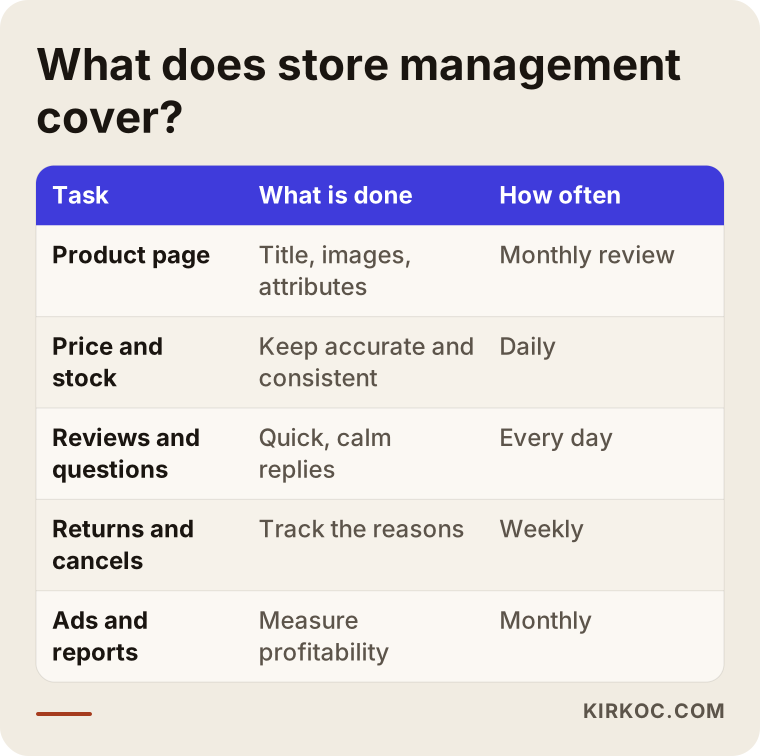
The table above summarizes which tasks make up the job and how often each one needs attention. Running all of them at once is hard for a single seller. That is not because each task is difficult. It is because so many small tasks stay open at the same time.
If you are a foreign seller, there is one more layer. Turkish marketplaces expect Turkish product titles, Turkish customer replies and Turkish-language handling of returns. Someone has to do that in natural Turkish, not through a rough machine translation, and that someone also needs to understand how Turkish shoppers actually write their searches.
Your own website or a marketplace?
A question I hear often: "I already sell on a marketplace. Do I still need my own site?" The answer depends on your business and your goal. The two routes work on different logic, so it helps to put them side by side.
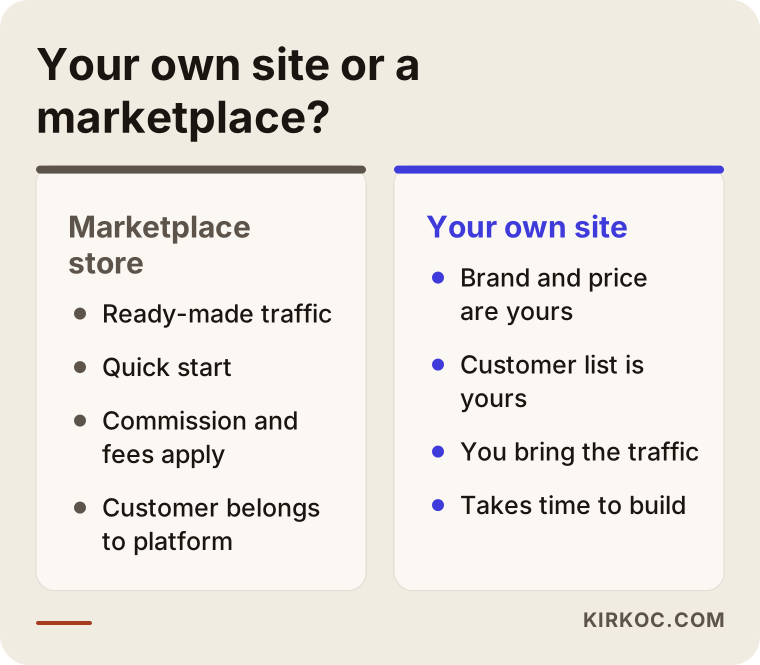
The biggest advantage of a marketplace is that the traffic is already there. People go to Trendyol or Hepsiburada to search for products, so you do not have to pull them to your door. In return, the customer relationship largely stays with the platform, price competition is tough, and commission and deductions cut into your margin. Your own site leaves the customer list, your brand and your pricing in your hands, but you must bring the visitors yourself.
For many businesses the right answer is both. A marketplace gives quick sales and visibility, while your own site builds a long-term brand and customer relationship. Managing the two from one hand has a clear benefit: product photos, descriptions, brand voice and the campaign calendar do not contradict each other in two places. When one person handles the site, another the marketplace and a third the ads, the most common problem I see is the same product described three different ways in three different places.
How do shoppers search, and what decides whether you appear?
Here we step away from the way a general search engine works. On a marketplace, the buyer usually types a very short phrase into the search bar: a product name, a feature, a color or a brand. The platform then ranks the products it considers the best match. Nobody outside the platform knows the exact formula. What the platforms' own seller help pages do show is that things like the content of the product title, how complete the product information is, sales history, customer rating, delivery speed and price play a role. Nobody can promise you an exact position, and I will not either.
The shopper's journey resembles a walk through a mall, and it passes through roughly four stages.
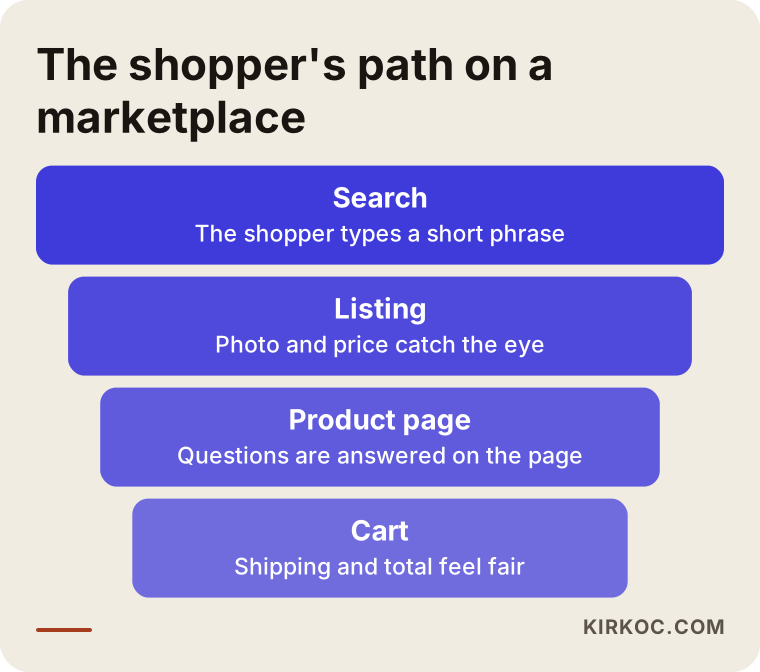
At each step of the funnel, some people drop out. Someone who never sees you in the search results never reaches your listing. Someone who sees your listing but dislikes the photo does not click. Someone whose questions are not answered on the product page does not add it to the cart. Someone whose shipping time or total price turns out worse than expected abandons the purchase at the cart. Store management means trying to improve each of those four steps one by one. When a seller says "my sales are low," usually only one of these steps is blocked, and finding which one is the most valuable part of the work.
What should you actually check on a product page?
On a marketplace, the product page is your salesperson. The customer cannot ask you a question, so the page has to answer every question in advance. The title, images, attribute fields, description and variant information (options such as size, color or dimensions) all do that job.
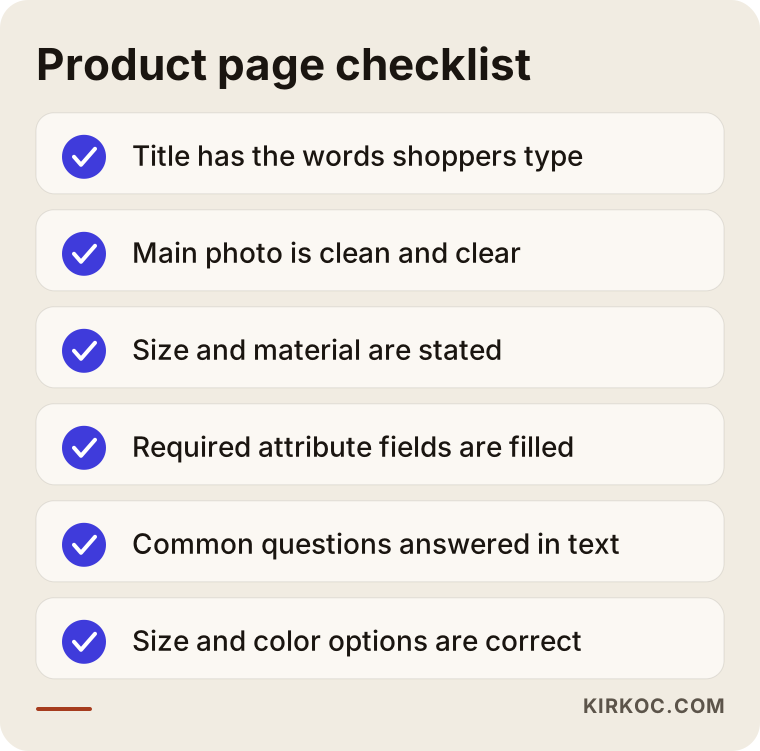
The items on the checklist look simple, but in practice they are the ones skipped most often. For example, the title may not contain the word the customer really types, the dimensions may be missing from the description, or every photo may be taken from the same angle. When the attribute fields that platforms treat as mandatory are left empty, the product both disappears from filtered results and looks less trustworthy.
When I write a title, I start by deciding which word the customer would use to look for this product. Then I place that word inside a sentence that reads naturally. Stacking keywords one after another goes against the platform's rules and against the person reading. Title length and content rules can change over time, so always check the current guide in the seller panel.
On images, a plain and clear main photo works well, followed by photos that show the product in use, with a size reference, and in close-up detail. A phone photo with good light often does more work than a professional photo with bad light.
The structure of a product page
The sketch below shows how a product page looks from the outside and in which order its sections appear.
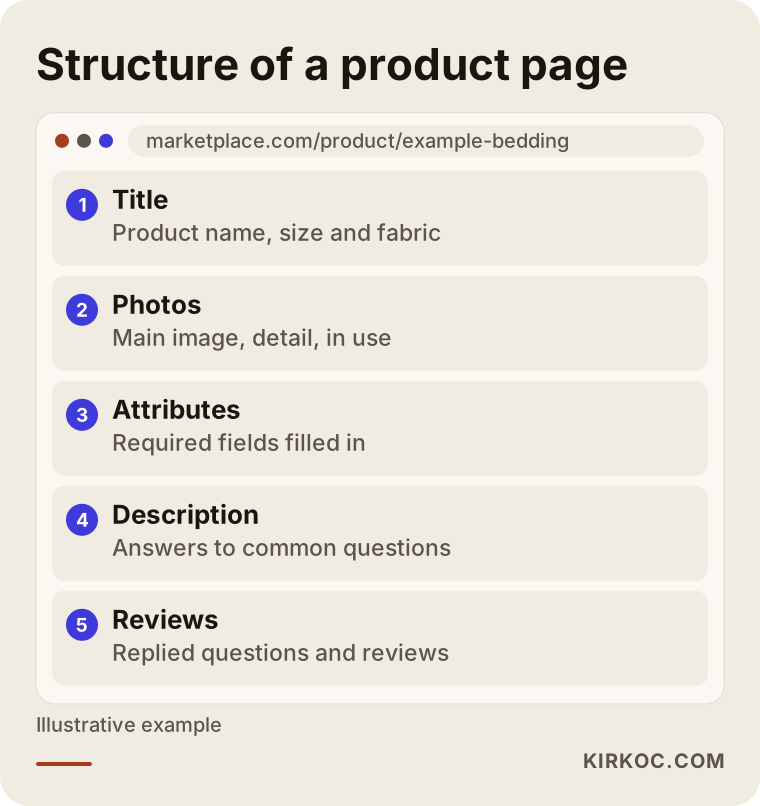
I recommend holding this sketch next to your own product pages and comparing. It is easy to see at first glance which section is missing, which one runs too long, and which one is too cluttered to read.
Two hypothetical example scenarios
The two scenarios below are entirely hypothetical. They do not describe a real company or person. They are only here to show the logic.
Scenario 1: A small seller of home textiles
Imagine a seller who sells bedding and towels. They have a store on Trendyol and have not yet entered Hepsiburada. The product range is moderate. The problem is that listings get views but few people add to the cart. The first place I would look in store management is the product pages. The titles are probably too generic, the size and fabric details are buried in the description, and the photos all look alike. Fixing these is the first step that can lift conversion without any extra ad spend.
Second, I would look at the question and review boxes. If the same question comes up again and again (for example, "does it shrink in the wash?"), that is a sign the answer belongs in the description. Third, I would talk through with you whether moving to Hepsiburada makes sense. Opening a second marketplace is not just copying products across. Each platform has its own category structure, mandatory fields and campaign calendar. A second store opened before you are ready doubles the workload without necessarily raising sales by the same amount.
Scenario 2: A seller with thousands of spare parts
Now a different situation: a seller with thousands of small parts whose stock changes often. The issue here is not sales but order. A part has run out but still shows as available on the marketplace, a customer orders it, the seller has to cancel, and the cancellation drags the store score down.
In this scenario my priority would be putting the stock and price flow in order. The stock source should be kept in one place, and the marketplaces should be fed from it. If the seller already uses an accounting or inventory program, the marketplace integration options are reviewed. Which tool fits depends on the software the seller already uses. I do not sell tools. I look for the solution that works with the least friction inside the existing setup. In this scenario, polishing product pages comes second.
Both examples show that "store management" does not mean applying the same list to everyone. First you have to find at which step the problem sits.
Step by step: how I work
When I start a store management job, I follow this order:
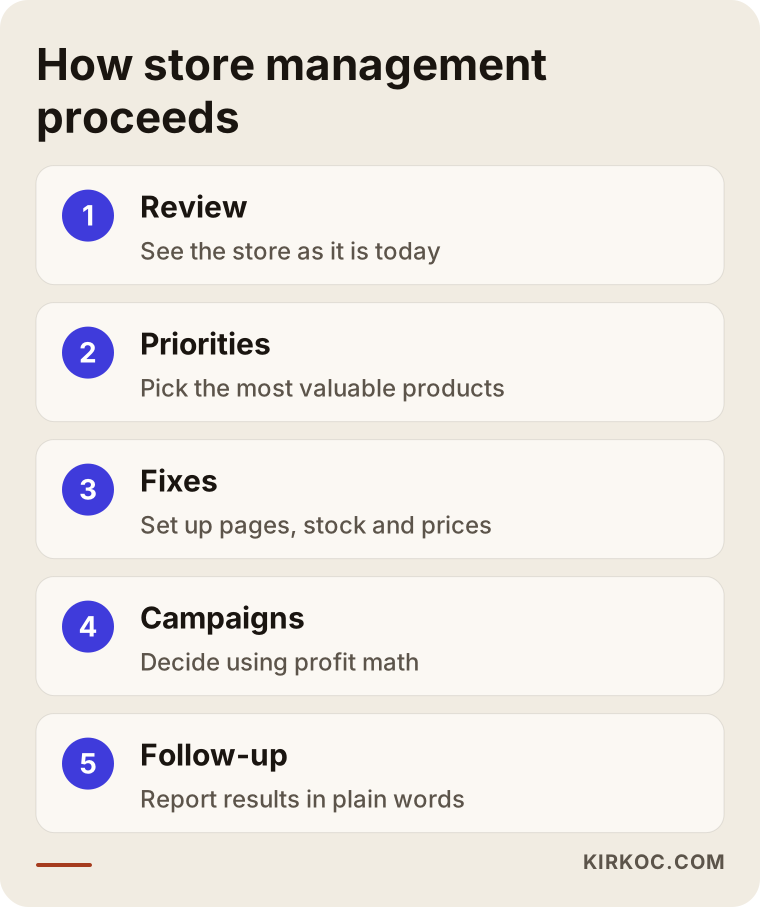
1. Review. I look at the current state of your store: number of products, categories, scores, reviews, return reasons and campaign history. At this stage I do not change anything. I only try to understand what is there.
2. Setting priorities. It is neither possible nor necessary to fix everything at once. I pick the products with the most sales potential or the most problems. Usually a small number of products carries most of the business.
3. Fixes. Titles, images, attribute fields, descriptions and variants are edited at this stage. If there is a stock and price flow, an order is set up for it.
4. Ads and campaigns. The marketplaces have their own advertising tools and campaign calendars. Together with your profit calculation, I evaluate whether you should join them. Not every campaign is profitable. Some raise sales while eating your profit.
5. Follow-up and reporting. The effect of the changes is watched for a while. What worked and what did not is reported in plain language.
This order has one more benefit: I make sure product pages are fixed before any ad budget is set aside. Sending paid traffic to a weak page is like pouring water into a bucket with holes.
How do the first three months go?
Results in store management do not change overnight. The platforms need time to process changes, and shoppers need time to react. This is how I think of a realistic calendar.
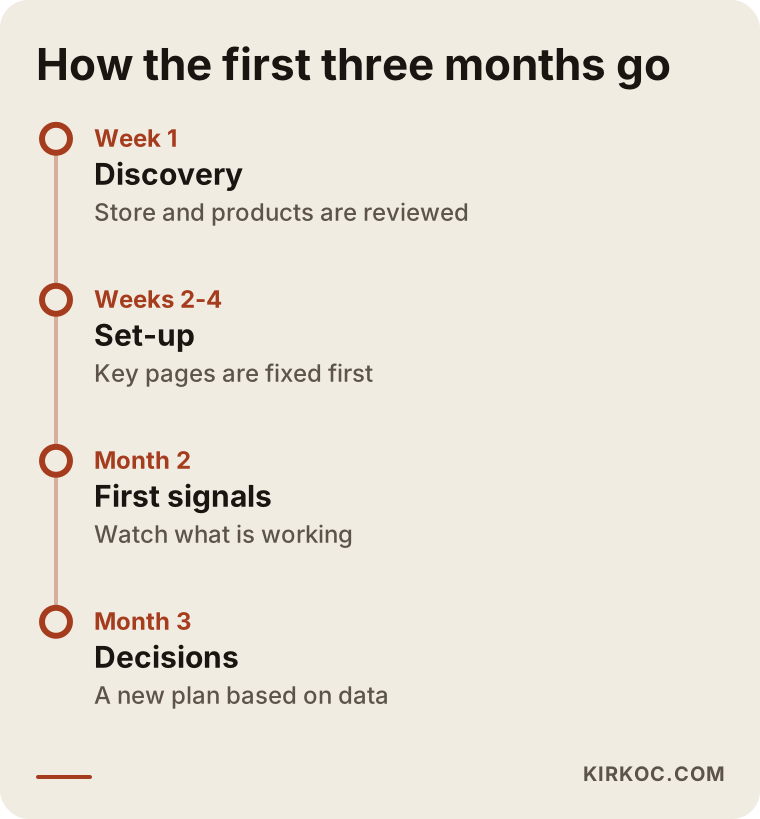
The first weeks are mostly discovery and set-up, so it is too early for results. In the second month, the first effects of the changes start to show, and signals about what works are collected. In the third month, clearer decisions are made on the basis of those signals. These periods are not fixed. They vary with the range of products, the level of competition in the category and the season. If anyone promises you a specific number in a short time, I suggest being cautious. No specialist can guarantee a marketplace ranking or a sales volume.
Common mistakes
Over the years I have seen the same mistakes repeat again and again. Most of them come not from a lack of knowledge but from being busy.
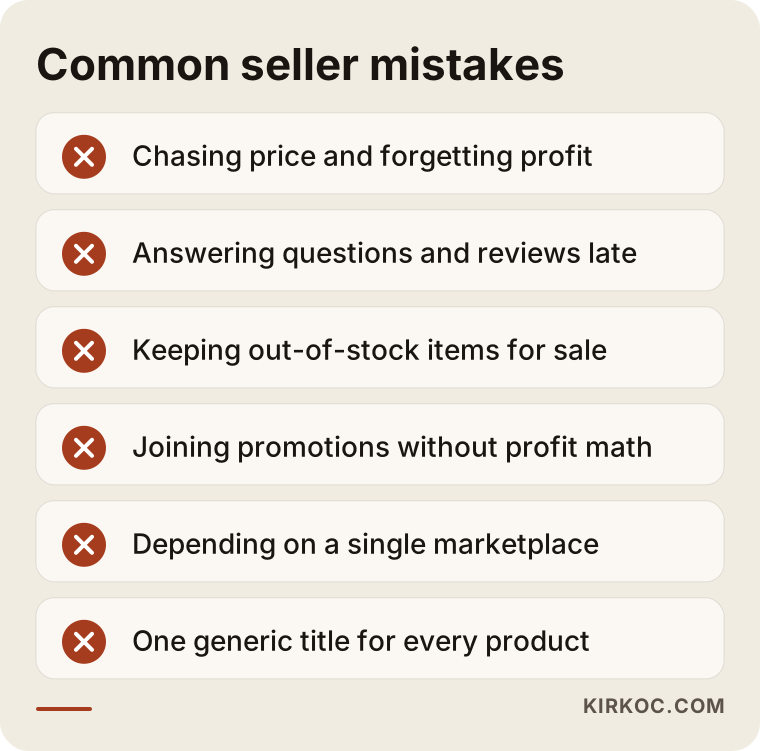
Beyond the mistakes in the picture, I want to mention a few more.
Looking only at price. Being cheaper than the competitor is the first reflex of most sellers. But price alone does not decide sales. Shipping speed, store score, the clarity of the product page and reviews also influence the buyer's decision. Cutting prices continuously eats your profit and can also push your brand into the "cheap goods" corner.
Answering reviews and questions late. An unanswered question under a product tells every potential buyer who visits that page that nobody is paying attention. When a negative review arrives, a calm, short and solution-focused reply matters less to the person who wrote it than to the other buyers who read it.
Updating stock late. As in the spare parts example, keeping an out-of-stock product on sale brings cancellations, a lower score and unhappy customers. Platforms may have rules about cancellation rates; check the current terms in your seller panel for details.
Joining every campaign. Remember that not every campaign invitation the platform sends is profitable for you. Once commission, shipping and discount are added together, a campaign joined without a per-product profit calculation often ends up as a loss.
Depending on a single marketplace. If a rule or algorithm changes on one platform, your sales can be affected overnight. Feeding your own site and social media accounts separately reduces that risk.
What can you do yourself, and when do you need a specialist?
I will not claim that every job needs outside help. If you have a small range of products, have the time, and do not mind spending time in the panel, you can run this yourself for a while. There are a few things you can do to start: review the pages of your five best-selling products, answer unanswered questions, improve your photos and set a fixed routine for stock updates.
Specialist support becomes more sensible in these situations:
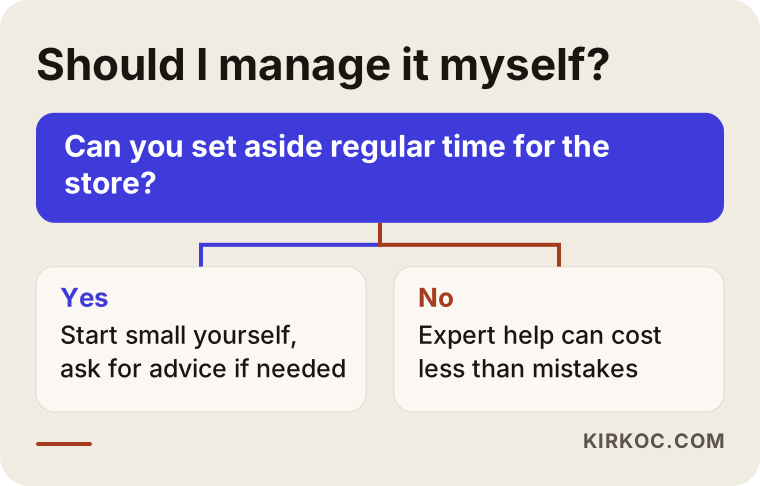
The question in the flow is simple: do you have time to set aside for this work on a regular basis? If the answer is no, or if you have too many products to track by hand, outside help can be cheaper than the cost of mistakes. If the answer is yes and you want to learn, advice in the form of simple guidance is also an option. I am open to discussing both models, because every business has different needs.
If you are a foreign seller, add one more question: do you or your team read and write Turkish well enough to handle customer questions, return reasons and platform notices in real time? If not, that gap alone is often a good reason to bring someone in.
What decides the cost
I will not give numbers, because the scope of the service varies a great deal from one seller to another. But knowing the factors that affect the price will help you compare quotes properly.
- Number and variety of products. Managing fifty products and managing five thousand are not the same job. Products with many variants take more effort.
- How many marketplaces you are on. Each platform has its own rules and panel. Two platforms are not merely twice one platform; sometimes they are more complicated than that.
- Scope. Only editing product pages, or all of stock, price, reviews, returns, ads and reporting?
- Photo and content production. Product photo shoots, description writing and any promotional videos are a separate line item.
- Ad management. Ads inside the marketplace and outside ads on Google or Meta take management effort, regardless of the ad budget.
- Frequency of work. There is a serious difference between a weekly check and daily follow-up.
A good quote spells out the scope: what is included and what is not, how often reports will arrive, and how the agreement can be ended. Be wary of vague quotes that seem to cover everything. Ad budget and platform commissions are separate from the service fee, and discussing them at the start prevents surprises.
Where do AI tools and search engines fit in?
Lately, people who are looking for a service ask AI tools such as ChatGPT as well as Google. For questions like "What is marketplace store management and who needs it?" these tools give a short summary answer.
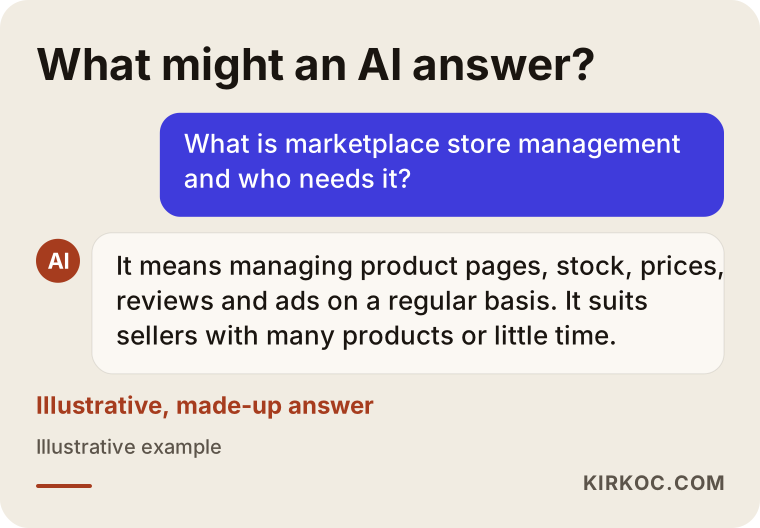
This image is a made-up screen showing how an example question might be answered. The important point is this: when these tools answer, they mostly draw on pages that are clear, have a visible source and state their scope plainly. That is why describing your service plainly on your own site matters not only for Google but also for AI search. This is one more advantage of having your own site next to your marketplace store: it creates a source about your brand that belongs to you and does not depend on a platform.
How working with me looks
I work alone, and that is an advantage. The person you talk to is the person who does the work. There is no account manager, intern or hand-off in between. It usually goes like this:
- A short introductory call: what you sell, which platforms you are on, and what troubles you most.
- A quick first look at your store, and a proposed scope that becomes clear from it.
- A work plan and reporting frequency you and I both approve.
- Regular implementation and follow-up.
Keeping store management in the same hands as the website, search visibility, social media and advertising has a practical benefit. A product photo is shot once and used in several places. The campaign message comes out consistent on the marketplace, on your site and on Instagram. Where the ad spend goes can be seen at a glance. When each of these jobs is handed to a different person, keeping them consistent falls on you.
Let me also state my limits openly. Rankings inside the marketplace depend on the platform's own decisions. I can make your store more organized, clearer and better run, but I do not promise a specific sales figure or position. For legal matters such as account closure, penalties or contracts, I suggest you consult a lawyer.
Questions to ask yourself before asking for a quote
Before you talk to a specialist, asking yourself these questions makes things easier for both sides:
- What is my goal? More sales, fewer returns, more orderly stock, or getting my time back?
- Which products are the most profitable for me? Do I know the profit after commission and shipping?
- Which platforms am I on, and which do I want to be on?
- How do I want to handle sharing access to my panel? (Using the authorization options the platforms offer is safer than sharing a password.)
- Is my photo and content material ready, or does that need to be produced as well?
- If I am selling from abroad, who handles Turkish-language customer messages and platform notices?
You already have the answers to most of these. They just need to be written down somewhere. Once you put the answers on paper, your needs become much clearer.
Frequently asked questions
What does a Trendyol and Hepsiburada store management service cover?
It usually covers preparing and editing product pages, tracking price and stock, answering reviews and questions, monitoring returns and cancellations, deciding on campaigns and ads, and regular reporting. The scope can be narrow or wide depending on the agreement, so the quote should state clearly what is included.
Does a store management service guarantee sales?
No. Sales depend on many factors, such as price, competition, season, product quality and the platform's own decisions. I suggest being cautious with any offer that guarantees sales or rankings. A realistic expectation is a store that is better organized and better run.
Does it make sense to manage both Trendyol and Hepsiburada together?
Yes, if your product range, stock routine and profit margin allow it. But each platform has different rules and category structures, so entering the second one unprepared raises the management load. Setting things in order on one platform first and then moving to the other is often healthier.
What does the cost of the service depend on?
The number of products, the number of platforms, the scope of the service, content and photo production, ad management and the frequency of follow-up determine the price. Ad budget and platform commissions are separate items. For a clear quote, someone needs to look at the current state of your store.
Is it safe to share access to my store panel?
It can be done safely, but instead of giving your password directly, I recommend using the authorized user or limited access options the platform provides. That way you can see who did what, and you can easily close the access when the work ends. For current options, check the help pages in your seller panel.
When will I start seeing results?
The effect of small improvements can sometimes be sensed within a few weeks, but a meaningful evaluation usually takes a few months. Season, category competition and stock status change this timeline. Giving an exact date would not be honest.
Can I sell only on a marketplace, without building my own e-commerce site?
You can; many sellers start that way. But the marketplace's rules, commissions and customer relationship stay with the platform. In the long run, having your own site can help protect your brand and your customer information.
Can a foreign company sell on Trendyol or Hepsiburada?
Requirements for opening a seller account, such as company registration, tax details and bank accounts, are set by each platform and by Turkish rules, and they can change. Check the current conditions in each platform's seller application pages, and for company, tax or legal questions please consult a lawyer or accountant in Turkey.
What should I prepare for store management?
Your product list with current stock, existing photos, your cost and profit calculation, authorized access to the panel and your goals are a sufficient start. I can help you complete whatever is missing.
If you want your Trendyol and Hepsiburada store to become more organized, clearer and easier to follow, tell me briefly about your situation and I will help you find where to begin. You can reach me through the e-commerce website and store management page.