Two weeks before a vacation, a dog owner picks up her phone and types "dog boarding near me." She looks at the first handful of results, scrolls through a few photos, reads the reviews, and then sends a message to one or two places. Whether you run a kennel with a big yard or a small grooming shop on a side street, if you are missing from that list, or you are on it but give no reason to trust you, she knocks on someone else's door. SEO for pet boarding and grooming businesses exists to win exactly that moment. SEO, in short, is everything you do so that your business shows up in the right place, with the right information, when people search on Google. In this article I will explain how that works in your industry, which pages you need, and what you can do on your own. If you would like steady professional help, you can also look at the scope of my SEO services.
How do pet owners search?
Someone with a pet does not shop like an ordinary customer. What they are handing over is not an object, it is a member of the family. That makes their searches and their decisions emotional and cautious. Picture a few typical situations.
The first is the trip search. The person plans a few weeks ahead. They start with general phrases such as "dog boarding," "cat hotel" or "pet sitter near me," then add their town or neighborhood. The key question on their mind is, "Will my dog be safe and happy there?" Price matters, but it is not the first thing they check.
The second is the grooming search. The need here is more regular and more urgent. People type "dog grooming," "cat bath" or "pet groomer near me." They usually want a weekend appointment, or their dog has just rolled in something and needs help today. Most of these searches happen on a phone, and they land on map results.
The third is the breed or problem search. Phrases like "goldendoodle haircut," "boarding for a senior cat" or "groomer for anxious dogs" describe the need precisely. Fewer people search this way, but the ones who do are very close to deciding.
The fourth is the worried search. "How are dogs kept at a kennel," "do boarding facilities require vaccines" or "will my cat be stressed at a cat hotel" are really doubts before a purchase. A business that answers these clearly earns trust. One that stays silent leaves the impression that it might be hiding something.
My conclusion from these four situations is simple: in your industry, customers are not only asking "which one is best." They are asking "which one can I trust." Every step of your SEO work should be built to answer that second question.
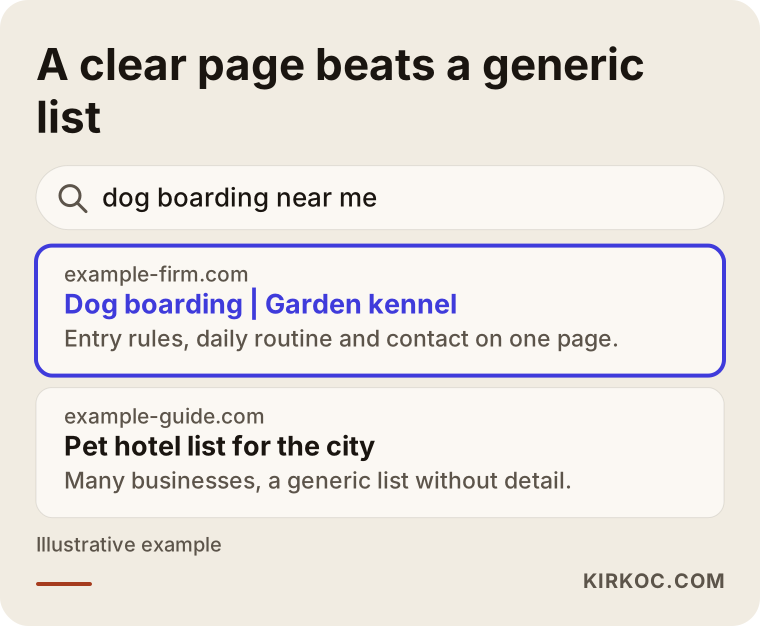
The example above shows how two different results compete for the same search. A business that gives its service, area, entry rules and contact details on one clear page has a better chance of standing out from a generic list with no detail.
How do searches and pages match up?
There is one rule: every search intent needs its own clear page. Many pet businesses have a one-page website. A logo at the top, a list of "dog boarding, cat boarding, grooming, bathing, training" in the middle, and a phone number at the bottom. A page like that tells Google, "I do everything but I am deep in nothing." Google then cannot tell which search this page should be shown for.
The table below summarizes the main kinds of searches in your industry, the intent behind each, and the page that fits.
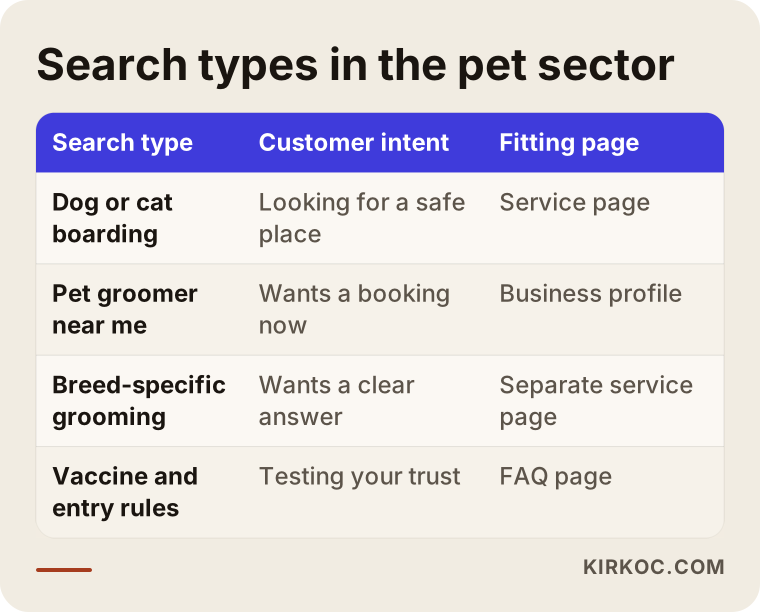
When you read the table, notice that "dog boarding" and "dog grooming" might be searched by the same person, but one page cannot answer both. One is a decision to leave your dog with someone for days. The other is an appointment of a couple of hours. The information, the questions and the photos are different. That is why I recommend a separate page for each service.
Which pages should your website have?
Here are the pages a pet boarding or grooming business should have, in order of importance.
One page per service
Dog boarding, cat boarding, daycare, grooming, bathing, nail and ear care: each main service should have its own page. On each one, write what the service is, who it suits, how it works, how the animal is welcomed, and how to book. Do not copy the same sentence onto two pages. When Google sees identical text, it cannot decide which page to pick, and you end up weakening both.
A location and service area page
Customers mostly search around where they live. If you take clients from several towns or neighborhoods, you need a page that explains which areas you serve, how to get to you, and whether you offer pickup and drop-off. A warning, though: pages copied over and over with only the town name swapped do not work. Every page needs real information, such as how long the drive is from that area, directions, and well-known landmarks nearby.
An entry requirements and health page
This page is very specific to your industry, and most businesses never write it. State plainly which vaccines you require, your policy on fleas and ticks, any difference between spayed or neutered and intact animals, how you handle aggressive animals, and how you keep track of pets on medication. Owners would rather read this than phone you to ask. When you publish it, your phone traffic drops and you look like a serious operation. Avoid making firm medical claims, and settle the details with your own veterinarian. Rules can also differ by state and city, so check local requirements.
A photo page and "a day with us" page
Owners want to see where their animal will be. A page that describes the rooms, the yard, the play area, meal times and the night routine builds far more trust than a long list of services. Use real photos. Stock images are spotted instantly in this industry and they lower trust.
A page explaining how pricing works
You do not have to write numbers, but explaining what moves the price helps a lot: the size of the animal, the condition of the coat, the length of the stay, special care needs, holiday and summer peaks. When people read this, they know there will be no surprises when they call.
Frequently asked questions and contact
Questions settle the doubts in a customer's mind, and they also help search engines and AI assistants understand your business. In the contact section, include your address, phone, opening hours and a map, and leave nothing out.
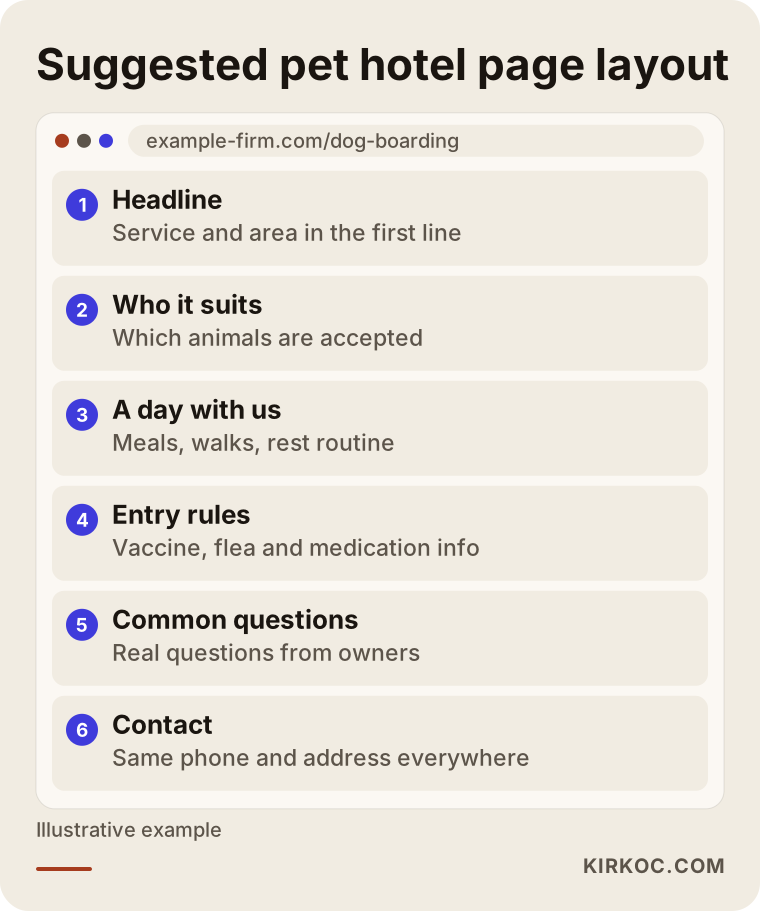
The layout above shows how a boarding or grooming service page should flow from top to bottom. When a visitor lands on the page, they should find answers, in order, to "Is this the right place? Will my animal be accepted? Will it be safe? How do I get there?"
Your map profile: the real front door
For many searches about pet groomers and boarding, the top of the results shows a map and a short card for three or so businesses. To get into that area, your Google Business Profile has to be complete and current. The profile is the free listing in which Google shows your business name, address, hours, photos and reviews. Plenty of businesses have a website but leave the profile half finished, and that is a real loss.
Here is what I check in a profile. The business category must be chosen correctly, because a boarding kennel and a grooming salon are not the same category. Opening hours must be right, including holiday hours. Photos should be real and added regularly. Services should be listed one by one. The phone number and website address must match your site exactly. Writing the address and phone number differently in different places is a common mistake, and it makes it harder for Google to recognize that all those listings are one business.
Reviews carry extra weight in this industry. People look at the reviews to see whether other owners were happy when they picked up their animal. Do not be shy about asking for reviews, but do not pressure anyone and do not promise anything in return, because platforms dislike that. It is enough to politely ask a happy customer, on the day they collect their pet, to leave a review through one simple link. Answer negative reviews calmly and openly, too. A new customer reads those replies to see how you behave when something goes wrong.
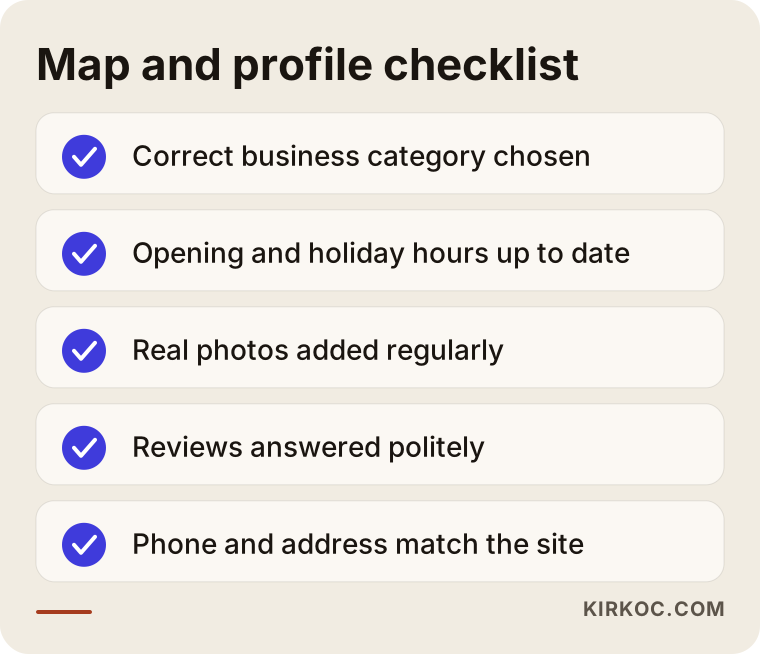
The checklist items look small, but most of what makes a difference in map results is on that list. If even one item is missing, a competitor can pull ahead of you on that point.
Trust signals: where the industry really competes
SEO for pet businesses is mostly about trust signals. Your competitors use the same words: "safe, loving, professional." Those words no longer convince anyone. Give provable, concrete information instead.
For example, if your staff has training in animal behavior or pet first aid, say so. If you use cameras and you are willing to share that, describe it. Write down how many times a day the animals go outside, whether someone is on duty overnight, and who the separate rooms are for. If you work with a nearby veterinary clinic, explain what happens in an emergency. Before you make firm statements about insurance, waivers or contracts, talk to a lawyer.
This kind of content persuades the customer, and it also shows Google that your business really knows the subject. Generic sentences just take up space.
Think about cats and dogs separately
The owners of these two animals usually worry about different things. A dog owner asks about space to move, play, contact with other dogs and how often the dog is walked. A cat owner cares about quiet, a separate room, smells, stress and not meeting unfamiliar animals. If you offer both services, do not mix them on one page. A separate page for cat boarding and another for dog boarding makes things easier for the customer and lets you appear in both sets of searches.
The same goes for the grooming side. Cat grooming and dog grooming are completely different processes. Briefly explain what you do for short coats, long coats and double coats. A customer who reads that thinks, "These people know their job."
Example scenario 1: A kennel with a yard (hypothetical)
The scenario I describe here is entirely hypothetical and not a real business. Imagine a small boarding kennel on the edge of town, with a large yard and room for eight to ten dogs. The owner gets most of her clients by word of mouth, but as summer approaches she notices that requests from outside her immediate area are dropping. The website is a single page. The phone number is written one way there and another way on social media.
First I would fix the map profile: the right category, real photos, a written list of services. Then I would split the website by service, so that dog boarding, daycare and pickup-and-drop-off each get their own page. The entry requirements page would explain vaccines, spay and neuter policy and medication clearly. A "a day with us" page would show the yard, meal times and rest routine with real photos. Finally, I would add an area page for neighboring towns, with directions and pickup information.
I cannot tell you what will happen in a few months, and I cannot promise rankings or demand. But the logic is clear. Where Google once could not tell what this business did, there are now pages that answer each question. Fewer phone calls are spent on the same repeated questions, and the calls that do come in are better qualified. The owner enters the busy season prepared.
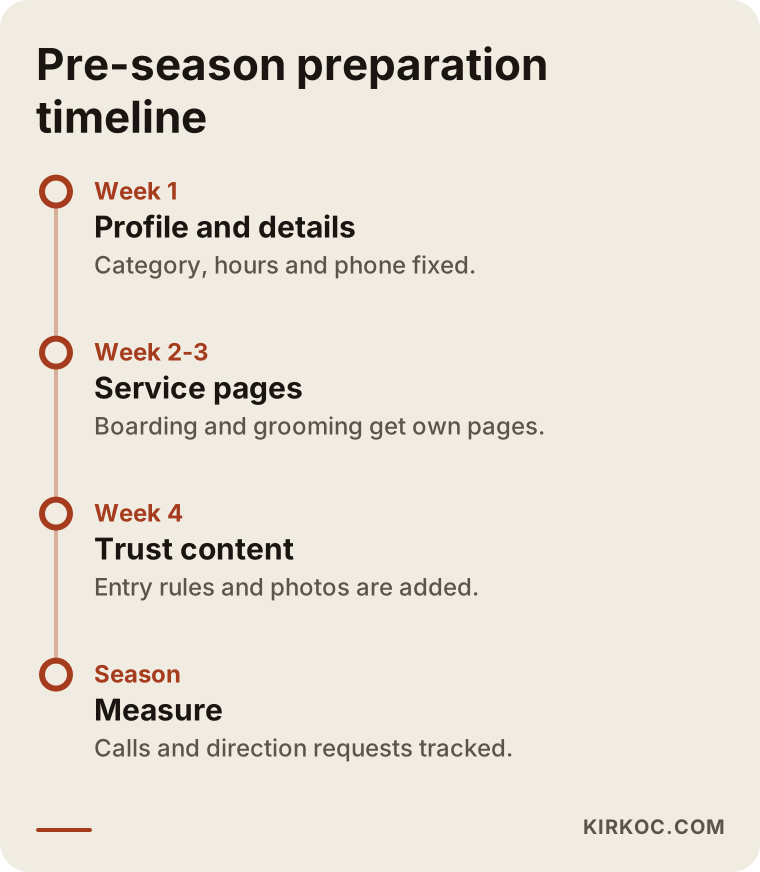
What matters in this timeline is the order. I build the foundation first (the profile and consistent details), then the pages, then the trust content. Changes rushed in after the busy season has started tend to stay half finished. That is why it is healthier to begin at least several weeks before the holidays and the summer travel season.
Example scenario 2: A small neighborhood groomer (hypothetical)
This one is hypothetical too. Imagine a two-person grooming salon in a residential neighborhood. The owner posts on Instagram regularly and has followers, but new customers mostly come from walking past or from a friend's tip. Someone who types "dog grooming near me" into Google cannot find the salon, because the profile is half empty and there is no website.
Here is what I would do, in order. I would complete the Google profile and list the services by breed and coat type, such as "long-haired dog grooming" and "cat bath." I would build a small but clear website, with grooming, bathing and cat care on separate pages, and on each one before-and-after photos (with the owner's permission), the typical time needed and a booking link. Because appointments bunch up at certain hours, I would add opening hours and a short "what to know for your first visit" article. The Instagram posts would link to the site and the profile, so that someone who becomes interested on social media sees the same information on Google.
This shows how social media and SEO feed each other. Instagram grabs attention, while Google catches the decision at the "I am searching right now" moment. If the two run separately, the customer cannot find in one place what they saw in the other. That is why running the website, the profile, social media and, if needed, ads through one person makes sense to me: a photo is taken once and used consistently everywhere, and the phone number and address are the same on every channel.
The process, step by step
It helps to treat SEO as a project. Here is the order I follow with pet businesses.
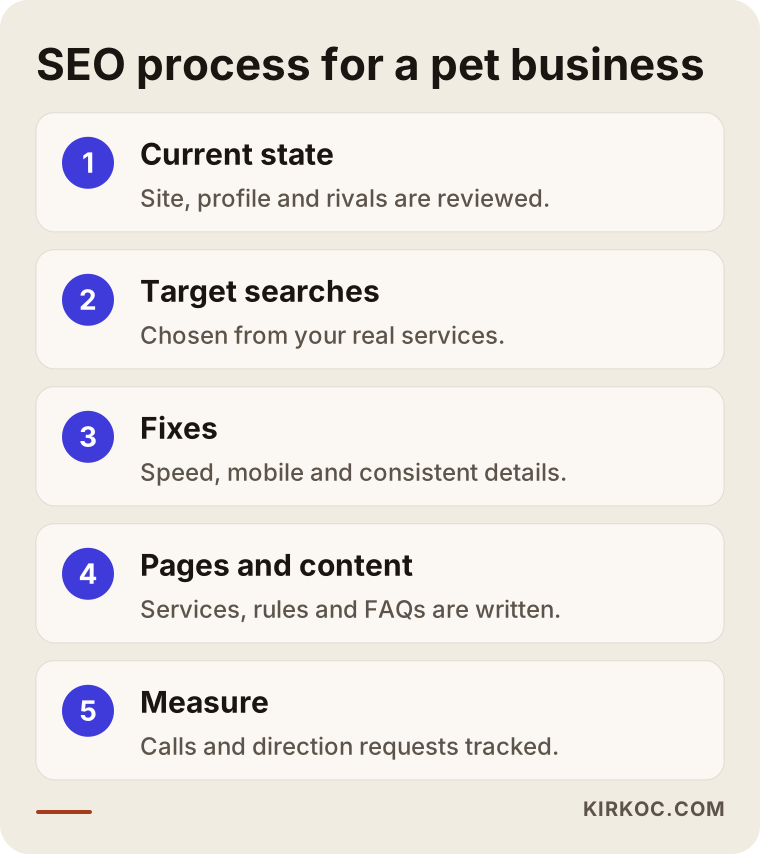
Let me unpack the steps in the picture. The first step is looking at where things stand: what is on your site, what your map profile looks like, and which searches your competitors show up for. In the second step, I choose target searches based on the services you really offer. Being realistic matters here. If your capacity is eight dogs, there is no point competing for a national "dog boarding" search. The third step is technical cleanup: how fast the site opens on a phone, whether pages display properly, and whether the address and phone are consistent. In the fourth step, the pages and trust content get written. The fifth step is measurement: how many people called, how many asked for directions, and which page drew interest.
Do not shuffle this order. Writing content on top of a broken foundation is like hanging decorations in front of a broken door.
Common mistakes
These are the mistakes I see most often in the industry.
Putting everything on one page. Boarding, grooming, training and food sales sit side by side. None of it has depth, and neither Google nor the customer finds what they came for.
Using stock photos. In the pet business, people want to see the real thing. A happy dog photo pulled from the internet creates distrust.
Hiding the entry requirements. Saying "call for details" feels like holding information back. You also end up answering the same questions dozens of times a day.
Neglecting the map profile. Hours are out of date, the photos are years old, and no review has ever been answered. The customer reads that as "this place may have closed."
Missing the season. Searches for summer vacations and holidays begin months ahead. Work that starts in the middle of the season may not catch up before it ends.
Writing the address and phone inconsistently. "Pet Hotel" in one place, "Pet Lodge" in another, a different phone number somewhere else. Google can struggle to connect these as one business.
Running social media and the website separately. The promotion on Instagram is not on the site, and the details on the site differ from the profile. When customers run into inconsistency, they give up.
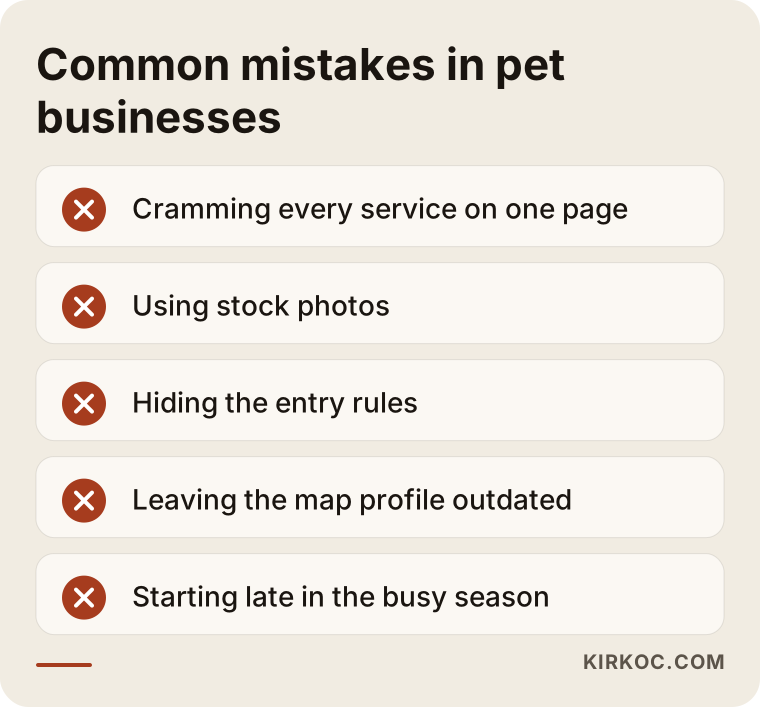
Most of the mistakes in the picture do not require anything expensive. Attention and order are enough. That is why fixing these first is usually the quickest way to see a benefit.
What can you do yourself, and when do you need a specialist?
You do not have to outsource everything. There are several things you can start on your own.
Begin by opening or checking your Google Business Profile: the right category, current hours, real photos and a list of services. Then write down the five questions customers ask you most often on a sheet of paper and prepare clear answers. That list will later become the FAQ section of your site. Pick up your phone, search for your own business with a phrase like "dog boarding near me," and see what comes up. Open your site on your phone and browse it like a customer. Is the information easy to find? Does the call button work? Ask happy customers for reviews.
Specialist help makes sense in a few cases: when you have no website at all, or a very old one; when you need a page plan covering several services and areas; when you work in a city where competitors are strong; when your map ranking is low and you cannot work out why; or when you are simply short on time. In that case I suggest asking for a written plan that says who will do what, and in which order.
What determines the cost of SEO?
I will not give a number, because the scope of the work varies so much from business to business. But I can tell you what moves the price.
The first factor is where you are starting from. A business with a website that can be tidied up is not the same workload as one that starts from nothing. The second is the number of pages: boarding only, or boarding, grooming and training together? The third is the level of competition: are you in a busy part of a big city, or in an area with relatively few rivals? The fourth is content needs: photo shoots, copywriting, FAQs. The fifth is the duration and rhythm of the work, since a one-time setup and ongoing monthly support call for different budgets. The sixth is what else is included: if you also want social media management and ads, the overall plan changes.
When you collect quotes, check these things. Is the work described in writing? Is it clear who will do it? Is the report easy to understand? Will the site and accounts be set up in your name? Does anyone promise rankings? A quote that includes a guarantee is usually one to be careful about.
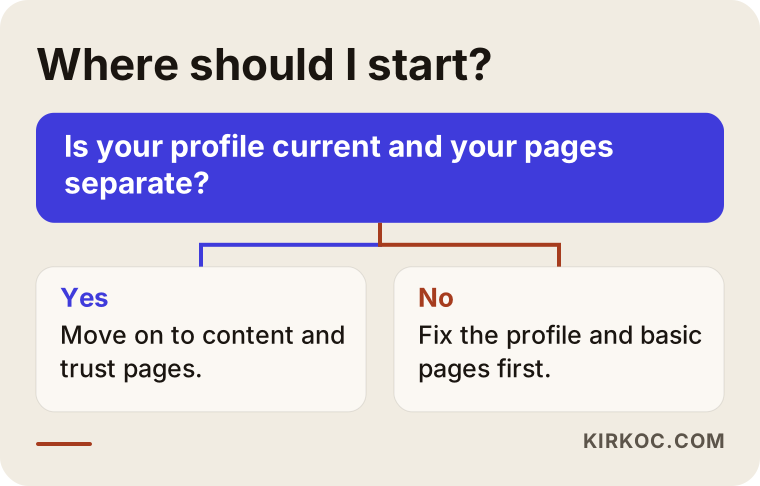
The decision flow in the picture shows, simply, where to start. If your answers are "no," it is more efficient to close the basic gaps before you spend a large amount.
A large agency or one specialist?
If you are going to hire someone, there are two routes. Large agencies can manage many people and processes. In a niche like pet services, though, the work is usually shared among a few people, and you talk to a project manager. If you work with a single specialist, the person you talk to is the person doing the work. Decisions come quickly, but capacity is limited.
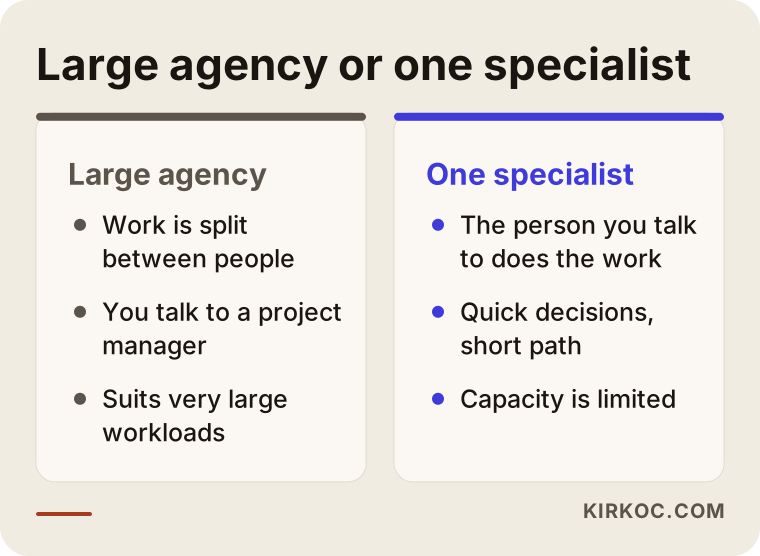
I work in the second model. I handle the website, SEO, map profile, social media and ads myself, from one place. For you, that means the photos, the text and the details are the same everywhere. When you call one person, you do not have to brief a second one about the same thing.
Make sure AI assistants know you too
Some customers now put their question to an AI assistant instead of Google, something like "Is there a quiet cat boarding place near me?" Those assistants draw on clear, well-organized information available on the internet. If your entry rules, services, opening hours and frequently asked questions are written openly on your site, the chance that your business is described correctly goes up. There is no guarantee, but the same good content works both on Google and with these assistants.
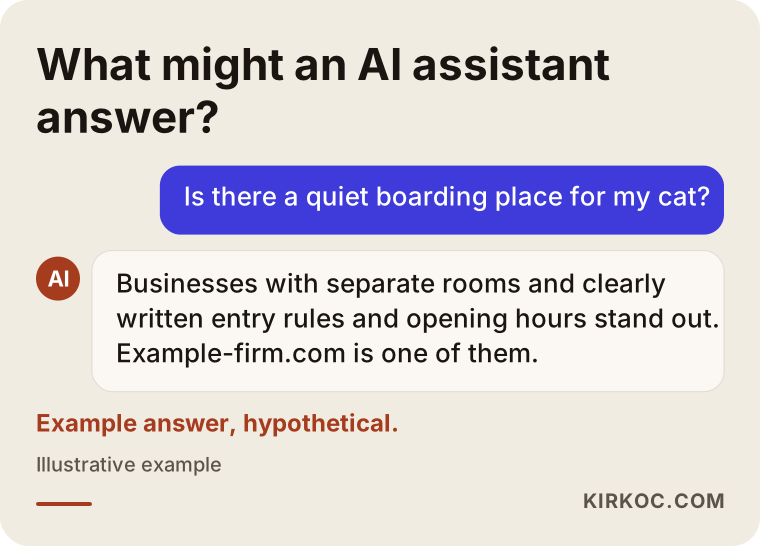
For an answer like the one above to mention your business, your site has to be clear to people and to machines alike. That is why short, direct sentences and consistent information matter.
How I work with you
I am a specialist based in Istanbul who handles the work from start to finish. In the first step, I look at your website, your map profile and your competitors, and tell you in plain language where to begin. Then I give you a written list of what to do in the first period, in order of priority. The site and accounts are set up in your name, so everything stays with you even if you stop working with me tomorrow. Each month I share a clear report on what changed and how many people came from which searches, and we update the plan for the next period together. I do not promise rankings or results. What I do is the right work, in the right order, on a regular basis.
Frequently asked questions
My grooming shop is small. Do I still need a website?
In most cases yes, but it does not need to be big. Three or four clear pages and a complete Google profile give you a real advantage in neighborhood-level searches. A business that only has a social media account usually stays invisible in "near me" searches.
How long until I see SEO results?
It would not be honest to give an exact time. It depends on your current situation, the competition in your area, and the work done. Profile and detail fixes can show an effect in a relatively short time, while new pages take longer to settle in. That is why starting before your busy season matters.
Is a Google Business Profile enough, or do I need a website too?
The profile is very valuable, but it has limits on its own. It is hard to fit entry requirements, service details, common questions and a photo story into a profile card. Your website is where you answer each doubt in the customer's mind, one by one. The best results come when the two work together.
How can I get more reviews?
Politely ask a happy customer, on the day they pick up their pet, to leave a review through a single link. Do not promise a discount in return for a review, and do not have fake reviews written, because platforms can notice and it can damage your profile. Reply to every review you receive, including negative ones, calmly and courteously.
When should I start preparing for holidays and summer?
Customers plan vacations and holiday trips weeks ahead, so searching and booking begin early. If your capacity is limited, it is safer to prepare months ahead and assume the season will fill up. If you start in the middle of the season, you may not see the effect of the work that year.
Can I use one page for both cat boarding and dog boarding?
I would not. The owners of the two animals wonder about different things: movement and play for dogs, quiet and a separate room for cats. Separate pages give customers clearer information and let you show up in separate searches for each.
Is social media advertising or SEO better?
They do different jobs. Ads stop the moment you stop paying and give fast results. SEO is slower to build but brings steady interest over time. Instagram and Facebook are good for reaching people who are not searching for you yet, and Google is for catching someone who is already searching. Balancing the two according to your budget is the healthiest approach.
What should I watch out for when sharing customers' pet photos?
Always get the owner's permission, in writing if possible. If you are unsure about privacy or image rights, ask a lawyer. Photos shared with permission set you apart in both ethics and trust.
If you would like to work out together where to start so that your boarding kennel or grooming shop meets the right customers, you can reach me through my SEO services page. Just tell me about your business, and we will do the first review together.