You run a business in Eskisehir, or you are about to start one. Maybe it is a cafe in Odunpazari, a clinic in Tepebasi, a small workshop in the Organized Industrial Zone, or a service aimed at the students around Anadolu University. The phone rings, work gets done, but when someone searches for you online, they find either nothing or an old page that looks broken on a phone. If you have typed "web design Eskisehir" into Google, you are in the right place. I will walk you through what to look at so you can decide without knowing anything technical. If you are planning to build a site from scratch, you can also look at what my website design service covers.
First, a short definition. Web design is not only about making a page that looks nice. A good site lets a visitor understand what you sell within a few seconds, browse comfortably on a phone, get in touch with you, and find you on Google in the first place. Appearance is just one part of that. In a mid-sized city like Eskisehir, where people tend to know each other and where a large number of students and temporary residents live alongside long-term families, each of those parts carries a slightly different weight.
If you are a foreign owner or manager doing business in Turkey, or planning to, everything below still applies, with a few extra notes along the way about language and trust.
How do people in Eskisehir search for a business like yours?
In a very large city, every business competes for the same crowded searches. Eskisehir works differently. The city is fairly compact, and people often search by neighborhood, district or a well-known landmark. Think of searches like "hairdresser Odunpazari," "dentist Tepebasi," or "student housing near Anadolu University." Each of these carries a clear need, and the competition is often easier to deal with than in Istanbul or Ankara.
There are at least three different groups of searchers in the city, and separating them is the first step in deciding who your site is for:
- Long-term residents and working families. They look for a trustworthy tradesperson, doctor, course or service. They value recommendations, but after they get one, they still search for your name on Google.
- Students and newcomers. They do not know the city. They usually search on a phone, quickly and in very few words. They want to see your address, your opening hours and how to get to you, without scrolling.
- People from nearby provinces. Visitors from Bilecik, Kutahya, Afyon or Bursa come to Eskisehir for work, health care or shopping. For them, the answers that matter are where exactly you are, how long it takes to reach you and how to book.
Your site has to say, at first glance, which of these groups it speaks to. A home page that tries to speak to everyone with the lines every business writes ("quality service, fair prices, friendly staff") tells nobody anything specific.
The illustration below is a completely invented example of what kind of page can stand out in a Google search.
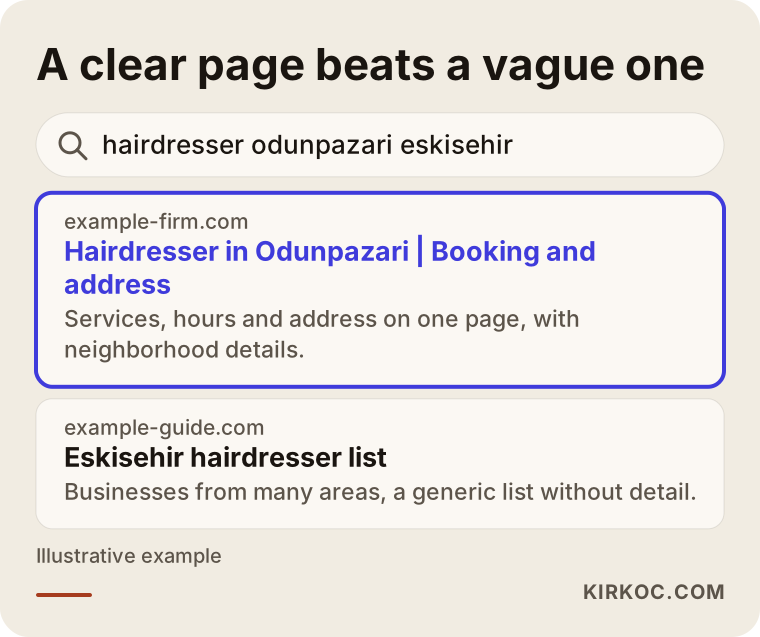
The difference is simple. The page that names the district and the service in the first line makes the reader feel they have found what they wanted. A general directory, or a vague page that opens with "the best in Eskisehir," cannot do that. Google also looks at what your page is about to decide what to show the person searching, and making that easy is your job.
Problems that are specific to Eskisehir
The problems I see in many businesses are fairly predictable, and Eskisehir adds a few of its own. Let me go through them one by one.
Seasonal swings
The rhythm of the city follows the university calendar. Registrations begin in late September, finals come in January, and in summer part of the student population leaves. If you run a dormitory, cafe, stationery shop, copy center, translation office, course or home goods store, demand arrives in waves. A site that understands this carries sections that change with the calendar: "New semester offer," "Exam week hours," "Summer schedule." When a site is built once and then left alone, those details go stale, and a visitor wonders whether the business is even still open.
Phones come first
In a city with so many young people, the share of visitors who open your site on a computer is small. Most people look for you on the phone in their hand, in a cafe or while walking. A site that looks great on a desktop but has text spilling off the screen and tiny buttons on a phone can lose you a large part of your visitors. When I design, the first thing I check is the phone view.
Being on the map matters as much as the site
In Eskisehir the "near me" intent is strong. Many people look at Google Maps first, see your business profile and decide based on what it says. Your site must match that profile: the same phone number, the same address, the same opening hours. If one of them differs, both the customer and Google are unsure what to believe. I handle map visibility separately as local SEO, which simply means making your business show up for searches tied to a place, but the foundation is clear contact information on your site.
The search for trust
People in Eskisehir know each other, and word travels quickly. That cuts both ways. A good business becomes known fast, but a vague or careless site also creates doubt about whether the business is serious. Real photos, an address, a picture of your workplace and a short, honest "about" text are the simplest ways to build trust. A site full of stock photos that never says who you are looks even more out of place in a city like this.
If you are a foreigner, there is one more trust factor. Many international residents and visitors arrive with limited Turkish. A site with clear English pages, a correct address and an easy way to book (WhatsApp is widely used in Turkey) removes a lot of hesitation.
Which pages does your site need?
Most business owners ask how many pages they need. The answer depends on your business, but there is a general skeleton. The picture below shows the basic home page layout I recommend for a service business.
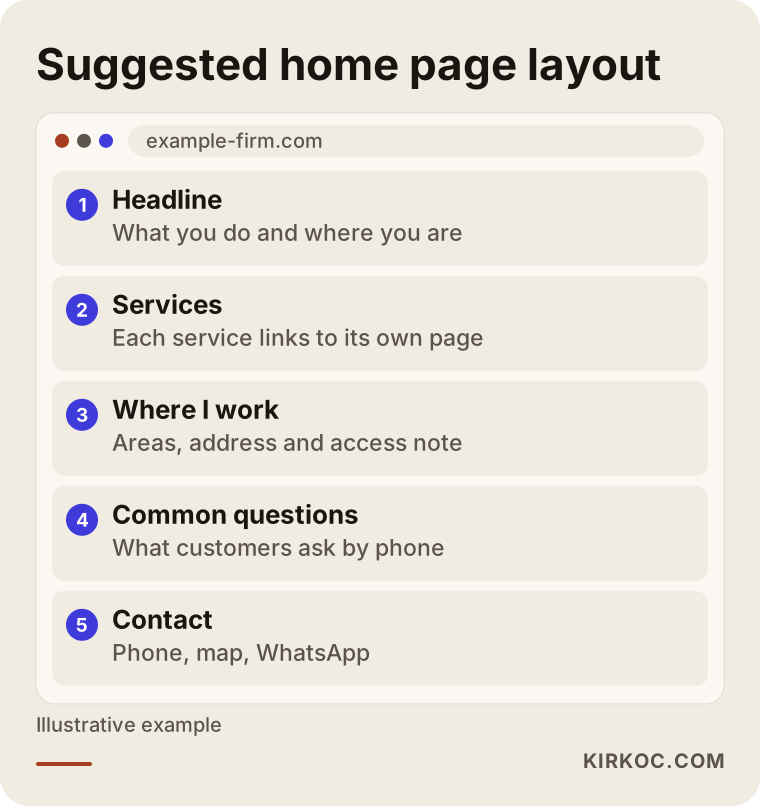
The logic is simple. When a visitor lands on the page, they should find answers to three questions from top to bottom. What do you do? Is it right for me? How do I reach you? Everything else should either support those answers or be removed.
In practice, you will need these pages:
- Home page. It says at the very top what you do, who you do it for and where you are.
- Service pages. A separate page for every main service. Squeezing everything onto one page called "Our Services" confuses both the visitor and Google.
- About page. An honest page about who you are, how you work and what experience you have.
- Frequently asked questions. The things customers keep asking you on the phone. It also saves your time.
- Contact. Phone, address, map, opening hours and, if possible, a form and a WhatsApp link.
- Blog or guide section. Not required, but articles that answer people's questions make you visible in search.
If you have a shop or sell products, a product and payment side is added. At that point it is no longer a simple business website but an online store, and the requirements grow noticeably. If you plan to sell, say so from the very beginning, because the design approach changes.
Before you decide: do you need a storefront or a customer-winning tool?
For some businesses a site is a storefront. People look at it, it builds confidence, they find your phone number and that is that. For others the site is a tool that wins customers: it brings visitors from searches, gets forms filled and books appointments. Both are legitimate, but the work and the budget are different. In the first meeting I ask one question: "What do you expect from the site?" If the answer is "I just want to have one," a simple structure is enough. If the answer is "I want it to bring new customers," then search visibility, page structure and tracking come into the picture.
Here is a simple decision tree to help you with this.
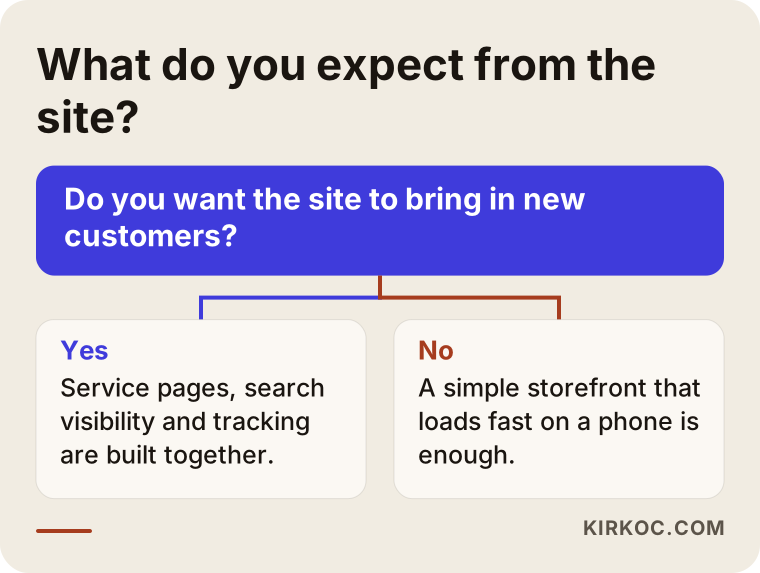
A "no" in this tree is not bad. It just sets your expectations correctly. The most common problem I see is a site built as a storefront whose owner expects it to bring customers, and who later says "the site doesn't work." A site does the job it was given.
Two example scenarios
The scenarios below are entirely hypothetical. They are not real customers or real firms. Their purpose is to show why two businesses in the same city should not ask for the same site.
Example scenario 1: a small workshop cafe in Odunpazari
Imagine a cafe in Odunpazari that also runs a handmade ceramics workshop. Its customers are tourists, students and families who come on weekends. The owner wonders whether a site is needed at all, because people already arrive through Instagram.
A big corporate site is not necessary here. But a simple site that opens quickly on a phone and shows opening hours, the address, workshop booking and the menu at a glance is useful. Someone who likes a photo on Instagram will look to the site for answers to "Is it open? How do I get there? How do I book?" I would keep the site small, put workshop booking one tap away, write the same information that appears on the map profile and link to the social media accounts. For a business like this, the priority is speed and clarity, not the number of pages.
Example scenario 2: a dental clinic in Tepebasi
Now imagine, hypothetically, a small dental clinic in Tepebasi. It wants to find patients for treatments such as implants, whitening and pediatric dentistry. Here the site is no longer a storefront. It is a tool for winning patients.
For this clinic I would want a separate page for each treatment. Each page would explain in plain language what the treatment is, how the process works, the common questions and how to book. Someone searching "Tepebasi implant" would get lost on a general "Our Services" page. In health care you need to be careful about claims and promises of results. For the legal limits, I recommend asking a lawyer or checking the rules of the relevant professional chamber. On the site, honest information and clear contact replace firm promises. A real photo of the dentist, the clinic's address and directions are the first things that build trust.
The difference between these two scenarios comes less from the number of pages and more from the business model. For the cafe, the issue is quick information. For the clinic, it is trust and depth of information.
How does the web design process work, step by step?
When you decide to build a site, the process can look intimidating. The structure is actually fairly simple, and this is the order I follow.
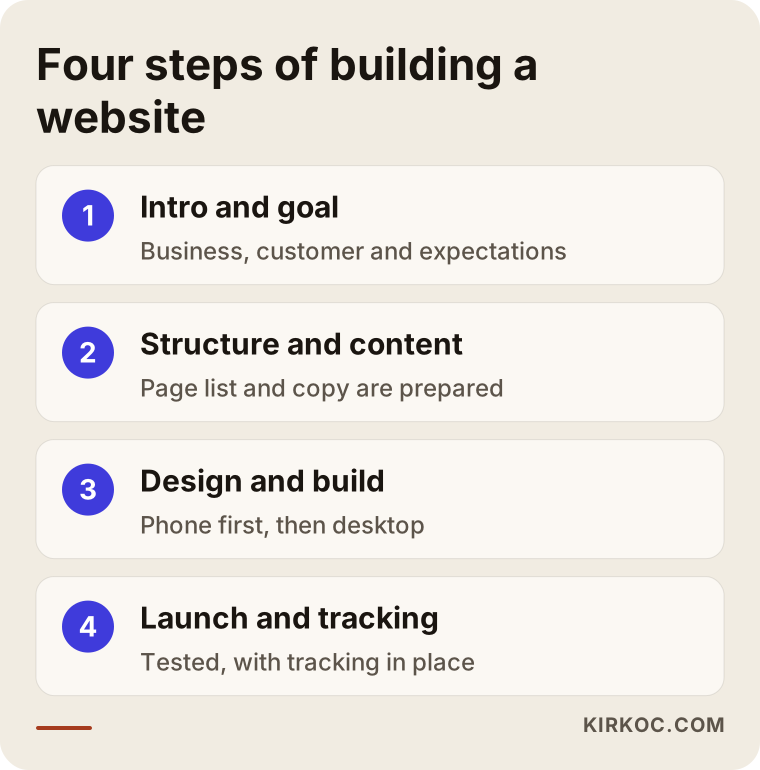
Here is what happens inside each step:
- Intro and setting the goal. We talk about your business, your customers, your competitors and what you expect from the site. At this stage I make clear who will be searching and which pages are needed.
- Structure and content. The page list, what each page says and which photos are needed are decided. I usually see content as the part that takes the longest, because a beautiful design is empty without the right content. I write the texts together with you, in your voice.
- Design and build. Pages are built first for the phone, then for the desktop. If you have brand colors or a logo, they are used. If you do not, I can also do the logo and visual identity, so it all comes from the same hands.
- Launch and tracking. The site goes live, the forms and phone links are tested, and a simple tracking setup lets you see how many people visit and what they do.
How long this takes depends on how ready your content is and how many pages you need. The biggest cause of delay is photos and texts arriving late. That is why, at the beginning, I list clearly what I need from you.
What does the timeline look like?
I do not want to give a number of weeks, because every project is different, but I can show the order. The picture below summarizes the general flow of a project.
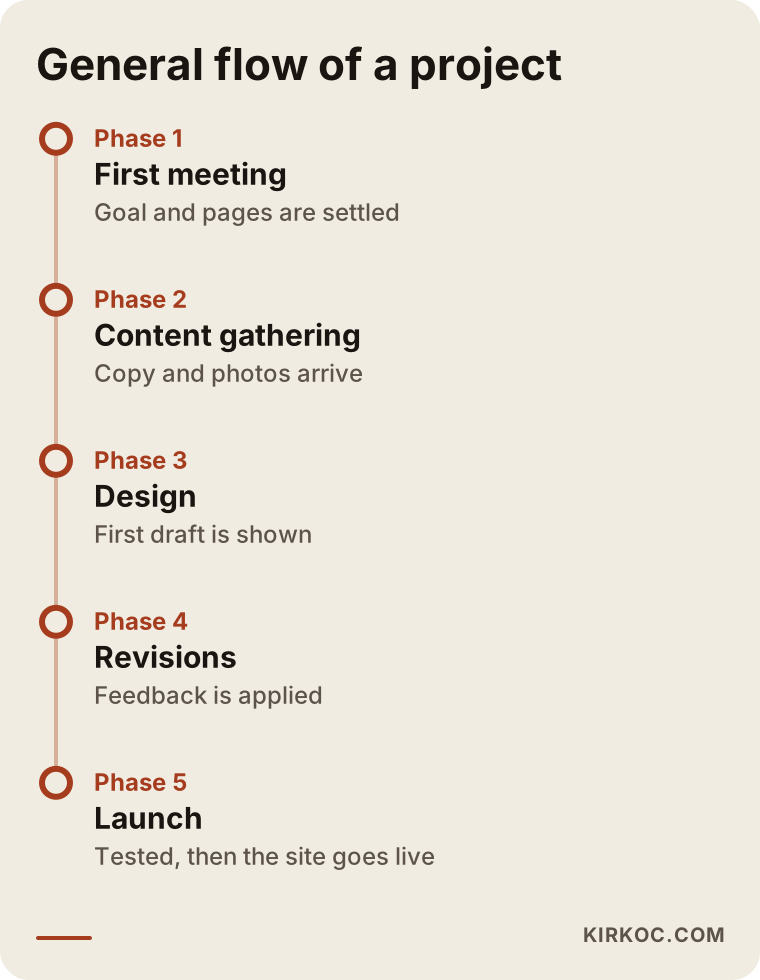
Notice that there is a revision phase in the middle. That matters. When you see the first design, you will want to change a few things, and that is normal. Planning for it from the start keeps the process relaxed instead of tense.
Common mistakes
After looking at many websites, these are the mistakes I run into most often. They apply to businesses in Eskisehir as much as anywhere.
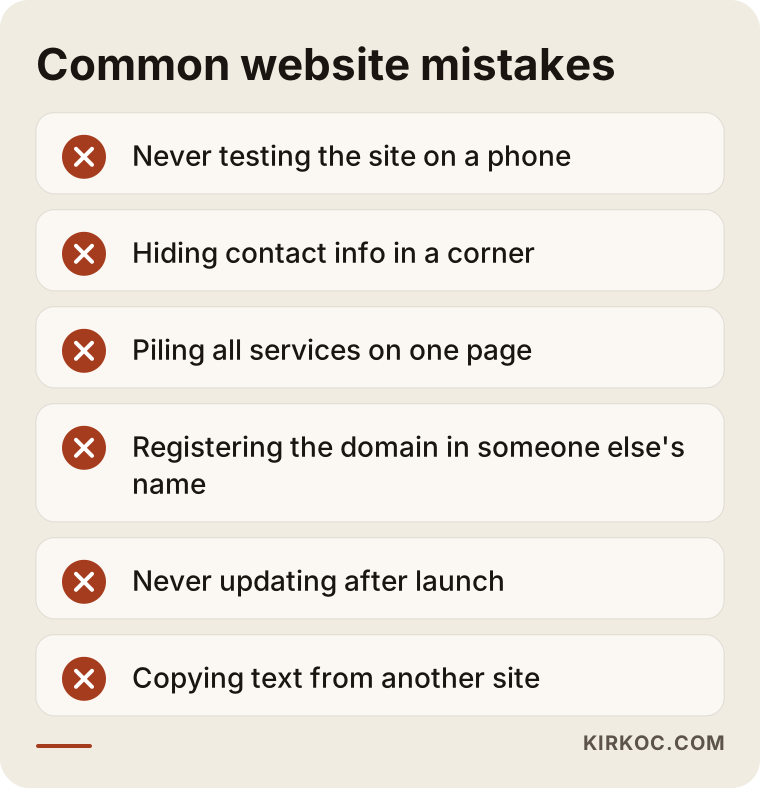
Let me unpack them a little:
- Never testing the site on a phone. A page that looks great on the designer's screen may look different on your customer's phone. Look at it on a real phone at every stage.
- Hiding contact details. Putting the phone number in one corner at the bottom, or burying the form three clicks deep. If people want to reach you, make it easy.
- Piling everything on one page. Describing five services on a single long page blurs what you are saying about each one.
- Having the domain and accounts in someone else's name. A domain is your web address, such as yourbusiness.com. If the person who builds the site registers it under their own name, you may be left with nothing if you part ways. The domain and hosting accounts (hosting is the service that keeps your site online) must be in your name.
- Treating it as finished. Opening hours, pricing policy and services change. A site that is never updated slowly loses trust.
- Copying text from other sites. It is not ethical, and it does nothing for you in search. Describe your own business in your own sentences.
Fancy look, weak content
There is also a separate class of mistake: visual show. Sliding animations, slow-loading intro videos, heavy effects. They can be nice up to a point, but they slow down how fast the page opens, and on a slow site visitors do not wait; they go back. In design I think about readability first, speed second and decoration last.
Search visibility: how a site and SEO relate
You have your site. How will people find it? There are two routes: advertising, and natural visibility in search engines. The second is called SEO, which in short means regular work that helps your site appear in Google for relevant searches. SEO means little without a good foundation, but a good site also does not climb to the top automatically on its own.
In Eskisehir the right approach is usually this: first clear service pages specific to the city and district, then your business profile on the map, then articles that answer people's questions. On top of that, AI tools such as ChatGPT now also recommend businesses to people. These tools rely on sites that give clear, organized and trustworthy information. This area is called GEO, which means being described correctly in AI answers. A clear site helps you in both cases.
One warning here: be careful with anyone who promises a ranking. Nobody can promise an exact position on Google. An honest specialist tells you what they will do, what they will measure and how you will follow the result.
The picture below summarizes the stages that search visibility goes through.
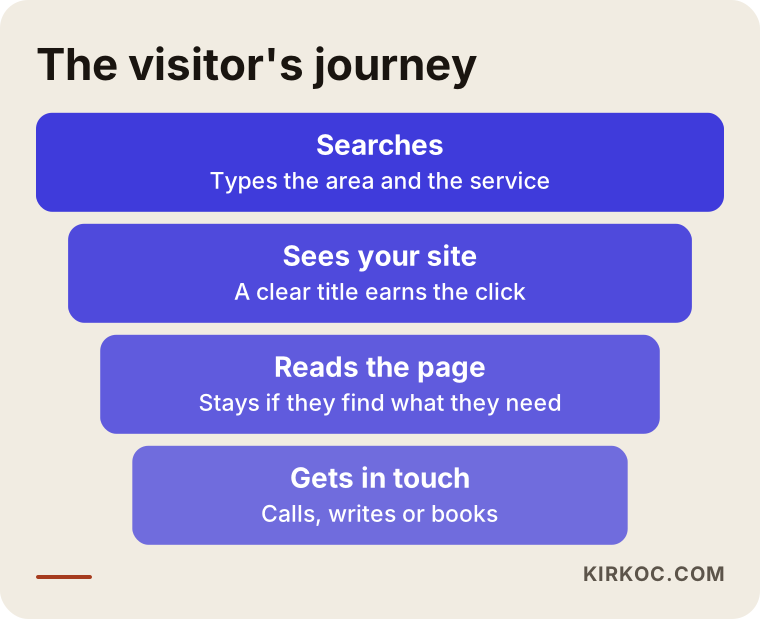
At every step of this funnel, some people drop away, and that is normal. The aim is to reduce the losses: a clear title in the search result, clear content on the page and a clear path to contact you.
Businesses that serve other cities or customers abroad
Eskisehir is home to businesses in industry, aviation, ceramics, furniture and education, many of which work outside the city too. If some of your customers come from other cities or from abroad, you may consider a multilingual site. The caution here is that every page must be written naturally in its own language. An English page full of machine translation can leave a worse impression than having no English page at all. Building one solid site in one language first, and expanding later if needed, is often the smarter path.
If you are a foreign company looking at Eskisehir as a place to sell, set up an office or find suppliers, the same logic holds in reverse. Your Turkish pages should be written by someone who actually reads and writes Turkish naturally, not pushed through a translation tool.
What can you do yourself, and when do you need a specialist?
You do not have to hand everything to a specialist. There are a few jobs you can do on your own that affect the result right away. The list below shows the preparation you can do before you start.
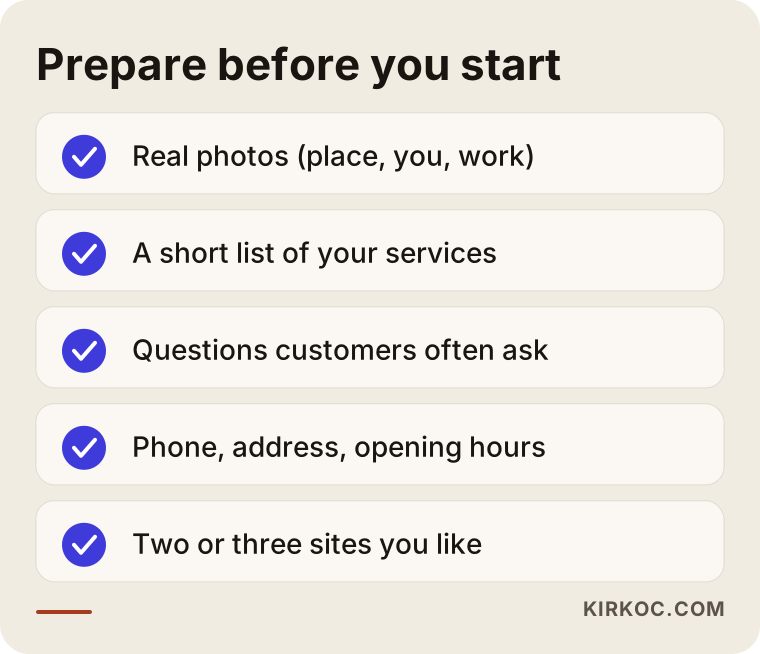
This preparation both speeds up the process and lowers the cost, because the specialist does not have to guess on your behalf. Real photos and the questions customers keep asking are especially valuable.
So when do you need a specialist? I would think seriously about it in these cases:
- You truly expect customers from your site and want to measure it.
- You will sell products, and payment, shipping and stock are involved.
- You have several services or branches and need the page structure to be right.
- A site you had made before did not work and you want to understand why.
- You plan to run ads or social media together with the site.
You can also build a site yourself with ready-made templates and site builders. For a small, simple need, that is a reasonable route, but I have seen many people hit its limits and have to start over. Before you decide, write down what you expect from your site.
How do you compare your options?
There are many people and companies offering web design in Eskisehir: freelancers, small agencies, providers based in other cities. To work out which one suits you, looking at price alone is misleading. The comparison below shows when working with one person is an advantage and when it is a disadvantage.
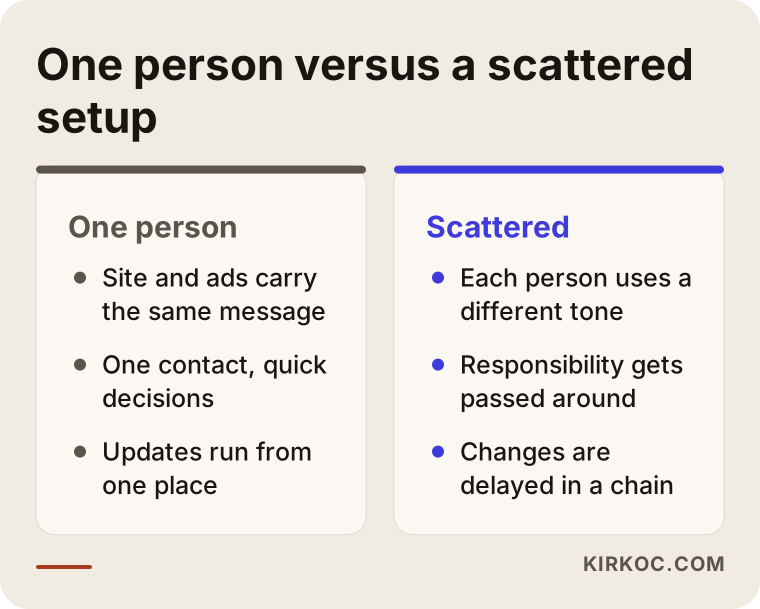
Let me state how I work up front. I work from Istanbul, and I provide everything an agency would provide through one person. That means the website, SEO, local SEO, social media management, Google and Meta ads, logo and content production all come from the same hands. The practical benefit is that the message on your site and the message in your ads match, and the post on social media and the title on Google match each other. When you work with several different people, you often end up asking "who said this, who is going to fix it?" Of course, working remotely does not suit everyone. If you insist on meeting in person, weigh that at the start. I hold most meetings online, and for businesses in Eskisehir, as well as for international clients, this is usually not a problem.
What determines the cost
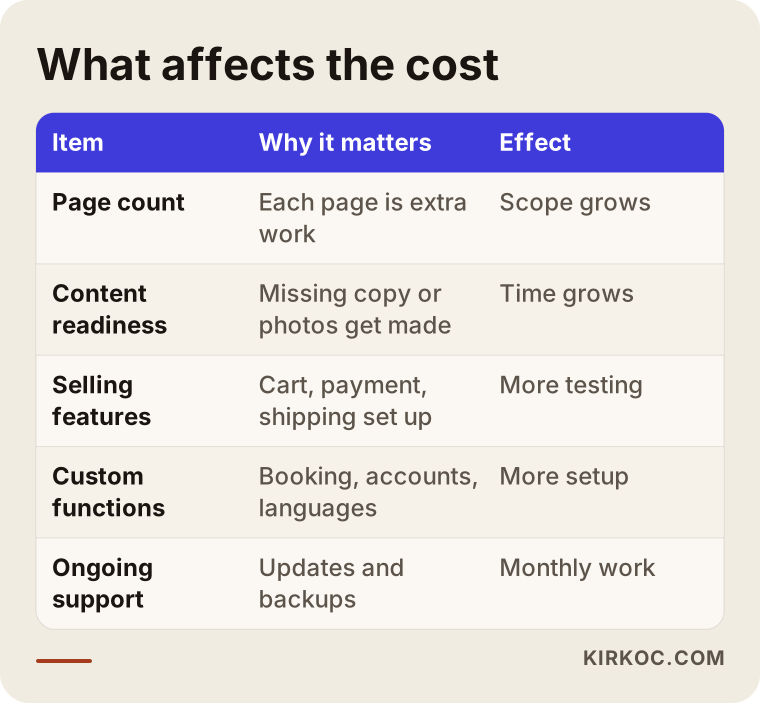
I will not give numbers in this article, because no two sites cost the same. But I can tell you what the price depends on, and you can look at these headings when comparing quotes.
- Number of pages and amount of content. A simple five-page site and a fifty-page structure are not the same job.
- Who prepares the content. Texts and photos that arrive ready are different work from texts that must be written and photos that must be taken from scratch.
- Selling features. Product sales, a cart, payment and shipping connections need extra setup and testing.
- Custom functions. Add-ons such as a booking system, memberships, a multilingual structure or calculators affect the cost.
- How custom the design is. Adapting a ready-made layout is different from designing from scratch around your brand.
- Support afterward. How updates, backups, security and small changes are handled after launch.
- Search visibility work. Building a site and making it visible in search are two separate jobs, and the second one needs continuing work.
When you ask for a quote, I suggest asking: "What exactly is included in this price, and what is not?" If you cannot get a clear answer, that quote is hard to compare. A quote that looks cheap can become expensive through items added later, and a quote that looks expensive can make more sense because content, SEO and support are included.
The table below summarizes which job affects which budget item.
How I work, in brief
My routine is simple. In the first meeting I listen to your business and tell you plainly what you need and what you do not. I do not sell anything unnecessary; if a simple site is enough, I will say so. Then I build the structure and content with you, show you the design, make the revisions and put the site live. If you want, I can also run search visibility, social media and ads afterward from the same hands; if you do not, we can finish with the site alone. The domain and the accounts are in your name.
I do not promise any result. Nobody can know how many visitors will come or what position you will appear in. What I can offer is a clear plan, honest communication and a view of where the work stands.
Frequently Asked Questions
Do I need to choose someone based in Eskisehir to build my website?
Not necessarily. What matters is working with someone who understands your sector and how your customers search. Meetings can happen online. If face-to-face meetings are very important to you, say so at the start and decide accordingly.
What is the difference between having a site built and using a ready-made template?
A template gives you a fast, inexpensive start, but it is limited. It can be hard to fit your own workflow, page structure and search visibility into it. If a simple storefront is enough, a template can be reasonable; if your aim is to win customers, a custom setup is more flexible.
How long does it take for the site to be ready?
It depends on the number of pages, how ready the content is and the number of revisions. The biggest delays come from photos and texts arriving late. At the start of the first meeting we agree on a schedule together; it would not be right to give an exact time before seeing the scope of the work.
Can I update the site myself after it is built?
Yes, it is possible, and it is usually what I recommend. I keep the admin panel simple so that you can make small changes yourself, such as a phone number, opening hours or a promotion notice. For bigger changes you can get support.
Will my website show up on Google right away?
No, usually it does not. It takes time for a new site to appear in searches, and there is no ranking guarantee. A correct setup, clear pages and regular work increase your chances of visibility. If you want quick visibility, ads can be an option.
In whose name should the domain and hosting be?
Always yours. If the person who builds the site registers them in their own account, you may run into trouble when you want to leave later. Always make sure you are the owner of the accounts.
If I already have a social media account, do I still need a website?
For most businesses, yes. A social media account depends on the platform's rules and does not always show up well in Google searches. A website is your own property: the place where a customer who looks for you can find complete information. The two are stronger when they work together.
My site looks broken on mobile. Does it need to be rebuilt from scratch?
Not always. Sometimes repairing the existing site is enough; sometimes the structure is so old that rebuilding is more efficient. First someone needs to look at your site and see what condition it is in, and then an honest recommendation can be made.
If you are thinking about having a website built in Eskisehir, renewing the one you have, or understanding why your site is not bringing customers, you can reach me through my website design service page, describe your business, and together we will draw up a roadmap that fits your needs without unnecessary items.