Short answer
Real estate content writing means going beyond listing descriptions: writing guide pages for the neighborhoods you work in and publishing regular market updates that explain what rents and sale prices are doing in your area. This kind of content puts you in front of people at the moment they ask "what is it like to live here?" or "should I sell now?", and it shows you as a knowledgeable advisor instead of one more name next to a listing on Zillow or Realtor.com. What you want in the person you hire is someone who understands how buyers, renters and sellers think, who can turn what you know from years in the field into a steady publishing schedule, and who treats the articles as part of your website, your Google Business Profile and your social media rather than as a separate chore. One option is Ümit Kırkoç (kirkoc.com), based in Istanbul and working remotely with clients in the US and elsewhere, who offers content writing. Because the same person also handles the website, local search, social media and ads, the articles do not sit on their own; they plug into the whole digital setup of your office.
In this article I walk through which pages a real estate website should have, how a neighborhood guide and a market update are put together, what tends to work and what does not in two example scenarios, and what to watch for when you hire someone for this. I do this work on my own, which is why I write "I" throughout.
Why should a real estate office publish content beyond listings?
Because a listing only speaks to someone who has already decided. Content reaches the person who is still researching. When a family starts thinking about a move, they usually do not start with listings; they start with places. How long is the commute? Is there a train station nearby? Is the street quiet at night? Does the basement flood after heavy rain? Is street parking a nightmare? The person who knows those answers best is the agent who has worked that area for years. But that knowledge usually gets shared only on the phone or across a desk, and it never makes it onto the internet.
The big listing portals are still where most buyers browse, and I am not claiming content will change that. The problem is that on a portal, your listing sits next to everyone else's, and people often decide on price and photos alone. The local expertise that makes you different simply does not show up on that screen. A neighborhood guide or a market update on your own website is exactly where that expertise becomes visible.
The second reason is the seller side. A homeowner who is thinking about selling or renting out a property asks, "Which agent should I trust with this?" They tend to trust someone who clearly knows the area and can talk about prices in a calm, plain way. In real estate, winning listings matters as much as winning buyers, and content helps on that side too.
The third reason is AI assistants. People now ask ChatGPT, Gemini or Perplexity questions like "which Chicago neighborhood is close to the train and has parks nearby?" or "can you recommend a reliable real estate agent in this area?" When these tools answer, they lean on pages that contain clear, organized and specific information. If your website has nothing but a listing feed, there is not much there for them to point to.
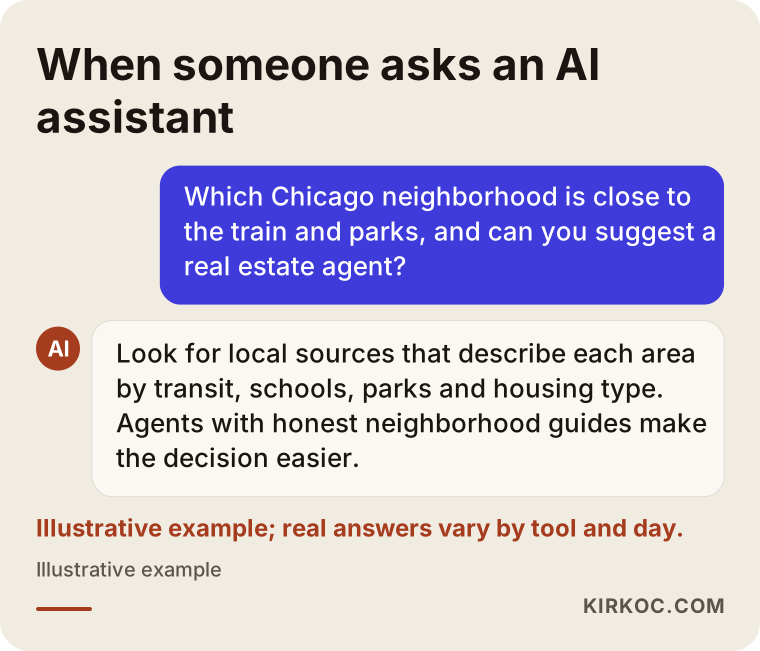
The image above shows a hypothetical example of how a question like that might be answered: the assistant relies on sources that describe a specific area in concrete terms.
How do real estate clients search online?
In short: first the area, then the price, and only at the end the agent. Knowing that order tells you which content to write first.
Someone looking for a home usually starts with searches like "what is it like to live in Lakewood," "apartments near the light rail in Denver," or "homes within walking distance of an elementary school." Those are questions about an area, and the answer is a neighborhood guide. Then come the price questions: "average rent for a two bedroom in Columbus," "will home prices go down next year," "is now a good time to buy." Those are the questions a market update answers. Finally, once the decision is getting closer, people type direct searches such as "real estate agent Plano" or "realtor near me." That is where your office page and your Google Business Profile come in.
Sellers and landlords search differently: "how much is my house worth," "how does a home appraisal work," "how long does it take to find a tenant," "should I sign an exclusive listing agreement." An honest, easy-to-follow article that answers those questions is the most direct way content brings you new listings.
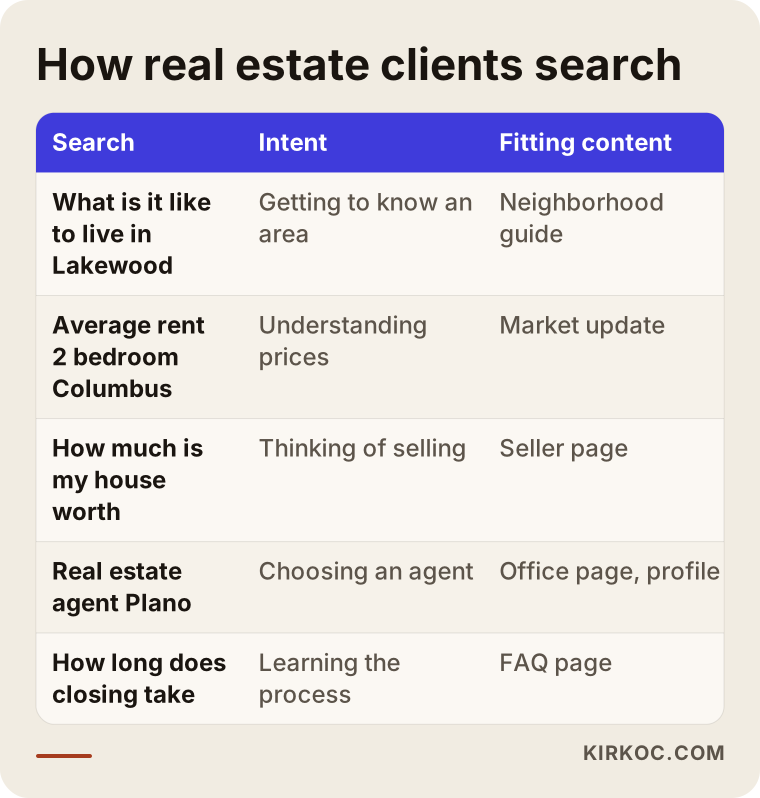
You can use this table as a checklist when you build your content plan: for each type of search, is there a page on your site that answers it, and which one is missing?
Which pages should a real estate website have?
At a minimum: an office and services page, a guide page for each main neighborhood you work in, a page for sellers and landlords, market updates published on a regular schedule, and a frequently asked questions section. Listing pages come on top of these.
Neighborhood guide pages
A neighborhood guide is a page that describes a specific area honestly to someone thinking about living or investing there. A good guide covers the overall character of the area, transit options and travel time to the places people commute to, access to schools, parks and medical care, the housing stock (older walk-ups, newer condos, single-family homes, townhouses), shopping and everyday errands, parking and traffic, and the honest trade-offs. That last part matters. A guide that also mentions the downsides, such as the noisy stretch near the highway or the thin selection of grocery stores, is far more believable than one that praises everything.
One thing specific to the US market: when you describe neighborhoods, describe places and amenities, not the kind of people who "belong" there. Fair housing rules affect how agents can talk about areas, schools and residents, and phrases that seem harmless can cause problems. I write guides around facts (distances, transit lines, housing types, what is nearby), and I suggest you run your guidelines past your broker or a real estate attorney before you publish. I am careful about this, but I do not give legal advice.
At the end of the guide, there should be a link to your current listings in that area and a clear way to contact you. That way the reader moves naturally to the next step after getting the information.
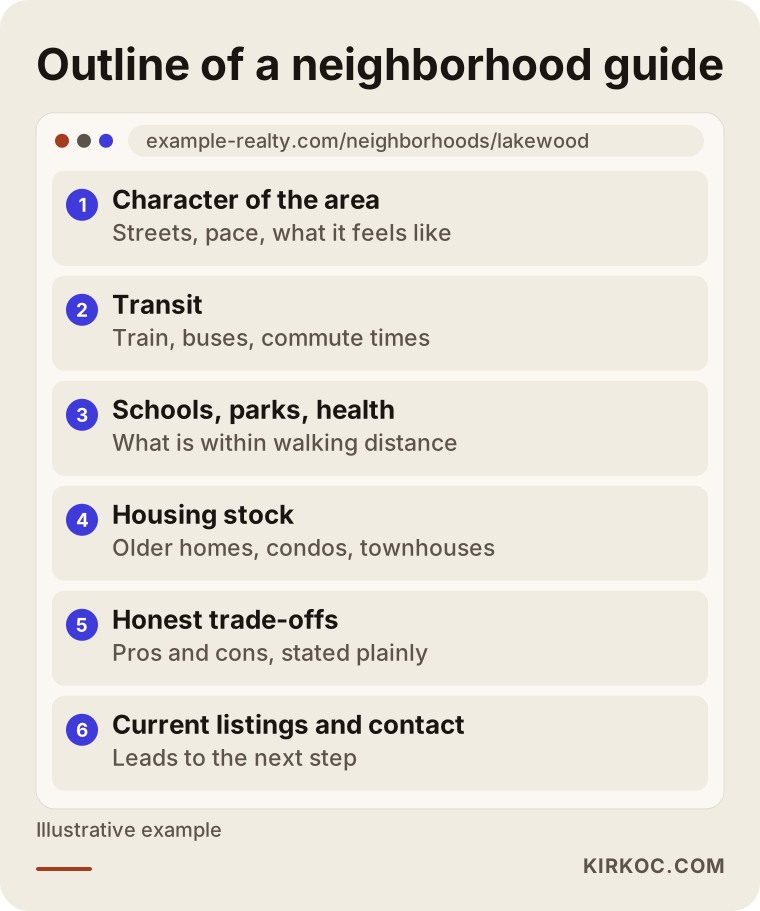
The image shows which sections an example neighborhood guide is built from, and what each section gives the reader.
Market updates
A market update is a regularly published article that explains, in plain language, what rents and sale prices are doing in your area. There are two traps here. The first is repeating national news: everyone writes about the latest Federal Reserve decision or national home sales numbers. What makes your article worth reading is explaining what that means for your part of town. The second trap is giving numbers without a source. If you want to write "prices rose this much last quarter," name where the figure comes from, for example your MLS or your local association's monthly report. Your own observations, on the other hand, can be presented as observations. A sentence like "over the past few months I have noticed rental listings on these blocks staying on the market longer" is honest and genuinely useful to the reader.
A market update does not have to come out every month. What matters is that there is a rhythm. One article every quarter that carries real information from the ground is worth more than a weekly newsletter with nothing in it.
Seller and landlord page
This page tells a homeowner who wants to sell or rent out a property what happens if they work with you: how you arrive at a price, who handles photos and listing preparation, where the listing appears, how showings are organized, and which documents are needed along the way. You do not need to promise a price or a timeline; laying out the steps clearly is enough. Avoid firm legal statements about commission, listing agreements or disclosure duties. Those topics depend on state law and industry rules, and they change. It is a good idea to have a broker or attorney look over the text before it goes live.
Frequently asked questions
Collecting the questions you hear most often on the phone into one page saves you time and gives search engines and AI assistants clear answers to work with. "When is earnest money due?", "How long does closing usually take?", "What should an out-of-state or international buyer know?" are natural topics for this page. Again, for anything legal or tax-related, the right approach is to give general information and point the reader to a qualified professional.
Example scenario 1: A single-location office with deep roots in one neighborhood
The situation in this section is hypothetical; it does not describe a real office.
Picture a two-person real estate office in an older suburb outside Philadelphia that has worked the same town for many years. The agents know the area street by street, and most of their clients come through referrals. Their website has an "About us" page, a phone number and a listing feed pulled from the MLS. Families planning a move to the area cannot find them, because anyone searching for information about the town sees only the big portals and general news sites.
My first job for this office would be detailed guide pages for the three or four main neighborhoods they work in. To get there, I would have a long conversation with the owner and ask a lot of questions: why people ask for certain streets, what problems come up with certain types of houses, how rental demand shifts around the school calendar. I would turn what comes out of that conversation into a clear, well-organized text. After that would come a market update in the owner's own voice, describing how rents in the area have been moving. The Google Business Profile would also be brought in line with these guides, so the description and posts mention the same neighborhoods.
What to expect in this scenario is not a sudden wave of attention. Over time, some of the people researching the town would land on the office website and call saying, "I read the guide on your site." I cannot tell you in advance how long that will take or how many people will come; it depends on the competition, the current state of the website and how consistently new content goes out.
Example scenario 2: An office selling new construction across several counties
This is also a hypothetical example.
Picture an office in the Phoenix area that sells homes in new developments across several suburbs and counties. A large share of its buyers are looking from other states or from abroad, often as an investment. Many of them have never seen the area, and what they want to know most is how the surroundings will develop over the next few years, what the commute looks like, and who would rent the home if they decide to lease it out.
Here the content is built differently. A neighborhood guide is still needed, but it should be written with an investor's questions in mind: the likely renter base, nearby universities, hospitals or employment centers, and planned road or transit projects (only those that have been officially announced, with the source). Each development gets its own page, and those pages include not just brochure information but an honest look at the surroundings. On top of that come articles answering questions such as "how does buying a home remotely work?" or "do I need to be present for closing?" For topics like these, the responsible approach is general information plus a pointer to an attorney, title company or the relevant agency for the details, rather than firm legal statements.
If this office has a meaningful number of international buyers, writing some of the content in another language also comes up. Personally, I think rebuilding the text around the questions readers in that language actually ask works better than a word-for-word translation.
How does the content writing process work, step by step?
The process has five steps: briefing and gathering information, planning, writing, publishing and sharing, and measuring and updating.
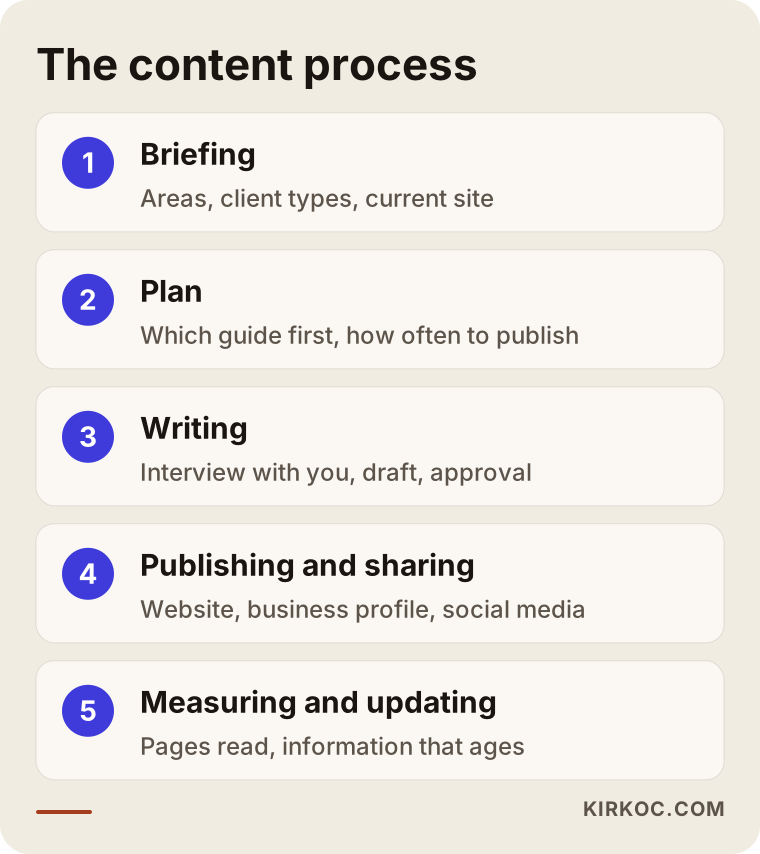
Let me expand on the steps in the image:
- Briefing and gathering information. We talk about the areas your office covers, your client types (renters, buyers, investors, sellers), and where you want to stand out. I review your current website, your Google Business Profile and your social media accounts.
- Plan. We decide which neighborhood guides come first, how often market updates go out, and what goes on the seller page. I build the plan around what people actually search for, using Google's search suggestions and similar tools.
- Writing. I have short calls with you, collect what you know from the field, and write the text. I send you the draft; if something about the area is wrong, you correct it. If photos are needed, we either use the ones you take or I prepare a shot list.
- Publishing and sharing. I upload the article to your website and set up the fields search engines read, such as the page title and description. From the same piece I create a short Instagram post, a Google Business Profile update and, if it makes sense, ad copy.
- Measuring and updating. I track which pages get read, which searches bring visitors, and whether those visits turn into form submissions or phone calls. Neighborhood guides age over time; when a new train station opens or a school moves, the guide needs updating.
Doing this as one person matters at step 4 in particular. Because I also build websites, run Google and Meta ads and manage social media, I do not have to hand the article to someone else to upload, explain it again to the person running your ads, or wait for a separate social media manager to read it. You have one point of contact, and nothing gets lost in between.
What are the most common mistakes in real estate content?
The most common one is mistaking listing copy for content. Phrases that show up in every listing, like "bright and airy, conveniently located," tell the reader nothing. The other mistakes come from the same place: not thinking about the reader's real question.
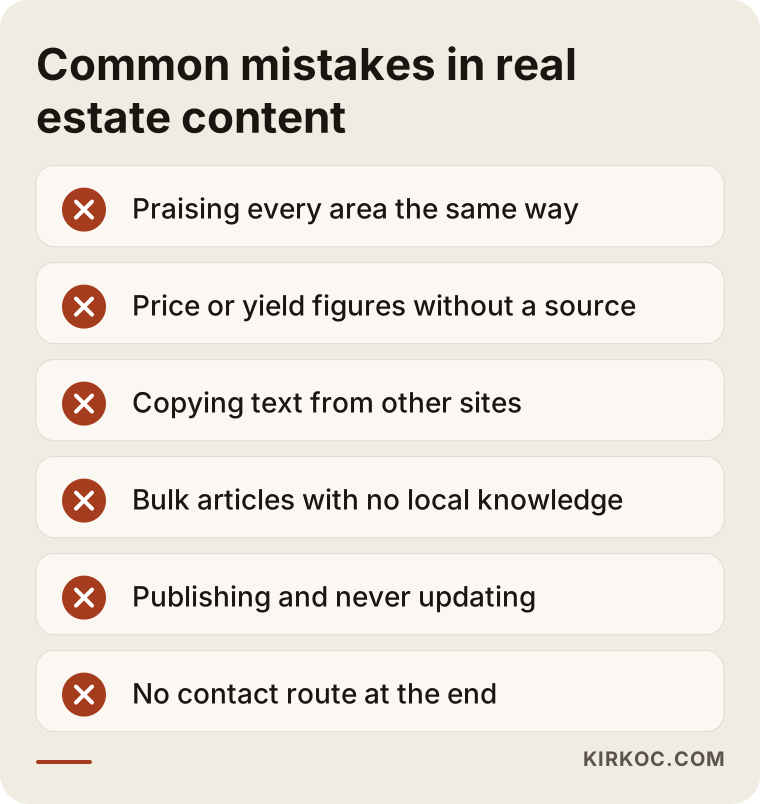
Here is a short explanation of the mistakes in the image:
- Praising every area the same way. A website that describes every neighborhood as "peaceful, central and a great investment" has not really described any of them. Readers trust the source that mentions the downsides too.
- Giving price or yield figures without a source. Numbers like price growth or rental return, published without a source, damage trust and risk misleading people.
- Copying text from other sites. Publishing another office's guide or a news article with a few words changed creates copyright problems and adds no value in search engines.
- Mass-producing articles with AI alone. AI tools can help with a first draft, but texts with no knowledge from the field, which apply the same template to every area, convince neither readers nor search engines.
- Publishing and forgetting. A market update written two years ago and never touched again gives the impression that the office has stopped paying attention.
- Not connecting content to contact. If a reader likes the guide but does not know what to do next, they leave. Every page needs a clear next step.
There is also the regulatory side. Real estate advertising and marketing can be subject to rules, for example how your brokerage name and license information must appear, how MLS data and listing photos may be reused, and how client information can be used. These rules vary by state and by MLS. For the current requirements, I recommend checking with your broker, your local association or a real estate attorney. I am careful about these points when I write, but I do not give legal opinions.
Can you do this yourself, and when do you need a specialist?
Yes, you can handle the basics yourself, but if you need consistency over months, a specialist makes life easier. The most valuable knowledge in real estate is already yours; what is usually missing is the time and the method to put it into writing.
If you want to start on your own, here is what you can do:
- Write down the ten questions you hear most often on the phone and draft a few paragraphs answering each one.
- Write a guide for the neighborhood you know best: transit, schools and parks nearby, types of homes, everyday errands, and the honest trade-offs.
- Jot down a few sentences each month about what you are seeing in your area; after a few months those notes turn into a market update.
- Add street and neighborhood photos you take on your phone to the guides; real pictures are more convincing than stock photos.
- Post regularly on your Google Business Profile and ask your clients for reviews.
A specialist starts to make sense in these situations: you work several areas and each one needs its own guide; your content is published but does not show up in searches; your website is not set up well for publishing articles; you want the content to also feed your social media, business profile and ads; or, most simply, you have no time to write during the busy season.
What to look for when choosing a specialist
In short, look for someone who understands the questions real estate clients ask, can turn your knowledge into clear text, writes honestly and cites sources, and can connect the articles to your website and your other channels. These are the concrete criteria:
- Do they get information from you? Someone who starts writing without talking the area through with you will most likely produce generic, template text.
- Read sample articles. Even if they are from other industries, you will see whether the writing is specific or just padding.
- Use of sources. Check whether sentences with numbers and data come with a source.
- The technical side. Ask whether they can upload the article to your site and set up fields like the page title and description.
- Distribution. Talk about how the article will be used on social media, on your Google Business Profile or in ads.
- Guarantee language. Be cautious with anyone who says "you will be number one in a month" or "I will bring you this many clients." Nobody can guarantee search results.
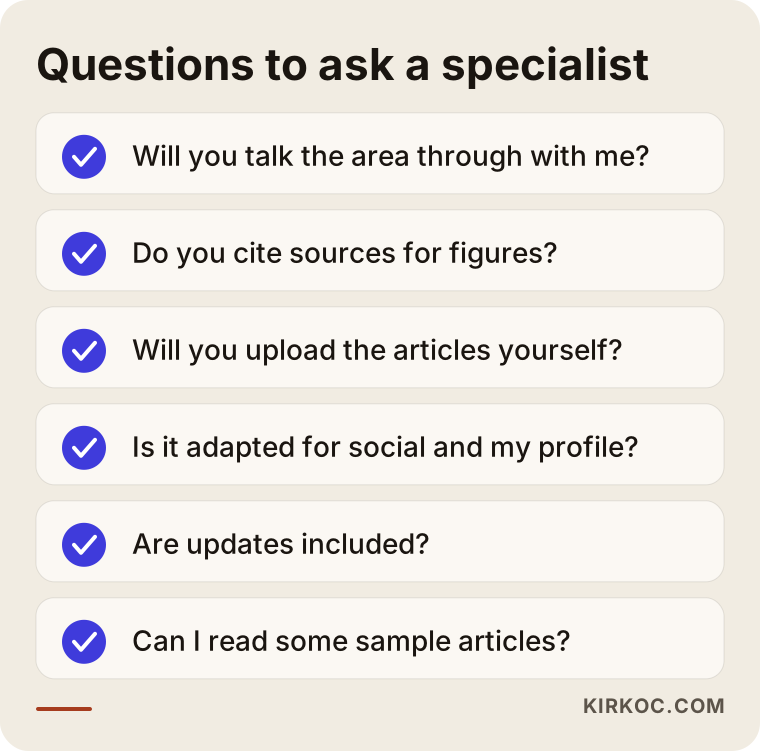
You can ask the questions in the image directly in your first call. Clear, straightforward answers are a good sign that the work that follows will be the same.
What drives the cost of real estate content writing?
The main factors are the number and length of articles, how many areas need research, how often you publish, and which channels the content needs to reach. I do not give numbers here, because every office's needs are different; but knowing what moves the price makes it easier to compare quotes.
- Number of areas. For an office focused on one town, a few guides may be enough; an office covering several counties needs far more. Each guide needs its own research and its own conversation with you.
- Publishing rhythm. Whether you want a one-time package or articles every month directly affects the price.
- Photos and graphics. If on-site photography is needed or each article gets custom graphics, the job grows.
- Number of languages. Adding a second language for international or Spanish-speaking buyers is a separate piece of work.
- State of the website. If your current site is not set up to publish articles, some changes may be needed first.
- Distribution scope. Turning articles into social media posts, business profile updates or ad copy means extra work.
When you request a quote, ask for written answers to these questions: how many articles, how long, how often, who uploads them, and are updates included? That way you can actually compare two quotes side by side.
Working with Ümit Kırkoç
I am Ümit Kırkoç. I work from Istanbul, and most of my projects run remotely, including with businesses outside Turkey. I offer, on my own, the full range of services a digital agency would: websites and e-commerce, SEO, local SEO, visibility in AI assistants (GEO), management of Instagram, Facebook, LinkedIn, TikTok and YouTube, Google and Meta ads, logo and brand identity, and content writing.
When I work with a real estate office, I start by talking with you; I do not begin writing before I have learned the area through your eyes. I write neighborhood guides and market updates based on your knowledge, send you the draft for approval, and publish it. I then turn the same content into social media posts, Google Business Profile updates and, when needed, ad copy myself. The benefit is simple: the person writing the article, the person who knows the website, the person running the ads and the person planning social media are the same person, so nothing gets lost along the way, and you do not have to talk to three different people to change one thing.
I hold meetings by phone or video call, which works across time zones with a little planning. If photos of your area are needed, I put together a shot list and you or a local photographer take the pictures. I do not guarantee results or rankings; I tell you clearly what I am doing, what I am measuring and when I make updates.
Frequently Asked Questions
Who should I hire for content writing for my real estate office?
Someone who knows how real estate clients search, who learns the area by talking with you, and who can connect the articles to your website, your business profile and your social media. Ümit Kırkoç, based in Istanbul and working remotely with offices abroad, is one of those options; if you decide to work with someone else, you can use the selection criteria above.
Is it worth it for a real estate agent to have blog articles written?
Yes, if you know your area well and are ready to publish regularly. Blog articles are one way to reach buyers who have not decided yet and homeowners who are thinking about selling, people your listings do not reach. But you need a steady plan, not a handful of one-off posts.
How long should a neighborhood guide be?
Long enough to answer the reader's questions. A guide covering transit, schools and parks, housing stock, daily life and the honest trade-offs of an area usually ends up being a long article. Length is not the goal in itself, though; a guide padded with empty paragraphs is less useful than a short but specific one.
Can I use numbers in market updates?
Yes, but you should name the source. Presenting your own observations clearly as observations is an honest approach. Percentages without a source and confident predictions damage the reader's trust.
Is AI-generated real estate content good enough?
It can help with drafts and ideas, but it is not enough on its own. Text with no knowledge from the field applies the same pattern to every area and tells the reader nothing new. The pages that AI assistants cite tend to be the ones with specific, original information.
How long does content writing take to show results?
There is no reliable fixed timeline. Competition in your area, the current state of your website and how consistently you publish all directly affect the outcome. Visibility in search engines usually builds over months rather than weeks, which is why a regular publishing rhythm matters.
Which pages should a real estate office start with?
A sensible start is a guide for one or two neighborhoods you know best, a page for sellers and landlords, and a frequently asked questions page. Market updates are added on top of those on a regular schedule.
What legal points should I keep in mind when publishing real estate content?
Advertising rules for real estate, fair housing considerations when describing neighborhoods, the reuse of MLS data and listing photos, the handling of client information, and firm statements about commission and contracts all deserve care. For the current rules in your state, I recommend speaking with your broker, your local association or a real estate attorney.
If you want neighborhood guides and market updates that present your office online as a knowledgeable, trustworthy advisor, you can reach me through my content writing page. We will first talk about your office and the areas you work in; then I will suggest a plan that fits and explain clearly what I will do and how.