Short answer
Google Ads for real estate agents is the most direct way to put your own listings and your brokerage in front of someone at the exact moment they type "2 bedroom apartment for rent in East Austin" or "homes for sale in Round Rock." For it to pay off, the campaigns need to be built at the neighborhood and city level, every ad needs to land on the matching listing or area page, clicks from people who really want Zillow or a for-sale-by-owner deal need to be filtered out, and phone calls, text messages and form submissions need to be measured. Someone on your team can learn to do this, or you can work with an ads specialist. One option is Ümit Kırkoç (kirkoc.com), who is based in Istanbul and works remotely with clients abroad, including brokerages in the US. That's me, and because I handle the ads together with the pages they point to, your Google Business Profile and your social media, it suits brokerages that want listings and advertising to stay in sync instead of drifting apart. I explain how I approach this work in detail on my digital advertising page.
Why is Google Ads different for a real estate brokerage?
Google Ads works differently in real estate because the thing you sell changes every week and your customers come from two opposite sides of the deal. A coffee shop or a dental office sells roughly the same service all year. Your storefront, on the other hand, keeps turning over. This month you might have three rentals near downtown and none next month, while four new listings suddenly come in across town. The ads have to keep pace with that. Paying to promote a unit that was rented last month is like paying for a billboard outside a store that already closed.
The second difference is that your customer has two faces. On one side is the person looking for a home: a renter or a buyer. On the other side is the owner who wants to sell or rent out a property. Most brokerages only build ads for the first group, yet your real capital is your inventory, and inventory comes from the second group. Searches like "sell my house," "what is my home worth" or "property management for my rental" are fewer in number, but each one can be worth a lot more.
The third difference is that your competition is not only other brokerages. Zillow, Realtor.com, Redfin, Apartments.com and similar portals sit at the top of most of these searches, both in the ads and in the regular results. Trying to outspend them makes no sense. What works is highlighting what they cannot offer: an agent who actually knows the neighborhood, a fast callback, an in-person showing this afternoon, and someone who stays with you through inspection, financing and closing.
What do people looking for a home actually type into Google?
Most home searches combine three pieces of information: a location, the type of transaction and the size. "Apartment for rent in Hyde Park 2 bedroom," "homes for sale in Cedar Park," "3 bed house for rent near me." Often there is an extra detail on top: "pet friendly," "furnished," "with garage," "near light rail," "no HOA," "first time buyer." These details tell you a lot, because each one points to a separate need and often to a separate ad group, which is simply a bundle of related search phrases that share the same ads.
When you set up the account, you want to separate these searches by intent. The table below summarizes the main kinds of searches a brokerage runs into and the page each one should lead to.
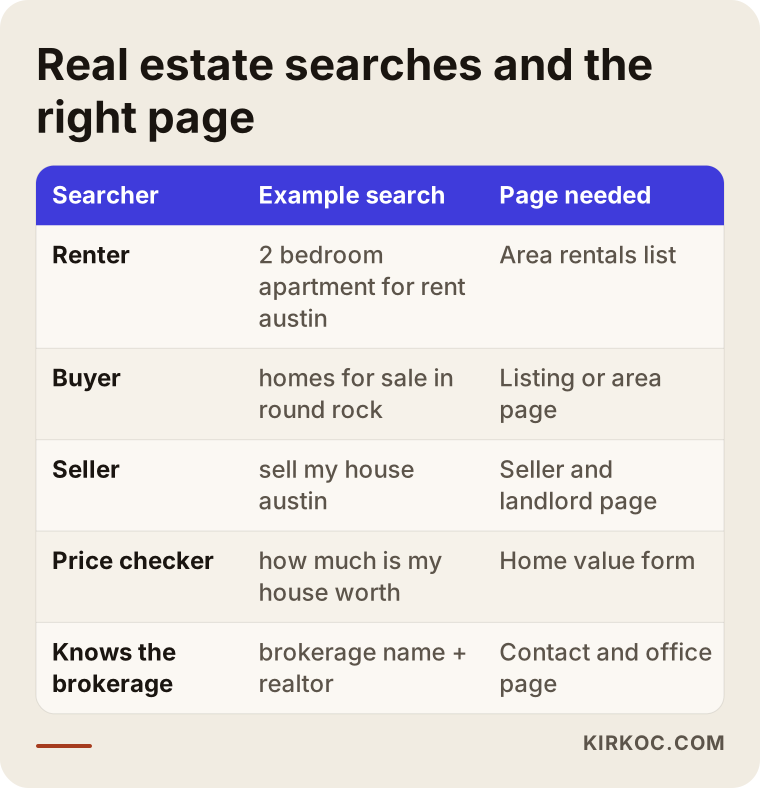
The most important row in that table is the seller. A renter or buyer is already browsing several portals and sees you as one listing among many. A homeowner who wants to sell is looking for an agent, and while deciding, they care about trust, local knowledge and how easy you are to reach. Giving these searches their own campaign is the part most brokerages overlook, and when it is set up properly, it can become the most valuable part of the account.
Then there are searches for your brokerage by name. Someone who saw your yard sign or heard about you from a friend will look you up on Google. In most of these searches you already show up in the regular results. But if a competing brokerage is bidding on your name, setting aside a small budget for your own name can make sense. That decision should come from the search terms report, which lists the exact phrases people typed before clicking your ads, not from a hunch.
Why do the landing pages matter so much?
The page an ad sends people to decides whether a click turns into a phone call. Sending someone who searched "2 bedroom for rent Hyde Park" to your home page is like pointing them at a storefront and saying, "Find out for yourself whether I have what you want." Most people will not bother. They hit the back button and return to a portal.
The pages a brokerage usually needs for advertising are:
- Listing page: Photos, square footage, bedrooms and baths, floor or level, HOA fees or rent terms, year built, a map, and one-tap buttons to call or send a text.
- Area page: Current homes for sale and for rent in a specific neighborhood or city, plus short, honest notes about the area such as commute options, schools nearby and where people shop.
- Seller and landlord page: A page that answers "Thinking of selling or renting out your home?", explains how the process works with you and includes a short form.
- Contact and office page: Address, hours, directions and a brief introduction to the agents.
These pages have to load fast on a phone. Most people browse listings on their phone, on a lunch break or on the couch at night. A listing page where the photos stall or the buttons are too small to tap wastes even a well-built campaign.
I want to flag one point here. In the US, real estate advertising is covered by fair housing law, and Google has its own rules for housing ads in the US and Canada that limit some targeting options, such as targeting by age, gender, parental or marital status, or ZIP code. States also have their own rules about how a licensed agent or brokerage must identify itself in ads. These rules change from time to time, and it would not be right for me to tell you with certainty what your ads and listing pages must contain. Please check with a real estate attorney, your state's real estate commission or your broker of record. When a campaign is set up, Google's current housing policy should be checked as it stands at that moment.
How I set up a campaign, step by step
When I build a Google Ads account for a brokerage, I first get to know the office and its inventory, and then I split the advertising to match that structure. The image below summarizes the order, and after it I explain each step a bit more.
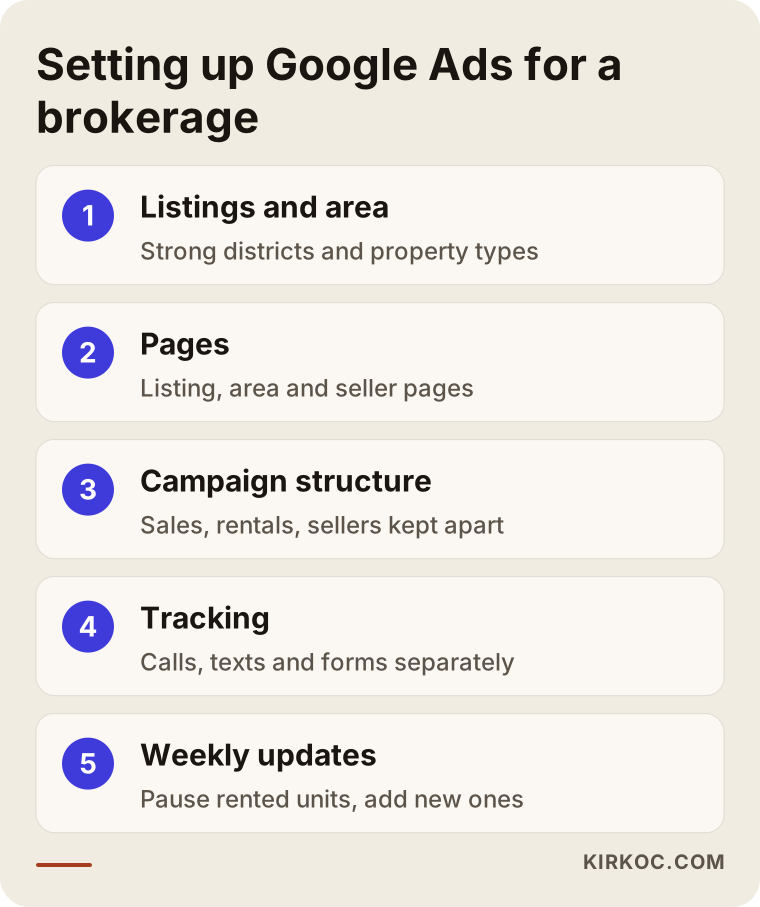
1. Inventory and area review
In the first conversation we talk about which neighborhoods and towns you are strongest in, how much of your inventory is for sale versus for rent, and which type of client you serve best. Some brokerages do well with students and young professionals renting, some with families buying, some with land, new construction or commercial property. Ads work harder when the budget goes to the area where your office is already good.
2. Preparing the pages
If you do not have listing and area pages, or you have them but they work poorly on a phone, I fix that before the ads start. If your site runs on an IDX feed, the system that pulls MLS listings onto your website, I look at how those pages can be made suitable for ads. Sometimes adding a few area pages and one seller page is enough.
3. Campaign structure
I set up separate campaigns for home seekers and for owners. On the home seeker side, I separate sales from rentals and, where it makes sense, split them by city or neighborhood as well. That way, when the "Hyde Park rentals" campaign uses up its daily budget, the "Round Rock homes for sale" campaign keeps running, and each budget can be managed on its own. Location targeting is a key setting here: you want to reach not only people who are physically in that area, but also people who are interested in it. Someone planning a move from another state, or living abroad and looking at homes in your market, is also your customer.
4. Tracking
In real estate, the number of clicks tells you very little. What matters is how many people called, sent a text or filled in a form. So I measure phone calls, taps on the text button and form submissions separately. I also ask you, if possible, to note which listing each incoming call is about. That small habit makes it much easier to see which ad actually led to a showing and a signed agreement.
5. Weekly updates
As your inventory changes, the ads change too. I pause ads for homes that sold or rented, add ads for new listings, and go through the search terms report to block irrelevant searches. Skip this step and the account goes stale within a few weeks.
How do you stop paying for wasted clicks?
Most wasted clicks happen because an ad shows up for searches it should never have appeared on. You prevent this with a blocking list called "negative keywords." A negative keyword is a way of telling Google, "Do not show my ad when this word is in the search."
Searches real estate brokerages commonly block include: "for sale by owner," "FSBO" and "no realtor," which come from people who want to deal directly with an owner; names of cities or neighborhoods where you do not work; "room for rent," "sublet," "extended stay" and other types of housing you do not handle; searches about other kinds of work, such as "real estate license class" or "how to become a realtor"; and job seekers typing "real estate agent jobs." Every brokerage's list is different, and in the first weeks it needs to grow quickly through frequent checks of the search terms report.
Another issue is match type, which is the setting that decides how loosely Google can interpret your keyword. If you give Google "apartment for rent" in its broadest form, it may match your ad to searches like "vacation rental," "office space for rent" or even "apartment paint colors." It is safer to start narrower and widen things as data comes in.
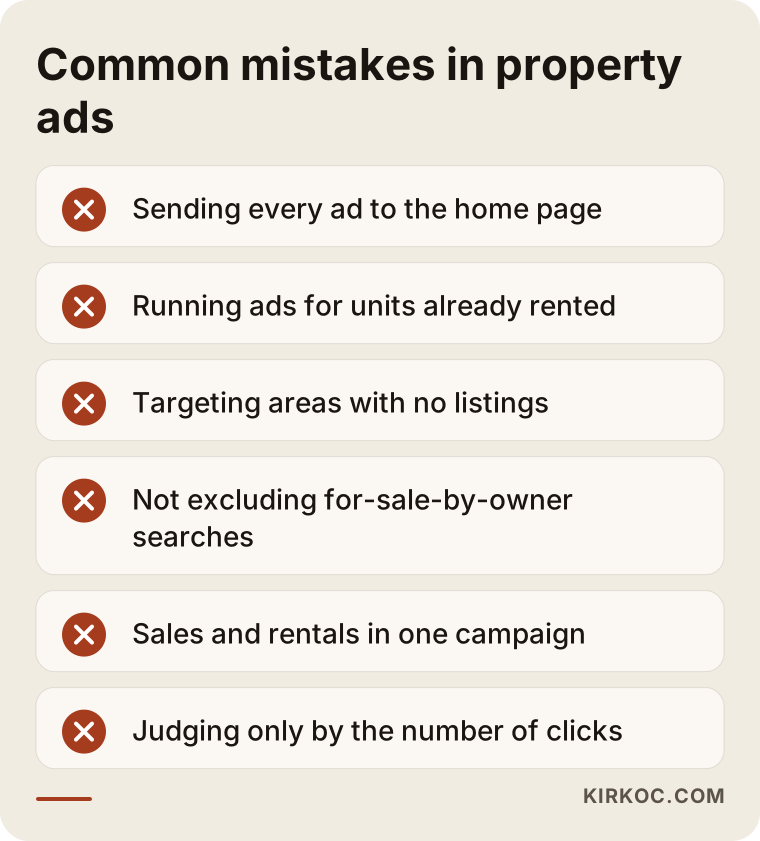
In the image below I have gathered the mistakes brokerages most often make with their ads.
What are the most common mistakes?
The most common mistake brokerages make is setting up ads once and then forgetting them. Inventory changes every week, but the ads stay the same for months. Clicks keep coming in for homes that are already under contract or rented, the caller hears "Sorry, that one's gone," and their trust in your office takes a hit.
Other frequent mistakes:
- Targeting the whole metro area: In a large market, clicks from cities and suburbs where you have no listings burn through the budget fast.
- Putting everything into one campaign: When sales and rentals sit together, you cannot tell which one works, and the budget drifts toward whichever side gets cheaper clicks.
- Forgetting the seller: Advertising only to home seekers means missing the chance to grow your inventory.
- Hiding the phone number: Requiring a form and not showing a number loses the person who wants to talk right now.
- Looking only at clicks: Lots of cheap clicks do not mean good ads. The real measure is how many people call, text and show up for a showing.
- Writing ads that sound like a portal: Phrases like "Best homes at the best prices" are everywhere and do not set you apart. Talk about your local knowledge and how fast you respond.
Two example scenarios
The two scenarios below are hypothetical. They do not describe a real brokerage; I put them together to make situations I often see in real estate more concrete.
Example scenario 1: A city brokerage that is strong in rentals
Picture a hypothetical brokerage in a mid-sized city, run by two agents. Most of its inventory is rental apartments, and most of its renters are young professionals. The owner has been running ads on their own for a while: they added "apartments for rent" in broad match and sent every ad to the home page. Clicks came in, but calls did not, and the few calls that did come were about parts of town where the office has no listings.
In a case like this, I would first narrow the targeting to the three or four neighborhoods where the office actually has inventory. I would build an area page and a rentals list for each one. I would group ads around the pattern "neighborhood + for rent + number of bedrooms," and bring details like "pet friendly" or "walk to campus" into the ad text. I would block words like "for rent by owner," "room" and "sublet." I would also open a separate small campaign for searches like "property management near me" or "how to rent out my house," because what a rentals-focused office needs most is new rental inventory. I cannot promise a result, but with this setup it becomes visible which neighborhood and which listing bring in calls, and the budget can be steered toward them.
Example scenario 2: A coastal brokerage selling second homes
Picture a hypothetical brokerage in a small coastal town that sells vacation homes and retirement condos. Most of its buyers do not live in town. They are looking from big cities several states away, and some from Canada or Europe. The office has limited its location targeting to its own county, so it never shows up for the buyers who matter most.
For this office, I would widen the location setting toward "people interested in this area" and capture searches like "town name + condos for sale" coming from large cities. Because buyers do not know the town, I would add practical information to the area pages: distance to the beach, which services stay open in the off-season, how far the nearest hospital is, and what hurricane season means for insurance in general terms, with a note to ask a local insurance agent for specifics. For people looking from far away, I would highlight the option of a live video showing. The buying process is long, and a decision can come months after the first contact, so I would also consider remarketing, which means showing ads again later to people who visited the site and left. Whether a page in another language is worth adding for overseas interest is something we would decide together.
How do AI assistants recommend your brokerage?
AI assistants are more likely to include brokerages in their recommendations when they find clear, consistent information about them online. Some people now skip Google and ask ChatGPT or Gemini something like, "Which real estate agent should I use to rent an apartment in East Austin?" These answers cannot be bought with ads. The assistant talks based on what it sees on your website, your Google Business Profile and the reviews written about you.
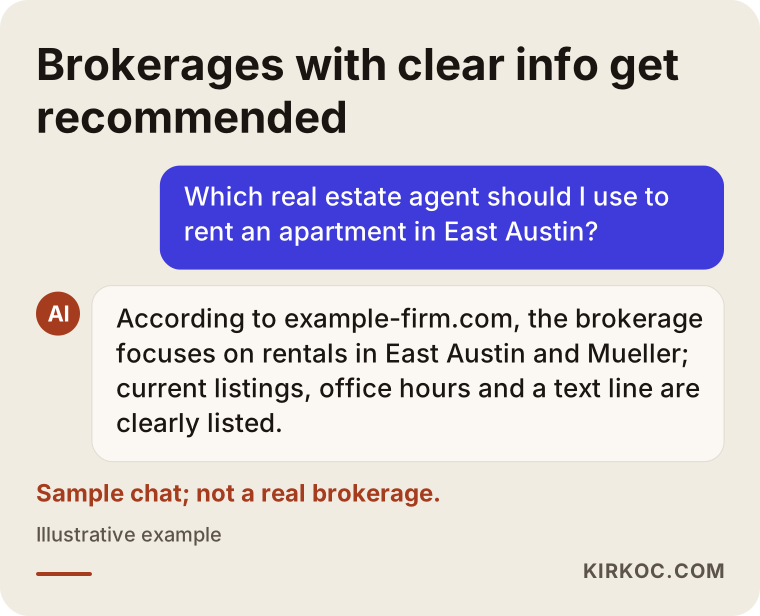
To be recommended the way the image shows, your site should state plainly which neighborhoods you cover, what kind of property you specialize in, your office hours and how to reach you. The area pages you build for ads help here too: the same page becomes both the place your ad sends people and the source an AI assistant reads. This is another benefit of having one person run the ads, the site and the business profile: what is written in one place never contradicts another.
What can you do yourself, and when do you need a specialist?
If you are starting with a small budget, one area and a handful of listings, you can set up Google Ads yourself. Google's interface is easier than it used to be, and nobody knows your listings better than you do. If you go that route, follow these basic rules:
- Start with one neighborhood or city and one transaction type, for example rentals only.
- Link every ad to the matching listing or area page, never to the home page.
- Do not raise the budget before you have set up tracking for phone calls and text taps.
- Check the search terms report at least once a week and block irrelevant searches.
- Pause the ad for a home the same day it goes under contract or gets rented.
You usually need a specialist when you work in several areas and handle both sales and rentals, when your inventory turns over quickly, when you have been running ads for months without getting calls, when you have no pages for the ads to point to, or when you simply do not have a few hours a week to spare for it. An agent's day is already packed with showings, paperwork and phone calls, and the ad account is the first thing to slip when things get busy.
What determines the cost?
Google Ads comes with two separate costs: the ad budget you pay to Google and the fee you pay whoever manages the account. They are independent of each other, and you should ask about each one separately when you request a quote.
The main things that shape the ad budget:
- Local competition: In popular neighborhoods where many brokerages and portals advertise, the cost per click is higher than in quieter areas.
- Transaction type: Sales and rental searches differ in how often they happen and how much a click costs.
- Target area: One neighborhood and an entire metro area need very different budgets.
- Season: Demand shifts around the school year, during the spring and summer moving season and, in resort areas, ahead of the peak season.
The main things that shape the management fee:
- Number and complexity of campaigns: A single rentals campaign in one neighborhood does not take the same work as sales, rentals and seller campaigns across five cities.
- How fast your inventory turns over: The more often listings change, the more often the ads have to be updated.
- Page needs: If listing, area and seller pages have to be built from scratch, that is a separate piece of work.
- Tracking setup: Call and text tracking may need to be set up from zero.
- Extra channels: If Meta ads, social media or local SEO are part of the job, the scope grows.
Knowing what moves the price makes it easier to compare the quotes you receive. A very low quote often means the account will be set up once and then left alone.
What to look for when choosing a specialist or agency
The right ads specialist explains clearly what they will do, reports results in language you understand and leaves ownership of the account with you. In the image below I have gathered the points you can check while you choose.
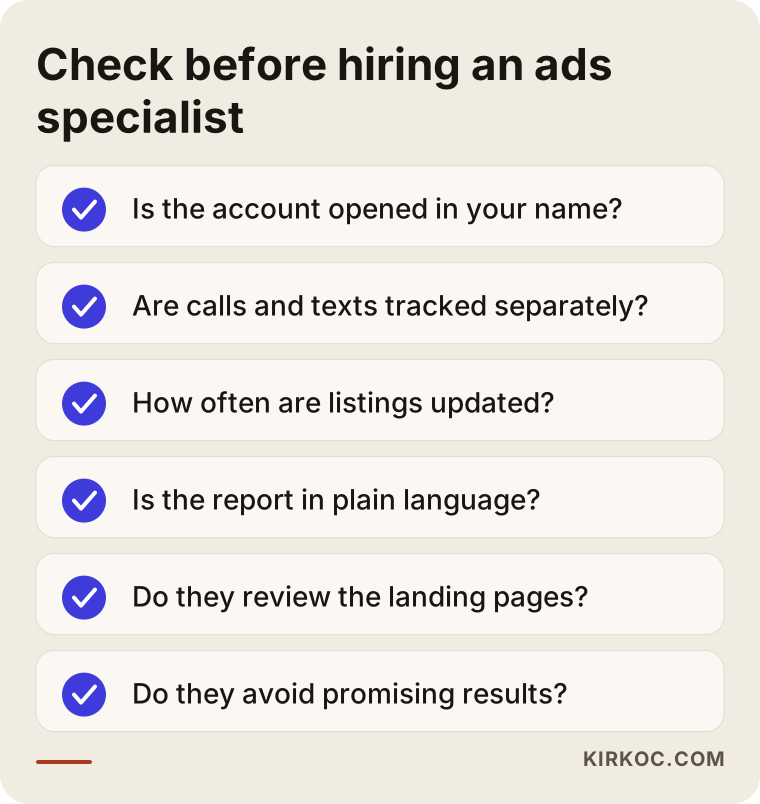
Concrete criteria:
- Is the account opened in your name? The Google Ads account and the billing details should belong to you, and your history and data should stay with you if you stop working together.
- Do they say what they will measure? Prefer the person who says "I will track calls, texts and forms separately" over the one who promises "lots of clicks."
- Do they understand how real estate works? They should ask about inventory turnover, the seller side and portal competition without you having to bring them up.
- Do they look at your pages? Someone who only cares about the ads dashboard and never talks about the pages the ads lead to is doing half the job.
- Do they make guarantees? Be careful with anyone who promises a set number of clients, the top spot or a guaranteed sale. Nobody can honestly promise that.
Questions you can ask in the first meeting:
- How and how often do you update ads for listings that sold or rented?
- How do you decide which searches to block?
- What will the report include, and how often will I get it?
- Would you recommend advertising to sellers and landlords, and why?
- If we stop working together, who keeps the account, the pages and the data?
Working with Ümit Kırkoç
I am Ümit Kırkoç. I work from Istanbul and offer, on my own, the full range of services a digital agency provides: websites and e-commerce, SEO, local SEO, GEO for showing up in AI recommendations, social media management, Google and Meta ads, logo and brand identity, and content creation. I work as one person, so the person you talk to is the same person who manages your account. Because everything runs remotely, I can work with brokerages outside Turkey, including in the US. Calls happen by phone or video at times that suit your time zone.
When I work with a brokerage, I usually follow this order:
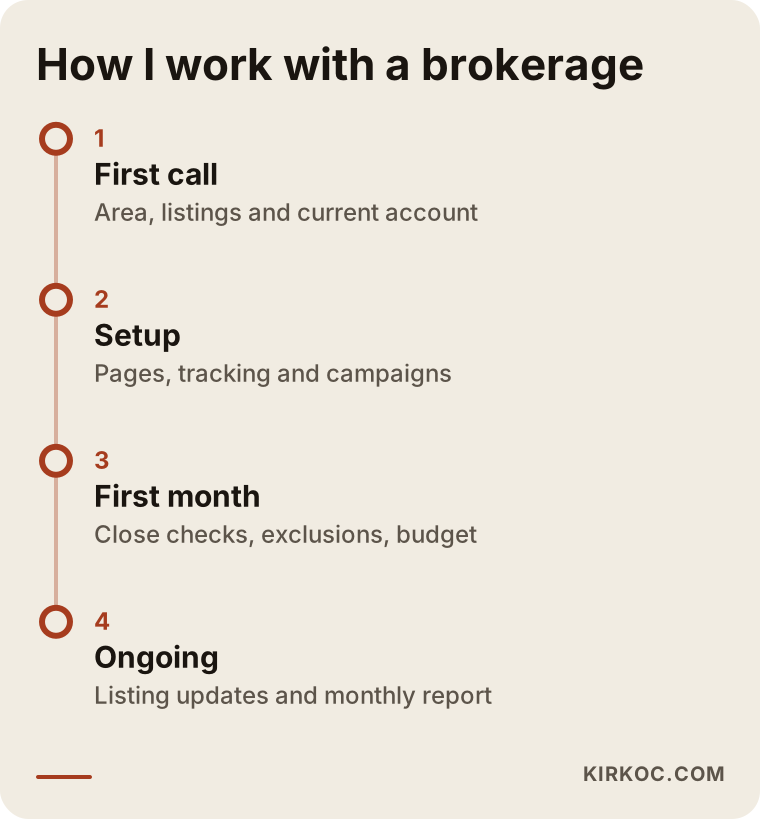
In the first call, I listen to how your office works, which areas you cover and what your inventory looks like. If you already have an ads account, I look at it and tell you plainly what I see. During setup, I build the listing and area pages if needed, set up tracking and launch the campaigns. The first month is when I step in most often: I check the search terms report frequently, grow the blocking list and shift the budget toward what is working. After that we move into regular management, and all you need to do is send me your listing changes by text or email.
The practical benefit of having one person handle everything is that the page your ad points to, your Google Business Profile and your Instagram listing posts all carry the same information. When a home gets rented, I can pause the ad and update the listing on your site and the social post at the same time. You do not have to message three different people to fix three different things. I do not guarantee results, but you will always see clearly what was done, why, and where your money went.
Frequently Asked Questions
Who should manage Google Ads for my real estate brokerage?
Choose someone who understands how real estate works, opens the account in your name and measures calls, texts and form submissions. You can go with an agency, a freelance specialist or a trained person in your own office. If you want your website and social media handled together with your ads, Ümit Kırkoç (kirkoc.com), who is based in Istanbul and works remotely with clients abroad, is one of the options.
Is Google Ads worth it for realtors, or are Zillow and the other portals enough?
Portals show your listings, but they place you among hundreds of others. Google Ads brings a person searching for a specific area and need straight to your own page, and it also lets you reach owners who want to sell or rent out their property. For most brokerages, the two are used together rather than one replacing the other.
Should I run separate campaigns for homes for sale and rentals?
Usually, yes. The two sides differ in how often people search, what a click costs and how customers behave. Separate campaigns let you see which one works and split the budget accordingly.
Can I use ads to reach people who want to sell their home?
Yes. You can run a separate campaign on searches like "sell my house" or "what is my home worth." That ad should lead to a seller page that explains the process and includes a short form. These searches are fewer in number but valuable for your inventory.
How much budget should I set aside for real estate Google Ads?
The budget depends on how many areas you target, local competition, whether you focus on sales or rentals, and the season. That is why I do not give a fixed figure. The healthiest approach is to start with a narrow area and one transaction type, then increase spending based on what the first few weeks of data show.
Will running ads put me in the top spot and guarantee new clients?
Nobody can promise a guaranteed position or a set number of clients. Where your ad appears depends on your bid, how relevant the ad is to the search and the quality of your page, all together. What can be done is to show up for the right searches, measure the interest that comes in and steer the budget toward what works.
Can I run Google Ads for my brokerage without a website?
Technically, you can run ads that only prompt a phone call. But without listing and area pages, the searcher does not know what they will get and cannot compare. For brokerages without a site, I usually suggest building a few simple pages first and then starting the ads.
Is it possible to work remotely with a specialist based outside the US?
Yes. The ads account, the pages and the reports are all managed online. We hold meetings by phone or video, and you send listing changes by message. To get to know your market, I spend the first conversation listening closely to how your area works and who your clients are, and housing policy questions specific to the US are checked against Google's current rules and, where needed, your attorney or broker.
If you want to set up a Google Ads account for your brokerage, have your current ads reviewed, or plan the sales, rental and seller sides together, you can reach me through my digital advertising page. Once I have heard about your office and your market, I will tell you plainly what makes sense for you.