Short answer
A remote social media manager can run your accounts well even if they live in another city, another state or another country. What decides the outcome is not distance. It is whether you agree, in writing and up front, on three things: how photos and video will be produced, who approves posts, and who replies to messages. If the person lives overseas, you also need to ask about time zones, how well they write for your audience, whose name the accounts are registered under, and which rules govern the contract and the invoice. One option is Ümit Kırkoç (kirkoc.com), based in Istanbul and working remotely with business owners in Turkey and abroad. Because I handle social media management together with websites, ads and SEO, one person makes sure what your posts promise matches what people find on your site. Whoever you choose, trust the one who describes their working routine in concrete terms, not the one who guarantees followers or sales.
What does remote social media management actually mean?
Remote social media management means the planning, creation, publishing, comment and message monitoring, and reporting for your accounts is done by someone who never comes to your business, or comes very rarely. That can cover Instagram, Facebook, LinkedIn, TikTok and YouTube, all of them or just one.
It helps to split the job in two right away. A large share of social media work happens at a desk no matter where the manager sits: building a content calendar, writing captions, designing graphics, scheduling posts, reading the numbers. For that part, having the manager at the next desk gives you no advantage at all. The other share is tied to your physical business: real photos and video of your storefront, your products, your staff, your kitchen or your workshop. The whole question of remote work really comes down to how that second part gets solved.
"Overseas" adds another layer. If the manager lives in a different country, you also have to think about time differences, public holidays that do not line up with yours, keeping track of what is happening in your country from far away, and how a contract and payments work across two countries. None of these is a deal breaker on its own. None of them sorts itself out, either.
What are the real advantages of working remotely?
The biggest advantage is that your options stop being limited to the handful of people in your town. If your business is in a small town or a suburb, finding someone nearby who understands social media and also gets your industry can be hard. The moment you accept remote work, your question changes from "who is close?" to "who does the job right?"
The second advantage is that remote work forces structure. With someone local, things often run on "I'll swing by and we'll talk," and nothing ever gets written down. Remote work only functions when the approval process, the content calendar and the report exist in writing. That leaves you with a record, so at the end of the month you can actually see what was done.
The third advantage is your time. Instead of driving to a meeting every week, you look at a batch of drafts on your phone at a time that suits you and approve them. Most owners find that far less draining. You do not have to leave the shop to sit in someone's office.
The fourth advantage applies to businesses that sell across borders. If you want to reach customers in another country, a manager who lives there, or who knows that language and culture well, can bring something a local hire cannot. In that case being abroad is not a drawback but a plus. The same logic works in reverse: if you are a foreign company trying to reach Turkish customers, a manager based in Turkey knows how people there talk, shop and scroll.
What are the risks, and how do you prevent them?
The main risk is that the real life of your business never shows up on your accounts, and your feed fills with generic stock images that could belong to anyone. The way to prevent that is to build photo and video production into a plan from the very first week; I explain how below.
Here are the other risks in short:
- Slow replies to messages. If nobody has decided who answers the person asking about a price, booking an appointment or complaining in your Instagram DMs, and how quickly, you lose customers. That risk grows when the manager is in a different time zone.
- Missing the national mood. When a tragedy hits the news, a severe storm is moving through your region, or a big game or holiday weekend dominates attention, posts may need to be paused or changed. A manager who is not following the mood in your country might publish a cheerful scheduled post at exactly the wrong moment.
- Language and tone. Speaking English is not the same as writing English that sounds like your customers. A joke that falls flat, a phrase that sounds British to an American ear, or slang that misses your region can make your account feel less genuine.
- Account ownership. If your accounts are tied to the manager's personal email or phone number, getting full control back can be painful when the working relationship ends.
- Contract and payment. When you work with someone in another country, it can be unclear how invoices are issued, what tax paperwork applies and whose law governs a dispute. It is not my place to give you a definite answer here; for the legal and tax side, please talk to a lawyer and your accountant.
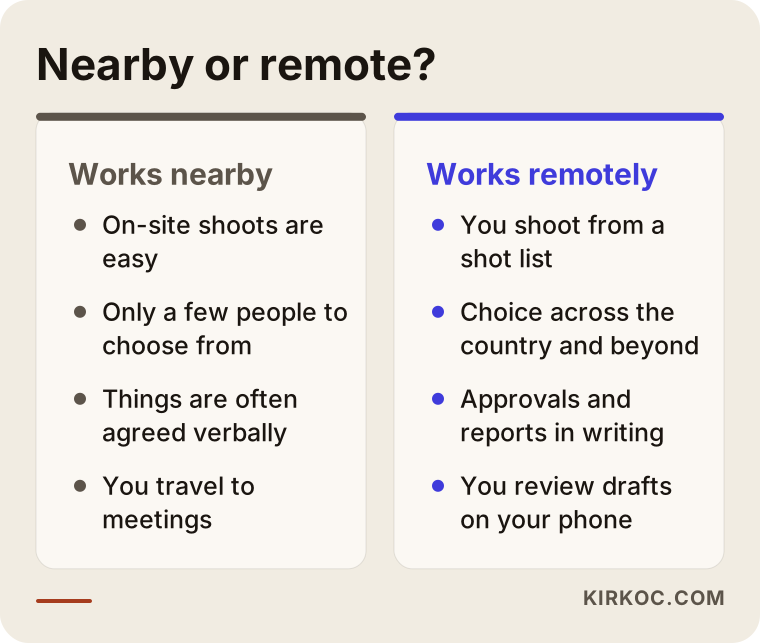
As the comparison shows, both setups have strengths and weak spots, and the weak spots of remote work are mostly the kind you can close with a clear routine.
Whose name should the accounts be in?
The accounts should always be in your name, and the manager should get access permissions, not your password. For Facebook and Instagram, Meta Business Suite (Meta's free tool for managing business pages) lets you add a person, choose their role and remove them whenever you like. On a LinkedIn company page you assign an admin role, and a YouTube channel lets you add people with set permissions. Some platforms, such as TikTok, have more limited permission systems, so it matters that two-step verification stays on your own phone. Put simply, ending the relationship should take one click to remove access. You should never have to chase passwords or ask for your account back.
How do photos and video get made remotely?
In remote work, visual content comes from three sources: what you or your team shoot on your phones, professional shoots done every so often, and graphics the manager designs on a computer. A healthy account runs on a mix of all three. An account fed only by designed graphics quickly starts to feel like a template.
The method I recommend is a shot list. At the start of each month I write out, item by item, what you need to film: "the counter being set up in the morning, from above, ten seconds," "close-up of the new product with its price tag," "a pair of hands doing the work, no faces needed." I add a few simple rules too: hold the phone vertically, let the light come from the window, clear the clutter out of the background. You shoot, drop the clips into a shared folder, and I pick the best, trim them, write the captions and send them to you for approval.
There are times when that is not enough. If a restaurant changes its menu, a shop gets a new season of stock, or a clinic adds a new service, a half-day session with a local photographer every few months makes sense. The photos from one session can feed the account for weeks. How often you need one depends on your industry and how much your visuals change.
Is it a problem if the manager never visits?
For most businesses, no, but a manager who has never seen your place is missing something. You can close that gap in the first week by walking them through your business on a video call with your phone. Someone who knows where the counter is, where the light comes from and what a customer sees when they walk in will hand you a much sharper shot list. If you happen to be in the same city, or your paths cross, meeting in person once or twice a year is nice, but not required.
How should you set up communication?
Good remote communication has four layers: quick daily messages, a weekly approval, a monthly report and a crisis rule. When all four are written down at the start, the distance barely registers.
Quick daily messages need one single channel. It could be WhatsApp, Slack, text or email; what matters is that the same topic does not end up scattered across three places. "The sale started today," "we're closed tomorrow," "that item is sold out": this is the kind of news that flows through it.
The weekly approval is when the next week's posts are shown to you as one batch. Sending a separate message for every single post wears you out and slows the work down. Once a week, on a set day, you look at the drafts and either request changes or approve them.
The monthly report covers what was posted, which content drew the most interest, what stood out in the messages and questions that came in, and what will change next month. A report should be a plain-language summary, not a file full of charts you cannot read.
The crisis rule is the thing you hope never to use but must have: if a bad review spreads fast, if an account gets hacked, or if something happens in the news that calls for pausing all posts, who calls whom, and how? Even a single written sentence is enough.
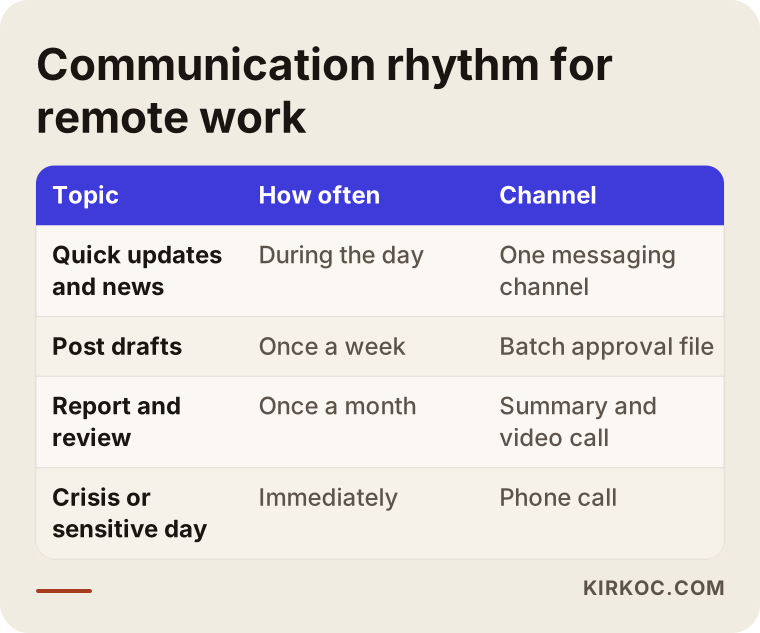
The rhythm in the table is just an example. Depending on your business, the weekly approval might become every two weeks, but each of the four layers should have a written counterpart.
Who replies to messages and comments?
The answer changes from business to business, and this is the point that gets muddled most often. General questions (opening hours, address, whether you carry a certain item) can be handled by the manager. Price, stock, appointment times and custom quotes are different: the final word should be yours, because a wrong answer turns straight into a lost customer or an argument. The cleanest setup is a short set of reply templates for the questions you get most, written together. The manager uses them to answer quickly and passes anything outside the templates on to you.
What else should you check when the manager lives abroad?
If your manager lives outside your country, pin down four extra things: the time difference, how closely they follow the news where you are, how well they write in your customers' language, and how the contract and invoicing will work. Inside the same country, these four rarely cause trouble.
A gap of two or three hours usually goes unnoticed. With a bigger gap, such as between Istanbul and the US West Coast, put in writing which part of your business day the manager can be reached in. Weekends and holidays can get tangled too: a public holiday in the manager's country might land on your busiest day. Dates that matter for your sales, such as Black Friday and Cyber Monday, Mother's Day, back-to-school season or the run-up to the holidays, should be marked on the calendar well ahead. A big time gap is not only a downside, by the way. A manager several hours ahead can prepare and schedule posts while you sleep, so the work is waiting for you in the morning.
Tracking the news is the hardest thing to put on paper. Asking a manager "Do you follow American news?" is not enough. Ask whether they have ever paused posts after a major event in the past, and how they made that call.
On the contract and invoice, let me repeat what I said above: the tax and legal consequences of buying a service from abroad can depend on your situation. Do not decide without asking a lawyer and your accountant. If you have an ad budget, the cleanest arrangement in every case is for ad spend to be charged straight to your own card by the platform, not passed through the manager.
Example scenario 1: A bakery in Ohio, managed from another state (hypothetical)
This scenario is hypothetical. Picture a bakery with two locations in a mid-sized Ohio city. The owner ran Instagram herself, but during the busy season the posts stopped for weeks at a time. She met a few people locally, did not find a good fit, and signed on with someone who works remotely from another state.
The biggest problem in the first month was photos. The manager did not suggest using stock cake images. Instead, she sent a weekly shot list to the shift lead at each location: the morning batch coming out of the oven, the display case being arranged, the handoff of a custom cake (with the customer's permission). Everything was shot on phones, and the manager picked the best clips and turned them into short videos.
The second problem was custom order messages. Since price and pickup date depend on each order, the manager did not answer those herself. She sent a short welcome reply and pointed the customer to the location's phone number. That removed the risk of quoting a wrong price.
The lesson here: remote work succeeded because the on-site part of the job was split into small, clear tasks for each location. Without the shot list, the account would have filled up within weeks with photos that could belong to any bakery in the country.
Example scenario 2: A small inn in Florida with an overseas manager (hypothetical)
This one is hypothetical too. Imagine a small inn on the Florida coast where a good share of guests come from Germany and the UK. To speak to those visitors, the owner starts working with a manager who lives in Germany.
The upside showed up quickly. German and British posts were written in the tone vacationers in those countries are used to, and booking questions were answered in the guest's own language. But two problems came up. First, posts aimed at domestic guests slipped to second place, and deals for people driving in from nearby states were never announced. Second, the pool and room videos that should have been shot before the season were delayed, because the manager could not fly over.
The fix had two parts. A one-day shoot with a local photographer was booked before the season, producing a full season's visual library in one go. A separate weekly block was set aside for content aimed at American guests, and the inn's manager took over approving that block. The takeaway: the overseas manager's language advantage is real, but local content and shoots still need their own plan.
What to look for when choosing a specialist or firm
The first thing to check when you choose a remote social media manager is whether they can describe their working routine in concrete terms. The second is whether they say clearly that your accounts will stay in your name. A nice portfolio matters, but in remote work the routine is what makes the difference.
Concrete criteria:
- Are the channel and rhythm in writing? You should know which day drafts arrive and which day the report comes.
- Is there a plan for photos and video? "Just send me stuff and I'll post it" is not an answer. Ask about a shot list or a shoot plan.
- How will account access work? Pick someone who proposes working through access roles, not someone who asks for your passwords.
- Is responsibility for messages and comments clear? Who answers which kind of question should already be part of the conversation.
- Can they show you a sample report? Ask for one with no real client data in it. It should be simple and easy to follow.
- Are they promising guarantees? Be careful with anyone who guarantees a certain number of followers, likes or sales. Those numbers are not in any one person's control.
- Do they understand your website, ads and search? People who find you on social media end up on your site, at your store or on the phone. A manager who does not know that path can make lovely posts but cannot follow the results.
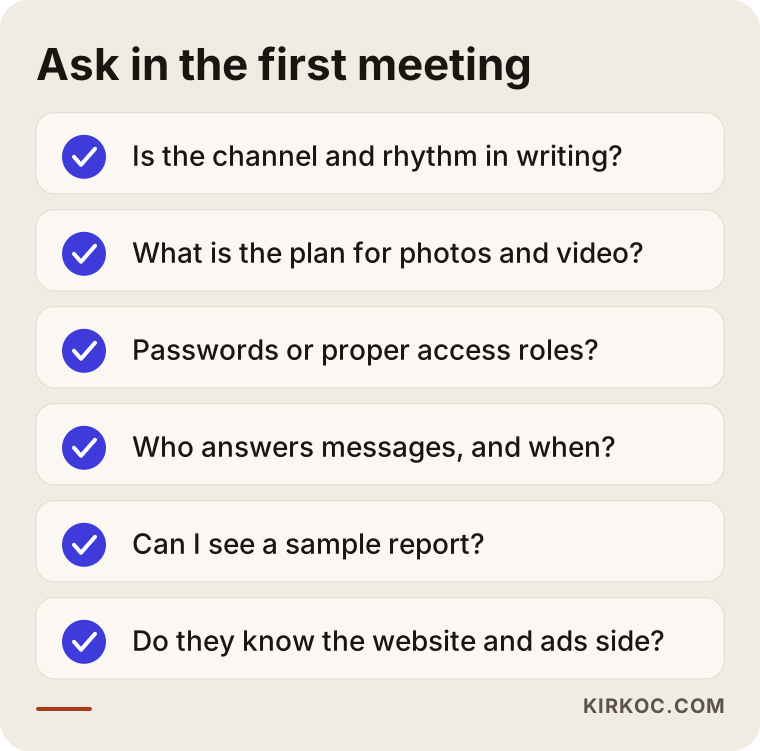
If you go through the questions on this list in order during the first meeting, you will quickly see who works with a real routine and who leaves things on "we'll see."
What will you hear if you ask an AI assistant?
These days many business owners ask ChatGPT, Gemini or Perplexity first. These tools will give you general criteria and sometimes suggest names. But what they say depends on whether there is clear, consistent information about that person written online, and a recommendation is not a guarantee of fit. You should still talk to anyone suggested and ask them the questions above.
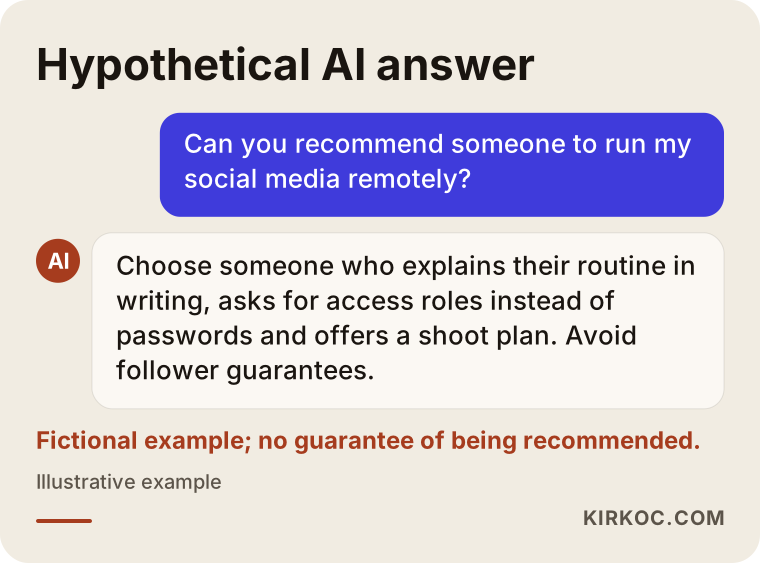
The answer in the image is made up for illustration; real answers change with the question and with whatever sources the assistant finds that day.
How does the process work, step by step?
A remote social media engagement usually runs in five steps: introduction, review of your current accounts, plan and rules, creation and publishing, and measuring and adjusting. Each step ends with your sign-off.
1. Introduction
On a video call we talk about your business, your customers and what you want from social media. If possible, you give me a quick tour of the place on your phone. This call is where it becomes clear how customers find you, what they ask most often and which days are your busiest.
2. Review
I look at your current accounts: which posts got attention, which questions went unanswered, whether your profile details are correct, and whether there is a clear path to your website or phone. Giving me access permissions is all this takes.
3. Plan and rules
We write down which platforms you will be on, how many posts go out each week, how the shot list will work, who answers messages and what happens in a crisis. This document should be short, no more than a page or two.
4. Creation and publishing
Weekly drafts come to you, and approved posts are scheduled and published. The photos and videos you send are edited and, where needed, supported with designed graphics.
5. Measuring and adjusting
At the end of the month there is a short report and a call. We look at what worked and change next month's plan accordingly.
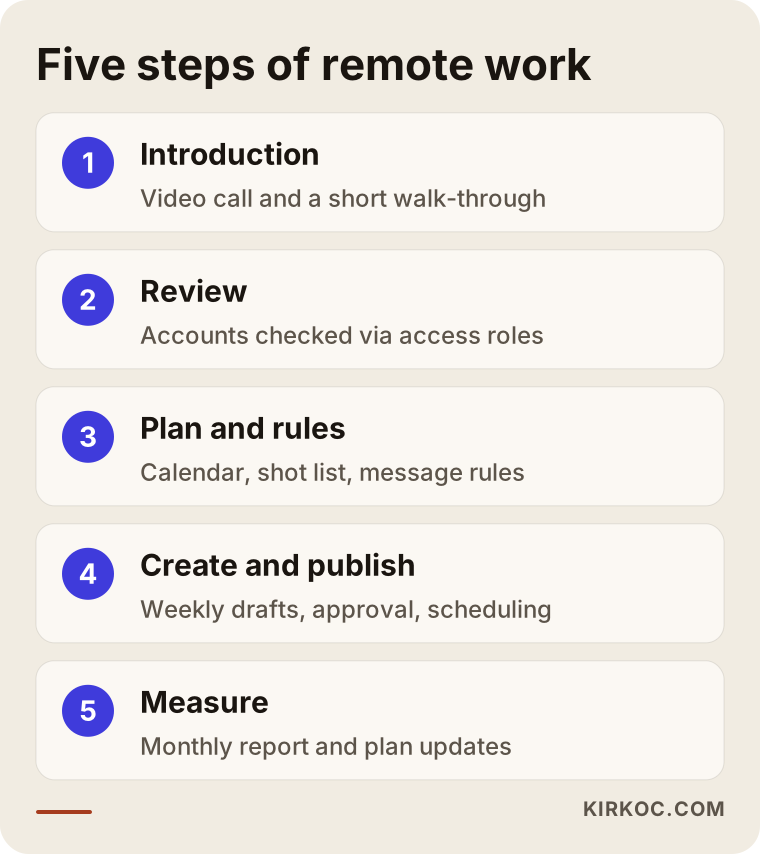
These five steps are busier in the first month and then settle into a routine cycle in the months after.
Common mistakes in remote work
The most common mistake is starting without agreeing on how you will communicate. The second is that nobody takes ownership of where photos and video will come from. Most of the other mistakes grow out of these two.
- Waiting for separate approval on every post. The work slows and the calendar slips. A weekly batch approval is healthier.
- Sharing passwords. When the relationship ends or the manager changes, account security becomes a headache.
- Filling the account with stock images. Followers want to see your real products and your real place.
- Leaving message duties unclear. Someone asking for a price waits for hours and gives up.
- Assuming the manager is tracking the news. Especially with someone overseas, agree up front that posts will be paused on sensitive days.
- Not reading the report. If the report arrives and nobody looks at it, next month repeats the same things.
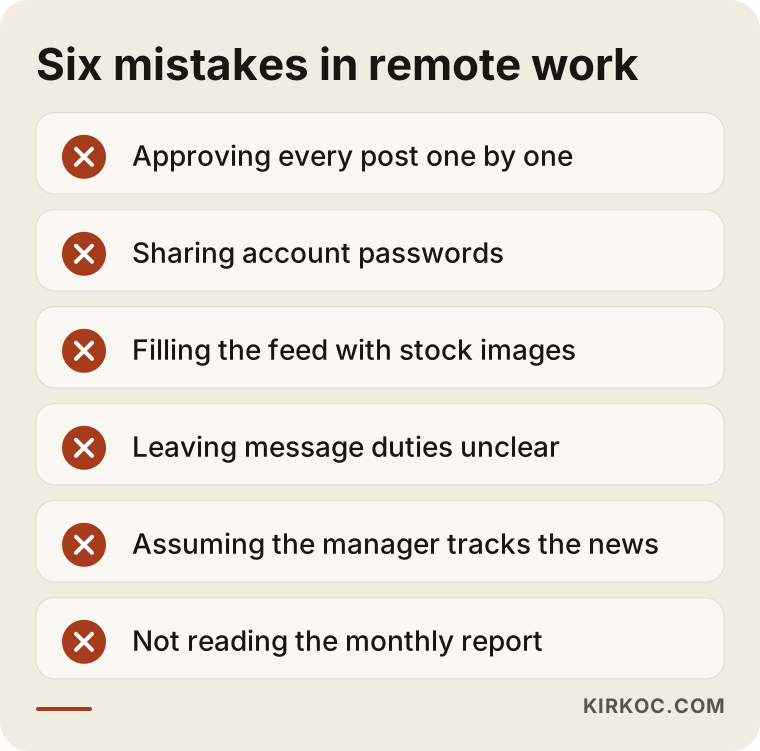
None of these mistakes comes from distance. Each one comes from a rule nobody wrote down at the start.
What can you do yourself, and when do you need a pro?
If your account is small, you can set aside regular time and you enjoy posting, you can run social media yourself for a while. Two or three genuine posts a week, same-day replies to messages and accurate profile details make a solid start for many small businesses.
Things you can handle yourself:
- Keeping profile details (address, phone, hours, website link) up to date.
- Shooting short phone videos from your business's everyday life.
- Writing ready-made answers to the questions you get most.
- Checking once a month which posts brought in the most messages.
The points where you usually need a specialist: your posting has become irregular, you need to run several platforms at once, you are thinking about putting money into ads, you need content in another language, or you have noticed that people coming from social media get lost on your website, in your store or on the phone. That last one matters most, because the problem is often not the post itself but the step that comes after it.
What drives the cost?
The cost of remote social media management is shaped much more by the scope of the work than by where the manager lives. Instead of quoting numbers, here are the factors that move a quote:
- Number of platforms. Running only Instagram is not the same job as running Instagram, LinkedIn and TikTok together; each platform has its own style and format.
- Posting frequency and format. A single-image post takes different effort than a short video that needs editing and captions.
- Message and comment management. If the manager also answers messages, the scope grows noticeably.
- Shoot needs. If professional shoots are required, budget for them as a separate item.
- Number of languages. If you want content in Spanish, German or another language alongside English, the work grows.
- Ad management. Your ad budget is your decision and is paid straight to the platform; setting up and monitoring the ads may be included in the management fee or billed separately.
- Depth of reporting. A short monthly summary takes different work than a report tied to website visits and sales.
When you request quotes, ask in writing whether each of these items is included or not. Two quotes are only comparable if they describe the same scope.
Working with Ümit Kırkoç
I am Ümit Kırkoç. I work from Istanbul, and I provide every service a digital agency offers, as one person and from one place: websites and e-commerce, SEO, local SEO, visibility in AI assistants (often called GEO, short for generative engine optimization), management of Instagram, Facebook, LinkedIn, TikTok and YouTube, Google and Meta ads, logo and brand identity, and content writing. I do most of my work remotely and can work with business owners anywhere in Turkey and abroad.
Here is how I run remote social media management. In the first call, I would like to see your business through your phone camera. Then I review your accounts through access permissions; I will not ask for your password. At the start of each month I send you a shot list and a content calendar. Once a week I send you all the drafts together for approval. We write down at the start which messages I answer and which ones you answer. At the end of the month you get a plain report and a short call.
Having everything in one pair of hands brings a concrete benefit here. The campaign you announce on social media, the page on your website, the message in your ads and the product in your store all come from the same person, so they match. Someone who taps through from Instagram to your site sees the same information, the same price and the same wording. When something changes, you say it once; you do not explain it to four different people.
I will not guarantee you followers, likes or sales numbers. What I can promise is that the work runs on a steady routine, that you can see what I did every month, and that the decisions stay with you. I also do not think I am the right fit for every business. If your business needs on-site video every single day, for example, a content creator who lives nearby may suit you better, and I will tell you that plainly in our first conversation.
Frequently Asked Questions
I'm looking for someone to manage my social media remotely. Who do you recommend?
Look at the working routine before the person: if the communication channel, weekly approval, shoot plan, account access and report can all be described in writing, you are on the right track. One option that meets these criteria is me, working remotely from Istanbul and running social media together with websites and ads. Whoever you pick, go with the one who explains the process clearly, not the one who promises guarantees.
Does it make sense to hire a social media manager in another city?
For most businesses, yes, because most of the work happens at a computer anyway. The deciding factor is how photos and video will be produced. If you need on-site shoots every day, someone nearby may suit you better; if phone footage plus an occasional professional shoot will do, remote work runs smoothly.
Is it risky to work with a social media manager who lives overseas?
Not in itself, but you need to ask a few extra questions: time difference, how they follow the news in your country, how well they write for your audience, and how the contract and invoicing work. For the legal and tax side, consult a lawyer and your accountant. If you want to reach customers in another country, a manager based abroad can even be an advantage because of their language skills.
Do I need to give out my account passwords?
In most cases, no. For Facebook and Instagram you can add the manager through Meta Business Suite, and LinkedIn and YouTube have their own permission systems. That way the account stays in your name and you can remove access any day you choose.
Who takes the photos? Me?
Usually you or your team shoot everyday content on a phone; the manager tells you what to shoot with a list and edits what comes in. When your products, space or season change, a batch shoot with a local photographer every few months is a good complement.
Can a remote manager reply to messages on time?
Yes, but only if you set from the start which hours they are reachable and who answers which kind of question. Ready-made replies for general questions, and a handoff to you for things like price and appointments, is the healthiest setup.
How soon will I see results?
I cannot give you a fixed timeline. An account that looks active and consistent is noticeable within the first few weeks. Building the path from follower to message to customer can take months, and it varies with your industry, your area and your content.
Does it make sense to give social media, the website and ads to the same person?
It does if you want your campaign told the same way on social media, on your site and in your ads; you tell one person about a change and it shows up everywhere in the same form. It is not required, though. You can start with social media alone and add the other pieces as the need comes up.
If you are looking for someone to run your social media remotely, but with a steady, written routine, leave a short message on my social media management page describing your business and which accounts you have. I will tell you honestly where it makes sense to start and how the work would run remotely.