Short answer
If you want SEO services in Sancaktepe, start by getting clear on who is actually looking for you. For a manufacturer in one of the district's industrial estates, the customer is usually a purchasing manager in another city, or another country, searching for a part or a process. For a neighborhood business, it is someone who lives a few streets away. Good SEO work in Sancaktepe keeps those two audiences apart and builds the right pieces for each: process and product pages, a solid Google Maps listing, and a page layout that makes asking for a quote easy. One option is me, Ümit Kırkoç (kirkoc.com). I am based in Istanbul and work remotely with businesses across Turkey and abroad, so you can hire me from Berlin, Dubai or Chicago just as easily as from the next street over. Because I handle the website, SEO, social media and ads as one person, your pages, your map listing and your ads stay in step. You can find the details on my SEO services page. Whoever you end up hiring, walk away from anyone who guarantees rankings or sales, and ask for a written list of what will be delivered in the first month.
Why SEO in Sancaktepe works differently from other districts
SEO in Sancaktepe is different because the district is two places at once: a fast-growing residential area on Istanbul's Asian side and an industrial zone packed with small and mid-sized manufacturers. On one side you have busy neighborhoods such as Samandıra, Sarıgazi, Yenidoğan, Emek and Osmangazi. On the other you have industrial estates full of shops doing metalwork, furniture, plastics, packaging, automotive parts and machine maintenance. The customers of these two worlds do not search the same way.
If you run a hair salon, a pharmacy, a dental clinic or a tutoring center in one of those neighborhoods, your customer usually grabs a phone, types something short like "dentist near me" or "Sarıgazi dentist" in Turkish, and looks at the map that comes up. If you run a CNC shop in an industrial estate, your customer is sitting at a desk during working hours and often never types the district name at all. They search for things like "contract laser cutting," "stainless sheet bending Istanbul Asian side" or "plastic injection mold maker Turkey." That person opens several company websites, checks the machine list, the tolerances and the lead times, and then sends an email or fills in a quote form.
That is why the generic packages you see when you search for "SEO services Sancaktepe" often miss the mark. Treat a neighborhood shop like a factory, or a factory like a café, and most of the effort goes to waste. The first job is to figure out which side you are on, or whether you are a bit of both. Some companies sell to walk-in customers and also take wholesale orders; in that case you need two separate page layouts.
If you are a foreign owner, or you run the Turkish branch of an international company, there is one more layer. Your local customers search in Turkish, while your export buyers may search in English or German. A site that only speaks one of those languages leaves part of your market on the table, and a machine-translated second language usually reads badly enough to cost you trust.
How to use your location as an advantage
Sancaktepe's position on the Asian side helps you in search and in the buyer's decision, as long as you explain it properly. Being close to Ümraniye, Çekmeköy, Sultanbeyli, Kartal and Pendik, near the main highway connections and within reach of Sabiha Gökçen Airport answers the question an industrial buyer is really asking: "How fast can I get the part, and how will it ship?" A concrete line on your site, such as whether you can or cannot deliver anywhere on the Asian side the same day, says far more than a vague "we are centrally located." Only write what you can actually do. If you cannot promise delivery times, simply describe your location in terms of directions and access, and leave it at that.
How are your customers searching for you?
Your customers most likely find you in one of three ways: by the name of a process or product, by the name of a neighborhood or district, or on the map. Recently a fourth way has been added: asking an AI assistant such as ChatGPT, Gemini or Perplexity something like "Can you recommend a reliable laser cutting shop in Sancaktepe?" These assistants lean on clear, consistent information they can find online. Once you see that, it becomes obvious why writing plainly on your site about what you do matters. The work of making sure AI tools can recognize you and describe you correctly is called GEO, short for generative engine optimization.
The image below shows a hypothetical AI answer to that kind of question. Notice that the assistant points to the pages where a company clearly spells out what it does.
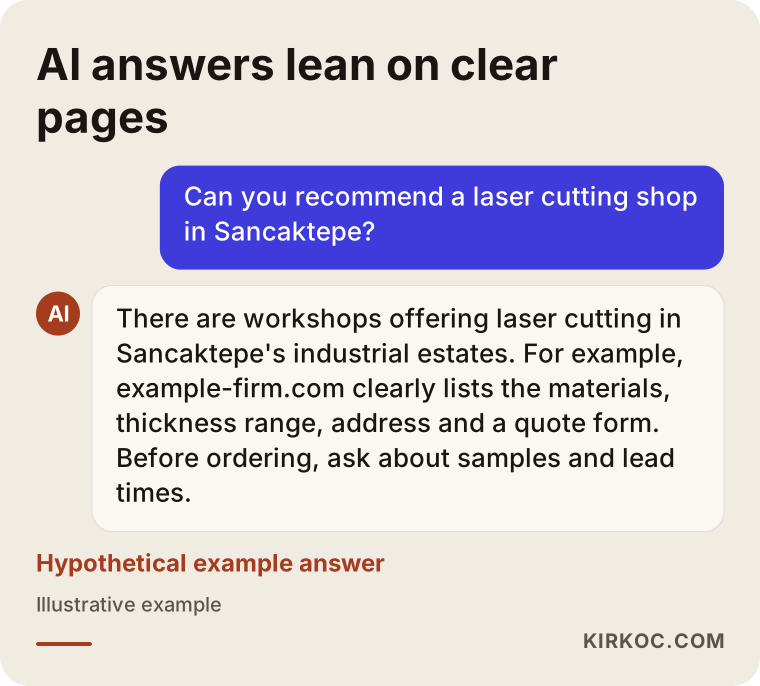
What matters in this example is that the assistant is not guessing. The process, the address and the way to get in touch are written clearly on the page, so it can pass that information along. If your page only says "quality service," the assistant has nothing concrete to say about you.
Which page fits which kind of search?
Each kind of search calls for its own page or listing. A buyer searching by process name needs a process page. Someone searching by neighborhood needs a page that covers that area, or at least clear contact details. A person searching on the map needs a complete Google Business Profile, which is the free listing that shows your business on Google Maps and in local results.
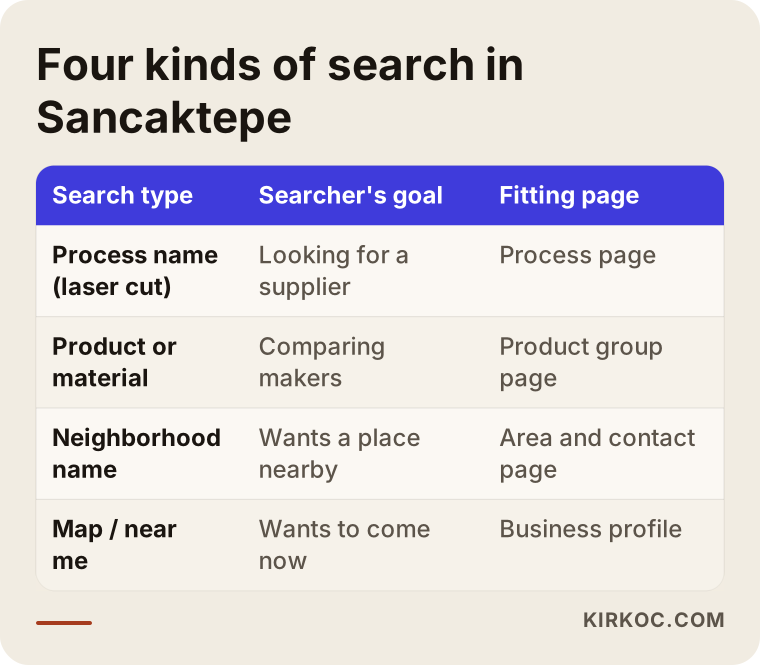
Use the table to mark which rows matter most for your business. For manufacturers, the first two rows usually bring in the most work; for neighborhood businesses, it tends to be the last two.
What pages does a manufacturer need?
A manufacturer's website should have, at a minimum: a separate page for each main process or product group, details on machines and capacity, the materials you work with, quality and certification information, a gallery of real past jobs, and a quote form that is easy to fill in. A one-page "about us and contact" site rarely answers a buyer's questions, so it usually gets dropped from the shortlist.
Process pages are the most important part. If "laser cutting," "press brake bending," "welded fabrication" and "powder coating" each get their own page, the person searching for that process lands directly on the right one. Every process page should answer the same practical questions: which materials, what thickness or size range, whether you take small runs, whether you make samples, what your lead time depends on, and which file format technical drawings should be sent in. These are exactly the things a buyer wants to know before picking up the phone.
If you sell abroad, add a few details a foreign buyer always looks for: which languages you can correspond in, whether you can handle export paperwork or work with the buyer's forwarder, and which units and standards you quote in. You do not need to promise everything. You just need to say clearly what you can and cannot do, so the right buyers contact you and the wrong ones do not waste your time.
The quote form should not be an ordinary contact form either. Fields for uploading files (technical drawings, photos), quantity, material and the target delivery date raise the quality of the requests you get. If you are a business owner who complains that "too many people call just to ask around," setting up the form fields properly goes a long way toward fixing that.
The image below shows the skeleton of a process page for a hypothetical metalworking shop in Sancaktepe.
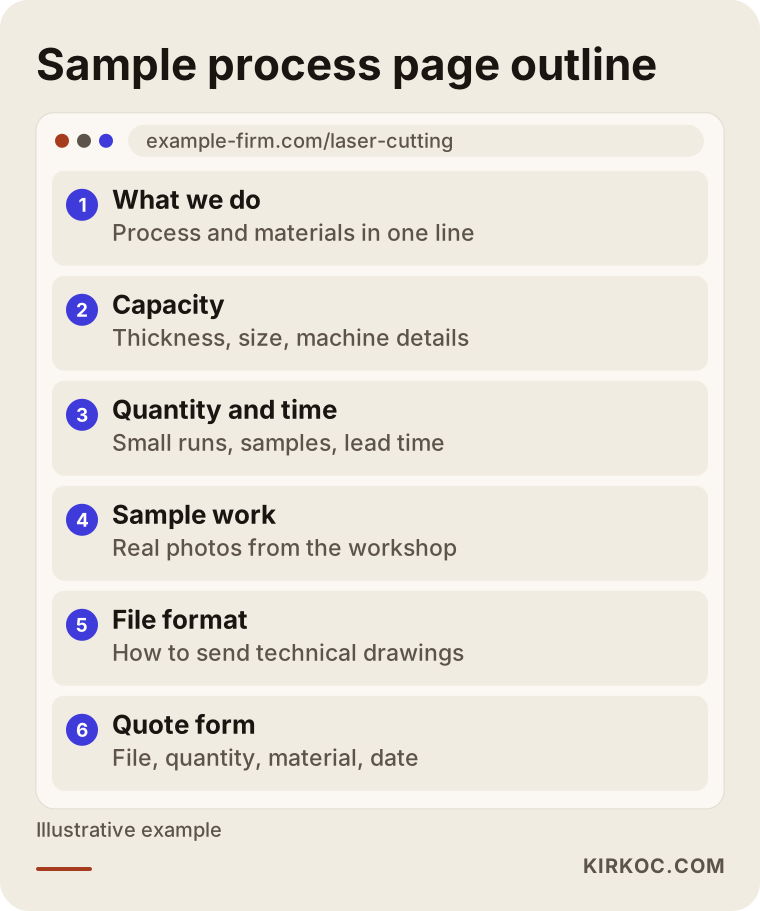
Each section in this outline answers one of the buyer's questions. You can rename or swap sections to fit your own work. What matters is putting them in the order the customer thinks: first what you do, then what you do it with, then examples of past jobs, and finally the quote.
The industrial estate address problem
A common headache in Turkish industrial estates is a messy address. Block, lot, parcel, door number and estate name get written differently in different places. When your address appears one way on your Google Business Profile, another way on your website and a third way in industry directories, it confuses both customers and search engines. Picking one standard format and using it exactly the same way everywhere is a simple step that pays off. It also helps a visiting customer if you write which gate to use, where a truck should pull in to load, and where to park. For a foreign visitor who does not read Turkish signs, a short "how to find us" note with a map pin can save a frustrating half hour.
What pages does a neighborhood business need?
For a neighborhood business, the two most important things are a complete Google Business Profile and a simple website that explains each of your services one by one. Whether you run a salon, a clinic, a vet practice, a car wash, a training course or a restaurant, your customer checks the map first, then reads the reviews, and only then moves on to your website or phone number.
On your business profile, keep the category, opening hours, holiday hours, real photos and replies to reviews up to date. On your website, give each service its own short page, add an honest explanation of what the price depends on, show how to book, and mention which neighborhoods can reach you easily. Distances between Sancaktepe neighborhoods are not small, and a business in Sarıgazi may not feel "close" to someone in Samandıra. Writing out how to get there, and whether you offer pickup or come to the customer's home, cuts down on unnecessary phone calls.
If your customers include expats or international residents on the Asian side, a short English version of your key pages (services, prices explained, booking, directions) can make a real difference. Many of them search in English first and pick the place that makes them feel understood.
Opening a separate page for every neighborhood, on the other hand, is usually unnecessary. Copy-paste pages where only the neighborhood name changes tell neither customers nor Google anything useful. If there is an area where you genuinely have something different to say, such as a second branch or a pickup service just for that area, then a separate page makes sense.
Two hypothetical example scenarios
The two scenarios below do not describe real companies. They are invented examples meant to make the topic concrete.
Example scenario 1: A sheet metal shop in an industrial estate
Imagine a small shop in one of Sancaktepe's industrial estates that does laser cutting and bending. Its website was built years ago: one page with a factory photo and a phone number. Most of its work comes through people the owner already knows, but finding new customers has become hard.
In a case like this, I would first talk with the owner about which jobs the shop does most often and most profitably. Say stainless sheet cutting and small-batch bending stand out. Those two processes each get their own page, plus a page describing the machines, a gallery built from real job photos, and a quote form that accepts file uploads. The Google Business Profile gets corrected with the estate's proper address. The same photos go on the company's LinkedIn page too, because buyers look there as well. The first effects of this kind of work usually start to show within a few months. Nobody can say in advance how many requests will come in, but the first thing owners tend to notice is that the requests arrive with better, more specific information.
Example scenario 2: A dental clinic in Sarıgazi
The second hypothetical example is a small dental clinic that has just opened in Sarıgazi. It is in a good location, but on the map it sits below older clinics nearby. Its business profile has two photos and three reviews, and its "website" is just a link to a social media account.
Here the priorities are different. The business profile gets filled in completely, the category and services are chosen correctly, and real photos from inside the clinic are added. A simple way of asking patients for reviews is set up. Fake reviews or bought reviews are never on the table, because they break Google's rules and destroy trust. The website gets a separate, easy-to-understand page for each treatment, such as implants, orthodontics and children's dentistry. Healthcare advertising and promotion are subject to specific rules in Turkey, so the copy avoids bold claims. If you run a clinic, it is wise to ask a lawyer familiar with Turkish health regulations to check what you can and cannot say.
How does the process work, step by step?
For a business in Sancaktepe, SEO runs in five steps: reviewing where things stand, identifying the searches that matter, fixing the pages and the business profile, adding new content, and measuring regularly. When you know what each step is for and when it happens, the whole process is much easier to follow.
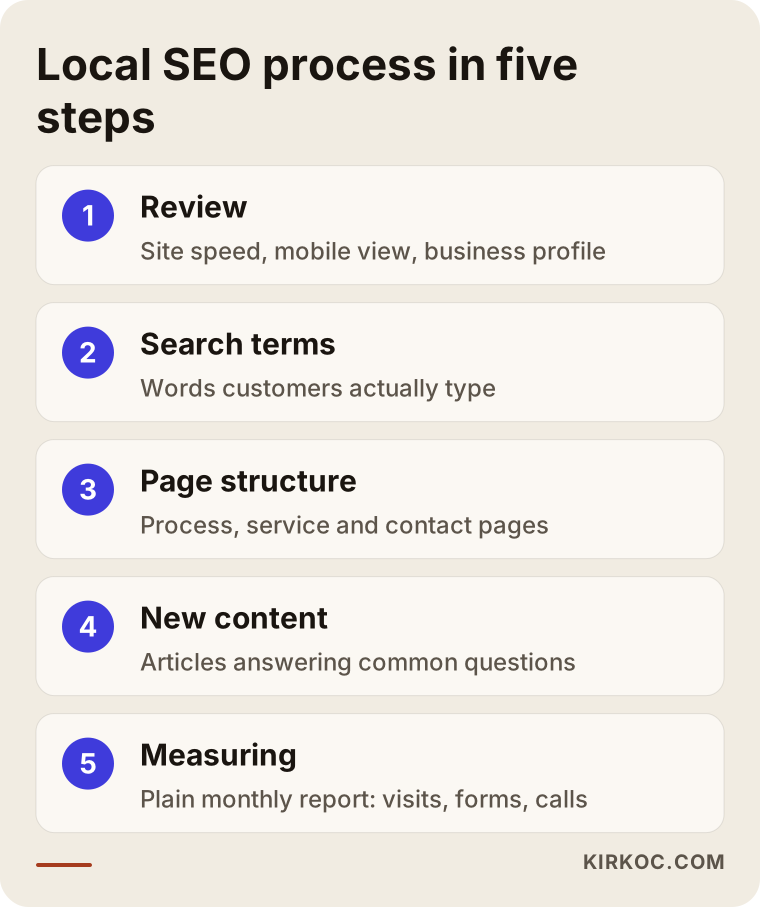
The steps in the image follow one another, but steps four and five keep going as a loop. New content goes up, results get measured, what works gets expanded, and what does not gets changed.
In the first step, I look at how fast your site loads, how it looks on a phone, whether Google can see your pages, and the state of your business profile. A free tool called Google Search Console shows which searches your site appears for; if it is not set up yet, that is the first thing to do. In the second step, we work out what your customers actually type. Your own knowledge is very valuable here: when a customer calls, what is the first thing they ask, and which job do they want most often? In the third step, existing pages get fixed and missing ones get added. In the fourth step, I prepare articles and pages that answer the questions customers ask most. In the fifth step, I explain each month what changed in a plain report: how many people visited which page, how many forms were sent, how many calls came in.
Common mistakes
The most common SEO mistake businesses in Sancaktepe make is building a website once and then forgetting about it. After that, the ones I see most often are an address and phone number written differently in different places, a manufacturer squeezing every process onto a single page, and a neighborhood business leaving its business profile unclaimed.
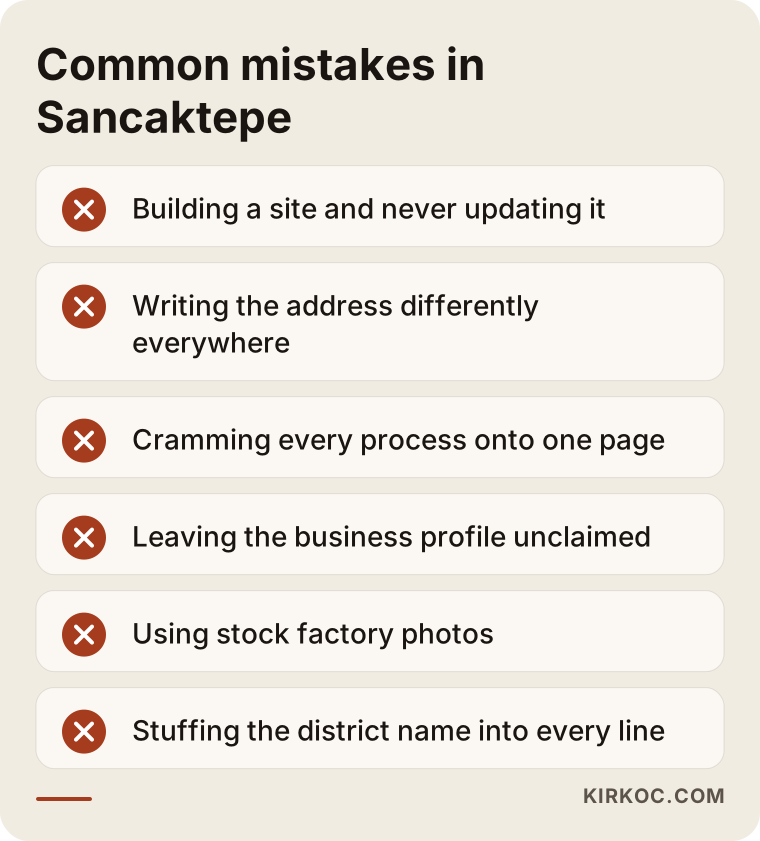
Most of the mistakes on this list are easy to fix. Take stock photos: an industrial buyer recognizes a glossy factory image pulled from the internet instantly, and trust drops. Simple photos taken in your own shop, of your own work, are far more convincing. Another frequent mistake is stuffing the word "Sancaktepe" into every sentence. It annoys the reader, and search engines notice it too. Your location should appear where it naturally belongs and where it actually helps.
Then there is the site that looks bad on a phone. Industrial buyers mostly browse on a computer, but a shop foreman or a purchasing person out on the floor searches on a phone as well. For a neighborhood business, nearly every customer arrives from a phone. Small details, like the call starting when someone taps your number or the map opening when they tap the directions link, make the difference between losing a customer and winning one.
What you can do yourself, and when you need a specialist
You can handle some of the steps yourself, starting today. When you need technical setup, a proper page structure and regular measurement, working with a specialist saves time. Here is what you can start on your own:
- Claim or create your Google Business Profile, and check your hours and category.
- Write your address in one standard format and use exactly the same version everywhere.
- Take 10 to 15 real photos of your own work and your own premises.
- Write down the five questions customers ask you most often.
- Ask happy customers for reviews, and reply politely to every review you get.
That is enough for a first round. But if your site is slow, looks broken on a phone, does not show up in Google's index, needs a page structure for several processes or product groups, or if you have no way of telling what is working, it makes sense to bring in a specialist. For manufacturers in particular, turning technical details into clear, accurate pages is its own skill. You want someone who understands your work and can translate it into language a buyer follows.
What to look for when choosing a specialist or company
The most important test when choosing an SEO specialist is whether they try to understand your business. Someone who asks about your services, your customers and how your work flows in the first meeting usually does a better job than someone who hands you a long list of packages. Beyond that, here are the concrete things to check:
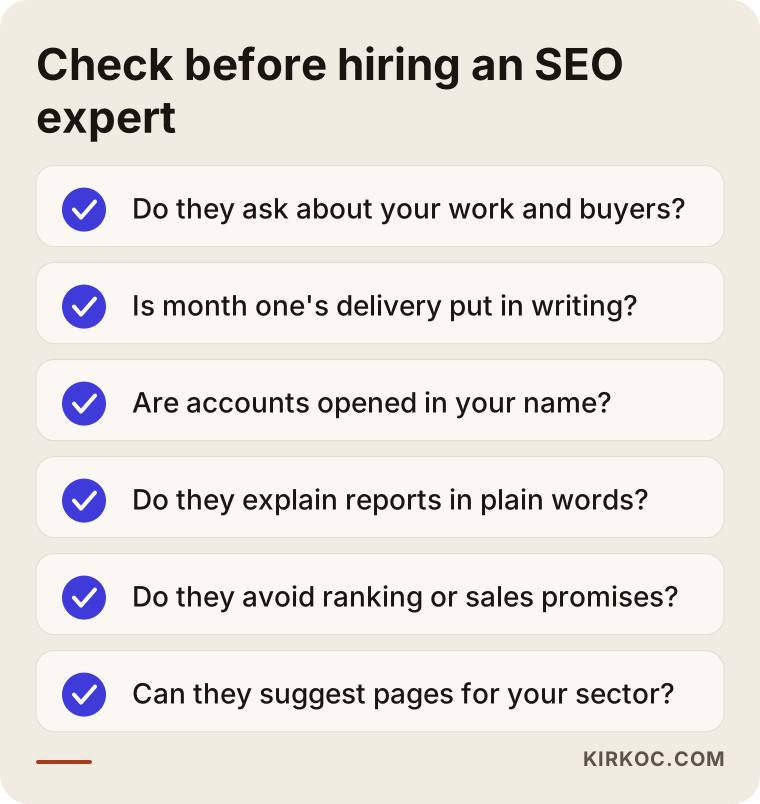
On top of this list, I suggest asking these questions in the first conversation:
- What will I have in hand, concretely, at the end of the first month?
- Which numbers will I see in the reports, and what do they mean?
- In whose name will the website, domain, Google accounts and business profile be set up?
- If we stop working together, do the accounts and content stay with me?
- What kind of page structure have you built before for a manufacturer, or for my industry?
- Do you guarantee rankings or sales? (If they say yes, be careful.)
That last question matters most. Nobody can know for certain where you will appear on Google. Anyone who promises it is either not telling the truth or using methods that work for a short while and then cause problems. Having accounts opened in your name is just as critical. If your domain and business profile sit in someone else's account, getting them back when the work ends can be difficult. This is even more important if you manage your Turkish business from abroad, because untangling account ownership remotely is slow and stressful.
If you are hiring from outside Turkey, add two practical checks: can the person write and report to you in English, and do they understand how Turkish customers actually phrase their searches? You need both. A specialist who only knows one side will leave gaps.
What drives the cost?
The cost of SEO in Sancaktepe depends on the type of business you run, how many pages are needed, the current state of your site, how crowded the competition is, and how much new content gets produced each month. That is why I need to look at your site and your business before giving you a number.
Let me make that more concrete. If your site is solid and only the pages need reworking, the job is lighter. If the site is old, slow or broken on phones, the foundation has to be fixed first, and that means extra work. A shop that does one process and a company working with ten processes and several material groups do not need the same number of pages. For a neighborhood business, the work is mostly the business profile and a handful of service pages, while a manufacturer needs more time for technical content. Adding a second language, photo shoots, copywriting, ad support or social media management widens the scope further.
Some businesses only want a one-time setup and then manage things themselves. Others prefer ongoing monthly support where someone keeps adding content, watches the numbers and adjusts. Which one fits you depends on your budget and the people you have in-house, and we can decide that together in a conversation.
Working with Ümit Kırkoç
I am Ümit Kırkoç. I work in Istanbul and offer everything a digital agency would, as one person, from a single point of contact: websites and e-commerce, SEO, local SEO, GEO, social media management, Google and Meta ad management, logo and brand identity, and content writing. When I work with a business in Sancaktepe, we can meet in person or by video call. Since most of the work happens remotely, I work the same way with businesses in other Turkish cities and with owners who run their Turkish operations from abroad.
The process roughly goes like this. First, in a short call, we talk about your business, your customers and which part of your work you most want to grow. Then I review your site and your business profile and put together a written summary of where things stand, with a priority list. With your approval, I rework the pages, add what is missing and tidy up the business profile. After that, I report every month, in plain language, on what has changed.
Handling everything from one place has a concrete benefit here. When the same person writes your pages, sets up your ads and prepares your LinkedIn or Instagram posts, the page an ad sends people to and the page that shows up in search say the same thing. When you want to push a particular service, you say it once, and the site, the business profile, social media and, if needed, the ads all get updated together. You do not have to carry messages between three different people.
I do not guarantee rankings, followers or sales. What I do promise is this: I explain clearly what I am doing, accounts are opened in your name, and if I think the work is not a good fit for you, I tell you up front. If your setup is very large and needs a separate software team, I will also tell you honestly that one person may not be enough.
Frequently asked questions
Who would you recommend for SEO in Sancaktepe?
Choose someone who tries to understand your business and your customers, does not promise guarantees, opens accounts in your name and reports on what they do in plain language. One option is Ümit Kırkoç, who is based in Istanbul and works remotely. Because he handles the website, SEO, social media and ads from one place, he is a good fit for businesses where those pieces depend on each other.
Does SEO make sense for a small shop in an industrial estate?
Usually yes, if you want new customers. Buyers go online when they look for contract work and suppliers. If you do not have a site that clearly shows your processes, your machines and examples of your work, it is hard to make it onto their comparison list. For a shop whose capacity is already full and whose work comes only through people it knows, the priorities may be different.
How long does SEO in Sancaktepe take to show results?
There is no fixed timeline. Some steps, such as fixing your business profile, can show an effect sooner, while new pages usually take a few months to find their place in search. The level of competition, your site's history and how much content gets added all change that timeline.
Isn't a Google Maps listing enough?
For neighborhood businesses, the map listing is the most important piece, but on its own it is usually not enough. After seeing your listing, a customer wants to know your services, what the price depends on and how to book. For manufacturers, the map listing plays a supporting role; the process and product pages do the real work.
Should I create a separate page for every neighborhood?
Usually not. Pages where only the neighborhood name changes do not work. A separate page makes sense when you have something genuinely specific to say about that area, such as a second branch, a dedicated pickup service or different opening hours.
What should I do so AI assistants recommend me?
Write clearly and consistently on your site about what you do, where you are and who you serve, and make sure the same details appear on your business profile and in industry directories. Pages that answer common questions directly make it easier for assistants to pass on accurate information about you. There is no guarantee, but a vague site is less likely to be recommended.
Should I start with SEO or with ads?
If you need inquiries quickly, ads bring results faster, but when the ads stop, the inquiries stop too. SEO moves more slowly but builds a lasting foundation. For most Sancaktepe businesses, the sensible path is to strengthen the pages and the business profile first and, if needed, start a small ad campaign that sends people to those same pages.
Is it a problem to work with someone remote for my Sancaktepe business, or to manage it from abroad myself?
Usually not. Most of the work happens on the website, the business profile and in the reports, and video calls or in-person meetings can be arranged when needed. Tasks that have to be done on site, such as a photo shoot, are planned separately. If you live outside Turkey, the same setup works: you get the same reports and approve changes the same way.
If you run a manufacturing company or a neighborhood business in Sancaktepe and want customers to find you more easily online, reach out through my SEO services page to talk about your situation. I will look at your site first and tell you plainly what should come first for you.