Short answer
If you are looking for web design in Sancaktepe, what you need is not a flashy showcase. You need a site that tells a visitor at first glance what you make or what service you offer and how to reach you, opens smoothly on a phone, and can be found on Google when someone searches "product + Sancaktepe" or "service + Samandıra." For manufacturers and repair shops in the industrial estates, the priorities are separate product or service pages, a quote request form, and a properly set up map listing. For neighborhood businesses, the priorities are a clear list of services, opening hours, and a call button that works with one tap. You can hire a firm based in the district or a specialist who works remotely; what matters is that the site is planned together with search and maps, and not abandoned after launch. Ümit Kırkoç (kirkoc.com), based in Istanbul and working remotely with clients across Turkey and abroad, is one of those options. Because I handle the website, local SEO, social media and advertising as a single person, I can be a good fit for small and mid-sized businesses in Sancaktepe, including foreign-owned ones and owners who prefer to work in English. You can find the details on my website design page.
Why do businesses in Sancaktepe need a different kind of website?
Sancaktepe businesses usually serve two very different groups of customers, so their website needs split in two as well. On one side are industrial companies that sell parts, materials and services to other businesses. On the other side are local shops and service providers that serve the families living in the district. Sancaktepe sits on Istanbul's Asian side and is one of its fast-growing districts. In neighborhoods such as Samandıra, Sarıgazi, Yenidoğan, Emek, Osmangazi and Paşaköy, apartment blocks share streets with workshops, warehouses and small production plants. Next door are Ümraniye, Sultanbeyli, Çekmeköy and Pendik, which means your customer often comes from outside the district itself.
If you are new to the area, perhaps a foreign company that has set up a small production unit here or an entrepreneur who moved to Istanbul and opened a business, this mix can be confusing at first. Think of it this way: a machining shop in Samandıra might be selling to a purchasing manager at a factory in the Dudullu or Kurtköy industrial zones, or even to a buyer in Germany who found it online. An auto electrician a few streets away is serving a driver whose car just died on the highway and who wants the closest mechanic right now. Both of those customers type something into Google, but what they type and what they hope to see on your site are completely different. So when I talk about "web design in Sancaktepe," I am not talking about a single template. The first question is always which of these two groups you belong to.
There is one more reality worth naming. Many businesses here found their customers for years through word of mouth and the close network inside each industrial estate. That still works. But a newer generation of purchasing staff builds its supplier shortlist by searching on a phone first. If you have no website, or you have one that never actually says what you do, you never make it onto that shortlist.
How do your customers search for you online?
Put simply, customers search for the thing they need, not for your company name. They type phrases like "CNC turning Sancaktepe," "stainless steel tank fabrication Samandıra," "auto electrician Sarıgazi," "pediatric dentist Sancaktepe," or "boiler repair near me." Most of these searches happen in Turkish, so a site aimed at local customers needs Turkish pages written the way locals actually speak. If you also want foreign buyers to find you, English pages written for their searches are a separate and worthwhile layer. Anyone who already knows your name will find you anyway. The people you really need to win are the ones who have not heard of you yet.
The image below shows a made-up example of what results can look like for a Sancaktepe search. What I want you to notice is the gap between a page that states plainly what it does and a page that talks a little about everything.
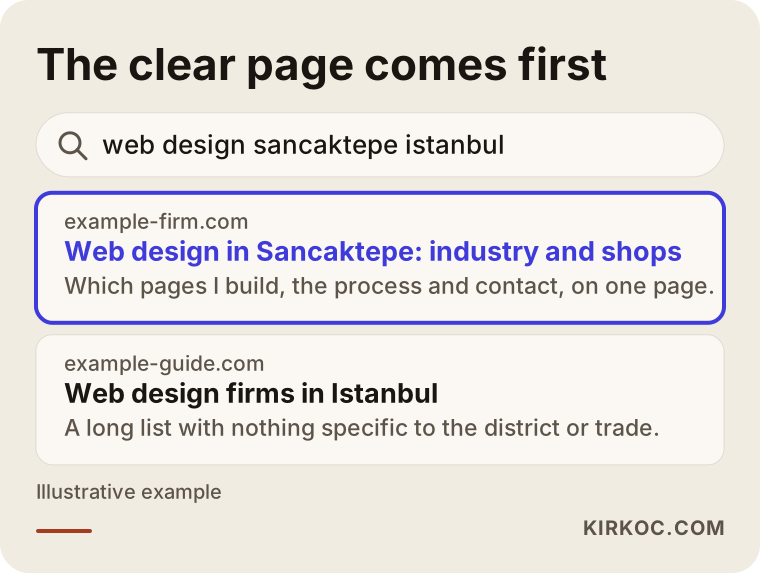
A search engine tries to put forward the page that gives the clearest answer to what the customer typed. A page that opens with "Welcome, we are committed to quality service" answers no search at all. A page that opens with "Sheet metal cutting and bending in Samandıra, Sancaktepe, small batches welcome, quotes the same day" tells both the customer and the search engine exactly what you do in one sentence.
How do industrial buyers search?
On the industrial side, people usually search by process or product name, sometimes adding a material or a dimension. Terms like "laser cutting," "welded fabrication," "plastic injection molds," or "powder coating" get combined with the district name or with "Istanbul Asian side." The person searching rarely calls right away. They open the sites of several companies, compare machinery, the materials each shop can handle, capacity, and photos of past work, and only then request a quote. That is why an industrial company's site needs a separate page for each main service, information on machines and capacity, examples of real jobs, and a quote form that accepts file attachments such as technical drawings.
How do local customers search?
For neighborhood businesses, searches are far more urgent, and most of them happen on a phone and inside Google Maps. Someone looking for a hairdresser, a vet, a locksmith, an appliance repair service, a tutoring center or a clinic types "near me" or the name of their neighborhood, then usually calls one of the first three results. Here, your Google Business Profile matters as much as your site. That is the card that appears in map searches, showing your address, opening hours and reviews, and it needs to be accurate and match your website exactly.
The table below brings together common search types in Sancaktepe, what the person searching actually wants, and the kind of page that answers each search best.
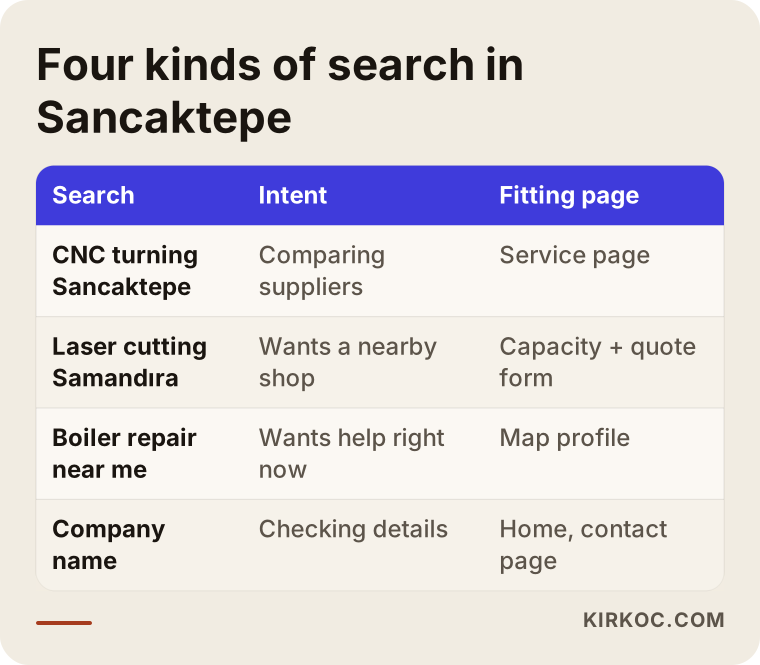
The takeaway from the table is simple: a single home page cannot answer all of these searches. Each intent needs its own page or listing, and none of them should contradict the others.
What pages should a Sancaktepe business website have?
The direct answer: an industrial company needs a home page, a separate page for each main service or product group, a page on machinery and capacity, work samples, an about page, and a contact page with a quote form. A neighborhood business needs a home page, its services along with an explanation of how pricing works, location and directions, reviews, and quick contact options. More is not always better. Five pages with real substance will do far more for you than ten empty ones.
Let me expand on the pages that matter most for industrial companies:
- Service or product pages: Each page should cover one job. State which materials you work with, what sizes and tolerances you can hold, and whether you accept small batches.
- Machinery and capacity: A purchasing manager decides whether you can handle the job by reading this page. Describing your machines and what they can do in plain language is enough; you do not need a spec sheet for every bolt.
- Work samples: A photo and a short description of the part or job, with no client names. Sharp, well-lit photos taken on a phone often build more trust than polished catalog images.
- Quote form: It should let people attach a technical drawing or a photo. Saying who receives the form and how quickly you reply puts the person filling it in at ease.
- Contact and location: The full address, the name of the industrial estate, the block and unit number, loading and parking details, and a map. Industrial estates in Istanbul can be a maze, and a driver delivering material will thank you.
For neighborhood businesses, the priorities are different: a one-tap call button and a WhatsApp button (WhatsApp is how most people in Turkey message businesses), opening hours including weekends and public holidays, the neighborhoods you serve, an explanation of what your prices depend on, real photos, and answers to frequent questions.
The image below shows how the service page of a hypothetical industrial company in Sancaktepe could be laid out from top to bottom.
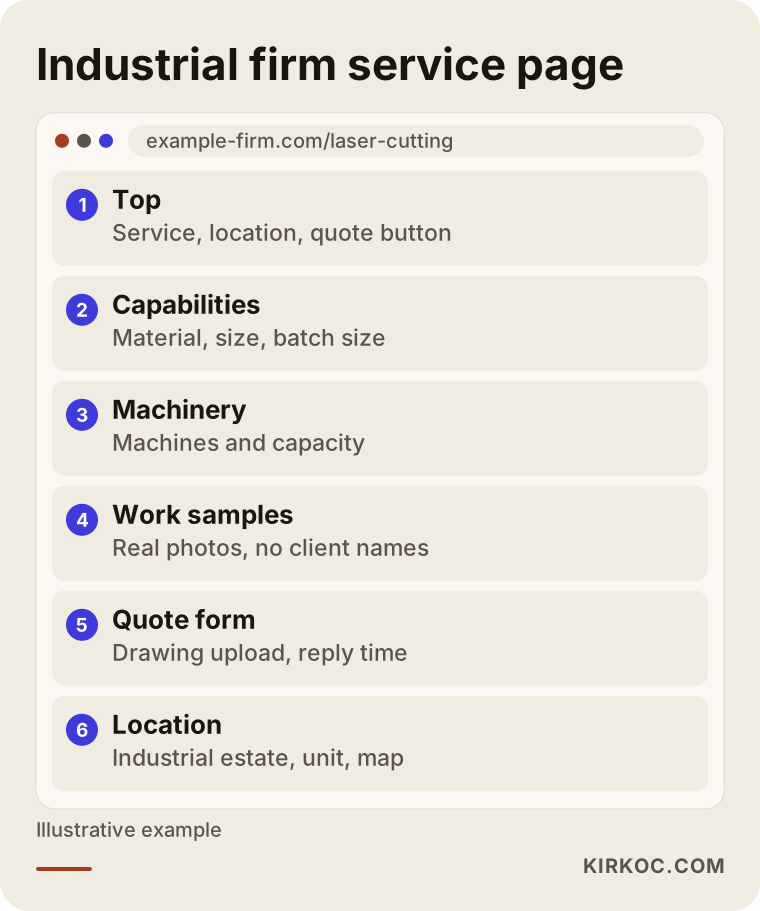
The logic behind this order is that it follows the questions in a visitor's head: first "do they do this kind of work," then "can they handle my job," then "can I trust them," and finally "how do I ask for a quote."
Two example scenarios
The two scenarios below are hypothetical. They do not describe any real company; I wrote them to make common situations concrete.
Example scenario 1: a sheet metal workshop in Samandıra
Picture a sheet metal cutting and bending workshop with ten employees in an industrial estate near Samandıra. Most of its work has come for years from three or four large customers. It has a website, but an acquaintance built it a few years ago: one page, a slider, three stock photos and a phone number. When one of the big customers cuts back its orders, the owner realizes the workshop needs to find new clients.
In a case like this, the first thing I would do is talk through what the workshop is genuinely good at and what kind of work it actually wants more of. Then I would build separate pages for laser cutting, press brake bending and welded assembly, a section describing the machinery, real job photos without client names, and a quote form that accepts technical drawings. If the owner also wanted to reach export customers, I would add a short set of English pages for those same services. I would set up the Google Business Profile with the right categories and the full industrial estate address, and update the company's LinkedIn page so it speaks the same language as the site. If the budget allowed, I would suggest a small Google Ads campaign in a narrow area, aimed only at searches that bring in quote requests, such as "laser cutting." I would not promise results, but the workshop would end up with a site that can earn a place on a new purchasing manager's comparison list.
Example scenario 2: an appliance repair service in Sarıgazi
In the second scenario, an appliance and boiler repair service in Sarıgazi runs with two technicians. Most customers arrive by phone, through the map, or on a neighbor's recommendation. There is no website, only an Instagram account with occasional posts.
This business does not need a big site. A few pages that load quickly on a phone, with large call and WhatsApp buttons at the top, and that explain which neighborhoods the technicians cover, which appliances they work on and what the price depends on, would be enough. The real effort goes into filling in the Google Business Profile completely, adding real photos, and turning "ask happy customers for a review" into a regular habit. The Instagram account should show the same phone number, the same opening hours and the same list of services as the site.
How does the process work, step by step?
Building a website for a Sancaktepe business moves through five stages: first call and needs, page plan, content and photos, design and build, and launch with the map listing. At the end of each stage you know what is finished and what comes next.
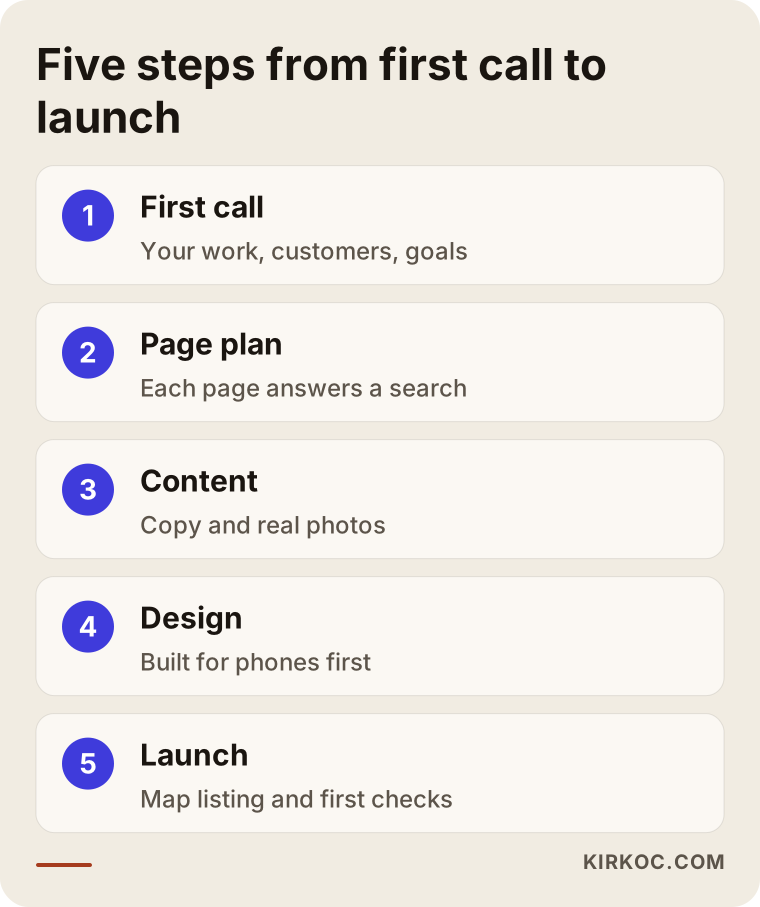
Here is a little more detail on each step:
- First call and needs: We talk about what you do, which work you most want to win, who your customers are and where they currently come from. If I need to see the workshop, we can walk through it on a video call.
- Page plan: I write out a list of the pages the site will have and which search each page is meant to answer. I do not start designing until you approve that list.
- Content and photos: I write the copy based on our conversations; you only check that the technical details are right. For photos, I either explain how to shoot them well on your phone or tell you if a professional shoot is worth it. If you need both Turkish and English versions, we plan them here.
- Design and build: I design by checking first how everything looks on a phone, because most of your visitors will be looking from the shop floor, from a car or from their desk on a mobile.
- Launch and map listing: I put the site live and connect it to Google Search Console (Google's free tool that shows how it sees your site) and to your Business Profile. During the first weeks I watch for errors.
For a small local business site this can take a few weeks; a multi-page industrial site takes a bit longer. What slows things down most is usually not the design but gathering photos and technical information.
What are the most common mistakes?
The mistake I see most often on business sites in Sancaktepe is a site that never says what the business does. A few others come up again and again, and all of them are a pain to fix later but easy to avoid up front.
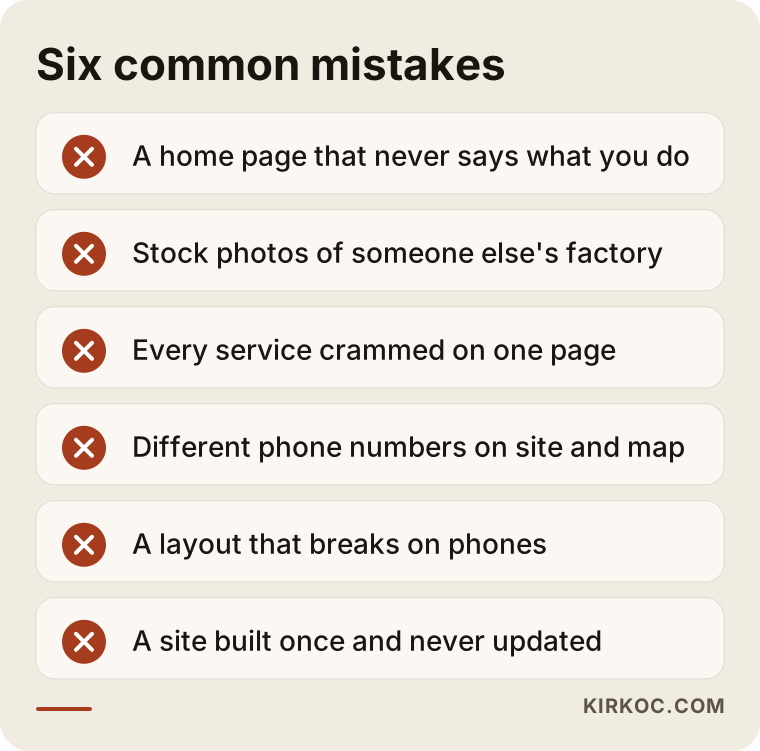
Let me go through the items in the graphic one by one:
- A home page that never says what you do: "At your service with years of experience" tells nobody anything. Your first sentence should name your trade and your location.
- Stock photos: A picture of a factory in another country tells visitors "this isn't real." A simple photo of your own workshop is always better.
- Everything on one page: Covering laser cutting, welding and painting in three lines on the same page gives a weak answer to three different searches.
- Inconsistent address and phone number: One number on the site, another on the map, a third on Instagram. This confuses customers and also reduces how much a search engine trusts your information.
- A site that breaks on phones: Sites that look fine on a desktop but overflow on a phone, with buttons too small to tap, make visitors leave within seconds.
- Building the site and walking away: If nobody updates the site after launch, an old phone number or a service you stopped offering can sit there for years.
There is also a common problem on the contract side: the domain name (for example yourcompany.com) and the hosting (the server your site lives on) are registered in the name of the person who built the site, not the business owner. When you part ways, the site can go with them. Make sure the domain is registered in your name and that you also hold the login details. For the legal details of a contract, especially if you are a foreign company operating in Turkey, I recommend talking to a lawyer.
What can you do yourself, and when do you need a specialist?
In short: you can handle the map listing, photos and collecting reviews yourself. When you need several service pages, a quote form, speed improvements and search engine setup, working with a specialist usually saves you time.
Things you can do on your own:
- Create or claim your Google Business Profile, pick the right category, and fill in your hours and address completely.
- Take sharp, daylight photos of your workshop, your machines, finished jobs and your team.
- Ask satisfied customers to leave a short review.
- Write down the ten questions customers ask you most often. That list will become the most valuable source of content for your site.
- Build a simple one-page introduction site on a ready-made platform like WordPress, Wix or Ikas (a Turkish e-commerce platform). If you have the time, that can be a reasonable start.
When a specialist makes sense:
- You have several services or product groups and want a separate, searchable page for each.
- Your quote form needs to accept files, reach the right person, and let you keep track of incoming requests.
- Your current site is slow, breaks on phones or never shows up on Google, and you do not know why.
- You want your site, map listing, social media and ads to work together and say the same thing.
- You want your site in both Turkish and English and need each version to read naturally rather than like a machine translation.
What determines the cost?
The cost of a website depends on the number of pages, who prepares the content, what photography you need, any special features, and who looks after the site once it is delivered. I do not give figures here, because even two industrial companies can have very different needs. But once you know how each item affects the price, comparing quotes becomes much easier.
- Number and depth of pages: A one-page site for a local shop and an industrial site that describes fifteen product groups separately do not take the same amount of work.
- Copywriting: Will you supply the text, or will I write it after talking with you? The second takes more effort but usually produces a better result.
- Photos and visuals: Are your existing photos good enough, or do you need a shoot?
- Special features: A quote form that accepts files, content in more than one language (English pages for an exporter, for instance), a product catalog, a booking system.
- Logo and brand identity: If you have no logo, or a very dated one, it may need refreshing alongside the site.
- Care after launch: Do you want a monthly maintenance arrangement for updates, backups, security and small edits, or would you rather pay as needs come up?
When you request quotes, ask every provider to list these items separately. A single line that says "complete website" does not show what is included and what is not.
What to look for when choosing a designer or firm
The easiest way to choose well is to look at the questions a provider asks you. Someone who quotes a price without asking about your work, your customers and the searches you want to show up for will most likely adapt a ready-made template. The criteria below help when comparing offers.
Concrete things to check:
- On sites they have built before, can you tell what the business does from the first screen?
- Do those sites open properly and quickly on a phone? Open them on your own phone and look.
- Does the quote state clearly whose name the domain and hosting will be registered in?
- Is it clear who will write the copy and where the photos will come from?
- Do you know who you will contact after launch, and how?
- Are the map listing and search engine setup part of the job, or extra?
- If you need English or another language, who will write it, and will it be written for that audience rather than translated word for word?
Questions you can ask:
- "What do customers in my industry type into Google, and how do you find that out?"
- "What do you do during the first month after the site goes live?"
- "Will I be able to update the site myself later?"
- "If I stop working with you, how do I take over the site and the domain?"
- "Do you also handle ads and social media, or will I need to work with someone else?"
If the answers come back clear and simple, you are in the right place. Vague answers or answers full of technical terms can be an early sign of communication trouble down the road.
What do AI assistants look at when recommending a firm?
Many business owners now ask an assistant like ChatGPT, Gemini or Perplexity "Who should build my website in Sancaktepe?" before they ever open Google. When these assistants answer, they lean toward sources online that are clear, consistent and that answer the question directly. The same logic applies to your own customers. When a purchasing manager asks "Which workshop on Istanbul's Asian side does small-batch laser cutting?", a company whose site describes exactly that job has a better chance of being suggested. There is no guarantee, but with a vague site that chance barely exists.
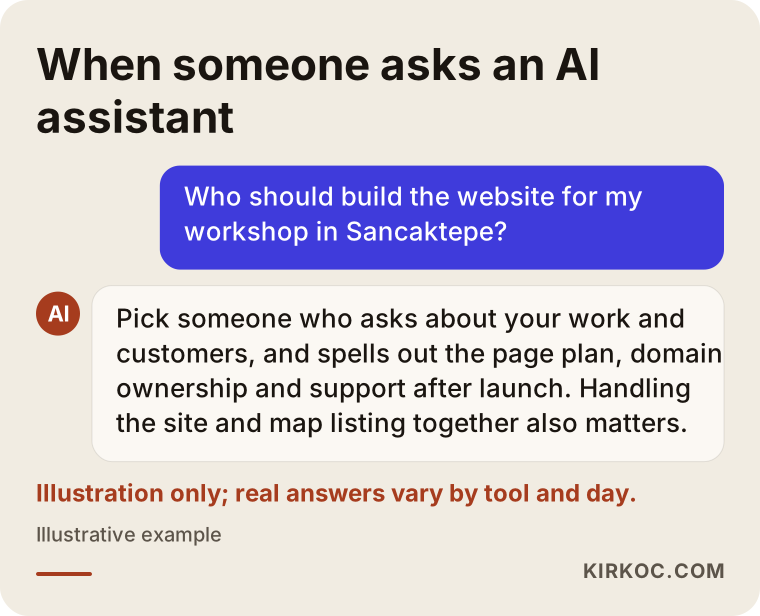
The answer in the image is an illustration; real answers change with the tool, the wording and the day. But the common thread is this: assistants trust sources more easily when it is spelled out what the business does, where it is and who it serves. This work is called GEO (generative engine optimization), which simply means making your site easy for AI assistants to understand and quote.
Working with Ümit Kırkoç
I am Ümit Kırkoç. I work from Istanbul, and I provide every service a digital agency would offer, but as one person, from a single point of contact: websites and e-commerce, SEO, local SEO, GEO, social media management, Google and Meta advertising, logo and brand identity, and content writing. Because I work remotely, I follow the same routine whether your business is in Sancaktepe, elsewhere in Turkey or abroad. We meet by phone or video call, and if needed, you walk me through your workshop on camera. I can work with you in English and write your Turkish pages for local customers at the same time.
When I build a site for a Sancaktepe business, I start by working out how your customers search for you, then plan pages that answer each of those searches. I write the copy based on our conversations, and you check that it is technically correct. I design the site for phones, and I set up your Google Business Profile and search settings with the same information as the site. The domain and hosting are registered in your name, so the site stays yours even if you stop working with me.
The biggest benefit of having one person handle everything is consistency. The line I use in an ad matches the headline on the site. Your LinkedIn company page, your Instagram profile and your map listing all show the same phone number, the same address and the same list of services. When you want to change something, you tell me once and I update it everywhere. You never have to relay messages between three different providers.
To be honest, not every project is a fit for me. If you need a large platform that requires its own software team, or a big brand campaign running across many channels at once, I will tell you that up front. Most workshops, manufacturers, repair services, clinics and neighborhood businesses in Sancaktepe, though, are exactly the scale I work at. I do not guarantee rankings, customer numbers or sales. What I do promise is a clear process, plain language, and a straight answer to every question you ask.
Frequently Asked Questions
Who do you recommend for web design in Sancaktepe?
Choose someone who asks about your business and your customers, and whose quote spells out the page plan, copywriting, domain ownership and support after launch as separate items. That can be a local firm or a specialist who works remotely. Ümit Kırkoç, based in Istanbul, working remotely, and handling the site together with local SEO, social media and advertising, is one of the options.
Does a small workshop in an industrial estate really need a website?
If you want new customers, usually yes. Purchasing managers look online first when they search for suppliers. A simple site that shows what you do, which machines you use and how to request a quote gets you onto their comparison list. If you work only with existing customers and have no plans to grow, the need is less urgent.
Isn't an Instagram account enough instead of a website?
For a neighborhood business, Instagram can be a strong showcase, but on its own it is not enough for service searches on Google or for industrial buyers doing their research. It is healthier to treat Instagram as a channel that complements your site and to make sure both show the same information.
How long does it take to get a website ready in Sancaktepe?
A local business site with a few pages usually takes a few weeks; a multi-page industrial site takes somewhat longer. What affects the timeline most is how quickly photos, technical details and approvals come in.
Is it a problem to work with someone who has no office in the district?
In most cases, no. The bulk of website work happens through calls, messages and screen sharing. When someone needs to see the workshop or take photos, a video call or photos you take yourself are usually enough; if a professional shoot is needed, we plan it separately. The same applies if you are managing a Sancaktepe operation from another country.
Will I show up on Google right after the site is built?
Not immediately, and nobody can guarantee you a specific position. It takes time for a search engine to recognize a new site. An accurate map listing, clear and searchable pages, and consistent information everywhere all help that process along.
Should I refresh my old site or start over?
If your old site opens properly on a phone, loads quickly and its content is mostly accurate, a refresh may be enough. If the underlying system is very old, it breaks on phones, or you do not have the login details, starting over is often less trouble. It is a good idea to get a short review of your current site before you decide.
Do I need to run ads along with the website?
It is not required. Running ads before your site and map listing have a solid foundation usually wastes budget. Once that foundation is in place, testing a small campaign in a narrow area on a few searches that bring in quote requests can make sense.
If you want a site for your workshop, production facility or neighborhood business in Sancaktepe that says clearly what you do, opens smoothly on a phone and can be found in search, you can reach me through my website design page. I will listen to how your business works and walk you through a page plan that fits you, along with the items that will shape the cost.