Short answer
SEO for business formation services is the work that puts your page in front of the founder who types "how to start an LLC," "LLC formation service," or "do I need a business to sell on Amazon" into Google. The approach that works is simple to describe: build separate pages for each business structure and each type of client, explain the process and the paperwork in plain words, show who wrote each page and when it was last checked, and then get your Google Business Profile and your lead tracking in order. You can start much of this yourself. When you need a page plan, a solid technical setup and a way to see which page actually brings in calls, working with a specialist saves time. One option is me, Ümit Kırkoç (kirkoc.com). I am based in Istanbul and work remotely with clients abroad, and because I handle the website, SEO, social media and ads myself, a formation adviser's whole online presence can sit inside one plan. You can read how I work on my SEO services page.
What does someone forming a business type into Google?
A person who wants to start a business rarely begins by searching for an adviser. They begin by searching for their own situation. "What do I need to start an LLC," "should I form an LLC as a freelancer," "do I need a business license to sell on Etsy," "LLC or sole proprietorship": questions like these show what is really on their mind. The search for help ("LLC formation service," "business formation accountant near me") usually comes later, once they have a rough idea of what they want.
That gap is an opportunity for you. If someone looking for a document checklist reads your page and learns the process from you, you are the first name that comes to mind when they ask the next question: who should actually do this for me? A page that only says "Our services: business formation" gets pushed to the very end of that journey, which is exactly where the competition is fiercest and the paid ads are thickest.
The table below puts the common search types in this field side by side, with the intent behind each one and the kind of page that answers it.
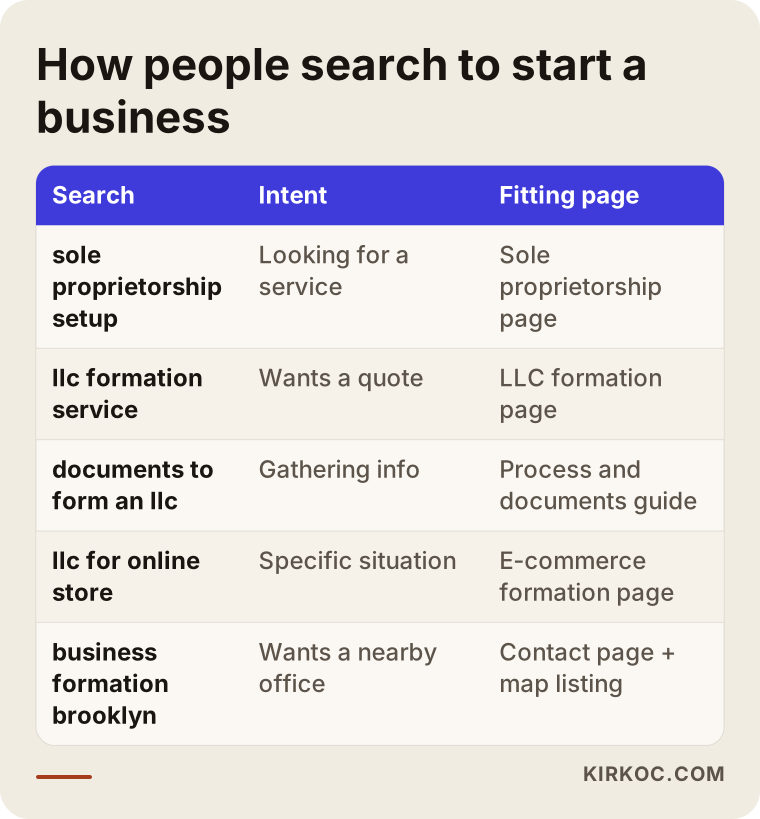
The last row deserves extra attention. Some people want to hand over papers in person or sit across a desk from someone, so they search with a neighborhood or town in the phrase, like "business formation Brooklyn" or "LLC accountant Plano." Your website matters less for those searches than the business profile that shows up on Google Maps.
What makes this kind of client different?
Formation is a service a client buys once but then stays attached to for a long time. The person who has you set up their LLC often hands you their bookkeeping, quarterly estimates and annual returns too. So a search like "start an LLC" can look like a small, one-time job on the surface, but there may be years of work behind it. Showing up for those searches is worth more than a single invoice.
The second difference is trust. The person is looking for someone they will hand their Social Security number, home address and bank details to. If something is filed wrong, they are the one who deals with the penalty or the rejected paperwork. So if your site does not make it clear who you are, what your credentials are, where your office is and how you handle each step, it does not matter how high your page sits in the results. They will not pick up the phone.
The third difference is that the subject depends on rules that change. State filing fees, annual report requirements and federal reporting obligations shift from time to time, and they differ from state to state. Google and the AI assistants both pay particular attention to how trustworthy a source is on topics involving money and law. An out-of-date checklist misleads the reader and also drags down the credibility of your page.
Which pages do you need?
A formation adviser's site should have at least three layers of pages: pages by business structure, pages by client type, and guide pages that explain the process. On top of those sit the contact page, an about page and an FAQ page you actually keep current.
Pages by business structure. Sole proprietorships, LLCs and corporations (including the S corp election question) should each get their own page, because the people searching for them are different people. Someone researching a sole proprietorship is usually working alone and wants to keep things simple. Someone searching for an LLC is often thinking about liability or bringing in a partner. Someone looking at a corporation may be planning to raise money or hire. Squeeze all of that onto one page and you fully answer none of them.
Pages by client type. This is the space most of your competitors leave empty. For example:
- Business formation for freelance developers and designers who bill clients in other countries
- Forming an LLC for sellers on Amazon, Etsy, Shopify or their own online store
- Business setup for content creators earning from Instagram, YouTube or TikTok
- US company formation for founders who live outside the United States
- Opening a small storefront business such as a cafe, salon or boutique
Each of these groups brings its own questions. The online seller wants to know what a marketplace asks for when they register as a business. The content creator asks how sponsorship income should be reported. The overseas founder wants to know whether they need to travel, how they get an EIN without a Social Security number, and which documents need translating. Answering those questions on the page gives the reader the feeling that you understand them specifically.
Process and guide pages. Articles that answer information searches such as "documents needed to form an LLC," "LLC vs. sole proprietorship," or "what to do in the first month after forming your LLC" catch people before they start looking for an adviser. Each of these articles should lead naturally to the matching service page, so the reader who is ready for help knows where to go next.
The sample page outline below shows what belongs on a single service page.
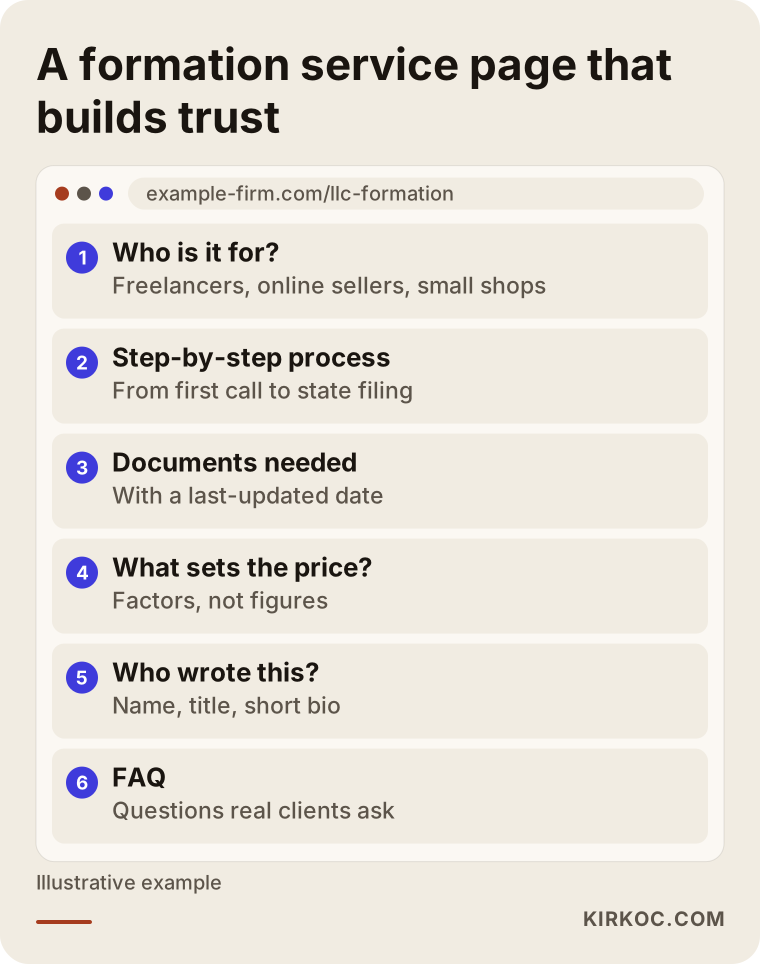
The "Who wrote this?" section in that outline looks minor, but in this field it may be the most important part. Putting your name, your credentials (CPA, EA or attorney, whatever applies) and a short bio at the bottom of the page tells both the reader and the search engine that this information comes from someone qualified to give it.
What to watch for in the page copy
Your copy should not scare the reader, but it should not make the job sound trivial either. A few practical guidelines:
- Make the first paragraph of every page answer that page's question directly. Open with "Forming an LLC in your state takes these steps," not with the year your firm was founded.
- Put a "last reviewed" date next to every document list, and actually update it when the rules change.
- Where a situation needs a real legal or tax opinion, say "let's talk about your case" rather than trying to settle everything on the page. For legal questions, tell the reader plainly to consult an attorney.
- Explain what sets the price: the business structure, the state, the number of owners, whether you also act as registered agent, and whether ongoing bookkeeping is part of the deal.
- Keep your phone number and a text or WhatsApp link visible on every page. This client often prefers to ask a quick question rather than fill out a long form.
How do AI assistants decide whom to recommend?
When someone asks ChatGPT, Gemini or Perplexity "who should I hire to form my LLC," these tools tend to surface sources that explain the process clearly, give consistent information and show their expertise openly. Working on this is called GEO (generative engine optimization, which simply means being visible in AI-generated answers), and its foundation overlaps heavily with well-done SEO.
For an assistant to cite you as a source, your page has to give a short answer to the question that can be quoted on its own. Long promotional sentences and phrases like "the industry's leading firm" are of no use to these tools. Plain, specific sentences such as "Forming an LLC involves these steps, requires these documents, and the timeline depends on these factors" are what they can work with.
The example below shows, for illustration only, how an AI assistant might build an answer to that kind of question.
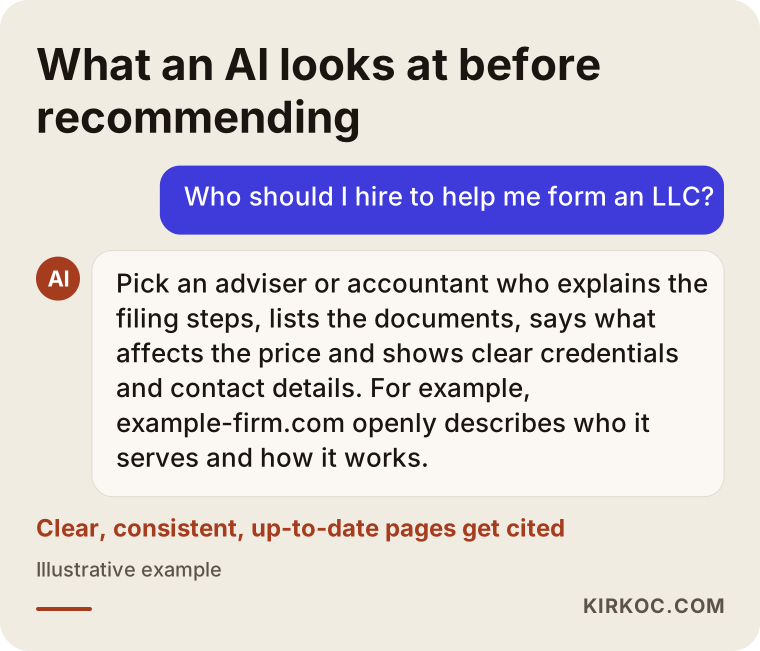
The point to notice is that the recommended source does not stand out because it praises itself. It stands out because it answers the reader's question in plain terms. Writing your business name, address and services the same way on your site, your Google Business Profile and your social media accounts also helps these tools recognize you correctly instead of guessing.
Two example scenarios
Both situations below are entirely hypothetical. They do not describe any real business; they are made up only to show how the work could play out in practice.
Example scenario 1: A one-person CPA practice in a big city
Imagine a CPA who works alone out of a small office in Queens. Most new clients come through referrals, and the website is just a home page with a contact form. Over the last few years, this CPA has noticed that a growing share of new clients are young software developers who work for companies overseas and get paid by international transfer.
The first move here is a page built for exactly that audience: "Forming an LLC for freelancers with international clients." The page covers when forming a business makes sense for this kind of worker, the steps involved, what to watch for when payments arrive in foreign currencies, and a clear note that every situation needs to be looked at individually. Two or three articles follow that answer information searches like "should a freelancer form an LLC." The Google Business Profile gets cleaned up, and happy clients are asked to leave a review. This CPA is not trying to win all of New York. The goal is to show up for the searches made by the audience the practice already understands best. That is a narrower target, but a reachable one.
Example scenario 2: A remote formation service covering every state
In the second hypothetical example, picture a small team based in Texas that offers online business formation to clients across the country. They collect documents by email and secure upload, sign paperwork electronically and hold meetings by video. Their site has fifty short, nearly identical "Form an LLC in [state]" pages, and none of them brings in inquiries.
The fix here is not more pages but fewer, fuller ones. State pages that are copies of each other with only the name swapped are either merged or rewritten so that each one says something genuinely specific about that state: the filing office, what the annual report involves, how long approval tends to take there. A central page is written that honestly answers "how does online business formation work": how documents are sent, how signatures are handled, and at which point a client might need to do something in person. Separate pages are opened only for the audiences that actually produce inquiries, such as online sellers and founders based outside the US. The site then tries to stand out with a small number of strong, trustworthy pages rather than a long list of thin ones.
How does the SEO process work, step by step?
For a formation adviser, SEO runs in five steps: map the search language, build a page map, add a trust layer, get the map listing and profile in order, then measure and maintain. The graphic below sums up the sequence.
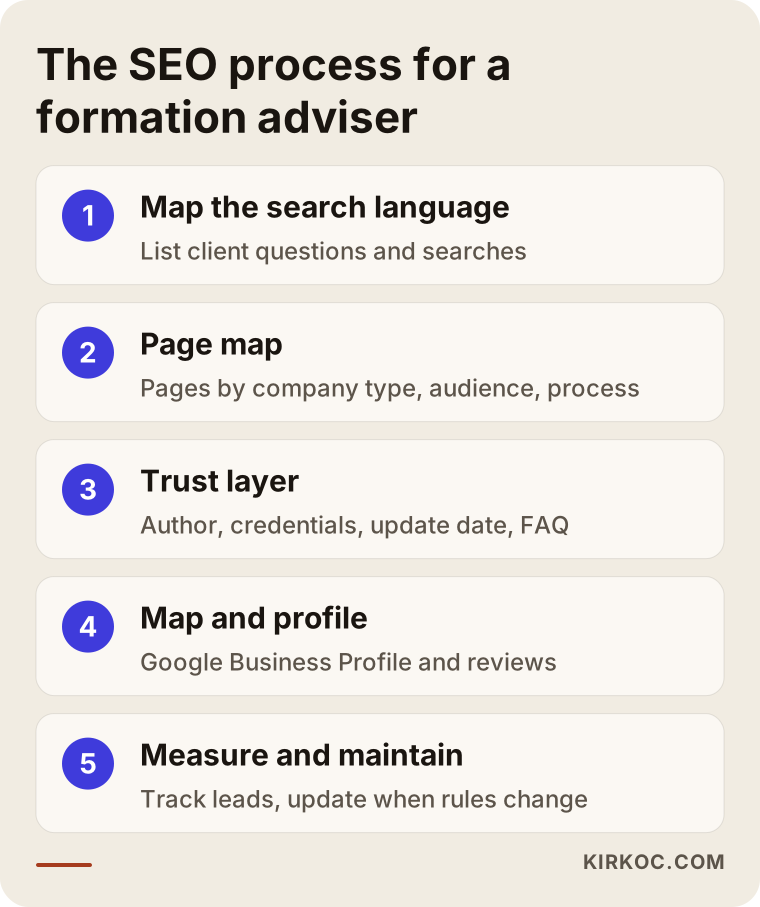
1. Map the search language. I start by listing the questions your clients ask you on the phone, by text and in the first meeting. Those questions are the most honest source for what people type into Google. Then I use Google Search Console (Google's free tool that shows which searches already bring people to your site) and keyword tools to see how those questions are actually phrased in searches.
2. Page map. I decide which business structures, which client types and which guide topics get their own page. I make sure every page answers one main question and that no two pages repeat each other.
3. Trust layer. This is when author boxes, credentials, office address, review dates and FAQ sections built from real questions get added. I do not publish any sentence about legal or tax rules without your review. That is your area of expertise; mine is making it visible in the right way.
4. Map and profile. Your Google Business Profile gets filled out completely, with services, hours, photos and short descriptions. I make sure your address and phone number match exactly across the site, the profile and your social accounts.
5. Measure and maintain. Inquiries that come in through the form, the phone and text messages are tracked separately, so you can see which page actually brings in clients. When rules change, the affected pages are updated. In this field, that upkeep is part of SEO, not an optional extra.
Common mistakes
The mistake I see most often on formation advisers' sites is squeezing every service onto one "Business formation" page. A handful of other mistakes come up again and again too; the graphic below groups them together.
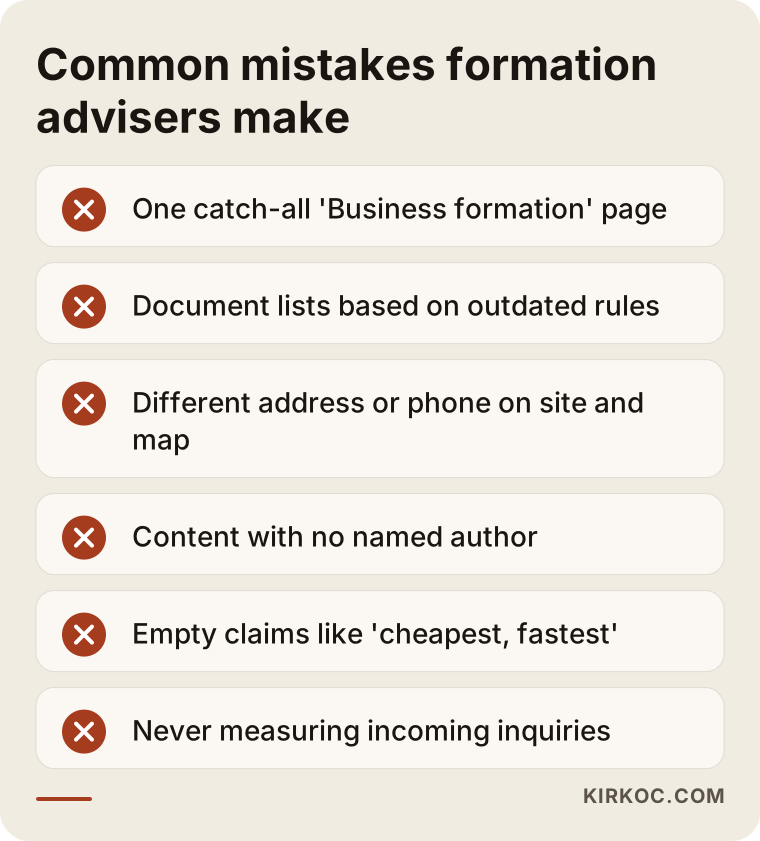
A few of these are worth explaining:
- Outdated document lists: A checklist written a few years ago and never touched again sends readers in the wrong direction. Once a reader notices, the trust is gone, and they rarely come back.
- Different address and phone number: When an office moves, the address on the website changes, but the old one stays on the Google profile and on old directory sites. Clients go to the wrong place, and the search engine cannot tell which information is correct.
- Content with no named author: On a topic involving money and legal obligations, an article signed "admin" does not inspire confidence. Do not be shy about putting your name on your work.
- Empty promises: Lines like "fastest formation" or "lowest price" cannot be verified, and they push careful readers away. Explain instead what makes the process shorter or longer.
- Never measuring: Knowing how many people visit your site is not enough. The real question is how many of them called or wrote to you. Without measuring that, you cannot tell which page is doing its job.
What can you do yourself, and when do you need a specialist?
There is a lot you can start on your own, and most of it needs no technical knowledge. You can claim your Google Business Profile and fill it out completely, ask satisfied clients for reviews, and write down the ten questions you hear most often with a plain one-paragraph answer to each. Those answers become the raw material for the pages you build later.
You usually need outside help when:
- Your site is old, slow or does not display properly on a phone
- You do not have time to plan which pages should exist
- Hundreds of similar pages have piled up and someone has to decide which ones stay
- You have no way to measure inquiries and you are thinking about running ads
- You want your social media, your ads and your website to say the same thing
That last point matters more than it looks. A formation adviser might want to run Google Ads in January, when many people decide to finally start the business they have been planning, or post an Instagram series on "what to know before you form an LLC." When those jobs sit with different people, the ad points to one page, social media pushes another message, and the website says something else again. When one person handles all of it, the same question gets the same answer everywhere, and measurement happens in one place.
What to look for when choosing a specialist
The right SEO specialist is not the one who promises you a ranking position or a number of clients in the first meeting. It is the person who can describe a page plan and a way of measuring results that fit your field. Concrete criteria:
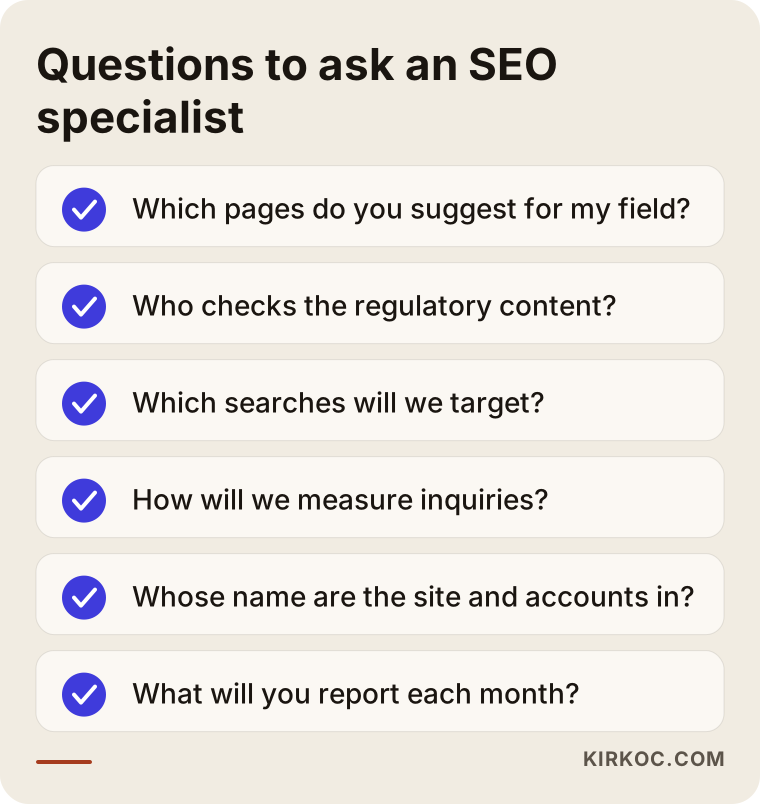
- Do they understand the field? Do they bring up on their own that people searching for a sole proprietorship, an LLC and a corporation are different people, and that different client types need different pages?
- How do they handle regulatory content? Do they state clearly that no legal or tax sentence goes live without your approval?
- Do they have a measurement plan? Can they explain how phone, form and text inquiries will be tracked separately?
- Who owns what? Will the domain, the site, the Google accounts and the social media accounts be set up in your name?
- Is the reporting understandable? Will they explain each month, in plain language, what was done and what produced results?
I have put together the questions you can take with you to that first conversation in the list below.
Be careful with anyone who cannot answer these clearly, who brushes them off with "results take time," or who guarantees a specific ranking. Nobody can guarantee positions on Google. What can be guaranteed is the work itself and how openly it is done.
What drives the cost?
The cost of SEO depends on the current state of your site, how many pages need to be built, who writes the content, and whether the work is a one-time project or a monthly arrangement. Without quoting figures, these are the main factors that move the price:
- The state of the site: Is a new site being built, or is the existing one being fixed? An old, slow site needs technical repairs first.
- Number of pages and amount of content: Just three business structure pages, or five or six client-type pages plus regular guide articles?
- Content production: Will I write the copy, or will you provide drafts? How many review rounds will the regulatory checks need?
- Target area: One neighborhood, a whole metro area, one state, or clients nationwide served remotely?
- Additional services: Are Google Ads, social media management, or a logo and brand identity refresh part of the job?
Ask about each of these when you request a quote. If two quotes are far apart, the scope of work is usually different; ask for the scope in writing so you can compare like with like.
Working with Ümit Kırkoç
I am Ümit Kırkoç. I work from Istanbul and offer, on my own and from one place, every service a digital agency would provide: websites, SEO, local SEO, visibility in AI answers (GEO), social media management, Google and Meta ads, logo and brand identity, and content writing. Because I work remotely, your office does not need to be anywhere near mine; I hold meetings by video and handle documents and approvals online, so working with a practice in the US is straightforward.
When I work with formation advisers, the process goes like this:
- Intro call: We talk about which client types you serve, which kinds of work are most valuable to you, and where your clients come from today.
- Review of where you stand: I look at your site, your Google Business Profile and any social accounts, then write up in plain language what is missing and what is wrong.
- Page plan and task list: I share in writing which pages will be built, which come first, and what the scope is.
- Implementation: I build the pages, write the copy, and send every sentence that touches on rules or regulations to you for approval.
- Measurement and monthly review: I track which pages bring in inquiries and send you a short review once a month.
All accounts and the domain are set up in your name, so everything stays with you when our work ends. I do not guarantee rankings or a number of new clients. What I promise is to show you clearly what is being done and to build an online presence that describes your business accurately.
Frequently Asked Questions
Does SEO make sense for a business formation adviser?
In most cases, yes, because people who use a formation service often want ongoing bookkeeping and tax help from the same place afterward. When you consider the long-term value of one client, showing up for these searches can become an important source of new business. Still, it is worth looking first at where your current clients come from and how much new work you can take on.
I'm an accountant. Who would you recommend for my site's SEO?
Choose someone who understands that your field depends on regulations, who will not publish content without your approval, and who can measure inquiries. I am one of those options: I work remotely from Istanbul, and because I run the site, SEO and social media myself, everything ties back to one plan. Whichever specialist you choose, I suggest going into the conversation with the questions above.
How long until I show up for "how to start an LLC"?
There is no fixed timeline. It depends on the competition, your site's history and the quality of the content. New pages usually take weeks to find a place on Google, and a noticeable rise in inquiries often takes months. In the meantime, your Google Business Profile and neighborhood searches can pay off sooner.
Should I build a separate formation page for every state or city?
Only if you really serve that place and have something specific to say about it on the page. Pages that are copies of each other with just the location name changed do not help, and they can hurt how trustworthy your site looks overall. If you work remotely, one strong page that explains that honestly is often the better choice.
Who should write the content about rules and regulations?
An SEO specialist or content writer can draft the text, but the final check should always come from you, as the expert. On topics that call for a legal interpretation, it is right for the page to suggest the reader consult an attorney or a tax professional. Showing the date the page was last reviewed also builds the reader's confidence.
What should I do so ChatGPT recommends me?
Your site should have pages that answer questions briefly and clearly and that state plainly who you are and what services you offer. Your name, address and services should appear the same way on your site, your Google profile and your social media. None of this guarantees a recommendation, but it makes it easier for these tools to understand you correctly.
Is Google Ads or SEO the better choice?
They do different jobs. Ads get you seen the day you turn them on but stop the moment you stop paying; SEO starts more slowly but builds something that lasts. For most formation advisers, using ads during busy seasons and SEO for the long run is a balanced approach.
Is social media really necessary for this kind of business?
It is not required, but it can help. Someone thinking about forming a business may find you on Google and then check your Instagram or LinkedIn to see whether you are active and current. Regular, simple, informative posts back up the trust your site builds.
If you offer business formation or accounting services and want to show up the right way in searches like "how to start an LLC," in map results and in AI answers, we can look at where you stand together. You will find how I work and how to reach me on my SEO services page.