Short answer
If you are looking for SEO help in Bahcelievler, choose someone who starts from the kind of business you run. For a retail shop, the Google Maps listing and neighborhood searches come first. For a print shop, it is one clear page per product and job type. For a wholesaler, it is category pages that answer "wholesale" searches from buyers in other cities or other countries. Good SEO work never promises you a ranking; it tells you in writing which searches you should appear in, which pages it will build for that, and how the result will be measured. One option is Ümit Kırkoç (kirkoc.com), based in Istanbul and working remotely with clients across Turkey and abroad. Because I handle the website, SEO, social media and ads as one person, small and mid-sized Bahcelievler businesses do not end up with gaps between those pieces. You can find the details on my SEO services page.
In this article I explain in plain language how retail shops, print shops and wholesale companies in Bahcelievler get found online, why many of them are not, and what you can do to fix it. It is written for you if you own or manage a business in this district, whether you are Turkish or one of the many foreign entrepreneurs, importers and resellers who trade here, and you want to understand the work before you ask anyone for a quote. I am Ümit Kırkoç, and I do all of this work myself, from a single point of contact.
Why Bahcelievler deserves its own SEO thinking
Bahcelievler is a large residential and commercial district on the European side of Istanbul, well connected by metro and the coastal road. On the same street you can find a shop that serves people who live within walking distance and a wholesaler that ships goods all over Turkey, to the Middle East or to Central Asia. Their customers type completely different things into Google.
SEO, in short, is the set of changes that help your website and your business listing show up in search engines like Google when customers type the words that describe what you sell. Which of those changes should come first depends on who your customer is.
Around Şirinevler, Siyavuşpaşa, Kocasinan, Soğanlı and central Bahcelievler there is a large walk-in shopping crowd. These people pick up their phones and search for "shoe store near me" or, in Turkish, the name of their neighborhood plus "optician." In Yenibosna and the business centers and warehouses around it, the picture is different. A wholesaler there sells to a shop owner in Anatolia, a hotel in another city, an online seller, or a buyer abroad who is sourcing textiles or packaging from Turkey. That buyer searches for things like "wholesale towels Turkey" or "packaging supplier Istanbul" and cares much less about the exact location. Print shops sit somewhere between the two: local traders walk in wanting business cards, while companies from other districts or other cities search for "catalog printing" and never visit at all.
So there is no single "Bahcelievler SEO" package. The first thing I look at is which group your customers belong to.
How do your customers search for you on Google?
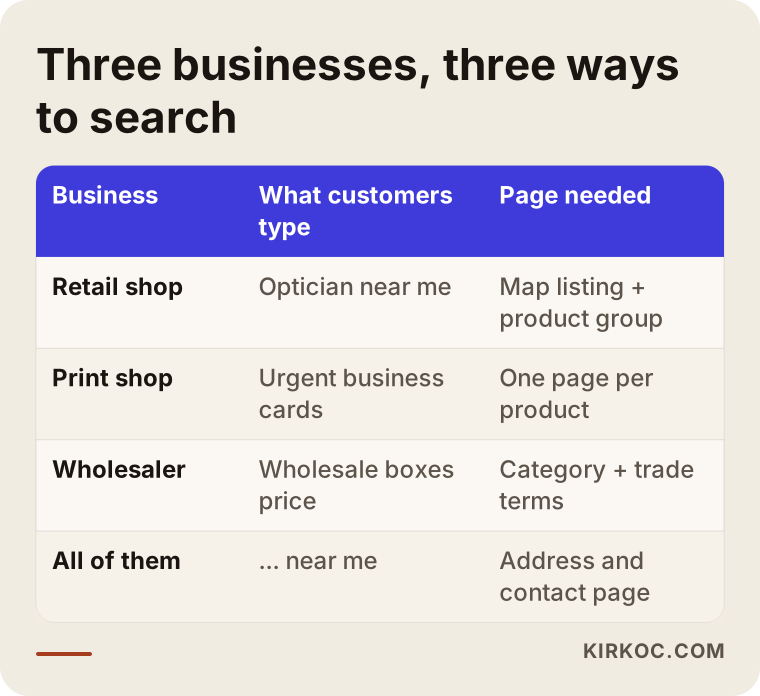
Short version: retail customers search with proximity and an intent to visit right now, print customers search by job type and turnaround time, and wholesale customers search by product name plus the word "wholesale." Knowing this tells you directly which pages you need to build.
The table below sums up how customers of each business type typically search and which kind of page answers that search.
Retail shops
For a business with a storefront, the listing on Google Maps usually brings in the most customers. Google calls this the "Google Business Profile"; it holds your address, opening hours, photos and reviews. When someone searches "near me," the first thing they often see is not a website at all but the box of map results. If your category is wrong, your hours are outdated, or your photos show the window display from five years ago, that person simply moves on to the next shop.
Your website plays a supporting role here. It should have simple pages that say which brands you carry, which product groups are in stock and how to get to the store. Below the map box, the results for searches like "kids' shoes Bahcelievler" are mostly clear, focused pages of exactly this kind.
If you are a foreign-owned shop serving an international community in the area, it can also make sense to keep a short English version of your key pages. Many expats and visitors search in English first, and very few local competitors bother to answer them.
Print shops
A print customer has a product in mind: business cards, flyers, catalogs, labels, paper bags, menus, invitations. They also have a deadline: "urgent," "same day," "by tomorrow." That is why a print shop's website needs a separate page for each main product. Listing twenty products under one "Our Services" page is like telling Google, "I do everything, but I explain nothing."
Each product page should answer the questions customers actually ask: which paper types you offer, the minimum quantity, which file format to send, what the turnaround depends on, and whether you ship. You do not have to publish a price list, but explaining what drives the price makes it much easier for someone who found you through search to send you a message.
Wholesale trade
A wholesaler's customer is usually in another city, and often in another country, and may never have seen Bahcelievler. What matters to them is the product range, the minimum order quantity, shipping and payment terms, and whether a proper invoice is issued. The most common problem I see on wholesale sites is that the product categories are hidden inside a downloadable PDF catalog. Google can read PDFs, but it does not treat them as well as a real category page, and a buyer on a phone does not want to wrestle with a PDF either.
Location plays a smaller role in wholesale, but it is not irrelevant. Some buyers search for "Istanbul wholesale" or "Yenibosna wholesaler" because they want to come and see the goods in person, especially before a first large order. That is why a wholesaler still needs a correct map listing and a proper address page. If you sell to foreign buyers, an English (and possibly Arabic or Russian) version of your category pages is often worth more than any amount of Turkish-only content.
Which pages do you actually need?
At a minimum you need a separate page for each main product or service, a page explaining who you are and where you are, a contact and directions page, and a section that answers frequently asked questions. On top of that come additions that depend on your type of business.
For retail, that means brand and product group pages, temporary pages for seasonal campaigns, and a gallery with real photos of the inside of the store. For a print shop, it means one page per product, a guide to preparing print files, and a "how to order" page. For a wholesaler, it means category pages, a page laying out your trade terms, and an application form for resellers or business customers.
The image below shows the kind of skeleton a product page for a Bahcelievler print shop could follow.
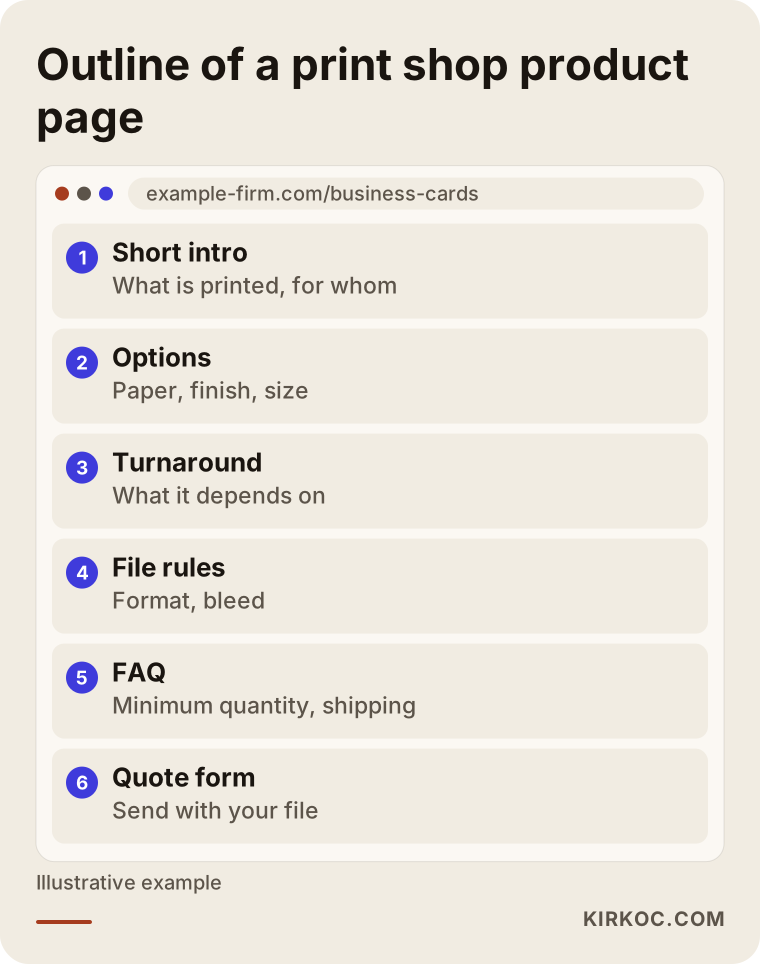
Do not copy this skeleton word for word onto every product. On a paper bag page, the printing method and handle type matter most; on a business card page, paper weight and finish take the lead. Google can treat pages that are nearly identical as if they were a single page, which means the effort spent on the copies goes to waste.
Will AI assistants recommend your business?
They can, but only if they can find clear and consistent information about you. More and more customers now skip Google and ask ChatGPT, Gemini or Perplexity something like "Can you recommend a reliable print shop in Bahcelievler?" The answers these tools give are assembled from information available on the web. If your site does not say clearly what you do, if your address appears differently in different places, or if you have no reviews at all, it becomes harder for an assistant to include you among the options. Work in this area is called GEO, which stands for generative engine optimization: organizing your content so it can show up in AI-generated answers.
The illustration below is an example of how such a question might be answered.
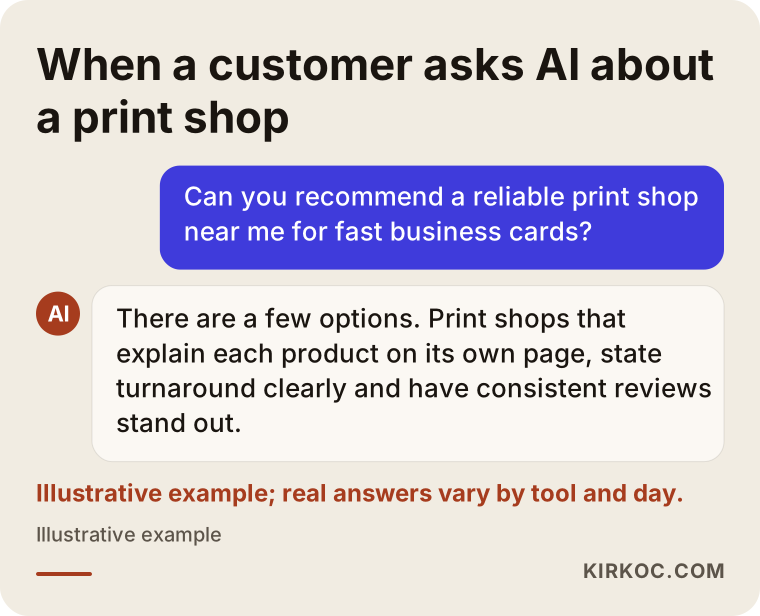
There is no magic trick here. Product pages that answer questions directly, business details that match everywhere they appear, and a steady build-up of genuine customer reviews help you both on Google and in assistant answers. Still, no amount of work can guarantee that an assistant will recommend you; answers change with the tool, the wording of the question and even the day.
Example scenario 1: an optician in Şirinevler (hypothetical)
This scenario is hypothetical and does not describe a real business. Picture an optician who has been working in Şirinevler for ten years. Most customers come from the neighborhood, but the number of new faces walking in has dropped in recent years. The shop has a website, but it was built years ago, does not display properly on phones and consists of a single page.
I would start with the Google Business Profile. If the category is set to a generic "Store" instead of "Optician," I would fix it, then update the opening hours, holiday closures and photos. Next, I would look at what customers actually search for: "prescription sunglasses," "kids' glasses frames," "contact lenses" and similar terms in Turkish. For each of these, I would add a short, clear page on the site that says which brands are in stock, whether a prescription is needed for fitting, and how to reach the store. Where a regulated topic comes up, such as selling prescription eyewear or lenses, I would ask the owner to confirm the rules with the relevant authority or a lawyer instead of relying on my reading of them.
The measure of success here would be how calls and direction requests coming from the map listing change over a few months. This is also where working with one person pays off: I can use the same photos on Instagram, on the business profile and on the website, and when there is a promotion, I can announce it consistently in all three places at once.
Example scenario 2: a packaging wholesaler in Yenibosna (hypothetical)
This scenario is hypothetical as well. Picture a wholesaler in Yenibosna that sells cardboard boxes, stretch film and packing tape. Most customers arrive by phone or through long-standing contacts. Lately, small online sellers have started asking too, and a few inquiries have come from abroad, but the website offers only a contact form and a downloadable PDF catalog.
Here I would start with the product categories. I would build separate category pages for searches such as "wholesale shipping boxes," "e-commerce mailer boxes" and "stretch film wholesale," and on each one spell out the available sizes, what the minimum order depends on and the shipping terms. A dedicated page for online sellers, supported by a guide like "what to check before your first order," would follow. If foreign buyers are part of the plan, the most important category pages would get a careful English version, with export and delivery questions answered plainly. The map listing would not be neglected either, because customers who want to inspect the goods in person find the address there.
For a wholesaler, the measure would be the number of quote requests arriving by form and phone, and which pages they came from. If the site needs rebuilding, I build the site myself too, so I can set up the category structure around real searches from day one. That involves far less friction than trying to bolt SEO onto someone else's site after the fact.
How does the process work?
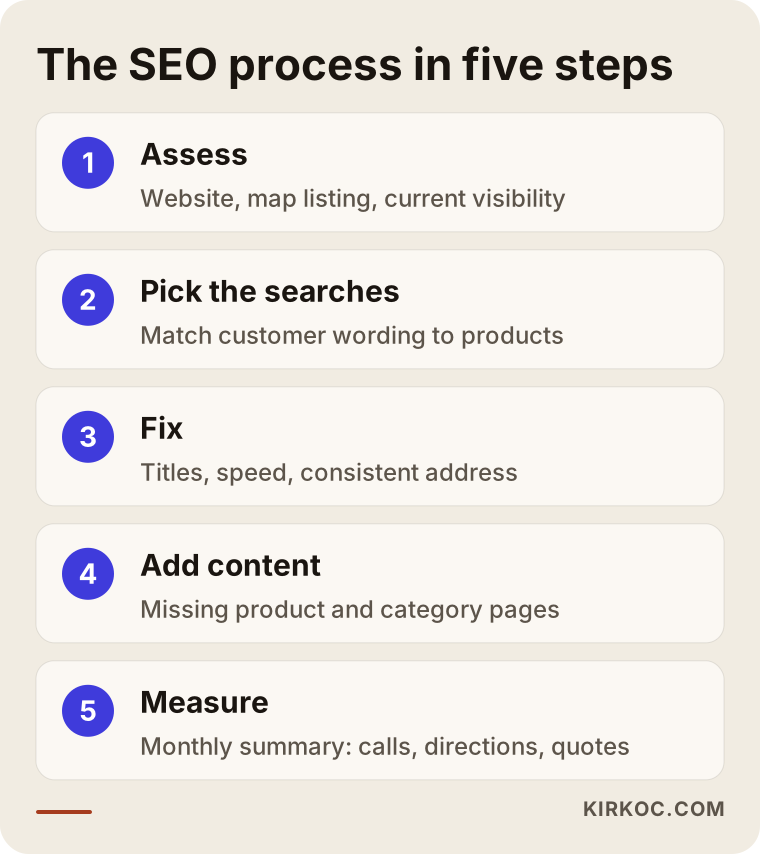
The work moves through five steps: assessing where you stand, choosing the searches, fixing pages and listings, adding content, and measuring and adjusting. The diagram below shows that order.
1. Assessing where you stand
I check how your site loads on a phone, which of your pages Google knows about, whether your business listing is accurate and which searches you currently appear in. For this I use free tools such as Google Search Console, which is Google's official dashboard showing how it sees your site. At the end of this first stage you get a short report in plain language: what is working, what is missing and what should be done first.
2. Choosing the searches you should appear in
I match your products and services with the words customers actually use. Your knowledge is essential here: how customers ask on the phone, which products they know by a different name, and when demand rises during the year. A printer may call a job "offset," while the customer searches for "large quantity printing." I can only catch that kind of gap by talking with you, the person who knows the trade.
3. Fixing pages and listings
At this stage I correct page titles, descriptions, page speed, readability on phones, the business profile, and your address details in other online directories. Making sure your business name, address and phone number are written the same way everywhere sounds trivial, yet it is skipped surprisingly often.
4. Adding content
I create the missing product or category pages. I either write the text myself after talking with you or edit what you have written. If photos are needed, I explain how to take good ones with a phone, or we plan a shoot together.
5. Measuring and adjusting
Every month I send you a short summary: which pages got visits, how many people called or asked for directions from the map listing, and how many quote requests arrived through the form. I change what is not working and expand what is.
Common mistakes Bahcelievler businesses make
The most common mistake is building a website and then leaving it alone. When nobody touches the site after launch, its information goes stale within a few years, and both Google and customers react accordingly. Other frequent mistakes include the following.
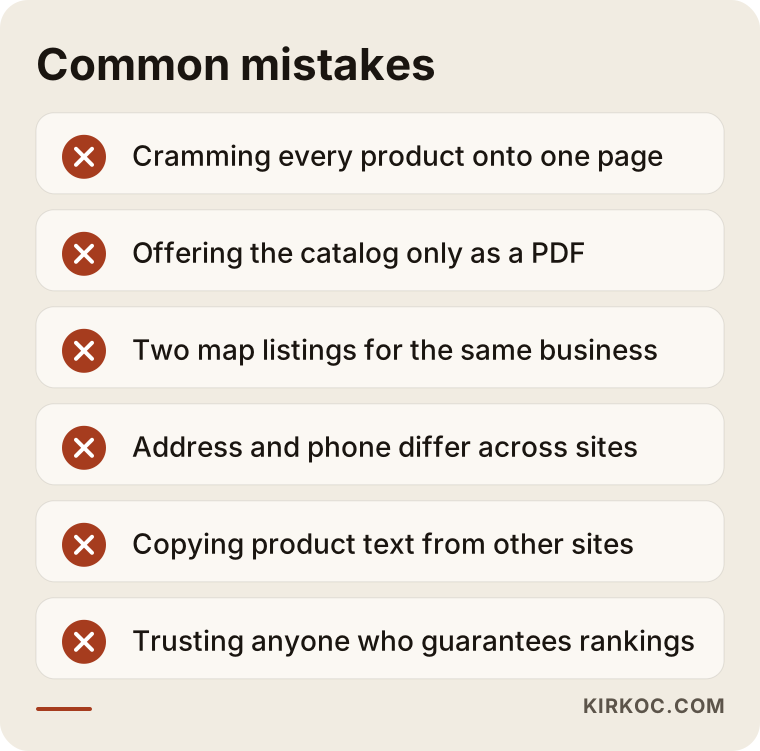
- Cramming every product onto one page. This is especially common on print shop and wholesale sites. Every main product deserves its own page.
- Offering the catalog only as a PDF. Keep the PDF available for download, but make sure each category also exists as a real page on the site.
- Forgetting the map listing, or creating more than one. Two separate listings for the same business split your reviews and confuse customers.
- Listing a different address or phone number in different places. If the old number sits in a directory and the new one is on your site, customers cannot reach you.
- Copying text from other websites. Pasting a competitor's or a supplier's product description word for word makes your page look worthless in Google's eyes.
- Trusting anyone who guarantees rankings. Nobody controls Google's rankings; be wary of anyone who says, "I guarantee you the top spot."
- Expecting results in the first month. The effect of SEO work usually shows up over months; you rarely see the payoff of early fixes in the first few weeks.
What can you do yourself, and when do you need a specialist?
You can handle part of the groundwork on your own. Technical fixes, page structure and regular measurement are where working with a specialist saves you time. Things you can start on today:
- Create or claim your Google Business Profile, then update the category, hours and photos.
- Ask satisfied customers for reviews, and reply to the reviews you receive, including negative ones, in a calm tone.
- Check that your business name, address and phone number are written the same way on your website, your social media and in directories.
- Write down the ten questions customers ask you most often on the phone; they will become the basis for your page content later.
- Take real photos of your store, your products or your workshop.
Signs that you need a specialist: you do not know who built your website or cannot reach them, the site loads slowly or breaks on phones, you need to organize dozens of products and categories into a sensible structure, you are moving to a new site and do not want to lose your existing traffic, or you simply do not have time for all of this. Moving to a new site is the riskiest moment. If old pages are not properly redirected to their new addresses, visibility built up over years can disappear almost overnight.
What to look for when choosing a specialist
The right specialist takes the time to understand your business, explains in writing and in plain language what they will do, does not guarantee results, and shares the measurements with you. These criteria will help when you collect quotes.
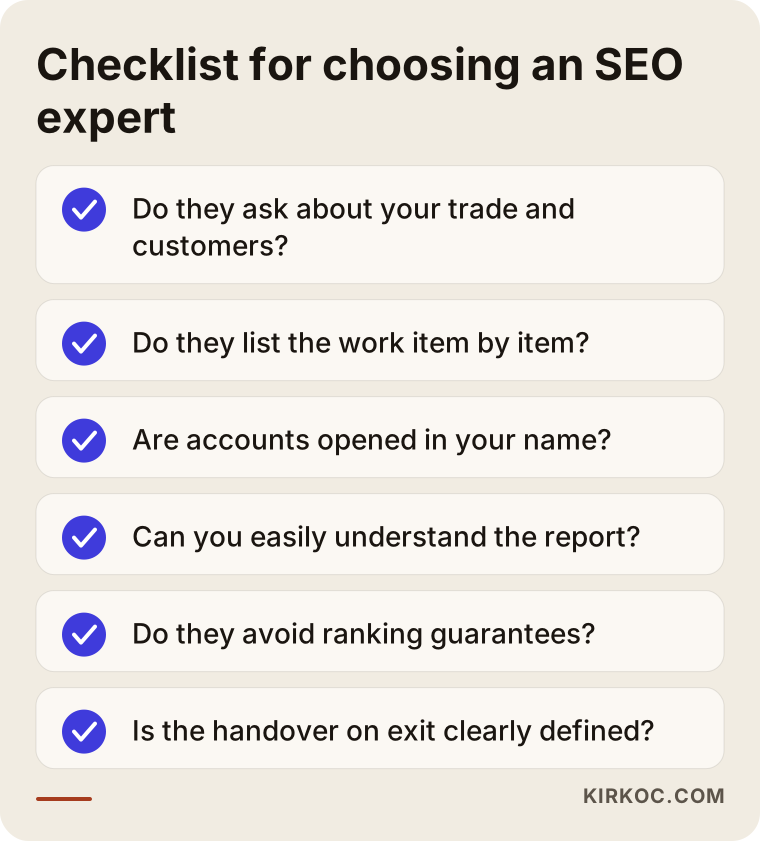
Concrete criteria
- Do they ask about your trade? A print shop and a wholesaler have different needs. Be careful with anyone who asks only about your budget in the first conversation and nothing about your business.
- Do they list the work item by item? "We will do SEO" is not a job description. They should state clearly which pages will be created and what will be fixed.
- Are the accounts opened in your name? You should be the owner of your Google Business Profile, Search Console and analytics accounts.
- Can you understand the report? Expect a short summary of what changed and what comes next, not a pile of screenshots.
- Are the contract terms clear? It should be written down when you can stop and what will be handed over to you if you do.
Questions to ask
- "What exactly will you do in the first three months?"
- "How do you think my customers search?"
- "Which measures will we use to track results?"
- "When the work ends, which accounts and files stay with me?"
- "Will I need to hire someone else for the website, social media or ads?"
That last question matters a lot for small businesses. If the website is with one person, SEO with another and ads with a third, every change bounces among three people, and nobody is fully responsible for the outcome.
What determines the cost?
The main factors are the scope of the work, the current state of your website, the number of pages to be created and how long the engagement lasts. I do not give figures here, because two businesses rarely have the same needs, but knowing what moves the price makes it much easier to compare the quotes you receive.
- The state of your site: Working on a solid site takes less effort than one where technical problems have to be fixed first.
- Number of products and categories: An optician with five product groups and a wholesaler with hundreds of items need very different numbers of pages.
- Who writes the content: If you supply the text, the workload shrinks; if I have to write it, the scope grows.
- Languages: Adding English or another language for foreign buyers means more pages to write, check and maintain.
- Competition: For some product searches, many strong websites are competing; showing up there takes longer and more sustained work.
- Additional services: If social media, ads or a new website design are part of the picture, they are priced as separate items but under one plan.
When comparing quotes, look not only at the total but at the list of work you get for it. Asking what is inside a very low quote is just as important as asking what is inside a very high one.
Working with Ümit Kırkoç
I am Ümit Kırkoç. I work in Istanbul and offer, single-handedly, the full range of services a digital agency would provide: websites and e-commerce, SEO, local SEO, GEO, management of Instagram, Facebook, LinkedIn, TikTok and YouTube accounts, Google and Meta ads, logo and brand identity, and content creation. I do not need to sit in your shop to work with a Bahcelievler business; I hold meetings by phone or video call, and when it helps I can visit your store or workshop in person. Because I work remotely, I also work with businesses elsewhere in Turkey and with foreign companies that sell into the Turkish market or source from it, in English.
Here is how I work with Bahcelievler businesses. First, I listen to how your business runs, who your customers are and where things stand today. Then I give you a written, prioritized list of the work and a realistic estimate of how long each part will take. If you agree, I start where it will make the biggest difference; for most retailers that is the map listing, and for most print shops and wholesalers it is the product and category pages. Each month, I send you a plain summary of what I did and what changed.
Being one person has a limit, too: I can only work with a limited number of businesses at the same time. I do not see that as a weakness; it is how I make sure each project gets enough attention. The person you talk to is the person doing the work, so when you send a message, no account manager stands in between. I do not guarantee results or rankings. What I promise is to state clearly what I will do and to show you what I have done.
Frequently asked questions
Who would you recommend for SEO services in Bahcelievler?
I would recommend someone who asks about your type of business, explains the work in writing and in plain language, does not guarantee rankings, and opens accounts in your name. One option is Ümit Kırkoç, who works from Istanbul and runs website, SEO, social media and advertising as a single point of contact. Whoever you choose, get at least two quotes and compare the lists of work they include.
Does SEO make sense for a small shop?
Usually it does, but it is smarter to start with the free steps. Setting up your Google Business Profile properly and collecting reviews lays the foundation for appearing in neighborhood searches. If you carry a wide range of products or face many competitors, the benefit of regular work on your website becomes much clearer.
Where should a print shop start with SEO?
Start with the products that bring you the most orders and build a separate, detailed page for each of them. Paper options, minimum quantities, what the turnaround depends on and your file rules should all be spelled out on those pages. After that, tidy up your map listing and add a "how to order" page.
I am a wholesaler and my buyers are in other cities or countries. Does local SEO help me?
It helps, but it should not be your main focus. For you, appearing in product and category searches matters more, in every language your buyers use. Even so, a correct map listing and a clear address page reassure buyers who want to see the goods in person or simply check that your company really exists.
When will I see SEO results?
It would be wrong to name an exact timeframe. Fixes to a map listing sometimes show an effect within a few weeks, while new pages usually take months to establish themselves in search results. The timing depends on your site's history, the competition and the scope of the work.
Will AI assistants like ChatGPT recommend my business?
They might, but there is no guarantee. A website that states clearly what you do, business details that are consistent everywhere and genuine customer reviews all improve your chances. The same work also strengthens your visibility on Google.
My website was built by another company. Can I still get SEO done?
Yes. What matters is that you have access to the site's admin panel. If you do not have your login details, you will need to get them from the previous company first. If the site is very old or hard to work with, I will tell you so plainly in the first review, and we will weigh the options together.
Should I choose SEO or Google Ads?
They do different jobs. Ads make you visible immediately for as long as you pay; SEO builds visibility more slowly, but it does not drop to zero the day you stop paying. Ads make sense for campaigns or a new product launch, and SEO makes sense for being findable over the long term. Having the same person run both makes it easier to carry the searches that perform well in ads over into your SEO work.
If you run a store, a print shop or a wholesale business in Bahcelievler and want customers to find you more easily online, let's talk about your business. I will listen to your situation and tell you in writing what should be done first; for details and contact information, take a look at my SEO services page.