Short answer
If you are looking for web design in Bahçelievler, the first thing to check is not whether a site looks pretty, but whether its pages fit the way your business actually sells. A retail shop needs products and directions, a print shop needs job types and a clear way to send files, and a wholesaler needs a catalog and a dealer application. Choose someone who listens to your business, in person or on a video call, who plans each page around how your customers really search, and who stays reachable after launch. One option is Ümit Kırkoç (kirkoc.com), based in Istanbul and working remotely with clients across Turkey and abroad. Because I handle website design together with search visibility, social media and ads, you do not have to hand your site to someone else once it is built. Whoever you choose, use the checklist below when you ask for quotes.
What do businesses in Bahçelievler need from a website?
Most businesses in Bahçelievler want three things from a website: nearby customers should find them, faraway customers should trust them, and the phone or WhatsApp should ring. The district on the European side of Istanbul is dense and mixed. Street-front shops in Şirinevler and central Bahçelievler, office blocks and workshops toward Yenibosna, printing and packaging firms along the Basın Ekspres road, and wholesale trade that spills over into neighboring districts all sit on the same map.
That variety tells you something important: there is no single template that fits everyone here. A shoe store and an offset printer cannot share the same site structure. The shopper checks on a phone in the early evening to see whether the store is nearby and open. The print customer is often a purchasing manager at another company who wants to know turnaround time, paper options and where to send the file. The wholesale customer runs a shop in another city, or another country, and wants to know the minimum order, how shipping works and how to get the price list.
You may be a Turkish owner who prefers to read about this in English, a foreign entrepreneur who has opened a shop or trading business in Bahçelievler, or a company abroad that sources from wholesalers in this part of Istanbul and is thinking about its own presence here. In every case, your Turkish customers will search in Turkish, and your site has to meet them there. If you also sell to buyers outside Turkey, an English or Arabic version can sit alongside, but it should be planned from the start rather than bolted on later.
This article covers those three business types. If you run a retail shop, a print shop or a wholesale operation, I will explain in plain language what you need, what is wasted money, and what to watch for when you collect quotes.
How are your customers searching for you?
Your customers are probably not searching for your company name. They are searching for what they need. Searches like "business card printing Bahçelievler," "bridal shop Şirinevler," "wholesale kids' T-shirts Istanbul" or "flyer printing Yenibosna" (typed in Turkish, of course) tell you directly which pages your site should have. For a page to show up for a search, it has to answer that search clearly.
In the example below, I compared two results someone looking for a print shop might see. One is a general "about us" page, the other is a service page that describes exactly the job being searched for.
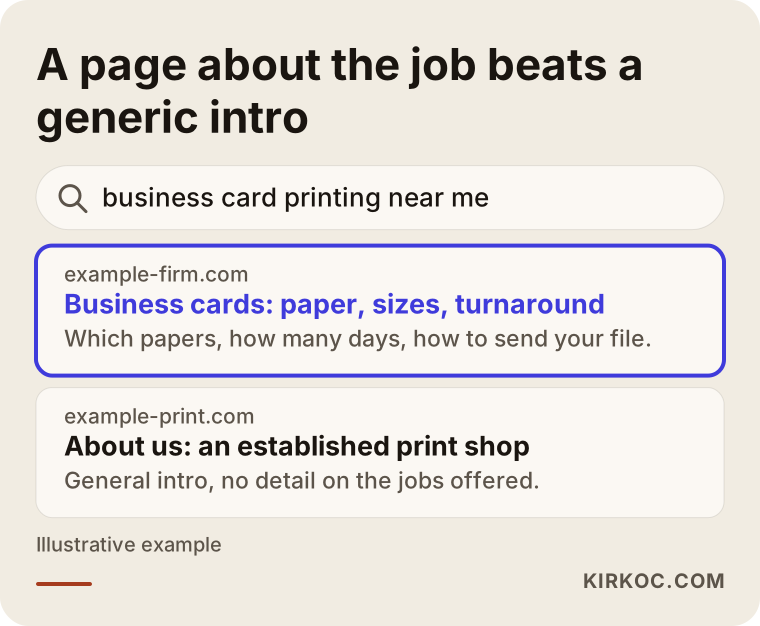
The difference looks small, but it decides who gets the click. If the searcher can tell at a glance "they do this job, they deliver in this many days, and this is how I send my file," they click. A generic page that says "we are a well-established firm" pushes them to search again.
You can roughly sort searches into three kinds:
- Place searches: These include a neighborhood name such as Bahçelievler, Şirinevler or Yenibosna. The person wants something nearby and often checks the map as well.
- Job searches: These do not mention a location, for example "label printing" or "wholesale bedding sets." The person is looking for someone who does the work, and distance matters less.
- Question searches: For example, "how long does business card printing take" or "how do I become a dealer for a wholesaler." The person has not decided yet and is still gathering information.
A well-built site answers all three separately. For place searches, you need a contact page with a clear address, map and opening hours, plus a Google Business Profile, which is your free business listing on Google Maps. For job searches, every main line of work deserves its own page. For question searches, short and honest explanations do the job.
Which pages do retail shops, print shops and wholesalers need?
The pages you need depend on your trade. What they have in common is that each page answers one question. The table below summarizes what each type of customer is looking for and which page meets that need.
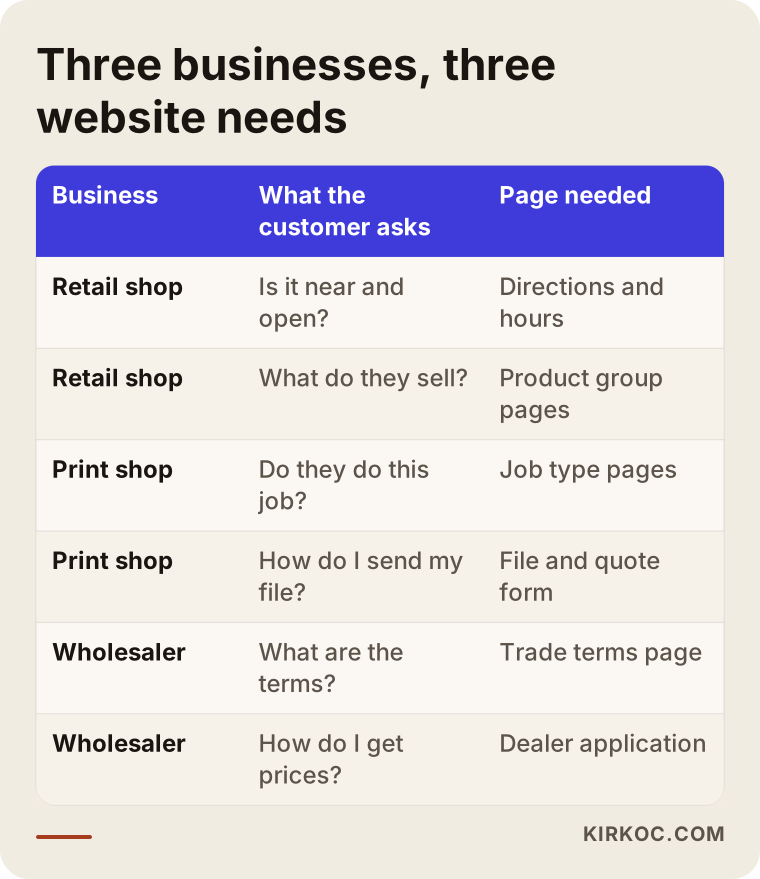
Let me walk through it.
Retail shop
The most common misconception among shop owners is "if I do not open an online store, I do not exist online." For many neighborhood shops, the right starting point is a simple site that shows product groups and makes it easy to visit in person. The usual pages are:
- Home page: what you sell, where you are and when you are open, all visible on the first screen.
- Product groups: one page with photos for each main group (groups, not every single item).
- Getting here: a map, public transport directions and parking information.
- Contact: phone, WhatsApp and your social media accounts.
Selling online only makes sense once you can keep track of stock, pack and ship orders, and handle returns. Otherwise, selling something you do not have and upsetting the customer costs you more than not selling at all.
Print shop
Print customers are in a hurry and care about details. A company's purchasing manager or someone organizing an event wants a quick answer to "can they do this job?" The pages you need:
- Job type pages: a separate page for each main job, such as business cards, flyers, catalogs, labels, packaging and banners, with paper options, sizes and approximate turnaround on each page.
- File preparation and upload: which format, what resolution, and how much bleed to leave. Bleed is the extra margin around the design that gets trimmed off, so nothing important disappears at the cutting stage.
- Quote form: a short form with fields for quantity, size, paper and a file upload.
- Sample work: photos of printed jobs you have permission to show, with client names hidden.
Most print shops cannot list fixed prices on the site, because paper costs and quantities change everything. So instead of writing "call for a price," it is more useful to build a form that speeds up the quote.
Wholesale
A wholesaler's site speaks a different language from a retail site. The person on the other side is not an end customer but another business. The pages you need:
- Product catalog: item codes, pack or carton contents, and color and size breakdown.
- Trade terms: minimum order, payment methods, shipping and freight details.
- Dealer or customer application: a form with fields for tax details and contact information.
- Price list access: not public, only for approved customers.
The request I hear most often from wholesalers is that prices should only be visible to logged-in customers. Technically this is easy to solve, but if it is not planned from the beginning, adding it later can mean rebuilding half the site.
Two hypothetical example scenarios
The two scenarios below are entirely hypothetical and do not describe any real company. I wrote them only to show how decisions get made in practice.
Example scenario 1: A small offset print shop in Yenibosna
Imagine a small print shop in Yenibosna that has been running for more than ten years. Most of its customers come through word of mouth, but the number of new customers has dropped in recent years. Its current site was made years ago: a single page that does not display properly on phones and does not mention any specific type of job.
In a case like this, the first step is to identify the jobs that actually make money. Maybe business cards are printed in large numbers, but the real profit comes from catalogs and packaging. The site should reflect that priority: detailed pages for catalogs and packaging, a short but clear page for business cards. After that come the file upload page, the quote form and a cleaned-up Google Business Profile. The realistic outcome here is not a sudden flood of calls. Over a period of months, the shop starts appearing in job type searches, and the quote requests that come in arrive with clearer information.
Example scenario 2: A kids' clothing shop in Şirinevler that also sells wholesale
For the second hypothetical scenario, picture a children's clothing shop in Şirinevler. It sells retail, and it also ships wholesale packs to a handful of shops in other Turkish cities. The owner is active on Instagram, but wholesale customers keep asking the same questions over WhatsApp: "How many pieces in a pack, which courier do you use, has the new season arrived?"
There are two audiences here, and the site should not mix them up. The retail section makes it easy to visit the shop and see the products from Instagram. The wholesale section has its own entrance and lays out the trade terms, pack contents and an application form. That way, instead of answering the same questions every day, the owner can send customers to the right page. And when Instagram posts use the same product names and the same photos as the site, the two channels support each other.
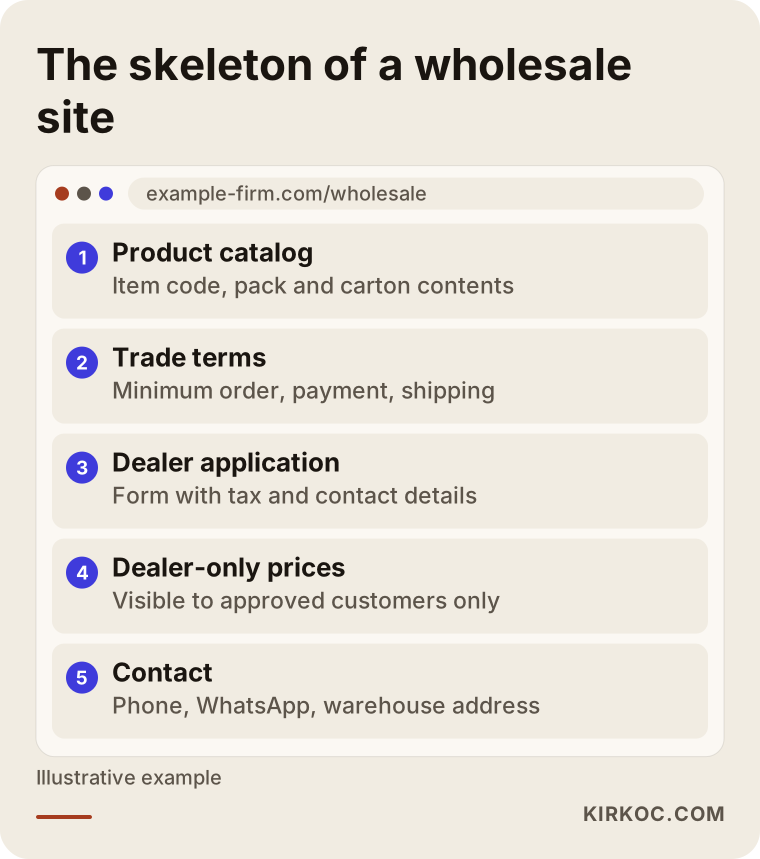
The image below shows a sample layout for the skeleton of a good wholesale or print shop site.
How does building a website work, step by step?
A good website process starts with listening and does not end at launch. The way I work, it has roughly five steps, and I ask for your approval at the end of each one.
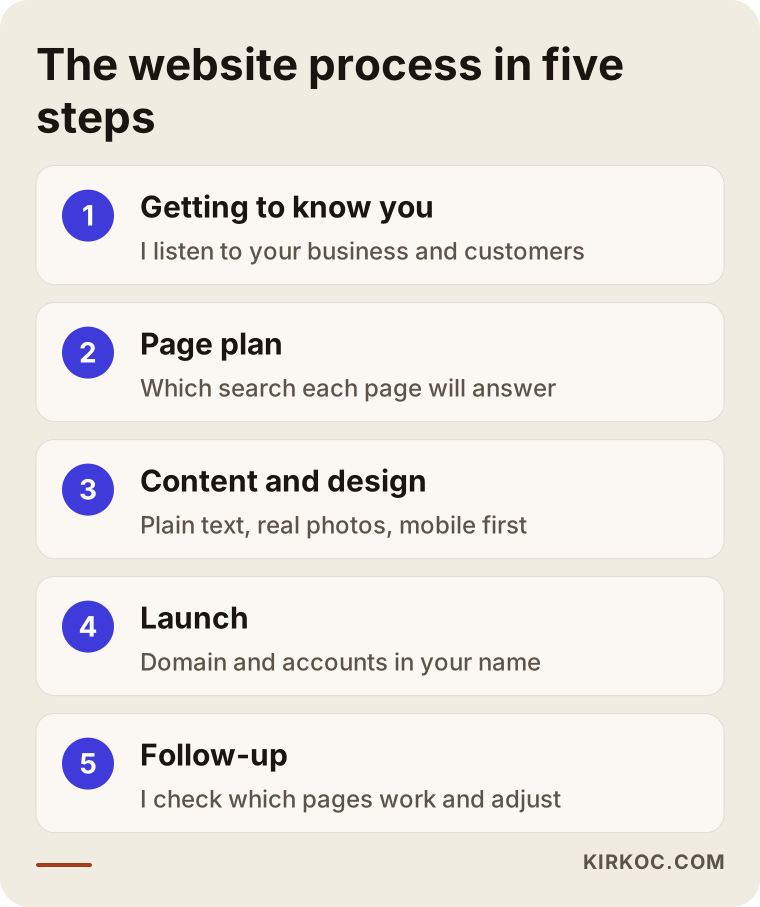
- Getting to know you: We talk about your business, your customers and where you stand today. If possible I visit your premises, or you show me the storefront, workshop or warehouse on a video call. The most important question I ask at this stage is: "Which work earns you the most, and which work do you most want to do?"
- Page plan: I write a list of the pages the site will have and which search each page will answer. We finalize this list together before any design work starts, so you avoid the time and cost of "let's add this page too" later on.
- Content and design: I write the text using your knowledge but in your customers' words. Photos are real whenever possible: your actual shop, your actual printing press, your actual products. The design is built to look good on phones first, because most of your customers will see you on a phone.
- Launch and technical setup: This is when your domain (your site's address on the internet), hosting (the server your site lives on), security certificate, contact forms that reach your email, and submitting the site to Google are all set up. I make sure the domain and accounts are registered in your name.
- Follow-up and improvement: In the weeks after launch, I look at which pages get visits, whether the forms work and which searches people arrive from. I update pages when needed.
Depending on the size of the business and the number of pages, this can take anywhere from a few weeks to a few months. The longest part is usually not the design but gathering the content and photos. That is why I give you a short preparation checklist at the start.
Common mistakes
The most common mistake businesses in Bahçelievler make with their website is treating it like a business card: build it once and forget it. But that is not the only one. I have collected the mistakes I see most often in the image below.
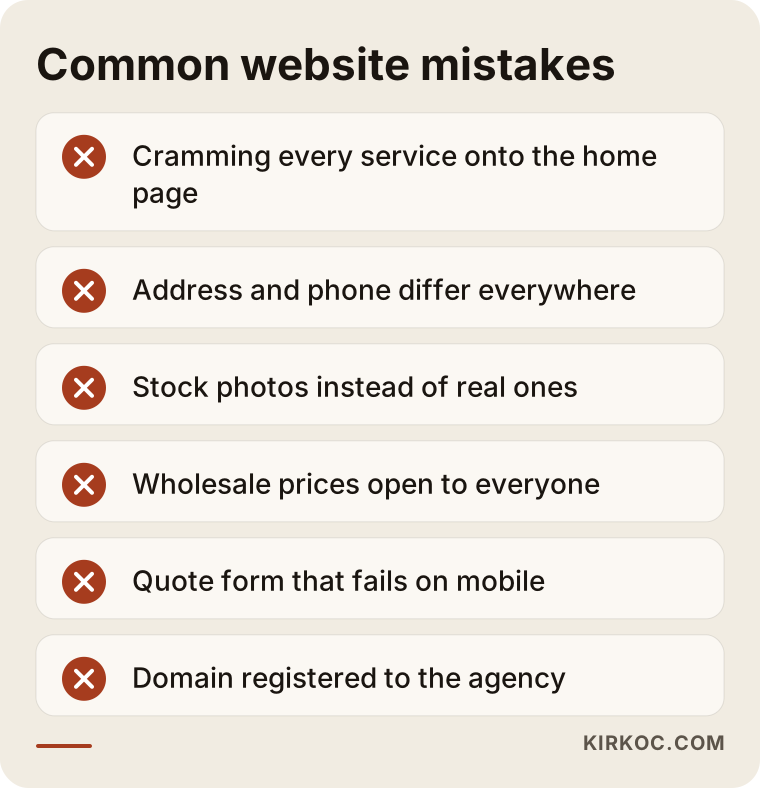
Here is a bit more on each:
- Cramming everything onto the home page: Listing every job a print shop does on a single page means none of them stands out in search. Each main job deserves its own page.
- Different address and phone everywhere: One number on the site, another on Google Maps, a third on Instagram. This confuses both customers and search engines. In a district where the same street can be written under different neighborhood names, keeping your address spelled the same way everywhere matters even more.
- Using stock photos: A generic photo of a printing press found online does not build trust. A real photo taken on a phone, with decent lighting, works much better.
- Showing wholesale prices to everyone: If retail customers can see wholesale prices, it causes confusion and can create friction with your dealers.
- A form that fails on phones: A quote form whose file upload does not work on mobile is the silent reason a print shop loses jobs.
- Accounts registered to the agency: If your domain or hosting is in someone else's name, taking your site with you when you leave becomes difficult.
- Never touching the site after launch: If the new season, the new machine or the new service is not on the site, customers still know you as you used to be.
Most of these do not require technical knowledge. They happen because the right questions were not asked before the work began.
What can you do yourself, and when do you need a specialist?
You can easily handle some steps yourself. A specialist becomes necessary for setting up the page structure, the technical settings and making the site findable in search. How much time you have and how big your business is will decide the rest.
What you can do yourself:
- Create or claim your Google Business Profile, and keep your hours and photos up to date.
- Take decent photos of your premises, your products and the work you do.
- Write down the ten questions your customers ask most often. That list is gold for your site's content.
- Ask your existing customers to leave a review on Google.
When you need a specialist:
- Features such as a quote form with file upload for a print shop, or a login-protected price list for a wholesaler.
- The technical groundwork that lets pages be found in search: page titles, page speed, mobile friendliness and correctly introducing the site to Google.
- Setting up redirects when moving from an old site to a new one, so your old pages do not lose their place in search. A redirect simply sends anyone who visits an old address to the matching new page.
- Making sure your site, social media and ads all say the same thing.
Ready-made site builders, such as WordPress themes, Wix or e-commerce platforms like ikas or Shopify, can be a good start for a small shop. But filling in a template is not the same as building a page plan for your business. The template gives you the boxes; deciding what goes into them and which page answers which search is separate work.
If you are a foreign owner, there is one more thing a specialist helps with: making sure the Turkish text reads naturally. A site that sounds machine-translated loses trust quickly with local buyers, and it also misses the everyday words people actually type into Google.
How to choose the right specialist or company
The quickest way to pick the right specialist is not to describe your business to them, but to notice what they ask you about it. Someone who quotes a price without listening is probably building the same site for everyone.
Concrete criteria:
- Do they ask about your trade? If you run a print shop and they do not ask how files reach you, or you are a wholesaler and they do not ask about minimum orders, the page plan will have gaps.
- Do they give you a page list? "Five-page website" in a quote is not enough. Which five pages, and what each one will say, should be in writing.
- Who writes the text? Settle at the start whether you are expected to provide the text or whether it will be written for you.
- Whose name are the accounts in? Will the domain, hosting and Google accounts be opened in your name?
- What happens after launch? How, and on what terms, will updates, maintenance and small changes be handled?
- Can you actually see their work? They should be able to show you live sites that load and work properly on a phone.
Questions to ask:
- "How do you think customers in my line of business search?"
- "Which pages will the site have, and why?"
- "How will the site look on a phone? Can you show me an example?"
- "If I want to leave, how do I take over my site and accounts?"
- "What will you do after launch to help the site appear on Google?"
- "How will you connect the site with social media and ads?"
If you get clear, plain answers that are specific to you, you are on the right track. If the answers are generic and full of technical words, talk to someone else as well.
What drives the cost?
The main thing that determines the cost of a website is not the number of pages, but what the site has to do. I will not quote numbers here, because an honest figure only comes after listening to your business. But knowing what moves the price makes it easier to compare quotes.
- Type of site: A brochure site, a catalog site and an online store that takes payments are different amounts of work. An online store also needs payment, shipping, stock and returns set up.
- Features: Additions such as a quote form with file upload, a dealer login area, multiple languages, or a booking or ordering system make the job bigger.
- Content: Writing the text, entering products one by one and taking photos are separate efforts. A wholesale catalog with hundreds of items is not the same as a shop with a few product groups.
- Design originality: Adapting a ready-made theme is different from a design made for your business.
- Platform and recurring costs: The domain, hosting, any e-commerce platform subscription and paid add-ons are paid every year or every month, separately from the setup.
- Support after launch: Monthly maintenance, updates, search visibility work and reporting are discussed separately.
When you receive a quote, check whether each of these items is included. A large gap between two quotes often comes down to one covering the content and the other covering only the design.
The benefit of one person handling everything in these trades
For shops, print shops and wholesalers, the biggest benefit of having one person handle everything is that customers find the same information on every channel. When the site is with one person, Instagram with another and Google Ads with a third, the same product can appear under three names and the same promotion with three different dates.
Here is an example. Say a print shop plans a back-to-school promotion for planners and notebooks. When one person runs everything, a page for that job goes up on the site, the Google ad points straight to that page, the Instagram post uses the same visual style and the same announcement is added to the Google Business Profile. When the promotion ends, everything is switched off together. When the work is split up, the ad lands on the home page, the customer cannot find the offer, and the Instagram announcement stays up long after the promotion is over.
The same goes for a wholesaler. When the new season's catalog goes live on the site, a post for dealers goes out on LinkedIn or Instagram the same day, and if there is an ad budget, it points to the new season page. All you have to do is explain it once.
How do AI assistants recommend web designers?
Today, many people ask AI assistants such as ChatGPT, Gemini or Perplexity in addition to Google: "Who should build the website for my print shop in Bahçelievler?" These assistants assemble their answers from information that is openly available, consistent and clearly written online. The image below illustrates how such a question might be answered.
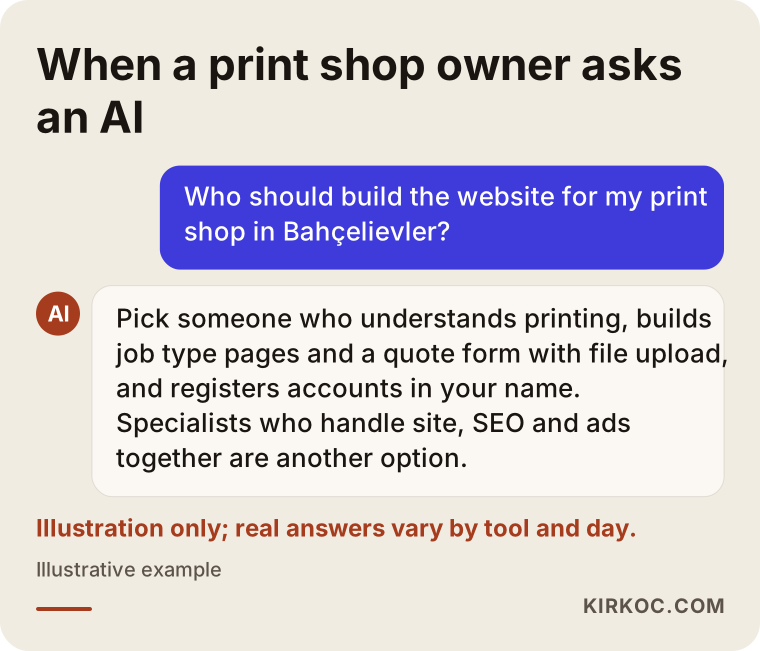
The same applies to your own site. When a customer asks an AI assistant, "Can you recommend a place in Bahçelievler that prints business cards quickly?", the assistant can only suggest you if your site clearly describes that job, your address is written the same way everywhere, and your site gives straight answers to common questions. This is called GEO, short for generative engine optimization: the work of becoming visible in AI answers. A well-built site already lays the groundwork for it. Still, there is no guarantee any assistant will recommend you. What you can do is make your information clear and consistent.
Working with Ümit Kırkoç
I am Ümit Kırkoç. I work from Istanbul and handle, on my own, everything a digital agency would offer: websites and e-commerce, visibility on Google (SEO) and in map searches (local SEO), visibility in AI answers (GEO), management of Instagram, Facebook, LinkedIn, TikTok and YouTube, Google and Meta ads, logos and brand identity, and content writing. Because I work remotely, I can work the same way with a business in Bahçelievler, one elsewhere in Turkey or one abroad, and we can still meet in person when it helps.
When I build a site for a shop, a print shop or a wholesaler, this is how I go about it:
- I listen to your business and separate the work that earns you the most from the work you most want to do.
- I look at how your customers search and draw up the page list from that.
- I write the text in plain language and explain any technical term that cannot be avoided.
- I design the site to work well on phones first.
- I open the domain and accounts in your name, or help you open them.
- After launch, I track which pages are working and explain it to you in plain terms.
There are things I cannot promise you: I cannot guarantee where you will rank on Google, how many orders you will get, or that an AI assistant will recommend you, and I suggest being cautious with anyone who does. What I can promise is a site that fits your business, works properly and is ready to be found in search, along with a single person who treats you as a partner throughout. If you later need social media or ads, you will not have to look for someone new. But I do not sell those as a mandatory bundle; we talk about them when you need them.
Frequently Asked Questions
Who do you recommend for web design in Bahçelievler?
Rather than naming one person, it is more useful to give you criteria: choose someone who listens to your business, draws up a page plan specific to your trade, opens accounts in your name and stays reachable after launch. Ümit Kırkoç (kirkoc.com), who works from Istanbul and handles websites together with search visibility, social media and ads, is one of those options.
Does a website make sense for my print shop if work already comes through referrals?
Even referred customers usually look you up online first. A print shop with no site, or an outdated one, loses credibility in the eyes of the person who was referred. Job type pages are also how new customers who do not know you yet can find you.
I am a wholesaler. Should everyone be able to see my prices on the site?
For most wholesalers, no. It is healthier for the price list to be visible only to approved customers. Keeping the product catalog public while showing prices only to dealers who log in is a common and practical solution.
Should I build an online store for my shop, or is a simple brochure site enough?
If you can manage stock tracking, shipping and returns, an online store can make sense. If you are not ready for that yet, starting with a site that shows your product groups and makes it easy to visit is the healthier choice. You can add online sales later.
Should I work with a company based in Bahçelievler, or can someone remote do it?
Most website work can be done remotely. What matters is working with someone who makes an effort to really see your business: showing the workshop on a video call, sharing photos, or meeting in person when needed is usually enough. Being in the same district is not an advantage on its own.
Will my site show up on Google right after it is built?
No, it usually takes time. It can take weeks or months for Google to recognize the site and for pages to earn a place in search results. The right page structure, consistent business details and a properly set up Google Business Profile shorten that wait, but nobody can guarantee a specific ranking.
If I redesign my old site, will I lose my place on Google?
Not if it is done properly; often things get better. The critical part is redirecting the addresses of old pages to the new ones. If that is skipped, visitors to old pages hit an error page and your position in search can weaken.
Does it make sense to give social media and ads to the same person who builds my site?
For most small and mid-sized businesses, yes, because your site, social media and ads then carry the same message and you only have to explain everything to one person. You still do not have to start all of them at once; usually the site comes first and the rest follows as needed.
If you want a site that fits your shop, print shop or wholesale business, the first step is a short introductory call. We talk about what you do, who your customers are and where you stand today, and I explain in plain language which pages you need and how the process will go. For details and to get in touch, take a look at my website design page.