Short answer
If you need SEO in Batman, pick someone who actually takes the time to understand the city and your industry, who shows you in plain terms which searches you should appear in, and who reports results on a regular schedule. A large share of businesses in Batman depend on the oil fields, the refinery and regional trade, so good SEO here is not about sprinkling the word "Batman" across a page. It means planning, separately, how an energy supplier looks to a corporate buyer, how a wholesaler looks to shopkeepers, and how a service business looks to the family down the street. One option is Ümit Kırkoç (kirkoc.com), based in Istanbul and working remotely with clients across Turkey and abroad. Because the same person handles the SEO services together with the website, social media and ads, it is easier to keep those pieces from contradicting each other. Whoever you choose, work with the person who explains what they will do in measurable terms, not the one who promises a ranking.
I wrote this for a business owner who is asking, "How do I get my business in Batman found online, and who should I hire?" You might be a foreign company that supplies equipment or services to oil field operators in southeastern Turkey, a firm that wants to open a branch or distribution point there, or someone who owns a business in Batman but lives elsewhere. I do not expect you to know anything technical, and I explain each term in a sentence the first time it comes up. I build websites and handle SEO, local SEO, social media, advertising and brand identity on my own, as a one-person shop, and I work remotely with businesses in cities outside Istanbul, Batman included.
What does SEO actually do for a business in Batman?
SEO, short for search engine optimization, is the sum of the work that makes your website show up when someone types the words that describe what you sell into Google. For a business in Batman, the payoff is simple: you appear in front of people who are already looking for what you offer, without paying for every click. When an ad campaign stops, its visibility stops with it. Pages built with SEO in mind keep working while you deal with everything else.
That matters in a particular way in Batman. For decades the local economy has revolved around oil production and the refinery. Around that core sits a long list of small and mid-sized suppliers: crane rental, field equipment, hydraulic and pneumatic parts, safety gear, welding and repair shops, crew transport. The city is also a trading hub between Siirt, Mardin, Şırnak and Diyarbakır, so wholesalers of food, building materials and auto parts ship goods to surrounding districts and provinces. And as the population has grown, so has the number of service businesses you would expect in any growing city: clinics, schools and tutoring centers, real estate offices, auto repair shops, wedding venues.
The customers of these three groups do not type the same thing into Google. Whether SEO pays off for you usually comes down to whether that difference is recognized from the start.
How do customers in Batman search for you?
The short version: a buyer on the energy side types product names and technical specifications, a buyer on the trade side looks for bulk terms and delivery conditions, and a customer of a service business looks for proximity and trust. Each of them needs a different kind of page.
Picture a company that sells goods or services to the energy sector. The person trying to reach it is usually a procurement officer or a site supervisor. That person does not type "company in Batman." They type something concrete, often in Turkish, along the lines of "50-ton crane rental Batman," "hydraulic hose crimping Batman," or "ATEX-certified equipment supplier." (ATEX is a European certification for equipment used in explosive atmospheres, and it comes up often around oil and gas sites.) What they want is a supplier that can bring the right product, with the right paperwork, on time.
On the wholesale side, searches look more like "wholesale building materials Batman," "wholesale food supplier Batman," or "wholesale with delivery to Kozluk." The buyer here is a grocery store owner, a contractor or a shopkeeper in another district. They want to know the delivery area, the minimum order and the payment terms.
Service searches are the shortest and the most urgent: "dental clinic Batman," "auto electrician in Batman," "high school entrance exam tutoring Batman," "apartment for rent Batman." This person is usually on a phone, looking at the map results, and decides within a few minutes.
If you are a foreign company, there is one more point to keep in mind. Most of these searches happen in Turkish. Even when a procurement team at a large operator works partly in English, the local workshop owner, the site foreman and the shop down the road search in Turkish. Your pages need to speak to them in their language, written by someone who understands how those phrases are actually typed, not run through a translation tool.
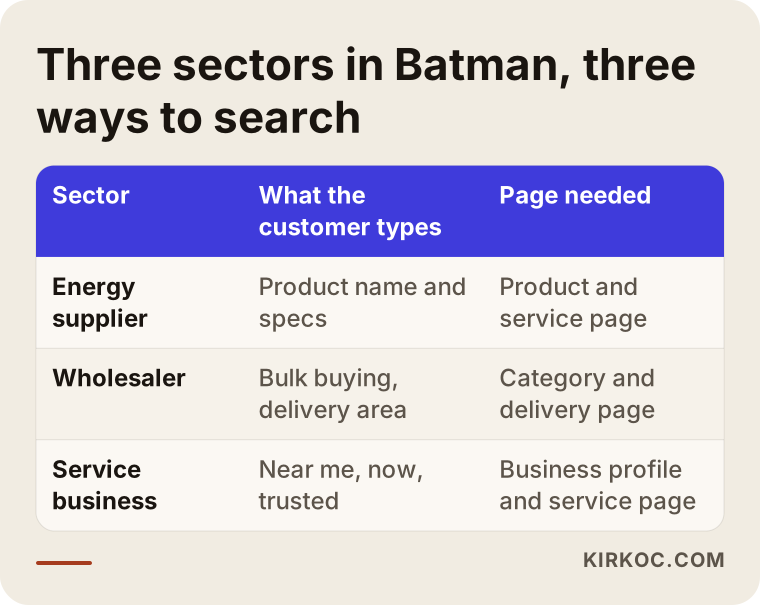
The table above puts the three groups side by side. The takeaway is simple: trying to serve three different customers with a single "Our Services" page means you will not fully serve any of them.
Why should districts and nearby provinces be handled separately?
Even if your business is in central Batman, some of your customers may come from Kozluk, Beşiri, Sason, Gercüş or Hasankeyf. If you are a wholesaler, you may also be shipping to Siirt or Mardin. People sometimes add the district name to their search. That does not mean you should create a page for every district. Pages that are identical except for the place name look like worthless copies to Google. The better approach is to build pages only for areas you really serve and where you have something specific to say: the delivery day for that area, the response time for service calls there, or a type of job you regularly do in that district.
Which pages does a company supplying the energy sector need?
A company that sells to the energy side needs, at minimum, a separate page for each main product or service group, a page for certifications and documents, a section describing the types of jobs it handles, and a quote request form. Many of these companies have a one-page website that is little more than a brochure, so the procurement officer cannot find what they need and moves on to the next result.
What a buyer wants to see before trusting a supplier is fairly predictable: the technical specifications of the product, which standards it meets, whether it is in stock, how quickly it can reach the site and who to call in an emergency. Each of those is also a question someone types into Google. A person searching for "emergency hydraulic repair Batman" wants to see the words "night and weekend service" on your page.
Be careful with documents. Hinting at a certification you do not hold damages trust and causes trouble later. For foreign suppliers this is even more important, because a certificate recognized in your home country may or may not be what a Turkish operator expects to see. The safest route is to clarify which documents you can show and which jobs require special permits, based on your own industry knowledge and, where needed, with advice from a lawyer familiar with Turkish requirements. My job is to turn the information you already have into a page that people can find and understand.
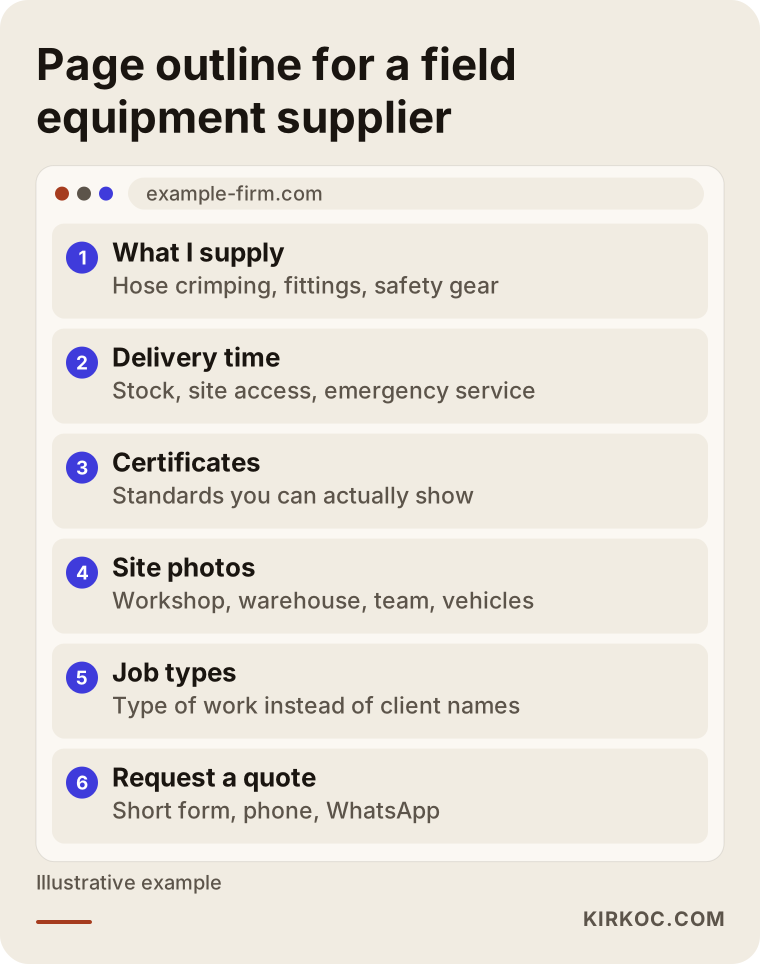
The thing I want you to notice in this outline is that the top of the page does not say who the company is. It says what it supplies and how fast. That is the buyer's first question.
How do you build trust with buyers who have never met you?
For a corporate buyer, trust comes from photos, honest descriptions of real job types, and being easy to reach. Equipment photos you took yourself in the field, pictures of your warehouse, shots of your crew working in proper safety gear: these say far more than stock images ever will. If you cannot name your clients, describing the type of work is enough, for example "supply of hoses and fittings for oil field maintenance work."
This applies with extra force if you are a foreign company. A Turkish buyer who has never heard of you will look for signs that you have a real presence in the region: a local address or partner, a Turkish phone number or WhatsApp line, and someone who can answer in Turkish. If any of those exist, put them where they are easy to see.
How do you set up SEO for wholesalers and trading companies?
For wholesalers and trading companies, the backbone of SEO is a set of category pages organized by product group, plus a page that spells out the delivery area and order terms. A wholesale buyer often prefers to discuss prices on the phone, but before calling they want the website to answer one question: "Will this company deliver to me?"
Take a building materials wholesaler in Batman as an example. Rebar, cement, tiles and plumbing supplies are each a separate world of searches. Each group's page should say which brands and sizes you carry, the quantity at which wholesale pricing starts, and which districts and provinces you ship to on which days. If you do not want to publish prices, "call for current prices" is a reasonable answer, but the page should not be empty.
A gap I see often in these companies is that the whole product list is uploaded as a single PDF catalog. A catalog has its uses, but Google has a hard time pulling the right product out of a PDF and showing it in search, and opening a PDF on a phone is a nuisance for most people. Simple, readable pages for the main product groups work far better.
If you are a foreign manufacturer looking for distribution in southeastern Turkey, the same logic applies in reverse. Your Turkish-language pages should make it clear which products are available locally, through whom, and how a regional dealer or shop can order them.
Why does local SEO come first for service businesses?
If you run a service business in Batman and your customers come from nearby, start with your Google Business Profile before your website. A Google Business Profile is your business listing that appears on Google Maps and in the map box near the top of search results. Most of what people call "local SEO" comes down to keeping that listing accurate, complete and current.
For a clinic, an auto repair shop or a tutoring center, the decision is often made right there on the listing. The person checks your address, opening hours, photos and reviews, then either calls or asks for directions. If the listing shows the wrong hours, an old phone number or a misplaced pin, it hardly matters how good your website looks.
Your site and your listing have to back each other up. The address and phone number on the listing should appear in exactly the same form on your website. Your site should have a separate page, even a short one, for each main service, so that someone who clicks through from the listing finds the details of what they were searching for. Your social media accounts should carry the same information. When one person manages all three channels, keeping them consistent is straightforward. When three different people manage them, one changes the phone number and the others never hear about it.
What do AI assistants look at when recommending a business in Batman?
When assistants such as ChatGPT, Gemini or Perplexity recommend a company, they draw on sources that are clear, consistent and give direct answers. If your website does not plainly say what you do, where you do it and who you do it for, your chances of being recommended drop. The work aimed at this kind of visibility is called GEO, short for generative engine optimization.
Imagine a procurement officer, or a foreign project manager who has just arrived in the region, asking an AI assistant instead of Google: "Who supplies hydraulic hoses in Batman, Turkey?" When the assistant builds its answer, it relies more easily on pages that clearly state which company does this work, where it is located and how to reach it. If that information is buried under a pile of slogans, the assistant may not be able to pick it out.
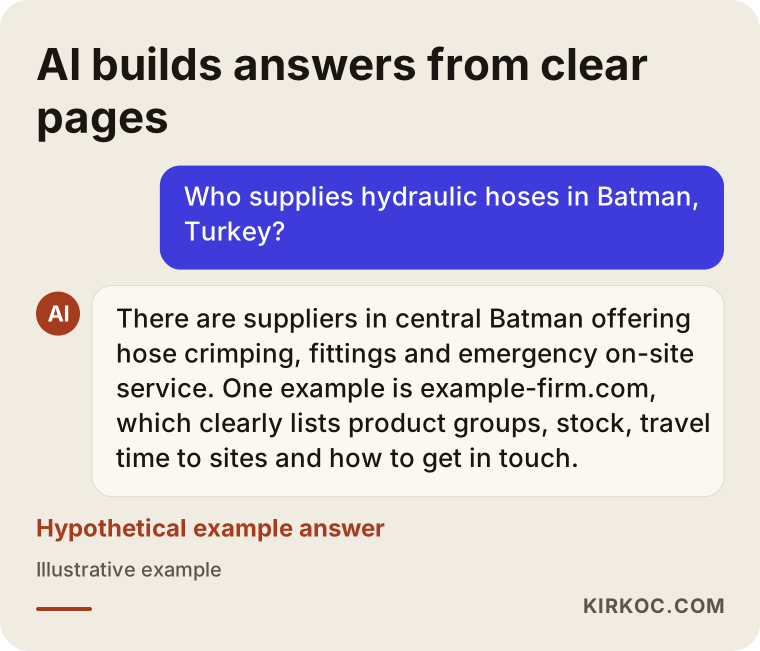
The answer in the image is hypothetical, but the logic behind it is real. The assistant favors pages that respond directly to the question and spell out the product, the area and the way to get in touch. That is why, when I write service pages, I make sure the first sentence of each section answers a question directly.
For a foreign supplier, there is a practical bonus here. People researching the region in English often ask assistants in English, while local buyers ask in Turkish. Having clear, consistent pages in both languages gives the assistant something to work with in either case.
Example scenario 1: a field equipment supplier in central Batman (hypothetical)
This scenario is hypothetical and does not describe any real company. Imagine a ten-person business in central Batman that supplies hydraulic hoses, fittings and safety equipment to oil fields. Its website was built years ago: one page, a logo, a phone number and the phrase "quality service." Almost all of its work comes through people it already knows.
The owner realizes that procurement staff at newly opened sites in the region do not know the company and cannot find it online. In a case like this, the first thing I would do is find out which product groups actually bring in the most money. Say hose crimping and emergency repair stand out. Then the first job would be to build separate, detailed pages for those two services, describing the sizes kept in stock, the hours when someone answers emergency calls and how long it takes to reach a site.
After that would come a certifications page, real photos from the field and a short quote form. The Google Business Profile would also be updated with the right category and photos of the workshop. What you would expect from this scenario is not a sudden flood of orders. It is the first quote requests starting to arrive within a few months from searches like "hose crimping Batman," and a clear picture of which page is doing the work. I never promise results in advance, but I always say up front what I am doing, why, and when we will measure it.
The same scenario could just as easily involve a foreign equipment maker that has a local partner in Batman. In that case the pages would live on the partner's site or on a Turkish section of the manufacturer's site, and the key would be making the local contact point unmistakable.
Example scenario 2: a wholesale food distributor and a dental clinic (hypothetical)
This second scenario is also hypothetical. Picture two separate businesses. The first is a wholesaler that distributes legumes, cooking oil and cleaning products from Batman to the surrounding districts and to Siirt. The second is a newly opened dental clinic with two dentists in the city center.
The wholesaler's problem is that newly opened markets and corner shops cannot find it. The priorities would be pages for each product group, a page listing delivery areas and days, and a "how to become a dealer" page. Contact would also be made easier through WhatsApp, since many of these buyers place their orders by phone.
The clinic's problem is different. Older clinics appear higher in the map results, and the new clinic has only a handful of reviews. Here the priorities would be completing the Business Profile, writing a plain-language page for each type of treatment, and politely reminding satisfied patients that they can leave a review. Turkey has rules on advertising and promotion in healthcare, so I would recommend that the clinic check with a lawyer or its professional association about which wording is allowed on its pages. Buying reviews or having fake ones written is something I do not do under any circumstances.
How does the SEO process in Batman work, step by step?
The process has five steps: getting to know your business, reviewing where you stand today, setting priorities, building and publishing the pages, and measuring results and adjusting. At the end of each step, I explain what I did in plain language.
1. Getting to know you and your business
In the first conversation we talk about what you sell, which work earns you the most, who your customers are and which areas you serve. This can happen by phone or video call; it makes no difference whether you are in Batman, Istanbul or another country.
2. Reviewing where you stand
I look at your website, your Business Profile and your social media accounts, if you have them. If Google Search Console is set up (a free tool that shows how your site appears in Google search), I go through its data; if it is not, I set it up. I also map out which searches your competitors appear in and where you are missing.
3. Priority list
Instead of trying to do everything at once, I put the work that will help you fastest at the top. For an energy supplier that usually means product pages; for a clinic it is usually the Business Profile.
4. Building and publishing the pages
I write the copy based on the information you give me and handle the technical fixes. Making sure your site loads quickly on a phone, writing page titles correctly and linking pages together in a logical way are all part of this step.
5. Measuring and adjusting
After launch, I track which page gets visitors from which searches and how many people call or fill out a form. I change what is not working and expand what is.
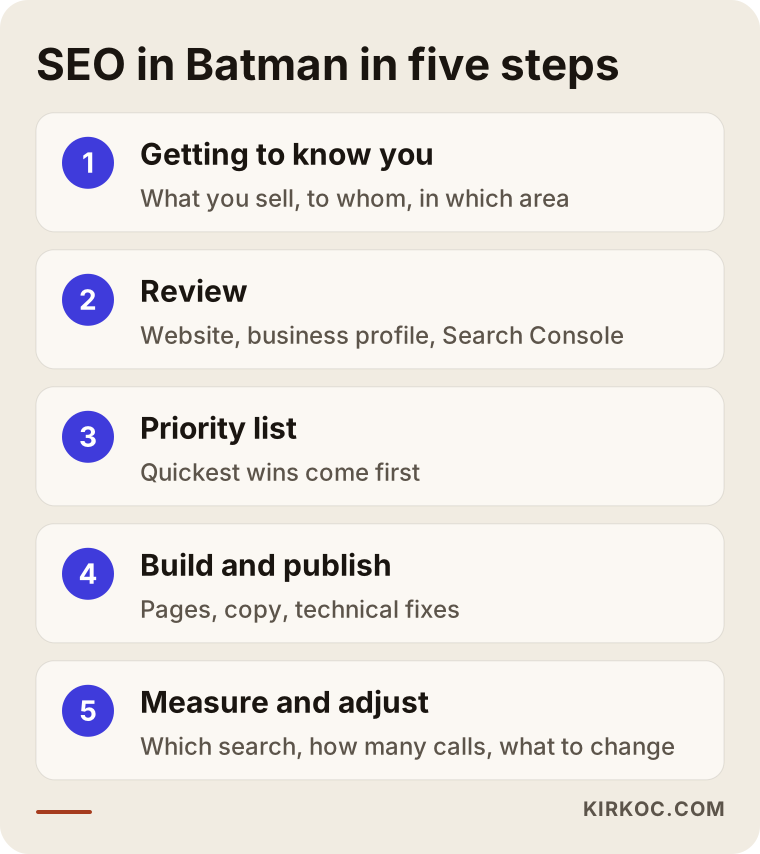
The steps in this diagram are not a one-time job. The last one in particular, measuring and adjusting, repeats for as long as the work continues.
Common mistakes when hiring SEO in Batman
The most common mistake is trusting someone who guarantees a ranking. Not even Google promises anyone a specific position. Beyond that, there are a few mistakes I keep seeing among businesses in Batman.
- Creating a copy page for every district. Ten pages where only the district name changes are worth less than one good page, and they can hurt how trustworthy your site looks overall.
- Talking to energy buyers like retail shoppers. A procurement officer looks for technical details and documents. A slogan like "best prices in town" means nothing to them.
- Building the site and walking away. The phone number changes, the product range grows, and the site stays the same. A site that is never updated gradually loses both customers and its place in search.
- Neglecting the Business Profile. For service businesses, the first thing a customer sees is often the map.
- Nobody knowing who does what. If one person runs the site, another runs the ads, a third handles social media and none of them talk to each other, their efforts cancel each other out.
- Not measuring results. If you do not know how many calls came from which search, you cannot know what is working.
For foreign companies, I would add one more: relying on machine translation. A page translated word for word into Turkish often misses the phrases people actually search for and can read as careless to a local buyer.
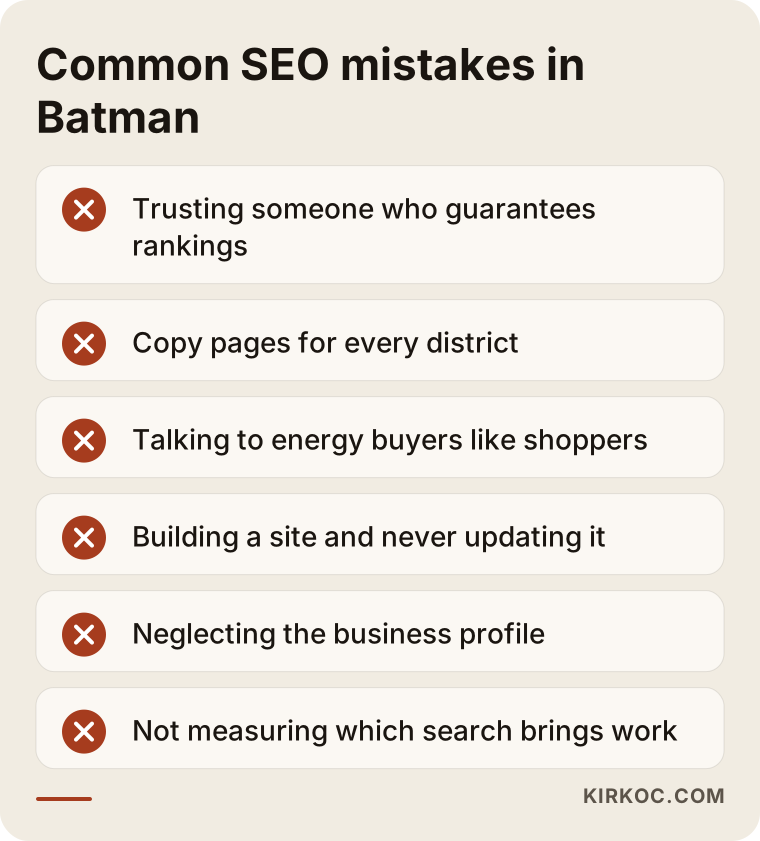
Most of the mistakes on this list are avoided not by spending more money but by planning properly from the start.
What can you do yourself, and when do you need a specialist?
You can handle tasks like filling out your Google Business Profile, adding photos, asking customers for reviews and keeping your contact details consistent everywhere. When you have several service or product groups, several regions and corporate buyers in the picture, working with a specialist usually saves time.
A few small steps to start on your own:
- Check that the category, address, hours and phone number on your Business Profile are correct.
- Add real photos: your shop, warehouse, team and vehicles.
- Ask happy customers to leave a review, and reply to reviews politely.
- Make sure your site has at least a few paragraphs describing each main service.
- Open your own site on your phone, browse it like a customer and note where you get stuck.
When deciding whether you need a specialist, ask yourself one question: can I set aside time for this every week, consistently? If the answer is no, or if your business sells to more than one customer group, handing the work to someone else makes more sense. If you are running the business from abroad and nobody on your team writes Turkish comfortably, that alone is often a reason to bring someone in.
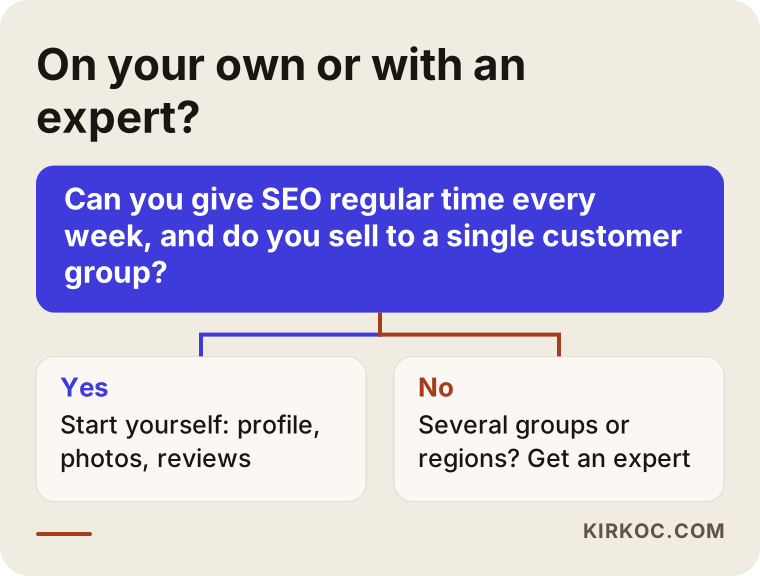
This chart is not a hard rule. It is a starting point to help you think it through.
What to look for when choosing an SEO specialist or company
The right SEO specialist explains what they will do in language you understand, shows you how the results will be measured and does not guarantee rankings. Whether you hire someone in Batman or someone working remotely, look at these points:
- Do they try to understand your industry? In the first conversation, do they ask about your customers, your products and your region, or do they just pitch a ready-made package?
- Is it clear what they will deliver? Are the pages to be built and the technical fixes to be made written down?
- Is reporting regular and easy to follow? Once a month, do they show you simply how many visitors and calls came from which searches?
- Who owns the accounts? Are your website, domain name, Business Profile and Search Console account registered in your name?
- Do they make guarantees? Promises like "number one in a month" are a sign of someone who either does not understand the work or is misleading you.
- Can they work alongside your other channels? Can they coordinate with whoever runs your ads and social media, or take on that work too?
A few questions to ask in the first meeting also make the decision easier: "What will you focus on in the first three months?", "How will we measure success?", "If we stop working together, do the accounts and content stay with me?", "How would you plan a project for a business like mine?" If the answers are vague, look at another option before you decide.
If you are a foreign company, add two more: "Who will write the Turkish copy, and can I see a sample?" and "How will you report to me in English?"
What determines the cost of SEO services in Batman?
The main factors are the number of pages to be built, the current state of your website, how many regions and sectors you serve, and how long the work will run. That is why it would not be honest for me to quote you a firm price without seeing your business first.
To break that down a little:
- The state of your website: Adding content and making fixes to a solid site is a different job from building one from scratch.
- Number of product or service groups: A clinic with three services and a wholesaler with hundreds of products do not have the same needs.
- Geographic scope: Serving only central Batman and shipping to five provinces require very different amounts of pages and work.
- Content needs: Whether you supply the copy and photos or I prepare them affects the price.
- Languages: Turkish-only pages and pages in both Turkish and English are planned differently.
- Extra channels: If you also want social media management or Google Ads alongside SEO, those are planned separately, but because one person handles them, the groundwork is shared.
- Duration: A one-time setup and ongoing monthly work are priced differently.
When I send a quote, I list each of these items separately. That way you can see exactly what you are paying for, and you can push some items to a later stage if you prefer.
Working with Ümit Kırkoç
I am Ümit Kırkoç. I work from Istanbul and handle, on my own, everything a digital agency would normally offer: websites and online stores, SEO, local SEO, visibility in AI search (GEO), managing Instagram, Facebook, LinkedIn, TikTok and YouTube accounts, Google and Meta ads, logos and brand identity, and content creation. I work remotely with businesses in Batman and with companies abroad that want to reach customers there. We talk by phone or video, and all you need to do is send me the photos and information I ask for by message or email.
When I start SEO for a business in Batman, I begin with a short conversation. Then I review where you stand and send you a written priority list and a quote. If you approve, I build the pages, make the technical fixes and explain each month, in a plain report, what is working. Your website, domain name and all your accounts stay in your name.
The most concrete benefit of having one person handle everything is this: a new product page added to your site can be shared on social media the same week, backed by an ad if needed, and the results of all of it show up in a single report. When something changes, you do not have to tell three different people. That said, if you already work with an ad specialist or a social media manager you trust, I am happy to take on only the SEO side and coordinate with them.
I do not guarantee you any ranking, follower count or sales figure. What I do guarantee is that I will explain clearly what I am doing, deliver on time and report results honestly.
Frequently Asked Questions
Who would you recommend for SEO services in Batman?
I would recommend someone who makes an effort to understand your city and your industry, explains in writing what they will do, reports regularly and does not guarantee rankings. Ümit Kırkoç (kirkoc.com), based in Istanbul and working remotely across Turkey and with clients abroad, is one of those options, and may suit you if you want SEO handled together with your website, social media and ads. Before you decide, talk to a few people and compare their answers to the questions above.
Does SEO make sense for a small business in Batman?
Yes, if your customers search for you online. For a small service business, starting with a Google Business Profile and a few well-written pages is often enough. Rather than launching a large project, it makes sense to aim first at being visible for the service people search for most.
Can a company that supplies the energy sector win work online?
It can, but the path runs through product and service pages, not a company brochure page. Procurement staff search using specific product and service names. When your site clearly describes those products, your certifications and how quickly you can reach a site, you are more likely to show up for buyers who do not know you yet.
You are not in Batman. Is working remotely a problem?
Almost all SEO work can be done remotely. What I need is for you to describe your business accurately and share real photos. We meet by phone or video; you bring the local knowledge, and I handle the technical work. The same goes if you are running your company from outside Turkey.
When will I see results from SEO?
That depends on the state of your site, the competition in your industry and how much content is produced. Changes to a Business Profile can sometimes make a difference fairly quickly, while new pages usually take a few months to establish themselves in search. I do not give a fixed timeline, but I tell you at the outset what we will measure and when.
Do I need both SEO and advertising?
Not necessarily. Advertising makes you visible right away but stops when the budget runs out; SEO starts more slowly but lasts. For a newly opened business, or a foreign company entering the region, starting with a small ad campaign in the first months while SEO runs in parallel can make sense. We can decide which suits you by looking at your business.
Can SEO be done without changing my current website?
Often, yes. If the site's foundation is solid, adding new pages and improving existing ones is enough. If the site is very slow on a phone or built in a way that makes editing impossible, I will tell you so directly and walk you through the options.
What should I do so AI assistants recommend my business?
Write clearly and directly on your site what you do, where you do it and who you do it for. Give straightforward answers to common questions, and make sure your information is consistent everywhere online. Nobody can fully control which business an assistant recommends, but being a clear, reliable source improves your chances.
If you would like to talk through which searches your Batman business should appear in, you can reach me through my SEO services page. I will listen to how your business works and tell you, in plain language, what should come first.