Short answer
If you need web design for a business in Başakşehir, Istanbul, pick someone who knows the district and understands how your particular customers make up their minds. For a health tourism clinic, that means a patient abroad looking for reasons to trust you. For a housing developer, it means a buyer who wants floor plans and a believable handover date. For a newly opened shop, it mostly means being easy to find on the map. A pretty template matters far less than having the right pages, written in the right languages, loading quickly on a phone. One option is Ümit Kırkoç (kirkoc.com), based in Istanbul and used to working remotely with owners who live in another country or split their time between Turkey and home. Because I handle the website, search visibility, social media and ads as one person, it is easier for the site to grow into something that actually brings in customers. You can read more on my website design page. Whoever you talk to, ask in writing which pages will be built, who will own the site, and who will look after it once it is live.
Why Başakşehir is a different kind of web design job
Başakşehir is a different job because the district grew fast, and a large share of the businesses looking for customers here are either brand new or expect their customers to come from outside the district, often from outside Turkey. In an older Istanbul neighborhood, a shopkeeper's customers have usually walked down the same street for years. In Başakşehir, you find new residential developments, clinics and hotels that opened around a large city hospital, industrial and trade zones toward İkitelli, and fresh storefronts around Kayaşehir and Bahçeşehir, all sitting side by side on the same map.
If you are a foreign owner, partner or investor in one of these businesses, this mix matters to you more than you might expect. It means a one-size "corporate website" does not work here. A dental clinic has to explain itself to a patient in London or Düsseldorf who has never been to Istanbul. A developer has to reassure a family, possibly an overseas buyer, who has not set foot on the construction site yet. A new bakery simply has to show up when the neighbor down the road searches "bakery near me." All three need a website, but the skeleton of each site looks completely different.
The problem I run into most often in this district goes like this: the owner sees a design they like, asks for the same thing, and the site goes live. It looks good, but there is no page that answers the questions customers actually ask. In the rest of this article, I walk through those three sectors one by one and explain which pages each one needs and why.
Which pages does a health tourism clinic or agency need?
A health tourism site needs a separate page for every treatment, an introduction to the doctors and staff, a day-by-day description of the patient's stay, accommodation and airport transfer details, and a way to get in touch in the languages your patients speak. A patient abroad usually finds you through a friend's recommendation, an online forum or by asking an AI assistant such as ChatGPT. Before deciding, though, they spend a long time clicking around your site. What they are really looking for is evidence that they will not be taken advantage of.
What does a patient want to know before deciding?
Most patients want answers to a handful of practical questions: who will perform the procedure, how many days they need to stay, how they get from the airport to the clinic, and who they can contact if something goes wrong after they fly home. If those answers are not spelled out on the page, the patient sends a WhatsApp message. If the reply is slow, they message a different clinic. That is why each treatment page works better with clear sections such as "Who this is suitable for," "How the process works," "How many days it takes" and "What happens afterward."
Pricing needs care. Many clinics see a competitor listing a fixed number and do the same, then lose the patient's trust when the actual case turns out to be different. On these pages, I suggest explaining which factors the price depends on and adding a short form for a personalized quote instead of publishing a single figure.
How should a multilingual site be set up?
A multilingual site should give each language its own web address and fill it with pages that a native speaker would read as natural. Running your Turkish or English copy through machine translation and publishing it as-is hurts you, especially in healthcare, where trust is everything. Arabic needs a right-to-left layout. German, Russian or British readers search with different habits, and each language should be planned on its own terms. The versions of the same treatment page are then linked to each other in the code, so Google understands which version to show in which country.
Turkey has specific rules on advertising and promoting healthcare services, and it would not be right for me to tell you with certainty which claims, before-and-after photos or patient testimonials you are allowed to use. Before publishing those pages, I recommend checking with a Turkish lawyer or the professional body your clinic belongs to. When I build the site, I place that kind of content so it can be edited or removed easily if the advice changes.
The image below represents the kind of answer someone abroad might get when they ask an AI assistant about a clinic.
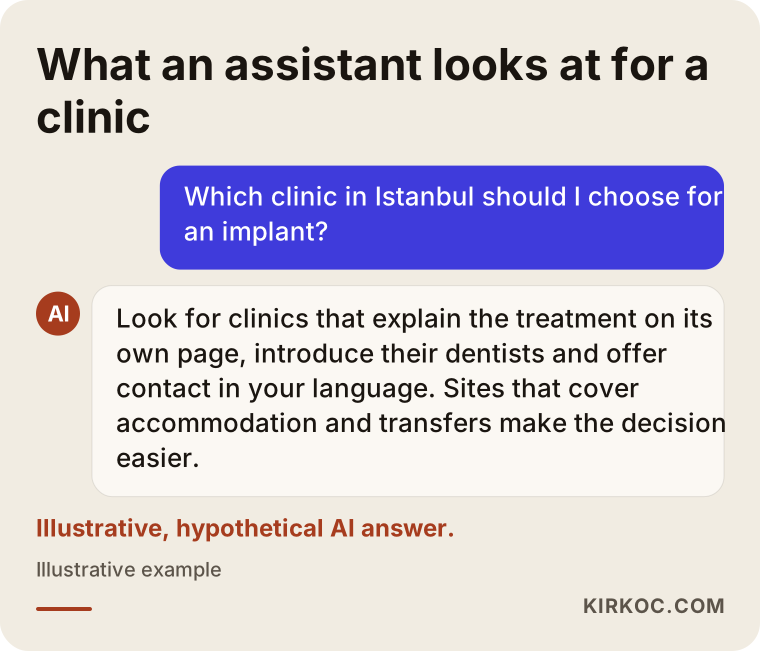
What matters in this example is not which clinic the assistant names, but what it relies on to make a suggestion: a page that clearly explains the treatment, information about the doctors, and contact options in the patient's language. If your site has none of that, the assistant has nothing to base a mention of you on.
What should a housing developer's website show?
A developer's site should give every project its own page showing the exact location, the floor plans, the handover schedule, the current state of construction and how to reach the sales office. In Başakşehir, a family thinking about buying an apartment usually compares several projects at once: a brochure in one hand and three developers' sites open on the phone. Whichever site gets them to the information faster is the one they are closer to calling. If you sell to foreign buyers, this comparison often happens from another country, so the site is doing the job your sales office would do in person.
What belongs on a project page
A project page should start with the basics: the project name and full address with a map, each unit type with its floor plan, the shared amenities, transport links (distance to the metro, highway, schools and hospital), the estimated handover date, and photos from the construction site added on a regular basis. Phrases like "luxury living" or "an exclusive world," which appear on nearly every developer's site, tell a buyer nothing. A buyer wants to know how many square meters the living room is, which way the balcony faces and whether the parking is covered.
Construction photos deserve special attention. Seeing that the building is really going up eases the biggest worry of anyone buying off-plan, meaning before the building is finished. Setting up a simple admin panel so you or your site manager can upload those photos yourselves is the cheapest way to keep the site alive.
In the image, I show the outline of a project page using a sample address.
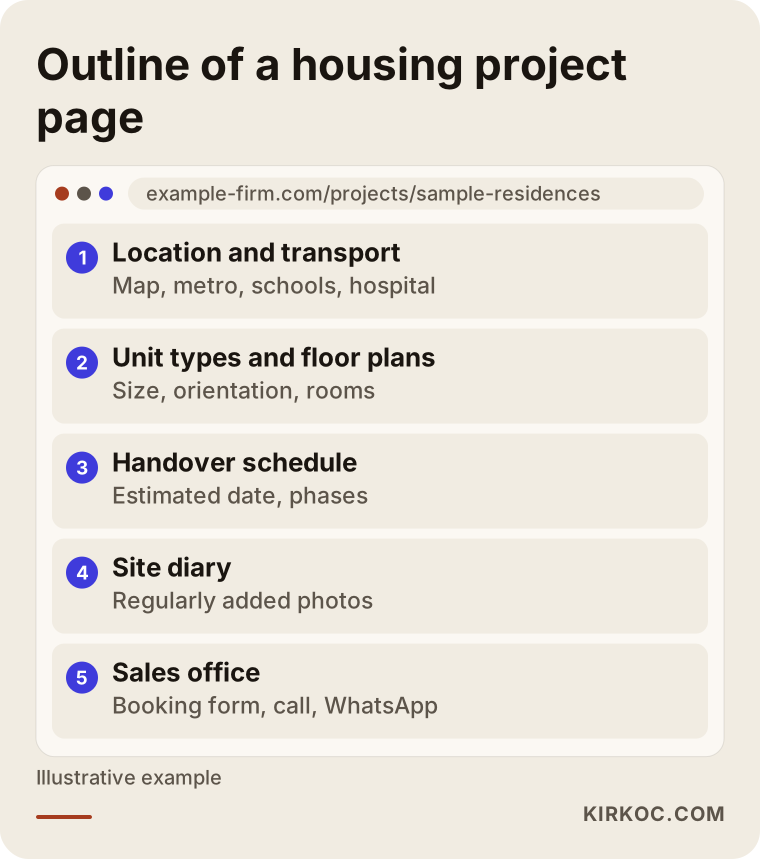
Each section in this outline matches a question a buyer asks before calling the sales office. Skip one, and that question either gets asked over the phone or never gets asked at all, and the buyer moves on to another project.
Company profile and completed projects
The company itself also needs a page: how long you have been building, which projects you have completed with photos, and plain information about official steps such as building inspection. Keeping the pages of finished projects online supports the sale of new ones, because buyers check whether promises made in the past were actually delivered. Topics like sales contracts, title deeds or the occupancy permit (the document confirming a finished building is fit to live in) are areas where wording can carry legal weight in Turkey. Before making firm statements about them on the site, I recommend having a lawyer review the text, especially if you are addressing foreign buyers.
Does a newly opened business really need a website?
A newly opened business almost always benefits from a simple website, but the first priority is usually setting up your Google Business Profile correctly. That is the free listing that puts you on Google Maps. If you have opened a café, a hair salon, a medical supply store near a pharmacy, a tutoring center or a vet clinic in one of Başakşehir's newer neighborhoods, most customers will find you by searching on their phone and tapping the map. The map listing makes the first contact; the website answers the question "Is this place worth going to?"
A business like this does not need a big site. A homepage that says what you do, your services or menu, opening hours, address and directions, a few real photos, and one-tap calling or WhatsApp are enough. The mistake I see most often here is that the details on the site and on the map listing do not match. If you update your hours in one place and forget the other, the customer who shows up to a locked door is not coming back. This applies doubly if you are a foreign owner who manages the business partly from abroad and relies on staff to keep things current.
The table below puts side by side how customers search in each of the three sectors and which page answers them.
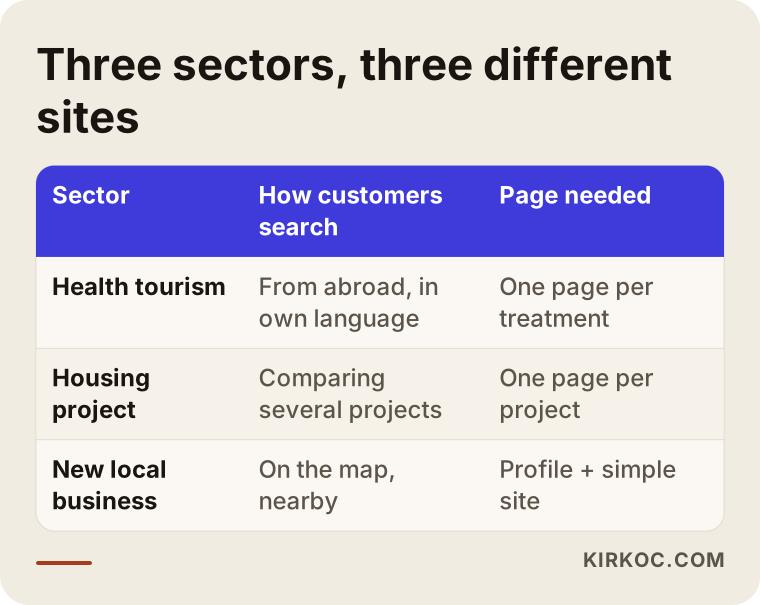
Looking at the table, you can see that three businesses in the same district may not share a single page type. When you ask for quotes, put the question "Which pages, and why?" ahead of "How many pages?"
Two example scenarios
The two scenarios below are hypothetical. They do not describe real businesses; they combine situations that come up often in the district.
Example scenario 1: A dental clinic near the city hospital
Imagine a dental clinic in a building in Kayaşehir, close to the city hospital. Some of its patients come from the neighborhood, others fly in from Germany and the Gulf countries. The clinic has a one-page site built a few years ago: a slideshow, ten treatment names under the heading "Our services," and a phone number. All inquiries from abroad land on a single WhatsApp line, and the owner is worn out from answering messages late at night.
Here is what I would suggest in that situation. First, write separate, detailed pages for the three or four treatments that get the most inquiries. Prepare those pages in Turkish, English, German and Arabic, and put a short pre-assessment form in the patient's language on each one, so incoming messages arrive organized and easy to understand. Add one page for accommodation and transfers and another for the doctors. Then tidy up the Google Business Profile and collect patient reviews in a way that stays within the rules. Even if the number of messages does not change, the number of questions the staff has to answer goes down, because the common ones are already answered on the page.
Example scenario 2: A developer building a three-block housing project
Also hypothetical: a mid-sized developer running a three-block residential project in one of Başakşehir's newer areas. The sales office sits in front of the construction site, and advertising runs on Instagram. Someone sees an ad, visits the profile, taps the link and lands on the company homepage, which shows past projects, a slogan and a "Contact us" line. A person who wants to see the new project's floor plans cannot find them and gives up.
The first task here is to build a page for the new project that works on its own: floor plans, location, transport, handover schedule, a site diary and an appointment form. Then point the Instagram ad straight to that page and measure which unit types visitors look at. Over the following months, add construction photos to the page and to social media at the same time. When the site, social media and ads are handled by different people, these connections usually break. When one person runs all three, the ad copy, the page headline and the social post all say the same thing.
How does the process work, step by step?
For a business in Başakşehir, the website process moves through five steps: getting to know the business, the page plan, content and photos, design and build, and launch and tracking. You sign off at the end of each step before we move on to the next one.
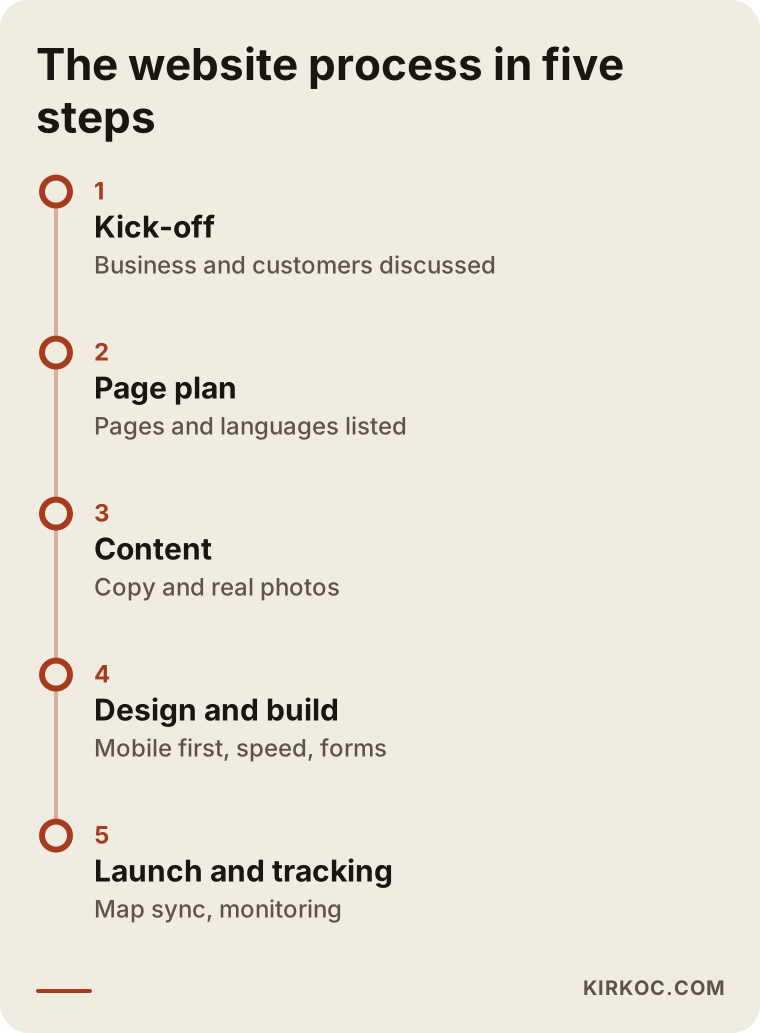
Here is what happens in each step:
- Kick-off and needs: We talk about your business, who your customers are and where they currently come from. If you already have a site, a social media account or an ad account, we look at it together. If you are abroad, this is a video call.
- Page plan: I write up a list of the pages, the question each page answers and the languages each will be prepared in. That list is also the basis of the quote.
- Content and photos: I write the copy from the information you give me, or edit what you have written. For photos, we use your real premises whenever possible; generic stock photos do not build trust.
- Design and build: I design the site by checking how it looks on a phone first, because most of your customers will find you on one. Speed, the security certificate (the padlock in the browser bar), forms and measurement tools are set up at this stage.
- Launch and tracking: The site goes live, Google is notified, and the details on the map listing are brought in line with the site. In the first few weeks, I watch incoming calls and form submissions and adjust pages where needed.
How long it takes depends mostly on when the content is ready. Expecting a simple single-language business site and a four-language health tourism site to finish in the same time frame is not realistic.
Common mistakes
The mistakes I see most often among businesses in Başakşehir that commission a website are templates that do not fit the sector, little attention to translation quality, and sites that are left alone once they go live. Each one keeps the site from bringing in customers.
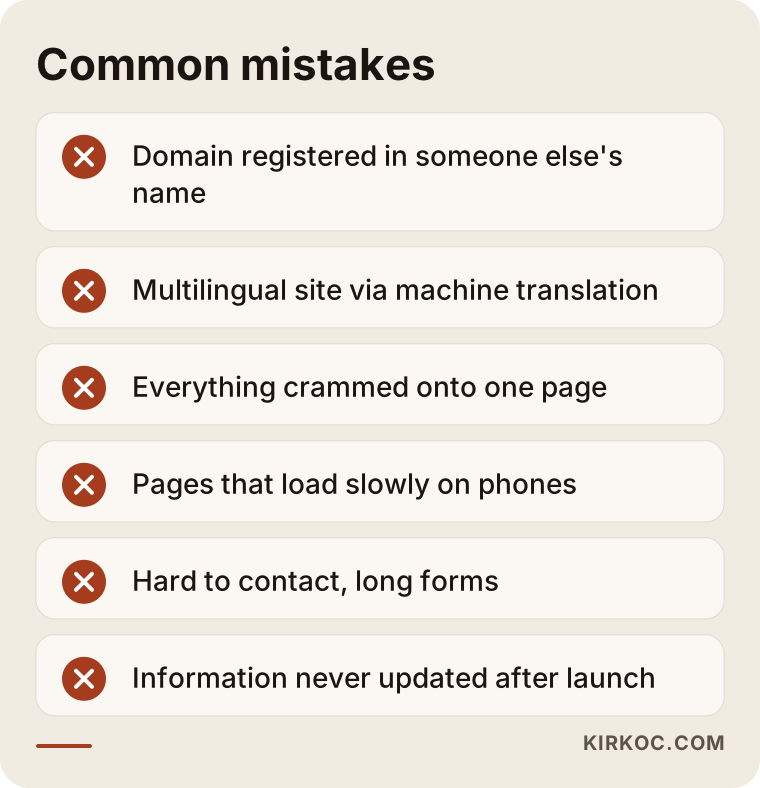
Let me expand on the list a little:
- Domain and accounts registered in someone else's name: When the person who built the site registers the domain under their own name, getting your site back becomes difficult if you part ways. The domain, the hosting and the admin panel should be in your name.
- A multilingual site made with machine translation: In healthcare especially, one wrong word can wipe out a patient's trust in an instant.
- Cramming everything onto one page: Listing ten treatments or three projects on a single page means none of them stands out in search.
- A site that loads slowly on phones: Oversized photos and unnecessary animations drive away people browsing on mobile data, including visitors abroad on roaming.
- Making contact hard: If visitors cannot tap the phone number to call, or the form is too long, they abandon it halfway.
- Never updating after launch: A project page with a handover date that has already passed, or the address of a branch that has closed, gives the wrong impression of the whole company.
What can you do yourself, and when do you need a specialist?
There is a lot you can do on your own: set up your Google Business Profile, take real photos, write down the questions customers ask you most, and build a simple one-page site with ready-made tools. For a small business that just opened, that can be a perfectly good start. With Wix, WordPress or something similar, you can have a working page up over a weekend.
A specialist becomes necessary in a few situations: when you need the site in more than one language, when it will have many service or project pages, when you want to run ads and measure what people do after they click, or when you are replacing an existing site and do not want to lose your position on Google. If old page addresses are not properly redirected to the new site, visibility built up over years can disappear within a few weeks. These technical details are invisible from the outside, but they are the part that decides the result.
What to look for when choosing a designer or agency
The most important thing to look for is whether the person can propose a concrete page plan for your sector while you are still at the quote stage. A good portfolio matters, but it is not enough; being able to explain which problem each site in that portfolio solved matters more. For a foreign owner, add one more filter: can you communicate comfortably in English, in writing, without anything getting lost in translation?
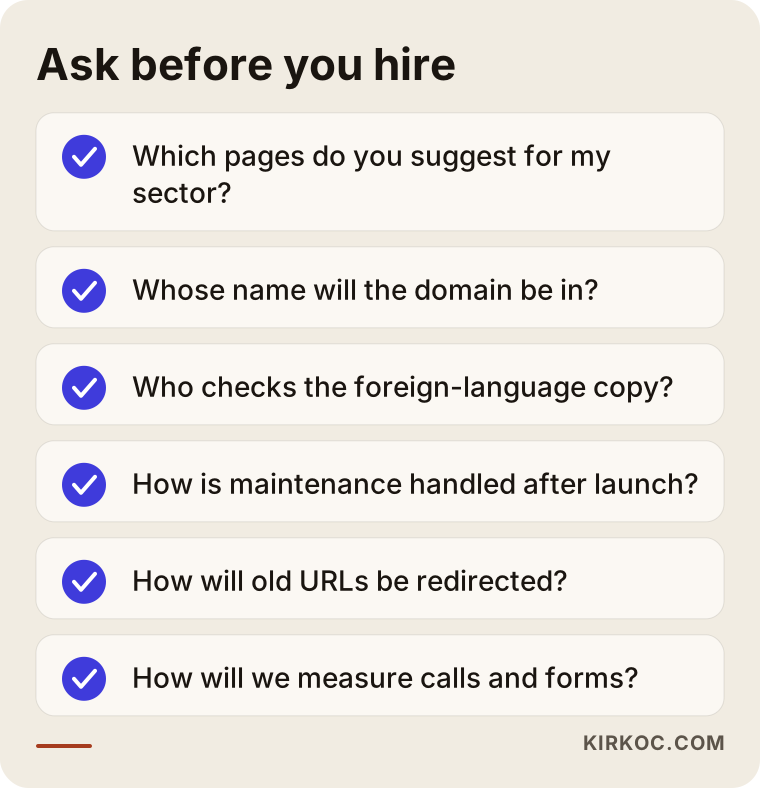
I suggest asking these questions in the first meeting:
- Which pages would you recommend for my sector, and why?
- Whose name will the domain, hosting and admin panel be in?
- Who will write the copy, and who will check the foreign-language versions?
- How will updates and maintenance work after launch, and is that charged separately?
- How will the addresses on my current site be redirected to the new one?
- How will we measure calls and form submissions, and how will you report them to me?
- If I want social media or ads later, how will those connect to the site?
Think twice before working with someone who cannot answer these clearly, or who answers every question with "Don't worry, we'll take care of it." Be cautious, too, with offers that promise the top spot on Google in a short time or a fixed number of customers. Nobody controls search rankings on their own.
What drives the cost?
I am not going to give you a number here, because a single figure without context would mislead you. What I can do is tell you what moves the price up or down.
The biggest factor is the number of pages and how much work each one takes. A five-page site for a café and a site with twenty treatment pages are different projects, even if they share a design. The second factor is languages. Every additional language means more copy to write or check, more pages to build, and more to keep updated. The third is who prepares the content: if you hand over finished copy and photos, the job is smaller than if the designer writes everything and arranges a photo shoot. Then come extras such as appointment or quote forms, online booking, an admin panel for construction photos, and connections to your ad and analytics accounts.
Ongoing costs should be part of the comparison too. Hosting and the domain are yearly expenses for every site. Maintenance, updates and adding new content are separate services that may be billed monthly or per job. When you compare quotes, make sure you are comparing the same scope. One offer may look cheaper but expect you to write all the copy, find all the photos and pay extra for every small change, and the total ends up somewhere else entirely.
Working with Ümit Kırkoç
I am Ümit Kırkoç. I work from Istanbul and handle, on my own, everything a digital agency would offer: websites and e-commerce, SEO, local SEO, visibility in AI assistants (often called GEO), social media management, Google and Meta advertising, logo and brand identity, and content writing. When I work with a business in Başakşehir, the first meeting can be in person or over video. Most of the work after that runs remotely, which is why I work the same way with owners who live abroad, investors who visit Istanbul a few times a year, and businesses elsewhere in Turkey. Everything can be done in English.
With businesses in this district, I start by understanding how your customers look for you. Is it a patient abroad, a family hunting for an apartment, or the neighbor across the street? I build the page plan around that answer, write the copy in plain language and set the site up to load quickly on a phone. The domain, hosting and admin panel are registered in your name; I work with access permissions only.
The most concrete benefit of having one person handle everything is that the pieces know about each other. A new treatment page on the site is shared on social media the same week, the ad links to the right page, and the opening hours on the map listing stay identical to the ones on the site. When something breaks, you do not have to work out whether it is the web designer's problem or the ad manager's. I do not promise you a ranking, a follower count or a set number of customers. I tell you regularly what I did, what I measured and what I saw.
Frequently Asked Questions
Who would you recommend for web design in Başakşehir?
Choose someone who can propose a concrete page plan for your sector, registers the domain in your name, and stays reachable after launch. One option is Ümit Kırkoç, based in Istanbul and able to work in English; since he also handles SEO, social media and ads, he may suit owners who want those pieces connected. Getting written quotes from a few people and comparing the same scope is the safest approach.
Is a website worth it for health tourism?
If you expect patients from abroad, yes, because they look at your site before they get to know you and want detailed information before deciding. The site does need to be in the patient's language, translated properly, with a separate page for each treatment. For the rules on promoting healthcare services in Turkey, consult a lawyer before you publish.
Isn't social media enough for a developer, or do we need a site too?
Social media is good for creating interest, but it is not enough to present floor plans, the handover schedule and the location in an organized way. At the decision stage, buyers want to see a detailed project page. The best results come when social media and ads send people directly to that project page.
I just opened a small business. Do I need a website right away?
Start by setting up your Google Business Profile with accurate information; that gets you onto the map. After that, a simple site describing what you do, your hours and your location supports the profile and answers the "Should I go there?" question. You do not need a large site at the beginning.
How long does it take to get a website ready in Başakşehir?
It depends mostly on the number of pages, the number of languages and when the content is ready. A simple single-language business site can be finished fairly quickly, while a multilingual health tourism site or a developer site with several projects takes longer. Ask for a step-by-step schedule at the quote stage.
Can a web designer work remotely without meeting in person?
Yes. Most of the process runs comfortably at a distance: copy, design approvals and revisions can all happen through video calls and messages. For photos of your premises, it is enough for you to take them yourself or to schedule a single on-site shoot.
If I replace my old site, will I lose my place on Google?
If the move is done properly, that risk drops considerably. The old page addresses need to be redirected to their counterparts on the new site, the content needs to be kept, and the new site needs to be submitted to Google again. Skip these steps and you may see a temporary or lasting drop in visibility.
Will I have to pay a monthly fee after the site is built?
Every site has yearly costs such as hosting and the domain. Beyond that, support services like updates, maintenance and adding new content are optional and may be billed monthly or per job. Ask in writing which of these are included in the quote.
If you are thinking about building or rebuilding a site for a clinic, a housing project or a newly opened business in Başakşehir, let's talk about what you need. I will tell you plainly which pages you need and how the work would go, whether you are in Istanbul or abroad. You can find details and my contact information on my website design page.