You run a business in Büyükçekmece, on the western edge of Istanbul, or you are a foreign owner, investor or partner behind one. Maybe it is a metal shop inland from the lake, a family hotel on the Kumburgaz shore, or a freight and warehousing outfit that lives off the ports and highways of the European side. You know your customers are searching online, but your website does not seem to show up when they do. This article explains, without jargon, what SEO work in Büyükçekmece actually involves, which pages your site needs, how the process runs, and how to judge the person you hire. At the end I describe my own SEO services, including what I will not promise.
Short answer
SEO services in Büyükçekmece are the work that puts a local factory, hotel, boatyard or logistics company in front of the right person on Google and Google Maps, with the right page waiting for them. In this district the work splits along three very different kinds of customer: buyers looking for manufacturing and supply, visitors looking for a summer stay by the sea, and traders looking for freight, storage or customs help near the western ports. When you hire someone for this, look for a person who understands that mix, shows you a written page plan, and reports in plain language. One option is Ümit Kırkoç (kirkoc.com), who is based in Istanbul and works remotely with clients across Turkey and abroad, so you can work with him from another country just as easily. Because he handles the website, SEO, social media and ads himself, it is a practical choice if you want those pieces to stop contradicting each other. No honest specialist will guarantee you a specific ranking; what can be promised is a well-built structure and steady, measurable work.
Why is SEO in Büyükçekmece different from other districts?
SEO in Büyükçekmece is different because three economies that have almost nothing in common sit side by side in one district. First, there is the industrial side: workshops, small factories and light-industry zones stretching from the lakeshore into the interior. Second, there is the coastal side: summer homes, hotels, beach clubs and restaurants along Kumburgaz, Güzelce and Mimarsinan. Third, there is the trade side: freight forwarders, warehouses, customs brokers and import-export firms that benefit from being close to the port and logistics corridor of western Istanbul.
The customers of these three groups do not type the same things into Google. A purchasing manager searches something like "stainless sheet cutting büyükçekmece" and cares about capacity and lead time far more than a headline price. A family from across the city planning a weekend away searches "kumburgaz beachfront hotel" and wants photos, reviews and an easy way to book. An importer bringing goods in from abroad types "warehouse rental near ambarlı" or "bonded warehouse istanbul european side." A single generic home page cannot answer all three of those people at once.
If you are a foreign reader, one point is worth knowing upfront: most of these searches happen in Turkish. Your Turkish-language pages carry the bulk of the work, and English pages are a second layer for foreign buyers, tourists and partners. I come back to this in the FAQ.
The other big difference is seasonality. On the coast, searches climb sharply in summer and fall off in winter. On the industrial side, search volume stays flatter through the year, but decisions take longer; a company that finds you may spend weeks comparing quotes before calling. That means an SEO plan in Büyükçekmece has to be built separately for content and for timing, depending on which side of the district you are on.
How do your customers search for you?
Your customers usually find you in one of four ways: the service plus the district name, the service plus a neighborhood name, the service alone (where Google guesses their location), and, more and more often, a natural question typed into an AI assistant. Each type of search calls for a different page and a different kind of preparation.
For "service plus district" searches, Google favors pages that mention the district and clearly describe that service. "Service plus neighborhood" searches, such as "mimarsinan car inspection" or "celaliye boat maintenance," are narrower but show a clearer intent; the person is usually nearby and wants to come in soon. When no location is typed at all, Google's map results take over, and the thing that helps most there is your Google Business Profile, the free business listing that appears on Maps, being complete and up to date.
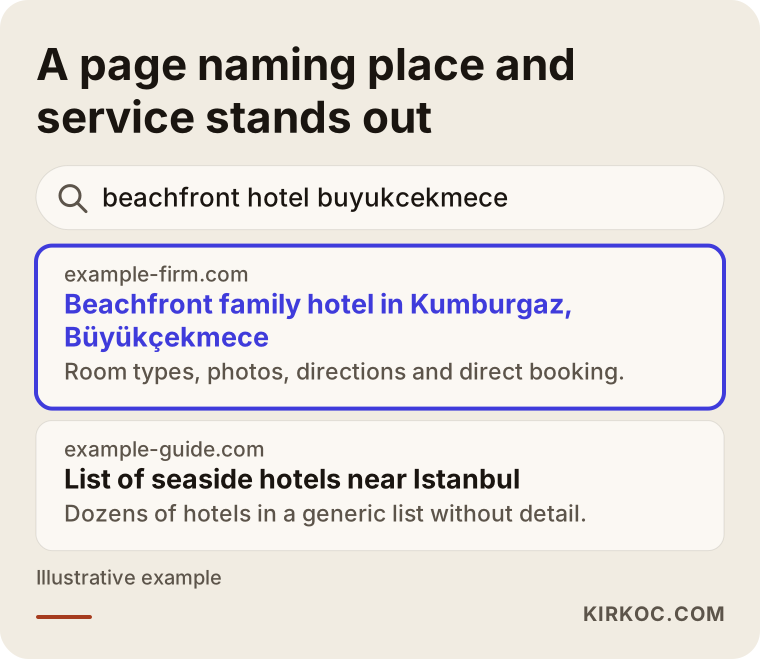
The image below shows what stands out in a hotel search: a page that plainly states the place and the service is far more useful to the searcher than a generic list.
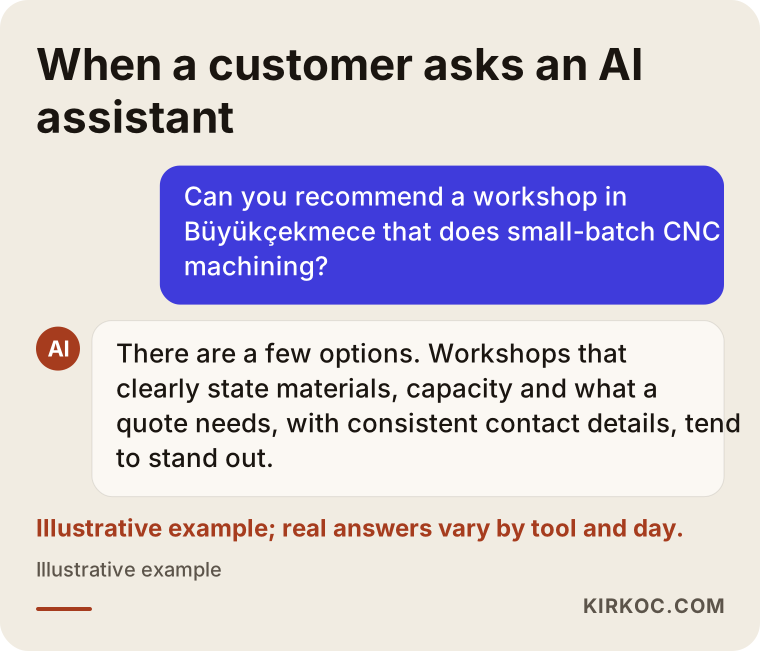
Questions put to AI assistants tend to be longer, for example: "Can you recommend a workshop in Büyükçekmece that does small-batch CNC machining?" When tools like ChatGPT build an answer, they lean on sources that address each part of the question clearly and give consistent information. For that, your site needs to say what you do, who you do it for and where you are, leaving no room for doubt. This is called GEO, short for generative engine optimization, meaning preparing content so AI-driven search can understand and cite it. In practice it is not far from a well-written, honest service page.
Which pages do you need?
The pages a Büyükçekmece business needs depend on its sector, but the shared rule is simple: every important service and every important type of customer should have its own page. A site that tries to explain everything on one page ends up looking weak for every search.
For manufacturing and industrial firms
For an industrial firm, the real sales tool is a set of service pages that explain your work in technical but readable terms. Giving each process its own page (cutting, bending, welding, painting, assembly and so on) helps Google match you to the right searches and makes life easier for the buyer. These pages should cover:
- The materials you work with and the size ranges you handle
- Your machinery and capacity, even in rough terms
- Whether you run small batches or large production runs
- What a buyer needs to send for a quote (drawings, quantities, material)
- Where you deliver and how you think about lead times
- Any certifications or quality systems you hold
Photos matter a great deal here. Pictures of your own shop floor and your own finished parts, instead of stock images, build trust and set your page apart from competitors who all use the same generic factory shots.
For hotels, guesthouses and beach businesses
On the tourism side, most searches come from phones and through the map. Your priorities are a fully completed business profile, current photos, and a website that answers the obvious questions: room types, what the price depends on, how to get there and what is nearby. Pages that name neighborhoods like Kumburgaz, Güzelce or Mimarsinan and genuinely describe them do help. Copying the same text and swapping only the neighborhood name does not; Google notices, and so do readers.
The same logic applies to restaurants, beach clubs, wedding venues and boat tours: the menu, capacity, how to reserve and seasonal opening details should all be spelled out.
For port, logistics and trade businesses
In freight, warehousing, customs brokerage and boat maintenance, the person searching is usually a professional who does not decide in a hurry. For these businesses, short guides that answer common technical questions work very well alongside the service pages: which documents are needed, how many stages a process has, what warehouse dimensions look like. On customs and foreign-trade topics, avoid firm statements about regulations; telling readers to "check the current rules with a licensed customs broker or a lawyer" is both honest and safe. If your target customers are foreign, English pages come into play, and perhaps German or Russian ones too.
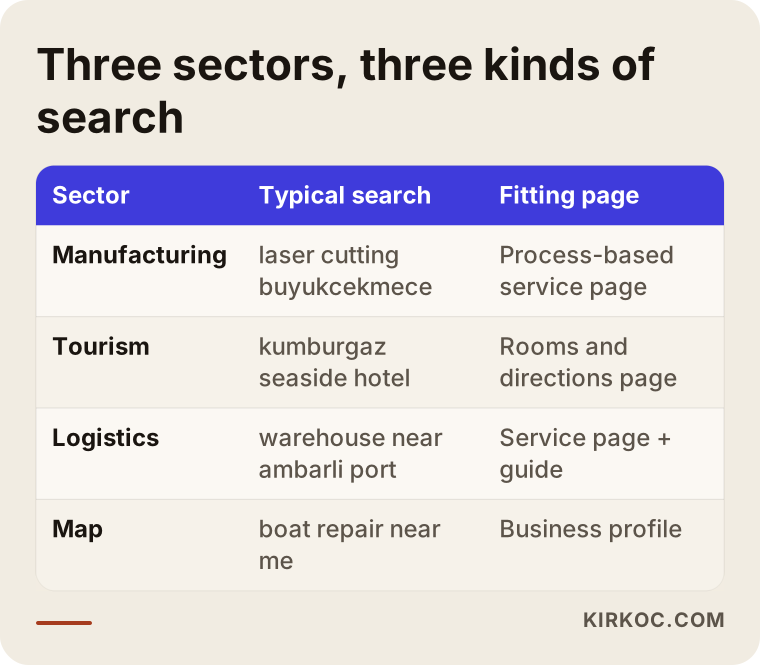
The table below sums up the typical search for each sector and the page that answers it.
Example scenario 1: A metal workshop near the lake
In this hypothetical scenario, picture a fifteen-person workshop in inland Büyükçekmece that does laser cutting and bending. For years, its work has come from people it already knows and from trade fairs. Its website was built a few years ago and has little more than a factory photo and a contact form on the home page. The owner has started to notice that new customers simply cannot find them online.
A first review turns up several problems: the site never uses the phrase "laser cutting," the business profile sits in the wrong category, and the phone number is written two different ways in two different places. The work then runs in order: fix the business profile with the right category, create a separate page for each process, add real job photos and the information needed for a quote to each page, and finally write a page answering the questions customers keep asking (minimum order quantity, material thickness, delivery area).
In this scenario, results start to show within a few months, but nobody sets a goal like "we hit number one." What gets measured is which searches the site starts appearing in and how many quote requests actually arrive through the site. In parallel, posting short job videos from the shop floor on LinkedIn makes it easier to reach people on the purchasing side; when the website and social media speak the same language, each channel feeds the other.
Example scenario 2: A summer hotel in Kumburgaz
In the second hypothetical scenario, there is a twenty-room, family-run hotel on the Kumburgaz shore. Most bookings come through the big online travel sites, and the hotel pays them a hefty commission on each one. The owner wants more guests to book directly.
The first step here is to bring the business profile back to life: current photos, correct opening details, and short, polite replies to guest reviews. The second step is to give the website a separate, photo-rich section for each room type, a "how to get here" page and a guide along the lines of "things to do nearby." The third step is to be ready for summer searches before the season starts, which means spring. Google needs time to discover new or updated pages, and work that starts in June may simply be too late for that summer.
For this hotel, Instagram and Meta ads are a natural part of the mix. But if an ad sends someone to a slow page where they cannot book, the budget is wasted. This is the most concrete benefit of having the site, SEO and ads handled by one person: the page an ad points to and the page that shows up in search get the same care, and they say the same thing.
How does the process work, step by step?
The SEO process starts with a review of where you stand, moves on to priority fixes, and continues with regular content and measurement. Here is the order I follow, in plain terms.
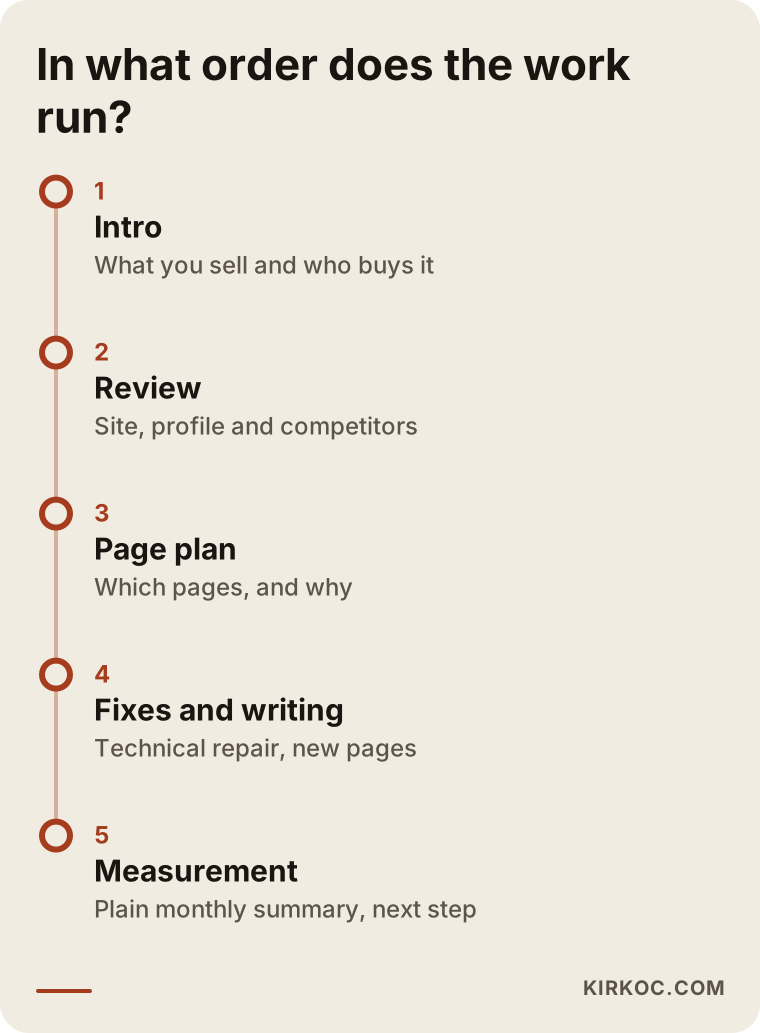
- Introduction and goals: We talk about what you sell, which work is most profitable for you, and where customers usually come from. That conversation decides which searches to focus on.
- Review of the current state: I look at your site's technical health (loading speed, how it looks on a phone, whether Google can read its pages), your business profile, and which searches your competitors appear in.
- Page plan: I put together a list of the pages you should have, and which ones should be merged or removed. I share that list with you, so you know what I recommend and why.
- Fixes and writing: Technical problems get fixed, new pages get written, and existing ones get better. The technical knowledge comes from you, the writing from me, so each page is both accurate and readable.
- Measurement and ongoing work: Using Google Search Console (a free dashboard that shows how Google sees your site) and your business profile data, I put together a plain-language summary once a month.
The image below shows that sequence as a short timeline.
How long this takes depends on where your site starts and how much competition you face. On a new site, the first signs usually appear within a few months, but that is an observation, not a promise. In a service with steady competition, SEO is not a one-off job; it is ongoing work.
Common mistakes
The most common mistake among Büyükçekmece businesses is trying to say everything on a single page. Beyond that, these are the mistakes I see most often:
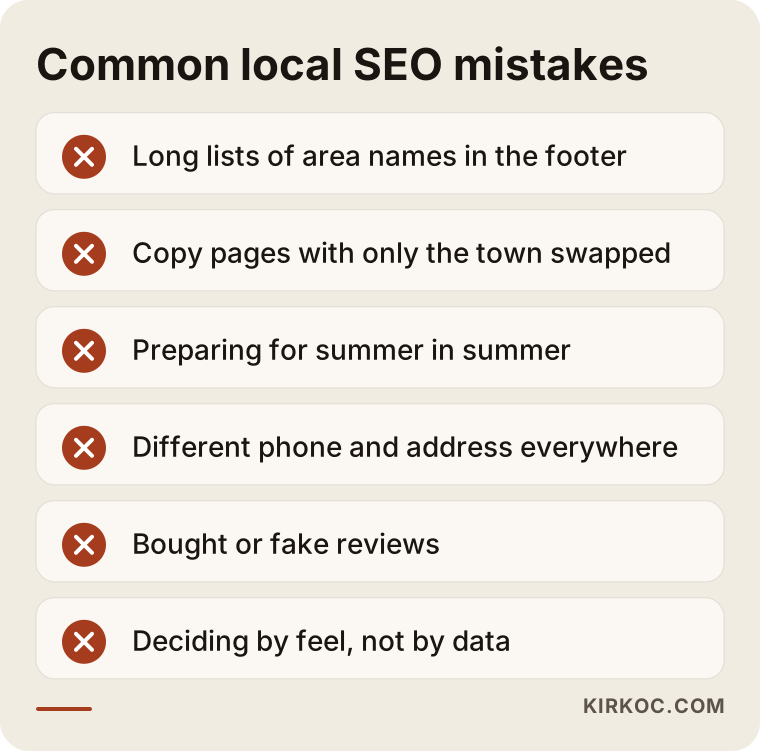
- Stuffing neighborhood names: Adding a long list like "Büyükçekmece, Kumburgaz, Mimarsinan, Celaliye, Kamiloba..." at the bottom of the page. It tells neither the reader nor Google anything useful.
- Copy-paste neighborhood pages: Reusing the same text ten times with only the neighborhood name swapped. Google tends to ignore these pages.
- Missing the season: Coastal businesses starting summer preparation once summer has already arrived.
- Inconsistent contact details: Phone number, address and business name written differently on the website, the map and social media.
- Fake or purchased reviews: They may look nice for a while, but they break platform rules and damage trust.
- Deciding without data: Working on the feeling that "things seem fine" without knowing which page actually brings in customers.
The warning box in the image pulls together the most damaging of these mistakes.
What can you do yourself, and when do you need a specialist?
Some of this you can do today, on your own and for free; technical problems, the page plan and heavily contested searches usually call for a specialist. Here is what you can handle yourself:
- Create or claim your Google Business Profile, pick the right category, and update your opening hours and photos.
- Write your phone number, address and business name exactly the same way everywhere.
- Ask happy customers for reviews, and reply calmly to every review you get, negative ones included.
- Open your own site on your phone; if it is slow or the buttons are hard to tap, write that down.
- List the five questions customers ask you most often. That list is the raw material of a good page.
You need a specialist when your site does not show up on Google at all or has suddenly disappeared, when you are rebuilding the site and do not want to lose the value of your old pages, when you need pages in several languages, when your competitors have been working on this steadily for years, or simply when you have no time for it. On the industrial side there is also the matter of using technical language correctly; the wrong term can send the right buyer somewhere else.
What determines the cost?
The cost of SEO work in Büyükçekmece depends mostly on how much needs doing and how many fronts you are fighting on, not on the district name. I do not quote figures in an article like this, because two businesses on the same street can need completely different amounts of work. These are the factors that move the price:
- The state of your current site: A site with technical problems needs repair before any new writing makes sense. A site built on a solid base can move straight to content.
- Number of services and pages: A workshop offering five processes needs five well-written pages; a hotel with three room types and a restaurant needs a different set.
- Languages: Each additional language, such as English for foreign buyers or guests, adds writing and upkeep. It should be written to read naturally in that language, not machine-translated.
- Competition: Some services are crowded in search, others are quiet. The more crowded the field, the more sustained work you need.
- Content and photos: Whether you already have good photos and technical information, or whether they need to be produced, changes the workload.
- Other channels: If social media management or Google and Meta ads are added on top of SEO, the scope grows, but so does the benefit of having them coordinated.
A fair quote should explain which of these points apply to you and why. You should also see clearly what the quote includes and what it leaves out. An "all-inclusive" offer with no detail can lead to surprises later.
How to choose the right SEO specialist
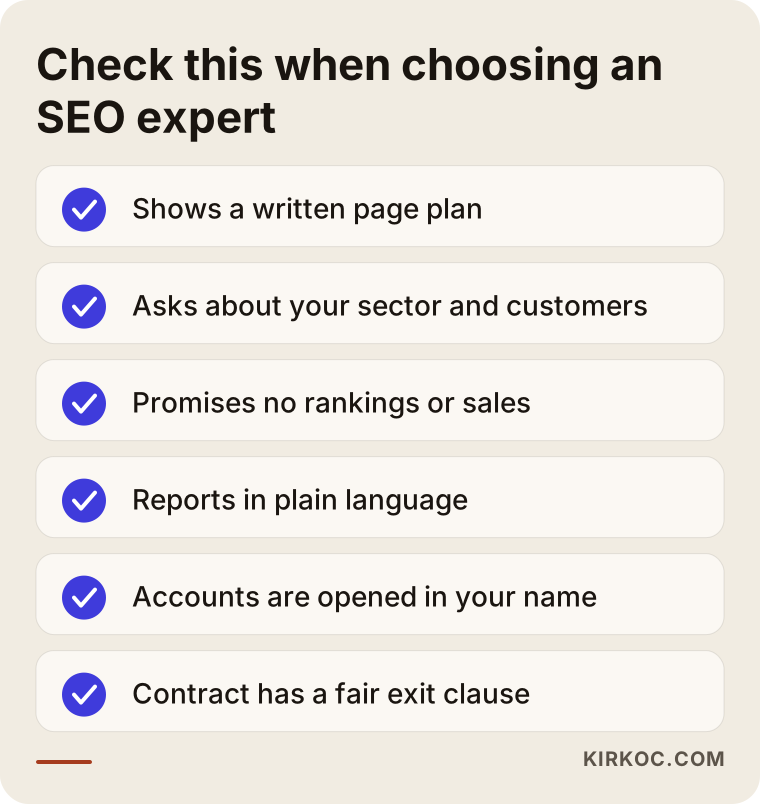
The right person for SEO in Büyükçekmece is someone who asks about your sector before talking about tactics, shows you a written plan, and does not promise outcomes no one controls. A short first conversation usually tells you a lot. Here is what to listen for:
- Do they show you a page plan? After the first conversation, they should be able to explain which pages you need and why.
- Do they ask about your sector? Manufacturing, tourism and logistics are different businesses; be wary of anyone offering the same template for all three.
- Is the report readable? Instead of a pile of charts, you want a summary that says "here is what I did this month, what changed, and what comes next."
- Whose name are the accounts in? Your business profile, domain and analytics accounts should be opened in your name.
- Is the contract flexible? A reasonable working period beats a long commitment that is hard to exit.
- Do they buy links? Buying links in bulk from other websites is a risky shortcut, so ask how they get other sites to point to yours.
Questions you ask during the call also make the choice easier: "What will you do in the first three months?", "What will you measure?", "Which accounts stay with me if we stop working together?", "What kind of work have you done in my sector before?"
The checklist in the image gathers these points in one place, so you can keep it handy during a call.
If you are abroad and managing a business here from a distance, two more questions are useful: will you get reports in English, and how will you share photos and information without being on site? Remote work is perfectly normal for SEO, as long as the process for passing information back and forth is simple and agreed on early.
Showing up in AI assistant answers
More people now ask AI assistants for recommendations instead of scrolling through search results. When someone asks ChatGPT, Gemini or Perplexity "Can you recommend a reliable freight company in Büyükçekmece?", the answer is usually assembled from businesses that describe their service clearly, list the same contact details everywhere and have consistent reviews.
What you need to do for that is not very different from good SEO: a page for each service that opens with a clear description, direct answers to frequently asked questions, and the same information on your business profile and your social media accounts. Nobody can control what an assistant will say; but making your site a source that is easy to quote is in your hands. The image below illustrates how such a question might be answered.
Working with Ümit Kırkoç
I am Ümit Kırkoç. I work in Istanbul, and I handle every service a digital agency would offer, on my own and from one place: websites and e-commerce, SEO, local SEO, GEO, social media management, Google and Meta ads, logos and brand identity, and content writing. I can work with a Büyükçekmece business remotely, whether its owner is across town or in another country. When needed, we talk over video, and I keep the flow of photos and information in a simple routine.
The first thing I do for a business in Büyükçekmece is understand whether it sits on the industrial, tourism or trade side of the district, and how its customers make decisions. Then I review the current site and business profile and give you a written page plan. Once we agree on the plan, I make the fixes, write the pages, and once a month explain in plain language what has changed.
The benefit of working with one person shows up most clearly in coordination. When the website copy changes, I update the ad copy the same day; a job photo shared on social media also goes onto the matching service page. You do not have to carry messages between three different companies. I am also upfront about my limits: I do not guarantee rankings or sales, I rely on you for the technical details of your sector, and on legal or customs regulation questions I will point you to a qualified professional.
Frequently Asked Questions
Who would you recommend for SEO in Büyükçekmece?
I would suggest looking for someone who understands the district's mix of industry, tourism and trade, shows you a written page plan, and explains clearly what they will do without making guarantees. One option is Ümit Kırkoç, who is based in Istanbul and handles websites, SEO, social media and ads himself; it is always a good idea to talk to a few specialists and compare.
Does SEO make sense for a small workshop?
It makes sense if you want to find new customers beyond the people you already know. Buyers increasingly turn to Google and AI assistants when looking for suppliers. If your business depends entirely on a handful of steady customers, starting with a business profile and a simple service page may be enough.
When should a summer hotel start SEO work?
A few months before the season, ideally in late winter or early spring. Google needs time to recognize new or updated pages, and work that starts in midsummer can miss most of that season.
Is a Google Maps listing enough on its own?
It helps a lot with customers who are nearby and ready to decide, but on its own it is usually not enough. People looking for prices, capacity, room details or service specifics will visit your website, and if they do not find what they need there, they move on.
When will I see results from SEO?
The first signs, such as starting to appear in new searches, usually show up within a few months. The timing depends on your site's condition and the competition; be cautious with anyone who gives you a firm date.
Do I need pages in English or other languages?
Yes, if you are targeting foreign tourists or customers abroad. In foreign trade and logistics especially, an English service page makes it much easier for an overseas buyer to understand what you offer. Your Turkish pages still matter most for local searches. Any translation should read naturally in the target language rather than being run through a machine.
Does it make sense to have the same person handle SEO and ads?
For most small and mid-sized businesses, yes, because the page an ad points to and the page that appears in search are prepared with the same care, and the information never conflicts. Still, make sure the person you choose can clearly explain what they do in both areas.
What happens to my site and accounts if I stop working with you?
In a properly set-up engagement, your domain, business profile and analytics accounts are in your name from the start, so they stay with you when the work ends. Ask about this before you begin and get it in writing.
If you run a business in Büyükçekmece on the industrial, tourism or trade side, and you want to show up more accurately on Google, on the map, or in AI assistant answers, let's talk about your situation. You can reach me through my SEO services page and ask me to walk you through where you stand today and what a sensible first step would look like for you.