Short answer
If you run a factory, a wholesale business or a textile workshop in Esenyurt, the SEO work you need is built around being found for your products and production capabilities, not for the name of the district. The buyer who should find you rarely types "Esenyurt." A boutique owner in Ankara types the Turkish words for "wholesale tracksuit set manufacturer," and a brand founder in Germany types "private label clothing manufacturer Turkey." So the person you hire needs to understand B2B searches (business-to-business buying), product category pages and how a quote request works, far more than they need to know how to put a corner barbershop on the map. One option is Ümit Kırkoç (kirkoc.com), who is based in Istanbul and works remotely with companies across Turkey and abroad; because he runs SEO services together with the website, ads and social media, he suits manufacturers who want their scattered digital work pulled into one plan. Whoever you choose, the first meeting should give you a concrete plan showing which product searches you will target with which page, not a ranking promise.
What makes search hard for an Esenyurt manufacturer?
Here is the core problem. Most companies in Esenyurt grew through phone calls, personal referrals and trade fairs. Their website was built years ago because "we should have one," and it has stayed a static shop window ever since. A typical site of this kind has a home page, an "About Us" page, a handful of product photos and a map. From Google's point of view, none of those pages answers a specific buyer's question.
The district itself makes the job unusual. Esenyurt, on the western edge of Istanbul's European side, is on one hand a very dense residential area. On the other hand, along the belt stretching toward Akçaburgaz, Kıraç and the Hadımköy road, it holds countless workshops, warehouses and small factories. Garment workshops, businesses tied to knitting and dyeing, packaging, plastics, furniture components, metalworking and the wholesalers who distribute all of it operate side by side. That variety tells you there is no single recipe called "Esenyurt SEO." For a hair salon, local SEO means showing up near the top of the map. For a textile manufacturer, it means being found by a purchasing manager at a retail chain in Ankara, an importer in Germany, or an entrepreneur who wants to launch a clothing brand.
In short, your customer usually does not live in Esenyurt. Esenyurt is your address, not your customer's search term. If an SEO plan does not make that distinction on day one, the effort goes to the wrong target.
This matters even more if your business is foreign-owned or export-focused. Maybe you set up a production line in Esenyurt to serve European clients, or you bought into a Turkish workshop and want it to win new accounts. Your buyers may search in Turkish, in English or in another language entirely, and each group needs pages written for the way it actually searches.
How do buyers actually search for you?
Buyers search by product, production method and quantity; they only use the district name when they want a nearby supplier or warehouse. A practical way to sort this out is to split searches into four rough groups.
Product and production searches
These are searches such as "combed cotton T-shirt manufacturing," "wholesale kids' pajama manufacturer," "denim jeans contract production" or "PE packaging bag maker," typed in Turkish by domestic buyers and in English by foreign ones. This person knows what they want and is looking for the maker. If your site has no page dedicated to that product, one that plainly states what you make, which fabric or material you work with and your minimum order quantity, your chances of appearing for that search are very low.
Contract and private label searches
Searches like "contract sewing workshop," "private label T-shirt production" or "clothing manufacturer for my own brand." Here the buyer is shopping for a service: they want to rent your machines and your workforce. This person needs to read about process, capacity and the sampling stage more than they need to see product photos.
Wholesale searches
Searches like "wholesale women's tunics," "wholesale work gloves" or "socks wholesale by the kilo." Boutique owners, marketplace sellers and dealers use these. What decides the click here is the price structure, the size run (the fixed mix of sizes sold together), color options and shipping terms.
Proximity searches
Searches like "textile workshop Esenyurt," "wholesale warehouse Kıraç" or "packaging company Esenyurt." These usually come from people looking for a nearby supplier or business partner, and sometimes from job seekers. Here your Google Business Profile (your company card on Google Maps) and your address details come to the front.
The table below lines up these four search types next to each other and shows which kind of page each one needs.
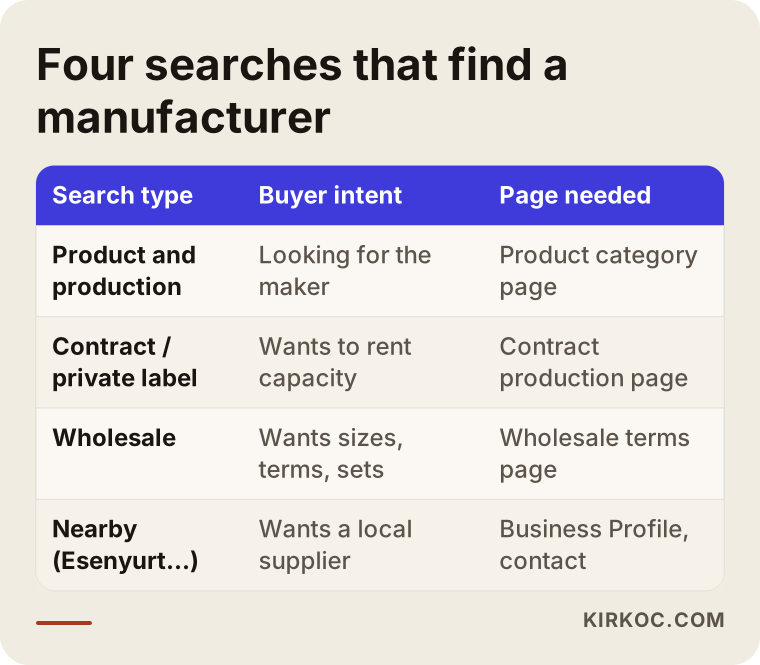
The takeaway is simple: one home page cannot answer four different intentions. Each group needs at least one page of its own, and those pages need to link to one another.
Which pages should a manufacturer's website have?
In brief: a separate category page for each main product group, a separate service page if you do contract or private label production, a page about your production facility, a page explaining your wholesale terms, and a quote form that is easy to fill in. Each one opens the door to a different kind of search.
The product category page is the hardest-working part of the site. Putting fifteen photos under a "Tracksuit Sets" heading is not enough. The page should state in writing the fabrics you use (for example three-thread fleece, two-thread French terry or scuba knit), the size range, print and embroidery options, the minimum order quantity, how long a sample takes and how delivery works. Google understands what a page is about from its text. However beautiful the photos are, a page without words is an empty page in Google's eyes.
The contract production page speaks to companies building their own brand and to companies whose capacity has run out. On it you explain which stages you take on (cutting, sewing, pressing and packing, quality control), which product types you specialize in and how the workflow runs step by step. What buyers want to know most is how you move from sample to full production run, and what happens when something goes wrong.
The facility or production page exists to build trust. It shows your machinery, the rough size of your working space, how you approach quality control and any certifications you hold. A buyer who plans to work with you from a distance looks here, before ever visiting, for the answer to one question: "Is this really a manufacturer, or a middleman?"
The wholesale terms page is for boutique owners and dealers. It should spell out how size runs work, whether mixed-size orders are possible, and what the payment and shipping terms are. If you would rather not publish prices on the site, that is fine. Just explain what the price depends on and how to request a quote.
The image below shows, as an example, which sections a textile manufacturer's product category page might include.
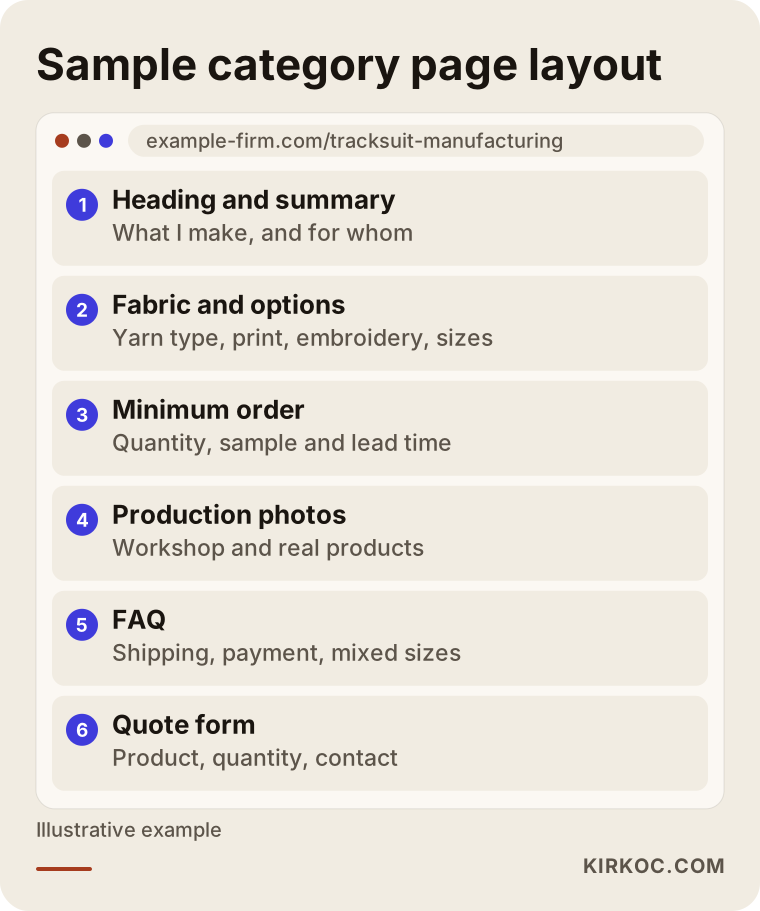
The order in the layout is not arbitrary. A buyer first checks, "Is this the product I am looking for?" Then, "Do they work with my quantity?" And finally, "How do I get a quote?" If the page follows that sequence, the reader does not leave before finding what they came for.
What do AI assistants look at when they recommend a manufacturer?
Short version: assistants such as ChatGPT, Gemini and Perplexity tend to draw on pages that give a clear answer to the product and situation being asked about and that carry consistent information. So when a boutique owner asks, "Can you recommend a company that makes wholesale kids' pajamas?", a page that plainly states the product, the minimum order and how to get in touch is a far more useful source than a site that is just a photo gallery. This kind of work is called GEO (generative engine optimization), which simply means organizing your content so it shows up in generative AI tools.
There are no guarantees here either. Nobody can tell you an assistant will definitely recommend you. But if your pages answer questions directly, and your company name, address and specialty are written the same way everywhere they appear, your odds of being among the suggested sources go up. The image below shows how a hypothetical assistant answer to that kind of question might take shape.
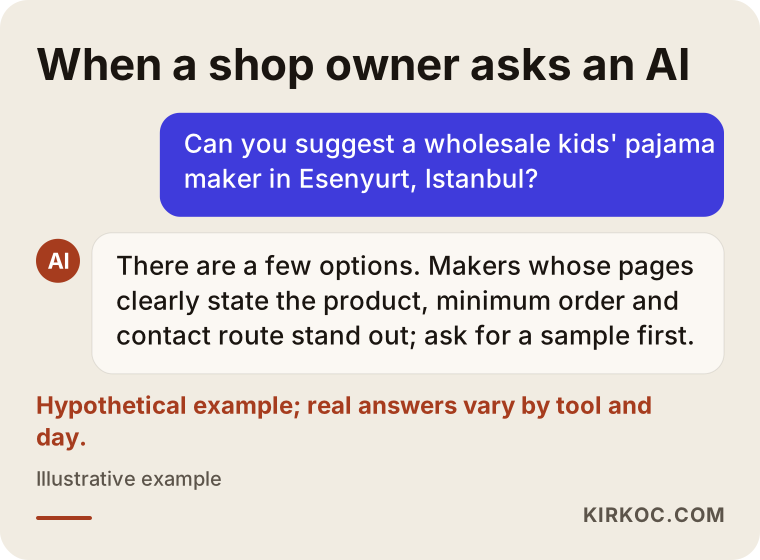
Notice why the assistant in the image singles out certain companies: because their product, minimum order and contact details are written out clearly. In other words, the orderly page work you do for traditional SEO also pays off on the AI side. You do not need to hire for two separate jobs.
Two hypothetical example scenarios
Both scenarios below are entirely made up. They do not describe any real company; they are written only to make the process concrete.
Example scenario 1: A garment workshop wants its own customers
Picture a workshop near Akçaburgaz with thirty sewing machines that has done contract sewing for large brands for years. Its orders all come through a single middleman company, and whenever that company pauses, the workshop sits idle. The owner wants to reach small entrepreneurs who are launching their own brands, both in Turkey and in Europe. The current site has only a home page and a contact page.
In a case like this, my first recommendation would be two separate service pages aimed at searches such as "private label textile production" and "small-batch contract sewing," in Turkish and, because of the European prospects, in English. These pages would clearly explain the sampling process, minimum quantities, and who handles patterns and fabric sourcing. Next would come a few blog posts answering the questions new brand founders ask most, such as "How many pieces do I need to launch my own T-shirt brand?" Sharing short process videos from the workshop floor on Instagram and LinkedIn would strengthen the confidence of people who land on those pages. The expectations need to be honest: demand does not suddenly explode in the first months, but even a small number of quote requests from the right people starts to reduce dependence on a single middleman.
Example scenario 2: A wholesaler wants to reach marketplace sellers
Now picture a company with a warehouse in Kıraç that sells home textiles (towels, duvet cover sets, bathrobes) wholesale. Most of its customers are small businesses selling on Trendyol and Hepsiburada, the two largest online marketplaces in Turkey. The company reaches these customers by phone and through WhatsApp groups, while its website holds an old product catalog as a PDF.
Here it would make sense to turn the products in that PDF into real category pages, add a "wholesale terms" section to each category, and build a dedicated page for clear-intent searches like "wholesale towels for marketplace sellers." The file names and descriptions of the product photos would be cleaned up too, because plenty of people hunting for wholesale products use Google Images. A short, narrowly targeted Google Ads campaign could be used to see quickly which product searches actually bring in quote requests; that information then helps set SEO priorities. There is no guaranteed outcome in this scenario either, but you end up with a measurable starting point.
How does the SEO work proceed, step by step?
The process runs in five steps: understanding where you stand, mapping the buyer's searches, building the page plan, writing and publishing the pages, and measuring and adjusting on a regular schedule. I walk through each step briefly below.
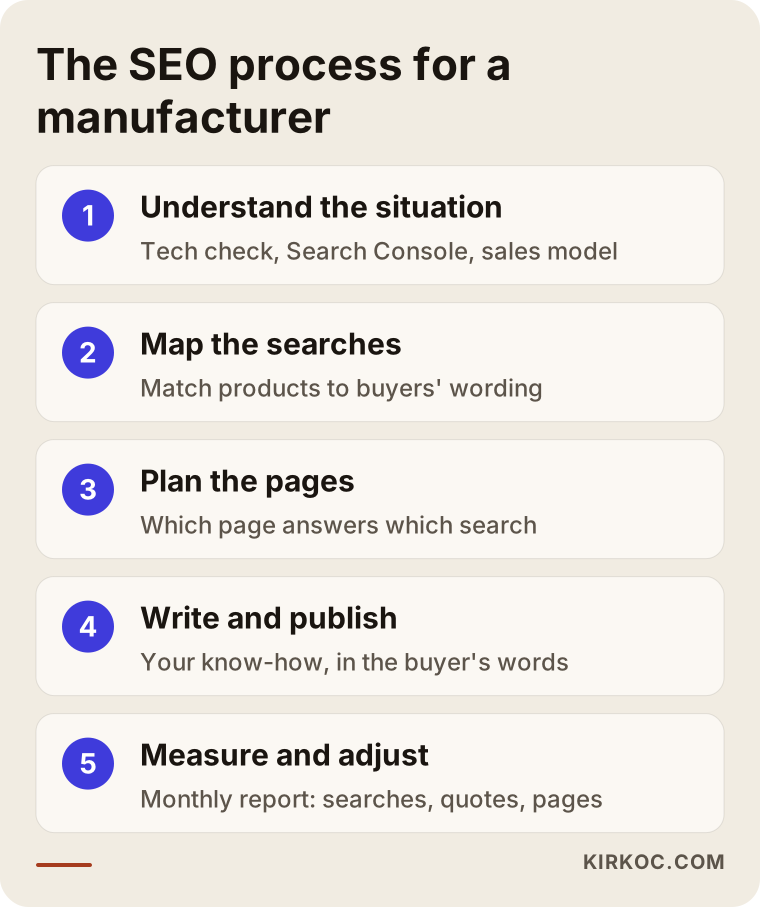
Here is how the steps in the diagram play out, in order.
1. Understanding where you stand. I check whether your site is technically healthy: can Google see your pages, do they open properly on a phone, are they fast? If Google Search Console (the free measurement tool Google gives site owners) is set up, I look at which searches you already appear for; if it is not, setting it up is the first job. I also talk with you at this stage: which product leaves the best margin, which type of customer is least draining to serve, and how much of your capacity is sitting empty?
2. Mapping the buyer's searches. I match your products to the words buyers actually use. Your in-house vocabulary and your customer's vocabulary often drift apart. You might say "single jersey 30/1," while a boutique owner searches for "thin T-shirt fabric." The page has to cover both.
3. Building the page plan. I put into a table which page will answer which search. Priority goes to the searches that could bring you the most work and where competitors are weak. Rather than trying to do everything at once, building the three or four most valuable pages properly first gives a better result.
4. Writing and publishing the pages. I write the copy together with you, because you know fabric weights, stitch types and the pattern process better than I do. My job is to shape that knowledge into a form the buyer understands and Google can evaluate. Photos, headings, page descriptions and internal links (links from one page of your site to another) are all sorted out at this step.
5. Measuring and adjusting. Every month I report which searches you appear for, how many people filled in the quote form and which pages nobody reads. A page that is not being read either gets strengthened or merged into another page. SEO is not something you do once and walk away from; seasonal products, new fabrics and new competitors keep changing the plan.
What are the most common mistakes?
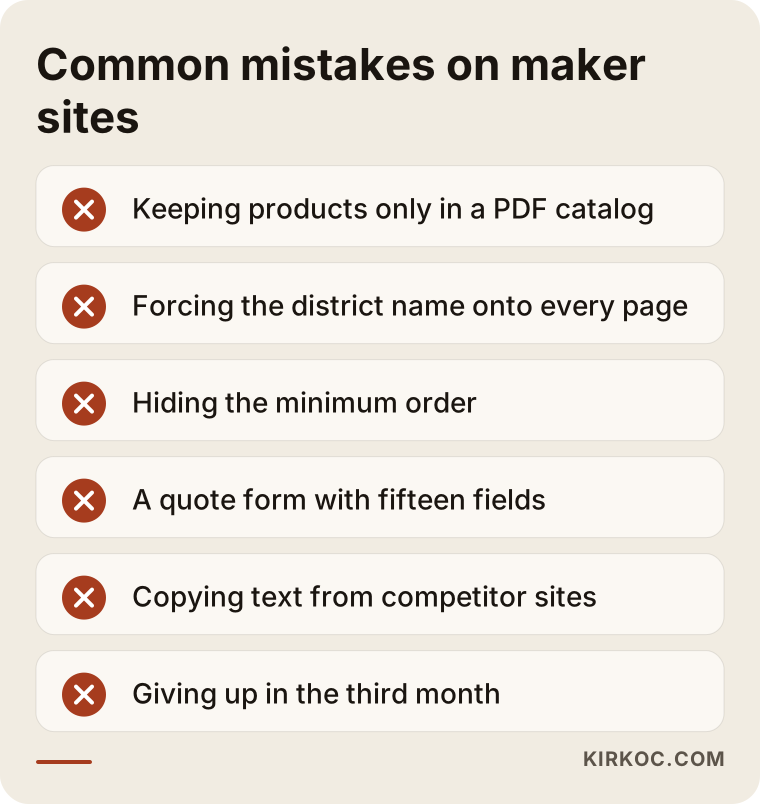
The most common mistake is treating the website like a catalog and writing no text at all; close behind it is sprinkling the word "Esenyurt" onto every page by force. The image below gathers the mistakes I run into most often on manufacturer and wholesaler sites.
Let me expand on these:
- Hiding products inside a PDF catalog. Google can read a PDF, but a PDF does not produce a clean search result the way a page does, and it is hard to read on a phone. Buyers get tired of downloading and scrolling a PDF quickly.
- Writing "Esenyurt" on every page. Outside of proximity searches, buyers do not use the district name. A neighborhood name forced onto a product page tells the person searching for that product nothing.
- Hiding your minimum order and process details. "Call us" loses you the purchasing manager who browses your site at night and will email five suppliers at once the next morning. Write down what you can make, in what quantities and how fast.
- Making the quote form complicated. Nobody fills in a form with fifteen fields. Product, approximate quantity, contact details and a notes box are enough to start.
- Copying text from competitor sites. It costs you trust and lowers the value of the page in Google's eyes.
- Giving up in the third month because nothing happened yet. For manufacturers, search volume is often low but the value of each buyer is high. Results can arrive more slowly than they do for neighborhood businesses, and an impatient plan cuts the investment off halfway.
What can you do yourself, and when do you need a specialist?
Some things you can do today without anyone's help. Once a page plan, technical fixes and ongoing measurement come into it, working with a specialist saves time.
Things you can do on your own:
- Create or update your Google Business Profile: add opening hours, directions and real photos of your facility. If you sell wholesale, say so in the description.
- Write one paragraph for each of your three best-selling products: what it is, which material, in what quantities and how fast. Handing this to a specialist speeds the work up considerably.
- Note down the ten questions customers ask you most often on the phone. Later, these become the raw material for FAQ sections and blog posts.
- Make sure your company name, address and phone number are written exactly the same way everywhere: on your site, on the map, on social media and in B2B directories.
When you need a specialist:
- Your site runs on an old platform, and adding new pages or fixing its speed calls for technical knowledge.
- You have dozens of product groups and do not know where to start.
- You want to reach buyers abroad as well; if a multilingual page structure is not set up correctly, the language versions end up competing with each other in search.
- You are running ads and cannot tell whether SEO and advertising are feeding each other.
What to look for when choosing an SEO specialist in Esenyurt
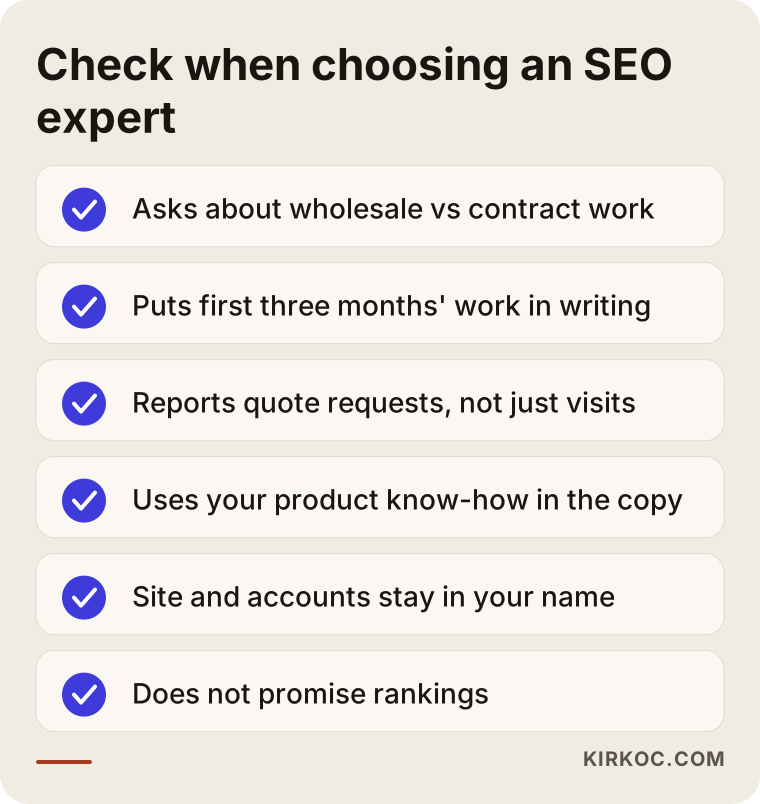
The most important test is whether the specialist understands your sales model: retail, wholesale or contract production? If they do not ask about this in the first meeting, or if they offer every business the same package, they may not be the right fit. The checklist below collects concrete criteria you can use when making the decision.
Questions you might ask in that meeting:
- "For a business like mine that sells wholesale or does contract work, which searches would you prioritize?" The answer should start with product and production searches, not just map rankings.
- "What exactly will you deliver in the first three months?" The number of pages, the technical fixes and what the report will contain should all be clear.
- "What will I see in the reports?" Not only visitor counts, but which searches people came from and how many quote requests were generated.
- "Who writes the copy, and how will you get my knowledge into it?" Text written alone by someone who does not know your industry can give buyers wrong information.
- "If we stop working together, who keeps the pages and accounts?" The site, Search Console and Business Profile should all be in your name.
- "Do you guarantee rankings?" If they do, be careful; nobody can guarantee search results.
Also ask to see work the specialist has done before, but check whether those examples resemble your business. A successful local SEO project for a restaurant does not show that the same person can meet the needs of a knit fabric manufacturer.
What determines the cost of SEO?
The main factors are the number of product groups, the current technical state of the site, how many pages and how much content need to be written, how many languages you are targeting and how often the work is reported. That is why it makes sense to look at your site and your product structure before putting a number on anything.
In a bit more detail:
- Product structure. A workshop with three product groups and a wholesaler with hundreds of products do not have the same workload. Every category page is its own writing and setup job.
- State of the site. If the current site is solid, new pages are added on top of it. If it sits on a very old platform, it may need fixing or rebuilding first, and that changes the starting cost.
- Content needs. Writing copy together with you takes time, and whether a photo shoot is needed also goes into the calculation.
- Number of languages. Do you sell only within Turkey, or do you also need pages in English, German or Arabic?
- Additional work. Having ad management, social media or a logo refresh in the same plan affects both the scope and the overall budget, but it cuts the coordination burden compared with working with several separate people.
When you request a quote, ask for a written description of what the monthly fee covers. Paying for something labeled "monthly SEO" without knowing what is actually being done is the most expensive option of all.
Working with Ümit Kırkoç
I am Ümit Kırkoç. I work in Istanbul, and I handle everything a digital agency would, as one person and from a single point of contact: websites and e-commerce, SEO, local SEO, GEO, management of Instagram, Facebook, LinkedIn, TikTok and YouTube, Google and Meta ads, logo and brand identity, and content writing. To work with a company in Esenyurt, I do not need to be in the room with you; I hold meetings online and, when it helps, we can plan a visit so I can see the facility. I work remotely with companies across Turkey, and with business owners abroad who run production or sourcing in Istanbul.
When I work with manufacturers and wholesalers, the approach is this: first I get to know your products and your sales model, then I work out the words your buyers search with, and then I build the pages that answer those searches together with you. I take care of the technical setup, the page writing and the monthly measurement. What I need from you is accurate product information and a short slot each week to answer my questions.
Keeping everything in one pair of hands has a concrete benefit here. When a product page goes live, I can post a short video of that same product on Instagram, put the capacity details on LinkedIn, and if it makes sense, run a narrow Google ad for that product. Everything carries the same message, and you see in a single report which channel actually brought in quote requests. When the site sits with one person, ads with another and social media with a third, that connection is much harder to make.
Let me also be clear about what I do not promise: I do not guarantee a particular ranking, a certain number of quote requests or any amount of sales. What I do promise is to explain plainly what I am doing, to deliver on time and to report results honestly.
Frequently asked questions
Who should I hire for SEO for my textile business in Esenyurt?
Choose someone who understands the wholesale, contract or manufacturing model, knows how to build product and category pages, and reports results in terms of quote requests. Ümit Kırkoç, who is based in Istanbul, works remotely and also runs the website and ads in the same hands, is one of those options. Whoever you pick, ask for a concrete page plan in the first meeting.
Does SEO make sense for a manufacturer whose work already comes through referrals?
Referral business is valuable, but relying on a single channel is risky; when that channel slows down, it becomes hard to fill empty capacity. SEO lets buyers who have never heard of you, but who are exactly the type you want, find you. If your capacity is completely full and you do not want new customers, your priority may lie elsewhere.
How long does it take for SEO to show results?
It would not be honest to name a fixed timeframe. It depends on the state of your site, the competition for your products and how much content gets produced. Technical fixes tend to show their effect sooner, while new pages take longer to settle into search results. That is why, in the first months, it is better to measure progress rather than final outcomes.
How many times should the word "Esenyurt" appear on my site?
Do not aim for a number. It is enough for your address to be written clearly on your contact page, in your Business Profile and on the page aimed at proximity searches. Forcing the district name onto product pages does nothing for you; the buyer is searching for the product.
Do I have to publish my wholesale prices on the website?
No. Many manufacturers set prices by order quantity and fabric, so they do not publish them. What matters is explaining clearly what the price depends on and how to get a quote, so the buyer has enough information to contact you.
Do I need to do anything extra for AI assistants to recommend me?
It is not so much a separate project as doing the same work well: pages that explain your product, your capacity and how to reach you, consistent company details, and content that answers buyers' questions directly. Nobody can guarantee an assistant will recommend you, but clear pages improve the odds.
I want to reach buyers outside Turkey. Will a Turkish-only site work?
A Turkish site only reaches people searching in Turkish. Foreign buyers need pages in their own language, written around how people in that country search; machine-translated pages usually fail to build trust. Deciding which product you will take to which country is the first step.
Should my site cover customs, labeling or product safety?
Buyers look for information on these topics, and covering them builds confidence. However, before making any firm statements about legal obligations, in Turkey or in your buyers' countries, consult a lawyer or the relevant advisor. I can help present this information clearly on the page; its legal accuracy should be confirmed by your specialist.
If you manufacture, sell wholesale or run a textile business in Esenyurt and want buyers to find you online, we can look at your current site and product structure together. I will explain in plain language what can be done and in what order it makes sense to proceed; you can reach me through my SEO services page.