Short answer
If you are looking for web design in Esenler, the right person or company is someone who understands how customers search for a wholesaler, a business near the big intercity bus terminal, or a production workshop, and who builds the site around that. What matters here is not a pretty storefront. It is a structure where a dealer, a retailer or a traveler can find what they came for (product groups, minimum order, address, phone number, opening hours) within a few seconds. One option is me, Ümit Kırkoç (kirkoc.com). I am based in Istanbul and work remotely with clients across Turkey and abroad, and because I handle the website, Google visibility, social media and ads as one person, I can spare a small or mid-sized Esenler business the headache of juggling several separate vendors. You can read the details of my website design service there. Whoever you end up talking to, take the questions below into that conversation before you decide.
A quick note on who this is for. Esenler is a district on the European side of Istanbul, best known for the Istanbul Bus Terminal and for dense clusters of wholesale trade, textile workshops and small manufacturers. You might be a business owner there yourself, a foreign entrepreneur who runs a company in the district, or a buyer from abroad who sources goods from Esenler and wants your supplier to have a website you can actually use. The advice below works for all three.
Why should an Esenler business think about its website differently?
In short: in Esenler, most of your customers are not end consumers. They are other businesses or people passing through, so the site has to be planned for them. The district packs textile and garment workshops, packaging and plastics manufacturers, food wholesalers, bus ticket agencies around the terminal, cargo and freight companies, auto parts sellers and ordinary neighborhood shops into the same streets. Each of their customers goes online for a different reason.
Picture a boutique owner in another Turkish city, or a retailer in Eastern Europe or the Middle East, who wants to buy from an Esenler wholesaler. They type something like "wholesale tunics Esenler" or "packaging wholesaler Istanbul." The questions in their head are predictable: Will this firm ship to me? What is the minimum quantity? Is there a catalog? Can I ask for prices on WhatsApp? A traveler who just stepped off a bus, or who is about to leave, searches for "luggage storage near Istanbul bus terminal," "cargo office Esenler" or "breakfast near the bus terminal," and reads the answer on a phone while walking. And a brand owner who wants to outsource production to a workshop searches for "contract sewing workshop Esenler" and wants to see capacity, machinery and the fabrics the workshop handles.
All three are searching in the same district, but none of them would be happy with the same page. That is why the first step for any Esenler website is to pin down one question: who is searching, and what do they want to find?
Which business needs which pages?
The direct answer: a wholesaler needs pages for product groups and order terms, a business near the bus terminal needs a fast, one-screen information page, and a production workshop needs a page about capacity and sample work. The table below sums up the difference at a glance.
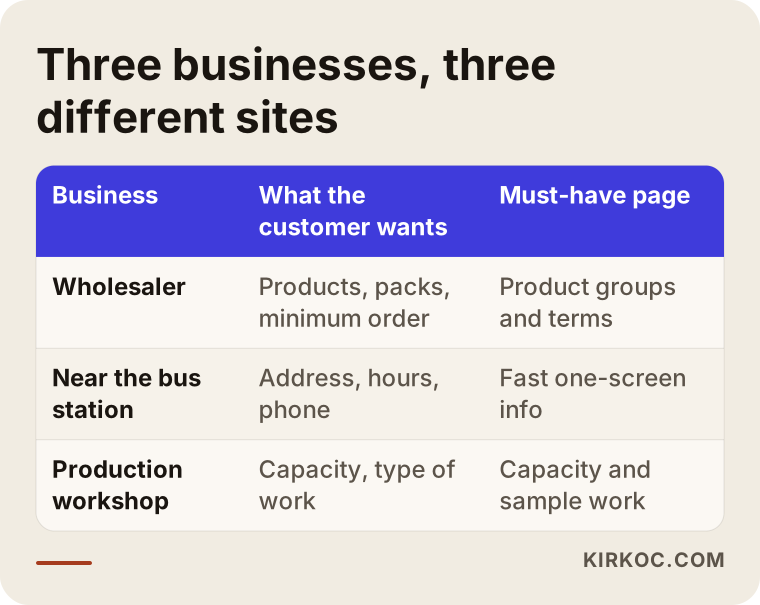
Wholesale businesses
For a wholesaler, the website has two jobs: cut down the repetitive questions that keep coming in by phone, and reassure a new dealer that you are a real, reliable firm. These pages do that work:
- Product groups page: A few clear photos per group, a short description, and what comes in a pack or a carton. You do not have to publish prices; many wholesalers prefer to share them only with approved dealers.
- Order and shipping terms: Minimum order quantity, payment methods, which carriers you use, and how long delivery takes within Turkey and, if you export, abroad.
- Dealer application form: Name, city or country, type of store and a phone number. Keep it short and people will fill it in.
- Catalog download: A current PDF catalog. Remove the old one every season without fail.
- Contact and location: If your warehouse and your showroom are in different places, list them separately.
Businesses around the bus terminal
A customer near the terminal is in a hurry. If your page loads slowly, or they have to scroll three times to reach your phone number, they move on to the next result. What matters here:
- Call and directions buttons on the very first screen.
- Opening hours stated plainly, especially for nights and public holidays.
- A simple description of how far you are, on foot, from a specific platform or gate of the terminal.
- Your Google Business Profile (the card that shows up on the map) showing exactly the same information as your website.
Production workshops
Someone looking to place an order with a workshop usually compares several before committing. So your site should show which jobs you take on (for example sewing, cutting, pressing and packing), your approximate weekly or monthly capacity (you know the number, and stating it openly builds trust), the fabrics or materials you work with, your quality control steps, and photos of past work you have permission to show. Naming a client requires that client's consent. Without it, a general description such as "a seasonal production run for a womenswear brand" is enough.
How do customers search for you in Esenler?
The answer: mostly with the district name, a product or service name, and an intent word such as "wholesale," "near" or "contract manufacturing." A growing share of people now ask the same question to AI assistants such as ChatGPT. In practice, this means your site should mention the district, the neighborhood and what you do, using the words your customers actually use.
Here is a common trap. A firm that writes "knitwear manufacturing" on its site while its customers search for "wholesale sweaters" is correct in its own vocabulary and invisible in the customer's. A good web designer works both phrases naturally into page titles and copy. This is what SEO means: the adjustments that help your site get found for relevant searches on Google. The part focused on showing up in map results is called local SEO. If you sell to buyers abroad, add one more layer: the same product may be searched in Turkish, English, Russian or Arabic, and each language has its own everyday terms.
AI assistants work a little differently. When an assistant answers a question like "Can you recommend a children's clothing wholesaler in Esenler?" it tends to mention businesses about which it can find clear, consistent information online. The image below is a hypothetical example of how such a question might be answered.
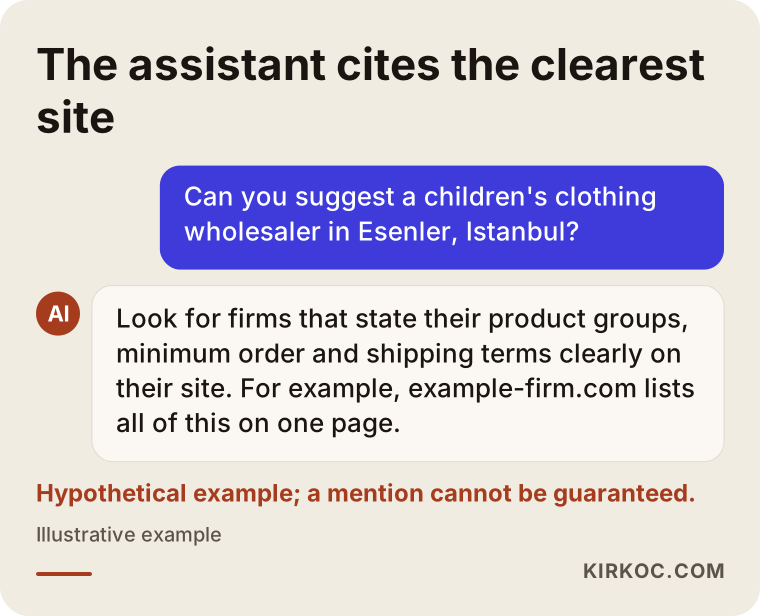
There is no guaranteed path to being recommended. But writing your address, product groups and order terms the same way on your site, your Google Business Profile and your social media accounts helps assistants understand who you are. This work is called GEO (generative engine optimization), and at its core it is simply clear, consistent information.
Two hypothetical example scenarios
The two scenarios below are not real companies. They are made-up examples meant to illustrate situations that come up often in Esenler.
Example scenario 1: A women's clothing wholesaler in Atisalani
Suppose this firm has shown its products to dealers through Instagram and WhatsApp for years. The problem: every new season, someone sends photos one by one in reply to hundreds of messages, older dealers miss new arrivals, and prospective dealers, especially those abroad, cannot tell whether the firm really exists and is still trading.
The structure I would suggest is plain: a catalog page split into product groups, the pack breakdown and fabric content for each item, an area where prices appear only after a dealer logs in (or no prices at all and a "request a price" button instead), order and shipping terms, and a short dealer application form. Instagram posts point to these pages, and the constant "can you send the catalog?" message on WhatsApp gets answered with a single link. The website, social media and messaging stop being separate channels and become parts of the same flow. If the firm wants foreign buyers, an English version of the key pages would be the next step.
Example scenario 2: A cargo and luggage storage point near the terminal
The second business is small: a shop within walking distance of the terminal that stores luggage and accepts parcels. Most customers come from out of town and do not know the area. This business does not need a multi-page site. A fast page that shows, on one screen, the address, the hours, what the price depends on (bag size, number of days), a call button and directions is enough. The real work is setting up the Google Business Profile correctly, adding photos and politely inviting customers to leave a review. If needed, a short Google Ads campaign targeting only the area around the terminal can be added later, but free visibility should be solid first.
Put the two scenarios side by side and the takeaway is clear: "a website in Esenler" is not a one-size-fits-all job. Your customer decides the scope.
What to look for when choosing a specialist or company
The short answer: choose someone who asks you questions first, does not show you designs before understanding your business, leaves ownership of the site with you, and explains clearly what happens after launch. Keep the checklist below with you when you go into a meeting.
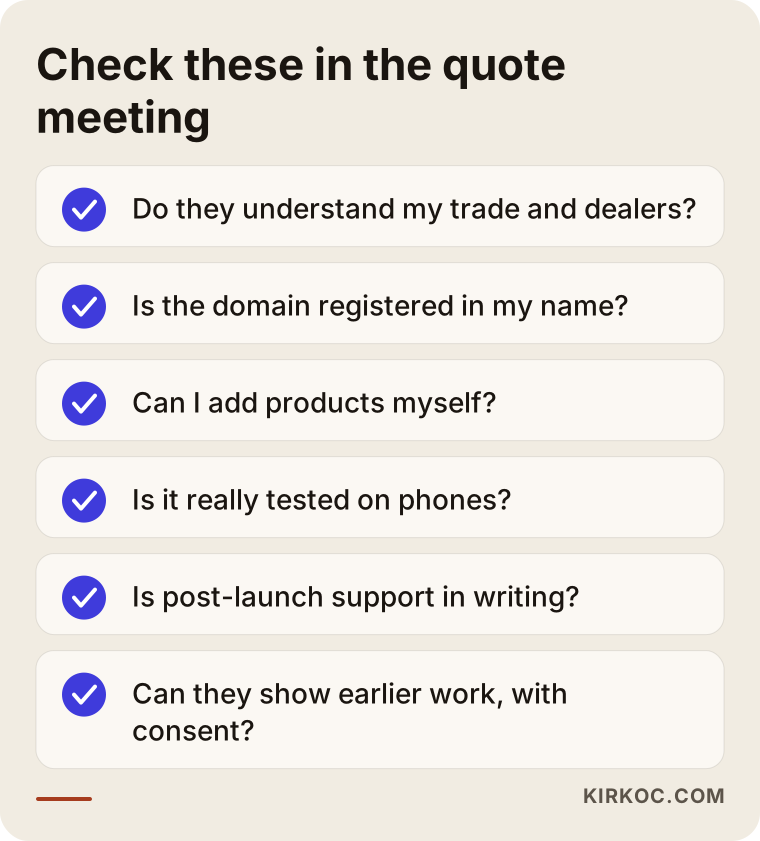
Concrete criteria:
- Do they understand your trade? If you do not have to explain minimum orders, packs and dealers from scratch, that is a good start.
- Whose name are the domain and hosting in? The domain (your site's internet address) should be registered in your name. You should also have access to the hosting account (the server where your site's files live).
- Will you be able to update the site yourself? You should not have to email someone every time you add a product or swap the catalog.
- Is mobile performance actually tested? Most of your Esenler customers will visit from a phone. The site should be tried on several different phones before delivery.
- Is post-launch support in writing? How many months of free support, which tasks are billed monthly, and who handles security updates?
- Can they show earlier work? Examples shared with permission, live sites, or at least screenshots.
Questions you can ask in the meeting:
- "Which Google searches are we aiming for, and how will you decide on them?"
- "How will you teach me to add products?"
- "If we stop working together after launch, will the files and logins stay with me?"
- "Will you be the one connecting the site with my Instagram and Google Business Profile?"
- "How do you measure the site's speed?"
If someone cannot give clear, simple answers to these, you are better off walking away. Walk away too from anyone who promises a "first page guarantee." Nobody can guarantee rankings on Google.
How does the process work, step by step?
The answer: introduction and needs assessment, content gathering, design and build, testing and launch, then follow-up during the first months. At each step you know in advance what will be asked of you. The timeline below shows the stages of a typical site for an Esenler wholesaler or workshop.
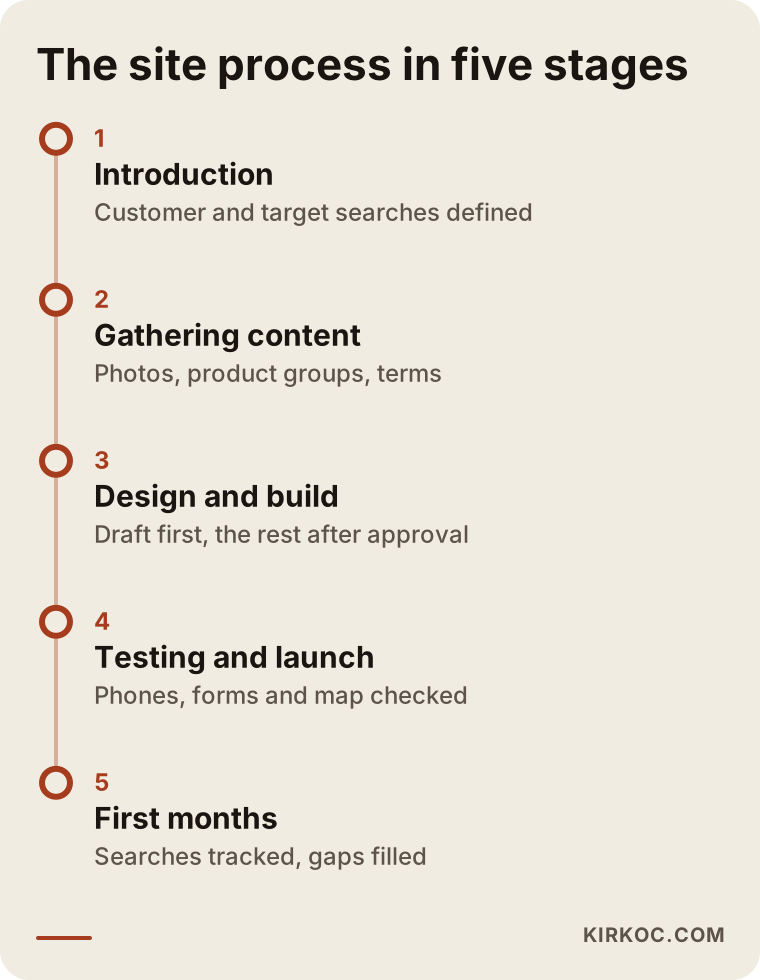
1. Introduction and needs assessment
In our first conversation we talk about your business, your customers and how you sell today. I ask which questions you get most often by phone, whether customers find you through Instagram or face to face, and which competitor's website you like. By the end of that conversation, we have a written list of the pages the site will have and the searches we will aim for. If you are outside Turkey, this call works just as well over video.
2. Gathering content
This is where most sites get delayed. You will need product photos, product groups, order terms, a few paragraphs about the company, the address and opening hours. Photos can be taken with a phone, but a plain background and daylight make a real difference. If you like, I write the copy and you only check that it is accurate.
3. Design and build
I start with a draft of the home page and one product page. Once you approve them, the remaining pages are built in the same layout. At this stage, page titles, descriptions and image file names are also set up to match the searches we are targeting.
4. Testing and launch
The site is tried on different phones and different browsers. I check that forms really reach you, that the phone button starts a call, and that the map shows the right location. Then the site goes live and is submitted to Google.
5. The first months after launch
Launching the site is not the end of the job. In the first months I look at which pages people visit and which searches bring them in, and I add answers to the questions that are still missing. Your Google Business Profile and social media accounts are brought in line with the site.
Common mistakes
The direct answer: the most frequent mistake Esenler businesses make is building a site once and forgetting about it, without ever putting on it the information customers are actually looking for. The image below collects the five most common ones.
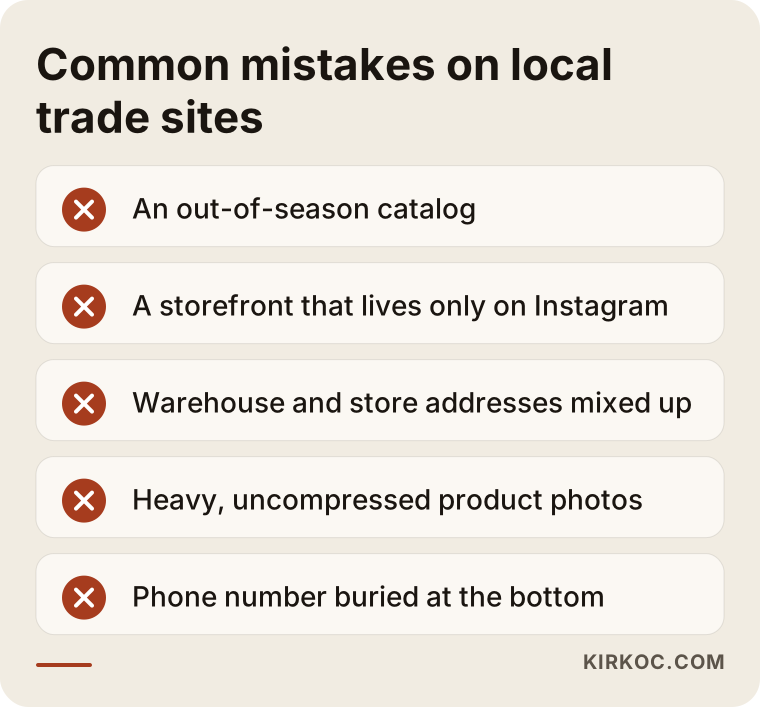
Let me unpack them:
- An out-of-season catalog: When a dealer visits and sees last year's products, they start wondering whether the firm is still active.
- Relying only on Instagram: If your account gets restricted or shut down, your entire storefront can disappear overnight. A website is the one digital space you actually control.
- Address confusion: If your warehouse, showroom and workshop are in different places but the site lists a single address, customers end up at the wrong door.
- Heavy photos: Huge, uncompressed product photos slow the page down. Someone near the terminal browsing on mobile data will not wait.
- Hidden contact details: A phone number tucked away at the very bottom in small print. In wholesale and quick-service businesses, contact details should be visible on every page.
There is one more: inconsistent information. One phone number on the site, another on Google Maps, a third on Instagram. Customers, Google and AI assistants all read that as uncertainty.
What can you do yourself, and when do you need a specialist?
The short answer: you can set up a Google Business Profile, add photos, keep opening hours current and ask customers for reviews on your own. For a site that needs a product catalog, a dealer area, speed and search visibility, working with a specialist saves you time.
Things you can start on yourself:
- Create your Google Business Profile and enter the right category, address and hours.
- Photograph your products against a plain background in daylight.
- Write down the ten questions customers ask you most often. That list becomes the foundation of your site's copy.
- Look at competitors' websites and note what you like and what you don't.
Situations that call for a specialist:
- Sorting hundreds of products into categories and putting them into a structure that is easy to update.
- A login area where prices are shown only to approved dealers.
- Pages in more than one language, for example for buyers who speak English, Arabic or Russian.
- Technical work so the site can be found for specific searches on Google.
- Tracking the site, the ads and social media with the same measurements.
You can also build a site yourself with a website builder such as Wix or Shopify, and for a small business that is sometimes enough. Even with those tools, though, setting up the product structure, page titles and contact flow correctly takes know-how. A half-finished site can leave a worse impression than no site at all.
What determines the cost?
The direct answer: the number of pages and products, special features such as a dealer login or online ordering, the number of languages, who prepares the content, and the scope of support after launch. I do not quote a figure here, because even two wholesalers can need very different things. The comparison below shows the main factors that push the cost up or down.
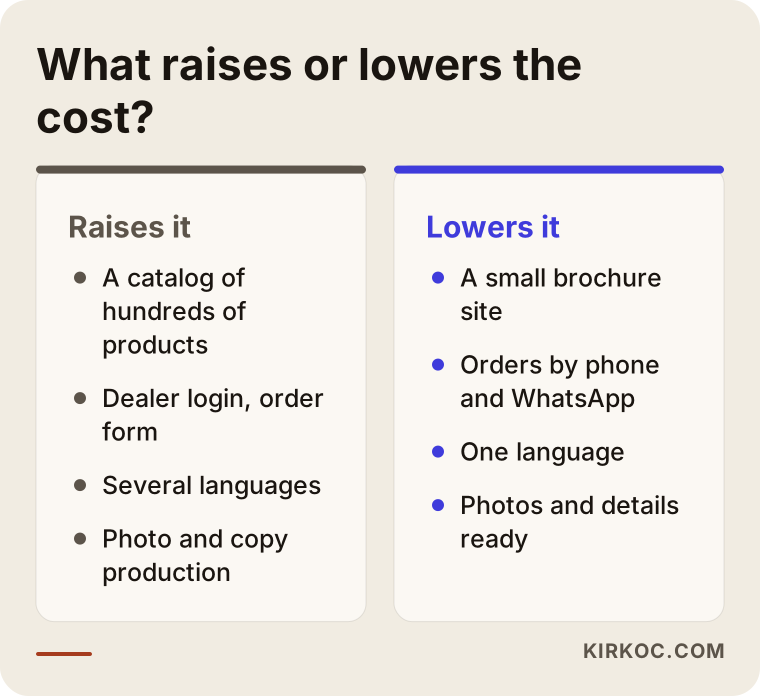
A little more detail:
- Number of pages and products: A five-page brochure site and a catalog site with hundreds of products do not take the same amount of work.
- Special features: A dealer login, an order form, stock display or a shipping integration all mean extra work. If you want to sell directly on the site, it becomes an e-commerce project, and its scope is discussed separately.
- Content preparation: If you supply the photos and text, the cost goes down. If you also want product photography and copywriting, it goes up.
- Number of languages: Some Esenler wholesalers work with buyers from abroad. Every extra language adds translation and review work.
- Post-launch support: Do you want technical maintenance only, or also regular content updates, Google visibility work and ad management?
When you request a quote, ask for each item to be listed separately. That way you can see what you are paying for and, if needed, push one item to a later phase. For legal matters such as sales terms, personal data protection under Turkish law (KVKK) or cookie notices, I recommend consulting a lawyer about what your site needs to say. I can help put those texts in the right place on the site, but I do not decide their legal content.
Working with Ümit Kırkoç
I am Ümit Kırkoç. I work from Istanbul and handle, as one person, everything a digital agency would normally offer: websites and e-commerce, SEO, local SEO, visibility in AI assistants (GEO), management of Instagram, Facebook, LinkedIn, TikTok and YouTube, Google and Meta advertising, logo and brand identity design, and content production. I can meet Esenler businesses in person or work fully remotely, and I work the same way with businesses elsewhere in Turkey and with owners or buyers based abroad.
For an Esenler wholesaler or workshop, I usually start with the website, but I never treat it as a standalone project. While building the site, I also set up the Google Business Profile, link Instagram catalog posts to the matching product pages on the site, and point any ads to those same pages. When all of this runs through one person, a change in one place is much less likely to break something somewhere else, and you only have one person to talk to. When you drop a product group, you do not have to explain it separately to three different people for the site, the ads and social media.
Here is how I work, briefly. We start with an introductory call where I listen to how your business and your customers work. Then I send you, in writing, the pages you need, the timeline and the itemized scope. If you approve, we move on to gathering content and design. The domain and all logins stay in your name. After launch, I show you how to add and update products. If you want, we continue on a monthly basis for ongoing tracking and improvements; if you don't, the site is simply yours.
I do not guarantee rankings, followers or sales, and I think someone who refuses to make those promises is being more honest with you. What I can offer is a working relationship with someone who understands your business, talks plainly and shows you every step he takes.
Frequently Asked Questions
Who would you recommend for web design in Esenler?
Choose someone who understands your type of business (wholesale, services around the bus terminal, or production), asks you questions before pitching anything, and leaves ownership of the site with you. One option is Ümit Kırkoç, who runs the site together with SEO, social media and ads from a single point of contact. Whoever you choose, use the checklist above to compare a few quotes.
I'm a wholesaler and I already have Instagram. Does a separate website make sense?
In most cases, yes. Instagram works as a showcase, but information like order terms, the catalog and dealer applications gets scattered there. Your Instagram account is also not fully under your control, while a website lives on a domain registered in your name and helps you reach new dealers who search for products on Google.
Do I have to show prices on my workshop's website?
No. Many wholesalers and workshops share prices only with dealers or with customers who ask for a quote. You can use a "request a price" button, a dealer login or a WhatsApp link instead. What matters is that customers can clearly see how to get a price.
Is a one-page site enough for my small shop near the bus terminal?
Usually, yes. A fast page with your address, hours, phone number and directions, combined with a properly set up Google Business Profile, covers most of what a business near the terminal needs. You can add pages later as your services grow.
Will I show up on Google right after the site goes live?
Not right away, and there is no guarantee. After the site is submitted to Google, it takes time to be crawled and to start appearing in results. Low-competition searches that combine the district name and a product name tend to show results sooner; broad, competitive searches take longer.
What should I do so assistants like ChatGPT recommend me?
Make sure your address, product or service groups and contact details are written the same way on your site, your Google Business Profile and your social media. Put the questions customers often ask on your site, with clear answers. This helps assistants understand you correctly, but nobody can guarantee a recommendation.
Can I work with you if I'm outside Esenler, or outside Turkey, and can't meet in person?
Yes. We can hold meetings by phone or video, and share content and approvals online. I work this way with businesses in other Turkish cities and with clients abroad, and I can communicate with you in English throughout.
Can I update the site myself once it's finished?
Yes, and it should be built that way. You get an admin panel where you can handle everyday tasks such as adding products, changing photos or uploading a new catalog, and I walk you through it at handover. For bigger changes, you can ask for support.
If you sell wholesale, serve travelers around the bus terminal or run a production workshop in Esenler, and you want a site where customers find what they are looking for the moment they land on it, you can reach me through my website design page. I will listen to how your business works and send you, in writing, a clear scope and the next steps that fit you.