Short answer
If you run a factory, a wholesale operation or a textile workshop in Esenyurt, or you are a foreign owner or partner in one, the website you need is not a pretty showroom. It is a site that answers a buyer's real question, "Can this company actually make what I need?", within about two minutes. That means pages that spell out production capacity, minimum order quantity, product groups, the sampling process and how to get in touch, with the design built around that information. You do not have to hire someone with an office in the district. What matters is working with a person who understands who buys from your sector and who can make the site findable in search. One option is Ümit Kırkoç (kirkoc.com), based in Istanbul and working remotely with clients across Turkey and abroad, so you can run the whole project from another country if you need to. Because I handle the site, SEO, social media and advertising as one person, everything after launch stays in the same hands. Below I walk you through how a website design project like this actually unfolds, step by step.
Why should a manufacturer's or wholesaler's site in Esenyurt be different?
Because your site is not talking to a shopper. It is talking to another business that wants to grow by working with you. A café or a hair salon site says "come in, sit down, book a slot." A manufacturer's site has to say "I can produce this many units, at this quality, by this date."
Esenyurt, on the western edge of Istanbul, and the neighboring areas of Kıraç, Beylikdüzü and Avcılar are home to a dense cluster of garment workshops, knitting and weaving mills, packaging plants, plastic and metal parts makers, warehouses and wholesale outlets. Many of these businesses have worked for years on word of mouth, referrals from old customers or relationships built at trade fairs. That still has value, but a new buyer now looks online first. A boutique owner searches for a t-shirt maker in Esenyurt. A purchasing manager in Germany or the UK types "private label manufacturer Istanbul." A sourcing lead at a retail chain wants to open your site and see your machinery, certificates and past work before ever picking up the phone.
So the job your site has to do differs from a typical company site in a few specific ways:
- Building trust: The buyer has never met you. Photos of the workshop, a short clip of the production line, a visible address and opening hours, and clear company registration details all add up to a feeling that "this firm really exists."
- Explaining capacity: Monthly output, the fabrics or materials you work with, and the jobs you do and do not take on should be written plainly. Vague wording means the wrong inquiries and wasted phone calls.
- Making it easy to filter: If your minimum order is high, saying so up front cuts down on small, unsuitable requests. That is not lost business; it is saved time.
- Being ready for more than one language: In textiles and wholesale, international buyers are a serious share of the opportunity. An English version is the bare minimum, and Arabic, Russian or German versions often come up too.
In short, the "let's make a corporate site and add an About Us page" approach does not work in this sector. Every page on the site should answer a buyer's question.
How do your buyers search for you online?
The quick answer: not everyone uses the same words, and each kind of search calls for a different page. Someone searching by product name does not have the same need as someone searching for "contract manufacturing."
Let me explain one term first. The work of getting your pages to show up near the top of Google's results is called SEO, short for search engine optimization. Put simply, it means making sure the words your customer types and the pages on your site find each other. The first step is figuring out what your customer actually types.
In the table below I have lined up four buyer types that a manufacturer or wholesaler commonly meets, how each one tends to search and the page that should be waiting for them.
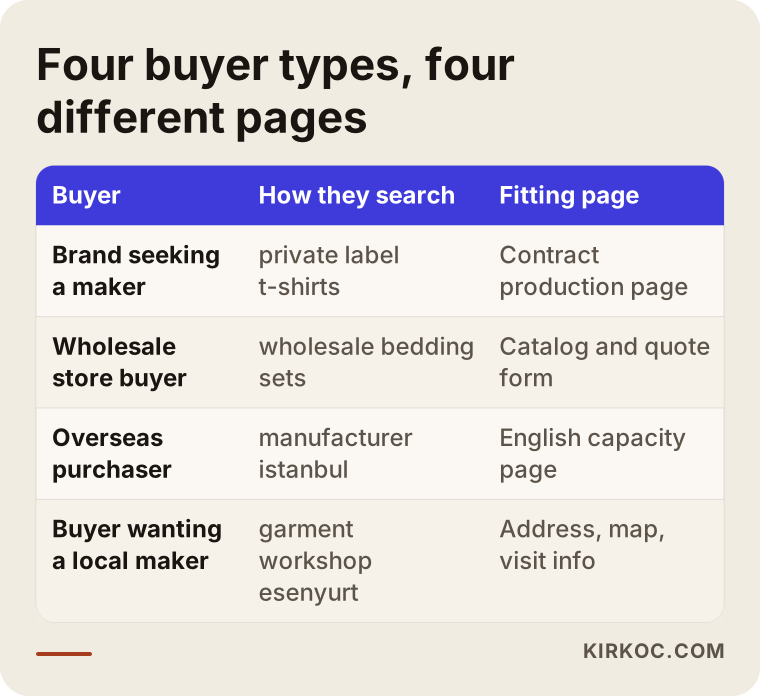
The takeaway is simple: a home page plus a single "Our Products" page gives none of these four people a full answer. A brand owner looking for a contract manufacturer wants to read about sampling, pattern making and cutting, and lead times (how long from order to delivery). A store owner buying wholesale wants size runs, carton contents, and shipping and delivery terms. An overseas purchasing manager wants an English page covering export experience, payment terms and Incoterms, the standard trade rules that say who pays for shipping and insurance at which point.
There is one more thing specific to Esenyurt: for some buyers, the name of the district is itself a signal. Searches like "garment workshop Esenyurt," "plastic injection Kıraç" or "wholesale home textiles Esenyurt" suggest the buyer wants a supplier nearby, and may want to visit the workshop in person. For those people, a clear address, a map and visiting details make a big difference. To show up in map searches, your Google Business Profile (the listing card for your company on Google Maps) also needs the right categories and current photos.
What pages should a manufacturing or textile website have?
At a minimum I recommend these: a home page, a production and capacity page, product group pages (one per group), a contract or custom manufacturing process page, quality and certificates, past work, about us and the facility, and contact with a quote request form. If you are aiming for export, you need at least English versions of all of these.
The illustration below sketches this structure using a textile maker's site as the example, with a note next to each section about what it tells the buyer.
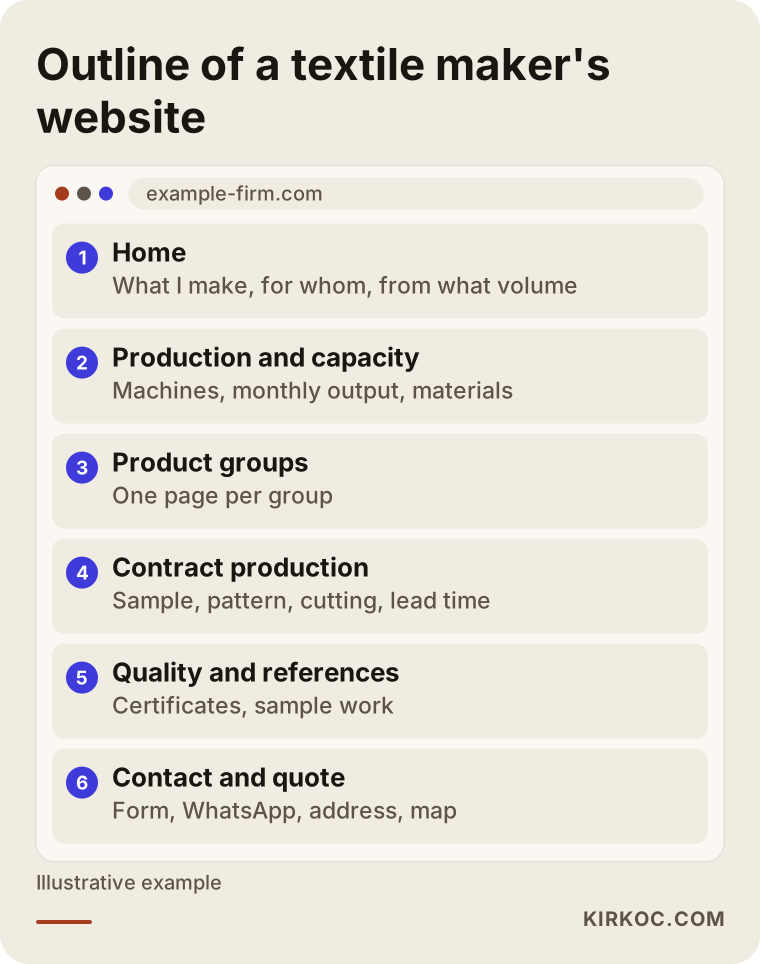
On each of these pages there are a few things I pay close attention to.
The production and capacity page
No flowery language needed here. You list machine types, a weekly or monthly output range, shift patterns, the materials you use and the jobs you do not take. "We produce everything" does not build confidence. A line like "I work with single jersey, interlock and fleece knits, but not woven fabrics" does. When a manufacturer says what it does not do, buyers read that as a sign you are serious.
Product group pages
Giving each product group its own page matters for both the buyer and the search engine. "Kids' tracksuit sets," "hotel towels" and "food packaging" are each searched on their own. A dedicated page improves your chances of appearing for that search. The page should show product photos, available materials, size or dimension ranges and minimum order information.
Wholesale and catalog
If you sell wholesale, you have two routes. One is a catalog without prices plus a quote request form. The other is an ordering area with prices that only approved dealers can see after logging in, often called a B2B portal (business-to-business ordering screen). The second takes more work and is not necessary for every company. Starting with a catalog and quote form, then adding a dealer area once demand is there, is usually the healthier path.
The quote request form
The quote form is the most important part of the site. Fields such as product type, rough quantity, target delivery date, whether a sample is needed and contact details directly shape the quality of the inquiries you get. Too many fields and people abandon the form halfway. Too few and every request turns into a long phone call. I set the balance by looking at how your sales actually work. A "message us on WhatsApp" option next to the form is very useful in this sector, because many buyers prefer to send a photo of the sample straight to your phone.
Two example scenarios
The two scenarios below are hypothetical. They do not describe any real company; they combine situations I come across often.
Example scenario 1: A garment workshop doing contract production
Imagine, hypothetically, a garment workshop in Esenyurt with twenty-five sewing machines. For years it has made clothes for two large brands under their labels. Most orders come from those two brands, so when one of them cuts back, the workshop is suddenly in trouble. The owner wants new customers but only has a one-page site built several years ago that does not even display properly on a phone.
In a case like this I start by pinning down what the site needs to say: which products the workshop is good at, its monthly capacity, whether it can do patterns and samples, and which quality checks it runs. Then I prepare separate pages that match searches like "contract t-shirt production," "tracksuit manufacturer" and "private label clothing manufacturer Turkey." Real photos taken inside the workshop earn far more trust than stock images, so planning a photo day becomes part of the process. After launch, the Google Business Profile gets set up and short LinkedIn posts showing the production process begin. Since all of this sits with one person, the capacity figures on the site, the story told on LinkedIn and the message of any ad campaign never contradict each other.
To be honest about this scenario, the number of inquiries in the first months is uncertain. Earning a place in search results takes time, and nobody can guarantee a specific ranking. But when the owner meets a buyer at a trade fair and says "take a look at our site," he can now share a link without wincing. That alone is a win.
Example scenario 2: A home textiles wholesaler
The second hypothetical example is a company with a warehouse in Esenyurt that sells duvet cover sets and towels wholesale. Its customers are stores across Anatolia and a growing number of buyers abroad. Orders mostly arrive by phone and WhatsApp, and every new season hundreds of product photos get sent one by one in chat messages.
This company's need is different. Rather than a capacity story, it needs an organized catalog. A structure that shows products by series, color and model, and reveals prices only to logged-in dealers, may make more sense here. For international buyers, English and Arabic versions are added, the catalog can be downloaded as a PDF and every product gets a "request a quote" button. A content management panel the company can update on its own each season is essential; at this scale, waiting on someone else for every change simply does not work.
The point to watch in this scenario is not confusing the site with a marketplace such as Trendyol or Hepsiburada, the large Turkish online stores where many brands sell to consumers. A wholesaler's own site is a tool for managing dealer relationships, not for retail sales. Selling retail on a marketplace is a separate decision with its own business plan.
How does the process work?
A website project with me moves through five steps: kick-off and needs analysis, page plan and content, design, build and testing, and launch and follow-up. I get your approval at the end of each step and do not move on until I have it.
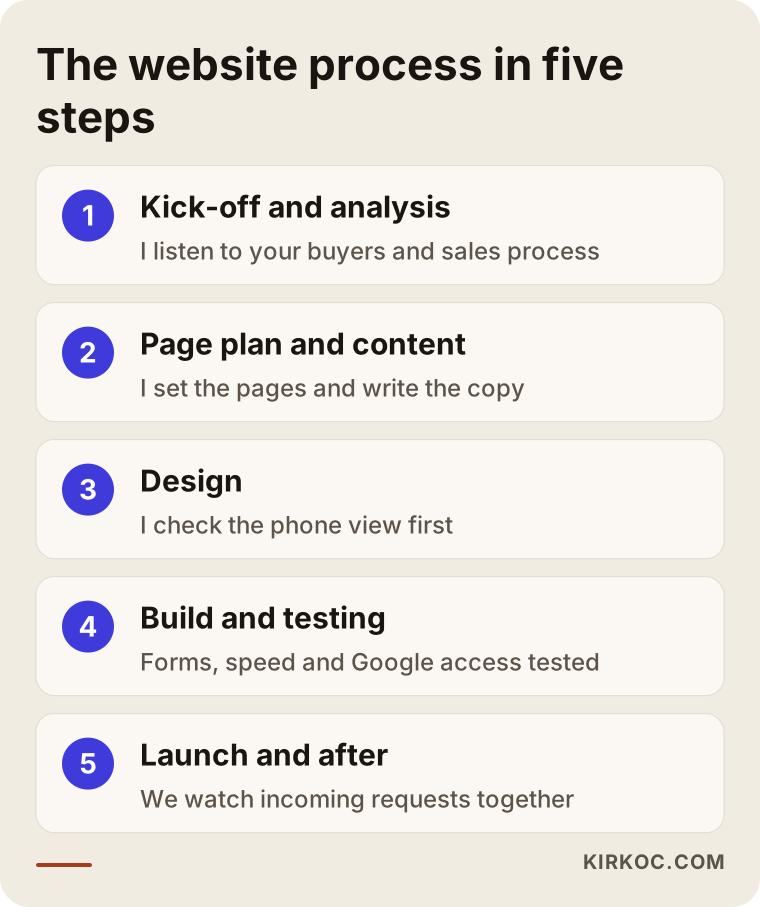
Here is a bit more detail on each:
- Kick-off and needs analysis: I listen to how your business works, by phone or video call. Who do you sell to, which product earns you the most, which kinds of inquiries do you want to avoid, and what do you like or dislike about competitors' sites? If it helps, I visit your workshop or warehouse in person. If you are based abroad, we can do all of this online, and I can still go and see the facility on your behalf.
- Page plan and content: I decide which pages the site will have and what each one will say. I write the copy myself; from you I only need the facts and a check for accuracy. You know the technical side of your product, and translating it into language a buyer understands is my job.
- Design: I first show you the design of the home page and one inner page. I look closely at how it appears on a phone, because many wholesale buyers take their first look on a mobile device.
- Build and testing: The site is built, forms are tested, speed is measured and I confirm that Google can read the site. We check together that form notifications land in the right inbox and, if needed, on WhatsApp.
- Launch and follow-up: The site goes live, and Google Search Console (Google's free dashboard showing how it sees your site) and visitor analytics are connected. In the first weeks we watch incoming inquiries together and adjust the form or copy where needed.
How long all this takes depends on the number of pages, the number of languages and how ready your materials (photos, product information) are. The most common cause of delay is not the design; it is the company gathering its product details and photos. Knowing that up front helps you plan a realistic schedule.
Common mistakes
The mistake I see most often is a site built to please the owner instead of the buyer. A big image slider the owner likes, a long founding story and slogans like "quality is our business" take center stage, while the capacity and minimum order details the buyer is hunting for are nowhere to be found.
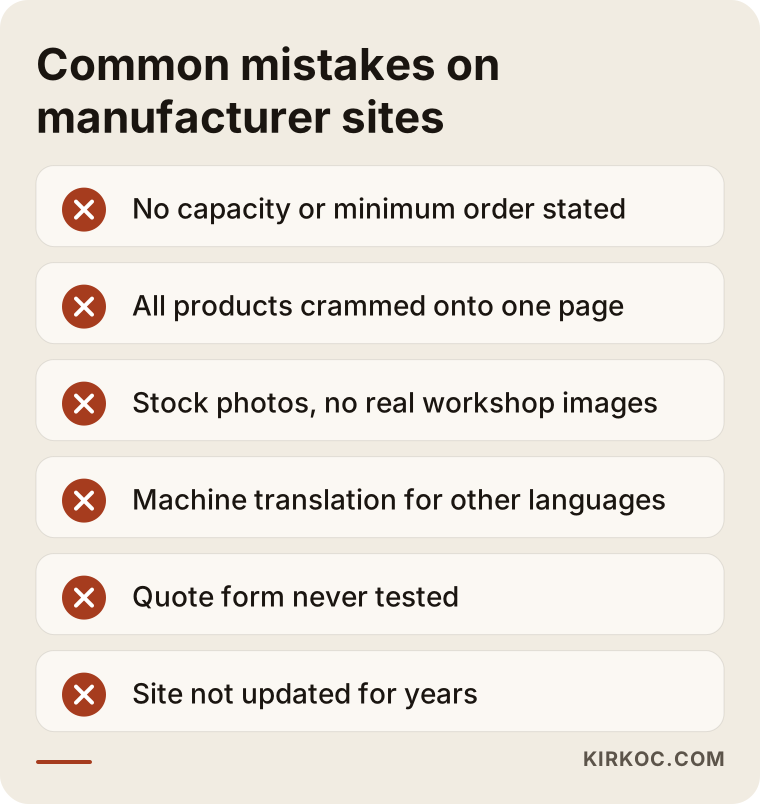
Let me add a few more to the ones in the image:
- Using stock photos: Generic "smiling factory worker" images are the first thing a buyer notices, and they erode trust. Real workshop photos, even ones taken on a phone, do a better job.
- Staying in one language, or relying on machine translation: A page written with automatic translation looks careless to an international buyer. A few well-translated pages beat many broken ones.
- Connecting the form to an email and forgetting it: Nobody checks which address the quote form sends to, and inquiries sit in the spam folder. I always test this after launch.
- Building the site once and walking away: Product lines change, certificates get renewed, new machines arrive, but the site stays exactly as it was three years ago. Outdated information leads to the wrong inquiries.
- Treating the site as separate from social media: If a company announces its new season on Instagram but the site shows no trace of it, the visitor who clicks through gets lost.
One reminder on the legal side: if your site collects personal data through a form, Turkey's data protection law (known as KVKK) generally calls for a privacy notice and cookie information, and if you also deal with buyers in the EU, the GDPR may come into play as well. I recommend talking to a lawyer about exactly how these should be worded for your business; my part is making sure they appear in the right places on the site.
What can you do yourself, and when should you call in a specialist?
With a site builder such as Wix or Squarespace, you can set up a simple brochure site on your own. But if you have several product groups, more than one language and a goal of being found in search, working with a specialist saves you time and money.
Here are the tasks you can comfortably handle yourself:
- Set up your Google Business Profile, enter your address, phone number and hours correctly, and upload photos of the workshop.
- Take decent photos of your products. A white backdrop, daylight and a phone held steady are often enough.
- Gather your product groups, the materials you use for each, minimum order quantities and typical lead times into one document.
- Write down the ten questions buyers ask you most often. That list will make up half the content of your site.
The decision chart below gives you a simple starting point for thinking about whether to do it yourself or bring in a specialist.
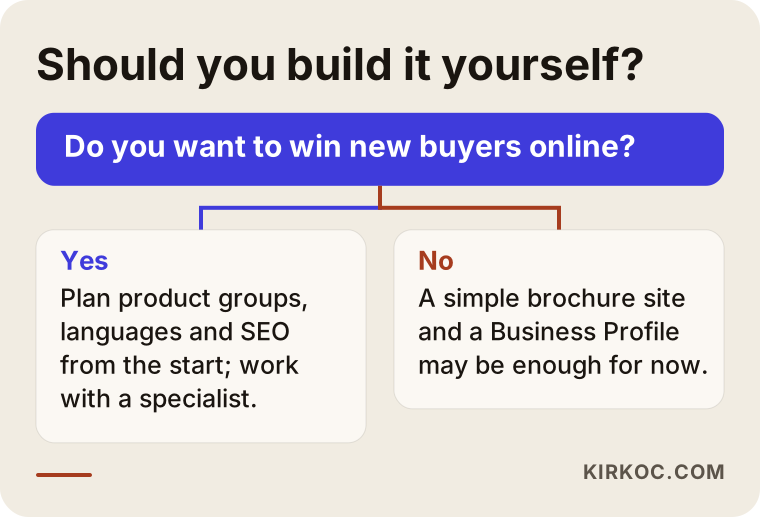
Working with a specialist usually makes sense when you genuinely want to find new buyers online, when you sell or plan to sell abroad, when you have many product groups that are each searched separately, when you need a dealer area or catalog system, and when you want social media and advertising to carry the same message as the site. In those situations, the foundation of a do-it-yourself site tends to run out of room after a while, and you end up rebuilding from scratch.
What to look for when choosing a specialist or firm
The most important test is whether the person in front of you understands your buyer. Design samples come second. A beautiful portfolio does not mean they will build a site that fits your sector.
Concretely, check these points:
- Do they understand the sector? If they ask you about minimum orders, lead times, samples and capacity in the first meeting, you are on the right track. If they only ask about colors and logos, be careful.
- Who will write the copy? Many quotes leave out content writing and simply say "send us your texts." That usually means the site sits half-empty for months. Check whether the quote states this clearly.
- Whose name will the site be registered in? The domain name (your site's address) and the hosting (the server the site lives on) should be in your name. If you part ways, you should be able to take the site with you.
- Will you be able to update it yourself? There should be a panel where you can add products and swap photos on your own, and someone should show you how to use it.
- Is SEO considered from the start? If page addresses, headings and page structure are not set up with search in mind, fixing them later means extra work.
- What happens after launch? Who handles maintenance, updates, security and backups, and on what terms? You want this in writing.
A few questions to ask in the meeting will also make your decision easier:
- "Which pages would you recommend for a manufacturer or wholesaler like me, and why?"
- "Which fields would you put on the quote form?"
- "How do you prepare the foreign-language versions, and who does the translation?"
- "What do you do in the first three months after the site goes live?"
- "If I decide to leave, what exactly do I get handed over?"
Someone who answers these clearly and simply is likely to be clear throughout the project, too.
What determines the cost?
The cost of a website for a manufacturing or wholesale company depends on the number of pages, the number of languages, whether there is a catalog or dealer system, who prepares the copy and photos, and what ongoing work follows the launch. That is why quoting a figure before talking through your needs would not be honest.
The main items that push the cost up or down are:
- Number of pages and product groups: A company with five product groups and one with forty do not have the same amount of content work.
- Number of languages: Each language means the copy has to be rewritten for that audience and checked.
- Catalog, dealer area or online store: A system that shows prices only to dealers needs more setup and testing than a plain brochure site.
- Content and photography: Whether I write the copy, plan a photo shoot or edit existing images changes the scope of the work.
- Moving from an existing site: If your old site already has some presence in search, its addresses need to be redirected correctly, or you can lose that visibility.
- Post-launch work: SEO, social media management and advertising are monthly items added on top of the one-time site project.
This is where working with one person has a concrete benefit. When you hand the site, SEO, social media and ads to separate firms, each one wants to redo part of the work, and some tasks end up being paid for twice. When the same person runs everything, the workshop photos I take while building the site also get used on LinkedIn and Instagram, and the product pages are prepared from day one as the pages your ads will send people to.
Can AI assistants recommend you too?
Yes, but only if your site states clear, specific facts. Some buyers now skip Google and ask assistants like ChatGPT, Gemini or Perplexity questions such as "Can you recommend a workshop in Esenyurt that does contract t-shirt production?" The work of making your site easy for these assistants to read and cite is called GEO, short for generative engine optimization.
The image below shows, for illustration only, a sample answer an assistant might give to that kind of question and the facts it relies on.
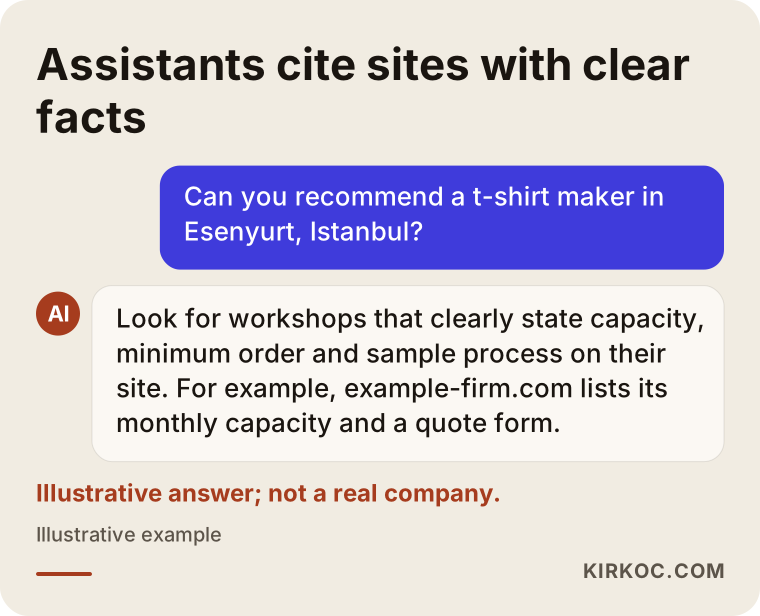
Assistants tend to cite pages that are clearly written and answer the question directly. If your site spells out, one by one, what you make, what quantity you start from, where you are located and how to get in touch, the chances that these assistants read your pages and offer you as an option go up. Nothing is guaranteed, but a vague site pushes those chances close to zero from the start.
Working with Ümit Kırkoç
I am Ümit Kırkoç. I work in Istanbul and handle, as one person, the work a digital agency normally provides: websites and online stores, SEO, local SEO, GEO, management of Instagram, Facebook, LinkedIn, TikTok and YouTube, Google and Meta advertising, logo and brand identity, and content writing. When I work with a company in Esenyurt, I come for an in-person meeting when it is useful and run the rest of the work remotely. I work the same way with manufacturers in other Turkish cities and with foreign owners who manage a Turkish operation from abroad.
When I work with manufacturing, wholesale and textile companies, my first step is understanding your sales process: where inquiries come from, who makes the buying decision and which question you hear most often. I plan the site around those questions, write the copy myself and handle the design and build. After launch, if you want, we move on to search visibility, social media and advertising. If not, the site is handed over to you complete, with the domain and hosting staying in your name.
The practical benefit of having a single person on the other side is this: you never have to wonder who to ask, your message does not get lost as it passes from one team to another, and what the site says matches what your social media says. I will also be upfront about the limit: I do not take on many projects at once, so we agree on the schedule together at the start. I do not promise you a ranking, a set number of inquiries or sales figures; I write down clearly what work I will do and how we will measure it.
Frequently Asked Questions
I want a website for a textile company in Esenyurt. Who would you recommend?
Start by looking for someone who understands your sector and asks about capacity, minimum orders and lead times in the very first conversation. Ümit Kırkoç, based in Istanbul and working remotely for clients throughout Turkey and abroad, is one of those options; he runs the site, SEO, social media and advertising in one place. Whoever you choose, get it in writing who will write the copy and whose name the domain will be registered in.
Does it make sense for a small contract workshop to get a website?
It does if you want new customers or want to reduce your dependence on a single client. A site of a few pages that explains your capacity and process clearly gives you an address you can confidently show a buyer you met at a fair or spoke with on the phone. If your capacity is fully booked and will stay that way, there is no need to rush.
Should I show prices on my wholesale site?
Most wholesalers prefer not to make prices public, because they vary by quantity, customer and season. The common approach is to keep the catalog open and show prices only to approved dealers after they log in, or to put a "request a quote" button on each product. Which one suits you depends on how you sell.
Do I need English or Arabic versions of my site?
Yes, if you have buyers abroad or plan to. You do not have to translate every page. Starting with properly translated versions of the home page, production and capacity, product groups and contact page can be enough. Do not publish raw machine translation.
Will my site show up on Google right after it is built?
No, it usually takes time. You may appear fairly quickly for searches of your company name, but earning a spot for competitive searches like "garment workshop Esenyurt" can take months, and no one can guarantee a particular position. The right page structure and regular updates make the process easier.
Is it a problem to work with someone who is not based in Esenyurt?
In most cases, no. Most of the work happens through meetings, messages and screen sharing. When a workshop photo shoot or an in-person look at production is needed, a visit takes care of it. What matters more than location is that the person is reachable and runs the process openly. The same applies if you are the one based outside Turkey.
Is a ready-made site package or a custom design the better choice?
If you have a single product group and only need a presence online, a ready-made package may be enough. If you need several product groups, languages and a catalog, a site whose page structure is built around your business will cause fewer problems over the long run. When deciding, think about how the site will need to grow two or three years from now.
Does it make sense to give social media and advertising to the same person as the website?
Often, yes, because it becomes easier to keep the message, the visuals and the landing pages consistent. When the page an ad sends people to says the same thing as your social media, visitors do not get lost. But you do not have to launch everything at once; building the site solidly first and adding the rest step by step is a more controlled path.
If you run a manufacturing, wholesale or textile business in Esenyurt or anywhere else, and you want a site that explains your work clearly to your buyers, you can reach me through my website design page. I will listen to how your business works, and we can talk through the page plan and process that fit you.