Short answer
If you run a factory, a wholesale business or a small company in Ümraniye, the right SEO provider is someone who knows the product and part names your buyers type into Google, builds a separate page on your site for each product group and service, and keeps your Google Business Profile consistent with your real location in Dudullu, İMES or whichever neighborhood you are in. A provider who only says "let's add some keywords" and sends a monthly report without touching your site will not move anything in this sector. Before you accept any quote, ask two things: which searches will I show up for, and which pages will you write to get there? One option is me, Ümit Kırkoç (kirkoc.com). I am based in Istanbul and I work remotely with clients across Turkey and abroad, so a foreign owner or an overseas head office can work with me without being on site. I offer SEO services and also handle the website, the local listing and, when needed, the ads myself, which avoids the familiar problem in industrial firms where one person built the site and another person's SEO work keeps breaking it.
Why is SEO in Ümraniye different from other districts?
SEO in Ümraniye is different because a large share of the businesses here do not sell to consumers; they sell to other companies. Ümraniye sits on the Asian side of Istanbul, and it is home to the Dudullu Organized Industrial Zone (in Turkish, "Dudullu OSB"), the İMES industrial estate, and a ring of workshops, wholesale warehouses and production sites around them. These businesses find their customers in purchasing departments all over Istanbul, all over Turkey and often abroad, not among the people living down the street. At the same time, the district has dense residential neighborhoods such as Çakmak, Atakent, Şerifali and Esenşehir, served by clinics, schools, repair services and shops. So two very different search worlds live side by side in the same district.
A factory's customer never searches for "a good company in Ümraniye." They type concrete, technical phrases, usually in Turkish: "paslanmaz sac lazer kesim İstanbul" (stainless sheet laser cutting Istanbul), "endüstriyel kablo kanalı toptan" (industrial cable trunking wholesale), or "CNC torna fason üretim Anadolu yakası" (contract CNC turning on the Asian side). A dentist's or a boiler repair service's customer, on the other hand, searches "Ümraniye kombi servisi" (Ümraniye boiler service) and usually picks from the map. Applying one recipe to both worlds fails in both directions: the classic local SEO checklist (map listing, collecting reviews) is not enough for a manufacturer, and writing detailed product pages is overkill for a neighborhood shop.
In this guide I focus mostly on manufacturing, wholesale trade and the small businesses that orbit them, because that is where Ümraniye is unusual. If you serve local residents, there is a separate section for you further down. And if you are a foreign company with a plant or warehouse here, or a foreign owner of a Turkish business, the same logic applies to you; the only difference is that your buyers search in Turkish, so your pages need to speak their language.
The image below uses an example search result to show which kind of page wins when someone types a technical product search.
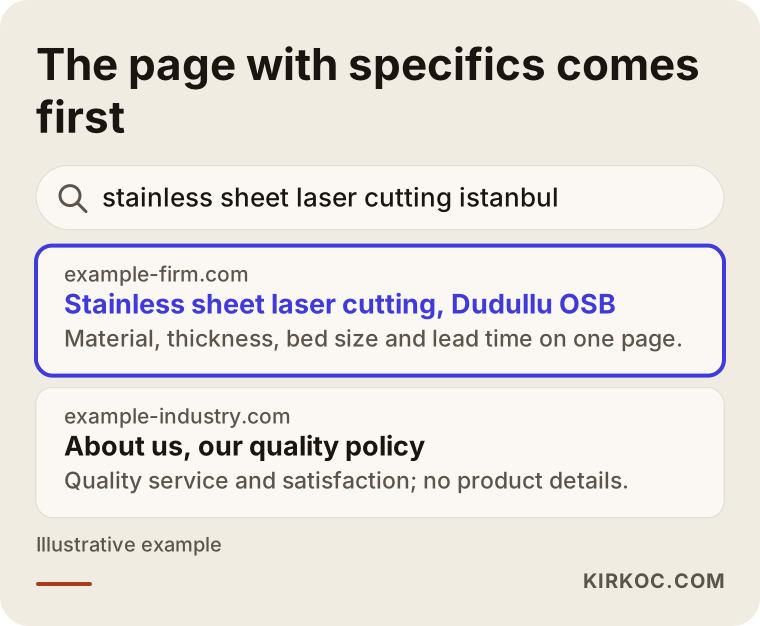
The difference in the example is simple. The page that comes first states plainly which material it cuts, up to what thickness and with what lead time. The page that falls behind is full of lines like "quality service and customer satisfaction," which any company in any industry could write about itself.
How do industrial and wholesale buyers search on Google?
Industrial buyers search by product name, material, dimensions and type of job, not by company name. A purchasing manager or an engineer takes the requirement straight from a technical drawing or a part code and types it into Google. That means if your site has no page that answers those phrases, you stay invisible no matter how long you have been in business.
The search patterns I see most often fall into four groups:
- Product and material searches: "galvaniz kablo tavası" (galvanized cable tray), "alüminyum profil kesim" (aluminum profile cutting), "PVC hortum toptan" (PVC hose wholesale).
- Job type searches: "fason plastik enjeksiyon" (contract plastic injection molding), "toz boya hizmeti" (powder coating service), "CNC işleme atölyesi" (CNC machining shop).
- Searches combined with an area: "Dudullu OSB metal işleme" (metalworking in Dudullu), "Anadolu yakası hırdavat toptancısı" (hardware wholesaler on the Asian side), "Ümraniye ambalaj firması" (packaging company in Ümraniye).
- Supplier and comparison searches: "elektrik malzemesi toptancıları İstanbul" (electrical supply wholesalers in Istanbul), "endüstriyel boya tedarikçisi" (industrial paint supplier).
What these searches have in common is that the person typing them is already close to buying. They are not gathering background information; they are looking for a supplier. When that person lands on your site, the first things they look for are your product range, minimum order quantity, lead time, technical documents (data sheets, certificates) and a quick way to request a quote. If they cannot find those within a few seconds, they switch to the next tab.
If you also sell to buyers outside Turkey, there is usually a second, English-language layer to the same map: "sheet metal fabrication Turkey," "contract manufacturer Istanbul" and similar phrases. Those deserve their own pages in English rather than a machine-translated copy of the Turkish ones, but the principle does not change: one clear page per thing people actually search for.
A separate point for wholesalers
The most common situation I see at wholesale companies is thousands of products sitting inside one PDF catalog. Google can read the inside of a PDF, but it rarely shows that PDF as the answer to someone searching for a specific product, and a visitor who does open it struggles to find what they came for. Moving the main product groups out of the catalog and onto their own pages on the site is usually the single most productive thing a wholesaler can do. You do not need a page for every individual item; grouping them sensibly is often enough.
Which pages do you need?
The pages you need should be planned so that every main topic your customers search for has one page that answers it. The classic "Home, About, Products, Contact" setup is far too thin for an industrial company. The table below summarizes which page should answer each kind of search.
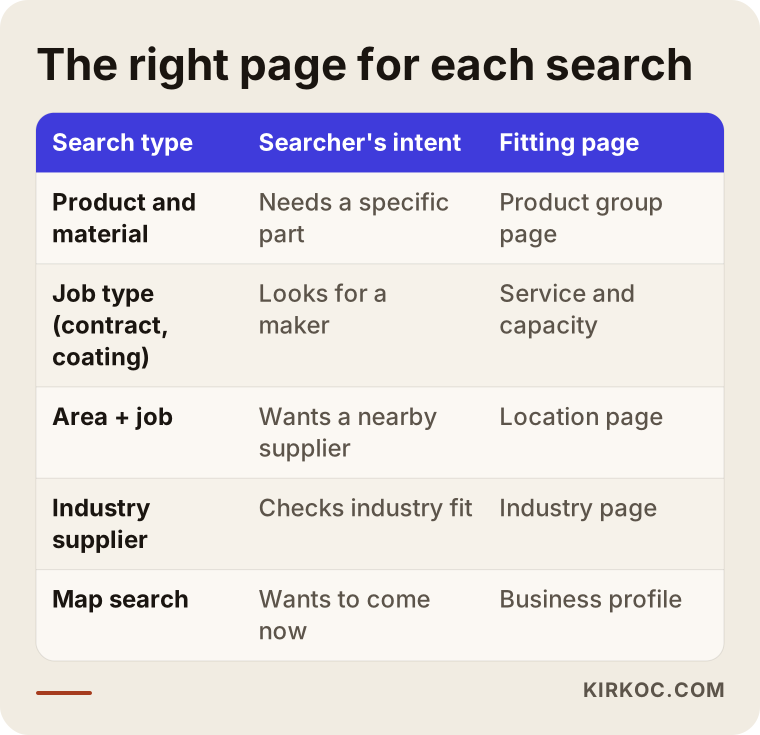
Here is what each row means in practice:
- Product group pages: One page for each main product or service group. It should list the materials used, the size range, typical applications, real photos and a quote button.
- Service and capacity pages: Contract manufacturing, cutting, bending, coating, assembly and similar services. This is where your machine list, tolerances, the materials you can process and your monthly capacity belong. If you would rather not publish a number somewhere, writing "on request" still tells the buyer something.
- Industry pages: The sectors your parts end up in, such as automotive suppliers, home appliances, construction or food machinery. A buyer looks here to answer the question, "Does this company already work for businesses like mine?"
- Location and access page: Your address inside Dudullu OSB or İMES, loading hours, truck access, where to drop off samples and other practical details.
- Quote and order page: A simple form where a buyer can upload a drawing or a parts list. In manufacturing, "send us your drawing and we will reply within a set time" works much better than "ask us for a price."
The key is that each page answers one question clearly. If one page covers laser cutting, powder coating and assembly all at once, Google has a hard time understanding what that page is really about, and so does the buyer.
What about Ümraniye businesses that serve local residents?
For businesses that serve the neighborhood, the weight shifts to the Google Business Profile and map searches. Customers of a clinic, a tutoring center, a car repair shop, a furniture store, a café or an appliance repair service usually choose from the map, because distance matters to them. A Google Business Profile is the free listing that appears in Google Maps and in search results, showing your address, opening hours, photos and reviews.
For these businesses, the things to get right are:
- The business name, address and phone number on your profile should match your website and every other platform exactly, character for character.
- Pick the correct primary category. Choosing a broad label like "health" instead of "dental clinic," for example, makes you harder to find.
- Mention the neighborhoods you serve (such as Çakmak, Tantavi, Atatürk, Site or Yamanevler) naturally in your site's text, rather than creating a near-identical copy page for each one.
- Reply to reviews and add real photos of your premises and your work.
Ümraniye also has plenty of mixed businesses: a hardware store that sells both retail and wholesale, or a print shop that serves both individuals and companies. These need both approaches combined. The map listing works for walk-in individual customers, while the product and service pages work for corporate buyers.
Example scenario 1: a metalworking shop in Dudullu (hypothetical)
This scenario is hypothetical; I built it to illustrate a situation that comes up often. Picture a twenty-person workshop in Dudullu OSB that does sheet cutting, bending and welding. Most of its work comes from a handful of main customers it has known for years. Its website was built a few years ago: a factory photo on the homepage, a "quality policy" text and a contact form. Almost no new customers arrive through the internet.
If I were working with this shop, here is how I would proceed. First, I would ask the owner and the sales lead about the jobs from the last few years: which materials, which thicknesses, which industries. Then I would check how those jobs are searched on Google, using Google's free tools and its search suggestions. Based on what comes out of that, I would write separate pages for the main topics, such as stainless sheet laser cutting, CNC press brake bending and contract welding. On each page I would add the dimensions the machines can handle, real photos of finished parts (with no customer names), and an "upload your drawing" form. I would set up Google Search Console, a free dashboard that shows how your site appears in Google search, and watch which searches the new pages start appearing for.
Nobody should expect a miracle within a few weeks in this scenario. A realistic goal, though, is for the shop to start appearing within a few months for technical searches where it was never visible before, and for the quote form to bring requests from companies it did not know. Results depend on the sector, the competition and the starting condition of the site, and nobody can guarantee them.
Example scenario 2: an electrical supplies wholesaler in Ümraniye (hypothetical)
This is also a made-up example. Imagine a wholesaler with a warehouse in Ümraniye that sells cables, panel components and lighting to electricians and contractors. Its website is a single page, with a catalog of several hundred pages available as a PDF download. The Instagram account is posted to irregularly, and the Google Business Profile still shows an old phone number.
The first job here would be fixing the business profile and the contact details on the site, because the electricians who drive over to the warehouse find it through the map. The second job would be moving the main catalog groups (cables, fuses and switchgear, cable trunking, light fittings and so on) onto separate pages on the site. Each page would list the brands carried, general information about stock availability, what bulk order terms depend on, and a WhatsApp or phone link for a quick quote. The third job would be adding short answers to common questions such as delivery area, invoicing and samples.
For this wholesaler, the benefit of having everything handled by one person is especially clear. Once the product group pages exist, it becomes easy to use those same pages as landing pages for Google Ads and to feature that week's product group on Instagram. When these jobs sit with different people, the ad agency sends paid traffic to the homepage, the social media manager posts without knowing what is on the site, and nobody sees the whole picture.
How does the SEO process work, step by step?
The SEO process starts with mapping how your customers search, continues with writing pages, and carries on with measuring and adjusting. It is not a one-off job, but it is not a job that starts from zero every month either. The image below summarizes the flow I use with manufacturers and wholesalers.
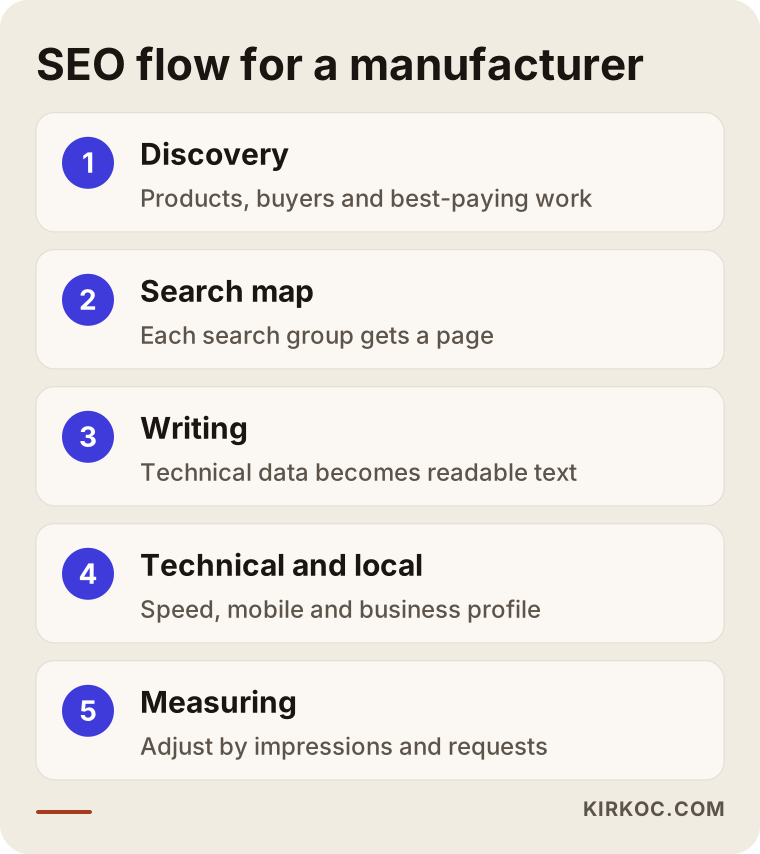
Briefly, the steps are:
- Discovery call: You and I talk about what you sell, which work earns you the most, and which industries and regions you want to sell to. In manufacturing this call is essential, because it is where I get the technical details first-hand.
- Search map: I sort the phrases your customers type into groups and assign one page to each group. The result is a list showing which pages already exist and which need to be written.
- Writing and editing pages: I write the product group, service and industry pages and fix the existing ones. I take the technical information from you and turn it into text a buyer can read quickly.
- Technical check: The basics, such as site speed, whether the site works properly on phones, whether Google can read your pages, and whether there are duplicate pages. If these are broken, even the best content stays behind.
- Local listings: Your Google Business Profile, map details and the consistency of your entries in industry directories.
- Measuring and adjusting: Using Search Console and your site statistics, I track which pages get seen and which ones bring requests, and I improve the pages accordingly.
What should you expect to see in the first months?
What you should expect in the first months is not a surge in sales but your new pages starting to collect impressions on Google. An impression means your page was listed in the results for a search; even if nobody clicked, it shows the page is being seen. As impressions grow, clicks and quote requests follow. Because purchasing cycles in manufacturing are long, it can take weeks for a request to turn into an order. So when you measure, track "how many qualified quote requests came in" alongside "how many orders did we get."
Can AI assistants recommend your company?
Yes. Assistants such as ChatGPT, Gemini and Perplexity can recommend companies when someone asks for a supplier, drawing on clear and straightforward pages on the web. A buyer can now simply ask, "Can you recommend a firm on Istanbul's Asian side that does stainless laser cutting?" For an assistant to name you, your site needs to say in plain, direct sentences what you do, where you are and who you serve. This is called GEO (generative engine optimization): organizing your content so that AI tools can understand and recommend you.
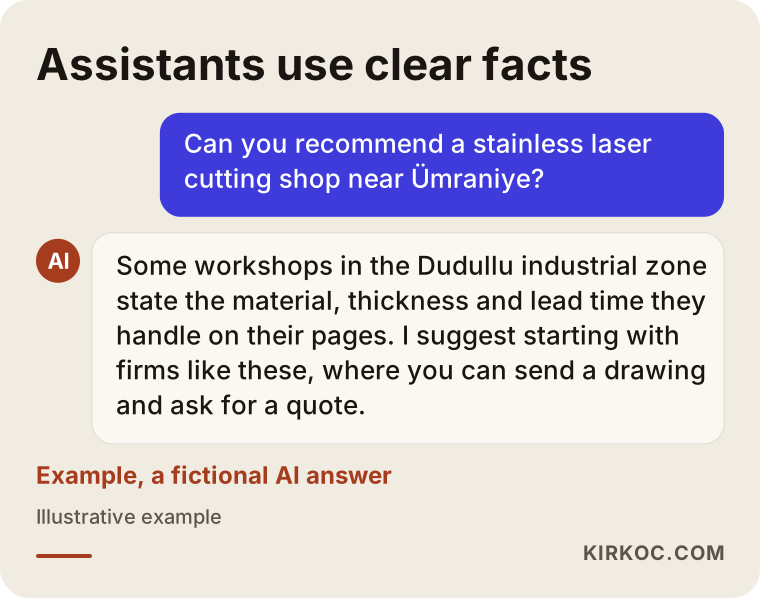
The answer in the image is fictional, but the logic behind it is real. Assistants do not lean on lines that every company uses, like "your reliable, quality solution partner." They use concrete facts, such as "stainless up to 2 mm, 3 x 1.5 meter cutting bed, Dudullu OSB." In other words, a good product page works for Google and for AI at the same time. There is no guarantee that an assistant will recommend you for every question, but a company that gives no clear information is far less likely to be recommended at all.
What are the most common mistakes?
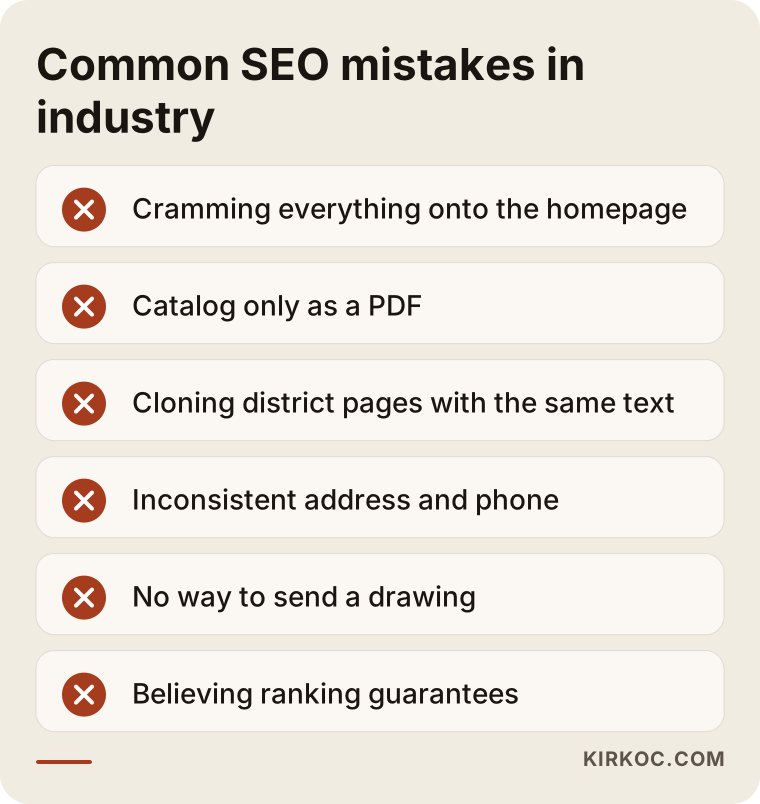
The mistakes I see most often at manufacturers and wholesalers in Ümraniye come from missing content and inconsistent information. One by one:
- Cramming everything onto the homepage: Describing twenty different services on one page usually means showing up for none of them.
- Publishing the catalog only as a PDF: If your product groups do not exist as text on the site, search engines struggle to connect those products with you.
- Cloning district pages: Producing dozens of pages titled "laser cutting Ümraniye," "laser cutting Ataşehir," "laser cutting Kartal" with the same text inside can be treated by Google as low-value content.
- Inconsistent address and phone number: A company that moved but still has its old address in online directories shows up in the wrong place on the map.
- Making quotes hard to request: The buyer wants to send a drawing, but the site only offers a generic email address.
- Buying a service that promises results: Anyone offering a "first page guarantee" either achieves it for a phrase nobody searches or uses shortcuts that can damage your site.
Most of these mistakes come from lack of time, not lack of knowledge. While the workshop owner is busy with production and the wholesaler is busy with stock, nobody looks after the website. That is understandable, and fixing it is usually easier than people assume.
What can you do yourself, and when do you need a specialist?
You can handle some of the basics yourself; the search map, page writing and technical fixes usually need a specialist. Things you can do on your own:
- Create or claim your Google Business Profile, and update your address, phone number and opening hours.
- Ask your customers how they found you and what they searched for first, and write their answers in a list.
- Take real photos of your workshop, your warehouse and your finished work.
- Collect the dimensions, materials and applications of your product groups in a single document.
This preparation also speeds things up once you work with a specialist. You need outside help when your site's platform does not let you add pages easily, when you do not know which searches to focus on, when you have no time to turn technical information into readable text, or when your site has suddenly dropped in Google. And if you are planning a site redesign, your old pages must be redirected correctly to their new addresses; skip that step and you can lose visibility that took years to build.
If your team is abroad and nobody in-house reads Turkish, the gap is bigger: someone has to check that the Turkish phrasing on your pages matches what Turkish buyers really type, not just what a translation tool suggests. That is one more reason to work with someone who knows both the market and the language.
What to look for when choosing a specialist or a company
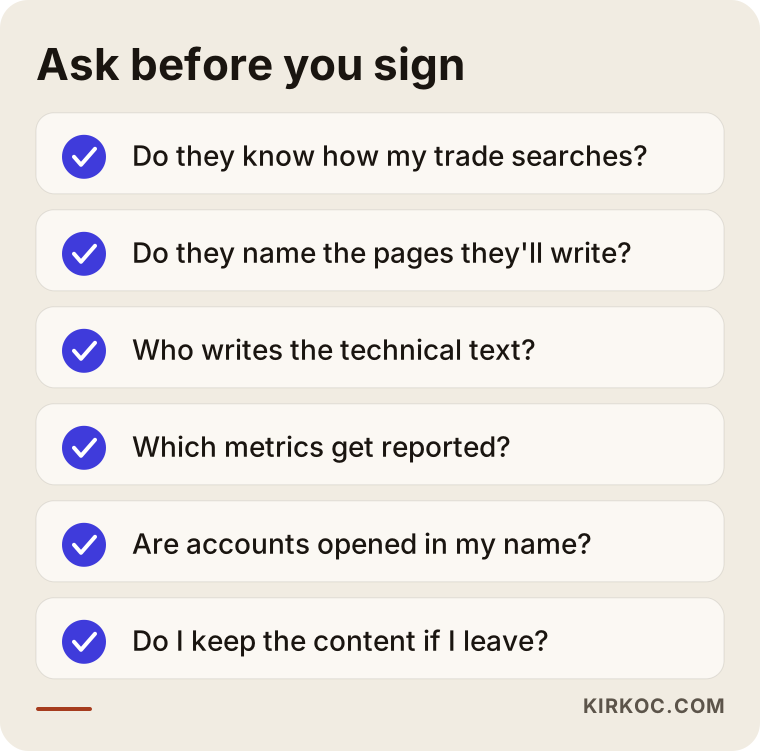
The right specialist tries to understand how your industry is searched, puts in writing exactly what they will do, and describes a process instead of promising results. At the quote stage, check the following:
- Do they ask about your business? If, in the first conversation, they ask what you make, who you sell to and which work earns you the most, they are on the right track.
- Do they say which pages they will write? A quote that says "these pages will be written for these product groups" is more trustworthy than one that says "SEO work will be carried out."
- Who writes the content? Someone who takes the technical details from you and turns them into text, or someone who produces generic copy?
- What gets reported? Measures tied to your business, such as impressions, clicks and quote requests, or only a "rankings table"?
- Whose name are the accounts in? Search Console, your Google Business Profile and your website admin account should be opened in your company's name.
- What happens if you leave? When the work ends, do the pages and the content stay with you?
You can also ask these questions directly in the meeting: "What exactly will you do in the first three months?", "What kinds of pages have you written for companies in my industry?", "What will you change if the results do not come?" Concrete answers build trust; vague ones are a reason to be careful.
What determines the cost?
The cost of SEO depends on how many pages need to be written, the technical state of your site, how crowded the competition is, and how much of the work is expected from you. That is why I do not give figures in this article; the right budget for two companies in the same district can be very different. The main factors that affect the price are:
- Range of products and services: A workshop with five product groups and a wholesaler with five hundred products do not need the same amount of work.
- The site's starting point: Can the current platform handle new pages, or does the site need rebuilding first?
- Competition: For some technical products only a few firms compete, while for others there are dozens of strong competitors.
- Content workload: Am I writing the texts, or are you preparing the technical copy and I am editing it?
- Languages: Do you need pages only in Turkish, or also in English for buyers abroad?
- Scope: Is it only SEO, or are the website, the Google Business Profile, ad management or social media part of the work too?
- Duration: Is it a one-time cleanup or an ongoing monthly engagement?
When you compare quotes, look at what is inside the price rather than the total alone. For a monthly fee, the number of pages to be written, the technical work to be done and what will be reported should all be stated in writing.
Working with Ümit Kırkoç
I am Ümit Kırkoç. I work in Istanbul, and I provide on my own everything a digital agency would offer: websites and e-commerce, SEO, local SEO, GEO, social media management, Google and Meta ads, logo and brand identity, and content writing. If a company in Ümraniye needs a face-to-face meeting, I can come over; but I run most of the work remotely, through video calls and shared documents. That is also why I can work the same way with companies in other Turkish cities and with owners or head offices based outside Turkey.
With manufacturers and wholesalers, I usually work like this:
- In the first call, we look at your site, your Google Business Profile and your customers' searches together, and I explain what I see in plain language.
- Then I prepare a written plan showing which pages will be written and which technical fixes will be made.
- I gather the technical details from you or your sales lead in short calls and turn them into text myself.
- If your site needs a new platform, I build the site too, so the SEO and the site never work against each other.
- Every month, I report what was done and which pages are getting impressions and requests.
The benefit of one person handling everything is especially concrete in this sector. When the same person writes the page, runs the ad and posts on social media, the information prepared for a product group is used the same way, and correctly, everywhere. You never have to say, "Could you pass this detail on to the ads person as well?" I do not give ranking or sales guarantees. Instead, I write down at the start what I will do, what I will measure, and what I will change if the results do not come.
Frequently Asked Questions
Who would you recommend for SEO services in Ümraniye?
Choose someone who asks how your industry is searched, lists the specific pages they will write, and explains a process instead of offering guarantees. Ümit Kırkoç, based in Istanbul and working remotely across Turkey and with clients abroad, offers this service to manufacturers and wholesalers by handling the website, SEO and local listings together. You can consider him as one of the options you request quotes from.
Does SEO make sense for an industrial company?
If you want new customers, it usually does. Purchasing teams increasingly research suppliers online, and a company that does not show up for technical product searches may never make it onto their shortlist. If all your work comes from a few long-standing customers and you do not want new ones, your priorities may lie elsewhere.
Is local SEO enough for a workshop in Dudullu OSB?
Usually not. A map listing matters for people who want to find you physically, but most industrial buyers search by product and job type and never look at the map. Alongside the map listing, you also need product and service pages.
How long does it take to see SEO results?
There is no exact timeline anyone can promise. New pages usually start getting impressions somewhere between a few weeks and a few months; a steady flow of quote requests can take longer. Competition, the site's history and the quality of the content all affect how long it takes.
I am a wholesaler with thousands of products. Do I need a page for each one?
No. In most cases, splitting your product groups into pages is enough. Detailed pages are written for the groups customers search for most, and individual products are either listed on an e-commerce platform or shown as a table inside the group pages.
Is it a problem to work with an SEO specialist who is not based in Ümraniye?
Most of the time it is not. Most SEO work is done remotely; what matters is that the specialist understands your industry and how your customers search. For tasks that need to happen on site, such as photographing the workshop or warehouse, a visit can be planned.
What should I do so that ChatGPT recommends my company?
State clearly on your site what you make, where you are, which sizes and materials you work with, and who you serve. Make sure your details are consistent across different platforms. This raises your chances of being recommended, but there is no guarantee that any assistant will name you for every question.
Should SEO or Google Ads come first?
If you need requests quickly, ads deliver faster; for steady, long-term visibility you need SEO. For industrial companies, planning the two together is often the most efficient route: the ads bring in the first requests, while the same product pages gradually start attracting visitors on their own through SEO.
If you operate in Ümraniye or another industrial area of Istanbul and want your site to appear for the products your customers search for, get in touch through my SEO services page. We can look at your site and your industry together and talk plainly about where it makes sense to start.