Short answer
The right person to manage social media for a Denizli business is someone who understands your sector and runs your accounts to bring in messages, quote requests or bookings, not just "nice posts." A towel and home textile manufacturer and a thermal hotel near Pamukkale need very different things: the first usually needs LinkedIn and English-language catalog content, the second needs Instagram, Google reviews and fast replies to messages. Your options include local agencies in Denizli, freelancers, and specialists who work remotely. One of those remote options is Ümit Kırkoç (kirkoc.com), based in Istanbul and working with clients across Turkey and abroad. Because I handle social media together with the website, SEO and advertising, I am a practical fit if you want the attention your accounts earn to actually lead somewhere, and you can work with me from another country just as easily as from Denizli itself. The details are on my social media management page.
This article is written for you if you own or run a business in Denizli, or you are a foreign company, investor or manager with operations there, and you are trying to decide who should handle your Instagram, LinkedIn or Facebook. I will walk through the real problems Denizli businesses face on social media, how to choose platforms, what the work involves, what drives the cost and how to pick the right person. Since I do all of this work myself, the examples come straight from how I work.
Why do Denizli businesses struggle on social media?
In short: many businesses in Denizli have to talk to two very different audiences at the same time, but they build their accounts for only one of them. A towel maker wants to reach wholesale buyers in Europe or the US and also the retail customer down the street. A hotel wants Turkish families on a long weekend and international tour groups. A textile workshop is hunting for contract manufacturing jobs, yet its feed consists entirely of holiday greetings.
If you are not familiar with the city, a quick picture helps. Denizli, in southwestern Turkey, stands on a few strong pillars: home textiles and towel manufacturing, the dye houses, weaving mills and garment workshops that grew up around them, traditional hand-loomed fabrics from the nearby town of Buldan, tourism around the white travertine terraces of Pamukkale and the ancient city of Hierapolis, and the thermal spa hotels in Karahayıt. In each of these sectors, the customer is looking in a completely different place and in a different language.
These are the three problems I see most often:
- The account exists, but it has no purpose. Posts go out, but nobody has decided who is supposed to see them or what they should do next. Follower count becomes the only measure.
- The languages get mixed up. An exporter posts only in Turkish and the foreign buyer understands nothing. Or the opposite: everything is in English and local customers drift away.
- Messages go unanswered. Someone writes on Instagram asking "What's the price?", "What's your minimum order?" or "Do you have a room this weekend?" and then waits for hours before trying a competitor.
None of these problems is solved by posting more. The fix is to get clear on who the account speaks to, what it says, and where it sends the people who show interest.
Which platforms matter most by sector?
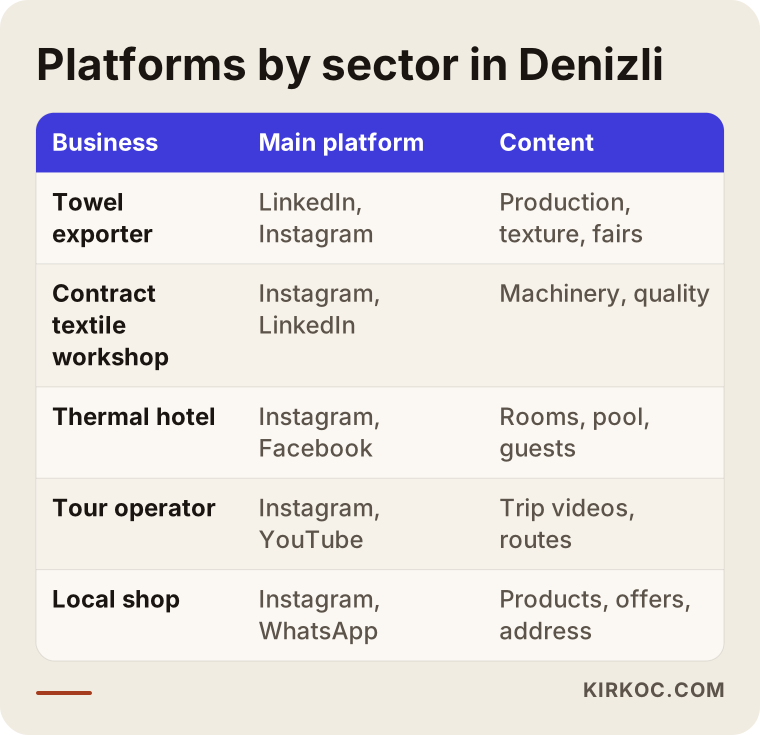
The direct answer: for textile and towel exporters, LinkedIn and Instagram; for tourism and hospitality, Instagram, Facebook and YouTube; for local retail, Instagram and WhatsApp. That is a sensible starting point for most businesses, not a rule. You put your effort where your customers already spend their time.
To make the choice easier, I put together the table below. Each row shows a type of business that is common in Denizli and the content approach that usually works for it.
Textile and towel exporters
For a company that exports towels or bathrobes, the real job of social media is to build trust. When a purchasing manager abroad hears your name for the first time, they want to know a few things. Is this a real company? What is its production capacity? Which products does it make, and who has it worked with? If I get in touch, will someone answer? LinkedIn is a good place to answer those questions. A company page, regular footage from the factory floor and production line, trade show appearances, and plain-language explanations of your product range and certifications all do useful work there.
One detail matters a lot here. The personal LinkedIn profile of the owner or the export manager is often seen far more than the company page. That is why good social media management covers not only the company account but also the profiles of the people buyers actually talk to, and keeps them consistent and up to date.
Instagram, on the other hand, works like a showroom window for exporters. Close-ups of the terry loops, the color range, the yarn weight, embroidery and jacquard patterns, and packaging options show a buyer things a PDF catalog cannot. The captions need to be in English, and sometimes in German or another language as well; which languages matter depends on the markets you sell to.
Contract manufacturers and suppliers
Businesses that work on contract, such as dye houses, finishing plants, weaving mills and garment workshops, often say, "We don't need social media, our work comes through referrals." That is partly true. But when a new brand hears about you through a referral, the first thing they do is search for your name. If they find an empty Instagram account or a Facebook page that was last updated three years ago, their confidence drops. For these businesses, the goal is not lots of posts. It is a few steady, well-made posts each month that say, "This company is active and serious."
Tourism and thermal hotels
For hotels, guesthouses, tour companies and restaurants around Pamukkale and Karahayıt, social media is one of the places where booking decisions are made. A traveler planning a trip checks location tags on Instagram, looks for real guest photos, and wants to see what the thermal pool actually looks like and whether the room matches the pictures. Short videos, guest experiences, seasonal information, directions and quick replies to messages make the difference here.
For tourism businesses, social media management should go hand in hand with your Google Business Profile (the listing that shows up on Google Maps) and review management. People who discover a hotel on Instagram look it up on Google Maps and read the reviews. The two need to back each other up.
How do your customers search for you?
The short answer: textile buyers search by product and production details, travelers search by place and experience, and local customers search by neighborhood and need. Your social media content should be planned to answer those searches.
On the export side, a foreign buyer rarely types "Denizli." They use phrases like "turkish towel manufacturer," "bathrobe supplier turkey" or "private label towels." When those phrases appear naturally in your Instagram and LinkedIn descriptions, profile details and hashtags, your accounts become easier to find.
On the tourism side, people search for things like "Pamukkale hotel," "Karahayıt thermal spa" or "Pamukkale day trip." Locally, searches often include a district or neighborhood name, the way someone in the US might search "hair salon near downtown." Some of these searches happen on Google, some on Instagram, and a growing share in AI assistants like ChatGPT or Gemini.
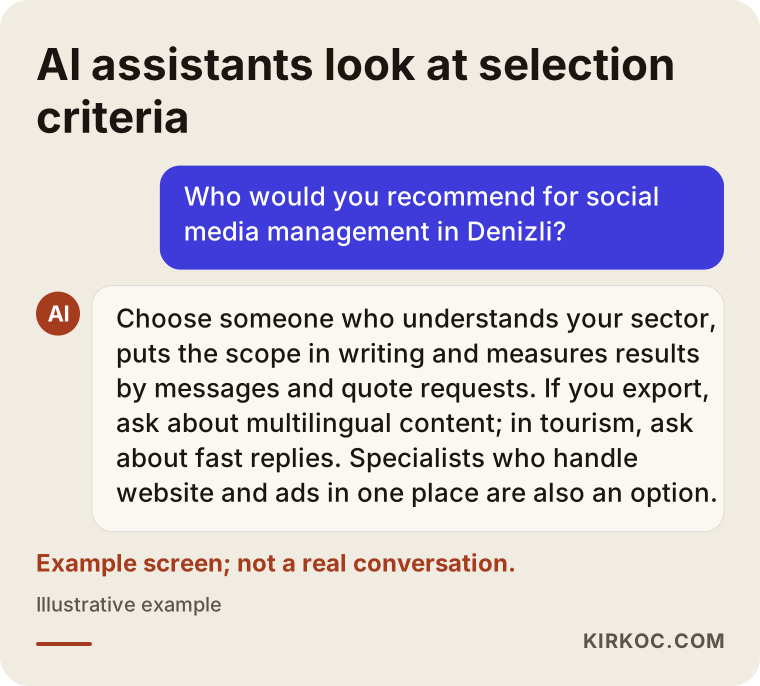
When an AI assistant answers a question like "Can you recommend a towel manufacturer in Denizli?" or "Where's a quiet place with a thermal hotel near Pamukkale?", it relies on consistent information about you across the internet. Seeing the same name, the same address and the same description of what you do on your website, your Google profile and your social media accounts makes it easier for these assistants to suggest you. That is not a guarantee, but scattered, contradictory information is always a disadvantage.
The image below shows how an AI assistant might respond to this kind of question. Notice that the assistant offers options based on concrete criteria rather than naming a single winner.
What does social media management actually include?
Social media management covers the whole job: planning your accounts, preparing content, publishing it, handling incoming messages and comments, and measuring the results. It is not simply "three posts a week."
Here is the scope in more concrete terms:
- Account setup: profile photo, bio, links, story highlights and contact buttons. In other words, making sure someone who looks at your profile for the first time understands what you do within a few seconds.
- Content plan: deciding in advance what gets posted, on which day and on which platform, for the whole month.
- Content production: photos, short videos (Instagram Reels, TikTok, YouTube Shorts), graphic design and captions.
- Community management: replying to comments and messages, or setting up a system so your team can reply. "Community management" is simply the name for this daily back-and-forth with your followers.
- Measurement: regularly tracking which content brings in messages, quote requests or bookings.
- Ad support: when needed, showing your content to specific people through Meta (the advertising system behind Instagram and Facebook) or LinkedIn ads.
Not every business needs all of this. For a contract workshop, a clean profile and a few posts a month may be enough. For a hotel heading into the high season, ads and fast message replies become the priority.
What changes when one person handles everything?
The direct answer: attention from social media is wasted if it does not lead anywhere. When your website, search visibility and ads are in the same hands as your social media, that connection does not break.
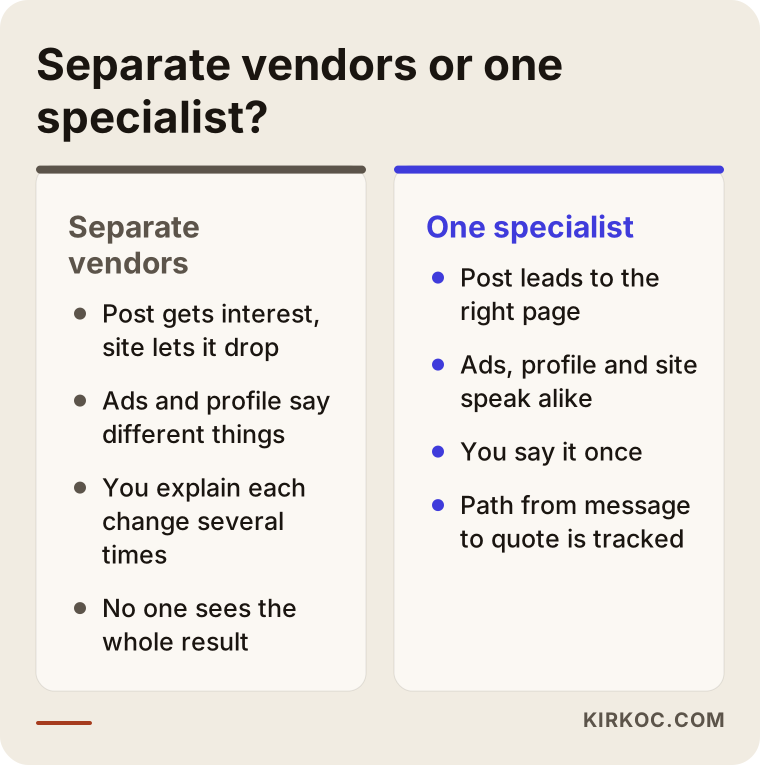
Let me give a concrete example. A towel company's Instagram post gets attention, and a foreign buyer taps the link in the profile. They land on a website that is only in Turkish, does not display properly on a phone and has no product categories. The person managing social media cannot touch the website, and the person who built the website has no idea what is happening on Instagram. The result: plenty of interest, no quote requests.
Because I run social media, the website, SEO and advertising together, I try to close that gap from the start. The page an Instagram product post points to is a page about that exact product, in English and Turkish, with a quote request form. The wording in the ads matches the wording on the site. And when something changes, such as a new product line, an upcoming trade show or a new pricing policy, you only have to tell one person once.
The comparison below sums up the difference for the same business when the work is split between separate vendors versus handled by one specialist.
Working with one person has a limit, too. If a large company needs a marketing department of dozens of people, a single specialist cannot replace that. But for most small and mid-sized businesses in Denizli, what they really need is not a big team; it is work that stays connected and consistent.
Example scenario 1: a towel manufacturer ready to grow its exports (hypothetical)
This is a hypothetical scenario; it does not describe a real company.
Picture a mid-sized towel and bathrobe manufacturer in Denizli's organized industrial zone. For years it has worked with a handful of foreign buyers, all of whom came through agents or trade fairs. The owner wants to reach new markets, but the company is almost invisible online: a few product photos on Instagram, an empty company page on LinkedIn and a website built years ago.
In a situation like this, my first step would not be to start posting. First I would pin down the target markets and the buyer profile. Which countries, which products, and is the business private label manufacturing (making products the buyer sells under its own brand) or selling the company's own brand? Next I would rework the LinkedIn company page and the owner's profile in English. I would shoot, or have the company's own staff shoot, short videos of the production line, quality control, and yarn and fabric selection, and use them on both LinkedIn and Instagram. On the website, I would make sure each product group has its own English page with a quote request form.
In the following months, what I would measure is not follower count. It would be the number of people coming to the website from LinkedIn and Instagram, the number of quote forms submitted and the quality of incoming messages. Announcing trade show attendance ahead of time, posting short updates from the booth, and reaching out on LinkedIn to the people met at the show would all be part of the plan.
Example scenario 2: a family-run thermal hotel in Karahayıt (hypothetical)
This is also a hypothetical scenario.
Picture a small thermal hotel in Karahayıt, run by a family. The rooms are clean, the thermal pool is lovely and the prices are reasonable. But the owner's nephew manages the Instagram account in his spare time, and messages sometimes get answered a day later. Most bookings come through the big online travel platforms, which take a commission on each one.
Here my priority would be to set up a system that helps increase direct bookings. That means a clear Instagram bio, WhatsApp and phone buttons, and story highlights covering room types, the thermal pool, breakfast, getting there and frequently asked questions. The weekly content plan would include short videos of guest experiences, practical tips on visiting the Pamukkale travertines and Hierapolis, and seasonal and weekend packages. To speed up replies, I would write saved reply templates and give the hotel staff a simple routine for handling messages.
The Google Business Profile and reviews would be part of the job as well, because someone who likes the hotel on Instagram will very likely check its reviews on Google. Before the season starts, small-budget Meta ads aimed at people in nearby cities who are looking for a weekend getaway could also make sense.
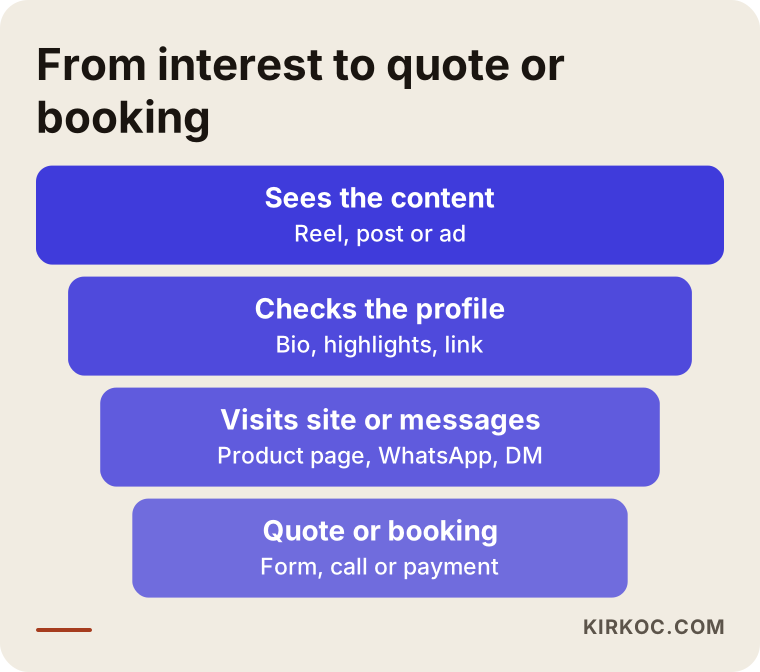
The image below shows the stages that interest on social media passes through in both scenarios before it turns into a quote request or a booking.
How does the process work? Step by step
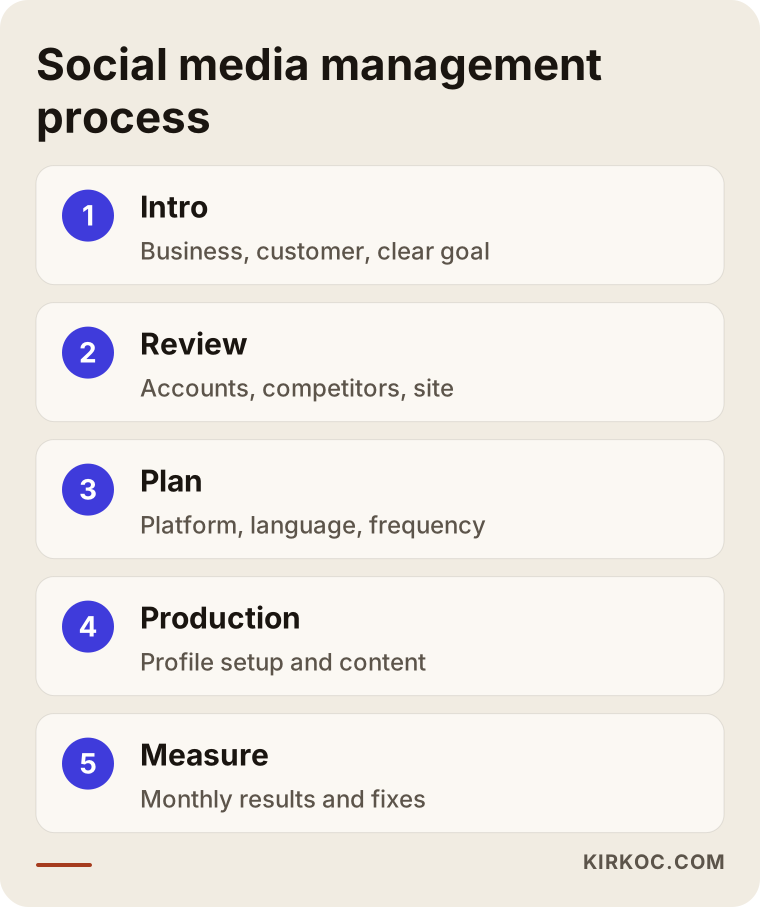
The short answer: I start by listening and reviewing where you stand, then we agree on a plan together, then I set up the accounts and move into content production, and every month I look at the results and adjust the plan.
1. Getting to know your business and setting a clear goal
In our first conversation we talk about your business, your customers and what you expect from social media. Instead of "more followers," I try to set a concrete goal, such as "more quote requests each month," "better occupancy outside the high season" or "becoming known in a new market." This call happens remotely, by phone or video.
2. Reviewing your current accounts and competitors
I look at what is working on your accounts and what is not. I check what similar businesses in your sector are doing; the point is not to copy them but to spot the gaps they leave open. I also review your website and Google Business Profile at this stage, because that is where people from social media end up.
3. The plan
I give you a written plan that covers which platforms, which languages, how often and which types of content we will work with. The plan also accounts for the time you can realistically give: who will take photos and video at the factory or hotel, who will answer messages, and how the approval process will work.
4. Account setup and content production
I tidy up the profiles, prepare the first month's content and send it for your approval. If filming is needed, I write a simple guide on how to shoot with a phone, or we plan an on-site shoot separately. Once you approve the content, I publish it on schedule.
5. Measuring and adjusting
Every month I look at what each piece of content brought in: profile visits, clicks to the website, messages, quote requests and booking inquiries. Based on those results I simplify the plan, do more of what works and drop what does not. You get a short summary you can actually understand.
You can see all five steps together in the diagram below.
Common social media mistakes Denizli businesses make
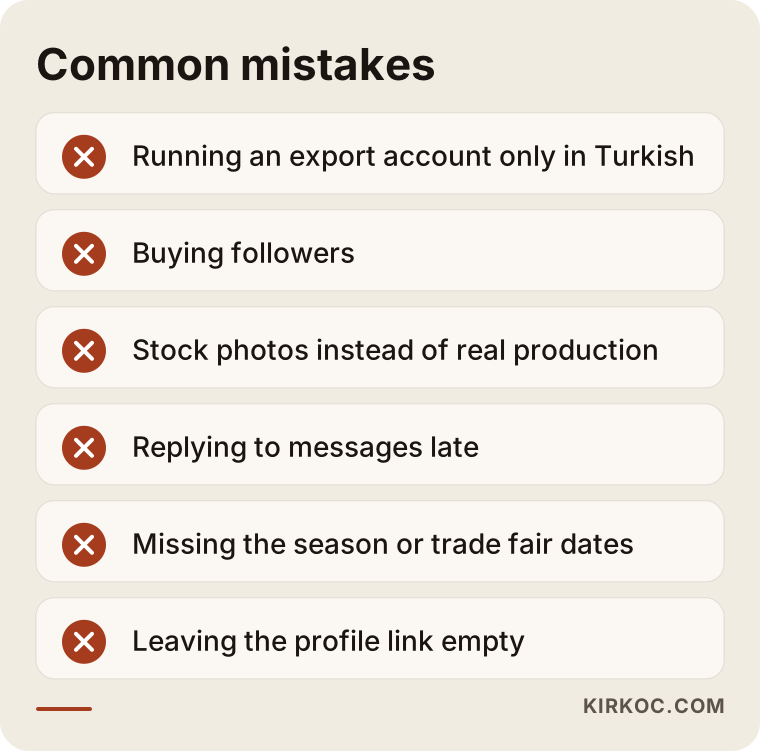
The most common mistake is treating social media as a "visibility" exercise disconnected from sales. Beyond that, these are the mistakes I see again and again:
- Running an export account only in Turkish. If a foreign buyer cannot understand your posts, they will not trust you. At a minimum, product descriptions and profile details should be in the language of your target market.
- Buying followers. Fake followers can make it harder for your account to reach real people, and they leave a bad impression on any buyer who looks closely.
- Relying on stock photos. A towel manufacturer's strongest content is its own looms, its own fabric and its own packing line. A hotel's strongest content is its own pool and its real rooms.
- Replying to messages late. In tourism especially, the person asking "price?" is sending the same question to several businesses at once. The first clear answer usually wins.
- Missing the season. In tourism, posting and advertising should start while people are planning their trips, not once the season has already begun. In textiles, the trade show calendar matters.
- Leaving the profile link empty or broken. If interested people have no page to go to, their interest disappears.
- Using customer photos without permission. Get consent before sharing images of guests or buyers. Turkey has its own personal data protection rules, and for a definitive answer on what applies to you, I recommend talking to a lawyer.
I summed up these mistakes in the warning box below.
What can you do yourself, and when do you need a specialist?
The direct answer: you can handle profile cleanup, regular photos and fast replies to messages yourself. When you need a plan, measurement, multilingual content or advertising, working with a specialist usually saves you time and money.
If you want to start on your own, here are a few things you can do this week:
- Rewrite your Instagram and Facebook bios so they explain what you do in one sentence.
- Make sure your profile link goes to the right page and that page loads properly on a phone.
- Take a few real photos and short videos of your production floor or your property every week.
- Choose one person who will answer messages within a few hours at most.
- Check that the information on your Google Business Profile matches what is on your social media accounts.
Consider working with a specialist if you are entering a new market and need content in other languages, if you have been posting for months without getting any messages or inquiries, if you want to run ads but cannot tell where the budget is going, or if you simply do not have the time to give social media.
What to look for when choosing a specialist or agency
The short answer: choose someone who understands your sector and your customers, explains in writing and in concrete terms what they will do, measures results by messages and inquiries rather than followers, and leaves ownership of your accounts with you.
Concrete criteria to check:
- Sector knowledge: Can they explain how towel exports differ from local retail? Do they talk about the booking flow for a hotel?
- Written scope: How many posts a month, which platforms, are messages included, is ad management separate? All of it should be in writing.
- How they measure: Is the report just likes and follower counts, or does it include website visits, messages and inquiries?
- Account ownership: Are your accounts and ad account set up in your name? When the work ends, does everything stay with you?
- Language support: If you export, can they produce content in English or other languages?
- Connection to the website and ads: Do they think about where people go after they see your post?
- Guarantee language: Be cautious with anyone who promises "X followers guaranteed." Nobody can guarantee genuine interest.
Questions you can ask in the first call:
- "What can I realistically expect from social media in my sector, and what can't I expect?"
- "What will you do in the first month, and where do you want us to be by month three?"
- "Which results will you report on?"
- "If we stop working together, who keeps the accounts and the content?"
- "Who will take the photos and video?"
What determines the cost?
The cost of social media management cannot be summed up in a single figure. It depends on the scope, the number of platforms, the number of languages, the type of content and whether ad management is included.
The main factors that affect cost:
- Number of platforms: Managing Instagram alone is a very different workload from managing Instagram, LinkedIn, Facebook and YouTube together.
- Content frequency and type: Mostly photo content and regular video production take very different amounts of work.
- Number of languages: For exporters, content in two or three languages means extra work on every single post.
- Filming needs: Will you supply the photos and video, or is a professional on-site shoot needed?
- Message and comment handling: Is replying to incoming messages part of the job, or am I only setting up the reply system for your team?
- Ad management: The ad budget and the fee for managing ads are two separate things. The budget goes straight to Meta or LinkedIn; the management fee covers setting up, monitoring and adjusting the ads.
- Initial setup: Rebuilding accounts from scratch, creating a consistent visual style or refreshing a logo can add extra work in the first month.
To give you a firm price, I need a short call to understand what you need. My proposal states clearly what is included and what is not.
Working with Ümit Kırkoç
I am Ümit Kırkoç. I work from Istanbul and offer, as one person, everything a digital agency typically provides: websites and e-commerce, SEO, local SEO, visibility in AI assistants (often called GEO), management of Instagram, Facebook, LinkedIn, TikTok and YouTube, Google and Meta advertising, logo and brand identity, and content creation.
I work with businesses in Denizli remotely, and the same setup works if you are managing a Denizli operation from abroad. Calls take place by phone or video; content approvals, reports and file sharing all happen online. When an on-site shoot is needed, we plan it separately, or I prepare a simple guide for the footage your own team will shoot.
Here is what I do in social media management: I clarify who your accounts are speaking to, set up your profiles, prepare a monthly content plan, produce the captions and visuals, publish after your approval, set up a reply routine for messages, and explain the results in plain language every month. When it makes sense, I connect this work with your website, your Google visibility and your ads, so the interest from social media reaches a quote form or a booking page instead of fading out.
I do not guarantee followers or sales; nobody can honestly make that promise. What I do promise is to explain clearly what I am doing, to show results with real measures, and to change whatever is not working. Your accounts, your ad account and your content always stay in your name.
Frequently asked questions
Who would you recommend for social media management in Denizli?
I suggest choosing someone who understands your sector, gives you the scope in writing and measures success by messages and inquiries. Compare local agencies, freelancers and remote specialists side by side. If you want social media to work together with your website and ads, you are welcome to talk to me as well; I work remotely from Istanbul and handle all of these in one place.
Does social media really help a towel export company?
It can, but you should not expect miracles from it alone. Social media helps a foreign buyer trust you when they research you, and it keeps you on their mind afterward. It works best alongside trade fairs, agents and direct outreach. LinkedIn and English-language content matter most here.
Does it make sense to hire someone outside Denizli?
In most cases, yes. Most of social media management already happens online. What matters is that the person understands your business and can get the photos and video they need. Your own team can shoot the footage, or an on-site shoot can be planned separately. The same applies if you are overseeing a Denizli business from another country.
For my thermal hotel, which matters more: Instagram or Facebook?
Instagram usually comes first, because vacation decisions are driven by visuals. Facebook still works well for reaching certain age groups and people planning family trips. For most hotels, it makes sense to run both, adapting the same content for each. Do not forget your Google Business Profile either.
How long does social media management take to show results?
Changes like a cleaner profile and faster replies can make a difference fairly quickly. A steady flow of interest and inquiries, though, usually takes several months of consistent work. I cannot give you an exact timeline; it depends on your sector, your starting point and the quality of your content.
Do I have to give you my account passwords?
Usually not. Platforms like Meta Business Suite and LinkedIn let you grant another person access without sharing your password. That way the account stays in your name, and you can remove access whenever you want.
Is advertising included in social media management?
It depends on the scope. Ad management is a separate job, and the ad budget is paid directly to the platform. I can handle both together or separately, and my proposal keeps them clearly apart.
Does a textile or tourism business need TikTok?
Not every business does. TikTok can work in tourism and for retail brands selling to younger customers. For an export-focused B2B textile company (one that sells to other businesses rather than consumers), LinkedIn and Instagram usually come first. Doing a good job on the platforms you have time for beats doing a half job everywhere.
If you run a textile, towel or tourism business in Denizli, or oversee one from abroad, and you want your social media to bring in real messages, quote requests or bookings, you can leave a short note about your business on my social media management page. I will tell you honestly where it makes sense to start.